hard to avoid难免 (hard to avoid / bound to)
Form: (situation,) (subject) + hard to avoid难免 + (can / will会) + result
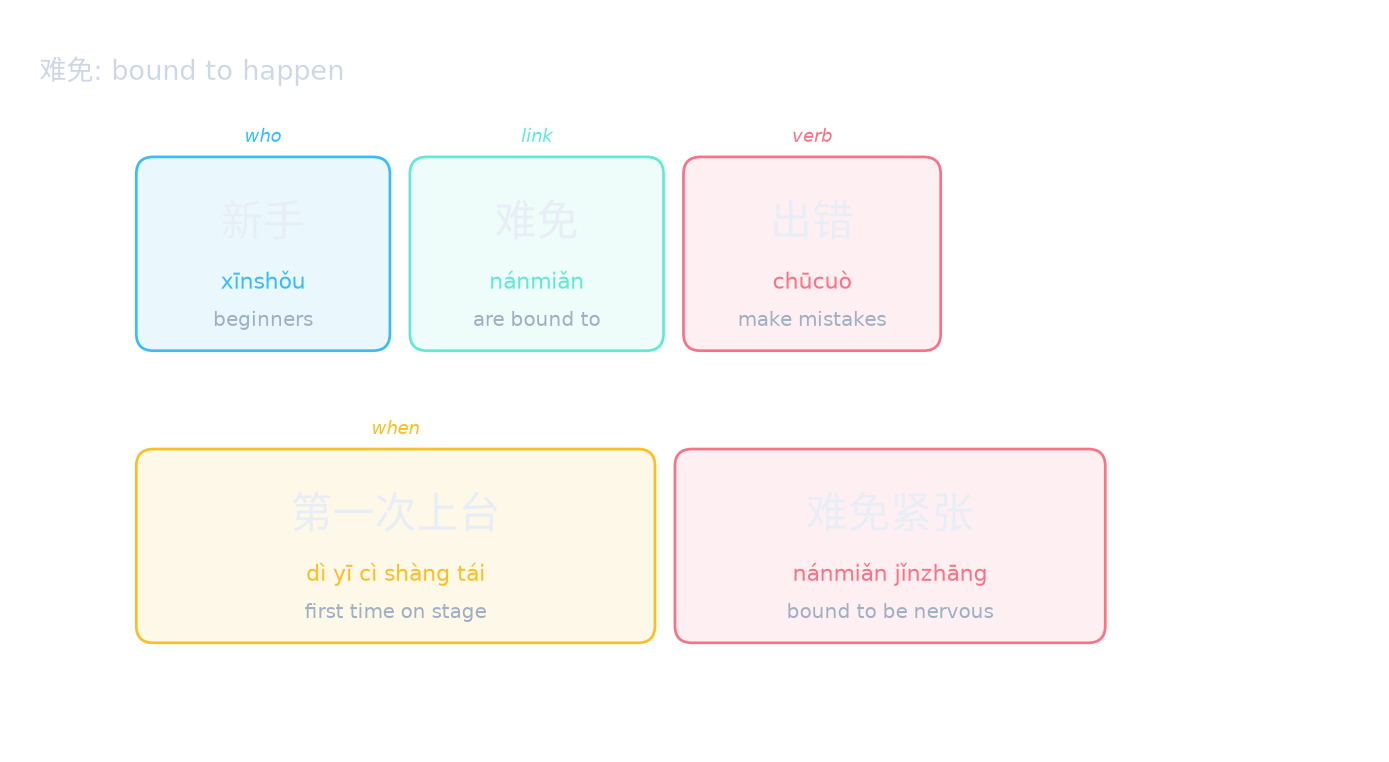
- new hand新手hard to avoid难免to make a mistake出错。 Xīnshǒu nánmiǎn chūcuò. – Beginners are bound to make mistakes.
- the first time第一次to go on stage / take office上台,hard to avoid难免nervous紧张。 – Your first time on stage, it's natural to be nervous.
- 路上车很多,难免会晚一点。 – With so much traffic, we'll inevitably be a bit late.
How it works. hard to avoid难免 nánmiǎn says that, in the circumstances, a (usually unwelcome) result is hard to avoid. Often it reassures or excuses, and the situation supplies the reason (the first time第一次, car车很多). It gives no number: if 3 of 12 beginners make a mistake, 9 didn't.
Watch out
- "Hard to avoid" doesn't mean "leave it": new hand新手hard to avoid难免to make a mistake出错,please; to invite请to check检查and并to correct改正.
- The reason belongs to its situation: a quiet route needs its own judgement.
- hard to avoid难免 is not definitely / certain一定 "certainly": hard to avoid难免nervous紧张 doesn't predict that everyone will be nervous.
to receive受 (receive / be affected)
Form: subject + (degree / adjective linker很) + to receive受 + to welcome欢迎 / influence影响 / to injure伤 … · A + to receive受 + B + to welcome欢迎 / influence影响
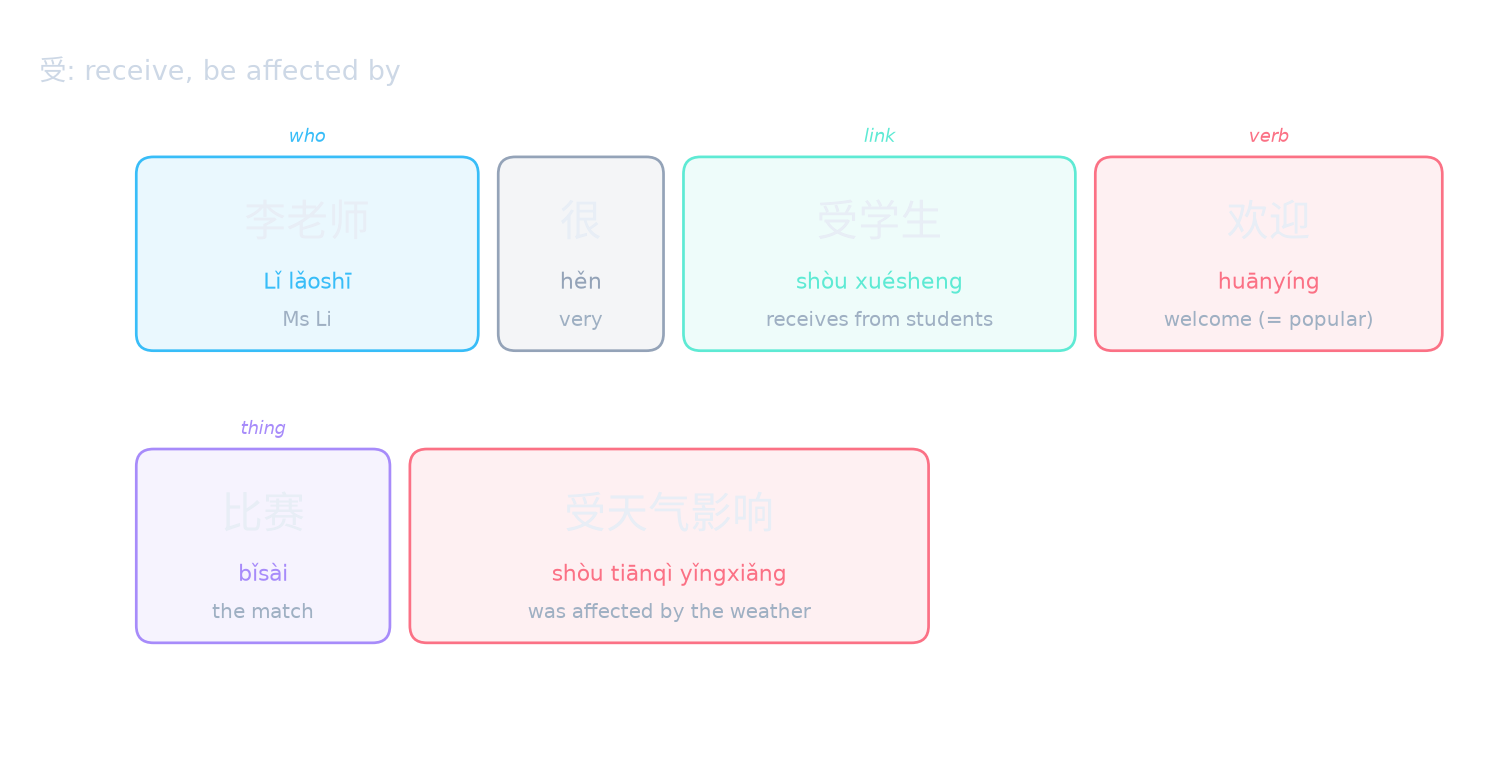
- this (person)这位teacher老师degree / adjective linker很popular受欢迎。 Zhè wèi lǎoshī hěn shòu huānyíng. – This teacher is very popular.
- competition比赛to receive受weather天气influence影响。 – The match was affected by the weather.
- he / him他to get hurt受伤(completed / change)了。 – He got hurt.
How it works. to receive受 shòu "receive, undergo": the subject is on the receiving end, and the result can be good or bad. The source can sit between to receive受 and the noun: teacher老师to receive受student学生to welcome欢迎 (students welcome the teacher). Learn the fixed phrases; to receive受 can't replace (passive: by)被 before any verb.
| Phrase | Meaning |
|---|---|
| popular受欢迎 | popular, well received |
| to receive受influence影响 | be affected |
| to get hurt受伤 | be injured |
| to receive (praise, help …)受到to criticize批评 / to praise表扬 | be criticised / praised |
Watch out
- to receive受weather天气influence影响 says the match was affected, not that it was cancelled.
- to get hurt受伤 names no cause or attacker. If 3 of 8 players were injured, 5 weren't reported injured.
Practice without the models
Cover the teaching sections before you answer. The answers follow.
hard to avoid难免 (hard to avoid / bound to)
1. Beginners are bound to make mistakes. new hand新手 ………… to make a mistake出错。
2. Choose the best ending: the first time第一次to go on stage / take office上台,……
- A. hard to avoid难免I / me我。
- B. hard to avoid难免nervous紧张。
- C. hard to avoid难免degree / adjective linker很good好。
- D. hard to avoid难免tomorrow明天。
3. 路上车很多,难免会晚一点 means…
- A. some lateness is hard to avoid
- B. we are never late
- C. we will be exactly 10 minutes late
- D. the road is empty
4. True or false? hard to avoid难免to make a mistake出错 means you don't need to correct the mistakes. If false, correct it.
5. Say in Chinese: "Living abroad, it's natural to miss home."
6. People inevitably make mistakes.
Put in order: person人 / to err犯错。 / hard to avoid难免 / can / will会
to receive受 (receive / be affected)
7. This teacher is very popular. this (person)这位teacher老师degree / adjective linker很 ………… to welcome欢迎。
8. competition比赛to receive受weather天气influence影响 means…
- A. the match was cancelled
- B. the match was good
- C. the weather affected the match
- D. the match affected the weather
9. Which phrase means "be injured"?
- A. to receive受influence影响
- B. popular受欢迎
- C. to receive受to praise表扬
- D. to get hurt受伤
10. True or false? to receive受 can replace (passive: by)被 before any verb. If false, correct it.
11. Say in Chinese: "He was praised by the teacher."
12. This book is popular with young people.
Put in order: to welcome欢迎。 / 很受 / young people年轻人 / this这本书
Answers and explanations
hard to avoid难免 (hard to avoid / bound to)
1. hard to avoid难免
hard to avoid难免: hard to avoid in the circumstances.
2. B. hard to avoid难免nervous紧张。
hard to avoid难免 + (usually unwelcome) result.
3. A. some lateness is hard to avoid
hard to avoid难免 gives no number.
4. False.
Hard to avoid doesn't mean leave it.
5. at / in在abroad国外life; to live生活,难免会homesick想家。
Situation,hard to avoid难免 + result.
6. person人难免会to err犯错。
hard to avoid难免 + (can / will会) + result.
to receive受 (receive / be affected)
7. to receive受
popular受欢迎 = popular.
8. C. the weather affected the match
to receive受influence影响 = be affected.
9. D. to get hurt受伤
to get hurt受伤 names no cause.
10. False.
Learn the fixed phrases.
11. he / him他to receive (praise, help …)受到(completed / change)了teacher老师(modifier / structural particle)的to praise表扬。
to receive (praise, help …)受到 + noun.
12. this这本书很受young people年轻人to welcome欢迎。
A to receive受 B to welcome欢迎.