This handout teaches C.5 Psychological skills for the course first assessed in 2026: goal types, their effects on attention and motivation, individual differences and the evaluation of a psychological skills programme. Self-talk, regulation and routines extend the C.2/C.4 connections.
Prerequisites: unit C.3 (motivation) and unit C.4 (stress, anxiety and arousal), which explain the problems these skills are used to solve.
11.2
Psychological skills training
Results and explanations
Michael Phelps won the Beijing 2008 men's 200 m butterfly in 1:52.03, the world record at that time. The dated result is documented in USA Swimming's 2009 record tables. It establishes his performance, not the separate contribution of confidence, rehearsal, technique or physical preparation. An account of a champion's preparation can suggest a question; it does not isolate a cause.
Consider instead a school tennis player who loses focus after a double fault. A short practised reset might give attention a useful next action. To judge it, measure comparable serves and the player's experience, including days without the reset. The question is which method helps this person with this task, and how good the evidence is.
A practised reset after an error
Skills that can be learned
Psychological skills training 心理技能训练 (PST) is the planned, regular practice of mental skills to improve performance, enjoyment and well-being. Practice can develop these skills, but effects depend on the technique, person, task and opportunities to use it. A programme is not a guarantee of improved results.
The three phases of psychological skills training
A psychological skill is a quality the athlete wants, such as confidence, concentration or control of arousal.
A psychological technique is a method used to develop it, such as goal setting, imagery, self-talk or relaxation.
A PST programme usually has three phases:
Education. The athlete learns why mental skills matter and how they work.
Acquisition. The athlete learns the techniques, often with a sport psychologist.
Practice. The athlete uses them in training and then in suitable competition situations, evaluating and adapting their use.
Mental skills are not only for elite athletes or for "fixing problems". Beginners, young athletes and injured athletes may have relevant goals too. Transfer to a different setting must be examined rather than assumed; the athlete should help choose and evaluate the programme.
Finding out what to work on
In a performance profile 表现剖面图, the athlete lists the qualities that matter in their sport, rates the ideal level (usually out of 10) and their current level, and discusses the gaps with a suitable coach or practitioner. Ratings are subjective and depend on the meaning of the scale and the situation.
The tennis player's performance profile
Worked example. A tennis player rates three qualities:
Quality
Ideal
Current
Gap
Concentration between points
9
5
4
Confidence on the second serve
8
4
4
Motivation in training
8
7
1
The two gaps of 4 identify possible discussion points, not automatic priorities or clinical diagnoses. Importance to the task, the athlete’s wishes, available resources and whether the rating is meaningful also matter. Repeating the same profile after eight weeks shows a change in reported gaps; use comparable performance and experience measures before concluding that a skill improved or that PST caused it.
Judging whether PST works
Define the intended outcome: a useful attentional action, reported experience, participation or a comparable performance measure. A questionnaire measures responses under specified conditions, not direct access to a person's inner state.
In a single-case design 单一个案设计, collect repeated baseline measurements before introducing a specified technique, then continue measurement during use and at follow-up. Baseline trend and variability matter: one good day after a poor day may be ordinary variation.
A multiple-baseline design introduces a technique at different times across participants or settings. A repeated change aligned with those starts can strengthen the inference, but starting times should not be chosen merely to favour a result. Physical training, maturation, expectancy, feedback, changed equipment and other simultaneous changes remain possible explanations.
Standardise task difficulty, scoring and testing conditions as far as feasible. Record whether the technique was actually used. Consider a suitable comparison and independent scoring; repeated improvement alone does not prove causation or universal effectiveness.
A single-case AB design
Use voluntary low-risk school tasks, protect personal reports and allow withdrawal. Do not induce distress or ask classmates to diagnose or treat one another. A practical programme should be feasible and acceptable, not just produce a lower questionnaire number.
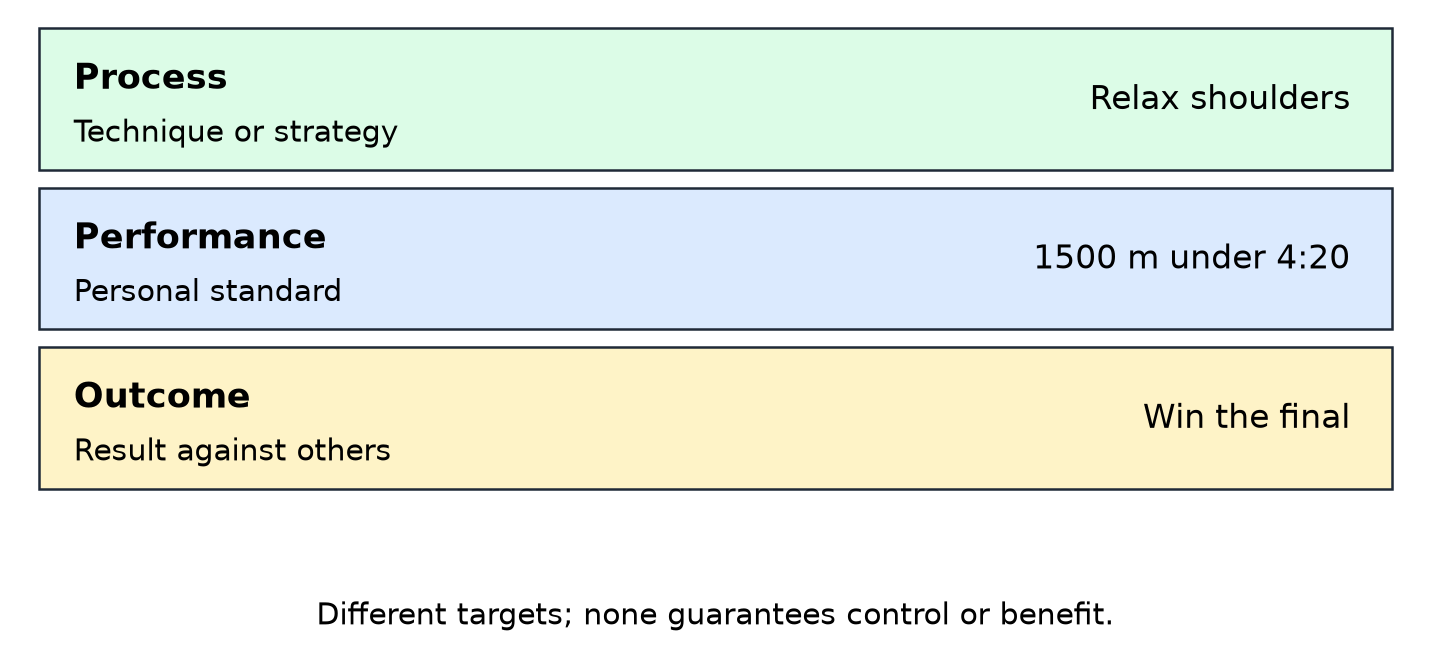
Goal setting 目标设定 is setting a target to work towards. Goals can influence performance by helping to:
direct attention to what matters;
increase effort;
increase persistence when things get hard;
encourage the athlete to develop new strategies.
Goal types describe the target, not a guarantee of control or benefit.
Type
Reference
Example and limitation
Outcome goal 结果目标
Norm-referenced: result against others
Win the county final; opponents and event conditions also influence placing
Performance goal 表现目标
Self-referenced, measurable standard
Run 1500 m under 4:20; weather, health and measurement still matter
Process goal 过程目标
Technique or strategy used to perform
Attend to relaxed shoulders on the final lap; fatigue, injury and the suitability of the cue still matter
An outcome target may provide direction; a performance target can monitor a personal standard; a process target can direct attention to a useful action. They can be combined, but using all three is not automatically the best plan. Too many simultaneous cues can overload attention; an athlete may benefit from one clear focus. A technically appropriate process goal is often more directly actionable than a placing, not fully controllable.
Achievement motivation matters. A performer who welcomes a challenging target may increase effort and persist; another may interpret the same public comparison as threat or become preoccupied with avoiding failure. Discuss the athlete's experience, perceived competence and resources. Neither a high need for achievement nor a history of success determines every response to a goal.
SMART goals
Letter
Meaning
Example
Specific
Clear and precise
"Improve my first-serve percentage"
Measurable
Can be checked with numbers
From 52 % to 60 %
Achievable
Plausible given the starting point and evidence
Discuss whether 60 % is feasible; the number alone cannot establish this
Realistic
Fits resources, recovery and other commitments
Agree suitable opportunities to practise
Time-bound
Has a deadline
By the end of the season, with a check after 6 weeks
A SMART goal names the measure, the target and the date; real progress is rarely an even staircase
SMART is a planning checklist, not evidence that a target is feasible or beneficial. A challenging goal can organise effort, while an unrealistic or imposed target may discourage engagement. Easier tasks can also support learning or recovery. Agree the goal, relevant feedback and review points; revise it when circumstances change. Progress need not form an even staircase.
Worked example. "I want to get better at swimming" is a vague goal. A SMART version: "Over the next 8 weeks, lower my 100 m freestyle time from 68.0 s to 66.0 s by completing three technique sessions a week, with a test every 2 weeks." Four two-week intervals would divide the proposed 2.0 s reduction into 0.5 s per interval: 67.5, 67.0, 66.5 and 66.0 s. That is an arithmetic planning line, not a prediction of physiological adaptation. Decide feasibility from the individual and conditions, not from the neat numbers.
Common problems: setting too many goals at once, setting only outcome goals, setting goals without the athlete's involvement, and never reviewing them.
These techniques extend C.2 attention and C.4 coping into a practical programme. Their labels do not establish an effect for every athlete; connect each action to a purpose and evaluate it.
Talking to yourself on purpose
Self-talk 自我对话 is what athletes say to themselves, aloud or silently. It can be spontaneous or deliberately planned; a useful programme may develop a manageable cue.
Instructional and motivational self-talk serve different purposes
Type
Intended purpose
Example
Possible application
Instructional self-talk 指导性自我对话
Directs attention to technique or tactics
"High elbow", "watch the ball"
Fine, precise skills; learning
Motivational self-talk 激励性自我对话
Raises effort, confidence and mood
"Keep pushing", "I've got this"
Strength, power and endurance tasks
A statement such as “I always miss” may distract or discourage a particular performer. Ask how it is experienced and what action it prompts.
Thought stopping 思维阻断 is a historical label for interrupting an unhelpful train of thought. A classroom application can notice the thought and redirect to an agreed cue; do not prescribe pain, snapping wristbands or forced suppression. Unwanted thoughts can recur without meaning that the athlete failed.
Reframing 认知重构 examines a more accurate and useful interpretation: “One missed penalty does not determine the next action; I can reset for the next phase.” Do not invent a factual excuse, promise success or deny an actual problem.
Short cue words 提示语 ("smooth", "explode") are easier to use in a fast game than long sentences. Try a suitable cue in training and check its usefulness under realistic conditions. A weightlifter may need a technical cue as well as encouragement; a darts player may need confidence as well as instruction. Sport labels alone do not choose the best words.
Unit C.4 compares models of arousal and performance, and that anxiety has a cognitive part (worry, negative thoughts) and a somatic part (racing heart, muscle tension, butterflies). The matching hypothesis 匹配假说 proposes relating a technique to the main reported difficulty. Cognitive and bodily experiences interact; this is a hypothesis for discussion, not a rule that a classroom label prescribes treatment.
A yoga class: slow breathing and muscle relaxation lower arousal when it is too highThe matching hypothesis pairs the technique with the main difficulty
Breathing awareness/control: explore a comfortable familiar voluntary method; avoid forced pacing, breath-holds or hyperventilation.
Progressive muscle relaxation 渐进式肌肉放松: learn the contrast between tension and release with appropriate guidance; avoid painful or injured areas and forced contractions.
Biofeedback 生物反馈: a device supplies information about pulse or muscle activity, which the athlete learns to change.
Mindfulness and meditation 正念: notice present experience without automatically judging it. Effects and acceptability vary. Autogenic training uses taught relaxation-related self-statements; self-talk may instead cue attention or motivation.
Develop and evaluate a technique in suitable practice before relying on it in a pressure situation. No fixed number of weeks guarantees a quick effect. If an athlete has a concerning health issue, use appropriate support rather than treating a classroom exercise as clinical care.
Psyching up
Feeling flat can suggest a need to examine activation, sleep, recovery, task demands and motivation; it does not identify one cause. Familiar music, ordinary warm-up movements or an agreed motivational cue may help some athletes prepare. Do not prescribe rapid short breaths or equate greater arousal with better performance.
A powerful movement can still require precise coordination, and a precision task can involve substantial activation. Evaluate the individual and the task rather than assigning every lifter a high optimum and every golfer a low one.
mindfulness and meditation/ˈmaɪndfəlnəs ænd ˌmedɪˈteɪʃn/
11.6
Concentration and routines
Attention
Concentration 专注 is focusing on the relevant cues and keeping that focus. Distractions can be external (crowd noise, an opponent's taunts, the scoreboard) or internal (worry, fatigue, thinking about past mistakes).
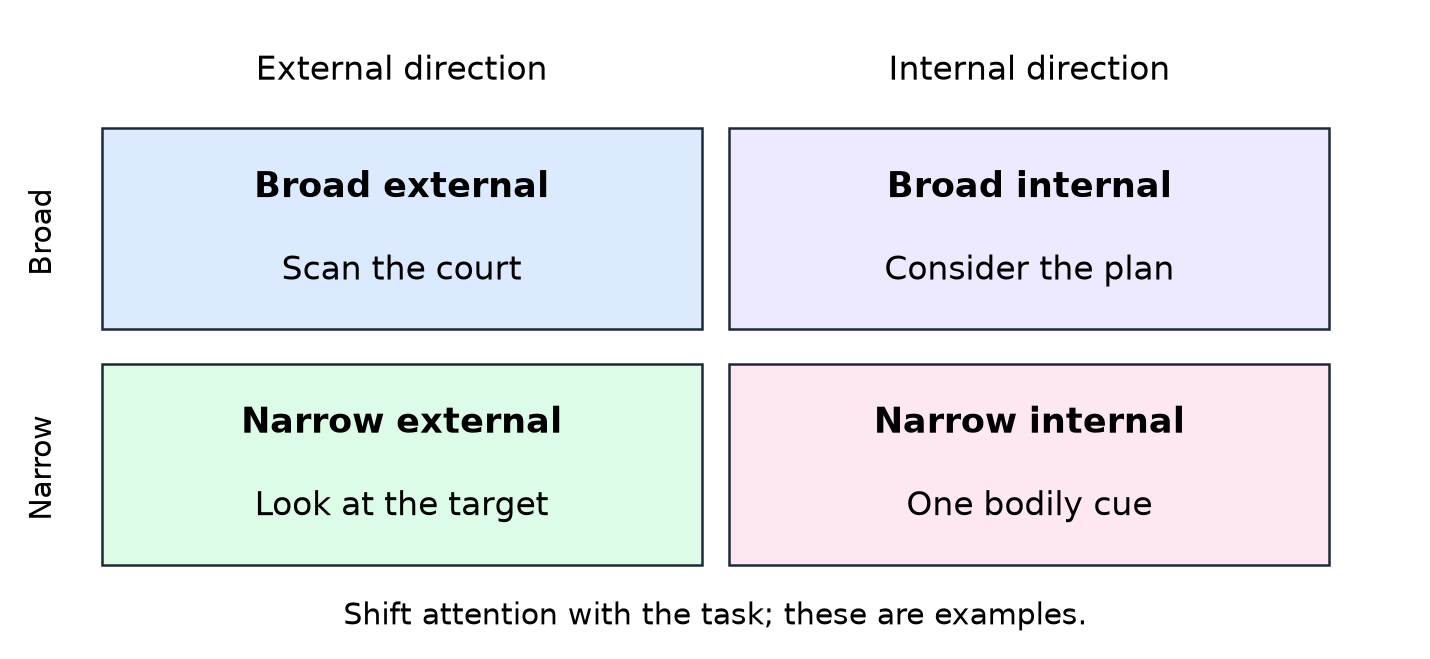
Nideffer's attentional styles
Nideffer described attention along two dimensions: width (broad, many cues; or narrow, one or two cues) and direction (external; or internal). Good performers shift between styles as the situation changes. A golfer uses broad external to read the wind and the green, broad internal to choose the club, narrow internal for one bodily cue, and narrow external to focus on the ball.
Pre-performance routines
A pre-performance routine 赛前常规 is a practised sequence of task-relevant thoughts and actions before a skill. A free-throw routine might check the feet, use one comfortable reset, choose a concise cue and look at the target. It can give attention a useful sequence and a familiar starting point; it does not eliminate distraction or guarantee the desired arousal or score.
At the free-throw line, a fixed pre-performance routine steadies attention before every shotA routine gives attention a familiar sequence and a way back after an interruption
Consistency can support learning, but a useful routine is adaptable to interruptions, rules and actual safety needs. Being unable to perform an exact ritual need not mean failure. A supposedly lucky object has no established direct mechanical effect on ball flight, although a belief about it could affect experience; test the claimed mechanism rather than dismissing or validating every ritual by name.
Choking 发挥失常 describes a marked performance decrement under pressure relative to capability or expectation. Proposed explanations include distraction and excessive conscious monitoring of normally fluent actions. A single error can also reflect ordinary variability, fatigue, technique or injury and does not diagnose choking. Process cues and routines may be evaluated as possible supports, not guaranteed prevention.
Distinguish a psychological skill from a technique. Outline education, acquisition and practice in a suitable programme.
A hockey profile gives ideal/current ratings: decision making 9/6, aggression control 7/6, confidence 9/5. Calculate the gaps and explain how to choose a priority without treating the profile as a diagnosis.
Evaluate one before–after test against repeated baseline and staggered intervention measurements. Name two remaining alternative explanations.
Classify “win the final”, “beat my previous time” and “attend to my release cue”. Explain why none is fully controllable and how achievement motivation may affect the response.
Improve “get better at swimming” using the 68.0→66.0 s, eight-week example. Calculate the four equally spaced two-week targets and explain the limit of that plan.
A runner proposes 58.0→56.0 s over ten weeks, testing every two weeks. Calculate the even improvement per interval, all five targets and the total percentage time reduction.
A basketball goal is to raise free-throw success from 60 % to 70 %. Find the percentage-point and relative increases. Give two conditions needed to judge a fair comparison and discuss feasibility.
A footballer misses a penalty and thinks “I always fail”. Give an instructional cue, a motivational cue and an accurate reframe. Explain why sport labels alone do not select the technique.
Explain the matching hypothesis and one limitation. Describe a safe interpretation of relaxation or psych-up without giving a fixed treatment dose.
Use broad/narrow and internal/external attention in a free-throw routine. Explain how to adapt it after an interruption and why one miss does not prove choking.
Plan a feasible evaluation of a chosen goal or routine: intended outcome, participant choice, comparison, repeated measurement, adherence and follow-up.
Answers.
Confidence or concentration is a skill; goal setting or a relevant self-talk cue is a technique. Education explains the purpose and limits, acquisition teaches a suitable method, and practice applies and reviews it in progressively relevant conditions. Neither access to a technique nor repetition guarantees benefit.
Ideal minus current gives 3, 1 and 4. Confidence has the largest reported gap, but discuss task importance, meaning of the ratings, wishes and available resources before choosing it. Repeat comparable reports alongside behaviour/performance measures; a changed gap alone proves neither a clinical condition nor a causal effect.
A single pair of results is vulnerable to ordinary variation and regression towards typical performance. Repeated baseline helps identify trends and variability; changes aligned with staggered starts across cases can strengthen an inference. Physical training and expectancy are two alternatives; maturation, changed scoring or simultaneous coaching are also possible. Record implementation and use suitable comparisons rather than claiming all alternatives are eliminated.
These are outcome, performance and process goals respectively. Placing depends on opponents; personal time on health/weather; executing a cue on fatigue, suitability and opportunity. A target may direct attention and effort, but excessive cues or fear of failure may hinder engagement. An achievement-motivation label does not determine the response.
Agree a measured 100 m target, appropriate practice opportunities, an eight-week review and comparable two-week checks. There are four intervals: 2.0/4 = 0.5 s each; 67.5, 67.0, 66.5, 66.0 s. Feasibility requires individual evidence; progress may be uneven and the target may need revision.
Five intervals give 2.0/5 = 0.4 s each: 57.6, 57.2, 56.8, 56.4, 56.0 s. Relative time reduction uses the initial 58.0 s: 2/58 × 100 = 3.448… %. This is a proposed reduction in time, not an equal percentage increase in speed or a prediction of adaptation.
10 percentage points; relative increase 10/60 × 100 = 16.666… %. Compare similar difficulty and sufficient attempts, using consistent scoring and conditions. Clarify current variability, resources and the athlete's agreement; the numbers and deadline alone do not show that 70 % is feasible.
Instructional: “scan for the next pass”; motivational: “keep contributing”; reframe: “one miss does not settle the next phase”. These are examples to agree and test, not guaranteed remedies. Do not invent a goalkeeper save or use pain to interrupt a thought. Technical and motivational needs can occur in any sport.
The hypothesis relates a predominantly bodily or cognitive difficulty to a suitable technique. A familiar comfortable breathing method or appropriately taught tension–release exercise may be explored voluntarily; avoid painful contractions or forced breathing. Familiar music or ordinary warm-up can be considered without assuming higher activation always helps.
Broad external: assess relevant court conditions; broad internal: consider the plan; narrow internal: one bodily cue; narrow external: the target. Not every routine needs all four at each attempt. After an interruption, reset within the rules and attend to the next useful action. A miss may reflect ordinary variability or technique; monitoring and distraction are proposed choking mechanisms, not diagnoses from one outcome.
Choose a specific relevant outcome with the athlete, for example an observed reset action plus experience and comparable success rate. Collect repeated baseline, describe the method and suitable comparison, record adherence and cointerventions, and follow up. Protect voluntary participation and reports. Evaluate feasibility and uncertainty; better scores alone do not prove universal efficacy.
11.8
Exam tips
Classify the target and its reference; connect attention and motivation to the person and task.
Show the reference and units in calculations, then discuss design and measurement limits. Distinguish a changed report from an established mechanism or diagnosis.
Was this helpful?
What went wrong? Only the site team sees this.
More topics in IB Sports, Exercise and Health Science SL