This handout teaches A.3 Response for the course first assessed in 2026: how the body responds to a single bout of exercise, what causes fatigue, how athletes recover, how training is planned, and how the body adapts to training and to hot, cold and high-altitude environments. It is written for both SL and HL students. Training principles and health benefits are common; target-group planning and the detailed fatigue/recovery material extend HL study.
Prerequisites: unit A.1 (the cardiovascular and respiratory systems, cardiac output and minute ventilation) and unit A.2 (energy systems, hydration and nutrition).
3.2
Acute responses to exercise
Two hours under two
On 12 October 2019 in Vienna, Eliud Kipchoge completed the supported INEOS challenge over 42.195 km in 1:59:40.2, averaging about 21.16 km/h (event account). That performance does not tell us his heart rate, temperature or oxygen uptake at each moment. Do not invent those measurements. An acute response 急性反应 occurs during or after a bout, such as a rise in heart rate; recovery times differ between variables. A training adaptation 训练适应 is a more persistent change following repeated training, such as greater mitochondrial capacity. Distinguish the timescale and evidence for each.
Heart rate
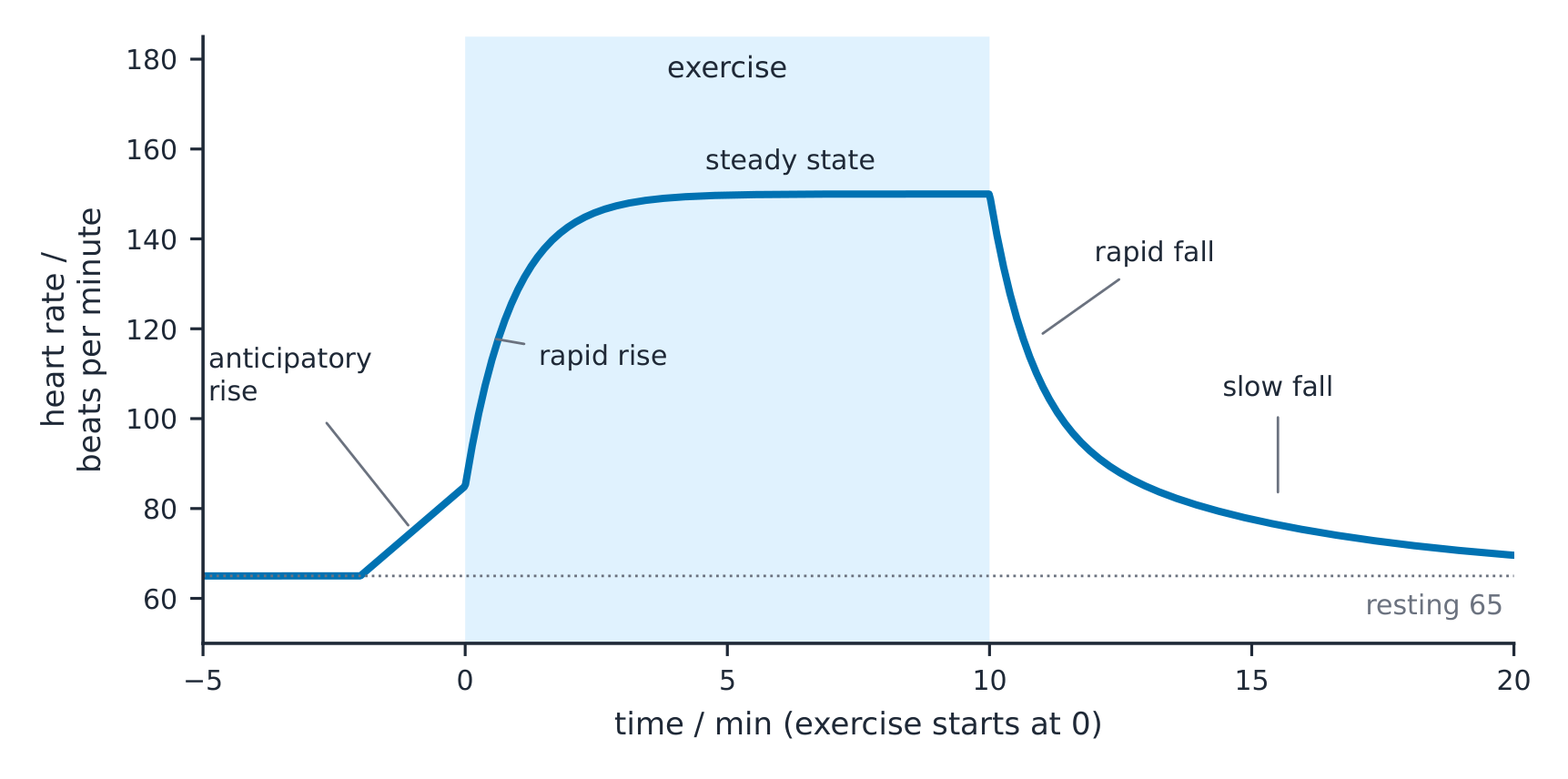
Heart rate response to steady submaximal exerciseAn exercise stress test: heart rate and the ECG are recorded while the cycling workload rises step by step
Anticipatory rise. Before exercise starts, the sympathetic nervous system and adrenaline raise heart rate. The athlete has not moved yet.
Rapid rise. At the start, receptors in muscles and joints signal movement, and the cardiac control centre in the medulla increases heart rate quickly.
Steady state 稳定状态. During steady submaximal 次最大 exercise, heart rate may approach a plateau at a fixed workload. A flat heart-rate trace alone does not measure oxygen uptake or prove an exact match between oxygen supply and demand; prolonged exercise, heat and hydration can change the trace.
Recovery. Heart rate falls quickly at first, then slowly back to the resting value.
In incremental exercise, where the intensity rises every few minutes, heart rate rises roughly in a straight line with intensity until it reaches the maximum heart rate 最大心率. Age-based equations such as 220 − age are population estimates with substantial individual error, especially when applied outside the population studied. They are not an exact measured maximum or a personal target for a child. Use the supplied maximum in a calculation; do not infer one from age unless the question explicitly asks about that estimation model.
Stroke volume and cardiac output
Stroke volume 每搏输出量 (the volume of blood pumped by the left ventricle in each beat) rises during exercise because:
What raises stroke volume, and so cardiac output
more blood returns to the heart (the skeletal muscle pump and the respiratory pump increase venous return 静脉回流);
the ventricle fills more and is stretched more, so it contracts more strongly. This is the Frank–Starling mechanism;
sympathetic nerves and adrenaline make the heart muscle contract more forcefully.
Stroke volume can plateau or continue to rise depending on posture, intensity, training and the individual; there is no universal plateau at one percentage of effort. Because cardiac output = heart rate × stroke volume, both factors contribute. Values such as 5 L/min at rest and 20 L/min during hard exercise illustrate the scale of a response; they are not diagnostic norms or fixed limits for everyone.
Blood pressure
In aerobic exercise such as running, systolic pressure 收缩压 rises (from about 120 to 180 mmHg or more) because cardiac output rises. Diastolic pressure 舒张压 stays about the same or falls slightly, because arterioles in the working muscles widen.
In heavy resistance exercise, both systolic and diastolic pressure rise sharply, especially if the athlete holds their breath while straining.
Oxygen delivery and extraction
Blood is redistributed by the vascular shunt (unit A.1): the fraction and absolute flow to working muscle can rise substantially. The exact distribution depends on workload, environment and the competing needs of other tissues. The muscles also take more oxygen out of each litre of blood.
Working muscle is warmer, more acidic and higher in carbon dioxide, so haemoglobin unloads more oxygen there
The arteriovenous oxygen difference 动静脉氧差 (a-vO₂ diff) is the difference between the oxygen content of arterial blood and of venous blood. At rest arterial blood holds about 200 mL of oxygen per litre and venous blood about 150 mL, so the difference is about 50 mL per litre. In hard exercise venous blood from working muscle may hold only 50 mL, so the difference rises to about 150 mL per litre.
Haemoglobin releases more oxygen in working muscle because the muscle is warmer, more acidic and has more carbon dioxide. Increased carbon dioxide and hydrogen-ion concentration lower haemoglobin's oxygen affinity: the Bohr shift 波尔效应. Higher temperature can also shift the dissociation curve towards easier unloading; do not define the Bohr effect simply as warming.
The Fick equation links oxygen uptake to delivery and extraction:
Worked example. For whole-body Fick calculations, use arterial minus mixed-venous oxygen content with whole-body cardiac output. A sample from one working muscle is not automatically representative of all venous return. At rest, cardiac output is 5 L/min and the a-vO₂ diff is 50 mL per litre: oxygen uptake = 5 × 50 = 250 mL/min. In a hard run, cardiac output is 20 L/min and the a-vO₂ diff is 150 mL per litre: oxygen uptake = 20 × 150 = 3000 mL/min = 3.0 L/min, twelve times the resting value. Cardiac output rose four times and extraction three times; both matter.
Ventilation and temperature
Minute ventilation 每分通气量 rises in two steps: a rapid rise at the start (signals from the motor cortex and from receptors in muscles and joints), then adjustment involving chemical feedback and other inputs. During moderate exercise arterial carbon dioxide need not rise: ventilation can increase enough to match its greater production.
In very hard exercise, ventilation rises faster than oxygen uptake, because extra carbon dioxide from buffering acid must be breathed out. The point where this starts is the ventilatory threshold 通气阈.
Body temperature rises because only about 20 to 25 % of the energy used by muscles becomes movement; the rest is heat. Sweat removes heat when it evaporates; skin blood flow supports exchange, whose direction depends on the temperature gradient (unit A.1).
In long exercise in the heat, heart rate slowly rises while the workload stays the same, because sweating lowers blood volume and stroke volume falls. This is cardiovascular drift (unit A.2).
During exercise the heart rate rises so blood reaches the muscles faster
Measuring responses safely in class. Record a resting baseline, use a standard, low-intensity workload (for example a 3-minute step test at a set rate), and time the recovery readings. Participation must be voluntary, with informed consent and teacher supervision; stop for any discomfort, and never use a classroom test as a health diagnosis.
Not true: "A lower heart rate after a step test proves that one student is fitter." The workload, room temperature, time of day, recent food and caffeine, and the students' body size all affect the reading. Only a comparison under matched conditions can suggest a difference in fitness.
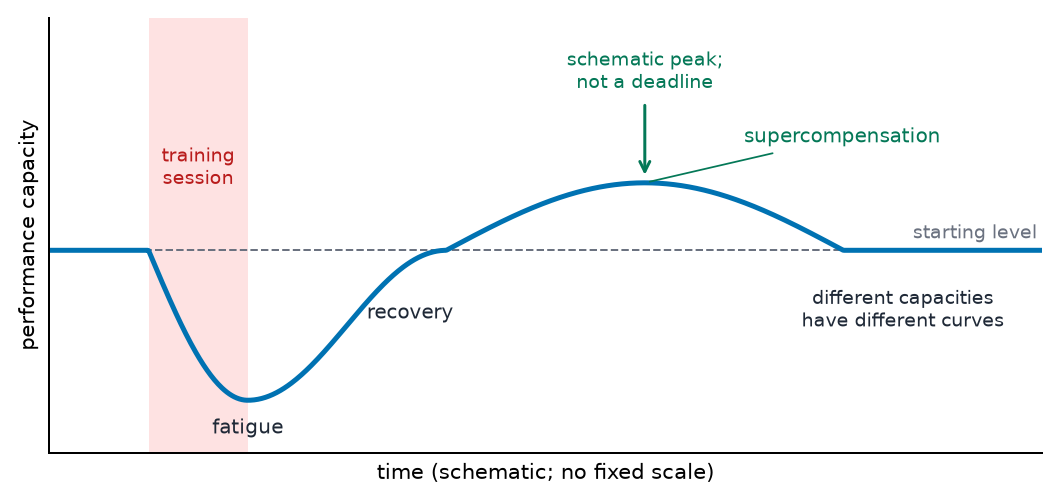
The supercompensation 超量恢复 model sketches fatigue followed by recovery and a possible temporary rise above baseline. It is a teaching model, not a measured universal curve. Glycogen, force, skill and psychological readiness have different trajectories. Planned training can sometimes occur before full recovery; a coach uses the goal, recent load and repeated observations rather than trying to hit one magic peak. Adaptation and fatigue interact during and between sessions; a single late session does not erase every gain.
The principles
Principle
Meaning
Example
Specificity 专项性
Adaptations match the training: the energy system, muscles, movement and speed used
Swimming technique requires swimming practice; other activities can support relevant capacities
Progressive overload 渐进超负荷
Load must be gradually increased above what the body is used to
Progress one suitable load variable after assessing response and technique
Reversibility 可逆性
Adaptations are lost when training stops
A prolonged reduction in stimulus can reduce adaptations; rates differ by capacity and person
Individual differences 个体差异
People respond differently to the same training
Genes, age, sex, starting fitness and recovery differ
Variety
Purposeful variation can support motivation and manage repeated loading
A runner adds cycling and swimming
Recovery
Balance stimulus and recovery so repeated loading remains appropriate
Hard days followed by easy days
Progressive overload: raise one variable in small steps, with lighter weeks for recovery
The amount of training is planned with FITT: frequency (sessions per week), intensity (how hard), time (how long) and type (which activity).
Individual responses depend on baseline capacity, training history, age, health, recovery, psychological stress and other circumstances. Differences between two measured changes can also reflect measurement error and programme adherence. Do not infer a genetic cause from one person improving less. Menstrual and reproductive circumstances may matter to an individual's experience and planning, but an assumed cycle phase does not dictate an identical programme for everyone; respect privacy and respond to relevant individual evidence.
Measuring intensity
Percentage of maximum heart rate, for example 70 % of 200 = 140 beats per minute.
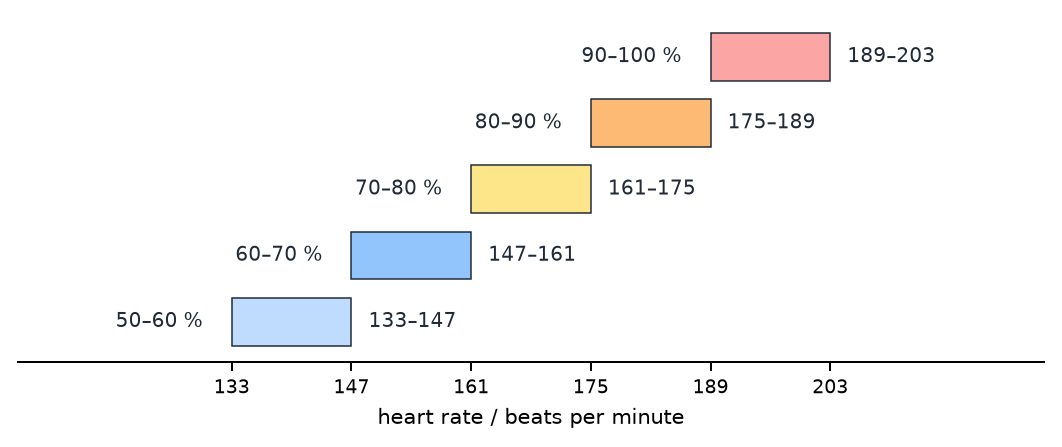
Heart rate reserve 心率储备 (the Karvonen method): heart rate reserve = maximum heart rate − resting heart rate, and the target heart rate = resting heart rate + percentage × heart rate reserve. It allows for a low resting heart rate in trained athletes.
Rating of perceived exertion 主观用力程度 (RPE): the Borg 6 to 20 scale and CR-10 are distinct scales. A rating is not a direct measurement or reliable individual conversion to heart rate. State the scale and anchors; session-load calculations here use CR-10.
Percentage of one-repetition maximum (1RM), the heaviest load that can be lifted once, for resistance training. Definition of 1RM does not require pupils to perform a maximal lift in class.
Percentage of maximal oxygen uptake 最大摄氧量, measured in a laboratory.
A GPS sports watch logs pace and heart rate, two common measures of training intensityReserve-percentage bands; named lactate or ventilation zones cannot be inferred from this arithmetic alone.
Worked example. Given a maximum of 203 and resting heart rate of 63 beats/min, reserve = 203 − 63 = 140 beats/min. At 70% reserve the model value is 63 + 0.70 × 140 = 161 beats/min. At 70% maximum it is 0.70 × 203 = 142.1 beats/min. These are different definitions, not interchangeable intensities or personal prescriptions. The supplied maximum was not inferred from the person's age.
rating of perceived exertion/ˈreɪtɪŋ ɒv pəˈsiːvd eɡˈzɜːʃn/
percentage of maximal oxygen uptake/pəˈsentɪdʒ ɒv ˈmæksɪml ˈɒksɪdʒn ˈʌpteɪk/
3.4
Training methods and periodisation
Training methods
Method
Description
Mainly develops
Continuous training 持续训练
Sustained effort without planned recovery breaks; duration depends on the purpose
Aerobic endurance
Interval training 间歇训练
Repeated work periods with planned rest; set by intensity, work time, rest time and number of repetitions
Aerobic or anaerobic power, depending on the design
Fartlek 法特莱克训练
Continuous activity with changes of pace, which can be planned or responsive
Aerobic and anaerobic; game-like
Resistance training 抗阻训练
Weights, bands or body weight, in sets and repetitions
Strength, power, muscular endurance
Plyometrics 增强式训练
Jumps and bounds using a fast stretch then a fast contraction
Power
Circuit training 循环训练
A series of exercises at stations
General fitness
Flexibility training
Static, dynamic or PNF stretching
Range of movement
Interval training: hard work bouts separated by planned recovery
Resistance adaptations depend on load, total volume, effort, movement, contraction speed, rest and training history. Heavier loads commonly support maximal-strength development; sufficient challenging work can produce hypertrophy 肌肥大 across more than one narrow repetition range. Lighter repeated work can develop local endurance. These outcomes overlap; do not treat one repetition boundary as a biological switch or copy an elite programme into a classroom.
For interval training, the work-to-rest ratio matters. Short, very hard efforts that use the ATP–PC system need long rests, such as 10 s of sprinting with 50 s of rest (1 : 5), so phosphocreatine can be rebuilt. Aerobic intervals use shorter rests, such as 3 minutes of hard running with 2 minutes of jogging.
Short all-out sprints need long rests so phosphocreatine is rebuilt; aerobic intervals use shorter, active rests.
Periodisation
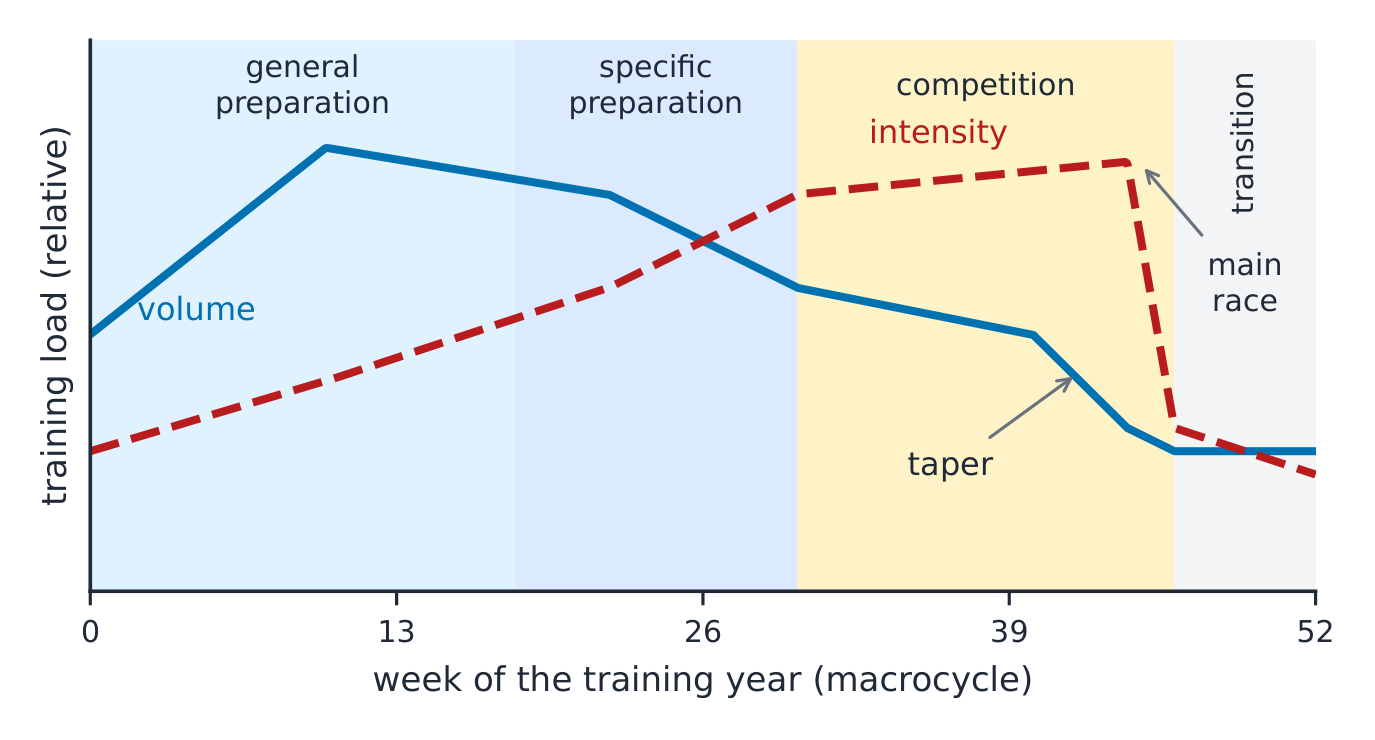
Periodisation 周期化 divides the training year into planned blocks to organise preparation and recovery around important events. It supports planning but guarantees neither a peak performance nor prevention of overtraining.
A macrocycle 大周期 is the long-term plan, often a whole season or year.
A mesocycle 中周期 is a block of about 3 to 6 weeks with one main aim.
A microcycle 小周期 is usually one week of sessions.
A simple periodised year for an endurance athlete
Preparation phase. General preparation builds a base with high volume at lower intensity; specific preparation makes training more like the sport.
Competition phase. Intensity stays high, volume falls, and the athlete keeps fit between events.
Transition phase. Light, varied activity allows physical and mental recovery.
A taper 减量训练 reduces accumulated fatigue before a priority event while aiming to retain relevant fitness and readiness. The amount, duration and maintained intensity depend on the sport and individual. In a plan, weekly volume falls from 600 to 360 minutes: reduction = (600 − 360)/600 × 100 = 40%. That arithmetic does not establish a 40% change in intensity or any guaranteed percentage improvement in race performance.
Resting cardiac output hardly changes with training: the lower heart rate is balanced by a larger stroke volume. For example, untrained 70 × 70 mL = 4.9 L/min and trained 45 × 110 mL ≈ 5.0 L/min. These values illustrate the product: 45 × 110 = 4950 mL/min. A low pulse alone is not a diagnosis of good health or a complete fitness measure.
Training reshapes the rectangle, not its area: a lower resting heart rate with a larger stroke volume.
Lung volumes and maximal ventilation are different quantities. Training can alter ventilatory demands and respiratory-muscle function without proportionately enlarging lung volume. Limits to performance depend on the person, activity and environment; do not rule out respiratory constraints in every healthy athlete. Cardiac structural adaptations likewise depend on loading pattern and individual context, rather than an absolute endurance-chamber/resistance-wall rule.
Muscular adaptations
Endurance (aerobic) training
Resistance and sprint (anaerobic) training
More and larger mitochondria 线粒体
Larger muscle fibres (hypertrophy), mainly type II
More myoglobin 肌红蛋白 to store and carry oxygen in muscle
More PCr and more glycolytic enzymes
More aerobic enzymes
Better buffering of acid
More glycogen and fat stored in muscle
Stronger tendons and denser bones
More fat used at a given pace, so glycogen lasts longer
Neural changes: more motor units recruited, firing better together
The training stimulus decides the muscular adaptation
Strength can rise before a clearly measurable increase in muscle size. These early gains are mainly neural adaptations 神经适应: more motor units are recruited, they fire at higher frequencies and in better time, and opposing muscles relax more.
Thresholds and maximal oxygen uptake
The lactate threshold 乳酸阈 is defined using a specified blood-lactate/workload protocol. Training can alter the workload or fraction of maximal uptake associated with it. It is not a universal concentration, exact switch to anaerobic metabolism or direct measure of all fatigue.
Maximal oxygen uptake, VO₂max, can improve with training, but the change depends on baseline, programme, duration and individual factors. An average response does not determine an individual's result.
Running economy compares the oxygen or energy cost at matched submaximal speed (A.2); it is distinct from the maximum uptake and can change without an identical change in it.
A maximal oxygen uptake test: the mask samples every breath while treadmill speed and gradient rise until the runner can go no furtherThreshold can rise much more than VO2max: sustainable fraction matters as well as the maximum
Worked example. Before training, an athlete's VO₂max is 45 mL per kg per minute and their lactate threshold is at 60 % of it. After six months it is 52 mL per kg per minute and the threshold is at 75 %. The threshold rose from 0.60 × 45 = 27 to 0.75 × 52 = 39 mL per kg per minute, a 44 % increase, much larger than the 16 % rise in VO₂max. These results show why both maximum capacity and sustainable fractional use can matter. They do not prove one universal predictor is always superior, nor determine an actual running speed without additional measurements.
A short-term performance reduction can follow planned loading and resolve with recovery (functional overreaching 功能性过度训练). Longer, maladaptive underperformance may be described as non-functional overreaching or overtraining syndrome 过度训练综合征 after appropriate assessment. These are not diagnoses obtained from a fixed number of days or one morning pulse. Illness, injury, psychological stress and problematic low energy availability can produce overlapping signs; further evaluation may be needed.
Session RPE turns each session into one load number; the weekly total flags changes to investigate
Warning signs include falling performance despite training, a higher resting heart rate in the morning, poor sleep, low mood and motivation, frequent colds and loss of appetite. Stress from school, travel and too little energy intake (unit A.2) add to the training load.
Coaches monitor load and response to inform adjustment; a monitoring score cannot guarantee prevention. Session RPE multiplies the rating (on the CR-10 scale) by the session length in minutes.
Worked example. A footballer does 60 minutes of training at RPE 7 and a 90-minute match at RPE 8. Load = 7 × 60 + 8 × 90 = 420 + 720 = 1140 arbitrary units. A weekly total can flag a change for investigation, but is not a validated universal injury threshold. Equal totals can hide very different intensity distributions, movements and recovery intervals. Arbitrary units are not kilojoules or a diagnosis.
Health benefits are broader than performance
Appropriate regular physical activity supports muscular function, bone loading and cardiometabolic health and can reduce the risk of hypertension, cardiovascular disease and type 2 diabetes. Activity can contribute to prevention or management of obesity and osteoporosis, but risk reduction is not a guarantee that an individual will avoid disease. Energy intake, total expenditure and energy stored in tissues are related. Benefits do not require elite performance. Immune health is influenced by sleep, nutrition, exposure and training/recovery balance; "more training always improves immunity" is an overclaim (WHO guidelines).
Regular activity reduces risk across body systems
Suitable loading can strengthen muscle and bone; poorly progressed or excessive loading can cause harm. Describe the mechanism and intended benefit, then consider baseline, access, preferences and limitations. A health programme and a competition programme can have different success criteria.
Explain mechanisms and limits as well as showing working.
Distinguish an acute response from a training adaptation. Describe possible phases of a heart-rate response before, during and after steady exercise, and explain why a plateau alone does not prove an oxygen balance.
Explain two reasons stroke volume can rise. Calculate cardiac output for rest HR 70 beats/min, SV 70 mL/beat and exercise HR 170, SV 105; find the factor increase.
Compare blood-pressure responses to dynamic running and heavy resistance exercise. Explain oxygen unloading, then use Q = 18 L/min and whole-body a-vO₂ difference = 140 mL/L to find oxygen uptake.
Explain the supercompensation model and two limits to using its peak as an exact training deadline. Apply specificity, overload and reversibility to one sport.
Given maximum HR 200 and rest HR 68 beats/min, calculate the model value at 75% reserve. Compare with 75% maximum; explain why age or these fractions alone cannot identify an individual's lactate threshold.
An interval model uses 40 s work and 160 s recovery. Find the work:rest ratio and explain what additional information is needed to judge its purpose. Explain preparation, competition, transition and tapering; calculate the volume reduction from 600 to 360 minutes.
Explain how a larger stroke volume can maintain resting cardiac output at a lower heart rate. Compare muscular adaptations to endurance and resistance training and explain strength gains before a clear increase in muscle size.
An athlete's maximal uptake changes from 45 to 52 mL/kg/min and the fraction at a defined threshold from 60% to 75%. Calculate both threshold values and their percentage increase; compare with the maximum's percentage increase. State a limit to the inference.
A swimmer completes four 75-minute sessions at CR-10 RPE 6 and one 20-minute race at RPE 9. Calculate weekly session load and give two limitations of this number.
Explain how appropriate activity can support muscle, bone and cardiometabolic health. Evaluate "a person who exercises cannot develop type 2 diabetes" and "one session proves a daily energy deficit".
Two people follow the same programme and their test scores change by different amounts. Explain three possible reasons, design a more defensible comparison and state why a genetic explanation is not established.
Answers.
Acute: a bout-related HR rise; adaptation: more persistent increased mitochondrial capacity after repeated training. Anticipatory autonomic rise, rapid onset rise, possible plateau, then faster and slower recovery phases. A plateau measures only HR; uptake, output and temperature may still differ or change.
Running usually raises systolic pressure while diastolic changes less as working-muscle arterioles dilate; heavy resistance can increase both substantially. Increased CO₂/H⁺ lowers Hb affinity (Bohr effect); warmth also favours unloading. Uptake = 18 × 140 = 2520 mL/min = 2.52 L/min. The oxygen-content sample must match the whole-body boundary.
The model sketches fatigue, recovery and a possible above-baseline response. Different capacities recover at different rates; its curve is not an individual's measured timetable. Football-specific changes of direction train relevant movement; gradual suitable progression adds stimulus; reduced stimulus can reverse some adaptations. Timing follows aims and monitoring, not one universal peak.
Reserve = 200 − 68 = 132; value = 68 + 0.75 × 132 = 167 beats/min. Percentage maximum = 0.75 × 200 = 150 beats/min. Neither calculation measures blood lactate or supplies an exact individual threshold. A supplied maximum is not the same as an uncertain age prediction.
40:160 = 1:4. Need intensity, activity, repetitions, participant history and next-task aim; several energy systems contribute. Preparation develops capacities and sport relevance; competition balances events and maintenance; transition permits recovery and variation. Taper aims to reduce fatigue while retaining readiness. Volume cut = 240/600 × 100 = 40%; no automatic performance gain follows.
Output is the product of rate and stroke volume: 45 × 110 = 4950 mL/min = 4.95 L/min, similar to 70 × 70 = 4.9 L/min. Endurance can increase mitochondrial/aerobic capacity and capillarisation; resistance can increase fibre size and neural force production. Recruitment, firing and task coordination can improve before visible hypertrophy; the processes overlap.
Before = 0.60 × 45 = 27; after = 0.75 × 52 = 39 mL/kg/min. Increase = 12/27 × 100 = 44.444…%. Maximum increase = 7/45 × 100 = 15.555…%. These are different metrics; they do not determine speed, prove cause or make one predictor universally superior.
Four sessions: 4 × 75 × 6 = 1800; race: 20 × 9 = 180; total = 1980 arbitrary units. The score depends on the stated subjective scale and timing and hides movement/intensity distribution. It is not energy expenditure or a guaranteed injury predictor.
Mechanical loading can support muscle and bone; appropriate activity improves cardiometabolic function and reduces several disease risks. Reduced risk does not imply zero risk. Daily energy balance requires intake and all expenditure over the stated period, not one activity measurement.
Baseline fitness/training history, adherence, recovery/stress, individual physiology and test noise are possible explanations. Standardise tests and exposure, repeat measurements and record relevant differences; use a suitable comparison. Different change scores alone cannot isolate genetic effects.
3.8
Exam tips
Say whether a change is an acute response (one bout) or a training adaptation (many sessions).
Describe a heart rate graph in phases: anticipatory rise, rapid rise, steady state, rapid fall, slow fall.
Explain stroke volume with venous return and the Frank–Starling mechanism.
Distinguish an indicator from a mechanism and a symptom from measured task performance.
Name the principle of training and give a sport-specific example of it.
In Karvonen calculations, show the maximum heart rate, the reserve and the target, with units.
Link each adaptation to its effect on performance, for example "more mitochondria, so more ATP is made aerobically".
More topics in IB Sports, Exercise and Health Science SL