These are selected topics, not the whole syllabus, and every example is fictional. Impulse links force and time to a change in momentum.
English narration · English + 中文 subtitles burned in
4.1
Scope and prerequisites
Why can a muscle need a much larger force than the weight held in a hand? The answer depends on attachment positions and turning effects, not simply on whether the athlete is strong. Follow a movement from anatomical description, through joints and muscle activation, to the lever that transfers force.
This handout covers B1: generating movement in the body. Shared teaching includes skeletal organization, positions and movements, connective tissues and joints, muscular function, and lever systems. Prerequisites are force, distance, simple ratios and the distinction between acute responses and training adaptations. Numerical examples and simplified diagrams are original teaching models, not measurements from athletes or examination papers.
4.2
Anatomical position gives descriptions a common reference
In anatomical position the person stands upright, looking forwards, with arms at the sides and palms facing forwards. Left and right refer to the person's own sides. A photograph taken from the front reverses these sides for the viewer. Terms retain this reference when the person changes posture: the palm does not become the back of the hand when someone turns it downwards.
Axial skeleton (skull, vertebral column, ribs, sternum) and appendicular skeleton (girdles and limbs)
The axial skeleton includes the skull, vertebral column, ribs and sternum. It supports the central body and protects structures such as the brain, spinal cord and organs in the chest. The appendicular skeleton includes the shoulder and pelvic girdles and the upper and lower limbs. It provides attachments and linked segments for movement. Protection, support, mineral storage and blood-cell formation are skeletal functions; these do not belong exclusively to one division.
Recognize the scapula and clavicle at the shoulder; humerus in the upper arm; radius and ulna in the forearm; carpals, metacarpals and phalanges in the hand. The pelvic girdle links the lower limb to the trunk. The femur is in the thigh; patella at the knee; tibia and fibula in the lower leg; and tarsals, metatarsals and phalanges in the foot. In anatomical position the radius lies on the thumb side, lateral to the ulna. The tibia is medial to the fibula. Use a labelled skeleton to locate these bones rather than memorizing an isolated word list.
Superior means towards the head and inferior towards the feet. Anterior is towards the front and posterior towards the back. Medial means closer to the body's midline; lateral means farther from it; intermediate means between structures. Proximal and distal compare distance from a limb's attachment to the trunk. The elbow is distal to the shoulder but proximal to the wrist. Calling the elbow simply “proximal” leaves the comparison unfinished. These terms describe position, not the direction a force acts.
4.3
Planes describe motion; axes describe rotation
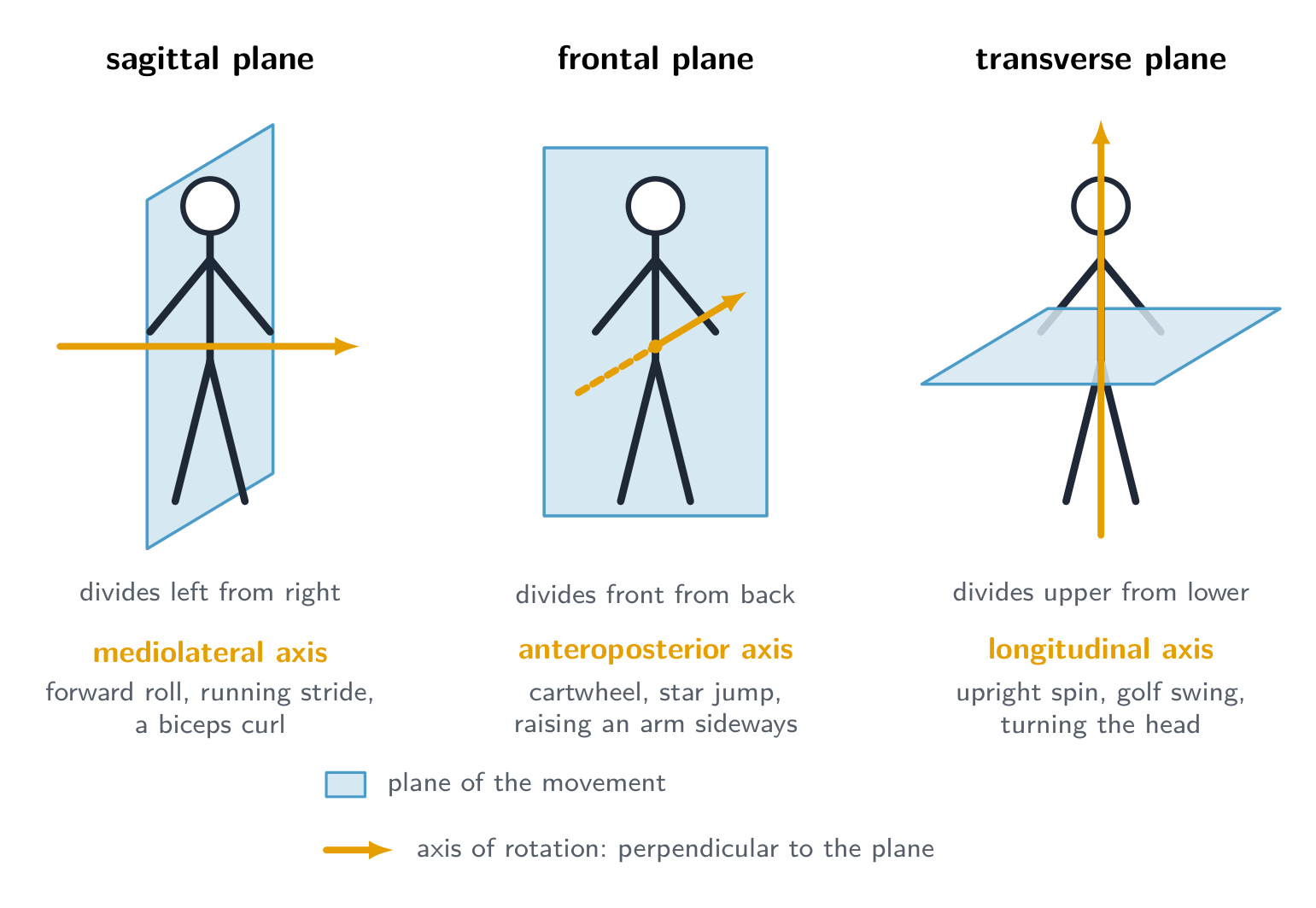
A plane 平面 is an imaginary flat surface. A sagittal plane divides left and right portions; only the midsagittal plane gives equal halves. A frontal plane divides anterior and posterior portions. A transverse plane divides superior and inferior portions. Many sporting movements combine all three.
An axis 轴 is a line about which rotation occurs. It is perpendicular to the plane of the rotation. In a simplified forward roll, motion mainly in the sagittal plane is about a mediolateral axis running from side to side. A cartwheel's main rotation is in a frontal plane about an anteroposterior axis running from front to back. A straight upright spin is in a transverse plane about a longitudinal axis running head to foot. Naming “the sagittal axis” when you mean a sagittal plane confuses a surface with a line.
Each named axis is perpendicular to its movement plane. Sporting actions are simplified here; a real sequence can combine rotations.
To analyse a video, name the joint and phase, describe the relative movement of the segments, and then assign a plane and axis. A side view may suit elbow flexion, but it hides out-of-plane rotation. Calibrate distance, know frame rate, keep the camera fixed and approximately perpendicular to the main movement plane, and use visible landmarks consistently. Perspective and obscured landmarks create uncertainty in a single two-dimensional recording.
Use movement terms for a specified joint and phase
Flexion usually decreases the angle between articulating segments; extension increases it. During a curl, bending the elbow is flexion; lowering the hand towards a straight elbow is extension even if the elbow flexors remain active. At the ankle, dorsiflexion brings the top of the foot towards the shin; plantarflexion points the foot away. Do not call every upward movement flexion: lifting the whole arm sideways is shoulder abduction.
Name the joint, then the movement: each term comes in an opposite pair
Abduction moves a limb away from the midline and adduction brings it towards the midline. For fingers, the reference is the middle finger; for toes, it is the second toe. Horizontal flexion moves a raised upper arm across the front of the body, as in bringing the arms together in a chest fly; horizontal extension reverses this action. These are mainly transverse-plane movements at the shoulder, unlike raising the arms sideways in a jumping jack.
Rotation turns a segment about its long axis. Circumduction combines successive movements so the distal end traces a cone; it is not simply the bone spinning about its own length. At the forearm, supination returns the palm forwards in anatomical position; pronation turns it backwards as the radius crosses the ulna. “Palm up” and “palm down” work for a bent elbow held horizontally, but anatomical reference makes the definition consistent in other positions.
Rotation spins about the long axis; circumduction sweeps a cone
Protraction brings the shoulder girdle forwards around the chest; retraction moves it backwards. Elevation raises a structure, as when shrugging the shoulders; depression lowers it. Opposition brings the thumb towards the fingertips; reposition returns it. Inversion turns the sole towards the midline and eversion turns it away, involving joints in the foot rather than simply pointing the toes. In a real throw, several joints and muscle groups contribute in sequence: a single label for the entire throw loses useful information.
4.5
Connective tissues transmit forces and constrain movement
Bone provides a relatively rigid support and a lever for muscle force. Tendons connect muscle to bone and transmit tensile force; some store and return elastic energy. Ligaments usually connect bone to bone and help limit excessive joint motion. Cartilage provides support and, at many joint surfaces, a smooth low-friction load-bearing covering. Fascia is connective tissue that surrounds and links muscles and other structures, helping organize and transmit forces. Do not swap tendon and ligament or describe all connective tissue as rigid.
Tendon, ligament, cartilageThe diagram separates tissues to show their roles. It is not a medical image or a measurement of a person's joint.
Joints are articulations between skeletal elements. In a fibrous joint, dense connective tissue links bones, as in skull sutures; movement is generally limited. Cartilaginous joints use cartilage, as at the pubic symphysis and between vertebral bodies; their movement depends on structure. Synovial joints have a cavity with synovial fluid, articular cartilage and a surrounding capsule. Fluid supports lubrication, cartilage distributes loads and the capsule and ligaments help stability. Muscles crossing the joint provide additional dynamic stabilization. Not every joint is freely movable or has a fluid-filled cavity.
Synovial classes differ in the movements their shapes permit. A hinge, such as the elbow's main articulation, mainly allows flexion and extension. A pivot, such as the proximal radioulnar joint, allows rotation. A ball-and-socket joint, such as shoulder or hip, allows movement about several axes. A condyloid joint, such as the radiocarpal wrist joint, permits movement mainly about two axes; a saddle joint at the base of the thumb supports flexion/extension and abduction/adduction, helping opposition. Plane joints between some carpal bones permit gliding. The knee is a modified hinge with some rotation: the simple categories are models, not claims that a living joint has only one possible motion.
The shoulder's large range supports throwing and reaching but requires substantial soft-tissue control. The hip's deeper socket and strong surrounding structures support load bearing and stability. More movement is not automatically better in every task. Describe the particular structure, useful movement and stability demand rather than declaring one joint universally superior. Cellular details of connective tissue are not needed for this unit.
4.6
Muscle activation produces graded force and controlled movement
A motor unit 运动单位 consists of one motor neuron and the muscle fibres it supplies. A motor-neuron action potential normally activates all the fibres of its unit. The all-or-none principle applies to the electrical response to a sufficient stimulus; it does not mean a whole muscle can produce only zero force or its maximum force. Twitch force also depends on muscle length, fatigue and other conditions.
Skeletal muscle fibres under the microscope: long, striped cells with many nuclei; force is graded by how many motor units fire, and how often
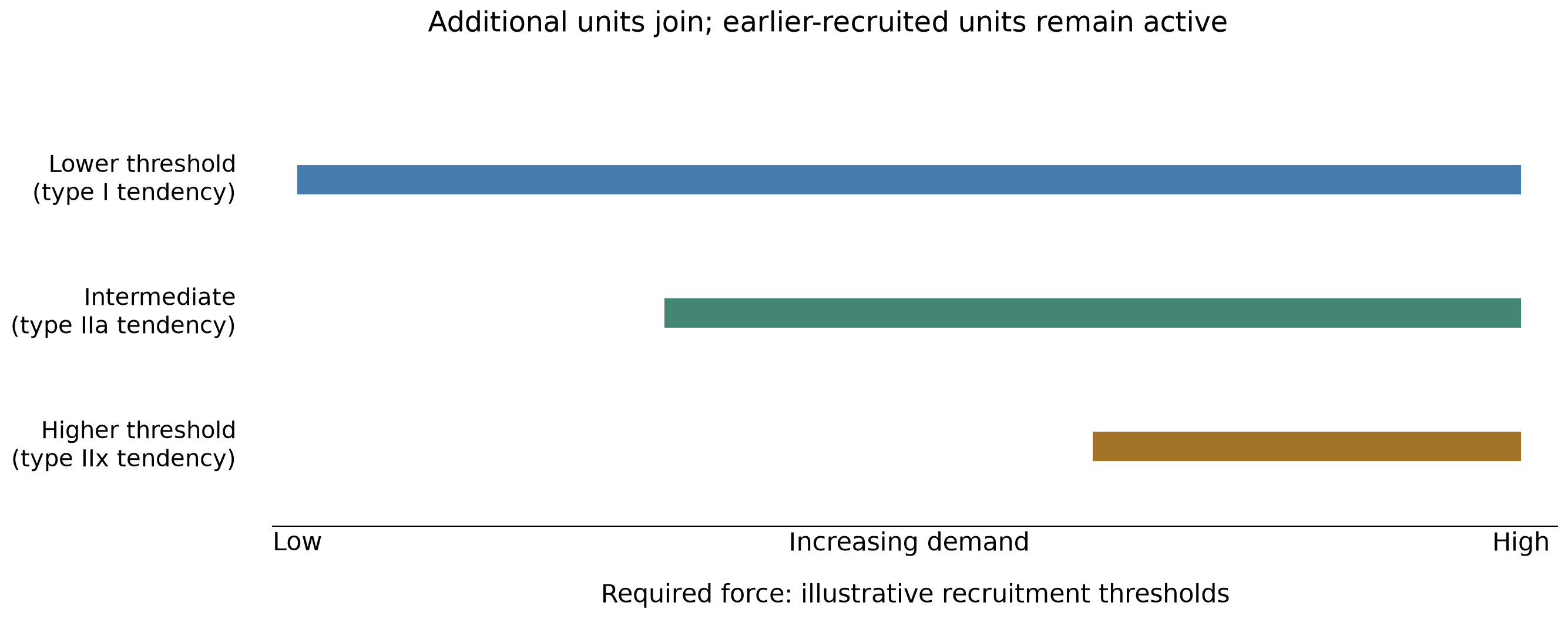
Whole-muscle force changes through recruitment of additional motor units and changes in their firing rate. At low demands, smaller, lower-threshold units are generally recruited first; additional higher-threshold units contribute as demand rises. Type I fibres are relatively slow and fatigue resistant, with strong oxidative capacity. Type IIa are faster and combine substantial oxidative and glycolytic capacities. Type IIx have high shortening speeds and rapid force potential but fatigue more rapidly in sustained repeated work. Lower-threshold units generally have smaller motor neurons and axons; higher-threshold fast units generally have larger neurons with larger-diameter axons. Neuron size relates to recruitment threshold and conduction, but axon diameter alone cannot predict sporting performance. These are relative tendencies; all active fibres require ATP, and “fast” does not mean never using oxygen.
*The schematic shows additional units joining those already active, not one fibre class switching off as another switches on. *
A posture task and a maximal explosive task therefore differ in recruitment demands. Hypertrophy increases muscle-fibre size and can increase force capacity; atrophy reduces it. The neural drive needed for a given external load can change as muscle capacity changes, while training also produces neural adaptations. A larger muscle does not automatically have more motor neurons, and fibre size alone cannot predict the recruitment pattern in every movement.
Muscles generate tension while shortening, maintaining length or lengthening under load. During concentric action the active muscle shortens; during eccentric action it lengthens while resisting the load; during isometric action its overall length remains approximately constant. Holding a dumbbell still at a fixed elbow angle involves isometric activity. Raising it by elbow flexion involves concentric elbow-flexor activity; lowering it under control involves eccentric elbow-flexor activity. “Eccentric” does not mean the muscle is relaxed or pushing the bones apart.
The syllabus uses isotonic concentric and isotonic eccentric for these dynamic actions. Strictly, isotonic means constant tension; ordinary free-weight movements do not maintain exactly constant muscle tension through their whole range. Isokinetic action maintains a specified angular velocity, usually using specialized equipment that varies resistance. Constant velocity does not mean constant force, and an isometric hold still consumes ATP even though external mechanical work on a stationary load is zero.
The agonist is the muscle or group producing the specified action; the antagonist can oppose it. In elbow flexion the elbow flexors are agonists and the extensors are antagonists; the roles change for an active extension. Synergists assist and stabilizers hold other segments appropriately. Reciprocal inhibition can reduce activation of an antagonist while an agonist is activated, supporting movement. However, co-contraction also occurs, particularly when stability is needed: antagonists are not necessarily completely inactive. ATP metabolism supports contraction and restoration of ionic conditions in all these tasks.
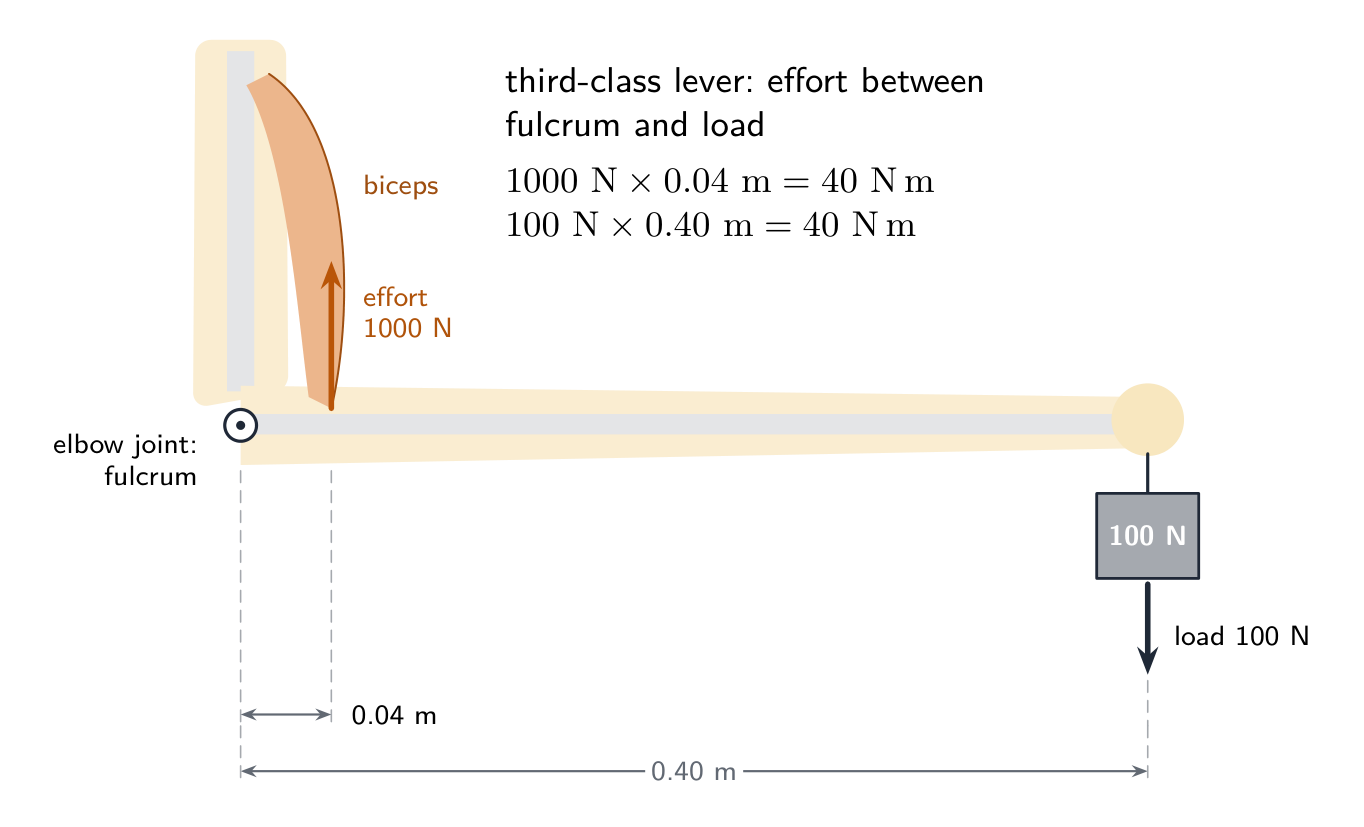
A lever has a fulcrum or pivot, an effort and a load. Classification depends on their relative positions. In a first-class lever the fulcrum lies between effort and load, as in a simple seesaw or a simplified head-extension model about the upper cervical joint. In a second-class lever the load lies between fulcrum and effort. A wheelbarrow illustrates this; in a simplified heel raise, the forefoot contact is the fulcrum, body weight is the load and the Achilles tendon supplies effort. A third-class lever has effort between fulcrum and load, as in elbow flexion holding a weight, or a forearm moving an implement held in the hand.
The moment depends on the perpendicular distance $d$ from the pivot to the line of action of the force
An implement can extend the lever outside the body. With angular motion, a longer distance from the axis can produce greater endpoint speed for the same angular velocity, but may increase the turning effect of a resisting load and the rotational inertia. A longer racket is not automatically easier to accelerate. First-class levers do not always have a force advantage: the arm lengths determine the ratio.
The moment of a force about a pivot is force multiplied by the perpendicular distance from the pivot to the force's line of action. Use metres for distance and newton metres for moment. A force applied obliquely may have a much smaller moment arm than the distance measured along the bone. Mechanical advantage for an ideal lever is effort arm divided by load arm. When it exceeds one, less effort force can balance the load; when it is below one, more effort force is needed. This exchanges force for movement distance and speed, not free energy.
For the horizontal segment, a 100 N downward load at 0.40 m balances a 1,000 N upward effort at 0.04 m. Joint reaction and segment weight need separate treatment in a fuller model.
In this static model, load moment is $100\times0.40=40$ newton metres. Required effort is $40/0.04=1000$ N and mechanical advantage is $0.04/0.40=0.10$. The muscle's force exceeds the external load because its moment arm is shorter. If effort arm increases to 0.05 m with other conditions unchanged, required effort falls to $40/0.05=800$ N. This does not mean anatomical attachment positions can be changed by a coaching instruction.
Adding segment weight changes the result. A 20 N forearm-and-hand weight acting 0.15 m from the pivot adds $20(0.15)=3$ newton metres. The effort must now balance 43 newton metres, requiring $43/0.04=1075$ N. The joint reaction balances the remaining forces; it is not automatically equal to the weight in the hand. A dynamic analysis also needs angular acceleration and other forces.
4.8
Connect this model to impulse and safe movement analysis
Impulse 冲量 is net force integrated over time and equals change in momentum. The landing example connects this unit to B2 forces and motion. For the same momentum change of 150 kg metres per second, stopping over 0.30 s requires a net average force magnitude of $150/0.30=500$ N; over 0.60 s it is 250 N. Greater stopping time can reduce average net force. The peak force need not halve, and net force is not automatically the ground reaction: weight and other forces must be included with directions. A 120 kg metre per second change over 0.40 s gives 300 N; 180 over 0.50 s and 1.00 s gives 360 N and 180 N.
Impulse is the area under a force-time graph, equal to the change in momentum
The base of support 支撑面 is the area enclosed by the supporting contacts. Its size and the position of the centre of mass affect stability, which B2 develops further. Joint angles, muscle actions, levers and momentum describe different aspects of the same movement. Name the body or segment, direction and movement phase before combining them. Use supplied data or consented teacher-approved ordinary low-risk movements. Do not deliberately increase impacts or prescribe rehabilitation from a classroom video.
Explore
Same momentum change, longer stopping time
A 50 kg athlete stopping from 3 m/s changes momentum by 150 kg m/s. Over 0.30 s the average force is 500 N; over 0.60 s it halves to 250 N, which is why bending the knees on landing helps.
Classify skull, sternum, scapula, femur and pelvic girdle into axial or appendicular skeleton. Compare the elbow's position with shoulder and wrist, and the tibia with the fibula.
Name the main plane and perpendicular axis for a simplified forward roll, cartwheel and upright spin. Explain why a single camera view can miss part of a throw.
Describe elbow flexion/extension, shoulder abduction/adduction and horizontal flexion/extension. Distinguish rotation from circumduction.
Explain pronation/supination, inversion/eversion, dorsiflexion/plantarflexion, protraction/retraction, elevation/depression and thumb opposition/reposition using anatomical reference.
Compare tendon, ligament, cartilage and fascia. Explain why muscle control matters even when a joint has intact passive supports.
Compare fibrous, cartilaginous and synovial joints. Name a hinge, pivot, ball-and-socket, condyloid, saddle and plane joint, linking each to a permitted movement.
Explain how a muscle can produce graded force despite the all-or-none principle. Compare types I, IIa and IIx and explain why a force-demand increase does not switch type I off.
Classify elbow-flexor activity while raising, holding and slowly lowering a dumbbell. Distinguish isokinetic from isometric action and explain antagonist involvement.
Identify the class when the order is effort–fulcrum–load; fulcrum–load–effort; and fulcrum–effort–load. Give an external implement example and explain why lever length has a trade-off.
A static lever has a 120 N load 0.30 m from the pivot and effort arm 0.045 m. Calculate load moment, required effort and mechanical advantage. Then add a 15 N segment weight acting at 0.12 m; recalculate effort. Assume all distances are perpendicular arms.
Momentum changes by 180 kg metres per second over 0.50 s and then over 1.00 s in two models. Calculate average net force magnitudes. Explain why this does not determine peak ground reaction or injury risk.
4.10
Worked answers
Skull and sternum are axial; scapula, femur and pelvic girdle are appendicular. Elbow is distal to shoulder and proximal to wrist. Tibia is medial to fibula in anatomical position. The reference comparison is part of a positional answer.
Forward roll: sagittal plane, mediolateral axis. Cartwheel: frontal plane, anteroposterior axis. Upright spin: transverse plane, longitudinal axis. A throw also involves out-of-plane components, which one projected view may hide or distort.
Elbow flexion decreases its angle and extension increases it. Shoulder abduction moves the arm away from the midline; adduction returns it. Horizontal flexion brings the raised arm across the chest; horizontal extension reverses this. Rotation turns about the segment's long axis; circumduction moves its distal end around a cone through combined actions.
Supination brings the palm forwards in anatomical position; pronation brings it backwards. Inversion turns the sole medially and eversion laterally. Dorsiflexion brings foot towards shin; plantarflexion points it away. Protraction/retraction bring the shoulder girdle forwards/backwards; elevation/depression move it up/down. Opposition brings thumb towards fingertips; reposition returns it.
Tendon transmits muscle tension to bone; ligament usually joins bones and limits excessive movement. Articular cartilage provides a smooth load-bearing surface; fascia surrounds and connects structures. Active muscles stabilize a joint under changing loads, so passive structures alone cannot control every movement.
Fibrous joints link bones with dense connective tissue; cartilaginous joints use cartilage; synovial joints have a lubricated cavity. Examples: elbow hinge, flexion/extension; proximal radioulnar pivot, rotation; shoulder ball-and-socket, multi-axis; radiocarpal condyloid, two-axis; thumb-base saddle, movements supporting opposition; intercarpal plane, gliding. These categories simplify living movement.
Recruitment and firing rate grade whole-muscle force; all-or-none concerns electrical activation. Type I is relatively slow, oxidative and fatigue resistant; IIa is faster with mixed capacities; IIx is fast and powerful but fatigues sooner. Greater demand generally adds units, retaining earlier ones. All use ATP; oxidative metabolism is not exclusive to type I.
Raising: concentric; hold: isometric; controlled lowering: eccentric elbow-flexor activity. Isokinetic means constant angular velocity under suitable resistance. Reciprocal inhibition reduces antagonist activation, but co-contraction can stabilize joints; antagonists need not be completely inactive.
First-, second-, then third-class. A longer racket gives greater endpoint speed at fixed angular velocity but can require more accelerating torque. Force advantage depends on perpendicular moment arms, not class alone.
Load moment $120(0.30)=36$ newton metres. Effort $36/0.045=800$ N. Mechanical advantage $0.045/0.30=0.15$. Added weight moment $15(0.12)=1.8$ newton metres, so total is 37.8 and effort is $37.8/0.045=840$ N. The ideal static model neglects other forces and acceleration; the joint reaction must also balance forces.
$180/0.50=360$ N and $180/1.00=180$ N. The longer interval halves average net force for this fixed momentum change. A force-time curve is needed for peaks; weight and other forces distinguish net force from ground reaction. Injury has further anatomical and contextual causes; do not test it by provoking impacts.
4.11
Exam tips and common mistakes
Name the joint, segment and phase; give positional reference structures and perpendicular plane/axis pairs. Active lengthening is eccentric. Tendon and ligament differ; antagonists can stabilize.
Mark fulcrum, effort, load and perpendicular arms. Include supplied segment weight and state static assumptions. Separate muscle force, net force, moment and momentum, with correct units.
More topics in International Baccalaureate · IB Diploma · Sports, Exercise and Health Science · SL




 *The schematic shows additional units joining those already active, not one fibre class switching off as another switches on. *