These are selected topics, not the whole syllabus, and every example is fictional. Compare injury rates per exposure, not raw counts.
English narration · English + 中文 subtitles burned in
6.1
Scope and prerequisites
A club records fewer injuries after changing its warm-up. Did the warm-up work, or did the club also play fewer matches? Injury prevention requires both a plausible explanation and a fair comparison of evidence. Counts, exposure, severity and reporting can point to different conclusions.
This handout covers B3: injury, including interacting risk factors, acute and cumulative trauma, prevention, treatment principles and staged concussion recovery. Prerequisites are B1 tissue and joint functions, B2 forces and movement phases, and rates and percentages. All datasets and scenarios are original teaching examples, not real athlete records or examination papers. Use them for scientific reasoning; students do not induce injuries, diagnose classmates or decide return-to-play clearance.
6.2
Risk factors interact rather than identify one inevitable cause
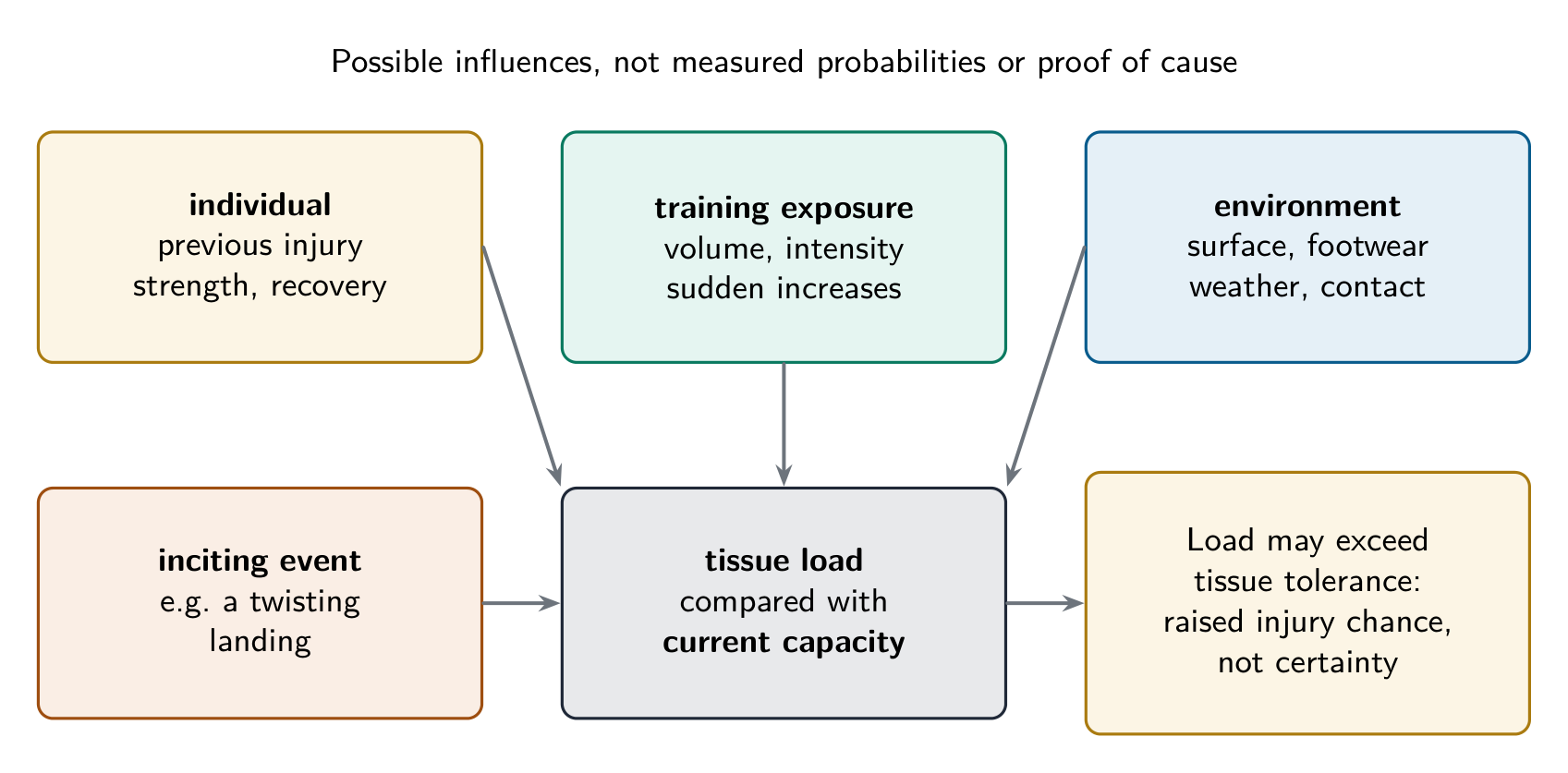
A risk factor is a characteristic or exposure associated with a greater chance of an outcome in specified circumstances. A mechanism describes how an injury occurs, such as a sudden twisting load that exceeds tissue tolerance. A risk factor is not itself a diagnosis, and an observed association is not automatically a causal mechanism.
Internal factors concern the individual. Age, development, physiological sex-related differences, pregnancy, congenital characteristics, previous injury and the effects of training can change the demands or capacities relevant to a task. Their effects depend on the sport, movement, environment and person. Previous injury may leave strength, range or control deficits; it may also be a marker of the activities and exposures that caused the earlier injury.
External factors include equipment, playing surface, weather, rules, contact with other participants and how activity is organized. Footwear that suits one surface may provide unsuitable traction on another. Protective equipment can reduce particular consequences of a collision without removing every injury mechanism. A training programme is an external exposure that interacts with the individual's current capacity and recovery.
The arrows represent possible influences, not measured probabilities or proof that one factor alone causes injury.
For a runner returning after an ankle injury, reduced strength or control, a sudden increase in running volume and an uneven surface may combine. It would be weak reasoning to attribute every later symptom only to the surface because the surface was visible in a video. Compare alternative explanations and the sequence of events. Training can improve capacity, but poorly matched loading and recovery can increase problems; “all training prevents injury” and “all training damages tissue” are both incomplete.
6.3
Acute and cumulative trauma describe loading histories
Acute trauma follows a sudden event, excessive force or unexpected force direction. A collision, an awkward landing or a rapid change of direction may impose a load that the involved tissues cannot tolerate. Cumulative trauma involves repeated loading whose combined effects exceed recovery and adaptation. An overuse injury 过度使用损伤 can develop without one dramatic accident. Symptoms may appear suddenly even when the preceding loading history was cumulative.
A stress fracture of the tibia on X-ray: repeated loading, not one big impact, cracked the boneAcute injury: one load exceeds tolerance. Cumulative injury: tolerance falls until an ordinary load exceeds it
Both mechanisms can affect different tissues. A ligament sprain concerns a ligament; a muscle or tendon strain concerns those tissues. A tendon can be affected by repeated loading, and a major tendon tear can also follow an acute event. Bone injuries include acute fractures and bone stress injuries associated with repeated loading. Skin can suffer cuts, abrasions or repeated friction damage. Muscle damage can involve overstretching, a direct blow or repeated demands. Tissue type and mechanism are separate classifications; “acute” does not mean only bone and “overuse” does not mean only muscle.
Fascia, cartilage and other connective tissues also transmit or distribute loads, so their structure and function affect the consequences of a movement. The same external force can produce different internal tissue stresses depending on geometry, contact area, joint position and tissue capacity. A net whole-body force from B2 is not a direct measurement of the force in one ligament.
For the brain, concussion involves a disturbance of function following transmitted mechanical forces. A blow or jolt to the body can transmit force to the head; a direct head impact is not required in every case. Symptoms can include headache, dizziness, balance difficulty, slowed thinking or changes in behaviour. Loss of consciousness is not required. Structural and functional injury are not identical categories: a routine scan can be normal despite concussion, while concerning signs may require urgent investigation for other or additional injury. This unit focuses on functional concussion-like injury rather than detailed structural neuropathology.
Surveillance needs a case definition and an exposure denominator
An incidence rate 发生率 counts new events relative to a stated exposure. An injury-surveillance record should define what counts as an injury, when it occurred, its tissue/location and mechanism where known, exposure and relevant consequences. An “any physical complaint” definition can produce a different count from a “missed training” definition. Keep the definition constant before interpreting a trend.
An athlete-hour is one participant exposed for one hour. Twelve participants each completing eight 1.5-hour sessions contribute $12(8)(1.5)=144$ athlete-hours, assuming full participation. Counting only the session duration gives the wrong denominator. Record actual participation if athletes miss part of a session, and distinguish training from match exposure where their risks differ.
The denominator counts every athlete in every session: 144 athlete-hours, not 12
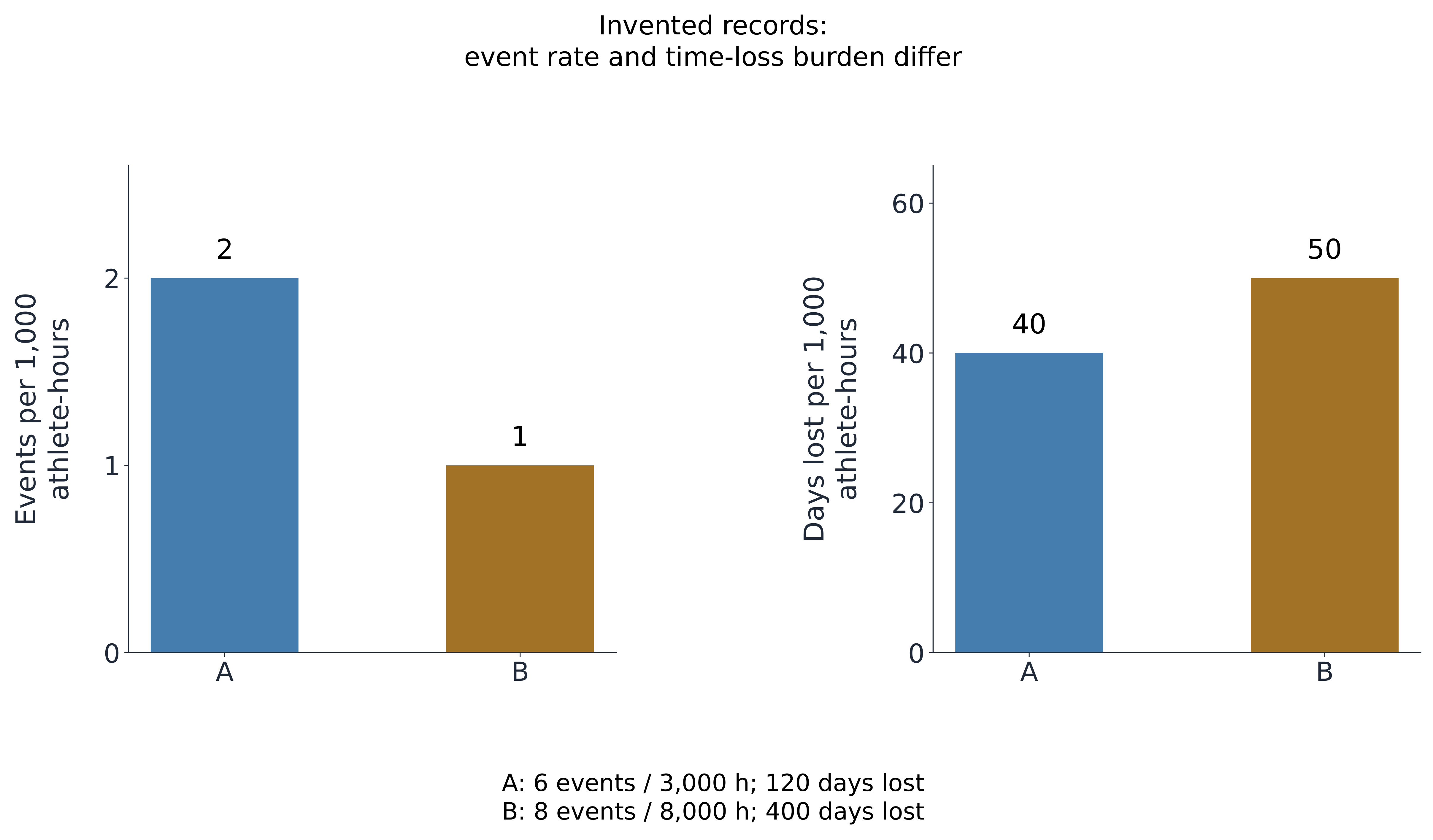
In the original comparison, group A records 6 injuries over 3,000 athlete-hours: $6/3000\times1000=2$ per 1,000 athlete-hours. Group B records 8 over 8,000 hours: rate 1 per 1,000. B has more events but a lower recorded rate. A further group with 9 events over 4,500 hours has rate 2. These are rates of recorded events, not percentages of all athletes or predictions that exactly two people will be injured in the next 1,000 hours.
Records: A has 6 events/3,000 hours and 120 days lost; B has 8 events/8,000 hours and 400 days lost. B has the lower event rate but greater days-lost burden per 1,000 hours.
Severity and recurrence matter alongside frequency. If A's injuries produce 120 total days lost, burden is $120/3000\times1000=40$ days per 1,000 athlete-hours. B's 400 days give 50 per 1,000. A lower event rate can therefore coexist with greater time-loss burden. State whether time loss refers to training, competition or both and how overlapping absences are counted. A recurrent injury and continuation or aggravation of an unresolved injury also need consistent definitions.
Three events over 1,000 hours give rate 3; four over 2,000 hours give rate 2. The first group has the higher recorded rate despite fewer events. Small numbers, under-reporting, incomplete exposure and differences in participants or activity limit the comparison. Do not label every individual in the first group “riskier” from a group-level estimate.
Evaluate prevention as a testable, specific intervention
A prevention explanation should connect an intervention to a load, capacity or consequence. A progressive programme can build strength, balance and control appropriate to a task. A warm-up prepares movement and physiological responses. Prehabilitation aims to develop relevant capacity and address vulnerabilities before an injury. Its content should follow the task and the individual rather than a universal routine copied from another sport.
Testing prevention fairlyPrevention either raises capacity or manages load
Flexibility training can increase useful range for particular activities; excessive range without control is not a universal goal. Learn and practise a suitable technique and progress demands appropriately. Developmentally appropriate rules, equipment and activity reduce mismatches between participant capacity and task demands. Rules that limit dangerous contact address a different mechanism from a balance exercise: both can be relevant without being interchangeable.
Protective equipment should fit the user and the sport, be maintained and meet appropriate standards. Its padding may spread an impact over time or area; its structure may protect a vulnerable region. Anthropometry helps match dimensions and adjustment ranges. A helmet can reduce particular serious head-injury risks, but no helmet is concussion-proof, as the CDC helmet guidance explains. Equipment does not replace safe rules, coaching and recognition of injury.
Surface and footwear should be considered together. Greater traction can support acceleration but can also change joint loading during turns; simply maximizing friction is not a complete safety policy. Weather, visibility, space, fatigue, communication and accessible facilities affect the setting in which a technique is performed. Explain which risk a proposal addresses and what evidence would show that it helped.
A before/after comparison needs comparable exposure, participants, task, recording and time of season. Improved reporting can make recorded injury rates rise even if care and prevention improve. Where appropriate, compare groups receiving a defined intervention with comparable controls, allocate at the appropriate level, and report adherence and missing data. A large relative change based on a few events remains uncertain. A null or mixed result should lead to evaluating the intervention and measurement, not concealing unwanted records.
6.6
Treatment balances protection, healing and restoration of function
Inflammation is part of the response to tissue damage. Changes in blood flow, vascular permeability and immune activity help organize defence, removal of damaged material and repair. Swelling, heat and pain can accompany it, but inflammation is not simply a useless error to eliminate at any cost. Treatment may aim to reduce excessive symptoms while protecting the tissue and supporting repair.
Tissue heals in overlapping phases over weeks to months, and strength returns only gradually, so loading has to follow the phase
The syllabus names compression, elevation, ice and non-steroidal anti-inflammatory drugs, or NSAIDs, as approaches used to manage inflammation or symptoms. Their suitability depends on the injury, timing and individual circumstances. Ice may reduce pain without proving that tissue repair is faster; inappropriate application can harm skin. Compression and elevation are not substitutes for assessment of a serious injury. NSAIDs have potential adverse effects and are not suitable for everyone; medication decisions belong with qualified health professionals, not a classroom calculation or a teammate's recommendation. No doses or treatment prescriptions are inferred from these examples.
A severe fracture or complete tear may require surgical repair, depending on the structures, stability, demands and assessment. Not every injury requires surgery. After initial protection and assessment, rehabilitation can progressively restore range, strength, control and task capacity. Therapeutic modalities may assist particular goals, but the use of a device or treatment name is not itself evidence of benefit. Distinguish symptom relief, tissue healing and readiness for the demands of sport.
A person may feel less pain before full load capacity has returned. Qualified practitioners consider findings over time, activity demands and individual circumstances. A safe return is a managed process with review points, not simply the end of an arbitrary number of days. Students can evaluate rehabilitation evidence without offering a diagnosis or clearance.
6.7
Concussion needs recognition, assessment and staged return
After a suspected concussion, remove the athlete from the activity and arrange appropriate medical assessment. Do not return them to sport the same day or let a classmate decide that they are “fine” because they can answer a question. Worsening headache, repeated vomiting, seizures, increasing drowsiness or new weakness after an impact are examples of danger signs needing urgent emergency assessment. The CDC response guidance distinguishes initial recognition from clinical diagnosis and clearance.
Heading the ball: repeated head impacts are one exposure that concussion surveillance has to count
Recovery can vary between people and can fluctuate. Complete isolation in a dark room until every symptom disappears is not the general recovery model. Current guidance uses a short initial period of relative rest, commonly the first 24–48 hours, with suitable daily activity and later increases in demand directed by clinical advice. Relative rest reduces excessive demands; it does not mean that all movement or all thinking must stop. The Amsterdam concussion consensus distinguishes early symptom-limited activity from later stages involving risk of contact or falling.
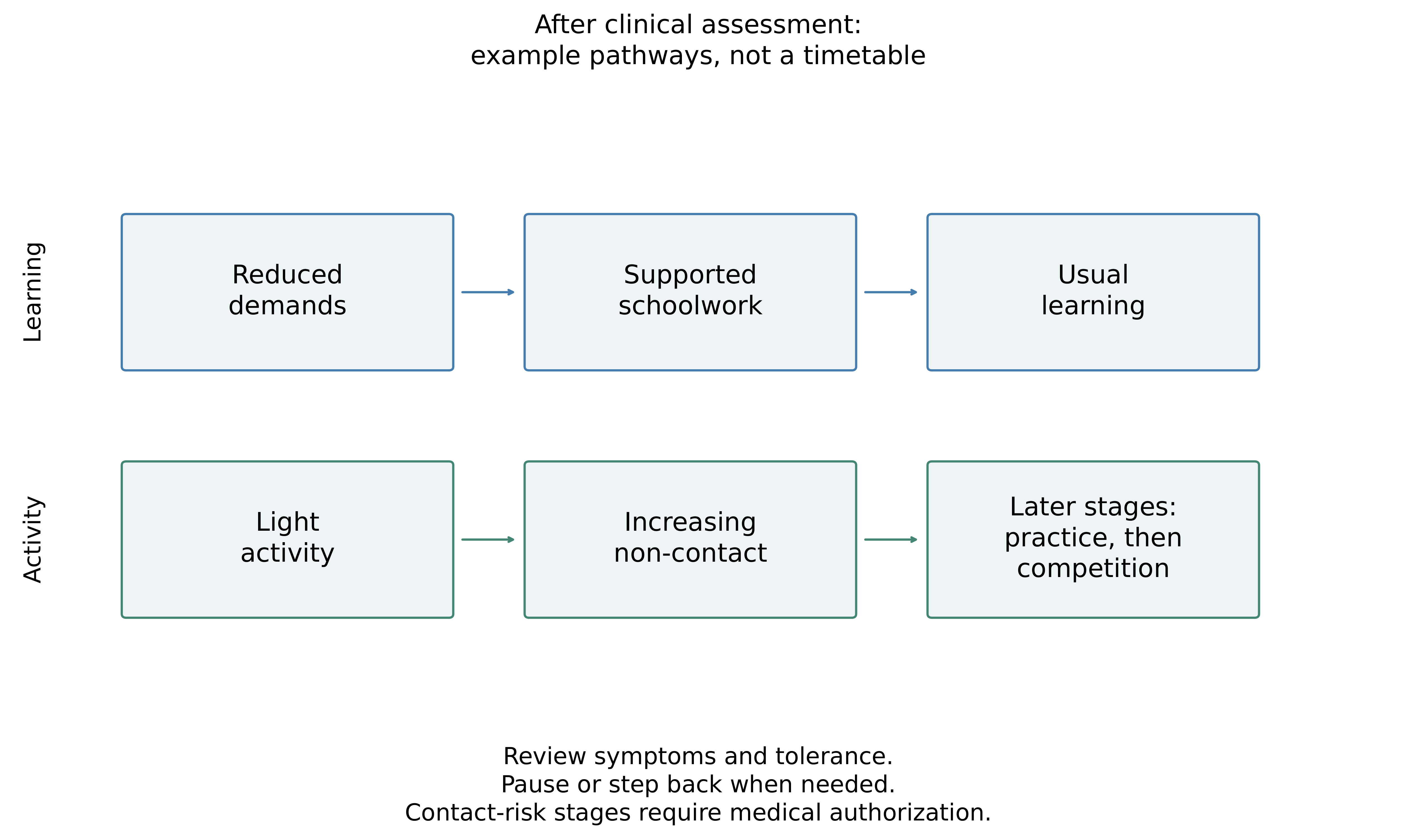
Learning and physical activity need coordinated support. Many students can return to school relatively early with adjustments such as breaks, shorter tasks, reduced screen demands or more time for work, according to their needs and medical advice. A return to lessons with support does not imply readiness for contact sport. Symptom changes, attendance and task tolerance help guide review; they are not a schoolmate-administered diagnostic score.
Learning support and physical progression can overlap. Medical review and symptom response guide changes; reaching one box does not automatically clear a person for contact.
A return-to-sport progression typically moves from ordinary activity through increasing aerobic and sport-specific non-contact demands to appropriate supervised practice and competition. The CDC six-step framework starts with return to regular activities, then light aerobic, moderate, heavy non-contact, practice/full contact where appropriate, and competition. The process needs healthcare-provider approval and supervision, and ordinary non-sport activities should be restored without injury-related supports before full sporting return. Each stage usually takes at least 24 hours; this is not a six-day recovery promise. Symptoms or clinical findings can require pausing or stepping back, and later contact-risk activity needs appropriate medical authorization.
Consider a follow-up record with symptom ratings 3, 2, 3, 1 and 0 on successive observations using one consistent scale. The temporary rise shows why recovery is not necessarily linear. State what was measured, under which conditions, and what further assessment is needed. An athlete's wish to compete and an upcoming final do not replace the staged clinical process.
6.8
Practice
Distinguish a risk factor from an injury mechanism. Give two internal and two external factors in a plausible sporting example, explaining their interaction.
Compare acute trauma and cumulative trauma. Explain why sudden symptom onset does not prove that all preceding loading was acute.
Classify ligament sprain, muscle strain, acute fracture, bone stress injury and skin abrasion by tissue and possible loading history. Explain why a whole-body net force is not one ligament's force.
Ten participants each complete six 1.5-hour sessions. Find athlete-hours. Eight new injuries occur over 4,000 athlete-hours: calculate rate per 1,000 and explain why it is not a percentage of participants.
A has 6 injuries/3,000 athlete-hours; B has 8/8,000. Compare counts and rates. A loses 120 days, B 400: calculate days-lost burdens and explain the different ranking.
A group records 9 injuries/4,500 athlete-hours. Another records 3/1,000 and a third 4/2,000. Calculate rates and give three reasons why these estimates cannot establish one individual's future risk.
Connect warm-up, strength/control work, suitable flexibility, equipment fit and developmentally appropriate rules to different prevention mechanisms. Explain why no helmet is concussion-proof.
Explain how a prevention study's case definition, exposure recording, reporting changes and adherence can affect its conclusion. Does fewer recorded injuries prove success?
Explain inflammation's roles and why symptom relief, healing and sporting readiness are different. Discuss why ice, compression, elevation, NSAIDs or surgery cannot be selected from an injury label alone.
Explain why concussion can occur without a direct head blow or loss of consciousness. What should happen after a suspected concussion, and why is one normal scan or one good answer insufficient clearance?
A symptom series is 3, 2, 3, 1, 0. Explain the evidence for non-linear recovery, the limits of the final zero, relative rest, school support and staged return to sport.
6.9
Worked answers
Risk factors concern outcome probability; mechanisms explain damaging loading. Previous ankle injury/reduced control can interact with uneven ground and abrupt training increases. This suggests hypotheses, not inevitability or diagnosis.
Acute trauma follows a sudden event; cumulative trauma reflects repeated loading exceeding recovery/adaptation. Accumulated damage can become symptomatic suddenly, so symptom timing alone cannot establish the preceding history.
Sprain: ligament; strain: muscle/tendon; fracture/stress injury: bone; abrasion: skin. Acute force and repeated loading can affect different tissues. Whole-body force does not specify internal geometry or tissue-load distribution.
Exposure $10(6)(1.5)=90$ athlete-hours. Rate $8/4000\times1000=2$ per 1,000 athlete-hours. The denominator is exposure time, not number of people; one person can contribute many hours and potentially more than one event.
A: 6 events and rate 2; B: 8 and rate 1 per 1,000 hours. Burdens: A $120/3000\times1000=40$; B $400/8000\times1000=50$ days per 1,000 hours. B has lower event frequency per exposure but greater recorded time-loss burden.
Rates are $9/4500\times1000=2$, $3/1000\times1000=3$ and $4/2000\times1000=2$. Small event counts, under-reporting, different activities/participants and exposure error limit comparisons. A group rate does not determine an individual's future outcome.
Warm-up prepares responses; strength/control improves capacity; flexibility targets useful range; fitted equipment addresses particular impacts/constraints; rules reduce inappropriate demands. No helmet removes every transmitted brain force; equipment supplements other protections.
Definitions alter event counts; exposure recording alters denominators; reporting changes affect ascertainment; adherence affects the intervention received. Fewer events need not mean lower risk. Comparable controls and consistent methods strengthen inference.
Inflammation supports defence and repair. Less pain does not establish restored capacity. Injury location, severity, timing and individual circumstances guide treatment; medicines carry risks and some severe tears/fractures need repair. Class records cannot supply prescriptions or clearance.
Body impacts can transmit head forces; loss of consciousness is not required. Remove from activity, arrange assessment and no same-day sporting return; danger signs need urgent assessment. A normal routine scan or one correct answer cannot establish normal function or exertional tolerance.
The rise 2→3 breaks a decreasing trend. Final zero is one condition-specific measure, not contact clearance. Relative rest initially reduces excessive demands; learning can resume with support. Clinically guided physical progression needs review, authorization for contact-risk stages and possible pauses or setbacks.
6.10
Exam tips and common mistakes
Define the injury, denominator and outcome. Distinguish counts, exposure rates, participant percentages and time-loss burden; give units and comparison conditions. Test prevention claims against alternative explanations.
Separate loading history from tissue type, protection from zero risk, and symptom relief from healing/readiness. Concussion recovery needs staged clinical review; a class table or video cannot provide diagnosis or clearance.
More topics in IB Sports, Exercise and Health Science SL