This handout teaches C.3 Wave phenomena in full, for the course first assessed in 2025, but HL students must also study the sections marked AHL: single-slit diffraction, the single-slit envelope on double-slit fringes, and multiple slits and diffraction gratings.
Prerequisites: wavelength, frequency, wave speed and $v = f\lambda$ from C.2; phase and phase difference from C.1; sine and inverse sine. Use $c = 3.00 \times 10^8\ \text{m s}^{-1}$.
13.2
Wavefronts and rays
Why can you hear someone round a corner but not see them?
Stand outside an open door and you can hear a conversation in the room, even when nobody is in your line of sight. Sound waves bend round the edges of the doorway; light waves hardly do. The same wave model explains this, along with mirrors, lenses, rainbows, optical fibres that carry the internet under the oceans, and the coloured bands on a CD. This unit follows waves as they meet boundaries, pass through gaps and overlap each other.
Describing waves in two and three dimensions
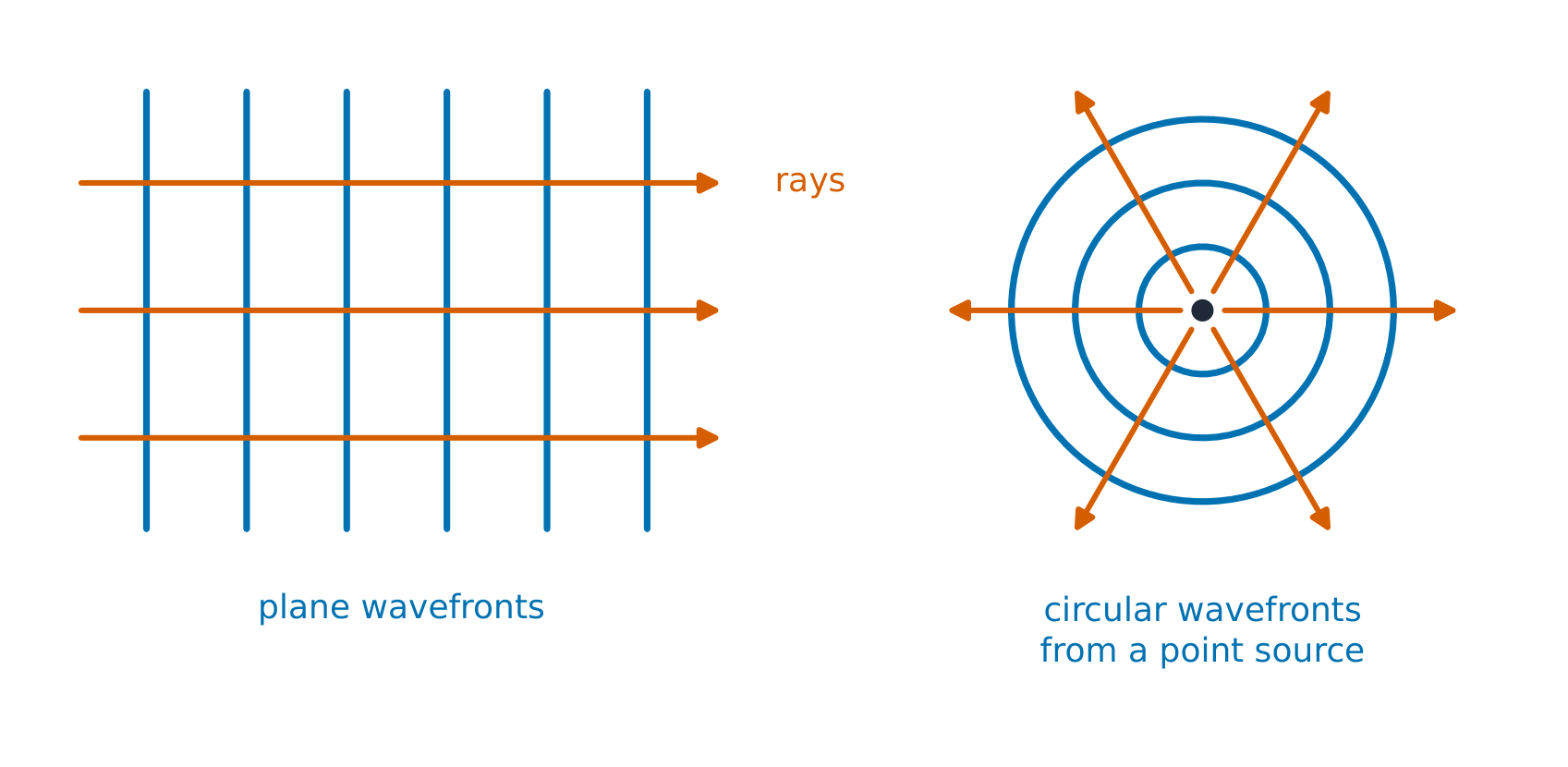
A wavefront 波前 is a line (or surface) joining points that are in phase, for example all the points on one crest. A ray 波线 is a line showing the direction in which the wave travels; it is perpendicular to wavefronts in the ordinary isotropic wave model used here. The distance between neighbouring wavefronts drawn on crests is one wavelength.
Rays are perpendicular to wavefronts in the isotropic model
Far from a source, or from a long straight source, the wavefronts are straight: these are plane waves.
Near a small source the wavefronts are circles (in two dimensions) or spheres (in three), and the rays spread out radially.
When a wave reaches a boundary 界面 between two media, three things can happen, usually all at once:
Plane waves in a ripple tank reflect off a straight barrier: the reflected wavefronts leave at the same angle they arrivedRefraction towards the normal entering glass; total internal reflection beyond the critical angle.
Reflection 反射: part of the wave bounces back into the first medium. The angle of incidence equals the angle of reflection, both measured from the normal 法线, the line at right angles to the boundary.
Transmission 透射: part of the wave passes into the second medium.
Refraction 折射: the transmitted wave changes speed and, unless it meets the boundary along the normal, changes direction.
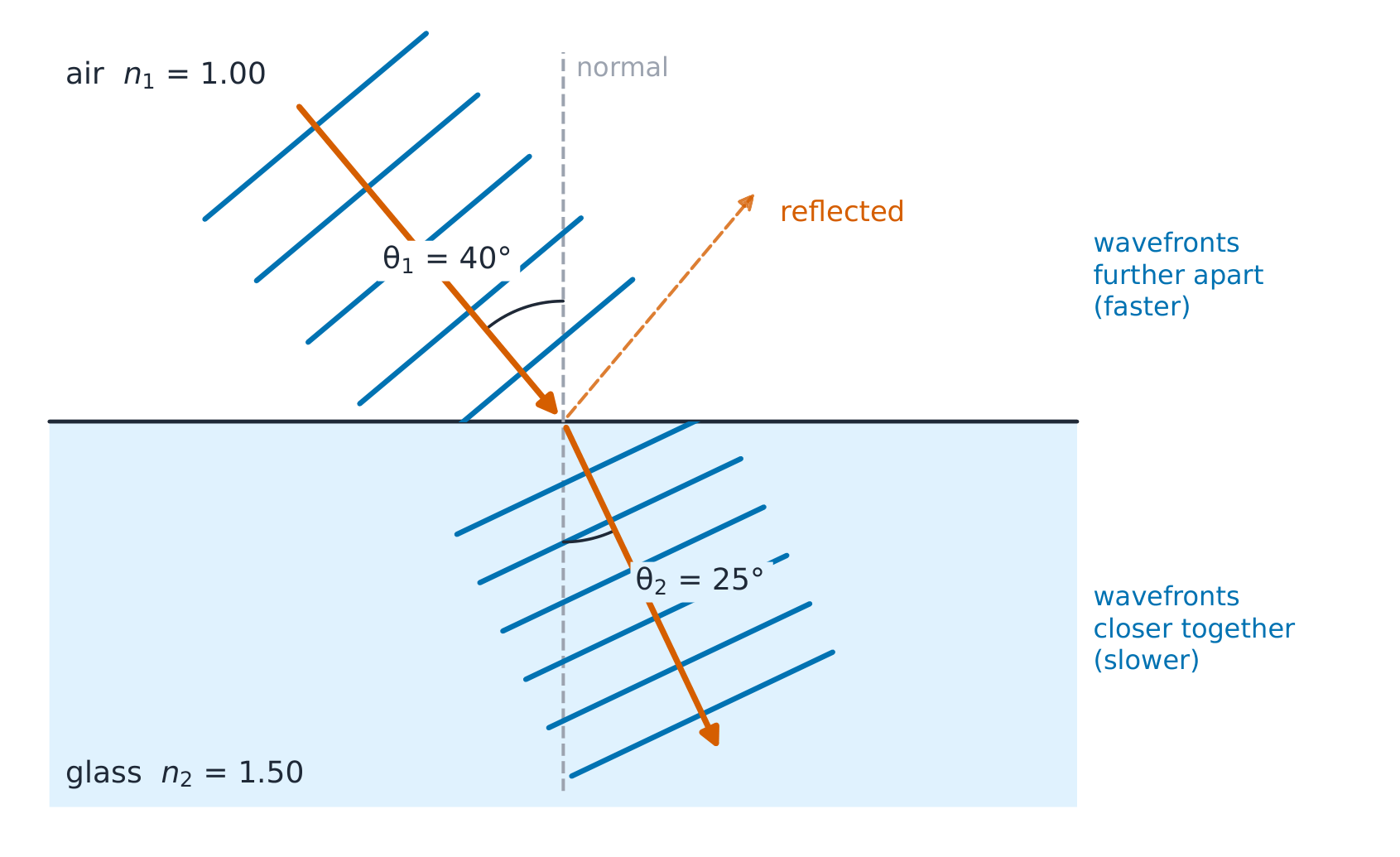
At a stationary boundary in this linear model, frequency remains fixed by the source. If the wave slows down, the wavelength gets shorter, so the wavefronts crowd closer together. The end of each wavefront that enters the slow medium first slows first, so the wavefront swings round and the ray bends towards the normal. A wave that speeds up bends away from the normal.
Slower in glass: shorter wavelength, and the ray bends towards the normal
Water waves show the same thing: they slow down in shallow water, so waves approaching a beach at an angle swing round until their crests are almost parallel to the shore.
In the lab: place a glass block on paper, trace its outline and send a narrow ray-box beam into one face. Mark the incident and refracted paths, then draw the normal at the entry point. Measure both angles from this normal, repeat for several incident angles and compare $\sin\theta_1/\sin\theta_2$. Keep the beam away from eyes. In a ripple-tank image, measure across several complete wavelengths and divide by their number to reduce fractional reading uncertainty; compare wavelengths on each side of the boundary while the source frequency stays fixed.
The refractive index 折射率$n$ of a medium compares the speed of light in a vacuum with its speed $v$ in the medium: $n = c/v$. Air has $n = 1.00$, water 1.33, glass about 1.50 and diamond 2.42. Light in water travels at $3.00 \times 10^8/1.33 = 2.26 \times 10^8\ \text{m s}^{-1}$.
Snell's law 斯涅尔定律 links the angles, measured from the normal:
which is often written as $n_1\sin\theta_1 = n_2\sin\theta_2$. A larger refractive index means a slower speed and a smaller angle to the normal.
Worked examples:
Light passes from air into glass at 40°: $\sin\theta_2 = 1.00 \times \sin 40°/1.50 = 0.429$, so $\theta_2 = 25°$.
Light passes from water into glass at 50°: $\sin\theta_2 = 1.33 \sin 50°/1.50 = 0.679$, so $\theta_2 = 43°$. It still bends towards the normal, but less, because the speeds are closer.
A ray in air at 30° to the normal refracts to 19.5° in a plastic block: $n = \sin 30°/\sin 19.5° = 1.50$.
The same refraction relationship applies to the ordinary sound and water-wave models used here. For sound or water waves, use the ratio of speeds $v_2/v_1$.
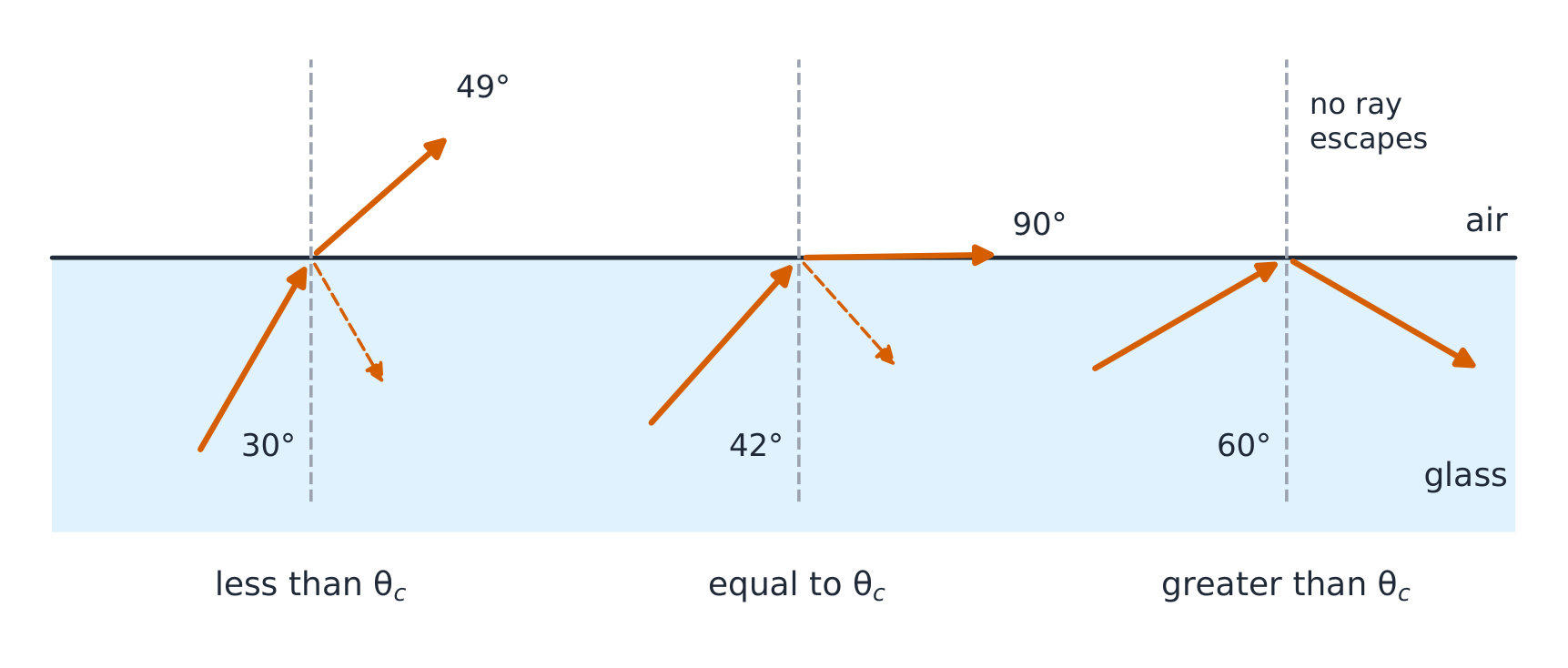
When light travels from a slower medium into a faster one (glass into air, for example) it bends away from the normal. As the angle of incidence increases, the refracted ray gets closer to the boundary. At the critical angle 临界角$\theta_c$ the refracted ray travels along the boundary, at 90° to the normal. For larger angles no light escapes: all of it is reflected back. This is total internal reflection 全内反射.
Below, at and above the critical angle for glass of refractive index 1.50
Setting $\theta_2 = 90°$ in Snell's law gives:
$$\sin\theta_c = \frac{n_2}{n_1}$$
for light going from medium 1 into medium 2 with $n_1 > n_2$. Two conditions are needed for total internal reflection: the light must be travelling into a medium with a lower refractive index, and the angle of incidence must be greater than the critical angle.
Glass to air: $\sin\theta_c = 1/1.50$, so $\theta_c = 42°$.
Water to air: $\theta_c = 49°$. Diamond to air: $\theta_c = 24°$, so light is trapped and reflected many times inside a cut diamond, which makes it sparkle.
An optical fibre 光纤 has a glass core ($n = 1.48$) inside a cladding ($n = 1.46$). The critical angle at the core edge is $\sin^{-1}(1.46/1.48) = 81°$, so light that travels nearly along the fibre is totally internally reflected again and again, carrying signals for many kilometres.
Light that meets the core edge above the critical angle is trapped in the core (angles not to scale)
total internal reflection/ˈtəʊtl ɪnˈtɜːnl rɪˈflekʃn/
optical fibre/ˈɒptɪkl ˈfaɪbə/
13.6
Diffraction
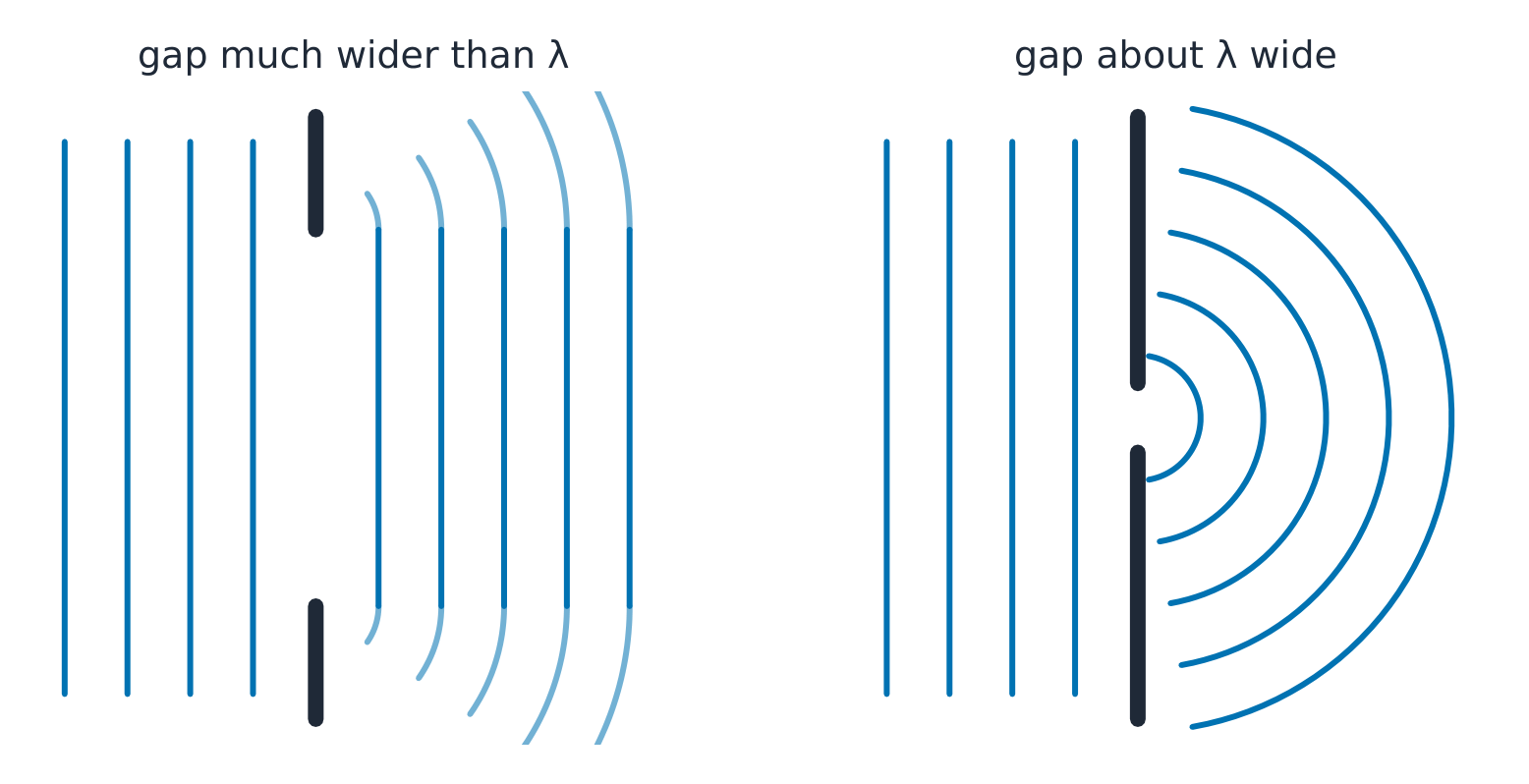
Diffraction 衍射 is the spreading of a wave as it passes through a gap (an aperture 孔径) or round the edge of an obstacle. Diffraction does not change the wavelength, the frequency or the speed.
Diffraction is strong when the gap is comparable to the wavelength or smaller
The spreading is significant when the gap or obstacle is about the same size as the wavelength, or smaller.
A gap much wider than the wavelength lets the wave through with little spreading.
This is why you can hear round a door but not see round it. Speech has wavelengths of about 1 m, similar to a doorway, so it diffracts strongly. Light has wavelengths of about $5 \times 10^{-7}\ \text{m}$, a million times smaller than the doorway, so its diffraction is too small to notice. Longer radio wavelengths can diffract more broadly around a hill than much shorter wavelengths. Actual reception also depends on source power, terrain and other propagation effects; diffraction alone does not guarantee reception.
In the linear wave model, when two waves meet, the resultant displacement at each point is the sum of the displacements of the individual waves. This is the principle of superposition 叠加原理. After they have passed through each other, each wave continues as if the other had never been there.
Two waves arriving exactly out of phase cancel to zero (destructive)Two waves arriving in phase add to give double the amplitude (constructive)
Two wave pulses 脉冲 that meet crest-to-crest add up to a pulse twice as tall for an instant.
A crest meeting an equal trough cancels it for an instant: the string is momentarily flat.
Add the displacements with their signs. A displacement of +3 mm and one of −1 mm give +2 mm.
principle of superposition/ˈprɪnsɪpl ɒv ˌsuːpəpəˈzɪʃn/
pulse/pʌls/
13.8
Interference
Coherent sources
When waves from two sources overlap, they can produce interference 干涉. With coherent sources this can give a steady pattern of maxima and minima. A steady pattern needs coherent 相干的 sources: sources with the same frequency and a constant phase difference. Two loudspeakers driven by the same signal generator are coherent. Two separate light bulbs are not, because each emits light in short random bursts, so their phase difference keeps changing. That is why light from one source is split into two, using two slits.
The same effect in a real ripple tank — two coherent sources give a steady interference patternTwo coherent sources give lines of maximum displacement where crests meet crests
Path difference
Each point in the pattern is a distance $r_1$ from one source and $r_2$ from the other. The path difference 程差 is $|r_1 - r_2|$. For two sources in phase:
What happens at Z depends on the path difference XZ − YZ, measured in wavelengths
Path difference
Waves arrive
Result
$n\lambda$ (0, λ, 2λ, …)
in phase, crest on crest
constructive interference 相长干涉: maximum amplitude
$(n + \tfrac{1}{2})\lambda$ (λ/2, 3λ/2, …)
in antiphase, crest on trough
destructive interference 相消干涉: minimum amplitude
where $n$ is a whole number. Worked example: two speakers emit sound in phase with $\lambda = 0.50\ \text{m}$. A listener 4.0 m from one speaker and 5.0 m from the other has a path difference of 1.0 m $= 2\lambda$: a loud point. At 4.0 m and 4.75 m, the path difference is 0.75 m $= 1.5\lambda$: a quiet point.
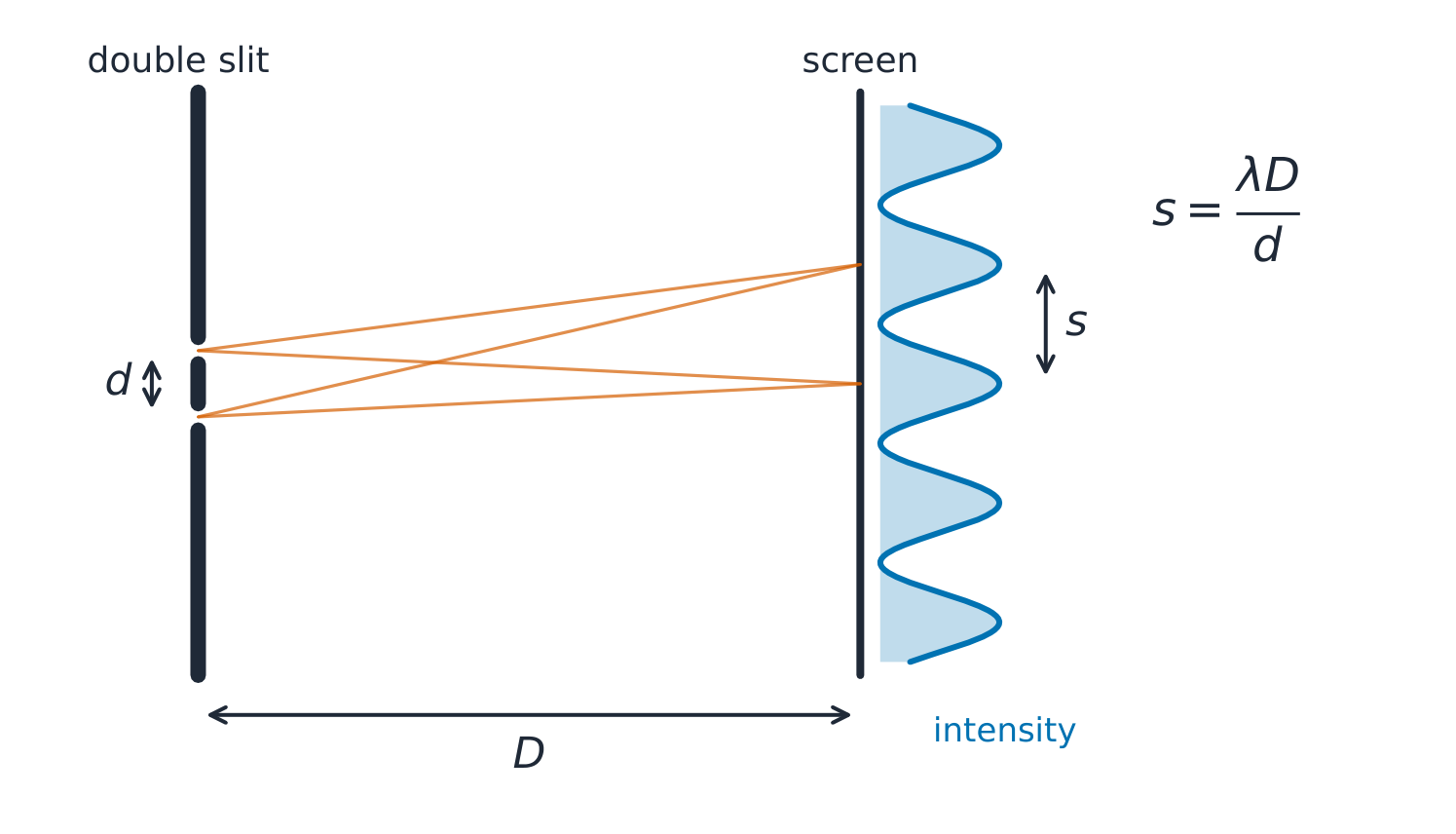
In Young's double-slit arrangement, coherent monochromatic light illuminates two narrow, closely spaced slits. The light diffracts at each slit, the two diffracted waves overlap, and a pattern of equally spaced bright and dark fringes 条纹 appears on a screen. This interference was strong evidence that light is a wave.
Young's double slit: bright fringes where the path difference is a whole number of wavelengths
The fringe separation 条纹间距$s$, the distance between the centres of neighbouring bright fringes, is:
$$s = \frac{\lambda D}{d}$$
where $d$ is the slit separation and $D$ is the distance from the slits to the screen ($D$ is much larger than $d$, and the observed angles are small).
The central bright fringe is where the path difference is zero.
Longer wavelength (red light), a more distant screen or closer slits all give more widely spaced fringes.
Worked example: a 633 nm laser shines on slits 0.50 mm apart, with a screen 2.0 m away. $s = \frac{633 \times 10^{-9} \times 2.0}{0.50 \times 10^{-3}} = 2.5 \times 10^{-3}\ \text{m}$ (2.5 mm). To measure $s$ accurately, measure across several fringes and divide: 10 fringe spacings span 25 mm.
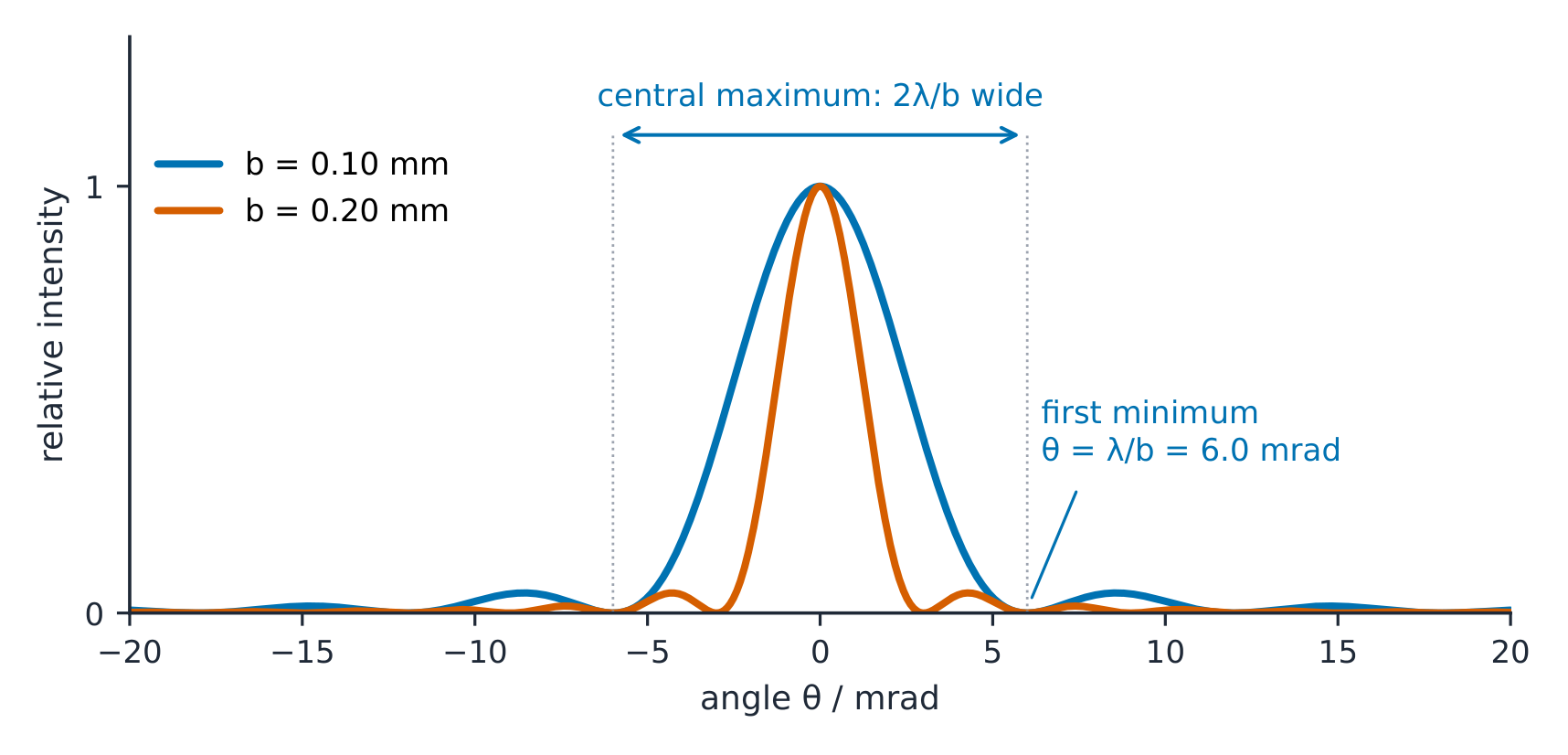
Light passing through a single slit of width $b$ also makes a pattern: a bright, wide central maximum with much fainter maxima on each side. Waves from different parts of the same slit interfere. The first minimum is at the angle:
$$\theta = \frac{\lambda}{b}$$
with $\theta$ in radians (the angle is small).
A narrower slit gives a wider central maximum; the plotted peaks are independently normalized
The central maximum is twice as wide as each side maximum: it runs from $-\lambda/b$ to $+\lambda/b$.
A narrower slit spreads the light more: the central maximum gets wider and dimmer, because less light gets through.
A wider slit gives a narrower, brighter central maximum.
A longer wavelength gives a wider pattern.
Worked example: 600 nm light through a 0.10 mm slit gives $\theta = \frac{600 \times 10^{-9}}{1.0 \times 10^{-4}} = 6.0 \times 10^{-3}\ \text{rad}$. On a screen 2.0 m away the first minima are $2.0 \times 6.0 \times 10^{-3} = 12\ \text{mm}$ from the centre, so the central maximum is 24 mm wide.
13.11
AHL: The double-slit pattern and its envelope
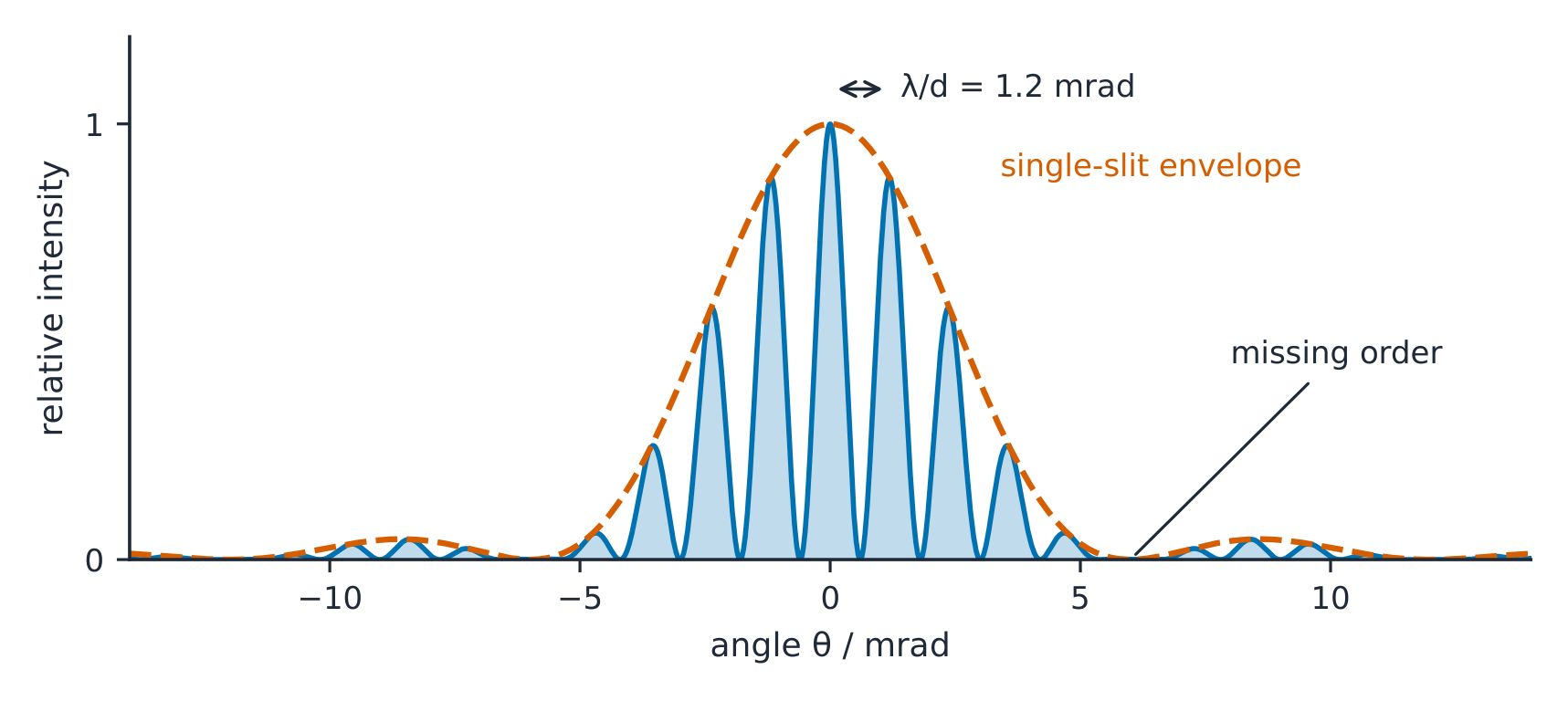
Finite slit width gives a single-slit diffraction envelope 包络线 that modulates 调制 the double-slit fringes. This describes relative intensity versus angle; absolute peak height also depends on coherent addition and illumination.
Fine fringes (set by d) under a wide envelope (set by b)
The fringe spacing is set by the slit separation$d$: angle $\lambda/d$.
The envelope is set by the slit width$b$: zero at $\lambda/b$.
Where a bright fringe falls at a minimum of the envelope, it is missing.
Worked example: with $\lambda = 600\ \text{nm}$, $d = 0.50\ \text{mm}$ and $b = 0.10\ \text{mm}$, the fringes are $1.2 \times 10^{-3}\ \text{rad}$ apart and the envelope reaches zero at $6.0 \times 10^{-3}\ \text{rad}$, exactly five fringe spacings. So the central maximum of the envelope holds 9 bright fringes (orders 0, ±1, ±2, ±3, ±4), and order 5 is missing.
Explore
Slit width sets the envelope; separation sets fine fringes
Widening a slit narrows its diffraction pattern; two finite-width slits add fine fringes under that envelope.
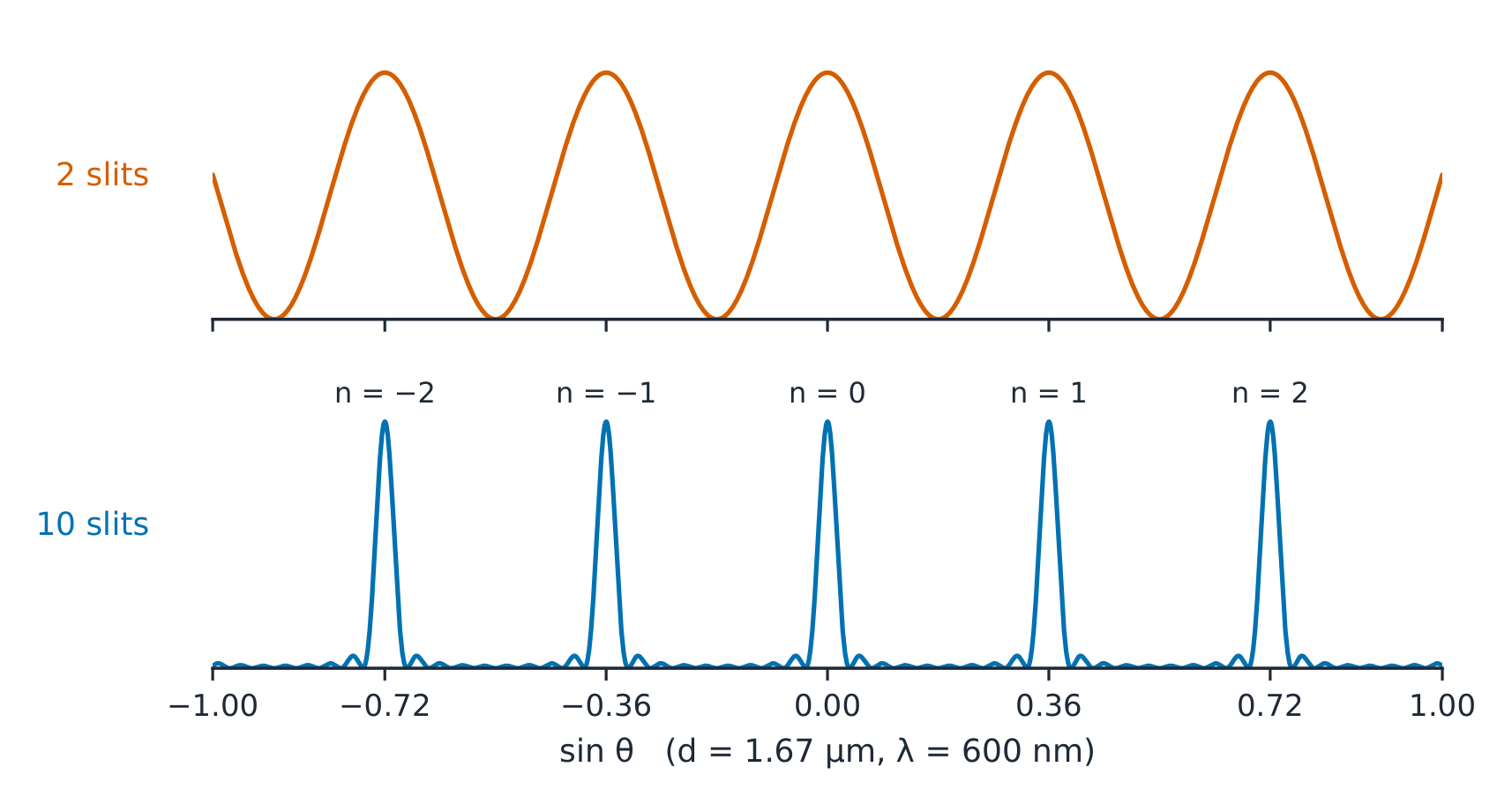
A diffraction grating 衍射光栅 has a very large number of equally spaced slits, often hundreds per millimetre. The bright maxima are at the angles where waves from neighbouring slits have a path difference of a whole number of wavelengths:
$$n\lambda = d\sin\theta$$
where $d$ is the slit spacing and $n$ is the order of the maximum.
A diffraction grating splits monochromatic light into sharp maxima on a screenThe normalized patterns show sharper principal maxima at the same angles; they do not compare absolute brightness
With more slits, the principal maxima stay at the same angles but become much sharper and, with unchanged illumination per slit, brighter, with almost total darkness between them. This lets a grating measure wavelengths very precisely.
The angles are large, so use $\sin\theta$, not the small-angle approximation.
$\sin\theta$ cannot exceed 1, so the highest possible order is the largest whole number $n \le d/\lambda$.
Worked example: a grating has 600 lines per mm, so $d = 1/600\ \text{mm} = 1.67 \times 10^{-6}\ \text{m}$. For 600 nm light:
second order: $\sin\theta = 0.72$, $\theta = 46°$;
third order would need $\sin\theta = 1.08$, which is impossible, so only orders 0, 1 and 2 appear on each side.
White light and spectra
With white light, every wavelength makes its own maxima. The zero order is white, because all wavelengths have zero path difference there. In each other order the light is spread into a spectrum 光谱, violet (shortest wavelength, smallest angle) nearest the centre and red furthest out.
Refraction bends each colour by a different amount, so a prism spreads white light into a rainbow
For the 600 lines per mm grating:
Order
Violet, 400 nm
Red, 700 nm
1
14°
25°
2
29°
57°
3
46°
not formed
The second- and third-order spectra overlap: the third-order violet (46°) appears inside the second-order spectrum, which runs to 57°. Higher orders are spread out more widely, so they separate close wavelengths better, but they overlap more.
Explore
Which diffraction orders can exist?
Wavelength and slit spacing set the angles; a required sine above one rules an order out.
Draw a wavefront–ray diagram for plane waves entering a medium where they travel more slowly, at an angle to the boundary. Label the normal and show how the wavelength changes.
Light enters glass ($n = 1.50$) from air at an angle of incidence of 55°. Find the angle of refraction and the speed of light in the glass.
A ray in air at 30.0° to the normal is refracted to 22.0° in a liquid. Find the refractive index of the liquid.
Find the critical angle for light going from water ($n = 1.33$) into air, and state the two conditions for total internal reflection.
Explain why an optical fibre can carry light round gentle bends.
In a diffraction-only model, a hill has a characteristic size comparable to 1500 m. Compare spreading of waves of wavelength 1500 m and 3 m around it.
Two pulses travel towards each other on a rope: one is a crest of height 4 mm, the other a trough of depth 4 mm. Describe the rope when they overlap exactly, and after they have passed.
Two loudspeakers in phase emit sound of wavelength 0.40 m. Point P is 3.0 m from one and 3.6 m from the other. State and explain whether P is loud or quiet.
Explain why two car headlamps do not produce an interference pattern.
In a double-slit experiment, fringes are 1.8 mm apart on a screen 1.5 m from slits 0.40 mm apart. Find the wavelength. State the effect on the fringes of moving the screen to 3.0 m.
HL. Light of wavelength 500 nm passes through a slit 0.050 mm wide. Find the angle to the first minimum and the width of the central maximum on a screen 1.2 m away.
HL. In a double-slit experiment the slits are 0.30 mm apart and 0.060 mm wide. Which order of bright fringe is missing? How many bright fringes are inside the central envelope?
HL. A grating with 300 lines per mm gives a second-order maximum at 20.0°. Find the wavelength, and the highest order that can be seen.
HL. Describe how the pattern from a diffraction grating differs from a double-slit pattern with the same slit spacing, and describe what is seen when white light is used.
Answers.
Wavefronts get closer together in the slow medium (shorter wavelength); the ray bends towards the normal; the frequency is unchanged.
$\sin\theta_c = 1/1.33$, so $\theta_c = 49°$. TIR needs a lower destination index and incidence greater than $\theta_c$.
Light meets the core–cladding boundary at angles greater than the critical angle, so it is totally internally reflected each time and stays inside the core.
The 1500 m waves diffract broadly round the comparable-sized hill; the 3 m waves spread less. Diffraction alone does not guarantee reception.
When they overlap, the displacements cancel and the rope is momentarily flat. Afterwards both pulses continue unchanged.
Path difference $= 0.6\ \text{m} = 1.5\lambda$, a half-integer number of wavelengths: the waves arrive in antiphase, so P is quiet.
The lamps are not coherent: their changing phase difference prevents a steady pattern.
$\lambda = sd/D = 1.8 \times 10^{-3} \times 0.40 \times 10^{-3}/1.5 = 4.8 \times 10^{-7}\ \text{m}$ (480 nm). Doubling $D$ doubles the fringe separation, to 3.6 mm.
HL.$\theta = \frac{500 \times 10^{-9}}{5.0 \times 10^{-5}} = 0.010\ \text{rad}$. First minimum $1.2 \times 0.010 = 12\ \text{mm}$ from the centre, so the central maximum is 24 mm wide.
HL.$d/b = 5$: the envelope reaches zero at five fringe spacings, so order 5 is missing; 9 bright fringes (orders 0 to ±4) lie inside the central envelope.
HL.$d = 1/300\ \text{mm} = 3.33 \times 10^{-6}\ \text{m}$; $\lambda = d\sin 20.0°/2 = 5.7 \times 10^{-7}\ \text{m}$ (570 nm). $d/\lambda = 5.8$, so the highest order is 5.
HL. At fixed slit spacing, principal maxima keep their angles and narrow; fixed illumination per slit makes peaks brighter. White light gives a white zero order and spectra in other orders, violet nearer the centre. Higher orders spread farther and can overlap.
13.14
Exam tips
Measure angles from the normal. Total internal reflection needs a lower destination index and incidence greater than the critical angle.
Use coherent sources and include their initial phase difference. Convert mm and nm to metres before using $s = \lambda D/d$.