A wave can carry energy across water while a floating marker mainly oscillates. Energy transfer and bulk transfer of matter are different.
English narration · English + 中文 subtitles burned in
12.1
Scope and prerequisites
This handout teaches C.2 Wave model in full, for the course first assessed in 2025. There is no additional higher level content in C.2, so SL and HL students study the same material.
Prerequisites: displacement, period, frequency and amplitude from C.1 Simple harmonic motion; speed $= \text{distance}/\text{time}$ from A.1. Use $c = 3.00 \times 10^8\ \text{m s}^{-1}$ for the speed of light in a vacuum and about $340\ \text{m s}^{-1}$ for the speed of sound in air.
12.2
Travelling waves
How does a seismometer 500 km away know where an earthquake was?
Earthquake body waves include longitudinal P-waves and transverse S-waves. In an uniform-rock model, let their speeds be 6.0 and 3.5 km/s. Over a shared 500 km path their arrival-time difference is about 60 s, although the rock does not travel 500 km with the disturbance. The British Geological Survey explains their different motions and the absence of S-wave transmission through the liquid outer core. Real location calculations need an Earth-velocity model and multiple stations, fitting depth and origin time as well as position; see the USGS explanation. The constant speeds here are teaching assumptions, not measured universal speeds.
The P–S lag grows with distance
Energy, not matter
A travelling wave 行波 is a disturbance that moves through a medium (or through space), transferring energy from one place to another. The particles of the medium 介质 oscillate about their equilibrium positions, each one a little later than the one before, but they do not travel with the wave. In the ideal small-amplitude model there is no net transport of medium with the wave. Real water waves can also produce drift, and currents can carry a cork: those effects are not described by the simple oscillation-only model.
Ripples spreading on water are progressive waves that carry energy outward.
Transverse and longitudinal waves
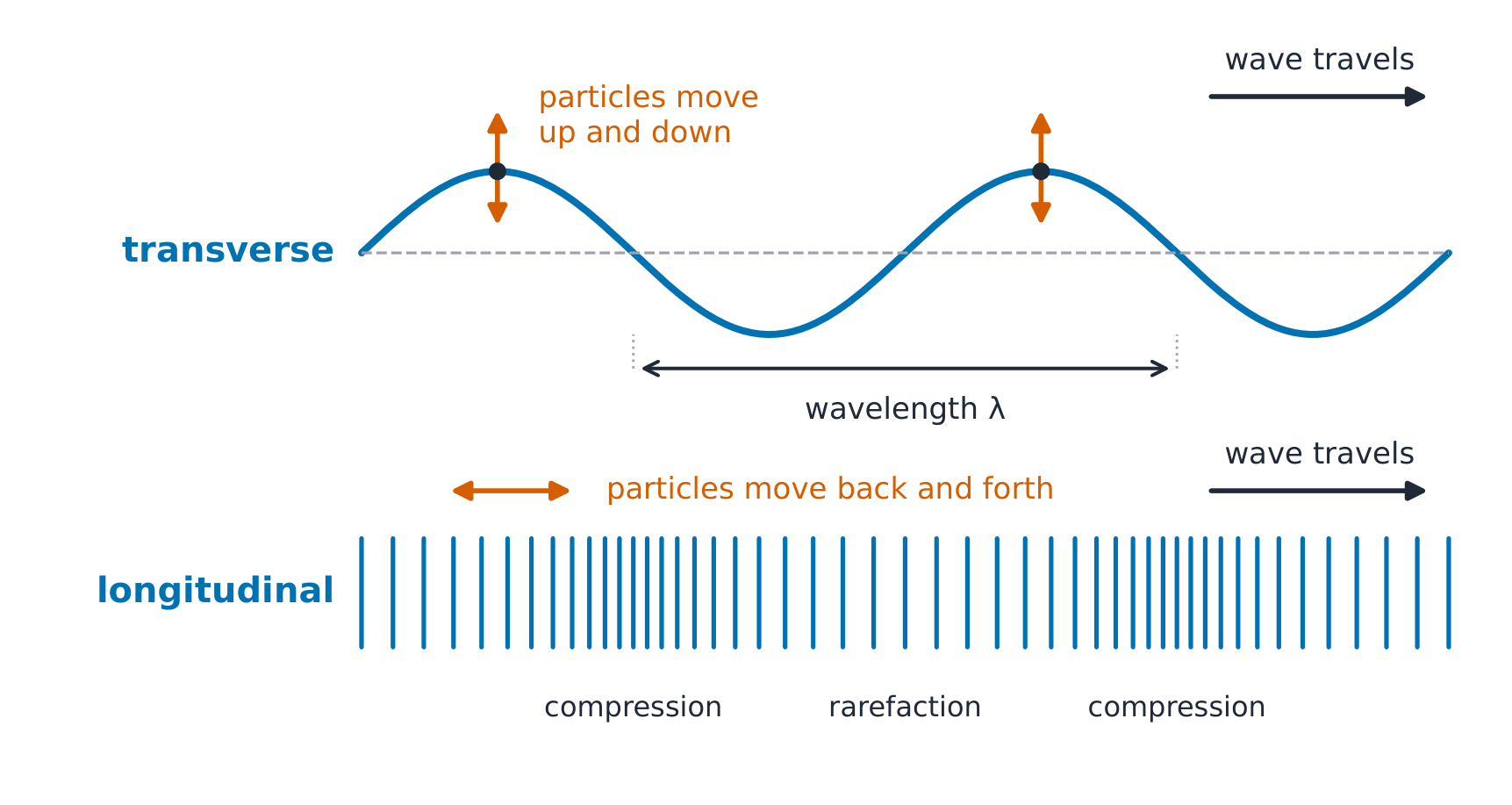
In a transverse wave 横波 the oscillations are perpendicular to the direction in which the wave travels. Examples: waves on a string or rope, S-waves, ripples on water (approximately), and all electromagnetic waves.
In a longitudinal wave 纵波 the particles oscillate parallel to the direction in which the wave travels. Examples: sound, P-waves, and pushes along a stretched spring.
Transverse and longitudinal waves differ in the direction the particles move
A longitudinal wave has regions where the particles are closer together than normal, called compressions 密部, and regions where they are further apart, called rarefactions 疏部. The pressure is higher in a compression and lower in a rarefaction.
distance of a particle from its equilibrium position
m
amplitude
$x_0$
maximum displacement of a particle
m
wavelength
$\lambda$
shortest distance between two particles oscillating in phase
m
period
$T$
time for one particle to make one complete oscillation
s
frequency
$f$
number of oscillations per second
Hz
wave speed
$v$
distance the wave travels per second
m s⁻¹
In one period a crest moves forward one wavelength, so v = λ/T = fλ.
The wavelength 波长 is, for example, the distance from one crest to the next, or from one compression to the next. The wave speed 波速 is the speed at which the energy (and the wave shape) moves, not the speed of the particles.
The wave equation
In one period $T$, each particle makes one oscillation and the wave moves forward by one wavelength. So:
$$v = \frac{\lambda}{T} = f\lambda$$
Worked examples:
A wave on a string has $f = 5.0\ \text{Hz}$ and $\lambda = 0.40\ \text{m}$: $v = 5.0 \times 0.40 = 2.0\ \text{m s}^{-1}$ and $T = 1/5.0 = 0.20\ \text{s}$.
Middle C on a piano is 262 Hz. In air, $\lambda = 340/262 = 1.3\ \text{m}$.
A radio station broadcasts at 100 MHz: $\lambda = \frac{3.00 \times 10^8}{1.00 \times 10^8} = 3.0\ \text{m}$.
Changing the frequency or the medium
The frequency is set by the source. It stays unchanged across a stationary boundary in the linear wave model used here.
The speed depends on the medium and its physical conditions; in dispersive media it also depends on frequency. Sound travels at about 340 m s⁻¹ in air, 1500 m s⁻¹ in water and 5000 m s⁻¹ in steel.
So the wavelength adjusts: $\lambda = v/f$. A 500 Hz sound has $\lambda = 0.68\ \text{m}$ in air but $\lambda = 3.0\ \text{m}$ in water.
In a nondispersive approximation for one medium, speed is fixed and a higher frequency gives a shorter wavelength. Some waves, including many water waves, are dispersive; do not assume fixed speed across every frequency range.
Crossing into a slower medium: the frequency stays the same, so the wavelength shortens.
Worked example: water waves of frequency 4.0 Hz travel at 0.32 m s⁻¹ in deep water ($\lambda = 8.0\ \text{cm}$). In shallow water they slow to 0.20 m s⁻¹; the frequency is still 4.0 Hz, so $\lambda = 0.20/4.0 = 5.0\ \text{cm}$.
In the lab: use a ripple-tank snapshot and a ruler to measure the distance across several complete crest spacings, then divide by the number of spacings to find the wavelength. This reduces the fractional reading uncertainty compared with measuring one spacing. For light, trace a narrow ray-box beam into a glass block, draw the normal at the entry point and measure the incident and refracted angles from it. Keep the beam away from eyes. The ray bends towards the normal when it slows; its frequency stays fixed and its wavelength becomes shorter. C.3 develops this refraction model.
Explore
Same frequency, different wavelength
At 5 Hz, speeds of 2.0 and 1.5 m/s give wavelengths of 0.40 and 0.30 m. Compare linked snapshots across a stationary boundary while keeping the source frequency shared.
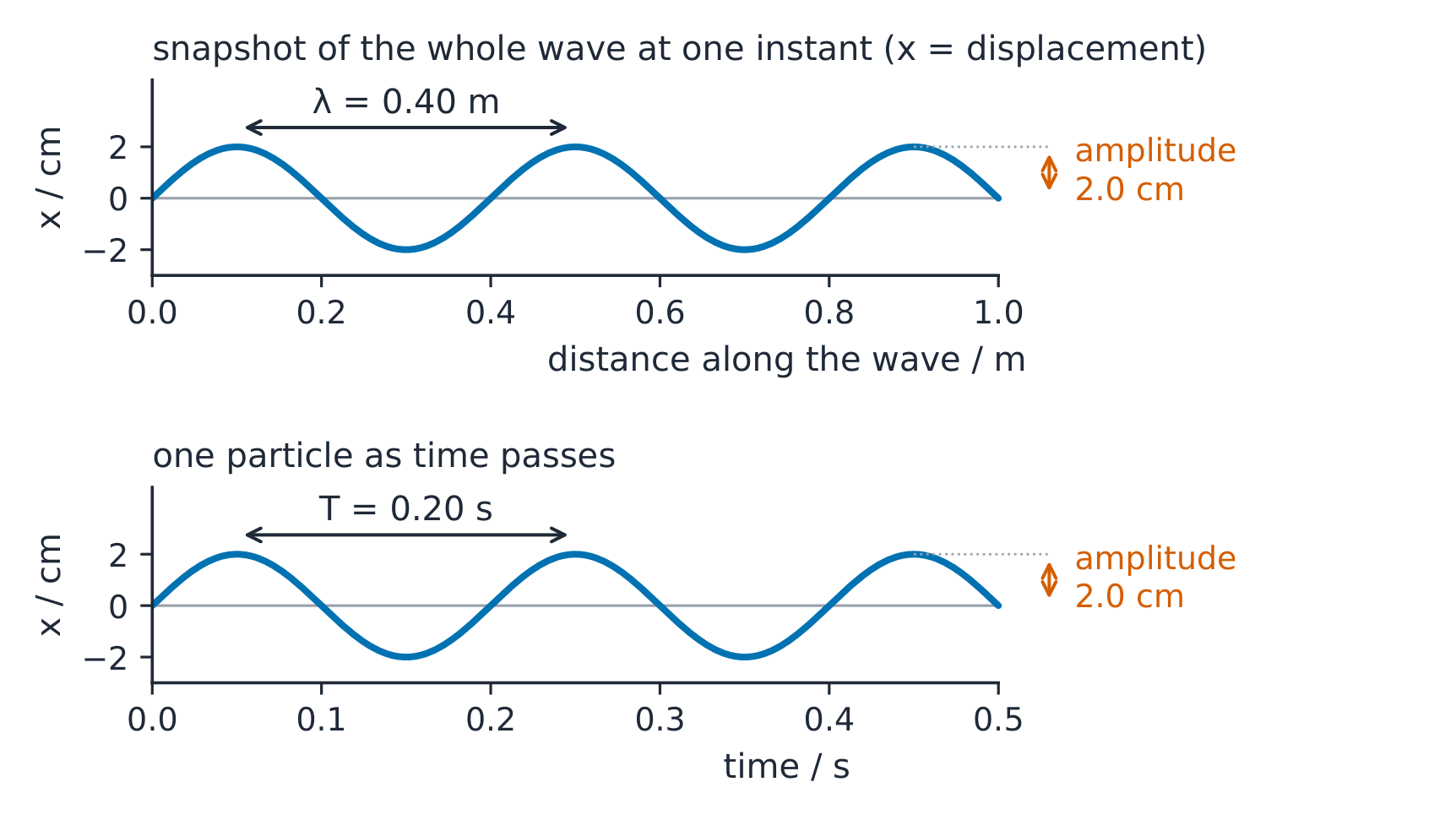
A wave can be drawn in two ways, and exam questions use both. Always read the horizontal axis first.
A displacement–distance graph is a snapshot of the whole wave at one instant. The repeat length on this graph is the wavelength.
A displacement–time graph shows how one particle moves as time passes. The repeat length on this graph is the period.
The same 5.0 Hz wave, as a snapshot in space and as one particle in time
From the two graphs above: $\lambda = 0.40\ \text{m}$ and $T = 0.20\ \text{s}$, so $v = \lambda/T = 2.0\ \text{m s}^{-1}$.
Which way is a particle moving?
On a displacement–distance graph of a transverse wave travelling to the right, each particle will next copy the displacement of the particle just to its left (the one the wave has already reached). So:
a particle on the front slope of a crest (the side facing the direction of travel) is moving up;
a particle on the back slope is moving down;
particles at a crest or a trough are momentarily at rest.
Which way each point moves: towards the displacement its neighbour on the incoming side has now; a crest or trough is momentarily at rest
Graphs of longitudinal waves
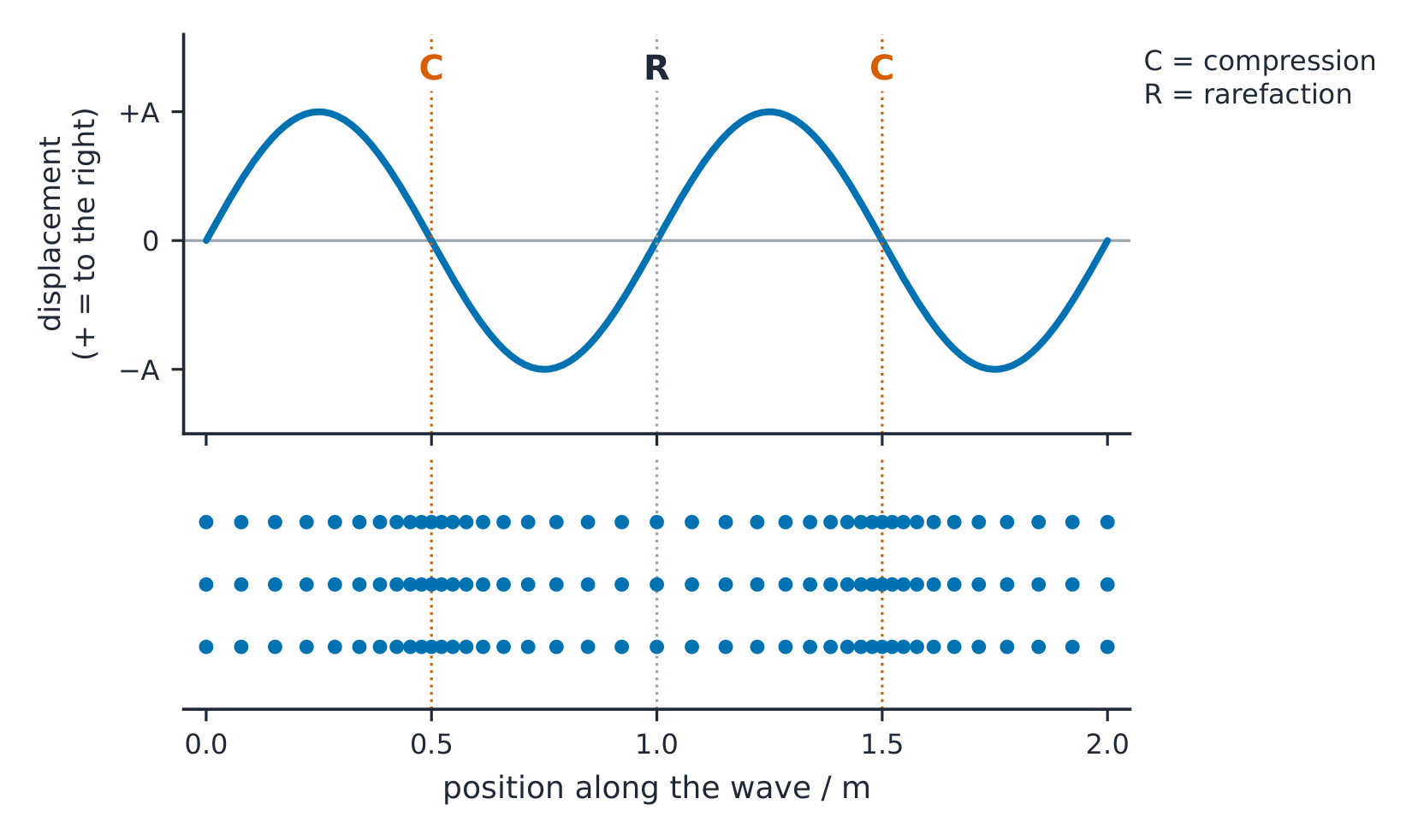
The displacement of a particle in a longitudinal wave is along the direction of travel, but it is still drawn on the vertical axis of the graph. Take displacement to the right as positive.
On the graph, a compression is where particles on both sides are displaced towards it
At 0.50 m, the particles just to the left have positive displacement (pushed right) and those just to the right have negative displacement (pushed left): they crowd together, so this is the centre of a compression. At 1.00 m the particles on either side move away, giving a rarefaction. Compressions and rarefactions are where the displacement is zero, not where it is largest.
12.5
Sound waves
Sound 声音 in air is a longitudinal mechanical wave. A vibrating object, such as a loudspeaker cone, pushes the air molecules next to it together (a compression) and then pulls back, leaving them spread out (a rarefaction). Each layer of air pushes on the next, and the pattern travels outwards.
Tuning forks: a longer, heavier fork vibrates more slowly, giving a lower frequency
Sound needs a medium. A ringing bell inside a jar goes silent as the air is pumped out, although it can still be seen ringing.
Sound speed depends on elastic response and inertia, not particle spacing alone. The listed air, water and steel values illustrate common conditions; they do not prove a universal speed ordering for every gas, liquid and solid.
Humans hear frequencies from about 20 Hz to 20 kHz: wavelengths in air from 17 m down to 17 mm. Sound above 20 kHz is called ultrasound 超声波; doctors use it for scans and ships use it to measure depth.
A louder sound has a larger amplitude; a higher-pitched sound has a higher frequency.
Reading the period T from a CRO trace using the grid and time-base
Worked example: thunder is heard 3.0 s after lightning is seen. Light arrives almost at once, so the storm is about $340 \times 3.0 = 1.0\ \text{km}$ away.
An electromagnetic wave 电磁波 is an oscillating electric field and an oscillating magnetic field, at right angles to each other and to the direction of travel. Electromagnetic waves are therefore transverse. They are produced by accelerating electric charges, such as electrons oscillating up and down a radio aerial.
The electric and magnetic fields oscillate in phase, at right angles to each other and to the direction of travel
They need no medium: they travel through a vacuum, which is how light and heat reach us from the Sun.
All electromagnetic waves travel at the same speed in a vacuum, $c = 3.00 \times 10^8\ \text{m s}^{-1}$; they slow down in materials such as glass and water.
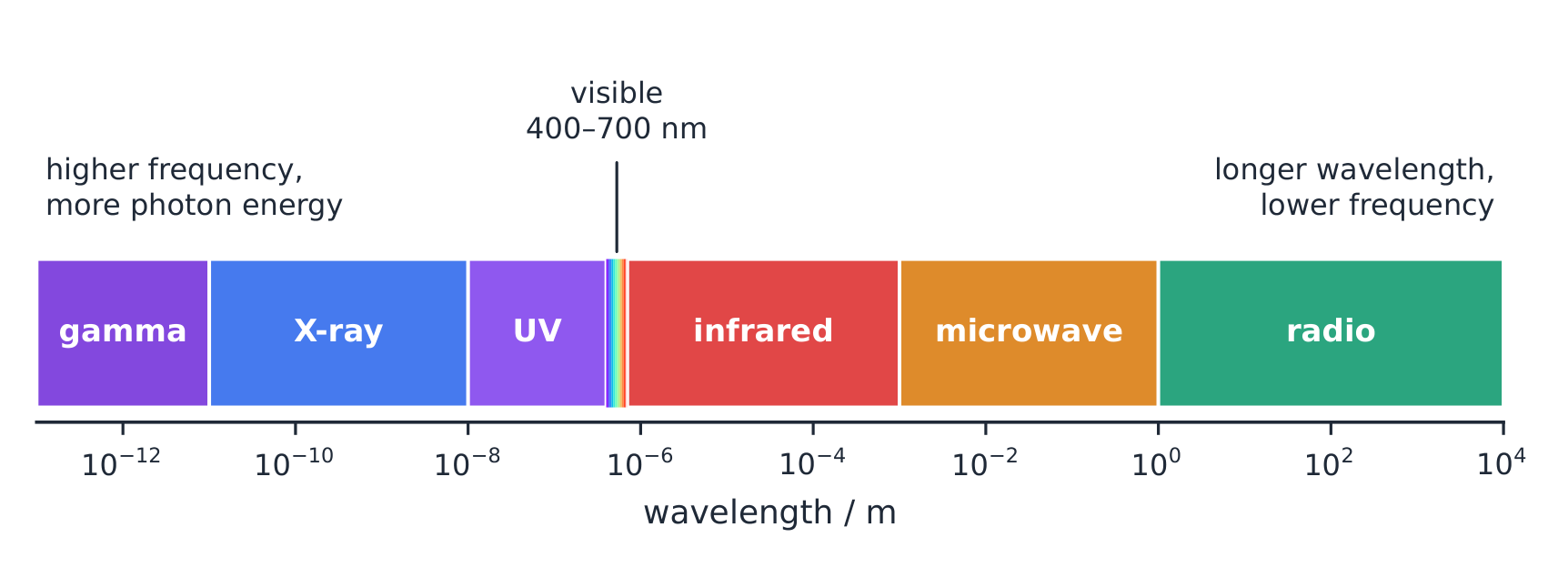
They form the electromagnetic spectrum 电磁波谱, from radio waves with wavelengths of kilometres to gamma rays shorter than an atomic nucleus.
Each step on the scale is a factor of 100 in wavelength
depends on the medium; hundreds or thousands of m s⁻¹
$3.00 \times 10^8\ \text{m s}^{-1}$ in a vacuum, slower in materials
Both kinds obey $v = f\lambda$, both transfer energy without transferring matter, and both show the wave behaviours of C.3: reflection, refraction, diffraction and interference.
12.8
Practice
Distinguish between transverse and longitudinal waves, giving one example of each.
A wave on a string has a frequency of 5.0 Hz and a wavelength of 0.40 m. Find its speed and period.
Find the wavelength of a 512 Hz sound (a) in air, (b) in water, where sound travels at 1500 m s⁻¹. State what happens to the frequency.
Find the wavelength of a radio station broadcasting at 98 MHz.
Thunder is heard 4.5 s after lightning is seen. Estimate the distance to the storm.
A displacement–distance graph shows exactly four complete waves in 2.4 m. The wave travels at 1.2 m s⁻¹. Find the wavelength and the frequency.
State three differences between sound waves and electromagnetic waves.
Put these in order of increasing wavelength: microwaves, X-rays, radio waves, visible light, ultraviolet.
Explain why astronauts on the Moon cannot hear each other without radios, although they can see each other.
Explain how a displacement–distance graph and a displacement–time graph of the same wave differ, and which quantity each gives directly.
On a displacement–position graph of a sound wave, state where the compressions are.
P-waves travel at 6.0 km s⁻¹ and S-waves at 3.5 km s⁻¹. A station records the S-waves 30 s after the P-waves. Find its distance from the earthquake.
A wave passes from deep to shallow water. Its speed falls from 0.32 m s⁻¹ to 0.20 m s⁻¹ and its frequency is 4.0 Hz. Find the wavelength in each region.
Answers.
Transverse: oscillations are perpendicular to propagation (electric and magnetic fields for light; particles for a string wave). Longitudinal: particles oscillate parallel to the direction of travel (sound, P-waves).
Any three: sound needs a medium, EM waves do not; sound is longitudinal, EM waves are transverse; sound is particles oscillating, EM is electric and magnetic fields oscillating; EM waves are about a million times faster.
X-rays, ultraviolet, visible light, microwaves, radio waves.
Sound is a mechanical wave and needs a medium; there is no air on the Moon. Light is electromagnetic and travels through a vacuum.
The displacement–distance graph is a snapshot of all the particles at one time; its repeat length is the wavelength. The displacement–time graph shows one particle over time; its repeat length is the period.
At the points of zero displacement where the graph slopes downwards (displacement changes from positive to negative), because the particles on both sides are displaced towards that point.
$d/3.5 - d/6.0 = 30$, so $d(0.286 - 0.167) = 30$ and $d = 2.5 \times 10^2\ \text{km}$.