A door is easier to open when pushed near its outer edge. Force size alone does not determine the turning effect.
English narration · English + 中文 subtitles burned in
4.1
Scope and prerequisites
This handout teaches A.4 Rigid body mechanics, for the course first assessed in 2025. The whole unit is additional higher level (AHL); there is no SL counterpart.
Prerequisites: Newton's laws, momentum and circular motion ($v = \omega r$) from A.2; kinetic and potential energy from A.3; the equations of motion from A.1. Use $g = 9.8\ \text{m s}^{-2}$. Formulas for the moment of inertia of particular shapes are given in questions when needed.
4.2
AHL: Torque and rotational equilibrium
Why is a door handle far from the hinge?
Push a door near its hinge and it barely moves; push the same force at the handle and it swings open easily. What matters for turning is not only the force but where and in which direction it acts. A rigid body 刚体 is an extended object whose shape does not change, so it can rotate as well as move along.
A tower crane is a moments problem: the counterweight's moment about the mast balances the moment of the load
Torque
The torque 力矩$\tau$ of a force about an axis is its turning effect:
$$\tau = Fr\sin\theta$$
$r$ is the distance from the axis to the point where the force acts, and $\theta$ is the angle between $r$ and the force. The product $r\sin\theta$ is the perpendicular distance from the axis to the line of action of the force, the lever arm 力臂. Torque is measured in N m. Always state its sense: clockwise or anticlockwise.
Torque = force × perpendicular distance = 10 N × 0.30 m = 3.0 N mOnly the perpendicular distance to the line of action counts: τ = 40 × 0.25 × sin 60° = 8.7 N m
A force whose line of action passes through the axis ($\theta = 0$) has no turning effect, however large it is. Two equal and opposite forces with different lines of action form a couple 力偶: they give a torque but no resultant force.
A couple: two equal and opposite forces, a distance apart, producing a torque
Rotational equilibrium
A body in rotational equilibrium 转动平衡 about a chosen fixed axis has zero resultant torque about that axis: clockwise and anticlockwise torques balance. Complete equilibrium requires both conditions below; with zero resultant force, torque balance then holds about any axis:
zero resultant force (translational equilibrium, A.2), and
zero resultant torque.
For forces such as weight, the whole mass of a body can be treated as acting at its centre of mass 质心. For a uniform beam that is the middle.
Finding a centre of gravity: hung freely, an object settles with its centre of gravity vertically below the pin, so two plumb lines from two pins cross at it
Worked example: a uniform 4.0 m plank of mass 20 kg rests on supports at each end. A 60 kg person stands 1.0 m from the left end. Find the support forces.
Taking torques about the left support removes $R_{\text{left}}$ from the torque equation
Take torques about the left support, so its unknown force has no torque.
Forces: $R_{\text{left}} = 80 \times 9.8 - 245 = 539\ \text{N}$. The support nearer the person carries more.
Explore
The force angle changes the lever arm
Start with 10 N perpendicular to a 0.30 m radius and I = 0.60 kg·m². Compare the radius with the perpendicular lever arm, and connect net torque to angular acceleration.
Every point of a rotating rigid body turns through the same angle in the same time, so rotation is described with angular quantities, measured in radians (one revolution $= 2\pi$ rad).
One radian is the angle whose arc length equals the radius
Linear
Angular
Link for a point at radius $r$
displacement $s$
angular displacement 角位移$\Delta\theta$ (rad)
$s = r\Delta\theta$
velocity $v$
angular velocity $\omega$ (rad s⁻¹)
$v = \omega r$
acceleration $a$
angular acceleration 角加速度$\alpha$ (rad s⁻²)
$a = \alpha r$ (along the path)
For rotation about a fixed axis, choose one sense as positive. Angular velocity has a sign in that convention; angular speed is its magnitude. The link $v=\omega r$ gives tangential speed when the magnitudes are used.
Equations of motion for uniform angular acceleration
Each linear equation has an angular twin. They hold only when $\alpha$ is constant.
AHL: Moment of inertia and Newton's second law for rotation
Moment of inertia
Mass resists changes in linear motion. For rotation, what matters is how the mass is distributed about the axis. The moment of inertia 转动惯量$I$ of a set of point masses is
$$I = \sum mr^2$$
measured in kg m². Mass far from the axis counts much more than mass near it, because $r$ is squared. Two 0.50 kg masses fixed 0.40 m either side of an axis on a light rod give $I = 2(0.50)(0.40^2) = 0.16\ \text{kg m}^2$. Slide them in to 0.20 m and $I$ falls to a quarter, 0.040 kg m².
Halving $r$ quarters $I$, because $I = \sum mr^2$
For a body of mass $M$ and radius (or length) $R$, the formula depends on the shape and the axis, for example: thin ring about its centre $MR^2$; solid disc or cylinder $\frac{1}{2}MR^2$; solid sphere $\frac{2}{5}MR^2$; thin rod about its centre $\frac{1}{12}ML^2$. Questions give the formula you need.
Newton's second law for rotation
An unbalanced torque gives a rigid body an angular acceleration:
$$\tau = I\alpha$$
For a rigid body with constant $I$ about a fixed axis, $\tau$ is the instantaneous resultant torque; average torque gives average angular acceleration over an interval. A 3.0 N m torque on a flywheel with $I = 0.60\ \text{kg m}^2$ gives $\alpha = 3.0/0.60 = 5.0\ \text{rad s}^{-2}$. The same torque on a body with a larger moment of inertia gives a smaller angular acceleration.
Coupled bodies: a mass on a pulley
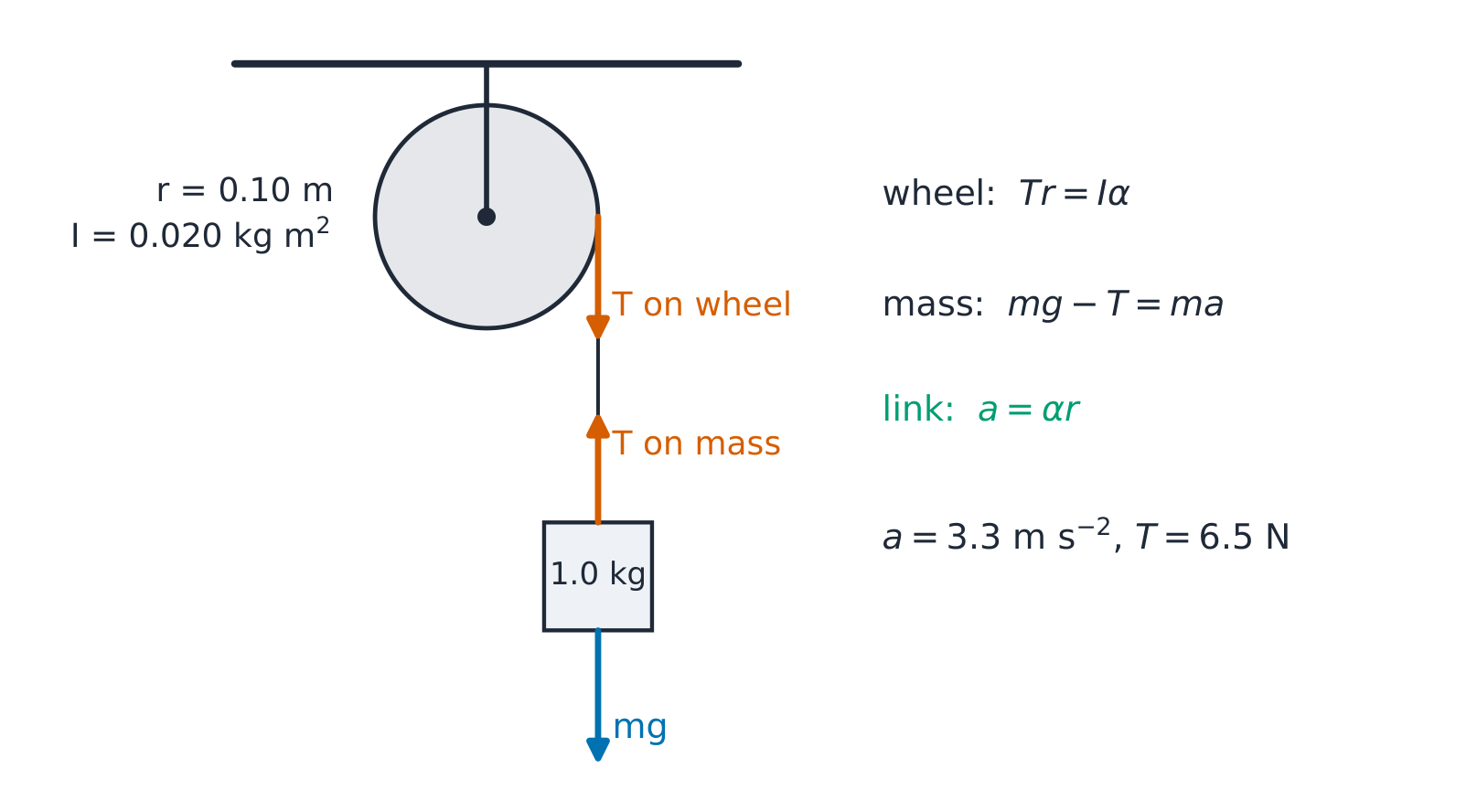
A 1.0 kg mass hangs from a light string wrapped round a pulley wheel of radius 0.10 m and moment of inertia $0.020\ \text{kg m}^2$. Treat the two bodies separately and link them: the string does not slip, so $a = \alpha r$.
The tension gives the wheel its torque and slows the mass: solve the two bodies together
Mass (down positive): $mg - T = ma$, so $9.8 - T = 1.0a$.
Add: $9.8 = 3.0a$, so $a = 3.3\ \text{m s}^{-2}$ and $T = 6.5\ \text{N}$.
The mass falls with less than $g$ because part of the energy goes into spinning the wheel.
In the lab: use a guarded pulley with its axle clamped securely. Fasten hanging loads and place a tray below them to catch a fall; keep hands and loose clothing away from rotating parts.
measured in kg m² s⁻¹. Angular momentum stays constant unless a resultant external torque acts: the conservation of angular momentum 角动量守恒.
A spinning ice skater pulls in their arms. The skater's moment of inertia falls from 3.0 to 1.0 kg m², so the angular velocity rises from 2.0 to $\dfrac{3.0 \times 2.0}{1.0} = 6.0\ \text{rad s}^{-1}$. The rotational kinetic energy rises from 6.0 J to 18 J: the extra comes from the work the skater's muscles do pulling the arms inwards. Divers and gymnasts tuck to spin faster for the same reason.
With no external torque, $L = I\omega$ is conserved: a smaller $I$ means a larger $\omega$
Coupled discs
A disc ($I = 0.20\ \text{kg m}^2$) spinning at 30 rad s⁻¹ is dropped onto a stationary disc ($I = 0.10\ \text{kg m}^2$) on the same axle, and they turn together. The torques between them are internal, so $L$ is conserved:
Kinetic energy falls from 90 J to 60 J: like a perfectly inelastic collision, 30 J is transferred to thermal energy by friction between the discs.
Angular impulse
A resultant torque acting for a time $\Delta t$ gives an angular impulse 角冲量 equal to the change in angular momentum:
$$\Delta L = \tau\Delta t = \Delta(I\omega)$$
Here $\tau$ is constant or is the average resultant external torque over the interval. For a varying torque, angular impulse is the signed area under its torque–time graph.
Take the initial rotation as positive. A brake applies a torque of $-15$ N m to a flywheel ($I = 2.0\ \text{kg m}^2$) for 4.0 s. Its angular impulse is $\Delta L = (-15)(4.0) = -60\ \text{kg m}^2\,\text{s}^{-1}$. If its initial angular velocity was 50 rad s⁻¹, it slows to $50 + (-60)/2.0 = 20\ \text{rad s}^{-1}$. The impulse magnitude is 60; the directed change is negative.
Worked example with data: a net external torque about a fixed axis rises linearly from zero to $+4.0$ N m, then falls linearly to zero, over a total of 3.0 s. The torque–time graph is a triangle. Its signed area is $\frac12(3.0)(4.0)=+6.0$ N m s, so the average torque is $+2.0$ N m, not the peak $+4.0$ N m. For a constant inertia of $0.50\ \text{kg m}^2$, $\Delta\omega=\Delta L/I=+12\ \text{rad s}^{-1}$. If the initial angular velocity is $+8.0\ \text{rad s}^{-1}$, the final value is $+20\ \text{rad s}^{-1}$. Using peak torque for the whole interval would double the impulse incorrectly.
Angular impulse is the area under the torque–time graph; use the average torque, not the peak.
Here $v$ is the speed of the centre of mass and $I$ is the moment of inertia about the centre-of-mass axis. Do not combine translational energy with a moment of inertia about the contact point: that would count the translation twice.
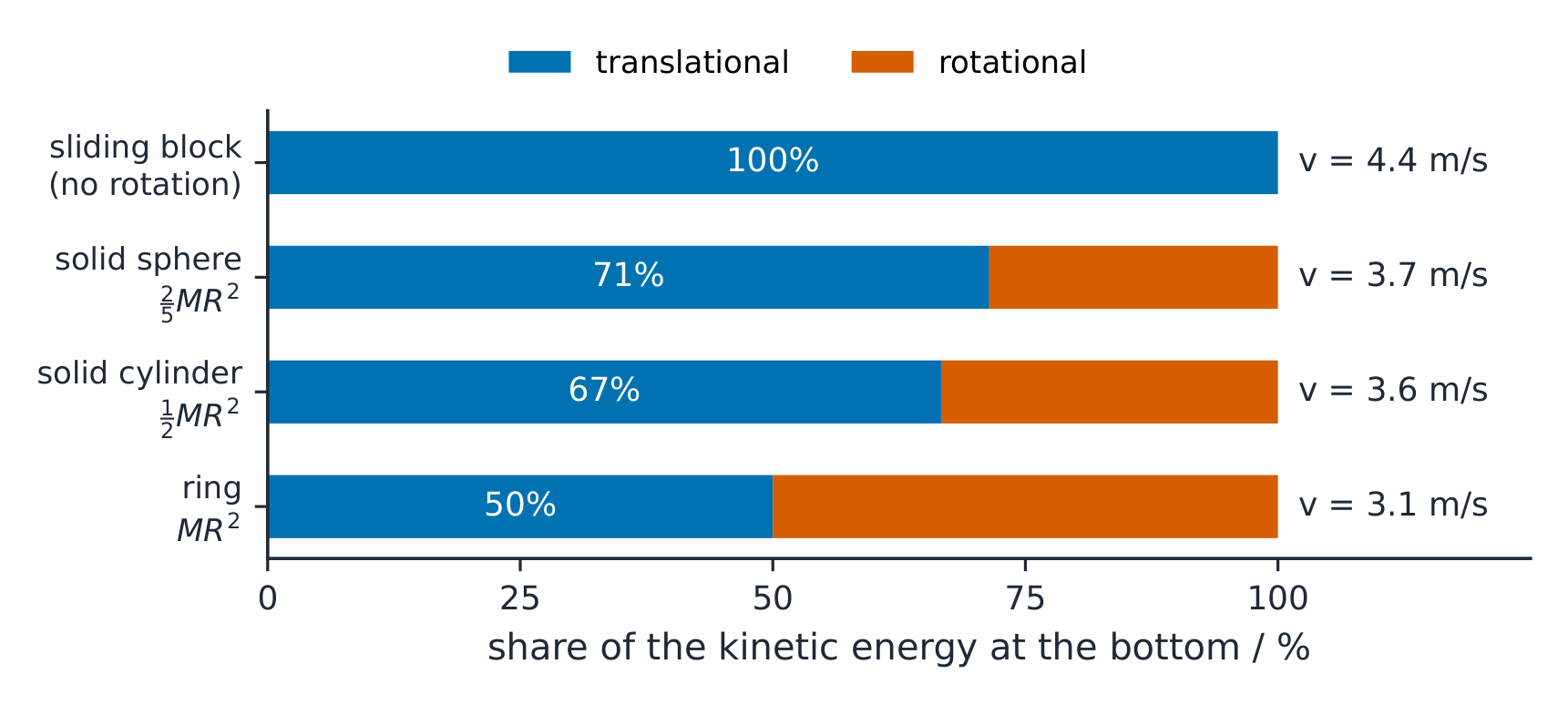
Worked example: a solid cylinder ($I = \frac{1}{2}MR^2$) rolls without slipping from rest down a slope with a vertical drop of 1.0 m. Neglect rolling resistance and other dissipative losses.
$v = \sqrt{\tfrac{4}{3}gh} = \sqrt{\tfrac{4}{3}(9.8)(1.0)} = 3.6\ \text{m s}^{-1}$, whatever its mass and radius.
The more of the energy that goes into spinning, the slower the body arrives
A frictionless sliding block would reach $\sqrt{2gh} = 4.4\ \text{m s}^{-1}$; a ring ($I = MR^2$) only $\sqrt{gh} = 3.1\ \text{m s}^{-1}$. For these shapes rolling without slip from rest down the same straight slope, the smaller ratio $I/(MR^2)$ gives the greater acceleration and final speed. Mass or radius alone does not decide the result.
A 40 N force is applied to the end of a 0.25 m spanner. Find the torque when the force is (a) perpendicular to the spanner, (b) at 30° to it.
A metre rule is balanced at its 50 cm mark. A 2.0 N weight hangs at the 20 cm mark. Where must a 3.0 N weight hang to balance it?
A wheel speeds up uniformly from 5.0 to 25 rad s⁻¹ in 4.0 s. Find its angular acceleration and the number of revolutions it makes.
Point masses of 0.20 kg, 0.30 kg and 0.50 kg sit at 0.10 m, 0.20 m and 0.30 m from an axis. Find the moment of inertia.
A constant 2.0 N m torque acts for 6.0 s on a disc ($I = 0.40\ \text{kg m}^2$) starting from rest. Find its final angular velocity, angular momentum and kinetic energy.
A diver leaves the board turning at 2.0 rad s⁻¹ with $I = 12\ \text{kg m}^2$, then tucks to $I = 4.0\ \text{kg m}^2$. Find the new angular velocity and explain where the extra kinetic energy comes from.
A turntable ($I = 0.050\ \text{kg m}^2$) turns freely at 3.0 rad s⁻¹. A 0.10 kg lump of clay is dropped onto it 0.15 m from the axis and sticks. Find the new angular velocity.
A motor applies 0.80 N m for 5.0 s to a wheel ($I = 0.20\ \text{kg m}^2$) at rest. Find the angular impulse and the final angular velocity.
A flywheel has $L = 6.0\ \text{kg m}^2\,\text{s}^{-1}$ and $I = 1.5\ \text{kg m}^2$. Find its kinetic energy without finding $\omega$.
A solid disc and a ring roll from rest down the same slope with a 0.50 m drop. Find each speed at the bottom and explain which arrives first.
In a model, a 1.0 kg mass falls from rest through 0.60 m while unwinding a light string from a fixed-axis pulley with radius 0.10 m and moment of inertia $0.020\ \text{kg m}^2$. Neglect axle friction and string slip. Use energy to find the final speed and the two kinetic-energy contributions; check against the acceleration method.
Disc: $v = \sqrt{\tfrac{4}{3}gh} = 2.6\ \text{m s}^{-1}$. Ring: $v = \sqrt{gh} = 2.2\ \text{m s}^{-1}$. The disc arrives first: its mass is nearer the axis, so a smaller share of the energy goes into rotation and more into forward motion.
With $\omega=v/r$, $mgh=\frac12mv^2+\frac12I(v/r)^2$. Thus $5.88=\frac12(1.0+0.020/0.10^2)v^2=1.5v^2$, giving $v^2=3.92$ and $v=2.0\ \text{m s}^{-1}$. Translational energy is 1.96 J; rotational energy is 3.92 J, summing to 5.88 J. Independently, $a=mg/(m+I/r^2)=9.8/3.0=3.27\ \text{m s}^{-2}$ and $v^2=2as=3.92$, agreeing before rounding.
4.8
Exam tips
Torque uses the perpendicular distance to the line of action; with $Fr\sin\theta$, $\theta$ is the angle between $r$ and $F$.
State the sense of each torque (clockwise or anticlockwise) and take torques about the point with the most unknown forces.
Work in radians: convert revolutions with $2\pi$ and rpm with $2\pi/60$.
$\tau = I\alpha$ uses the resultant torque; subtract a frictional torque first.
For coupled bodies, write one equation for each body and link them with $a = \alpha r$.
When $I$ changes with no external torque, conserve $L = I\omega$, not kinetic energy.
A rolling body has translational and rotational kinetic energy; use $v = \omega r$ to combine them.