A sealed gas container changes pressure when heated. Celsius ratios cannot predict the pressure change because the gas model uses absolute temperature 绝对温度.
English narration · English + 中文 subtitles burned in
8.1
Scope and prerequisites
This handout teaches B.3 Gas laws in full, for the course first assessed in 2025. There is no additional higher level content in B.3, so SL and HL students study the same material.
Prerequisites: momentum and Newton's second law from A.2; kelvin temperature, $\overline{E}_k = \frac{3}{2}k_BT$ and internal energy from B.1. Use $R = 8.31\ \text{J K}^{-1}\ \text{mol}^{-1}$, $k_B = 1.38 \times 10^{-23}\ \text{J K}^{-1}$ and $N_A = 6.02 \times 10^{23}\ \text{mol}^{-1}$.
8.2
Pressure and amount of substance
Why does a bicycle tyre feel harder on a hot day?
Pump a tyre up in the cool morning and it feels firmer by the afternoon, though no air has been added. A sealed bag of crisps carried up a mountain swells; a plastic bottle closed at the top of the mountain is crushed by the time it reaches the bottom. The pressure, volume and temperature of a gas are linked, and the link comes from billions of molecules hitting the walls.
Pressure
Pressure 压强 is the force per unit area acting perpendicular to a surface:
$$P = \frac{F}{A}$$
in pascals, $1\ \text{Pa} = 1\ \text{N m}^{-2}$. A 600 N person standing on shoes of total area 0.030 m² exerts $600/0.030 = 2.0 \times 10^4\ \text{Pa}$ on the floor. Atmospheric pressure at sea level is about $1.0 \times 10^5\ \text{Pa}$ (100 kPa). Gas laws use absolute pressure; a gauge reads the difference from its reference pressure, often the atmosphere. Add that atmospheric pressure before forming a gas-law ratio.
Amount of substance
The amount of substance 物质的量$n$ is measured in moles:
$$n = \frac{N}{N_A}$$
where $N$ is the number of molecules and $N_A$ is the Avogadro constant 阿伏伽德罗常数. One mole of any substance contains $6.02 \times 10^{23}$ particles. The molar mass 摩尔质量 is the mass of one mole: 32 g of oxygen gas (O₂, molar mass 32 g mol⁻¹) is 1.0 mol, or $6.02 \times 10^{23}$ molecules.
One mole contains the Avogadro number of particles
For a fixed amount of gas in a regime well approximated by the ideal model, experiments hold one of $P$, $V$ and $T$ constant and vary the other two. Temperatures must be in kelvin.
Heating the air in a balloon at constant pressure makes it expand (Charles's law), so its density falls and it risesBoyle's law: at constant temperature, pressure times volume is constant
Law
Held constant
Relationship
Graph
Boyle's law
temperature
$PV = \text{constant}$
$P$ against $1/V$ is a straight line through the origin
Charles's law
pressure
$V/T = \text{constant}$
$V$ against $T$ is a straight line through 0 K
pressure law
volume
$P/T = \text{constant}$
$P$ against $T$ is a straight line through 0 K
Worked examples:
Boyle: a syringe holds 60 cm³ of air at 100 kPa. Pushed slowly to 20 cm³, $P = 100 \times 60/20 = 300\ \text{kPa}$.
Charles: 2.0 L of gas is heated from 27 °C (300 K) to 127 °C (400 K) at constant pressure: $V = 2.0 \times 400/300 = 2.7\ \text{L}$.
Pressure law: a constant-volume tyre model at an absolute pressure of 200 kPa and 7 °C (280 K) warms to 35 °C (308 K): $P = 200 \times 308/280 = 220\ \text{kPa}$.
Boyle's law: at constant temperature $pV$ is constant, so a $p$–$V$ graph is a hyperbola
In the lab: investigate the pressure law using teacher-approved constant-volume apparatus with a pressure sensor in a water bath. Keep the amount of gas fixed; the teacher sets the temperature range and pressure limit. At each bath temperature, wait for the gas to reach thermal equilibrium before recording its absolute pressure and temperature in kelvin. Plot pressure against kelvin temperature and repeat readings to check consistency. Never heat an improvised sealed vessel.
Absolute zero from the gas laws
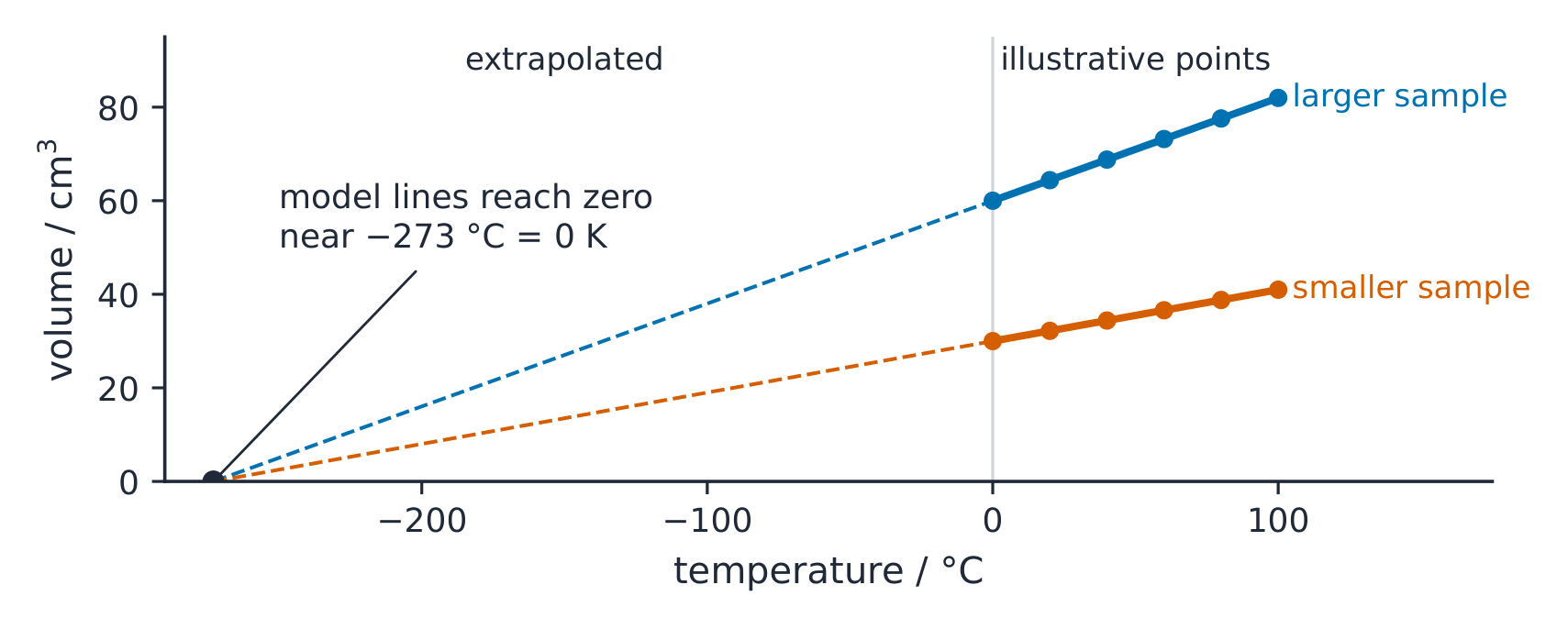
For a fixed amount of gas at constant pressure, volume is approximately linear with Celsius temperature over a range where ideal-gas behaviour is a good approximation. Extrapolating that model gives a zero-volume intercept near −273 °C: absolute zero 绝对零度, 0 K. Real gases depart from the ideal model and can condense before that extrapolated state; the graph is not a claim that a real gas reaches zero volume.
Ideal-model points illustrate a common extrapolated intercept; these are
for a fixed amount in the ideal-gas approximation. Worked example: 50 cm³ of gas at 100 kPa and 300 K is compressed to 20 cm³ and warms to 360 K. $P_2 = 100 \times \dfrac{50}{20} \times \dfrac{360}{300} = 300\ \text{kPa}$.
Gauge pressure is not the pressure in a gas law
A rigid, sealed vessel has gauge pressure 150 kPa when the gas is at 300 K. Atmospheric pressure stays at 100 kPa. Heating to 360 K gives initial absolute pressure $150+100=250$ kPa, then final absolute pressure $250(360/300)=300$ kPa. The final gauge reading is $300-100=200$ kPa. Multiplying the original gauge reading by the temperature ratio would wrongly give 180 kPa. Hold amount and volume fixed, and convert back to the requested pressure reference at the end.
Pressure–volume diagrams
Changes of a gas are drawn on a pressure–volume diagram 压强体积图. Each isotherm 等温线 is a curve $PV = \text{constant}$; hotter isotherms lie further from the origin.
Isothermal changes follow an isotherm, constant-volume changes are vertical lines and constant-pressure changes are horizontal lines
For 1.0 mol: at A (10 L, 300 K) $P = 249\ \text{kPa}$; at B (40 L, 300 K) $P = 62\ \text{kPa}$, a quarter of A; heating at constant volume to 600 K doubles the pressure to 125 kPa at C; cooling at constant pressure to 300 K halves the volume to 20 L at D.
Experiments show that $PV/T$ is proportional to the amount of gas. The constant of proportionality is the same for every gas at low pressure: the molar gas constant 摩尔气体常数$R$. This gives the ideal gas law 理想气体定律:
$$PV = nRT \qquad \text{or} \qquad PV = Nk_BT$$
The two forms agree because $nR = Nk_B$, so $R = N_Ak_B$.
Worked example: how many moles and molecules of air are in a 1.0 m³ box at 100 kPa and 300 K?
One mole of any ideal gas at 273 K and 101 kPa occupies $\frac{8.31 \times 273}{1.01 \times 10^5} = 0.0225\ \text{m}^3$, 22.5 L, whatever the gas.
Units
Use SI units throughout: $P$ in Pa, $V$ in m³ ($1\ \text{L} = 10^{-3}\ \text{m}^3$, $1\ \text{cm}^3 = 10^{-6}\ \text{m}^3$), $T$ in K and $n$ in mol. A ratio question with the gas laws can keep any units for $P$ and $V$, as long as both sides match, but $T$ must always be in kelvin.
Explore
Gas pressure uses kelvin temperature
$\frac{p_2}{p_1}=\frac{T_2}{T_1}\frac{V_1}{V_2}$
For a fixed amount of ideal gas, pressure rises with kelvin temperature and falls as volume increases.
An ideal gas 理想气体 is a model that explains the gas laws by the motion of its molecules. The kinetic theory 分子动理论 assumes:
An aneroid barometer: air pressure is the force per unit area from countless molecular collisions
The gas has a very large number of identical molecules in random motion.
The volume of the molecules themselves is negligible compared with the volume of the container.
There are no forces between molecules except during collisions.
Collisions with each other and with the walls are elastic, and last a negligible time.
Between collisions, molecules move in straight lines at constant speed.
The key assumptions of the kinetic theory of an ideal gas
Pressure from molecular collisions
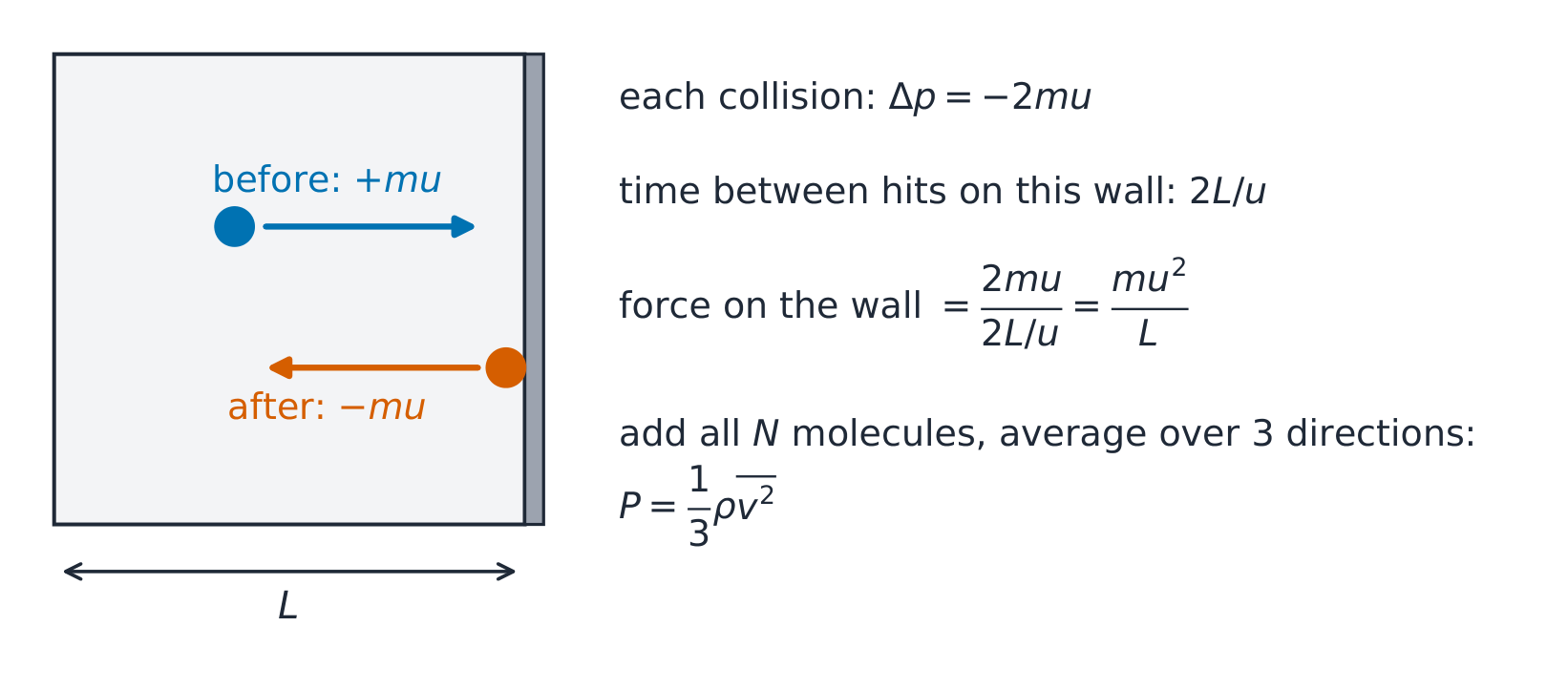
Each collision changes the molecule's momentum by 2mu; many collisions each second make a steady force
In the simplified cube model, take $u$ as the velocity component perpendicular to the wall. A molecule of mass $m$ bounces back elastically, so its momentum changes by $-2mu$. By Newton's third law the wall receives an impulse $+2mu$. Ignoring intervening collisions for this one-molecule argument, the perpendicular round trip is $2L$, so it hits it every $2L/u$ seconds, and the average force it exerts is $\dfrac{2mu}{2L/u} = \dfrac{mu^2}{L}$. Adding up all the molecules, and averaging over the three directions of motion, gives:
$$P = \frac{1}{3}\rho\overline{v^2}$$
where $\rho$ is the density of the gas and $\overline{v^2}$ is the mean of the squared speeds. The square root $\sqrt{\overline{v^2}}$ is the root mean square speed 方均根速率$v_{\text{rms}}$.
Root-mean-square speed: square each speed, take the mean, then the square root
Worked example: a single-species ideal-gas sample at 100 kPa has density 1.2 kg m⁻³. $v_{\text{rms}} = \sqrt{3P/\rho} = \sqrt{3 \times 1.0 \times 10^5/1.2} = 500\ \text{m s}^{-1}$ in this model. For a mixture such as air, species have different rms speeds; a one-species calculation is an effective approximation.
Explaining the gas laws
Boyle's law: halving the volume at constant temperature keeps the mean translational kinetic energy unchanged and doubles the number density. The mean momentum transferred per unit wall area per second therefore doubles, so the pressure doubles. Individual wall-hit rates also depend on container geometry.
Pressure law: heating at constant volume makes the molecules faster. They hit the walls more often and with a greater change of momentum each time, so the pressure rises.
Charles's law: heating increases molecular speeds, and the gas expands against a movable boundary. The reduced number density balances the increased momentum transfer per particle until the pressure again matches the external constraint.
Temperature and molecular speed
Combining $PV = Nk_BT$ with $P = \frac{1}{3}\rho\overline{v^2} = \frac{1}{3}\frac{Nm}{V}\overline{v^2}$ gives $\frac{1}{2}m\overline{v^2} = \frac{3}{2}k_BT$: the average translational kinetic energy of a molecule depends only on the temperature. At the same temperature lighter molecules move faster. At 300 K, nitrogen (molar mass 28 g mol⁻¹) has $v_{\text{rms}} = \sqrt{3k_BT/m} = 520\ \text{m s}^{-1}$, while helium (4 g mol⁻¹) has $1370\ \text{m s}^{-1}$. Doubling the kelvin temperature multiplies $v_{\text{rms}}$ by $\sqrt{2}$.
The spread of molecular speeds: a higher temperature broadens the curve and shifts it to faster speeds
In the ideal-gas model, intermolecular interaction energy is neglected. For a classical monatomic 单原子 gas, such as the helium or argon models here, internal energy is translational kinetic energy:
Average molecular kinetic energy is proportional to kelvin temperature: $\overline{E}_k = \tfrac32 k_BT$
$$U = \frac{3}{2}Nk_BT = \frac{3}{2}nRT$$
Polyatomic ideal gases can also have rotational and vibrational internal energy; neglecting intermolecular forces does not remove those contributions. The three-halves formula is not a formula for every ideal gas. For a fixed amount and composition in the ideal model, internal energy depends only on temperature. Worked example: 2.0 mol of helium at 400 K has $U = 1.5 \times 2.0 \times 8.31 \times 400 = 1.0 \times 10^4\ \text{J}$. Heated to 800 K, its internal energy doubles.
A real gas 实际气体 behaves like an ideal gas when its molecules are far apart and fast:
low pressure and low density: the volume of the molecules is negligible, and molecules are rarely close enough to attract each other;
high temperature, well above the temperature at which the gas liquefies: the molecules' kinetic energy is much larger than any intermolecular potential energy.
At high pressure the volume of the molecules is no longer negligible, and at suitable lower temperatures attractions can reduce pressure relative to the ideal prediction. Condensation can occur when temperature and pressure permit it; lowering temperature does not imply that every gas at every pressure must pass into a liquid phase. The ideal gas model cannot describe a liquid at all. Air at room temperature and atmospheric pressure is very close to ideal.
Compressed gas cylinders store a fixed mass of gas at high pressure.
A 1200 kg car rests on four tyres, each touching the road over 0.015 m². Find the pressure on the road.
Find the number of molecules in 0.50 mol of carbon dioxide, and the mass of this gas (molar mass 44 g mol⁻¹).
A diver at 10 m depth (200 kPa) breathes out a 4.0 cm³ bubble. Find its volume at the surface (100 kPa), assuming constant temperature.
A rigid, sealed container of ideal gas at 20 °C and absolute pressure 150 kPa is heated to 120 °C. Find the new pressure.
Explain why the temperature in the gas laws must be in kelvin.
Find the volume of 0.25 mol of an ideal gas at 300 K and 120 kPa.
Use an ideal-gas estimate for a cylinder of volume 0.020 m³ holding oxygen at absolute pressure $1.5 \times 10^7\ \text{Pa}$ and 290 K. Find the amount and mass of oxygen (molar mass 32 g mol⁻¹), and state why the high pressure makes checking this approximation important.
On a $P$–$V$ diagram, sketch (a) an isothermal compression, (b) a heating at constant volume, (c) a cooling at constant pressure.
State four assumptions of the kinetic model of an ideal gas.
Use the kinetic model to explain why the pressure of a gas rises when it is heated at constant volume.
A gas of density 0.18 kg m⁻³ is at 100 kPa. Find the root mean square speed of its molecules.
Find the internal energy of 3.0 mol of argon at 300 K, and the energy that must be added to warm it to 400 K at constant volume.
State and explain the conditions under which a real gas behaves most like an ideal gas.
A rigid, sealed ideal-gas vessel initially reads 150 kPa on a gauge at 300 K. Atmospheric pressure is 100 kPa and remains constant. Find the final absolute pressure and gauge reading at 360 K. Explain why scaling the gauge reading directly fails.
The gas laws are proportionalities that pass through zero at absolute zero. On the Celsius scale zero is arbitrary: doubling a Celsius temperature does not double the pressure or volume.
$n=PV/(RT)=300\,000/(8.31\times290)=124.49$ mol; $m=124.49(0.032)\approx4.0$ kg. This is an ideal estimate at 150 bar; a reliable real mass needs real-gas data or measurement.
(a) A curve along an isotherm towards smaller volume and higher pressure. (b) A vertical line upwards. (c) A horizontal line towards smaller volume.
Any four of: very many identical molecules in random motion; negligible molecular volume; no intermolecular forces except in collisions; elastic collisions; collisions take negligible time; straight-line motion between collisions.
The molecules gain kinetic energy and move faster. They hit the walls more often and each collision gives a larger change of momentum, so the force per unit area on the walls increases.
Low pressure (low density) and high temperature. The molecules are then far apart, so their own volume is negligible, and fast, so intermolecular forces have little effect.
Use absolute pressure: $P_1=150+100=250$ kPa, so $P_2=250(360/300)=300$ kPa. Subtract 100 kPa to get 200 kPa gauge. Scaling the gauge reading gives the wrong 180 kPa because its reference is atmosphere, not vacuum.
8.9
Exam tips
Use kelvin and absolute pressure; convert volume to m³ with $PV=nRT$. Identify the fixed amount and constraint before selecting a gas law. Keep $n,R$ together and $N,k_B$ together. On $P$–$V$ axes, fixed volume is vertical, fixed pressure horizontal, and fixed temperature an isotherm. Explain pressure through normal momentum change and collision rate. Reserve $U=\frac32nRT$ for the classical monatomic ideal-gas model.