Two observers can assign different times between the same events. A clock reading has meaning only when the frame and events are specified.
English narration · English + 中文 subtitles burned in
5.1
Scope and prerequisites
This handout teaches A.5 Galilean and special relativity, for the course first assessed in 2025. The whole unit is additional higher level (AHL); there is no SL counterpart.
Prerequisites: velocity and displacement from A.1, Newton's laws from A.2, squares and square roots. Use $c = 3.00 \times 10^8\ \text{m s}^{-1}$. Derivations of the Lorentz transformations, velocity addition, time dilation and length contraction are not required.
5.2
AHL: Reference frames and Galilean relativity
Who is moving?
Sit in a train waiting at a station while the train on the next track pulls away: for a moment you are sure that you are moving. Without looking out of a window, no experiment inside a smoothly moving train can tell you whether it is moving or at rest. Physics describes motion only relative to a reference frame.
Reference frames and events
A reference frame 参考系 is a set of rulers and synchronized clocks used by an observer to give every event a position and a time.
An event 事件 is something that happens at one place at one instant, with coordinates $(x, t)$ in a frame.
An inertial reference frame 惯性参考系 is a frame that is not accelerating. In it, a body with no resultant force moves at constant velocity.
Galilean relativity 伽利略相对性: Newton's laws of motion are the same in every inertial frame.
The Galilean transformation
Frame S′ moves at speed $v$ along the $x$-axis of frame S, and the origins coincide at $t = 0$. An event at $(x, t)$ in S has coordinates in S′:
$$x' = x - vt \qquad t' = t$$
Time is the same for everyone. Differentiating gives the velocity addition rule: an object moving at $u$ in S moves at
$$u' = u - v$$
in S′. A ball thrown forwards at 5 m s⁻¹ inside a train moving at 20 m s⁻¹ moves at 25 m s⁻¹ relative to the ground.
Galilean addition: velocities in the two frames differ by the frame speed $v$
Where Galilean relativity fails
Maxwell's equations of electromagnetism predict that light travels at $c$, with no mention of a frame. Galilean addition says that light from a moving source should move faster or slower than $c$. Experiments (such as Michelson and Morley's, and measurements of light from fast-moving particles) always find $c$. Galilean relativity is only an approximation for speeds much smaller than $c$.
Einstein built special relativity 狭义相对论 on two postulates:
The laws of physics are the same in all inertial reference frames.
The speed of light in a vacuum is the same, $c$, for all inertial observers, whatever the motion of the source or the observer.
Together these force space and time to depend on the frame. Two observers in relative motion can disagree about time intervals, lengths and whether two events are simultaneous, yet both are right in their own frame.
$\gamma$ is 1 at rest and grows without limit as $v$ approaches $c$: $\gamma = 1.25$ at $0.60c$, $1.67$ at $0.80c$, $7.1$ at $0.99c$. At everyday speeds $\gamma \approx 1$ and the Lorentz equations reduce to the Galilean ones. They also apply to intervals: $\Delta x' = \gamma(\Delta x - v\Delta t)$ and $\Delta t' = \gamma(\Delta t - v\Delta x/c^2)$.
Relativistic effects are tiny at everyday speeds and grow without limit near $c$
Worked example: S′ moves at $0.60c$ relative to S ($\gamma = 1.25$). An event in S happens at $x = 3.0 \times 10^8\ \text{m}$, $t = 2.0\ \text{s}$.
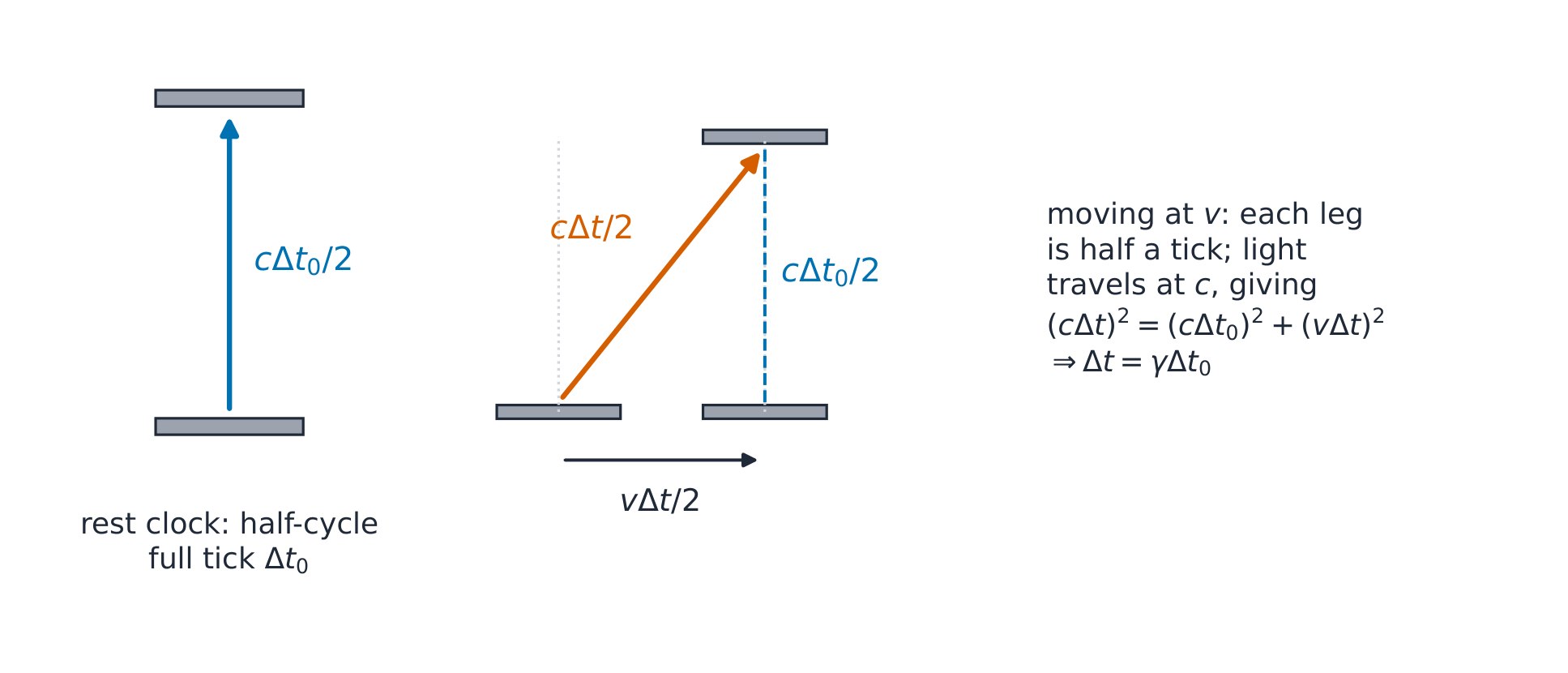
The proper time interval 固有时间$\Delta t_0$ between two events is the time measured in the frame where both events happen at the same place, for example by a single clock that travels with them. Every other inertial observer measures a longer interval:
The CMS particle detector at CERN: particle lifetimes measured in such experiments match the time-dilation formula
$$\Delta t = \gamma\Delta t_0$$
This is time dilation 时间膨胀: a moving clock runs slow, as seen by the observer it moves past.
The shown path is half a tick; a full tick returns light to the same lower-mirror clock, defining its proper interval Δt₀. Both half-cycles give Δt = γΔt₀
A spacecraft passes the Earth at $0.60c$. Its clock measures 4.0 μs between two flashes made on board (proper time, same place in the craft). Earth observers measure $1.25 \times 4.0 = 5.0\ \mu\text{s}$.
Proper length and length contraction
The proper length 固有长度$L_0$ of an object is its length measured in the frame where it is at rest. An observer who sees it moving along its length measures it shorter:
$$L = \frac{L_0}{\gamma}$$
This is length contraction 长度收缩; it happens only along the direction of motion. A 100 m spacecraft moving at $0.80c$ is 60 m long in the Earth's frame.
$L = L_0/\gamma$: the proper length is measured in the object's rest frame
Before substituting, label which frame measures the proper quantity. The proper time is measured by the observer who sees both events in one place; the proper length by the observer who sees the object at rest. Do not mix a length from one frame with a time from another.
Explore
Same events, different frame times
At v = 0.60c, a 4 μs proper interval corresponds to 5 μs in the lab frame. Compare the vertical and diagonal light paths while keeping c fixed and identifying where the two events occur.
Observers disagree about $\Delta t$ and $\Delta x$, but they all agree on the space–time interval 时空间隔 between two events:
Every frame lands on the same curve
$$(\Delta s)^2 = (c\Delta t)^2 - (\Delta x)^2$$
Two events are 900 m apart and 5.0 μs apart in S ($c\Delta t = 1500\ \text{m}$). $(\Delta s)^2 = 1500^2 - 900^2$, so $\Delta s = 1200\ \text{m}$, the same in every frame. In the frame where both events happen at one place, $\Delta x' = 0$, so $c\Delta t' = 1200\ \text{m}$: the proper time is 4.0 μs, matching $\Delta t = \gamma\Delta t_0$ with $v = 900/(5.0 \times 10^{-6}) = 0.60c$.
The interval also checks Lorentz calculations: in the worked example above, $(c \times 2.0)^2 - (3.0 \times 10^8)^2 = (c \times 1.75)^2 - (7.5 \times 10^7)^2 = 2.7 \times 10^{17}\ \text{m}^2$.
The relativity of simultaneity
Events that are simultaneous in one frame are generally not simultaneous in another frame moving along the line joining them. This is the relativity of simultaneity 同时的相对性. From the Lorentz transformation with $\Delta t = 0$:
Equal-time lines tilt in a moving frame
$$\Delta t' = -\gamma\frac{v\Delta x}{c^2}$$
Lamps at the two ends of a 3.0 km platform flash at the same time in the platform frame. For a train passing at $0.60c$, $\Delta t' = -1.25 \times 0.60 \times 3000 / (3.0 \times 10^8) = -7.5\ \mu\text{s}$: the train frame assigns the lamp ahead (further along $+x$) an emission time 7.5 μs earlier. These are event times assigned using synchronized clocks and light-travel corrections, not the times at which the two light signals reach one passenger. Events at the same place that are simultaneous in one frame are simultaneous in all frames.
relativity of simultaneity/ˌreləˈtɪvɪti ɒv ˌsɪməltəˈneɪɪti/
5.7
AHL: Space–time diagrams
Drawing world lines
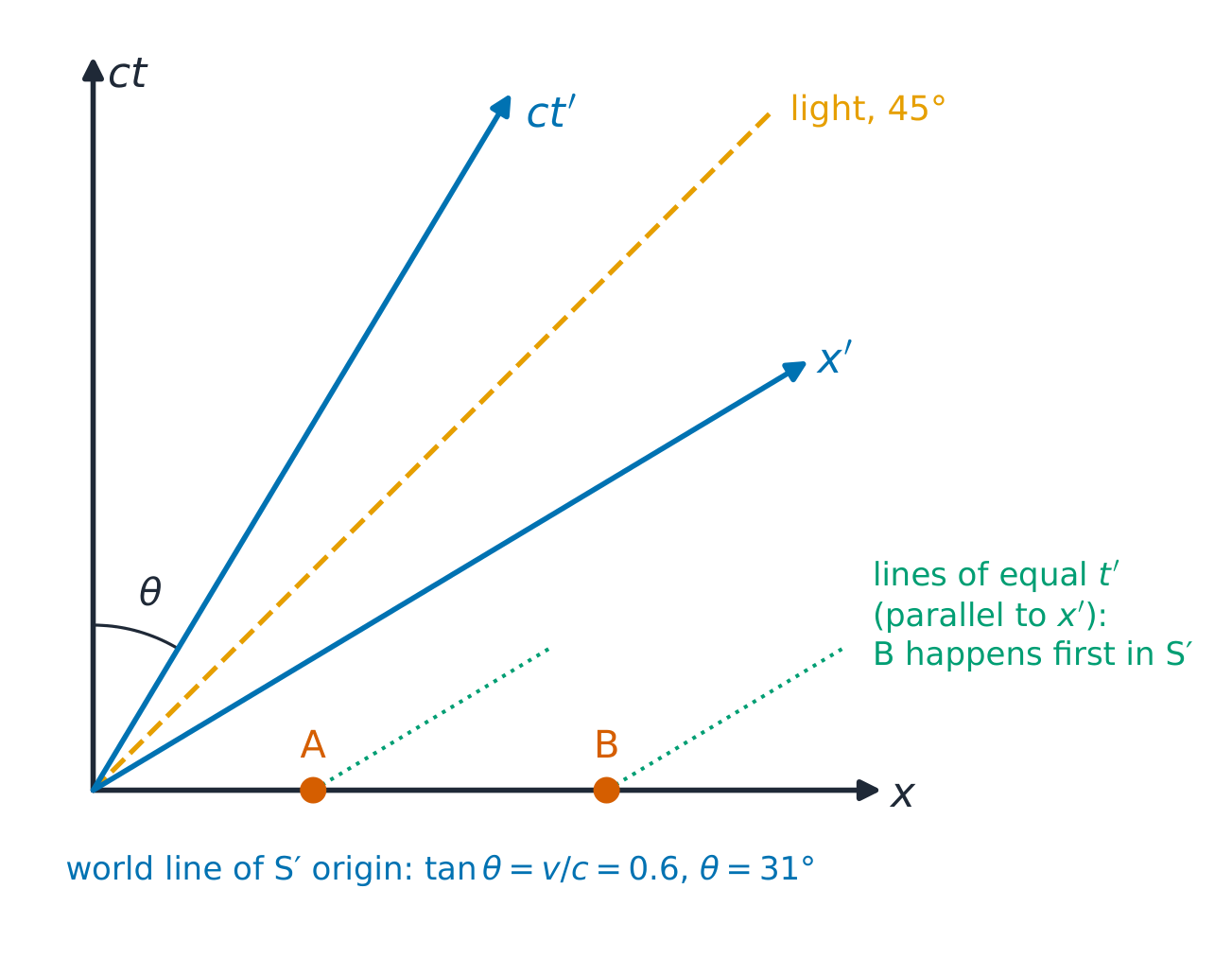
A space–time diagram 时空图 plots events with $x$ horizontal and $ct$ vertical, so both axes are in metres. The path of an object is its world line 世界线.
An object at rest is a vertical line.
Light is a line at 45°, since $x = ct$.
An object at constant speed $v$ is a straight line at angle $\theta$ to the $ct$ axis, with
$$\tan\theta = \frac{v}{c}$$
At $0.60c$, $\theta = \tan^{-1}(0.60) = 31°$. A future-directed world line of a massive particle stays within the light cone; light lies on its boundary. With equal axis scales, this means at most 45° from the time axis. A line joining spacelike-separated events can be steeper away from that axis, but is not a possible material-particle trajectory.
The moving frame's axes close in towards the light line; lines of simultaneity in S′ are parallel to the x′ axis
The axes of a moving frame
On the same diagram, the axes of S′ (moving at $v$) are both tilted by $\theta$ towards the light line:
Moving axes close in on the light line
the $ct'$ axis is the world line of the origin of S′, at $\theta$ from $ct$;
the $x'$ axis (all events with $t' = 0$) is at $\theta$ above the $x$ axis.
To read an event's coordinates in S′, draw lines parallel to the S′ axes. Events on a line parallel to $x'$ are simultaneous in S′; events on a horizontal line are simultaneous in S. The scales on the S′ axes differ from those on the S axes; they are fixed by the invariant interval.
The diagram shows each effect without equations: two events on the $x$ axis (simultaneous in S) lie on different $x'$-parallel lines, so they are not simultaneous in S′.
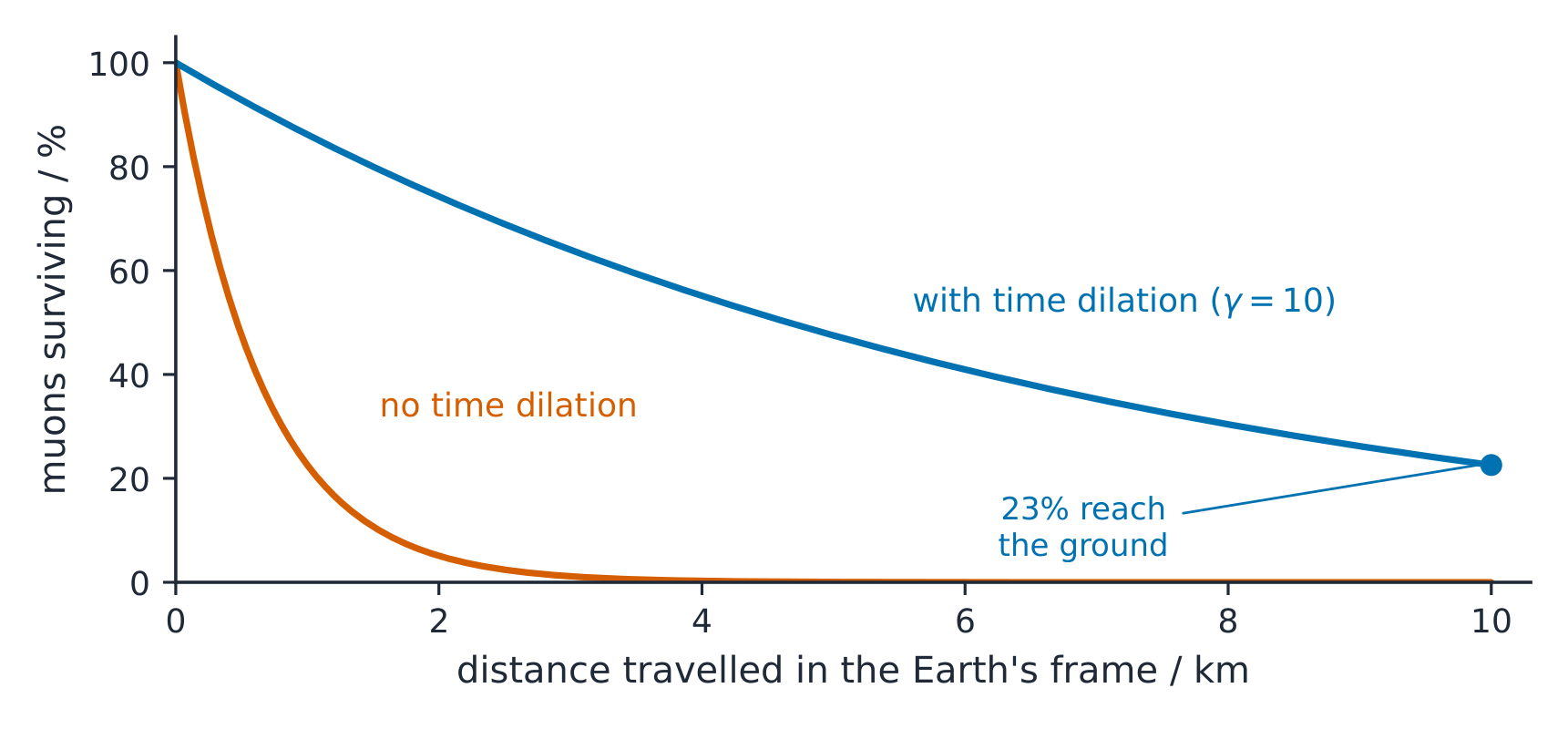
Consider an muon 缪子 model: particles start 10 km above the ground and travel at constant $0.995c$ ($\gamma \approx 10$), neglecting energy loss and a spread of production heights or speeds. Use an at-rest population half-life of 1.56 μs. The following numbers are model predictions, not measurements from a particular experiment.
Without relativity: the trip takes $10\,000 / (0.995 \times 3.0 \times 10^8) = 33.5\ \mu\text{s}$, about 21.5 half-lives, so only $2^{-21.5} \approx 3 \times 10^{-7}$ of the muons should survive.
Earth frame (time dilation): the muons' half-life is $\gamma \times 1.56 = 15.6\ \mu\text{s}$. The trip is only 2.15 half-lives, so about 23% survive.
Muon frame (length contraction): the muons are at rest and their half-life is 1.56 μs, but the atmosphere rushes past contracted to $10\,000/10 = 1.0\ \text{km}$. That takes $3.35\ \mu\text{s}$ = 2.15 half-lives: the same 23%.
Time dilation in one frame, length contraction in the other: the same number of half-lives
Both frames predict the same surviving fraction: time dilation and length contraction are descriptions of one model. For actual evidence, the Rossi–Hall paper abstract reports a faster decay rate in a less penetrating particle group, consistent with the relativistic clock-rate prediction. That comparison does not make this 23% curve measured data.
Survival predictions for the stated model; neither curve represents measured counts
Two cars travel towards each other at 30 m s⁻¹ and 25 m s⁻¹ relative to the road. Use Galilean relativity to find the speed of one relative to the other.
State the two postulates of special relativity.
Calculate $\gamma$ for $0.50c$, $0.90c$ and $0.99c$.
S′ moves at $0.80c$ relative to S. An event in S has $x = 600\ \text{m}$ and $ct = 900\ \text{m}$. Find $x'$ and $t'$, and check your answer with the space–time interval.
Two protons move in opposite directions in a laboratory, each at $0.90c$. Find the speed of one relative to the other.
A spacecraft travels at $0.80c$. Its clock records 1.0 hour for a journey. How long does the journey take in the Earth's frame?
A rod has a proper length of 2.0 m. Find its length when it moves along its length at $0.60c$.
Pions have a proper mean lifetime of 26 ns. A beam moves at $0.95c$. Find the mean lifetime in the laboratory and the average distance travelled.
Muons ($t_{1/2} = 1.56\ \mu\text{s}$ at rest) move at $0.98c$ through 2.0 km of atmosphere in the Earth's frame. Find the fraction that survive, using (a) the Earth's frame, (b) the muons' frame.
On a space–time diagram, a world line makes 25° with the $ct$ axis. Find the object's speed.
Explain, using a space–time diagram, why two events simultaneous in S are not simultaneous in S′.
Answers.
$30 + 25 = 55\ \text{m s}^{-1}$.
The laws of physics are the same in all inertial frames; the speed of light in a vacuum is the same for all inertial observers.
In S, the events lie on a horizontal line (same $ct$). Lines of simultaneity in S′ are parallel to the tilted $x'$ axis, so the two events lie on different $x'$-parallel lines and have different $t'$; the event further along $+x$ happens first in S′.
5.10
Exam tips
Decide which frame measures the proper time (both events at one place) or the proper length (object at rest) before you substitute.
For the same timelike-separated events and inertial-frame comparison, proper time is the shortest coordinate-time interval. Proper length is measured at rest; a moving length requires simultaneous endpoint readings in the measuring frame.
Use the Lorentz transformations when events are at different places and different times; time dilation alone fails there.
Check any pair of transformed coordinates with the invariant interval $(c\Delta t)^2 - (\Delta x)^2$.
In velocity addition, keep the signs: objects moving in opposite directions have opposite signs of $u$.
On space–time diagrams, label the time axis $ct$; light is at 45°, and $\tan\theta = v/c$ is measured from the $ct$ axis.
For muon questions, say which frame you use: time dilation in the Earth's frame, length contraction in the muon's frame.