This handout teaches Reactivity 3.1, Proton transfer reactions, for the course first assessed in 2025.
Prerequisites: amount of substance and concentration from Structure 1.4, equilibrium and $K$ from Reactivity 2.3, and logarithms to base 10. Use the stated temperature and $K_w$ value. Numerical examples below use the dilute-solution concentration model at 298 K unless stated otherwise; they are supplied teaching data.
18.2
Brønsted–Lowry acids and bases
What do vinegar, stomach acid and cleaning ammonia have in common?
Vinegar and stomach acid both turn blue litmus red, and ammonia solution turns red litmus blue. One idea explains all three: in every Brønsted–Lowry acid–base reaction a proton 质子, an $\text{H}^{+}$ ion, moves from one particle to another.
Vinegar is a dilute solution of ethanoic acid, a carboxylic acid
Acids donate, bases accept
A Brønsted–Lowry acid 布朗斯特-劳里酸 is a proton donor.
A Brønsted–Lowry base 布朗斯特-劳里碱 is a proton acceptor. Ammonia and water accept a proton using an available lone pair. The general definition is proton acceptance, rather than a requirement that every possible base be one of these molecules.
In aqueous solution a proton is hydrated rather than present as a bare isolated particle. The oxonium representation is $\text{H}_3\text{O}^{+}$. Writing $\text{H}^{+}(\text{aq})$ is a short form for $\text{H}_3\text{O}^{+}(\text{aq})$.
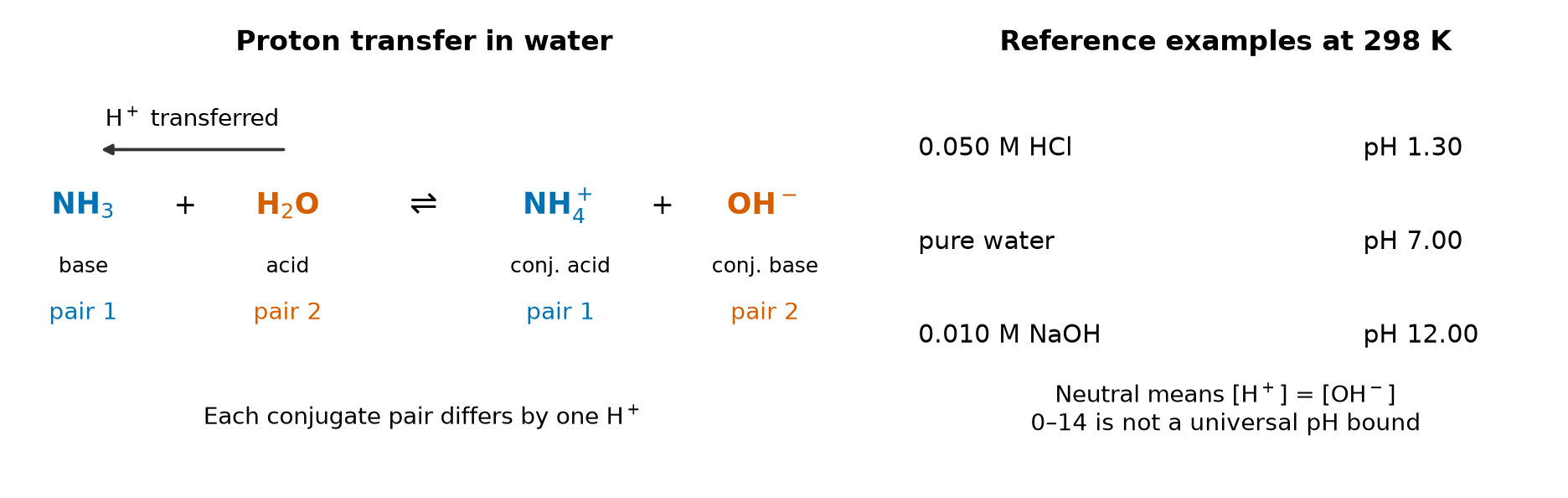
When an acid donates a proton, what is left can accept a proton back: it is a base. A conjugate acid–base pair 共轭酸碱对 is two species that differ by one proton.
A Brønsted–Lowry acid donates H⁺ and a base accepts it; pH = −log[H⁺]
Here $\text{NH}_3$ (base) and $\text{NH}_4^{+}$ (its conjugate acid) are one pair; $\text{H}_2\text{O}$ (acid) and $\text{OH}^{-}$ (its conjugate base) are the other.
Water acts as a base with HCl and an acid with NH₃. Such proton donors/acceptors are amphiprotic 两性的; other examples include HCO₃⁻, HSO₄⁻ and H₂PO₄⁻. Show both roles: HCO₃⁻ + H₂O ⇌ CO₃²⁻ + H₃O⁺, and HCO₃⁻ + H₂O ⇌ H₂CO₃ + OH⁻. Check atoms and charge. Conjugate partners differ by one H⁺ and one charge unit; reacting partners are not automatically conjugates.
A base can neutralize an acid; an alkali is a base that produces an alkaline aqueous solution. CuO is a basic oxide but not a soluble alkali. Aqueous ammonia is an alkali even though NH₃ contains no OH group: it accepts a proton from water, producing OH⁻.
The pH scale expresses hydrogen-ion activity logarithmically. For the dilute solutions in these calculations, use the numerical hydrogen-ion concentration in mol dm⁻³:
Universal indicator is red at low pH, green near neutral pH 7 at 298 K, and purple at high pH; colour depends on pH, not acid/base strength alone.
A decrease of one pH unit means $[\text{H}^{+}]$ is ten times larger.
pH has no units. Give it to the same number of decimal places as the significant figures in $[\text{H}^{+}]$.
Worked example: $[\text{H}^{+}] = 0.050\ \text{mol dm}^{-3}$ gives $\text{pH} = -\log(0.050) = 1.30$. A solution of pH 3.40 has $[\text{H}^{+}] = 10^{-3.40} = 4.0 \times 10^{-4}\ \text{mol dm}^{-3}$.
Measuring and comparing pH
Universal indicator mixes indicators for approximate chart-based pH. Sample colour and lighting can interfere; it cannot justify two-decimal-place accuracy. A probe needs suitable buffer calibration, rinsing between samples, stabilization and temperature control. Display resolution alone does not establish accuracy.
pH paper estimates the pH of a solution from the colour it turns
On ordinary linear axes, pH against [H⁺] is a decreasing logarithmic curve, not a straight line. Sample [H⁺] values 0.0010, 0.010 and 0.10 mol dm⁻³ give pH 3.00, 2.00 and 1.00. Equal tenfold concentration factors give equal pH intervals. Values outside 0–14 are possible; 0–14 is a familiar range for dilute aqueous examples, not a universal bound.
In pure water $[\text{H}^{+}] = [\text{OH}^{-}] = 1.00 \times 10^{-7}$, so the pH is 7.00. A solution is neutral when $[\text{H}^{+}] = [\text{OH}^{-}]$, acidic when $[\text{H}^{+}] > [\text{OH}^{-}]$ and alkaline when $[\text{H}^{+}] < [\text{OH}^{-}]$.
The ionization of water is endothermic, so $K_w$ increases with temperature. At $50\ ^\circ\text{C}$ pure water has a pH of about 6.6, but it is still neutral, because $[\text{H}^{+}]$ and $[\text{OH}^{-}]$ are still equal.
pH of strong acids and bases
For a fully ionized monoprotic strong acid well above the water contribution, [H⁺] is approximately its analytical concentration. A fully dissociated soluble hydroxide supplies OH⁻ according to its formula: one per NaOH, two per dissolved Ba(OH)₂. Do not automatically set every acid concentration equal to [H⁺] regardless of proton count or dilution. Water ionization matters for extremely dilute solutions.
ionic product of water/aɪˈɒnɪk ˈprɒdʌkt ɒv ˈwɔːtə/
18.4
Strong and weak acids and bases
Full and partial ionization
A strong acid 强酸 ionizes completely in water: HCl, $\text{HNO}_3$, $\text{H}_2\text{SO}_4$ (first proton). A strong base ionizes or dissociates completely: group 1 hydroxides and $\text{Ba(OH)}_2$.
A weak acid 弱酸 ionizes only partly; the equilibrium lies to the left: ethanoic acid and other carboxylic acids, carbonic acid. A weak base accepts protons only partly: ammonia and amines.
Same concentration, different ionisation: a strong acid is fully dissociated into ions; a weak acid stays mostly as whole molecules
For the supplied ethanoic-acid model with $K_a=1.74\times10^{-5}$, approximately 1.3% of a 0.10 mol dm⁻³ solution is ionized. The fraction depends on concentration and temperature; it is not a fixed percentage for every ethanoic-acid solution.
Do not confuse strong with concentrated. Strength is about how far the acid ionizes; concentration is how much acid is dissolved in each $\text{dm}^3$. A dilute solution of a strong acid can have a higher pH than a concentrated solution of a weak acid.
For conjugate pairs in the same solvent at the same temperature, the stronger the acid, the weaker its conjugate base: $\text{Cl}^{-}$ has almost no tendency to accept a proton, while $\text{CH}_3\text{COO}^{-}$ accepts one easily.
Acid–base equilibrium favours the weaker acid and weaker base. For CH₃COOH + NH₃ ⇌ CH₃COO⁻ + NH₄⁺, compare the two acids and their conjugates, not simply whether the substances are on the left or right. Proton transfer towards the less strongly donating acid is favoured under the corresponding equilibrium model.
Telling them apart
Compare solutions of the same concentration at the same temperature:
Equal volumes of these equal-concentration monoprotic acids contain equal acid amounts and need equal hydroxide amounts for complete neutralization. With excess magnesium, complete reaction and matched collection conditions, they give the same final gas amount despite different initial rates. More weak acid ionizes as H⁺ is consumed. Control solid surface when comparing rates; leaks or limiting solid can change observed totals.
Proton-transfer neutralization forms a salt; water is formed when hydroxide or a basic oxide takes up the proton. Ammonia and amines can form salts without producing water. For dilute strong acid with hydroxide, the net ionic equation is:
NH₃(aq) + HCl(aq) → NH₄Cl(aq), and CH₃NH₂(aq) + HCl(aq) → CH₃NH₃Cl(aq): no water product is needed.
For ammonium nitrate, a possible parent acid is HNO₃ and parent base is NH₃. For sodium ethanoate they are CH₃COOH and NaOH. The cation and anion identify useful parent choices; a salt name alone does not imply the solution is neutral.
To prepare a soluble salt from acid and an insoluble basic oxide, add oxide until some remains unreacted, filter off the excess, concentrate the filtrate carefully and allow crystals to form. Wash and dry the crystals as appropriate. For two soluble reactants, a titration can establish the reacting amounts; repeat those amounts without indicator before concentrating, to avoid indicator contamination. Do not evaporate every hydrate to dryness as a universal preparation method.
Titration technique and concentration
Wear appropriate eye protection. Rinse the burette with its titrant and the pipette with the solution it transfers; rinse the conical flask with distilled water. Read the meniscus at eye level, swirl over a white tile and add titrant dropwise near the endpoint. The titre is the final burette reading minus the initial reading. Exclude the rough trial and average careful titres meeting the stated concordance rule.
A titration setup: reacting volumes from a burette find the concentration of an unknown solution
For an HCl/NaOH titration, 25.00 cm³ of HCl needs 0.150 mol dm⁻³ NaOH. Careful titres of 18.35, 18.40 and 18.45 cm³ meet a stated maximum range of 0.10 cm³; their mean is 18.40 cm³. HCl + NaOH → NaCl + H₂O gives a 1:1 ratio. First find the known amount: $n(\mathrm{NaOH})=cV=0.150(18.40/1000)=0.00276$ mol. Hence $n(\mathrm{HCl})=0.00276$ mol, and $c(\mathrm{HCl})=n/V=0.00276/0.02500=0.110$ mol dm⁻³ to three significant figures. Both volumes must be in dm³ when calculating amounts or concentrations this way.
The pH curve of a strong acid and a strong base
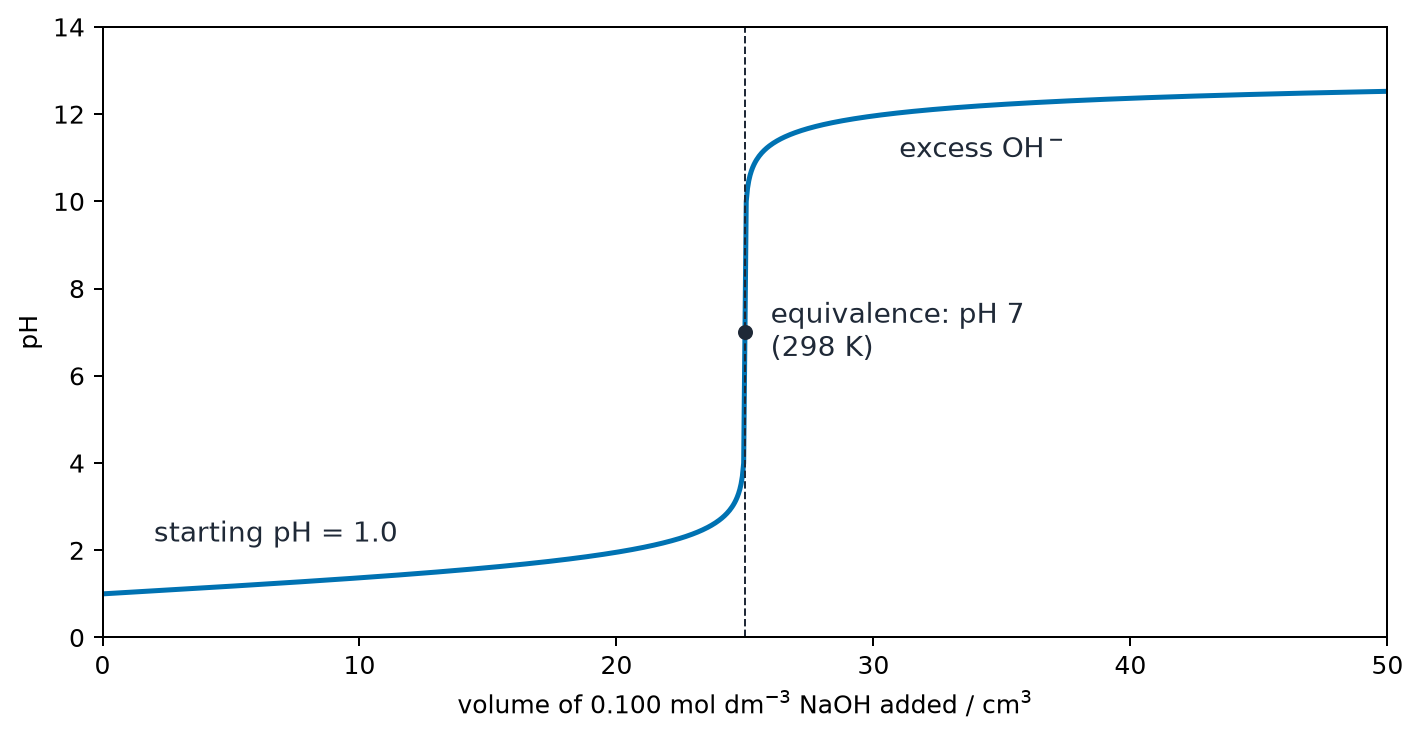
A pH curve 滴定曲线 shows how the pH changes as one solution is added to another in a titration.
This 298 K example reaches equivalence at 25.0 cm³ and pH 7.00.
The equivalence point 化学计量点 is where the amounts of acid and base match the equation. For dilute strong acid and strong base at 298 K it is at pH 7.00. Equal amounts mean the balanced reacting ratio, not necessarily equal solution volumes.
Near equivalence in this supplied 0.100 mol dm⁻³ example, a small addition causes a steep pH rise. The size of the rise depends on concentration, volume and the increment added. This steep section is why an indicator can show the end point sharply.
The starting pH comes from the acid concentration; with a large excess of titrant, pH approaches that of the alkali. During titration, mixing dilutes both solutions. Add smaller measured increments near the steep region, mix and allow the pH reading to settle.
A solution has pH 4.70. Calculate $[\text{H}^{+}]$ and $[\text{OH}^{-}]$.
Compare two tests of 0.10 mol dm⁻³ HCl and ethanoic acid. State expected results and controls.
Why can heated pure water have pH below seven while remaining neutral?
Sketch 0.100 mol dm⁻³ NaOH added to 20.0 cm³ of 0.100 mol dm⁻³ HCl: mark starting pH and equivalence.
Classify CuO and aqueous NH₃ as bases/alkalis. Balance NH₃ + HCl and identify whether water forms.
Name parent acid/base choices for sodium ethanoate and ammonium nitrate. Outline salt crystallization from acid and insoluble oxide.
Compare universal indicator and a probe for resolving 0.05 pH unit. State two calibration/control requirements.
At a stated temperature $K_w=4.00\times10^{-14}$. Find neutral [H⁺] and pH; explain why the solution is neutral.
Worked answers.
$\text{HNO}_3$ (acid) and $\text{NO}_3^{-}$ (conjugate base); $\text{H}_3\text{O}^{+}$ (acid) and $\text{H}_2\text{O}$ (conjugate base).
As an acid: $\text{HCO}_3^{-} + \text{H}_2\text{O} \rightleftharpoons \text{CO}_3^{2-} + \text{H}_3\text{O}^{+}$. As a base: $\text{HCO}_3^{-} + \text{H}_3\text{O}^{+} \rightleftharpoons \text{H}_2\text{CO}_3 + \text{H}_2\text{O}$.
$[\text{H}^{+}] = 10^{-4.70} = 2.0 \times 10^{-5}\ \text{mol dm}^{-3}$; $[\text{OH}^{-}] = 1.00 \times 10^{-14} / 2.0 \times 10^{-5} = 5.0 \times 10^{-10}\ \text{mol dm}^{-3}$. These values use $K_w=1.00\times10^{-14}$ at 298 K.
Compare equal concentration, volume and temperature: HCl has lower pH and higher conductivity than ethanoic acid. With equal magnesium surface, HCl has faster initial bubbling.
Endothermic water ionization increases on heating, raising [H⁺] above $10^{-7}$ mol dm⁻³. Water stays neutral because [H⁺]=[OH⁻].
Start at pH 1.0; rise slowly, then steeply at 20.0 cm³, with equivalence pH 7 at 298 K; approach the excess-NaOH pH beyond equivalence.
CuO is a basic oxide, not a soluble alkali. Aqueous NH₃ produces OH⁻ and is an alkali. NH₃ + HCl → NH₄Cl; no water product.
Parents: CH₃COOH/NaOH; HNO₃/NH₃. Add excess oxide, filter, concentrate carefully, cool to crystallize, then wash and dry appropriately.
Use a suitably calibrated, stable pH probe, with buffer standards and temperature control. Rinse between samples. Universal indicator lacks this precision; display resolution alone does not prove accuracy.
Identify donor/acceptor and conjugate pairs. Compare strength at matched concentration; state temperature for $K_w$. Show logarithms and match precision to the data and measuring method.
More topics in International Baccalaureate · IB Diploma · Chemistry · SL