A reusable container can require more energy to manufacture than a single-use one. Its impact depends on how often it is used and what happens at disposal.
English narration · English + 中文 subtitles burned in
14.1
Scope and prerequisites
This handout teaches Reactivity 1.3, Energy from fuels, for the course first assessed in 2025. The understandings in this unit are shared by SL and HL. It also develops the life-cycle comparisons and functional-unit reasoning in the course objectives.
Prerequisites: balancing equations, mole calculations, enthalpy changes and oxidation–reduction. Numerical scenarios are original and unless a reference value is explicitly identified. They are not official examination questions.
14.2
Combustion: where the energy comes from
A fuel stores chemical energy that can be transferred in a useful process. During combustion, a substance reacts with oxygen. Many metals, non-metals and organic substances burn when sufficiently heated. Examples include
Natural gas — mainly methane, the simplest alkane — burns on a stove.
These reactions release energy overall because forming the product bonds releases more energy than breaking the reactant bonds requires. The energy is not released simply by “breaking the fuel's bonds”. An ignition source overcomes an activation barrier; a fuel that releases much energy can still be relatively unreactive during safe storage.
Complete combustion of a hydrocarbon or an alcohol produces carbon dioxide and water. Balance carbon first, hydrogen second and oxygen last. An alcohol already contains oxygen, so include that oxygen when calculating the external oxygen supply.
Worked example: ethanol
Ethanol is $\mathrm{C_2H_5OH}$, with two carbon atoms, six hydrogen atoms and one oxygen atom per molecule. Two carbon atoms give $2\mathrm{CO_2}$; six hydrogen atoms give $3\mathrm{H_2O}$. The products contain seven oxygen atoms. One comes from ethanol, leaving six to be supplied by three oxygen molecules:
Water may leave a hot flame as vapour. If using a tabulated combustion enthalpy, match its specified water state; a value for liquid water includes the additional energy released on condensation. Do not compare fuel values defined with different product states without accounting for that difference.
14.3
Limited oxygen and incomplete combustion
Incomplete combustion occurs when carbon is not fully oxidized to carbon dioxide. Carbon monoxide and/or solid carbon can form, usually alongside some carbon dioxide and water. The following equations are idealized limiting cases, not a claim that a real flame produces only one carbon-containing product:
Complete combustion gives $\text{CO}_2$ and water; incomplete also gives CO and soot
Carbon monoxide is colourless and odourless and is toxic because it binds strongly to haemoglobin, impairing oxygen transport. Soot consists of carbon-rich particles; inhaled particles damage health. A yellow, sooty flame can indicate incomplete combustion, but the absence of visible soot does not prove the absence of carbon monoxide.
Hydrocarbons with higher carbon-to-hydrogen ratios, such as longer-chain alkanes, tend to soot more under comparable burning conditions. Oxygen delivery, vaporization and mixing also affect the outcome.
More chemical energy remains in CO or carbon than in fully oxidized products, so incomplete combustion releases less heat per mole of original fuel than complete combustion to the same final water state. It wastes fuel as well as increasing health risks. Provide a suitable oxygen supply and ventilation; never use an unvented flame in an enclosed room. This is a reason to improve apparatus, not an instruction to experiment with unsafe oxygen restrictions.
Worked example: balancing an incomplete reaction
For ethanol producing only CO and water as the carbon/hydrogen products, begin with $\mathrm{C_2H_5OH\rightarrow2CO+3H_2O}$. Products contain five oxygen atoms; ethanol supplies one, so two $\mathrm{O_2}$ molecules supply the remaining four:
Check every atom after balancing. A smaller oxygen coefficient than in the complete-combustion equation is consistent with incomplete oxidation.
14.4
Compare fuels on the same basis
A more negative molar enthalpy does not automatically identify the most useful fuel. A large molecule can release more energy per mole simply because it contains more atoms. Specific energy compares energy per unit mass; energy density compares energy per unit volume. Storage volume, safety, cost, availability, transport and conversion efficiency also matter.
Use positive magnitudes when comparing energy released. For molar mass $M$ and molar combustion enthalpy $\Delta H_c$,
If $\Delta H_c$ is in $\mathrm{kJ\,mol^{-1}}$ and $M$ in $\mathrm{g\,mol^{-1}}$, the result is in $\mathrm{kJ\,g^{-1}}$, numerically equal to $\mathrm{MJ\,kg^{-1}}$.
Worked comparison: methane and ethanol
Use rounded comparison values of $-890\ \mathrm{kJ\,mol^{-1}}$ for methane and $-1367\ \mathrm{kJ\,mol^{-1}}$ for liquid ethanol, both for complete combustion to liquid water. Use $M=16.0$ and $46.0\ \mathrm{g\,mol^{-1}}$, respectively.
The denominator changes the question being answered; use a common basis before comparing fuels.
Ethanol releases more per mole, but methane more per gram. Methane is a gas under ordinary conditions, requiring a storage strategy such as compression; ethanol is a liquid. The mass comparison alone does not settle a vehicle-storage decision.
Carbon dioxide per unit energy
From the balanced equations, one mole methane makes one mole CO₂, while one mole ethanol makes two. With $M_{\mathrm{CO_2}}=44.0\ \mathrm{g\,mol^{-1}}$,
These are direct combustion emissions per energy released, not full life-cycle emissions. The carbon source in ethanol and energy used during production have not yet been counted.
A functional unit 功能单位 specifies a common service, such as 1 MJ of useful heat, rather than one mole or one tank. If a heater transfers only a fraction $\eta$ of the fuel energy usefully,
$$\text{direct CO₂ per useful MJ}=\frac{\text{direct CO₂ per released MJ}}{\eta}.$$
For efficiencies of 80% for methane and 90% for ethanol, the respective intensities become $(44.0/0.890)/0.80\approx61.8$ and $(88.0/1.367)/0.90\approx71.5$ g per useful MJ. Retain unrounded combustion intensities until the final rounding; rounding ethanol to 64.4 first would instead give 71.6. Write percentages as fractions. Comparing released energy on one side with useful energy on the other is unfair.
Fossil fuels are formed from ancient biological material over geological timescales and are non-renewable on human timescales. Coal is a carbon-rich solid with impurities; crude oil is a mixture refined into useful fractions; natural gas is methane-rich, with composition varying by source.
Fermenting sugar makes bioethanol, a renewable fuel: its carbon came from the air only a season agoFractions separate by boiling point: small molecules leave the cool top, thick bitumen stays at the hot bottom
Coal can be stored as a solid but produces substantial direct CO₂ per released energy; impurities and ash create additional pollution concerns.
Oil-derived liquid fuels are convenient for transport and energy storage, but combustion emits CO₂ and spills can damage ecosystems.
Natural gas generally emits less direct CO₂ per released energy than coal, but extraction and transport can leak methane, itself a greenhouse gas. Lower combustion emissions do not remove the need for life-cycle assessment.
CO₂ absorbs and emits infrared radiation at particular wavelengths. Increasing its atmospheric concentration initially reduces net energy escaping to space; warming changes the energy balance towards a new equilibrium. This enhanced greenhouse effect is distinct from ozone depletion. Direct CO₂ accounting therefore addresses a climate impact, while CO and soot introduce additional health and pollution effects.
A renewable source is replenished on a timescale relevant to its use; a finite source is not made renewable merely by using it more slowly. Solar energy captured by plants can become a biofuel. Photosynthesis fixes atmospheric carbon into biological material:
Light supplies energy; photosynthesis is not an energy source independent of sunlight. Fermentation can convert glucose into ethanol and carbon dioxide:
Biomass can regrow, but this does not guarantee that a biofuel is carbon neutral. Growing, harvesting, fertilizer production, processing and transport consume energy and may emit greenhouse gases. Land-use change can release stored carbon or displace food production; regrowth and land availability matter. Waste-derived fuels may have different impacts from crops grown specifically for fuel. Carbon taken up during growth must be counted consistently with carbon released later, without counting the same uptake twice.
14.6
Life-cycle assessment and a defensible decision
A life-cycle assessment 生命周期评价 follows impacts from raw materials and production through transport, use and end-of-life processes. Specify the boundary and functional unit before comparing options. Carbon dioxide alone does not describe water demand, land use, toxicity, local air pollution or waste.
Worked comparison: useful heat with upstream emissions
In a comparison per 1 MJ of useful heat, fuel A has 62 g direct CO₂ and 14 g CO₂-equivalent upstream emissions. Fuel B has 72 g direct CO₂; its stated accounting credits 60 g of uptake during feedstock growth, and assigns 25 g CO₂-equivalent upstream emissions.
B has lower net greenhouse-gas emissions under these assumptions, despite higher direct CO₂. This is a conditional result: the uptake credit, land-use boundary and upstream data must be justified. CO₂-equivalent is an accounting measure combining greenhouse gases on a stated basis; it is not a claim that the exhaust contains that mass of CO₂ alone.
The same logic applies beyond fuels. In a simplified reusable-container model, manufacturing costs 1000 energy units and cleaning costs 10 per use, whereas a disposable costs 60 per use. With the same delivered service,
Equal at 20 uses; the reusable option uses less energy after that point.
Equality occurs at $n=1000/(60-10)=20$ uses. The reusable option uses less energy only after 20 uses. Cleaning assumptions, transport and disposal can change the crossover; energy break-even does not establish break-even for water or emissions. “Recyclable” describes a possibility, not proof of collection and recycling. State which impacts and priorities support the final judgement.
Explore
Equal service, different energy totals
1,000 + 10n and 60n are equal at 20 uses. Change the manufacture and per-use energy assumptions to see when reuse has lower energy for the same completed service.
Fuel cells: chemical energy directly to electricity
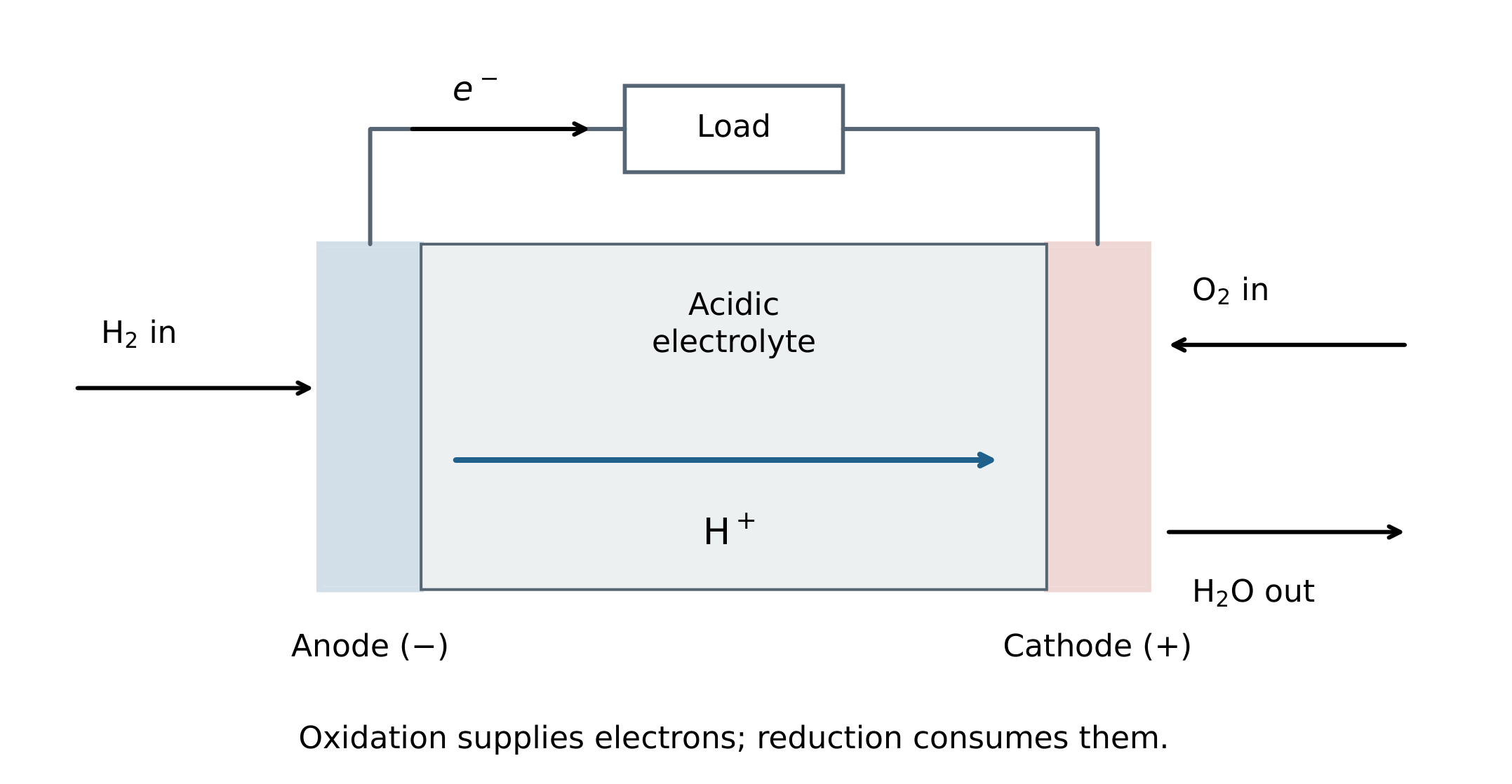
A fuel cell separates fuel oxidation from oxygen reduction at electrodes. Electrons travel through an external circuit and can do electrical work; ions carry charge through an electrolyte. The electrolyte must not provide an electron short circuit. Fuel and oxidant are supplied continuously, unlike the finite stored reactants of a primary cell. A fuel cell is not simply a battery that must be recharged after consuming its original reactants.
Oxidation at the anode supplies electrons to the external circuit; oxygen is reduced at the cathode.
Add and cancel electrons and hydrogen ions to obtain $\mathrm{H_2+\tfrac12O_2\rightarrow H_2O}$. Check both atoms and charge in each half-equation. In this operating cell the anode is negative and the cathode positive; the definitions oxidation/anode and reduction/cathode remain valid in other electrochemical cells too.
In alkaline conditions, balance using hydroxide ions. At the anode:
After cancelling species, the overall reaction is $\mathrm{CH_3OH+\tfrac32O_2\rightarrow CO_2+2H_2O}$. Methanol is a convenient liquid to store, but it is toxic and its use produces CO₂. It is incorrect to say all fuel cells emit only water.
Hydrogen cells have no direct CO₂ from the hydrogen–oxygen reaction. However, hydrogen is an energy carrier: producing, compressing, transporting and storing it require resources and energy. Emissions depend on the production pathway and energy supply. Fuel cells can avoid an intermediate combustion heat engine, but still have losses; neither direct conversion nor a water-only cell product proves 100% efficiency or zero life-cycle impact.
14.8
Practice
Use the rounded fuel data above where needed.
Balance complete combustion equations for propane, $\mathrm{C_3H_8}$, and methanol, $\mathrm{CH_3OH}$. Include water as a liquid.
Balance separate idealized equations for propane forming (a) only CO and water vapour and (b) only carbon and water vapour as products. Why can a real flame differ from both equations?
Explain why an exothermic fuel can need ignition. Identify the error in “energy is released when fuel bonds break”.
Compare methane and ethanol on energy released per mole and per gram, using the given data. Why do the rankings differ?
Calculate direct CO₂ produced when methane releases 4.45 MJ and when ethanol releases 4.101 MJ. Then express each as g per released MJ.
A methane heater has efficiency 70%. Calculate direct CO₂ per useful MJ and the mass of methane required to deliver 7.00 MJ useful heat.
Explain one advantage and one limitation each of coal, oil-derived fuels and natural gas. Distinguish a combustion-emissions comparison from a life-cycle comparison.
Write the photosynthesis and ethanol-fermentation equations. Explain two reasons why crop-derived ethanol need not be carbon neutral.
A reusable product needs 900 energy units to manufacture and 6 per use; a disposable needs 36 per use. Find the equality point and the first whole number of uses for which reuse consumes less energy. State two model limitations.
For the life-cycle example, suppose B's upstream emissions rise to 70 g CO₂-equivalent and its uptake credit falls to 50 g, all per useful MJ. Recalculate B's total and compare with A. What does this show about the decision?
Write and add acidic hydrogen-cell half-equations. Identify the electron direction, the oxidation electrode and the species carrying charge through the electrolyte.
Derive the acidic methanol-cell overall equation from its two half-equations. Explain why “fuel cells have no carbon emissions” is too broad.
A cell receives 100 kJ chemical energy and supplies 58 kJ electricity and 30 kJ useful heat. Find electrical efficiency and total useful-energy efficiency. Explain why neither value alone establishes the lower-impact fuel supply.
Worked answers
$\mathrm{C_3H_8+5O_2\rightarrow3CO_2+4H_2O(l)}$; $\mathrm{2CH_3OH+3O_2\rightarrow2CO_2+4H_2O(l)}$. Carbon and hydrogen balance first; then count oxygen already present in methanol.
(a) $\mathrm{2C_3H_8+7O_2\rightarrow6CO+8H_2O(g)}$. (b) $\mathrm{C_3H_8+2O_2\rightarrow3C+4H_2O(g)}$. Real flames can produce mixtures of CO₂, CO, soot and unburned fuel because mixing and oxygen availability vary.
Ignition supplies the activation energy needed to begin a pathway. Bond breaking absorbs energy; product bond formation releases energy. A negative net enthalpy does not imply a negligible barrier.
Per mole: ethanol 1367 > methane 890 kJ mol⁻¹. Per gram: $E=|\Delta H_c|/M$ gives methane $890/16.0=55.6$ and ethanol $1367/46.0=29.7$ kJ g⁻¹. The molar masses differ; neither ranking alone describes storage or life-cycle impact.
Methane: $n=4450/890=5.00$ mol, giving $m_{\mathrm{CO_2}}=5.00\times44.0=220$ g; $220/4.45=49.4$ g MJ⁻¹. Ethanol: $n=4101/1367=3.00$ mol, giving $m_{\mathrm{CO_2}}=2\times3.00\times44.0=264$ g; $264/4.101=64.4$ g MJ⁻¹.
Intensity $=49.4/0.70\approx70.6$ g per useful MJ. Released energy $=E_{\mathrm{useful}}/\eta=7.00/0.70=10.0$ MJ. $n=10000/890=11.24$ mol and $m=nM=11.24\times16.0\approx180$ g methane. Guard digits avoid premature rounding.
Coal: solid storage is straightforward, but combustion and impurities create CO₂/pollution concerns. Oil fuels: convenient liquid transport, but CO₂ and spills matter. Gas: lower direct CO₂ per released energy than coal in a suitable comparison, but methane leakage and storage/infrastructure matter. Life-cycle assessment also counts production, transport and other upstream/downstream impacts.
$\mathrm{6CO_2+6H_2O\rightarrow C_6H_{12}O_6+6O_2}$ using light; $\mathrm{C_6H_{12}O_6\rightarrow2C_2H_5OH+2CO_2}$. Fossil energy in production and transport can emit CO₂; fertilizer use and land-use change can add greenhouse-gas emissions. Biomass uptake must be assessed over the stated boundary and timescale.
$900+6n=36n$, so $n=900/30=30$. Totals are equal at 30 uses; reuse uses less from 31 whole uses onwards. Cleaning and transport assumptions may change the result; energy equality does not establish equality in water use or waste impacts.
$I_B=72-50+70=92$ g CO₂-equivalent per useful MJ, exceeding A's 76. The ranking reverses when the assumptions change. State the boundary, uncertain inputs and priorities rather than declaring one fuel universally preferable.
Anode: $\mathrm{H_2\rightarrow2H^++2e^-}$. Cathode: $\mathrm{\tfrac12O_2+2H^++2e^-\rightarrow H_2O}$. Overall: $\mathrm{H_2+\tfrac12O_2\rightarrow H_2O}$. Electrons travel from the oxidation anode through the load to the reduction cathode; hydrogen ions carry charge through the acidic electrolyte in this model.
Add $\mathrm{CH_3OH+H_2O\rightarrow CO_2+6H^++6e^-}$ to $\mathrm{\tfrac32O_2+6H^++6e^-\rightarrow3H_2O}$. Cancel electrons, hydrogen ions and one water: $\mathrm{CH_3OH+\tfrac32O_2\rightarrow CO_2+2H_2O}$. Methanol cells directly produce CO₂; even hydrogen cells can have upstream emissions.
Electrical efficiency $=58/100\times100=58$%. Total useful efficiency $=(58+30)/100\times100=88$%; the remaining 12 kJ is not useful output in this boundary. A full comparison also needs fuel production emissions, storage/transport and a common service; useful heat is only credited if there is an actual use for it.
14.9
Exam tips
Balance all atoms, including oxygen already in alcohols, and check charge in half-equations. Use one electrolyte medium consistently.
Compare the same functional unit. Distinguish direct emissions from life-cycle impacts, and renewable supply from a justified carbon-neutral claim.
Support a conditional judgement with data, boundaries and uncertain assumptions. Hydrogen cells have no direct CO₂, but fuel production can emit it; methanol cells directly produce CO₂.