Complements finish the meaning of a verb. Some show degree ((degree marker)得extremely; terrible要命, bad坏(completed / change)了), some ability ((degree marker)得(completed / change)了/(as a resultative verb…不了), some a result (to live (somewhere)住, to open; to drive开, come out / (result: see, think up)出来, (ongoing -ing)着, to / arrive / (result: get)到), and Verb + to come来 + Verb + to go去 shows an action going back and forth. Ask each time: does it say how much, whether you can, or how it ended?
Complements
HSK 5 · Topic 18
 5:44
HSK 5 Grammar 18: Complements
Carrying boxes upstairs on a hot Saturday, you need words for extremes. After an adjective, 得 and a short ending push the quality to the top of the scale.…
English explanations + Mandarin examples · captions follow the spoken text
18.1
At a glance
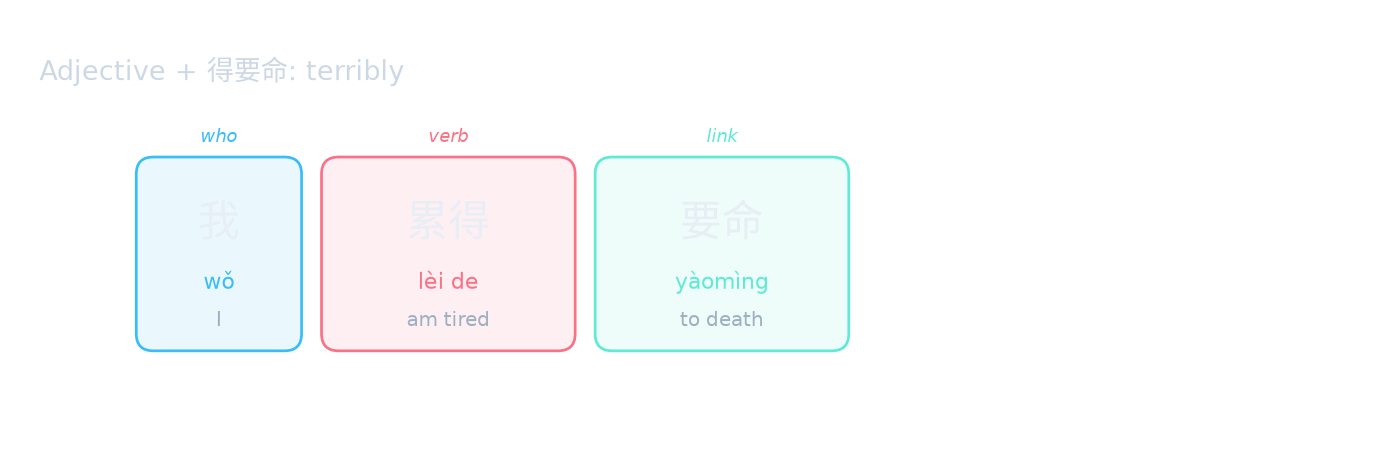
- 1. Advanced degree complements – (degree marker)得 + degree / adjective linker很 / extremely; terrible要命 …: 我累(degree marker)得extremely; terrible要命,what什么all / both都not want to不想to do; to make做(completed / change)了。
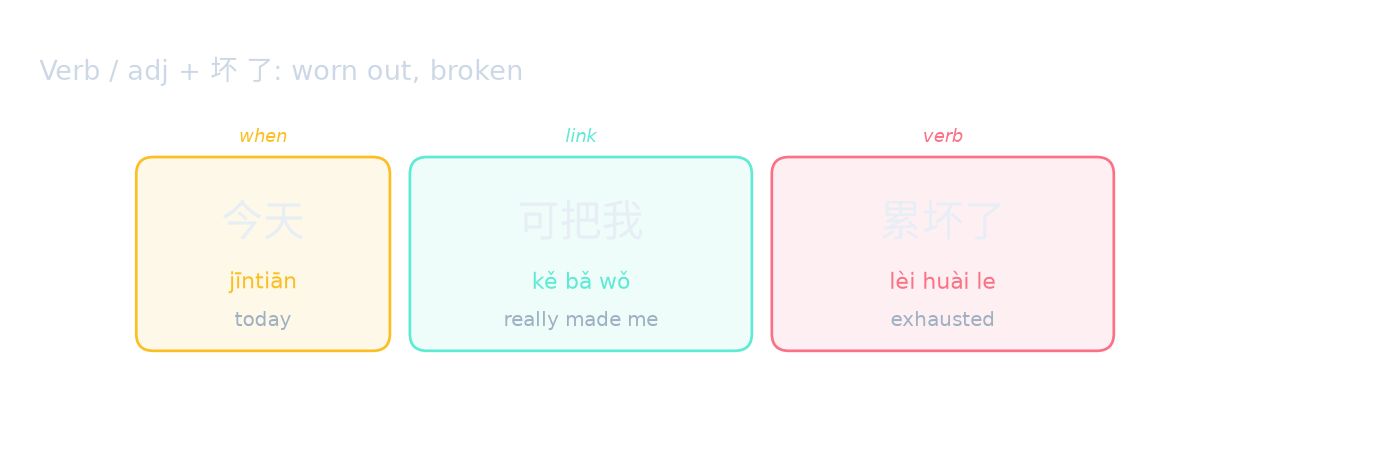
- 2. Verb / Adj + bad坏(completed / change)了 – broken / to an extreme: today今天(prefix) can可(把: marks the object)把I / me我to become exhausted累坏(completed / change)了!
- 3. Verb + (degree marker)得(completed / change)了 / (as a resultative verb…不了 – can / can't manage: so much这么多菜,we / us我们to eat吃(as a resultative verb…不了。
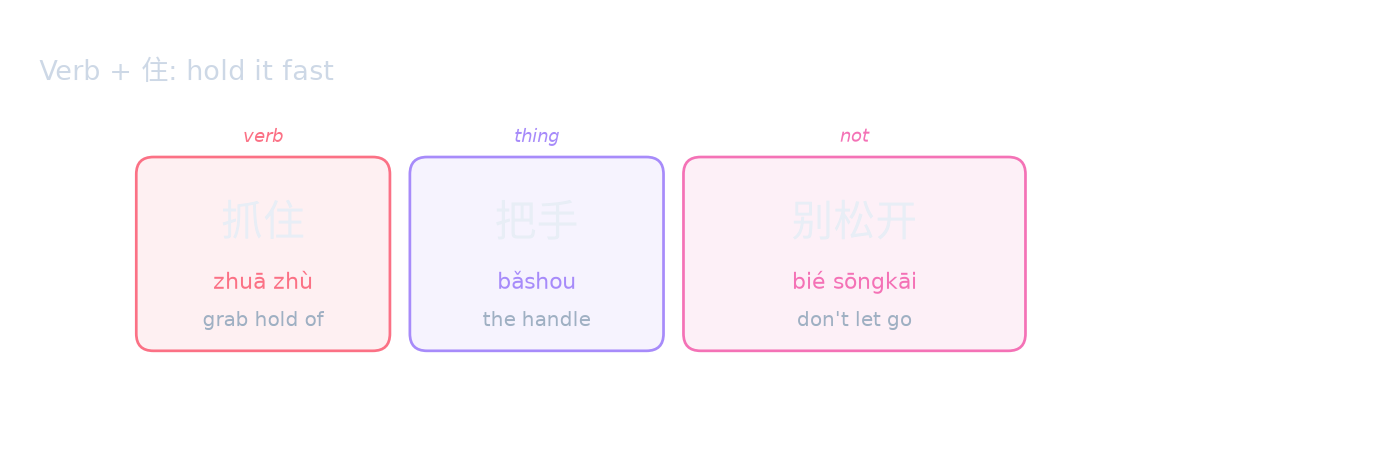
- 4. Result complements to live (somewhere)住 / to open; to drive开 / come out / (result: see, think up)出来: to grab hold of抓住handle把手,don't别to release松开!
- 5. Verb + (ongoing -ing)着 (zháo) – managed to / succeeded: I / me我两点only then / not until才to fall asleep睡着。
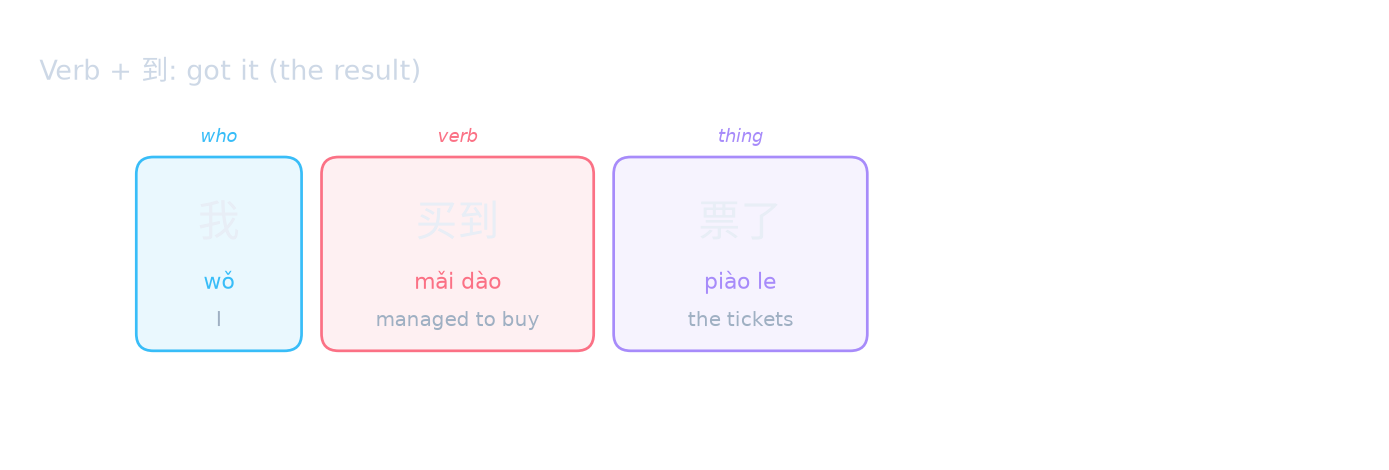
- 6. Verb + to / arrive / (result: get)到 – succeed in reaching: I / me我to buy买to / arrive / (result: get)到ticket票(completed / change)了!
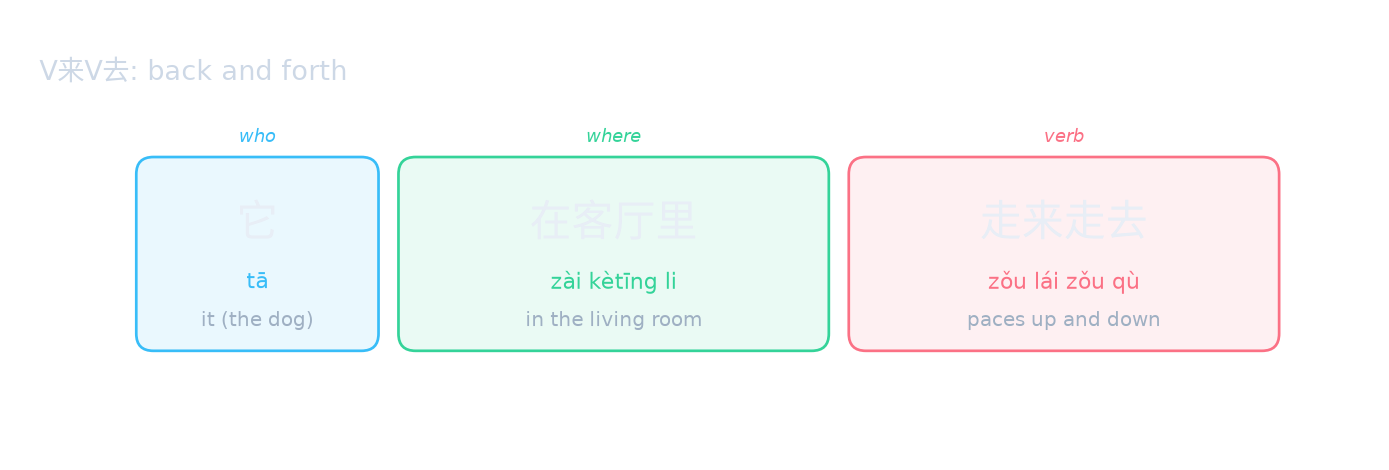
- 7. Verb + to come来 + Verb + to go去 – back and forth: it它at / in在living room客厅inside; in里走来走去。
18.2
1. Advanced degree complements (得 + 很 / 要命 …)
Form: adjective / feeling + (degree marker)得 + degree / adjective linker很 / extremely; terrible要命 / won't do不行 / extremely / terrible不得了
- 我累(degree marker)得extremely; terrible要命,what什么all / both都not want to不想to do; to make做(completed / change)了。 Wǒ lèi de yàomìng. – I'm dead tired; I don't feel like doing anything.
- here这里quiet安静(degree marker)得degree / adjective linker很。 – It's really quiet here.
- I / me我hungry饿(degree marker)得won't do不行(completed / change)了。 – I'm starving.
- to hear听到news; message消息,she / her她happy; glad高兴(degree marker)得extremely / terrible不得了。 – She was overjoyed at the news.
How it works. These complements come after the adjective with (degree marker)得 and push it to a high degree. They are spoken and expressive.
| Complement | Feel | Example |
|---|---|---|
| (degree marker)得degree / adjective linker很 | emphatic, mild | good好(degree marker)得degree / adjective linker很 |
| (degree marker)得extremely; terrible要命 | very strong, usually a complaint | 疼得extremely; terrible要命 |
| (degree marker)得won't do不行 | can hardly bear it | 困得won't do不行 |
| (degree marker)得extremely / terrible不得了 | extreme, good or bad | happy; glad高兴(degree marker)得extremely / terrible不得了 |
Watch out
- Not literal: 冷得extremely; terrible要命 means "freezing", not dangerous.
- No degree word before the adjective: wrong: 很累(degree marker)得extremely; terrible要命 → tired累(degree marker)得extremely; terrible要命.
- In essays, use very非常 / very十分 / especially / special特别.
Vocabulary
Train
| 汉字 | Pinyin | English |
|---|---|---|
| 不得了 | bù dé liǎo | extremely; terrible |
18.3
2. Verb / Adj + 坏了 (broken / to an extreme)
Form: action verb + bad坏 ((completed / change)了) (broken) · feeling / state + bad坏(completed / change)了 (terribly)
- I / me我(modifier / structural particle)的mobile phone手机to drop and break摔坏(completed / change)了。 Wǒ de shǒujī shuāihuài le. – I dropped my phone and broke it.
- younger brother弟弟(把: marks the object)把I / me我(modifier / structural particle)的spectacles眼镜弄坏了。 – My little brother broke my glasses.
- today今天(prefix) can可(把: marks the object)把I / me我to become exhausted累坏(completed / change)了! – Today completely wore me out!
- to hear听到this这个news; message消息,she / her她happy; glad高兴bad坏(completed / change)了。 – She was thrilled at the news.
How it works. After an action verb, bad坏 is a result: the thing broke (to drop and break摔坏 by dropping, to use / with用bad坏 by use, to ruin弄坏 by handling). After a feeling or state, bad坏(completed / change)了 means "extremely" and nothing breaks: 饿坏(completed / change)了, 急坏(completed / change)了, happy; glad高兴bad坏(completed / change)了. (completed / change)了 is usually needed in that sense.
| computer电脑to wear out (tools)用坏(completed / change)了 | I / me我饿坏(completed / change)了 |
|---|---|
| broken (result) | starving (degree) |
Spoken frame. (prefix) can可(把: marks the object)把 + person + feeling + bad坏(completed / change)了: (prefix) can可(把: marks the object)把I / me我急坏(completed / change)了 "I was worried sick".
Watch out
- The broken-result sense often takes (把: marks the object)把 with the thing damaged: (把: marks the object)把spectacles眼镜弄坏了.
18.4
3. Verb + 得了 / 不了 (can / can't manage)
Form: verb + (degree marker)得(completed / change)了 / (as a resultative verb…不了 (liǎo)
- so much这么多菜,we / us我们to eat吃(as a resultative verb…不了。 Wǒmen chī bu liǎo. – That's more food than we can eat.
- so much这么hot热(modifier / structural particle)的day天,I / me我can't stand受不了。 – I can't stand this heat.
- tomorrow明天I / me我to be occupied with sth有事,to go去(as a resultative verb…不了。 – I've got something on tomorrow, so I can't go.
- you你一个person人to move搬(degree marker)得(completed / change)了(yes/no ?)吗? – Can you move it by yourself?
How it works. (completed / change)了 here is read liǎo "manage, finish". (degree marker)得(completed / change)了 says something can be managed and (as a resultative verb…不了 that it can't: too much, too hard, or blocked by circumstances. (as a resultative verb…不了 is far more common; questions use (degree marker)得(completed / change)了(yes/no ?)吗 or (degree marker)得(completed / change)了……(as a resultative verb…不了.
| to eat吃(as a resultative verb…不了 | 吃不完 | cannot不能to eat吃 |
|---|---|---|
| can't manage (too much / unable) | can't finish (some will be left) | mustn't / can't eat it |
Watch out
- Not le: wrong: chī bu le → chī bu liǎo.
- (as a resultative verb…不了 also predicts: 他来(as a resultative verb…不了 means he won't be able to come.

18.5
4. Result complements 住 / 开 / 出来
Form: verb + to live (somewhere)住 / to open; to drive开 / come out / (result: see, think up)出来 (result complements)
- to grab hold of抓住handle把手,don't别to release松开! Zhuāzhù bǎshǒu, bié sōngkāi! – Hold on to the handlebars, don't let go!
- to remember记住I / me我(modifier / structural particle)的电话号码。 – Remember my phone number.
- I / me我to look at; to watch; to read看come out / (result: see, think up)出来he / him他at / in在to lie说谎。 – I could tell he was lying.
- he / him他want / think / miss想out / to happen出(completed / change)了一个good好means办法。 – He came up with a good idea.
How it works. The complement says what result the action reached.
| Complement | Result | Examples |
|---|---|---|
| to live (somewhere)住 | fixed, held, stopped | to grab hold of抓住 grab, to remember记住 remember, to stop / stand still站住 stop! |
| to open; to drive开 | open, apart, away | to open打开 open, to pull open拉开 pull open, to leave走开 go away |
| come out / (result: see, think up)出来 | out, produced, recognised | want / think / miss想come out / (result: see, think up)出来 think of, to look at; to watch; to read看come out / (result: see, think up)出来 tell, to write写come out / (result: see, think up)出来 write out |
Potential forms. can't remember记不住 can't remember · 打不开 won't open · want / think / miss想not不come out / (result: see, think up)出来 can't think of it. With an object, come out / (result: see, think up)出来 can split: want / think / miss想out / to happen出一个means办法to come来.
Watch out
- to see看见 means seeing with your eyes; to look at; to watch; to read看come out / (result: see, think up)出来 means working something out from clues.
18.6
5. Verb + 着 (zháo) (managed to / succeeded)
Form: verb + (ongoing -ing)着 (zháo) · verb + not不(ongoing -ing)着 / not / haven't没 + verb + (ongoing -ing)着
- I / me我两点only then / not until才to fall asleep睡着。 Wǒ liǎng diǎn cái shuìzháo. – I didn't fall asleep until two.
- I / me我太紧张(completed / change)了,睡不着。 – I'm too nervous to sleep.
- I / me我to look for; to give change找(completed / change)了a long time / half a day半天also也not / haven't没to look for; to give change找(ongoing -ing)着。 – I looked for ages and couldn't find it.
How it works. Read zháo, (ongoing -ing)着 after a verb means the action reached its goal: to fall asleep睡着 fall asleep, to look for; to give change找(ongoing -ing)着 find, to buy买(ongoing -ing)着 manage to buy. The potential 睡不着 "can't get to sleep" is very common. With to look for; to give change找 and to buy买, to / arrive / (result: get)到 is the standard form (to find找到, to buy买to / arrive / (result: get)到); (ongoing -ing)着 sounds colloquial and northern.
| to fall asleep睡着 shuìzháo | to fall asleep睡着 shuìzhe | to sleep睡to / arrive / (result: get)到十点 |
|---|---|---|
| fall asleep | in the state of sleeping (he / him他to fall asleep睡着(and …? / softener)呢) | sleep until ten |
Watch out
- The sentence tells you the reading: 睡不着 and not / haven't没to fall asleep睡着 are always zháo.
- to fall asleep睡着 "fall asleep" has no to / arrive / (result: get)到 version.

18.7
6. Verb + 到 (succeed in reaching)
Form: verb + to / arrive / (result: get)到 (+ object / place / time)
- I / me我to buy买to / arrive / (result: get)到ticket票(completed / change)了! Wǒ mǎidào piào le! – I got tickets!
- you你to receive收到I / me我(modifier / structural particle)的mail邮件(completed / change)了(yes/no ?)吗? – Did you get my email?
- he / him他to walk / to leave走to / arrive / (result: get)到doorway门口。 – He walked to the door.
- we / us我们聊到degree / adjective linker很late / evening晚。 – We chatted until very late.
How it works. to / arrive / (result: get)到 after a verb marks that the action reached its goal (a thing found, bought, received), a place or a time.
| Action | Result |
|---|---|
| to look for; to give change找 look for | to find找到 find |
| to look at; to watch; to read看 look | to see看到 / to see看见 see |
| to listen to听 listen | to hear听到 / to hear听见 hear |
Forms. Negative: 没买to / arrive / (result: get)到 (tried, didn't get one). Potential: to buy买to get得到 / 买不到.
Watch out
- Searching isn't finding: I / me我to look for; to give change找(completed / change)了,but可是not / haven't没to find找到.
- Don't negate the result with not不 for past events: wrong: I / me我not不to buy买to / arrive / (result: get)到 → I / me我not / haven't没to buy买to / arrive / (result: get)到.
18.8
7. Verb + 来 + Verb + 去 (back and forth)
Form: verb + to come来 + same verb + to go去
- it它at / in在living room客厅inside; in里走来走去。 Tā zài kètīng li zǒu lái zǒu qù. – It keeps pacing back and forth in the living room.
- child孩子(plural)们at / in在courtyard院子inside; in里to scamper跑来跑去。 – The children are running about in the yard.
- I / me我想来想去,or / still还是to decide / decision决定不去(completed / change)了。 – I thought it over and over and decided not to go after all.
- they他们说来说去or / still还是that那几句话。 – They went round in circles saying the same few things.
How it works. Repeating a one-syllable verb with to come来 and to go去 shows movement in many directions, or doing something over and over. With thinking and talking, it suggests going round in circles before a conclusion (or / still还是 / finally; last最后).
| 走来走去 | to make a round trip来回to walk / to leave走 | 一个to make a round trip来回 |
|---|---|---|
| walk about, pace | walk back and forth | a round trip |
Watch out
- Use the same verb twice: wrong: 走来to run跑to go去 → 走来走去.
- It describes an activity; don't add a result complement (wrong: 走来走去to finish完(completed / change)了).
Vocabulary
Train
| 汉字 | Pinyin | English |
|---|---|---|
| 客厅 | kè tīng | living room |
18.9
Practice
Cover the teaching pages before you answer. The answers are at the end.
1. Advanced degree complements ((degree marker)得 + degree / adjective linker很 / extremely; terrible要命 …)
1. Complete: “I'm starving.” I / me我hungry饿…………won't do不行(completed / change)了。
2. Which suits a formal essay?
- A. this这个question / problem问题难死(completed / change)了。
- B. this这个question / problem问题rare; hard to come by难得won't do不行。
- C. this这个question / problem问题very非常difficult / hard难。
- D. this这个question / problem问题rare; hard to come by难得extremely; terrible要命。
3. Match each phrase to its meaning.
-
(1) 疼得extremely; terrible要命
-
(2) quiet安静(degree marker)得degree / adjective linker很
-
(3) happy; glad高兴(degree marker)得extremely / terrible不得了
-
A. hurts terribly
-
B. over the moon
-
C. really quiet
4. True or false? 冷得extremely; terrible要命 means it is literally dangerously cold. If false, correct it.
5. You finally reach the hostel after walking all day in the mountains. Write your answer in Chinese, then say it aloud.
2. Verb / Adj + bad坏(completed / change)了 (broken / to an extreme)
6. Complete: “The kids are starving.” child孩子(plural)们hungry饿…………(completed / change)了。
7. In computer电脑to wear out (tools)用坏(completed / change)了, what does bad坏 express?
- A. someone was angry
- B. the computer broke from use
- C. the computer is bad quality
- D. extremely
8. Build: “My brother broke my glasses.”
Put in order: younger brother弟弟 / to ruin弄坏 / (把: marks the object)把I / me我(modifier / structural particle)的spectacles眼镜 / (completed / change)了。
9. True or false? In happy; glad高兴bad坏(completed / change)了, something is broken. If false, correct it.
10. Your mum comes home after a twelve-hour shift and collapses on the sofa. Use Verb / Adj + bad坏(completed / change)了. Write your answer in Chinese, then say it aloud.
3. Verb + (degree marker)得(completed / change)了 / (as a resultative verb…不了 (can / can't manage)
11. Complete: “I've got something on tomorrow, so I can't come.” I / me我tomorrow明天to be occupied with sth有事,to come来…………(completed / change)了。
12. How is (completed / change)了 read in can't stand受不了?
- A. lài
- B. le
- C. lā
- D. liǎo
13. Build: “I can't stand this heat.”
Put in order: so much这么hot热(modifier / structural particle)的day天 / can't stand受不了。 / , / I / me我
14. True or false? In a rule, you你cannot不能to go去 means you are not allowed; you你to go去(as a resultative verb…不了 means you are not able to go. If false, correct it.
15. Your host keeps adding dishes to the table, far more than two people can eat. Use Verb + (degree marker)得(completed / change)了 / (as a resultative verb…不了. Write your answer in Chinese, then say it aloud.
4. Result complements to live (somewhere)住 / to open; to drive开 / come out / (result: see, think up)出来
16. Complete: “Remember: the meeting is at nine.” to record记…………:meeting会议九点to start开始。
17. “I can't open this bottle.” Which is correct?
- A. this这个bottle瓶子I / me我打不开。
- B. this这个bottle瓶子I / me我not不to open打开。
- C. this这个bottle瓶子I / me我cannot不能(of a sports competition or…开打。
- D. this这个bottle瓶子I / me我to open打开not不。
18. Match each verb to its meaning.
-
(1) to grab hold of抓住
-
(2) to depart离开
-
(3) want / think / miss想come out / (result: see, think up)出来
-
(4) to look at; to watch; to read看come out / (result: see, think up)出来
-
A. tell, make out
-
B. come up with
-
C. grab hold of
-
D. leave
19. True or false? to look at; to watch; to read看come out / (result: see, think up)出来 and to see看见 mean the same. If false, correct it.
20. You are helping your little sister learn to ride a bike. Use Result complements to live (somewhere)住 / to open; to drive开 / come out / (result: see, think up)出来. Write your answer in Chinese, then say it aloud.
5. Verb + (ongoing -ing)着 (zháo) (managed to / succeeded)
21. Complete: “I'm too nervous; I can't get to sleep.” I / me我太紧张(completed / change)了,to sleep睡not不…………。
22. How is (ongoing -ing)着 read in I / me我两点only then / not until才to fall asleep睡着?
- A. zhuó
- B. zháo
- C. zhe
- D. zhāo
23. Build: “Did you find the keys?”
Put in order: (completed / change)了 / key钥匙 / to look for; to give change找(ongoing -ing)着 / (yes/no ?)吗?
24. True or false? to sleep睡to / arrive / (result: get)到十点 means “fell asleep at ten”. If false, correct it.
25. You tossed and turned for hours before you managed to sleep. Use Verb + (ongoing -ing)着. Write your answer in Chinese, then say it aloud.
6. Verb + to / arrive / (result: get)到 (succeed in reaching)
26. Complete: “I looked for it for ages but didn't find it.” I / me我to look for; to give change找(completed / change)了a long time / half a day半天also也not / haven't没to look for; to give change找…………。
27. Which says “I can't get hold of this book anywhere”?
- A. this这本书where哪儿all / both都to buy买to / arrive / (result: get)到not不。
- B. this这本书where哪儿all / both都not不to buy买to / arrive / (result: get)到。
- C. this这本书where哪儿all / both都not / haven't没to buy买。
- D. this这本书where哪儿all / both都买不到。
28. Build: “We chatted until very late.”
Put in order: 聊到 / we / us我们 / degree / adjective linker很late / evening晚。
29. True or false? to hear听到 makes clear that the sound was actually heard. If false, correct it.
30. Concert tickets sold out in two minutes, but you clicked fast enough. Use Verb + to / arrive / (result: get)到. Write your answer in Chinese, then say it aloud.
7. Verb + to come来 + Verb + to go去 (back and forth)
31. Complete: “Birds are flying back and forth.” bird鸟儿飞来to fly飞…………。
32. Which is correct?
- A. he / him他走来走去。
- B. he / him他走来to run跑to go去。
- C. he / him他to walk / to leave走to go去走来(completed / change)了to finish完。
- D. 他来to walk / to leave走to go去to walk / to leave走。
33. Build: “I thought it over and over and decided not to go.”
Put in order: or / still还是to decide / decision决定 / , / 不去(completed / change)了。 / I / me我想来想去
34. True or false? 一个to make a round trip来回 means “a round trip”. If false, correct it.
35. Your dog can't settle before the storm and keeps pacing around the living room. Use Verb + to come来 + Verb + to go去. Write your answer in Chinese, then say it aloud.
18.10
Mixed practice
These questions mix the patterns and use new situations.
36. Choose (degree marker)得(completed / change)了 or (ongoing -ing)着: so much这么多菜,I / me我一个person人to eat吃not不…………。 / I / me我to look for; to give change找(completed / change)了a long time / half a day半天,finally终于to look for; to give change找…………(completed / change)了。
37. Choose to live (somewhere)住 or to open; to drive开: 请记…………I / me我(modifier / structural particle)的电话号码。 / please; to invite请to stand as a goalkeeper把门to hit / play / make (a call)打…………。
38. Say "He walked back and forth in the room."
39. What does 饿坏(completed / change)了 mean?
40. Find and fix the problem. A classmate thinks to look at; to watch; to read看(as a resultative verb…不了 and not / haven't没to look at; to watch; to read看to finish完 mean the same. What is the difference?
41. Use it yourself. Ask someone to hold the door, and say you can't eat so much food.
18.11
Answers and explanations
Mark your work, then correct each mistake in your own words.
1. Advanced degree complements ((degree marker)得 + degree / adjective linker很 / extremely; terrible要命 …)
1. (degree marker)得
Adj + (degree marker)得 + won't do不行.
2. C. this这个question / problem问题very非常difficult / hard难。
The (degree marker)得 complements are colloquial; essays use very非常.
3. (1) A: 疼得extremely; terrible要命 = hurts terribly; (2) C: quiet安静(degree marker)得degree / adjective linker很 = really quiet; (3) B: happy; glad高兴(degree marker)得extremely / terrible不得了 = over the moon
All are degree complements with different flavours.
4. False.
extremely; terrible要命 is just an intensifier here.
5. Model answer: 我累(degree marker)得extremely; terrible要命,what什么all / both都not want to不想to do; to make做(completed / change)了。
Check your answer:
- extremely; terrible要命 does not mean real danger: 冷得extremely; terrible要命 just means "freezing".
- No degree / adjective linker很 before the adjective: tired累(degree marker)得extremely; terrible要命, not 很累(degree marker)得extremely; terrible要命.
2. Verb / Adj + bad坏(completed / change)了 (broken / to an extreme)
6. bad坏
Feeling / state + bad坏(completed / change)了 = extremely.
7. B. the computer broke from use
Action verb + bad坏 = broken by that action.
8. younger brother弟弟(把: marks the object)把I / me我(modifier / structural particle)的spectacles眼镜弄坏了。
(把: marks the object)把 + object + verb + bad坏 + (completed / change)了.
9. False.
With feelings, bad坏(completed / change)了 just means “extremely”.
10. Model answer: today今天(prefix) can可(把: marks the object)把I / me我to become exhausted累坏(completed / change)了!
Check your answer:
- Action verb + bad坏 = something is physically broken: computer电脑to wear out (tools)用坏(completed / change)了 – "The computer broke from use."
- Feeling / state + bad坏(completed / change)了 = an extreme degree, nothing broken: 饿坏(completed / change)了. (completed / change)了 is usually needed.
3. Verb + (degree marker)得(completed / change)了 / (as a resultative verb…不了 (can / can't manage)
11. not不
Verb + (as a resultative verb…不了 = can't manage.
12. D. liǎo
In potential complements (degree marker)得(completed / change)了 / (as a resultative verb…不了 (“can / can't manage”), (completed / change)了 is read liǎo: can't stand受不了 shòu bu liǎo “can't stand it”. The particle le is a different use.
13. so much这么hot热(modifier / structural particle)的day天,I / me我can't stand受不了。
Topic, then subject + can't stand受不了.
14. True.
cannot不能 can be a rule; to go去(as a resultative verb…不了 says it is impossible.
15. Model answer: so much这么多菜,we / us我们to eat吃(as a resultative verb…不了。
Check your answer:
- In to eat吃(as a resultative verb…不了 / to go去(degree marker)得(completed / change)了, (completed / change)了 = liǎo, not the particle le.
- Ask with both forms: you你to go去(degree marker)得(completed / change)了to go去(as a resultative verb…不了? ("Can you make it?") or you你to go去(degree marker)得(completed / change)了(yes/no ?)吗? – "Can you make it?"
4. Result complements to live (somewhere)住 / to open; to drive开 / come out / (result: see, think up)出来
16. to live (somewhere)住
to remember记住 = remember (fix in memory).
17. A. this这个bottle瓶子I / me我打不开。
Potential complement: 打不开.
18. (1) C: to grab hold of抓住 = grab hold of; (2) D: to depart离开 = leave; (3) B: want / think / miss想come out / (result: see, think up)出来 = come up with; (4) A: to look at; to watch; to read看come out / (result: see, think up)出来 = tell, make out
to live (somewhere)住 fixes, to open; to drive开 separates, come out / (result: see, think up)出来 brings out.
19. False.
to see看见 = see; to look at; to watch; to read看come out / (result: see, think up)出来 = work out from clues.
20. Model answer: to grab hold of抓住handle把手,don't别to release松开!
Check your answer:
- can't remember记不住 = can't remember; 打不开 = can't open; want / think / miss想not不come out / (result: see, think up)出来 = can't think of it.
- come out / (result: see, think up)出来 can split around an object: want / think / miss想out / to happen出一个means办法to come来 / want / think / miss想come out / (result: see, think up)出来一个means办法 – "Come up with a solution."
5. Verb + (ongoing -ing)着 (zháo) (managed to / succeeded)
21. (ongoing -ing)着
睡不着 = can't fall asleep.
22. B. zháo
Success in reaching the goal = zháo.
23. key钥匙to look for; to give change找(ongoing -ing)着(completed / change)了(yes/no ?)吗?
Verb + (ongoing -ing)着 (zháo) + (completed / change)了.
24. False.
False. to / arrive / (result: get)到 after a verb shows the end point in time: to sleep睡to / arrive / (result: get)到十点 means “slept until ten”. “Fell asleep at ten” is 十点to fall asleep睡着(completed / change)了.
25. Model answer: I / me我两点only then / not until才to fall asleep睡着。
Check your answer:
- to fall asleep睡着 (shuì zháo) = fall asleep (the goal reached); to fall asleep睡着 (shuì zhe) = in a sleeping state – context and reading tell them apart.
- For finding, to find找到 is the standard, more general form; to look for; to give change找(ongoing -ing)着 is colloquial, mainly northern.
6. Verb + to / arrive / (result: get)到 (succeed in reaching)
26. to / arrive / (result: get)到
to find找到 = find (the goal reached).
27. D. this这本书where哪儿all / both都买不到。
Potential complement: 买不到.
28. we / us我们聊到degree / adjective linker很late / evening晚。
Verb + to / arrive / (result: get)到 + degree / time.
29. True.
True. to listen to听 is the action of listening; adding the result complement to / arrive / (result: get)到 shows the sound was actually perceived: I / me我to listen to听(completed / change)了,but可是not / haven't没to hear听到.
30. Model answer: I / me我to buy买to / arrive / (result: get)到ticket票(completed / change)了!
Check your answer:
- to look for; to give change找 = look for; to find找到 = find. I / me我to look for; to give change找(completed / change)了,but可是not / haven't没to find找到 – "I looked but didn't find it."
- Negate with not / haven't没: 没买to / arrive / (result: get)到; potential: 买不到 / to buy买to get得到.
7. Verb + to come来 + Verb + to go去 (back and forth)
31. to go去
Vto come来Vto go去.
32. A. he / him他走来走去。
In verb + to come来 + verb + to go去 the same verb repeats to show movement back and forth: he / him他走来走去 “He paces up and down.” Mixing two verbs or adding (completed / change)了to finish完 breaks the pattern.
33. I / me我想来想去,or / still还是to decide / decision决定不去(completed / change)了。
想来想去 + decision.
34. True.
True. to make a round trip来回 can be a noun meaning “a round trip”: 一个to make a round trip来回want / will / need要两个hour小时. As an adverb it means “back and forth”.
35. Model answer: it它at / in在living room客厅inside; in里走来走去。
Check your answer:
- Use the same verb in both places: 走来走去, not 走来to run跑to go去.
- It describes a repeated activity, so it rarely takes a result complement: 走来走去, not 走来走去to finish完.
Mixed practice
36. I / me我一个person人to eat吃(as a resultative verb…不了 (cannot manage)。finally终于to look for; to give change找(ongoing -ing)着(completed / change)了 (zháo: managed to find).
37. please; to invite请to remember记住 (fix it in memory)。please; to invite请to stand as a goalkeeper把门to open打开 (open).
38. he / him他at / in在room房间inside; in里走来走去。
39. Extremely hungry. After an adjective, bad坏(completed / change)了 means "terribly"; after a verb it can mean broken (computer电脑to wear out (tools)用坏(completed / change)了).
40. to look at; to watch; to read看(as a resultative verb…不了 says you cannot manage it (too much, no time, not allowed). not / haven't没to look at; to watch; to read看to finish完 reports that you did not finish it.
41. Model answer. please; to invite请to stand as a goalkeeper把门to pull拉to live (somewhere)住。so much这么多菜,I / me我to eat吃(as a resultative verb…不了。
Review later. Tomorrow, make one sentence each with to live (somewhere)住, to open; to drive开 and come out / (result: see, think up)出来.
Interactive lessons on this topic
Work through it step by step, with instant-check exercises.