instead (contrary to expectation)反而 means "instead, on the contrary": the result is the opposite of what you would expect. It goes before the verb, and often follows not only不但not不/not / haven't没: he / him他not only不但没生气,instead (contrary to expectation)反而to laugh笑(completed / change)了.
"But" statements
HSK 5 · Topic 13
 3:23
HSK 5 Grammar 13: But" statements
You add more sugar to a cake because you want it to taste better. Your friends take one bite and reach for water. The extra sugar made it worse. That is the…
English explanations + Mandarin examples · captions follow the spoken text
13.1
反而 (on the contrary / instead)
Form: subject + instead (contrary to expectation)反而 + predicate · (subject) not only不但not不 / not / haven't没……,instead (contrary to expectation)反而……
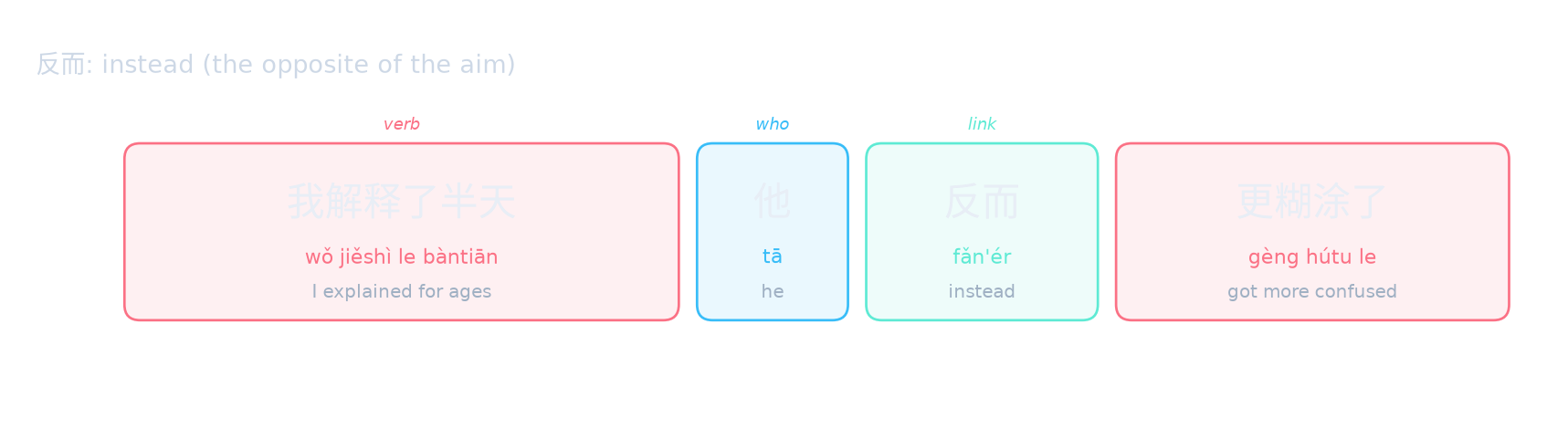
- I / me我to explain / explanation解释(completed / change)了a long time / half a day半天,he / him他instead (contrary to expectation)反而more更confused; muddled糊涂(completed / change)了。 Wǒ jiěshìle bàntiān, tā fǎn'ér gèng hútu le. – I explained for ages, and he only got more confused.
- he / him他not only不但没生气,instead (contrary to expectation)反而to laugh笑(completed / change)了。 Tā búdàn méi shēngqì, fǎn'ér xiào le. – Far from getting angry, he actually laughed.
- to eat吃(completed / change)了medicine药,illness / ill病instead (contrary to expectation)反而更重(completed / change)了。 Chīle yào, bìng fǎn'ér gèng zhòng le. – After taking the medicine, the illness actually got worse.
- rain雨not only不但没停,instead (contrary to expectation)反而越下越大。 Yǔ búdàn méi tíng, fǎn'ér yuè xià yuè dà. – Far from stopping, the rain got heavier and heavier.
- I / me我to think以为to sit / to take (a bus …)坐taxi出租车会快a little一点儿,didn't expect没想到instead (contrary to expectation)反而更慢(completed / change)了。 Wǒ yǐwéi zuò chūzūchē huì kuài yìdiǎnr, méi xiǎngdào fǎn'ér gèng màn le. – I thought a taxi would be quicker, but it turned out even slower.
- teacher老师to criticize批评(completed / change)了he / him他,he / him他instead (contrary to expectation)反而more更to work hard / effort努力(completed / change)了。 Lǎoshī pīpíngle tā, tā fǎn'ér gèng nǔlì le. – The teacher criticised him, and instead of giving up he worked even harder.
How it works. instead (contrary to expectation)反而 fǎn'ér "instead, on the contrary" marks a result that goes against what was expected or intended. The expectation comes first, either stated (I / me我to think以为……) or obvious from the situation: explaining should help, medicine should cure, a taxi should be faster. Then instead (contrary to expectation)反而 introduces the surprising opposite.
With not only不但not不 / not only不但not / haven't没, the first half rules out the expected reaction and the second half gives the opposite: he / him他not only不但没生气,instead (contrary to expectation)反而to laugh笑(completed / change)了. more更 often follows instead (contrary to expectation)反而, because the result is "even more" of the unexpected thing.
| instead (contrary to expectation)反而 | but但是 / but; yet却 | opposite; on the contrary相反 |
|---|---|---|
| goes against an expectation; adverb after the subject | a plain contrast between two facts | "on the contrary"; can start a sentence |
| I / me我to explain / explanation解释(completed / change)了,he / him他instead (contrary to expectation)反而more更confused; muddled糊涂(completed / change)了。 | he / him他degree / adjective linker很intelligent聪明,but但是not不to work hard / effort努力。 | he / him他没生气,opposite; on the contrary相反,he / him他degree / adjective linker很happy; glad高兴。 |
Watch out
- instead (contrary to expectation)反而 is an adverb, so it goes after the subject: wrong: instead (contrary to expectation)反而he / him他to laugh笑(completed / change)了 → he / him他instead (contrary to expectation)反而to laugh笑(completed / change)了.
- It needs an expectation to go against; a plain contrast takes but可是 or but但是: wrong: I / me我degree / adjective linker很tired累,instead (contrary to expectation)反而I / me我to go去to play ball打球(completed / change)了 → I / me我degree / adjective linker很tired累,but可是or / still还是to go去to play ball打球(completed / change)了.
- Pair not only不但 with not / haven't没 / not不 here, not with moreover而且: wrong: he / him他not only不但没生气,moreover而且to laugh笑(completed / change)了 → he / him他not only不但没生气,instead (contrary to expectation)反而to laugh笑(completed / change)了.
In a passage
in order to为了to lose weight减肥,小张every day每天only只to eat吃一顿饭。but可是一个月after / from now on以后,he / him他not only不但没瘦,instead (contrary to expectation)反而fat胖(completed / change)了two两kilogram公斤。doctor医生to tell告诉he / him他,hungry饿(degree marker)得too太amazing; severe厉害,evening晚上instead (contrary to expectation)反而easy容易to eat吃(degree marker)得more更many; much多。later; afterwards后来he / him他to convert改成on time按时to have a meal吃饭、many; much多sports / to exercise运动,body weight体重only then / not until才slowly慢慢降下来。
Read and notice. What did 小张 expect, and what happened instead? Find both instead (contrary to expectation)反而 sentences.
Vocabulary
Train
| 汉字 | Pinyin | English |
|---|---|---|
| 反而 | fǎn ér | instead (contrary to expectation) |
| 糊涂 | hú tu | confused; muddled |
13.2
Practice
Cover the teaching pages before you answer. The answers are at the end.
1. Complete: “After the rain, it got hotter instead.” down / next; to fall (rain), get off下(completed / change)了rain雨,weather天气…………more更hot热(completed / change)了。
2. Which sentence is correct?
- A. he / him他not / haven't没to cry哭instead (contrary to expectation)反而,to laugh笑(completed / change)了。
- B. he / him他instead (contrary to expectation)反而not only不但没哭,to laugh笑(completed / change)了。
- C. he / him他not only不但没哭,instead (contrary to expectation)反而to laugh笑(completed / change)了。
- D. he / him他to laugh笑(completed / change)了instead (contrary to expectation)反而。
3. Build: “Far from getting angry, he actually laughed.”
Put in order: , / instead (contrary to expectation)反而 / he / him他not only不但没生气 / to laugh笑(completed / change)了。
4. True or false? opposite; on the contrary相反 can open a sentence followed by a comma. If false, correct it.
5. You tried to help your little brother with maths, but he got more confused. Use instead (contrary to expectation)反而. Write your answer in Chinese, then say it aloud.
13.3
Mixed practice
These questions mix the patterns and use new situations.
6. Fill in instead (contrary to expectation)反而 or moreover而且: I / me我to think以为他会to get angry生气,but可是he / him他not only不但没生气,…………to laugh笑(completed / change)了。
7. Join with instead (contrary to expectation)反而: I took medicine / my cold got worse.
8. Find and fix the problem. A classmate writes I / me我degree / adjective linker很tired累,instead (contrary to expectation)反而I / me我to go去to play ball打球(completed / change)了 to add a second fact. Why does instead (contrary to expectation)反而 not fit?
9. Use it yourself. Describe something you expected to be hard that helped you instead.
13.4
Answers and explanations
Mark your work, then correct each mistake in your own words.
1. instead (contrary to expectation)反而
instead (contrary to expectation)反而 marks the opposite of what you'd expect.
2. C. he / him他not only不但没哭,instead (contrary to expectation)反而to laugh笑(completed / change)了。
not only不但not / haven't没…,instead (contrary to expectation)反而… with instead (contrary to expectation)反而 after the (omitted) subject.
3. he / him他not only不但没生气,instead (contrary to expectation)反而to laugh笑(completed / change)了。
not only不但not / haven't没…,instead (contrary to expectation)反而….
4. True.
True. opposite; on the contrary相反 can open a sentence, followed by a comma, to mean “on the contrary”: he / him他没生气,opposite; on the contrary相反,he / him他degree / adjective linker很happy; glad高兴.
5. Model answer: I / me我to explain / explanation解释(completed / change)了a long time / half a day半天,he / him他instead (contrary to expectation)反而more更confused; muddled糊涂(completed / change)了。
Check your answer:
- instead (contrary to expectation)反而 is an adverb: rain雨instead (contrary to expectation)反而更大(completed / change)了 is the usual order.
- It needs an expectation to go against; for a plain contrast use but但是 / but; yet却.
Mixed practice
6. instead (contrary to expectation)反而. I / me我to think以为 sets up an expectation, and the result is the opposite; moreover而且 only adds more of the same.
7. I / me我to eat吃(completed / change)了medicine药,to catch cold感冒instead (contrary to expectation)反而more更amazing; severe厉害(completed / change)了。instead (contrary to expectation)反而 goes before the verb phrase, after the subject.
8. instead (contrary to expectation)反而 needs a result opposite to what was expected, and it goes after the subject: I / me我to think以为to rest休息can / will会good好a bit一点,instead (contrary to expectation)反而更累(completed / change)了.
9. Model answer. I / me我to think以为this这本书很难,didn't expect没想到it它instead (contrary to expectation)反而to help帮I / me我more更to understand / clear明白(completed / change)了。
Review later. Tomorrow, make one not only不但not / haven't没……instead (contrary to expectation)反而…… sentence.
Interactive lessons on this topic
Work through it step by step, with instant-check exercises.