if要是……then / just就…… is the spoken "if". It works like if如果……then / just就……, but sounds more relaxed: if要是you你to have / there is有time时间,we / us我们then / just就together一起to go去. then / just就 comes after the subject of the second half.
"If" statements
HSK 4 · Topic 17
 3:00
HSK 4 Grammar 17: "If" statements
要是 and 就 are the everyday spoken if and then, the chatty twin of 如果. The condition leads, and 就 stamps the consequence. The exam checks the 就.
English explanations + Mandarin examples · captions follow the spoken text
17.1
要是 … ,就 … (if – spoken)
Form: if要是 + condition + (if (coming after a…的话),subject + then / just就 + result
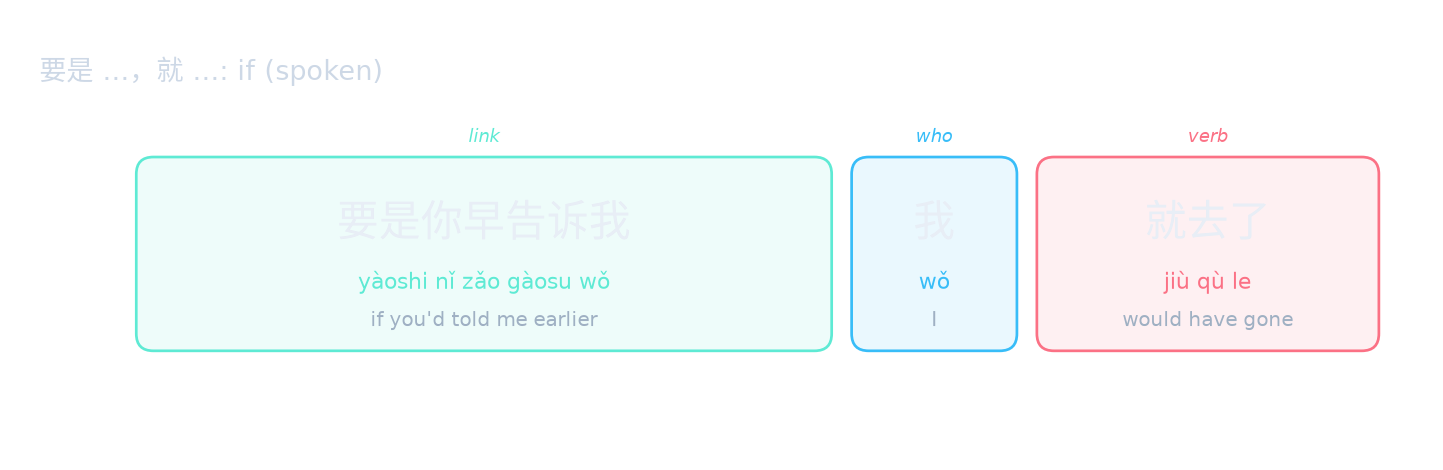
- if要是you你early早to tell告诉I / me我,I / me我then / just就to go去(completed / change)了。 Yàoshi nǐ zǎo gàosu wǒ, wǒ jiù qù le. – If you'd told me earlier, I would have gone.
- if要是tomorrow明天不下雨,we / us我们then / just就to go去to climb a mountain爬山。 Yàoshi míngtiān bú xià yǔ, wǒmen jiù qù pá shān. – If it doesn't rain tomorrow, we'll go hiking.
- if要是I / me我早点儿to go out出门,then / just就won't / can't不会to arrive late迟到(completed / change)了。 Yàoshi wǒ zǎo diǎnr chūmén, jiù bú huì chídào le. – If I'd left earlier, I wouldn't have been late.
- if要是you你tired累(completed / change)了,then / just就to rest休息(used after a verb) give it…一下。 Yàoshi nǐ lèi le, jiù xiūxi yíxià. – If you're tired, have a rest.
- if要是to have / there is有question / problem问题if (coming after a…的话,at any time随时to / for / give给I / me我to make a telephone call打电话。 Yàoshi yǒu wèntí dehuà, suíshí gěi wǒ dǎ diànhuà. – If there's any problem, call me any time.
- if要是I / me我to be / is是you你,I / me我then / just就not不to buy买so much这么expensive贵(modifier / structural particle)的。 Yàoshi wǒ shì nǐ, wǒ jiù bù mǎi zhème guì de. – If I were you, I wouldn't buy such an expensive one.
How it works. if要是 yàoshi is the everyday spoken "if". The condition comes first; if (coming after a…的话 can close it (if要是……if (coming after a…的话). The result clause takes then / just就, placed after its subject; when the subject is the same, it can drop: if要是tired累(completed / change)了,then / just就to rest休息.
if要是 covers three kinds of "if": a real possibility (if要是tomorrow明天不下雨), advice (if要是you你tired累(completed / change)了,then / just就……), and an unreal past or present (if要是you你early早to tell告诉I / me我,I / me我then / just就to go去(completed / change)了; if要是I / me我to be / is是you你……). Chinese verbs do not change form for these, so the context, (completed / change)了 and then / just就won't / can't不会……(completed / change)了 tell you that something did not happen.
| if要是……then / just就…… | if如果……then / just就…… | as long as只要……then / just就…… |
|---|---|---|
| spoken "if" | neutral, fits writing | "as long as": this one condition is enough |
| if要是to rain下雨,we / us我们then / just就not不to go去。 | if如果to have / there is有question / problem问题,please; to invite请to contact; connection联系I / me我。 | as long as只要to have time (to do sth)有空,I / me我then / just就to come来。 |
Watch out
- then / just就 goes after the subject: wrong: if要是to rain下雨,then / just就we / us我们不去 → if要是to rain下雨,we / us我们then / just就not不to go去.
- Do not add but但是 or so / therefore所以 to the result: wrong: if要是you你to come来,so / therefore所以I / me我degree / adjective linker很happy; glad高兴 → if要是you你to come来,I / me我then / just就degree / adjective linker很happy; glad高兴.
- In a formal letter or essay, prefer if如果.
In a passage
weekend周末I / me我want / think / miss想and / with和friend朋友to go去coast海边。if要是weather天气good好if (coming after a…的话,we / us我们then / just就early morning早上七点to set off出发,at / in在coast海边to play玩一整天。if要是to rain下雨,we / us我们then / just就to go去museum博物馆。last time上次we / us我们not / haven't没to look at; to watch; to read看weather forecast天气预报,result; as a result结果at / in在on the road路上to get soaked淋湿(completed / change)了。if要是that day那天早点儿to research查(used after a verb) give it…一下,then / just就won't / can't不会like that那么in a difficult situation狼狈(completed / change)了。
Read and notice. Which if要是 sentence talks about something that did not happen? Which words tell you?
Vocabulary
Train
| 汉字 | Pinyin | English |
|---|---|---|
| 只要 | zhǐ yào | as long as |
| 联系 | lián xì | to contact; connection |
| 出发 | chū fā | to set off |
| 结果 | jié guǒ | result; as a result |
17.2
Practice
Cover the teaching pages before you answer. The answers are at the end.
1. Complete (spoken): “If you're tired, have a rest.” …………you你tired累(completed / change)了,then / just就to rest休息(used after a verb) give it…一下。
2. Which sentence is correct?
- A. if要是to rain下雨,then / just就we / us我们不去。
- B. we / us我们will就要to be / is是to rain下雨不去。
- C. if要是to rain下雨,we / us我们then / just就not不to go去。
- D. if要是to rain下雨,we / us我们not不then / just就to go去。
3. Build: “If I'd left earlier, I wouldn't have been late.”
Put in order: , / to arrive late迟到(completed / change)了。 / then / just就won't / can't不会 / if要是I / me我早点儿to go out出门
4. True or false? if如果 suits formal writing better than if要是. If false, correct it.
5. Your friend didn't tell you about the party, and you would have loved to go. Use if要是 … ,then / just就 …. Write your answer in Chinese, then say it aloud.
17.3
Mixed practice
These questions mix the patterns and use new situations.
6. Which sentence is correct?
- A. if要是you你tired累(completed / change)了,then / just就to rest休息(used after a verb) give it…一下(suggestion)吧。
- B. if要是you你tired累(completed / change)了,to rest休息(used after a verb) give it…一下then / just就(suggestion)吧。
- C. you你tired累(completed / change)了if要是,then / just就to rest休息(used after a verb) give it…一下(suggestion)吧。
7. Choose if要是 or even if即使: …………tomorrow明天不下雨,we / us我们then / just就to go去to climb a mountain爬山。 / …………tomorrow明天to rain下雨,we / us我们also也to go去to climb a mountain爬山。
8. Say casually: "If you're free tonight, let's watch a film."
9. Find and fix the problem. A friend says if要是you你to have / there is有time时间,we / us我们so / therefore所以together一起to go去. Correct the second half.
10. Use it yourself. Invite a friend for tea if they finish early.
17.4
Answers and explanations
Mark your work, then correct each mistake in your own words.
1. if要是
if要是 + condition, then / just就 + result.
2. C. if要是to rain下雨,we / us我们then / just就not不to go去。
if要是to rain下雨,we / us我们then / just就not不to go去 is right: in the result clause, then / just就 comes after the subject we / us我们 and before the verb phrase.
3. if要是I / me我早点儿to go out出门,then / just就won't / can't不会to arrive late迟到(completed / change)了。
if要是 + condition, then / just就won't / can't不会…(completed / change)了.
4. True.
if要是 is spoken; if如果 is neutral and written.
5. Model answer: if要是you你early早to tell告诉I / me我,I / me我then / just就to go去(completed / change)了。
Check your answer:
- Subject first, then then / just就: I / me我then / just就to go去, not then / just就I / me我to go去.
- if要是 is spoken; in an essay, if如果 or supposing假如 sounds better.
Mixed practice
6. A. if要是 starts the condition; then / just就 goes before the verb of the second half.
7. if要是……then / just就 = if (the plan depends on it);even if即使……also也 = even if (the plan stays the same).
8. if要是you你today今天evening晚上to have time (to do sth)有空,we / us我们then / just就to go去to look at; to watch; to read看电影吧。
9. if要是 pairs with then / just就, not so / therefore所以: if要是you你to have / there is有time时间,we / us我们then / just就together一起to go去. so / therefore所以 is for real reasons, not conditions.
10. Model answer. if要是you你早点儿to do; to make做to finish完,we / us我们then / just就together一起to go去to drink tea喝茶。
Review later. Tomorrow, make two if要是……then / just就…… offers to a classmate.
Interactive lessons on this topic
Work through it step by step, with instant-check exercises.