Give and follow directions. from从……to / arrive / (result: get)到…… gives the start and the end of a route, first先……again / then / (再…也) however再…… puts the steps in order, and towards往 and towards向 point the way. away from离 tells you how far one place is from another, and (ongoing -ing)着 describes a state that continues, like a door that is open.
任务四、五、八 · Weather, describing places and directions
HSK 2 · Topic 3
 3:01
HSK 2 · Weather, Describing Places and Directions
Good directions are ones a listener could draw. 从 and 到 frame the route, 往 marks each turn, and 先 and 再 put the steps in order. Always confirm the destination…
English explanations + Mandarin examples · captions follow the spoken text
3.1
At a glance
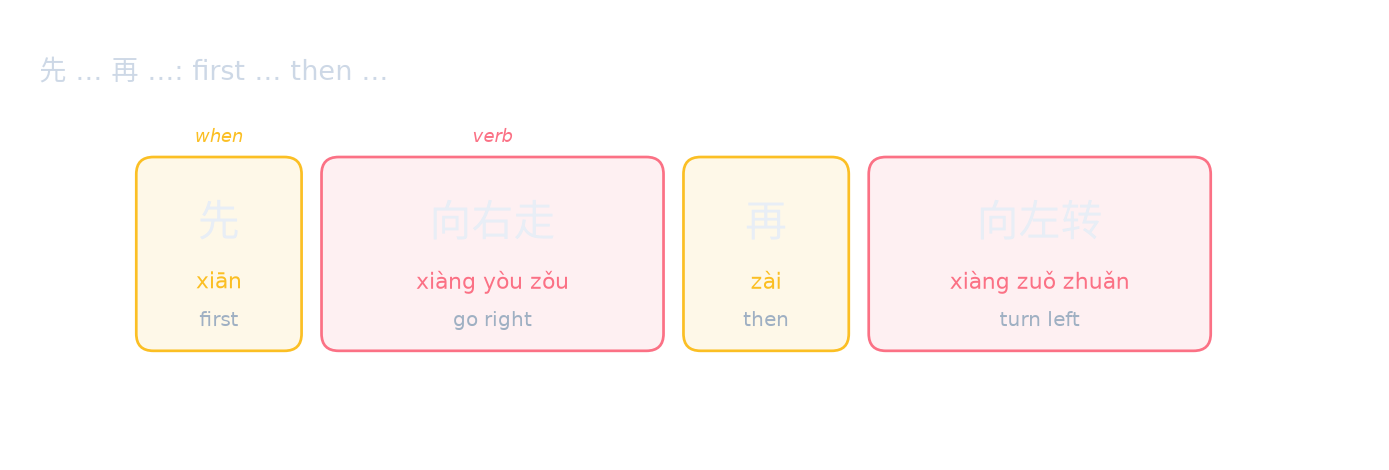
- 1. from从……to / arrive / (result: get)到…… / first先……again / then / (再…也) however再…… – from … to … / first … then …: from从school学校to / arrive / (result: get)到hospital医院,first先向右走,again / then / (再…也) however再向左转。
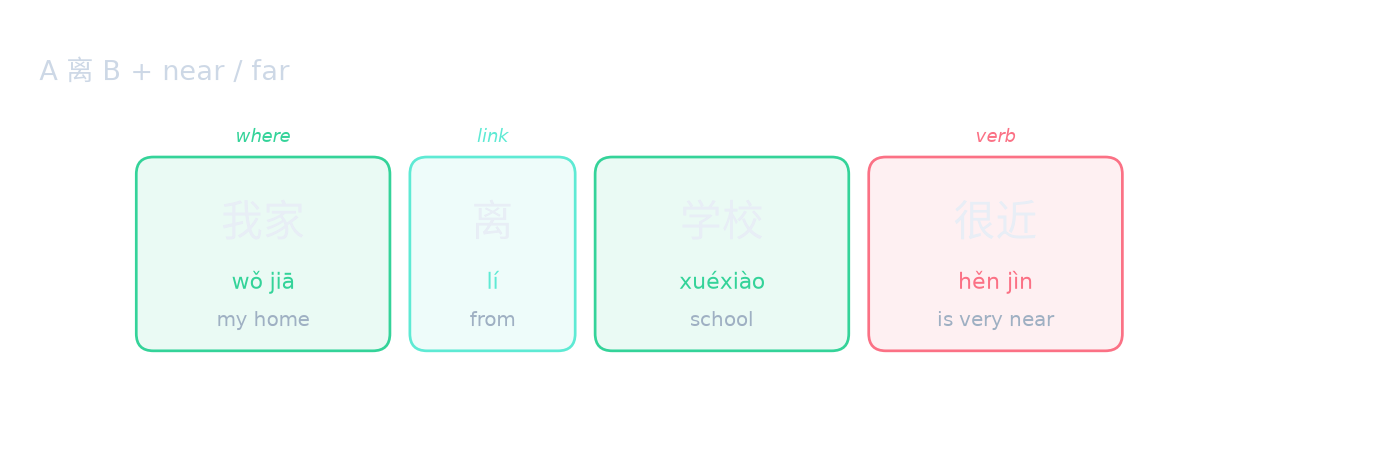
- 2. away from离 – near to, far from, and time until: 我家away from离school学校很近。
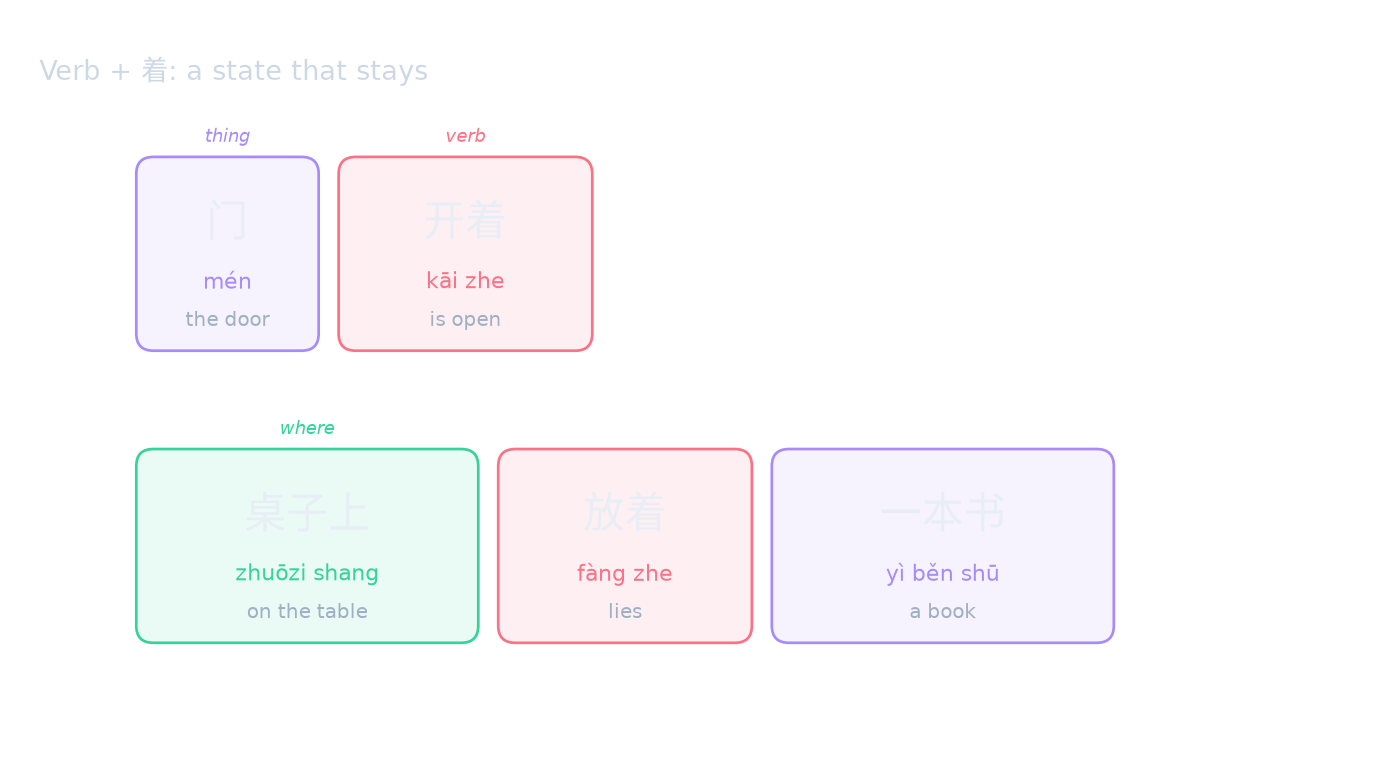
- 3. (ongoing -ing)着 – describing a continuing state: 门开(ongoing -ing)着,lamp灯also也开着。
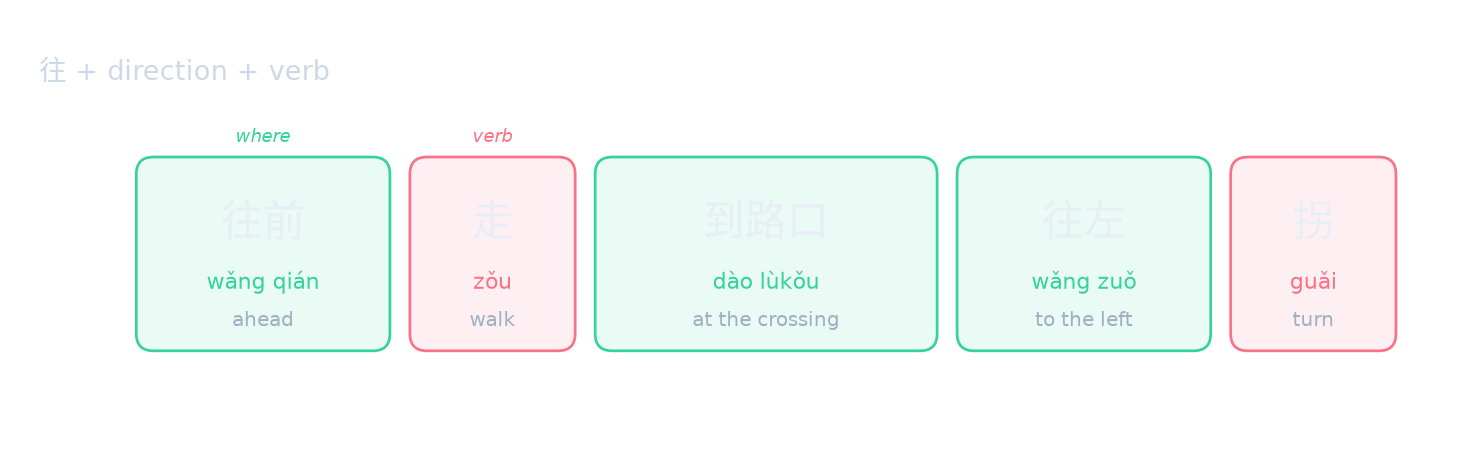
- 4. towards往 – giving directions: 往前走,to / arrive / (result: get)到crossing路口towards往left左to turn (a corner etc)拐。
3.2
1. Understand a route and repair confusion
Follow simple directions and ask for clarification.
Key sentences
- from从school学校to / arrive / (result: get)到hospital医院how / why怎么to walk / to leave走? Cóng xuéxiào dào yīyuàn zěnme zǒu? – How do I get from the school to the hospital?
- first先向右走,again / then / (再…也) however再向左转。 Xiān xiàng yòu zǒu, zài xiàng zuǒ zhuǎn. – First go right, then turn left.
- hospital医院at / in在library图书馆beside; next to旁边。 – The hospital is next to the library.
- I'm sorry对不起,please; to invite请talk later / besides再说one time (all the way…一遍。 Duìbuqǐ, qǐng zài shuō yí biàn. – Sorry, could you say that again?
How it works
from从 A to / arrive / (result: get)到 B gives the start and the end of a route. first先……again / then / (再…也) however再…… puts steps in order: first先 is the first step, again / then / (再…也) however再 the next. towards向left左 / towards向(bound form) right右 + to walk / to leave走 or to revolve转 gives the direction.
Checking you understood. If you miss a step, ask please; to invite请talk later / besides再说one time (all the way…一遍 (please say it once more), then repeat the route back: first先向右走,again / then / (再…也) however再向左转,to / towards / correct对(yes/no ?)吗?
Watch out
- The order of first先 and again / then / (再…也) however再 is the order of the actions.
- from从school学校to / arrive / (result: get)到hospital医院 describes a route; it does not say where the hospital is.
Words in context
- from从 cóng – from. from从school学校to set off出发。
- to / arrive / (result: get)到 dào – to / arrive. to / arrive / (result: get)到hospital医院。
- left左 zuǒ – left. 向左转。
- (bound form) right右 yòu – right. 向右转。
- again / then / (再…也) however再 zài – then / again after. 先走,again / then / (再…也) however再to revolve转。
Reading
from从school学校to / arrive / (result: get)到hospital医院,first先向右走,again / then / (再…也) however再向左转。hospital医院at / in在library图书馆beside; next to旁边。林安听不清,to ask问:“please; to invite请talk later / besides再说one time (all the way…一遍。”
Speaking
Give two-step directions. Your partner asks you to repeat the final turn.
Vocabulary
Train
| 汉字 | Pinyin | English |
|---|---|---|
| 从 | cóng | from |
| 到 | dào | to arrive; to |
| 走 | zǒu | to walk |
| 再 | zài | again |
| 旁边 | páng biān | beside; next to |
| 向 | xiàng | towards |
| 问 | wèn | to ask |
3.3
2. 离 – near to, far from, and time until
Form: A + away from离 + B + near近 / far远 · A away from离 B to have / there is有 + distance · away from离 + event + also / there is still还有 + time
- 我家away from离school学校很近。 Wǒ jiā lí xuéxiào hěn jìn. – My home is very close to school.
- hospital医院away from离here这儿不远。 Yīyuàn lí zhèr bù yuǎn. – The hospital isn't far from here.
- 我家away from离school学校to have / there is有两公里。 – My home is two kilometres from school.
- away from离exam; to take an exam考试also / there is still还有三天。 Lí kǎoshì hái yǒu sān tiān. – There are three days left until the exam.
How it works. away from离 lí measures the gap between two points. The first is the topic, the second is the reference point. To ask, use far远(yes/no ?)吗: 你家away from离school学校far远(yes/no ?)吗? The same pattern measures time until an event: away from离 + event + also / there is still还有 + time.
away from离 or from从?
| away from离 | from从……to / arrive / (result: get)到…… |
|---|---|
| distance between two places | a route or journey |
| 我家away from离school学校很近 | from从我家to / arrive / (result: get)到school学校want / will / need要十分钟 |
Watch out
- wrong: 我家away from离school学校to be / is是near近 → 我家away from离school学校很近.
- away from离 does not mark a starting point: wrong: away from离Beijing北京to set off出发 → from从Beijing北京to set off出发.
Vocabulary
Train
| 汉字 | Pinyin | English |
|---|---|---|
| 离 | lí | away from |
| 近 | jìn | near |
| 远 | yuǎn | far |
| 考试 | kǎo shì | exam; to take an exam |
| 要 | yào | to want; will; need |
3.4
3. 着 – describing a continuing state
Form: verb + (ongoing -ing)着 · place + verb + (ongoing -ing)着 + thing · verb₁ + (ongoing -ing)着 + verb₂
- 门开(ongoing -ing)着,lamp灯also也开着。 Mén kāizhe, dēng yě kāizhe. – The door is open and the lights are on.
- table桌子上放(ongoing -ing)着one / a一本书。 Zhuōzi shang fàngzhe yì běn shū. – There's a book lying on the table.
- he / him他to laugh笑(ongoing -ing)着to speak说:"hello你好!" Tā xiàozhe shuō: "Nǐ hǎo!" – He said hello with a smile.
- we / us我们to sit / to take (a bus …)坐(ongoing -ing)着to have a meal吃饭(suggestion)吧。 – Let's eat sitting down.
How it works. (ongoing -ing)着 zhe after a verb describes a state that continues, the result that stays after an action. to open a door (lit. and…开门 is the action of opening; 门开(ongoing -ing)着 is the door standing open.
- Describing a room or picture: place + verb + (ongoing -ing)着 + thing: 墙上to write写(ongoing -ing)着name名字 (names are written on the wall).
- How someone does something: verb₁ + (ongoing -ing)着 + verb₂: to laugh笑(ongoing -ing)着to speak说 (say smiling), to sit / to take (a bus …)坐(ongoing -ing)着to eat吃 (eat sitting).
(ongoing -ing)着 or at / in在? (ongoing -ing)着 is a state; at / in在 / in the middle of正在 + verb is an action in progress: he / him他at / in在to read看书 (he is reading).
Watch out
- The negative uses not / haven't没: door门not / haven't没to open; to drive开(ongoing -ing)着 (wrong: 门不开(ongoing -ing)着).
Vocabulary
Train
| 汉字 | Pinyin | English |
|---|---|---|
| 着 | zhe | continuous-aspect particle |
| 也 | yě | also |
| 笑 | xiào | to laugh |
| 吧 | ba | suggestion particle |
| 正在 | zhèng zài | in the process of |
| 门 | mén | door |
3.5
4. 往 – giving directions
Form: towards往 + direction / place + movement verb · to / arrive / (result: get)到 + place + towards往……to turn (a corner etc)拐
- 往前走,to / arrive / (result: get)到crossing路口towards往left左to turn (a corner etc)拐。 Wǎng qián zǒu, dào lùkǒu wǎng zuǒ guǎi. – Go straight on and turn left at the crossing.
- first先往前走,again / then / (再…也) however再往右to turn (a corner etc)拐。 – First go straight, then turn right.
- 这辆车往Beijing北京to open; to drive开。 Zhè liàng chē wǎng Běijīng kāi. – This bus is heading for Beijing.
How it works. towards往 wǎng means "towards". The direction comes straight after it, then the movement verb: 往前走, towards往left左to turn (a corner etc)拐, towards往up / on / last; to get on, attend上to look at; to watch; to read看. Common directions: front / before前 after / back后 left左 (bound form) right右, east东 west西 south南 north北, up / on / last; to get on, attend上 down / next; to fall (rain), get off下.
Giving directions. Join steps with first先……again / then / (再…也) however再……, and use to / arrive / (result: get)到 + place for where the next step happens: to / arrive / (result: get)到bank银行towards往left左to turn (a corner etc)拐 (turn left when you reach the bank).
Watch out
- towards往 comes before the verb: wrong: 拐往left左 → towards往left左to turn (a corner etc)拐.
- towards往 shows direction, not arrival. towards往Beijing北京to open; to drive开 = heading for Beijing; to / arrive / (result: get)到Beijing北京(completed / change)了 = arrived in Beijing.
3.6
Practice
Cover the teaching pages before you answer. The answers are at the end.
1. Understand a route and repair confusion
1. Listening. A partner reads the script for this question from the answers aloud. What is the final turn in the recording?
- A. Left
- B. Right
- C. No turn
2. Reading. Where is the hospital in the reading?
- A. Inside the school
- B. Beside the station
- C. Beside the library
3. Complete “first go, then turn”: 先走,…………to revolve转。
4. Match each word with its meaning in this unit.
-
(1) from从
-
(2) to / arrive / (result: get)到
-
(3) left左
-
(4) (bound form) right右
-
(5) again / then / (再…也) however再
-
A. from
-
B. then / again after
-
C. left
-
D. to / arrive
-
E. right
5. Write a two-step route with a starting point and destination. Write your answer in Chinese, then say it aloud.
6. first先向左转,again / then / (再…也) however再向右转。向左转 means turn left and 向右转 turn right. Which action comes first?
- A. Turn left
- B. Turn right
- C. Both turns happen at once
7. A route says from从library图书馆to / arrive / (result: get)到shop商店,first先向左走,again / then / (再…也) however再向右转。library图书馆 means library, shop商店 shop, 向左走 go left and 向右转 turn right. First identify the start, then the first action. Which pair is correct?
- A. Start at the library; turn right first
- B. Start at the shop; turn right first
- C. Start at the library; go left first
8. Read: from从school学校to / arrive / (result: get)到library图书馆,first先向右走,again / then / (再…也) however再向左转。library图书馆at / in在shop商店beside; next to旁边。library图书馆 means library and shop商店 shop. Which statement preserves order and reference place?
- A. The route goes right then left; the library is beside the shop.
- B. The route goes right then left; the school is beside the shop.
- C. The route goes left then right; the library is beside the shop.
9. Create a short fictional route with a start, destination and two ordered actions. Give it to a partner, who repeats the sequence or asks for clarification. Add one location statement about the destination and name one practical route detail you have not supplied. Write your answer in Chinese, then say it aloud.
2. away from离 – near to, far from, and time until
10. Complete: “My home is very close to the school.” 我家…………school学校很近。
11. You want to say how long the trip from home to school takes. Which fits?
- A. away from离我家to / arrive / (result: get)到school学校to be / is是十分钟。
- B. 我家away from离school学校want / will / need要十分钟from从。
- C. from从我家to / arrive / (result: get)到school学校want / will / need要十分钟。
12. True or false? away from离exam; to take an exam考试also / there is still还有三天 means “There are three days left until the exam.” If false, correct it.
13. Build: “Is your home far from school?”
Put in order: away from离 / far远(yes/no ?)吗? / 你家 / school学校
14. Describe where you live for a new friend. Say if your home is near or far from school and a shop, and how many days are left until the holiday. Use away from离. Write your answer in Chinese, then say it aloud.
3. (ongoing -ing)着 – describing a continuing state
15. Complete: “The door is open.” 门开…………。
16. Which sentence describes a book lying on the table?
- A. one / a一本书to put / let go放table桌子up / on / last; to get on, attend上(ongoing -ing)着。
- B. table桌子up / on / last; to get on, attend上one / a一本书放着。
- C. table桌子上放(ongoing -ing)着one / a一本书。
17. True or false? 门不开(ongoing -ing)着 is the usual way to say “The door is not open”. If false, correct it.
18. Build: “Let’s eat sitting down.”
Put in order: to sit / to take (a bus …)坐(ongoing -ing)着 / (suggestion)吧。 / to have a meal吃饭 / we / us我们
19. Describe your desk or bedroom to a friend on the phone. Say what is on the desk, what is on the wall and whether the window is open. Use (ongoing -ing)着. Write your answer in Chinese, then say it aloud.
4. towards往 – giving directions
20. Complete: “Turn left.” …………左拐。
21. Which says “First go straight, then turn right”?
- A. first先往前走,again / then / (再…也) however再往右to turn (a corner etc)拐。
- B. 先走to move forwards往前,again / then / (再…也) however再to turn (a corner etc)拐往右。
- C. to move forwards往前先走,往右again / then / (再…也) however再to turn (a corner etc)拐。
22. True or false? 这辆车往Beijing北京to open; to drive开 means the bus has already arrived in Beijing. If false, correct it.
23. Build: “Turn left when you reach the bank.”
Put in order: towards往left左 / to turn (a corner etc)拐。 / to / arrive / (result: get)到 / bank银行
24. A visitor asks you the way from your school gate to a nearby shop. Give two or three steps. Use towards往. Write your answer in Chinese, then say it aloud.
3.7
Mixed practice
These questions mix the patterns and use new situations.
25. Choose away from离 or from从: 我家…………school学校很近。 / …………school学校to / arrive / (result: get)到hospital医院want / will / need要十分钟。
26. Say "The door is open" (it stays open).
27. Tell a visitor: go straight, then turn left at the crossing.
28. Find and fix the problem. Directions say 先到rail station车站,again / then / (再…也) however再坐地铁. Someone takes the metro first. What went wrong?
29. Use it yourself. Tell a visitor to go straight on, turn left at the next crossing, and ask again if unsure.
3.8
Answers and explanations
Mark your work, then correct each mistake in your own words.
1. Understand a route and repair confusion
1. Script: first先向左走,again / then / (再…也) however再向右转。hospital医院at / in在school学校beside; next to旁边。
B. Right
again / then / (再…也) however再向右转 is the second action.
2. C. Beside the library
hospital医院at / in在library图书馆beside; next to旁边 gives the stated location.
3. again / then / (再…也) however再
again / then / (再…也) however再 marks the following action.
4. (1) A: from从 = from; (2) D: to / arrive / (result: get)到 = to / arrive; (3) C: left左 = left; (4) E: (bound form) right右 = right; (5) B: again / then / (再…也) however再 = then / again after
Use the example sentences to check each word’s meaning in context.
5. Model answer: from从school学校to / arrive / (result: get)到hospital医院,first先向左走,again / then / (再…也) however再向右转。
Check your answer:
- Name the starting point and destination.
- Use first先 and again / then / (再…也) however再 to order actions.
- State a direction for each step.
6. A. Turn left
first先 marks the first action, left; again / then / (再…也) however再 introduces the later right turn. Spotting a familiar direction without its sequence marker can reverse the route.
7. C. Start at the library; go left first
from从library图书馆 gives the start and first先向左走 the first action. to / arrive / (result: get)到shop商店 is the destination, not the start. The right turn follows again / then / (再…也) however再, so it is later.
8. A. The route goes right then left; the library is beside the shop.
first先向右走 comes before again / then / (再…也) however再向左转. The last sentence locates the library beside the shop, not the school. One incorrect choice reverses the actions; the other gives the destination’s location to the starting place.
9. Model answer: Possible route: from从school学校to / arrive / (result: get)到shop商店,first先向左走,again / then / (再…也) however再向右转。shop商店at / in在hospital医院beside; next to旁边。Partner: please; to invite请talk later / besides再说one time (all the way…一遍。Reply: first先向左走,again / then / (再…也) however再向右转。The route does not give distance or walking time. This is a fictional language task, not navigation instructions for a real journey.
How to revise: If repetition reverses the route, match each direction with first先 or again / then / (再…也) however再 and repeat again. If a detail is unclear, ask for it explicitly. Do not treat an invented real-world layout as evidence from your short description.
Check your answer:
- Name a start and a distinct destination with from从…to / arrive / (result: get)到….
- Keep the actions ordered with first先…again / then / (再…也) however再….
- Make repetition preserve the same directions.
- Distinguish a location statement from an unstated distance or travel time.
If repetition reverses the route, match each direction with first先 or again / then / (再…也) however再 and repeat again. If a detail is unclear, ask for it explicitly. Do not treat an invented real-world layout as evidence from your short description.
2. away from离 – near to, far from, and time until
10. away from离
away from离 links the two places when you describe their distance.
11. C. from从我家to / arrive / (result: get)到school学校want / will / need要十分钟。
A route or journey uses from从……to / arrive / (result: get)到……. away from离 describes distance between two places, not a starting point.
12. True.
True. away from离 + event + also / there is still还有 + time gives the time remaining.
13. 你家away from离school学校far远(yes/no ?)吗?
Place + away from离 + reference place + far远(yes/no ?)吗 asks about distance.
14. Model answer: 我家away from离school学校很近,away from离shop商店slightly有点儿far远。away from离to have a holiday or…放假also / there is still还有五天。
Check your answer:
- My distance sentences use A away from离 B + near近/far远 with no to be / is是 before the adjective.
- My time sentence uses away from离 + event + also / there is still还有 + time.
- I did not use away from离 for a route from one place to another.
- I tried another version with different places.
3. (ongoing -ing)着 – describing a continuing state
15. (ongoing -ing)着
Verb + (ongoing -ing)着 shows the open state continues.
16. C. table桌子上放(ongoing -ing)着one / a一本书。
Place + verb + (ongoing -ing)着 + thing is the pattern for describing a scene.
17. False.
False. The negative of verb + (ongoing -ing)着 uses not / haven't没 – door门not / haven't没to open; to drive开(ongoing -ing)着.
18. we / us我们to sit / to take (a bus …)坐(ongoing -ing)着to have a meal吃饭(suggestion)吧。
Verb1 + (ongoing -ing)着 + verb2 shows how the second action is done.
19. Model answer: table桌子上放(ongoing -ing)着两本书,墙上to write写(ongoing -ing)着I / me我(modifier / structural particle)的name名字。window窗户开着。
Check your answer:
- My scene sentences use place + verb + (ongoing -ing)着 + thing.
- I used (ongoing -ing)着 for states, not for a quick action.
- Any negative uses not / haven't没, not not不.
- I tried another version with a different room or picture.
4. towards往 – giving directions
20. towards往
towards往 + direction comes before the movement verb.
21. A. first先往前走,again / then / (再…也) however再往右to turn (a corner etc)拐。
first先……again / then / (再…也) however再…… orders the steps, and towards往 + direction comes before each verb.
22. False.
False. towards往 shows the direction the bus is heading; arrival would be to / arrive / (result: get)到Beijing北京(completed / change)了.
23. to / arrive / (result: get)到bank银行towards往left左to turn (a corner etc)拐。
to / arrive / (result: get)到 + place marks where the next step happens, then towards往 + direction + verb.
24. Model answer: first先往前走,to / arrive / (result: get)到crossing路口往右to turn (a corner etc)拐,again / then / (再…也) however再往前走五分钟then / just就to / arrive / (result: get)到(completed / change)了。
Check your answer:
- Each step puts towards往 + direction before the verb.
- I ordered the steps with first先……again / then / (再…也) however再…… or marked a turning point with to / arrive / (result: get)到.
- I did not use towards往 to say we have arrived.
- I tried another version with a different destination.
Scripts and models for section 1
Listening script. first先向左走,again / then / (再…也) however再向右转。hospital医院at / in在school学校beside; next to旁边。 – First go left, then turn right. The hospital is beside the school.
Reading in English. From school to the hospital, first go right, then turn left. The hospital is beside the library. Lin An asks for repetition because she cannot hear clearly.
Speaking model. A: first先向右走,again / then / (再…也) however再向左转。 B: please; to invite请talk later / besides再说one time (all the way…一遍。 A: again / then / (再…也) however再向左转。
Mixed practice
25. 我家away from离school学校很近。from从school学校to / arrive / (result: get)到hospital医院want / will / need要十分钟。away from离 measures the distance between two places; from从 marks where a route starts.
26. 门开(ongoing -ing)着。(ongoing -ing)着 after a verb describes a state that continues.
27. all along / straight一直往前走,to / arrive / (result: get)到crossing路口towards往left左to turn (a corner etc)拐。towards往 + direction points the way.
28. first先 marks the first step and again / then / (再…也) however再 the next one: first go to the station, then take the metro.
29. Model answer. all along / straight一直往前走,to / arrive / (result: get)到down / next; to fall (rain), get off下一个crossing路口towards往left左to turn (a corner etc)拐。not不distinct清楚if (coming after a…的话,can / may可以again / then / (再…也) however再to ask问。
Review later. Tomorrow, give a two-step route and ask a partner to repeat it back to you.
Interactive lessons on this topic
Work through it step by step, with instant-check exercises.