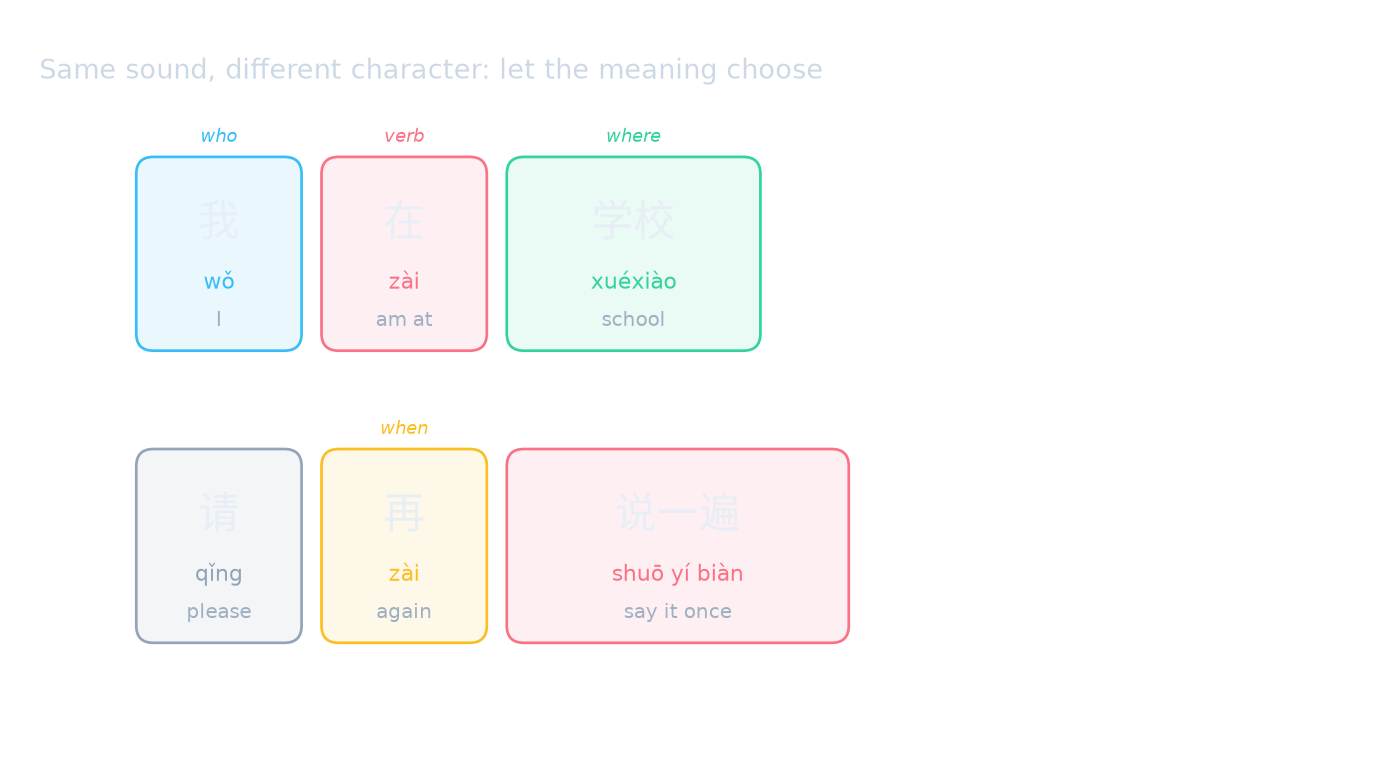
Characters that sound the same can mean different things: at / in在 zài says where, again / then / (再…也) however再 zài means again. To complete a message, read the whole sentence, look at the pinyin, and decide what job the missing word does. Sound alone will not tell you.
书写 · Build characters and use pinyin in a sentence
HSK 2 · Topic 7
 2:51
HSK 2 · Build Characters and Use Pinyin in a Sentence
The writing task is real. Ten writing items join twenty-five listening and twenty-five reading : ten minutes, real handwriting. First five: complete a…
English explanations + Mandarin examples · captions follow the spoken text
7.1
Complete a message with the right character
Use the sentence meaning and pronunciation to choose a character.
Key sentences
- I / me我at / in在school学校。 Wǒ zài xuéxiào. – I'm at school.
- please; to invite请tomorrow明天again / then / (再…也) however再to come来。 Qǐng míngtiān zài lái. – Please come again tomorrow.
- tomorrow明天afternoon下午三点to see / meet见。 Míngtiān xiàwǔ sān diǎn jiàn. – See you at three tomorrow afternoon.
How it works
Many characters share a sound. at / in在 and again / then / (再…也) however再 are both zài, but they do different jobs:
| at / in在 zài | again / then / (再…也) however再 zài |
|---|---|
| at, in (a place); at / in在 + verb = doing now | again, then (a later action) |
| I / me我at / in在school学校。I / me我at / in在to read看书。 | please; to invite请talk later / besides再说one time (all the way…一遍。tomorrow明天again / then / (再…也) however再to come来。 |
Choosing the right character. Read the whole sentence and ask what the missing word does: does it give a place, or a repeated / later action? Then check the pinyin and the shape. When typing, read the character the keyboard offers before you send.
Watch out
- wrong: tomorrow明天at / in在to come来 → tomorrow明天again / then / (再…也) however再to come来.
- to see / meet见 (see) and measure word for clothes and matters件 (a measure word) are both jiàn: tomorrow明天to see / meet见.
Words in context
- at / in在 zài – at / in. I / me我at / in在school学校。
- again / then / (再…也) however再 zài – again / then. please; to invite请talk later / besides再说one time (all the way…一遍。
- to see / meet见 jiàn – see. tomorrow明天to see / meet见。
- here这里 zhèlǐ – here. I / me我at / in在here这里。
- Chinese character字 zì – character. this这个Chinese character字how / why怎么to read (aloud); to study读?
Reading
林安写:“I / me我at / in在school学校。please; to invite请tomorrow明天again / then / (再…也) however再to come来。tomorrow明天afternoon下午三点to see / meet见。”she / her她to check检查(completed / change)了time时间and / with和place地点,then / after然后to issue (an order, decree…发出news; message消息。
Speaking
Ask a partner how to read at / in在, then say a sentence with it. Explain in English how again / then / (再…也) however再 differs.
Vocabulary
Train
| 汉字 | Pinyin | English |
|---|---|---|
| 再 | zài | again |
| 件 | jiàn | measure word for clothes and matters |
| 时间 | shí jiān | time |
7.2
Practice
Cover the teaching pages before you answer. The answers are at the end.
1. Listening. A partner reads the script for this question from the answers aloud. Where is the speaker?
- A. At the library
- B. At school
- C. At the park
2. Reading. Which character in the message means “again”?
- A. to see / meet见
- B. at / in在
- C. again / then / (再…也) however再
3. Choose zài for location: I / me我…………school学校。
4. Match each word with its meaning in this unit.
-
(1) at / in在
-
(2) again / then / (再…也) however再
-
(3) to see / meet见
-
(4) here这里
-
(5) Chinese character字
-
A. at / in
-
B. here
-
C. again / then
-
D. see
-
E. character
5. Write a two-line message giving your location and tomorrow’s meeting time. Check at / in在 and again / then / (再…也) however再 carefully. Write your answer in Chinese, then say it aloud.
6. Complete “I am at school”: I / me我___school学校。Choose between at / in在, used for a location, and again / then / (再…也) however再, again or then.
- A. Either character gives the same meaning
- B. at / in在
- C. again / then / (再…也) however再
7. Complete “Please say it again”: please; to invite请___to speak说one time (all the way…一遍。to speak说one time (all the way…一遍 means say once. First decide whether the missing character locates a person or requests repetition.
- A. again / then / (再…也) however再
- B. Either character has the same function here
- C. at / in在
8. Read both sentences and choose the characters that fit: I / me我___home / family / (measure: shops)家。please; to invite请afternoon下午___to come来。home / family / (measure: shops)家 means home and afternoon下午 afternoon.
- A. at / in在;again / then / (再…也) however再
- B. again / then / (再…也) however再;at / in在
- C. at / in在;at / in在
9. Write a new short message locating yourself somewhere and asking the reader to come again at a stated time. Use both at / in在 and again / then / (再…也) however再. Read it aloud, then explain how the written context distinguishes the two characters despite the shared sound. Write your answer in Chinese, then say it aloud.
7.3
Mixed practice
These questions mix the patterns and use new situations.
10. Find and fix the problem. A message meant as "See you tomorrow" says tomorrow明天measure word for clothes and matters件. What is wrong, even though jian is the right sound?
11. Use it yourself. Write a short note thanking a friend and confirming that you will meet tomorrow.
7.4
Answers and explanations
Mark your work, then correct each mistake in your own words.
1. Script: I / me我at / in在library图书馆。tomorrow明天afternoon下午四点to see / meet见。
A. At the library
at / in在library图书馆 names the current location.
2. C. again / then / (再…也) however再
again / then / (再…也) however再 in tomorrow明天again / then / (再…也) however再to come来 means come again tomorrow.
3. at / in在
at / in在 locates the speaker; again / then / (再…也) however再 would mean again or then.
4. (1) A: at / in在 = at / in; (2) C: again / then / (再…也) however再 = again / then; (3) D: to see / meet见 = see; (4) B: here这里 = here; (5) E: Chinese character字 = character
Use the example sentences to check each word’s meaning in context.
5. Model answer: I / me我at / in在school学校。tomorrow明天afternoon下午四点to see / meet见。
Check your answer:
- Use at / in在 for the current location.
- Give tomorrow’s time.
- Check the characters, not only pinyin.
6. B. at / in在
at / in在 introduces the location school学校. again / then / (再…也) however再 does not express being at school in this sentence. Shared pronunciation does not make the written characters interchangeable.
7. A. again / then / (再…也) however再
again / then / (再…也) however再 requests another saying. please; to invite请talk later / besides再说one time (all the way…一遍 is the repetition request; at / in在 would not supply that meaning in this frame. Use the function of the phrase rather than the shared sound.
8. A. at / in在;again / then / (再…也) however再
I / me我to be at home在家 is a location statement. please; to invite请afternoon下午again / then / (再…也) however再to come来 requests another visit in the afternoon. at / in在 supplies location and again / then / (再…也) however再 repetition; the shared sound alone does not select the written character.
9. Model answer: Possible message: I / me我at / in在library图书馆。please; to invite请tomorrow明天morning (before noon)上午again / then / (再…也) however再to come来。library图书馆 means library. at / in在 gives the current location, while again / then / (再…也) however再 requests another visit tomorrow morning. Other places and times can work. This is written word choice, not proof of handwriting quality or pronunciation.
How to revise: If the characters are swapped, identify the place phrase and the repetition request before rewriting. Read the revised message for meaning; a correct spoken syllable alone does not verify the written choice.
Check your answer:
- Use at / in在 for the intended location statement.
- Use again / then / (再…也) however再 for the repeat-visit request.
- Make the return time explicit and coherent.
- Explain both choices from meaning, not sound alone.
If the characters are swapped, identify the place phrase and the repetition request before rewriting. Read the revised message for meaning; a correct spoken syllable alone does not verify the written choice.
Scripts and models
Listening script. I / me我at / in在library图书馆。tomorrow明天afternoon下午四点to see / meet见。 – I am at the library. See you tomorrow at four in the afternoon.
Reading in English. Lin An writes that she is at school and asks the reader to come again tomorrow, meeting at three in the afternoon. She checks the time and place before sending.
Speaking model. A: this这个Chinese character字how / why怎么to read (aloud); to study读? B: zài。 A: I / me我at / in在school学校。
Mixed practice
10. It should be tomorrow明天to see / meet见. measure word for clothes and matters件 is a measure word for clothes and matters; to see / meet见 means see or meet. The same sound can be written with different characters.
11. Model answer. to thank谢谢you你!we / us我们tomorrow明天to see / meet见。Check to thank谢, bright明, day天 and to see / meet见 before you send it.
Review later. Tomorrow, write the note by hand, then type it and check every character.
Interactive lessons on this topic
Work through it step by step, with instant-check exercises.