Speak to people politely and ask them to do things. Put the surname before the title (王老师), ask permission with can / may可以……(yes/no ?)吗, and ask or tell someone not to do something with please; to invite请 and don't别. Three smaller patterns make requests softer: slightly有点儿 and a little一点儿 (a bit), to let / make让 (ask or let someone do something) and (used after a verb) give it…一下 (just a moment).
任务一、六、十七 · Personal descriptions, requests and forms of address
HSK 2 · Topic 1
 3:20
HSK 2 · Personal Descriptions, Requests and Forms of Address
Polite Chinese in four moves. Respectful titles, adjective descriptions, permission and requests : and the 为什么 or 因为 pair. Titles follow role, not English…
English explanations + Mandarin examples · captions follow the spoken text
1.1
At a glance
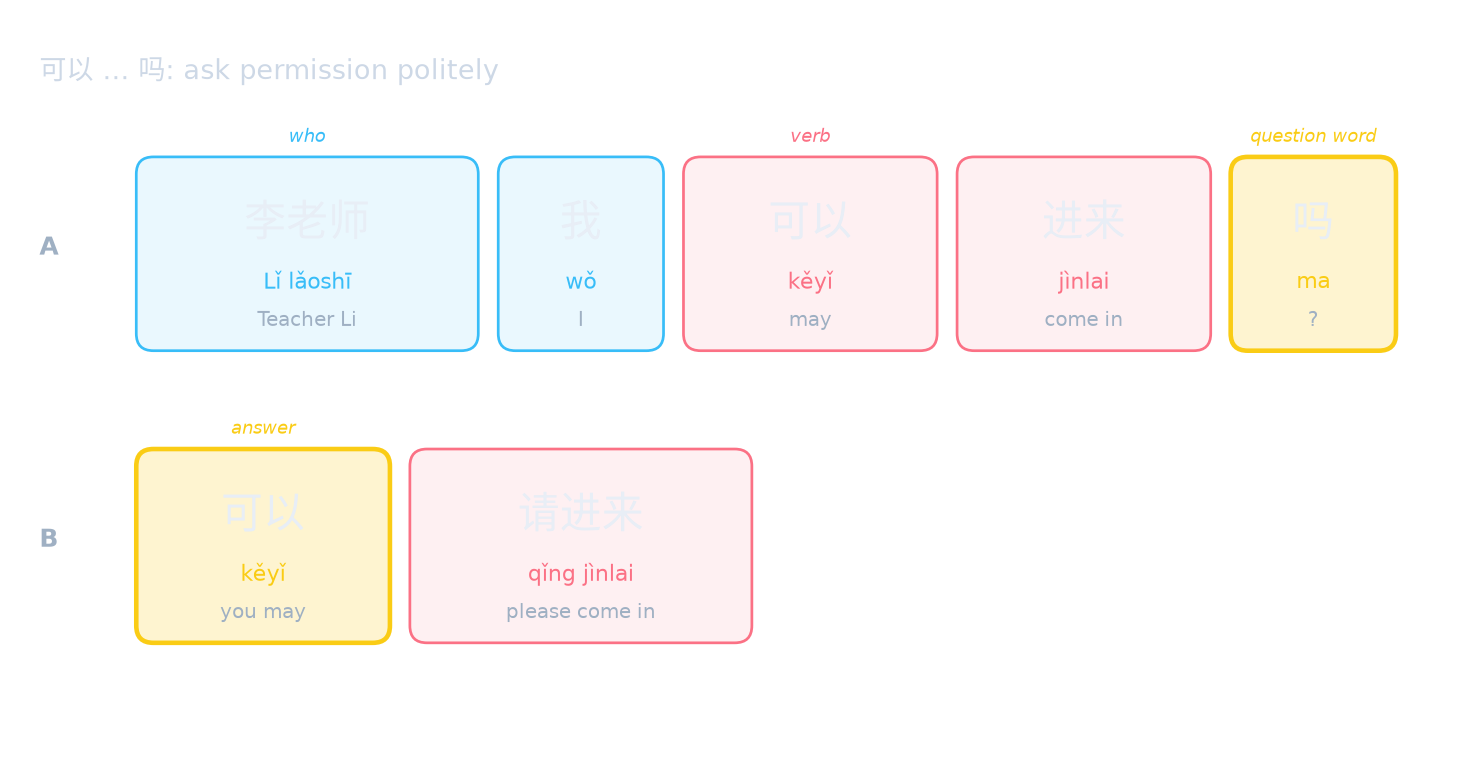
- 1. please; to invite请 / can / may可以……(yes/no ?)吗 / don't别 – please / may I …? / don't: please; to invite请to enter; to come in进。I / me我can / may可以to come in进来(yes/no ?)吗?
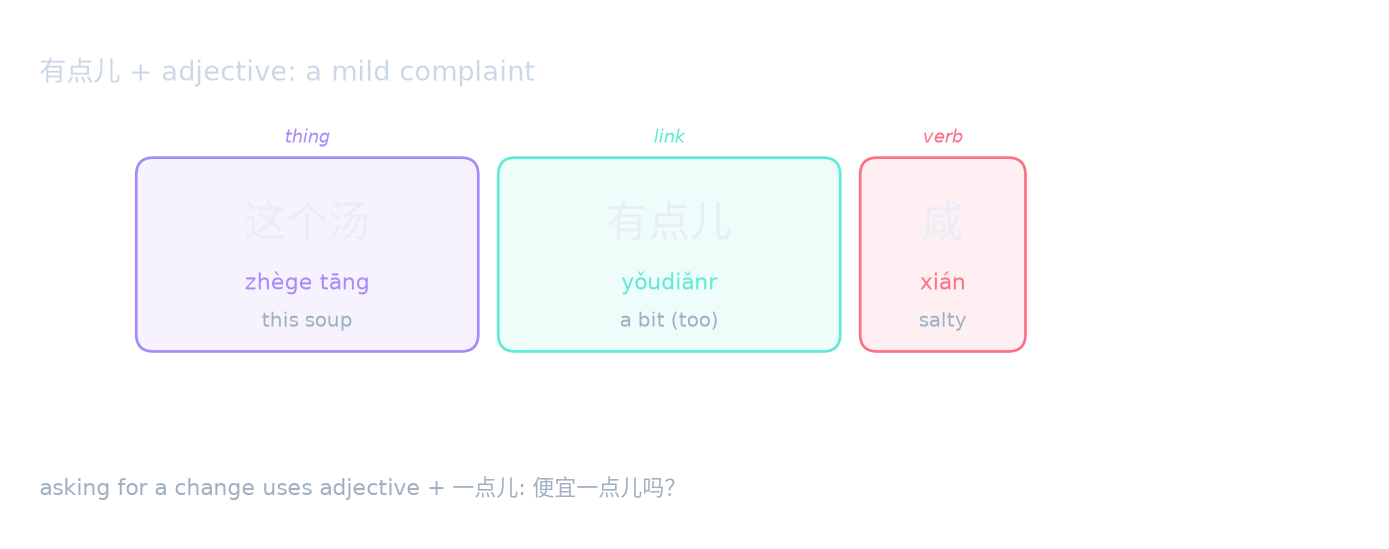
- 2. slightly有点儿 and a little一点儿 – “a bit”: this这个soup汤slightly有点儿salty咸。
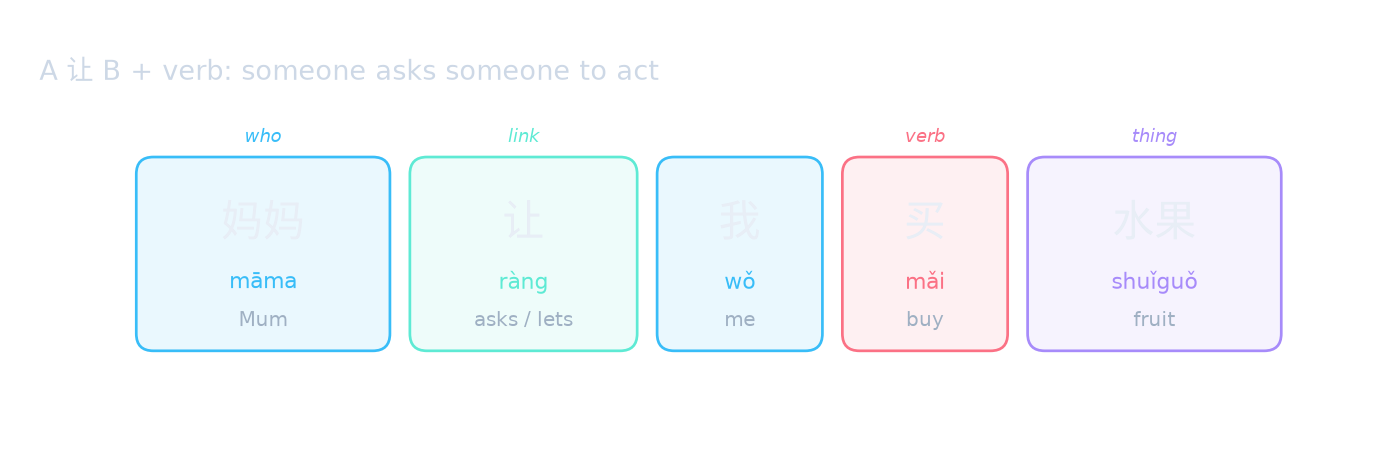
- 3. to let / make让 – asking or letting someone do something: mum; mother妈妈to let / make让I / me我to buy买fruit水果。
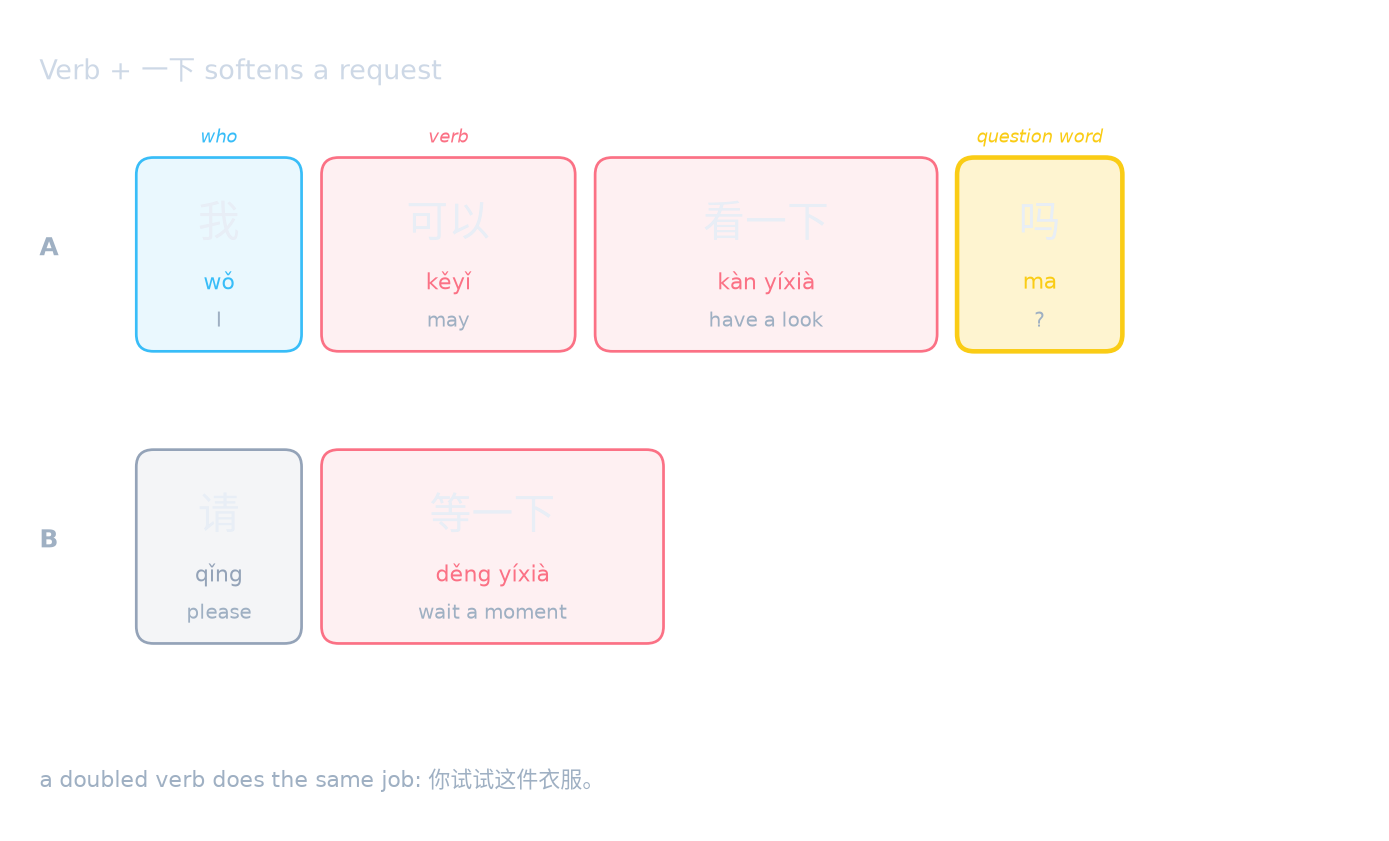
- 4. (used after a verb) give it…一下 and doubled verbs – “just a moment”: I / me我can / may可以to look at; to watch; to read看(used after a verb) give it…一下(yes/no ?)吗?
1.2
1. Address someone and make a request
Use a suitable title and ask permission politely.
Key sentences
- 王老师,I'm sorry对不起,我来late / evening晚(completed / change)了。 Wáng lǎoshī, duìbuqǐ, wǒ lái wǎn le. – Teacher Wang, I'm sorry I'm late.
- I / me我can / may可以to come in进来(yes/no ?)吗? Wǒ kěyǐ jìnlai ma? – May I come in?
- can / may可以,please; to invite请to enter; to come in进。 Kěyǐ, qǐng jìn. – Yes, please come in.
- 请别to speak; to talk说话。 Qǐng bié shuōhuà. – Please don't talk.
How it works
Addressing people. The surname comes first, then the title: 王老师 (Teacher Wang), 李医生 (Doctor Li). Chinese students call teachers teacher老师 rather than by name.
Three kinds of request
| Purpose | Pattern | Example |
|---|---|---|
| ask permission | I / me我can / may可以……(yes/no ?)吗? | I / me我can / may可以to come in进来(yes/no ?)吗? |
| ask politely | please; to invite请 + verb | please; to invite请to enter; to come in进。please; to invite请to sit / to take (a bus …)坐。 |
| ask someone not to | (please; to invite请)don't别 + verb | 请别to speak; to talk说话。 |
Watch out
- wrong: teacher老师to rule王 → 王老师.
- you你not不to speak; to talk说话 is a statement ("you don't talk"). To ask, say 请别to speak; to talk说话.
Words in context
- teacher老师 lǎoshī – teacher. 王老师。
- can / may可以 kěyǐ – may / can with permission. I / me我can / may可以to come in进来(yes/no ?)吗?
- to come in进来 jìnlái – come in. 请进来。
- don't别 bié – do not, instruction. don't别to speak; to talk说话。
- late / evening晚 wǎn – late. 我来late / evening晚(completed / change)了。
Reading
林安来late / evening晚(completed / change)了。she / her她to speak说:“王老师,I'm sorry对不起。I / me我can / may可以to come in进来(yes/no ?)吗?”王老师to speak说:“can / may可以,请进来。don't别to speak; to talk说话。”
Speaking
Address Teacher Li, ask to come in, and respond when permission is given.
Vocabulary
Train
| 汉字 | Pinyin | English |
|---|---|---|
| 可以 | kě yǐ | can |
| 进 | jìn | to enter; to come in |
| 别 | bié | don't |
1.3
2. 有点儿 and 一点儿 – “a bit”
Form: slightly有点儿 + adjective · adjective + a little一点儿 · a little一点儿 + noun
- this这个soup汤slightly有点儿salty咸。 Zhège tāng yǒudiǎnr xián. – This soup is a bit salty.
- can / may可以cheap便宜a little一点儿(yes/no ?)吗? Kěyǐ piányi yìdiǎnr ma? – Could it be a bit cheaper?
- I / me我want / think / miss想to drink喝a little一点儿water水。 Wǒ xiǎng hē yìdiǎnr shuǐ. – I'd like a little water.
- I / me我a little一点儿also也not不tired累。 Wǒ yìdiǎnr yě bú lèi. – I'm not tired at all.
How it works. Both mean "a bit", but the position changes the job.
| slightly有点儿 + adjective | adjective + a little一点儿 |
|---|---|
| comments on how things are now | compares, or asks for a change |
| usually something unwanted | often in requests |
| slightly有点儿expensive贵 (a bit expensive) | cheap便宜a little一点儿 (a bit cheaper) |
| slightly有点儿tired累 (a bit tired) | fast; soon快a little一点儿 (a bit faster) |
Before a noun, a little一点儿 means "a little": a little一点儿water水. With also也not不 or all / both都not不 it means "not at all": a little一点儿also也not不cold冷.
Watch out
- To ask for a lower price, say cheap便宜a little一点儿. wrong: slightly有点儿cheap便宜 says "it's a bit cheap".
- slightly有点儿 sounds negative, so wrong: slightly有点儿good好 is odd. Say degree / adjective linker很good好 or not bad / pretty good不错.
Vocabulary
Train
| 汉字 | Pinyin | English |
|---|---|---|
| 便宜 | pián yi | cheap |
| 也 | yě | also |
| 贵 | guì | expensive |
| 累 | lèi | tired |
| 快 | kuài | fast; soon |
1.4
3. 让 – asking or letting someone do something
Form: A + to let / make让 + B + verb · 不让 · to let / make让I / me我……
- mum; mother妈妈to let / make让I / me我to buy买fruit水果。 Māma ràng wǒ mǎi shuǐguǒ. – Mum asked me to buy fruit.
- to let / make让I / me我to take a look at看看。 Ràng wǒ kànkan. – Let me have a look.
- he / him他不让I / me我to go去。 Tā bú ràng wǒ qù. – He won't let me go.
- who谁to let / make让you你to come来(modifier / structural particle)的? Shéi ràng nǐ lái de? – Who asked you to come?
How it works. to let / make让 ràng means that someone asks, tells or allows another person to do something. The person who does the action comes straight after to let / make让, then the action: teacher老师 + to let / make让 + we / us我们 + to read a book读书.
Questions. who谁 replaces the person who asked (who谁to let / make让you你to come来(modifier / structural particle)的?); what什么 replaces the action (teacher老师to let / make让we / us我们to do; to make做what什么?).
Saying no. not不 goes before to let / make让: he / him他不让I / me我to go去 (he doesn't allow me to go).
Watch out
- wrong: mum; mother妈妈to let / make让to buy买I / me我fruit水果 → mum; mother妈妈to let / make让I / me我to buy买fruit水果: the person goes directly after to let / make让.
- to let / make让 reports a request; it does not say the action is done. mum; mother妈妈to let / make让I / me我to buy买fruit水果 does not mean you have bought it.
Vocabulary
Train
| 汉字 | Pinyin | English |
|---|---|---|
| 让 | ràng | to let |
1.5
4. 一下 and doubled verbs – “just a moment”
Form: verb + (used after a verb) give it…一下 · doubled verb (to take a look at看看, 试试, to rest休息to rest休息)
- I / me我can / may可以to look at; to watch; to read看(used after a verb) give it…一下(yes/no ?)吗? Wǒ kěyǐ kàn yíxià ma? – May I have a quick look?
- 请等一下。 Qǐng děng yíxià. – Please wait a moment.
- you你试试这件clothes衣服。 Nǐ shìshi zhè jiàn yīfu. – Try this jacket on.
- I / me我to introduce介绍(used after a verb) give it…一下I / me我(modifier / structural particle)的friend朋友。 Wǒ jièshào yíxià wǒ de péngyou. – Let me introduce my friend.
How it works. Both patterns make an action short and light: "have a look", "give it a try", "just a moment". They make requests softer and friendlier.
- (used after a verb) give it…一下 yíxià follows the verb, and the object comes after it: to look at; to watch; to read看(used after a verb) give it…一下this这本书.
- A one-syllable verb doubles with a light second syllable: to take a look at看看, 试试, 问问. A two-syllable verb doubles as a whole: to introduce介绍to introduce介绍, to rest休息to rest休息.
Watch out
- Use one or the other: wrong: to take a look at看看(used after a verb) give it…一下 → to take a look at看看 or to look at; to watch; to read看(used after a verb) give it…一下.
- These patterns are for short, casual actions. For a whole year of study, say to study; to learn学习一年 (wrong: to study; to learn学习(used after a verb) give it…一下).
Vocabulary
Train
| 汉字 | Pinyin | English |
|---|---|---|
| 休息 | xiū xi | to rest |
| 介绍 | jiè shào | to introduce |
1.6
Practice
Cover the teaching pages before you answer. The answers are at the end.
1. Address someone and make a request
1. Listening. A partner reads the script for this question from the answers aloud. What permission is requested?
- A. To leave
- B. To come in
- C. To sit here
2. Reading. What does the teacher ask Lin An not to do?
- A. Speak
- B. Sit
- C. Enter
3. Complete “May I come in?”: I / me我…………to come in进来(yes/no ?)吗?
4. Match each word with its meaning in this unit.
-
(1) teacher老师
-
(2) can / may可以
-
(3) to come in进来
-
(4) don't别
-
(5) late / evening晚
-
A. teacher
-
B. may / can with permission
-
C. do not, instruction
-
D. late
-
E. come in
5. Write a polite request to sit here, using a surname and title. Write your answer in Chinese, then say it aloud.
6. I / me我can / may可以to come in进来(yes/no ?)吗?can / may可以 means may or can, and to come in进来 means come in. In a classroom entrance situation, what is the speaker doing?
- A. Giving their name
- B. Asking permission to enter
- C. Announcing that the teacher must leave
7. A teacher replies can / may可以,请进来。don't别to speak; to talk说话。can / may可以 permits entry, 请进来 means please come in and don't别to speak; to talk说话 means do not talk. First separate permission from the restriction. Which action is allowed?
- A. Entering while continuing a loud conversation
- B. Entering, with an instruction not to talk
- C. Leaving immediately because entry is refused
8. 王老师 says now现在cannot不能to come in进来,please; to invite请at / in在doorway门口to wait; and so on等(used after a verb) give it…一下。doorway门口 means doorway and to wait; and so on等 wait. What should the visitor understand?
- A. The visitor can enter now but should wait briefly inside.
- B. The visitor cannot enter now and should wait at the doorway.
- C. The visitor cannot enter now and must never return.
9. Write or speak a fictional classroom exchange: address a teacher appropriately, ask permission for a specific action, and give a reply that permits it with one condition or asks the visitor to wait. Explain which action is allowed and which is restricted. Write your answer in Chinese, then say it aloud.
2. slightly有点儿 and a little一点儿 – “a bit”
10. At a market: “Can it be a bit cheaper?” can / may可以cheap便宜…………(yes/no ?)吗?
11. You feel slightly tired after class. Which fits?
- A. I / me我slightly有点儿tired累。
- B. I / me我a little一点儿tired累。
- C. 我累a little一点儿。
12. True or false? a little一点儿also也not不cold冷 means “not cold at all”. If false, correct it.
13. Build: “Please speak a bit more slowly.”
Put in order: a little一点儿。 / to speak说 / please; to invite请 / slow慢
14. You are buying a jacket. It is a little too big and a little expensive. Say one sentence about each problem and one request, then write them in Chinese. Use slightly有点儿 and a little一点儿. Write your answer in Chinese, then say it aloud.
3. to let / make让 – asking or letting someone do something
15. Complete: “The teacher asks us to read.” teacher老师…………we / us我们to read a book读书。
16. Which sentence says “He won’t let me go”?
- A. he / him他to let / make让not不I / me我to go去。
- B. he / him他不让I / me我to go去。
- C. he / him他to let / make让I / me我not不to go去。
17. True or false? mum; mother妈妈to let / make让I / me我to buy买fruit水果 tells us that I have already bought the fruit. If false, correct it.
18. Build: “Who asked you to come?”
Put in order: to let / make让 / you你 / to come来(modifier / structural particle)的? / who谁
19. Tell a friend about two things your parents ask you to do at home, and one thing they do not let you do. Use to let / make让. Write your answer in Chinese, then say it aloud.
4. (used after a verb) give it…一下 and doubled verbs – “just a moment”
20. Complete: “Please wait a moment.” please; to invite请to wait; and so on等…………。
21. Which sentence is natural for “Let me introduce my friend”?
- A. I / me我to introduce介绍(used after a verb) give it…一下I / me我(modifier / structural particle)的friend朋友。
- B. I / me我(used after a verb) give it…一下to introduce介绍I / me我(modifier / structural particle)的friend朋友。
- C. I / me我to introduce介绍I / me我(modifier / structural particle)的friend朋友一下一下。
22. True or false? 试试 and 试一下 can both mean “try (briefly)”. If false, correct it.
23. Build: “Try this jacket on.”
Put in order: clothes衣服。 / you你 / 这件 / 试试
24. In a shop you want to look at a bag, try on a jacket and ask the assistant to wait. Say three short requests, then write them in Chinese. Use (used after a verb) give it…一下 and doubled verbs. Write your answer in Chinese, then say it aloud.
1.7
Mixed practice
These questions mix the patterns and use new situations.
25. Choose slightly有点儿 or a little一点儿: this这个soup汤…………salty咸。 / please; to invite请to speak说slow慢…………。
26. Ask your teacher, Teacher Wang, if you may come in.
27. Say "Mum asked me to buy fruit" with to let / make让.
28. Make the request softer with (used after a verb) give it…一下:please; to invite请to wait; and so on等。
29. Find and fix the problem. In a quiet library, a classmate says you你not不to speak; to talk说话 to ask someone to be quiet. Make it a clear request.
30. Use it yourself. Ask a classmate to wait a moment, then ask them not to open the door.
1.8
Answers and explanations
Mark your work, then correct each mistake in your own words.
1. Address someone and make a request
1. Script: 李老师,I / me我can / may可以to sit / to take (a bus …)坐here这里(yes/no ?)吗?
C. To sit here
to sit / to take (a bus …)坐here这里 asks to sit here, not to enter.
2. A. Speak
don't别to speak; to talk说话 is a negative instruction about speaking.
3. can / may可以
can / may可以……(yes/no ?)吗 asks permission.
4. (1) A: teacher老师 = teacher; (2) B: can / may可以 = may / can with permission; (3) E: to come in进来 = come in; (4) C: don't别 = do not, instruction; (5) D: late / evening晚 = late
Use the example sentences to check each word’s meaning in context.
5. Model answer: 王老师,I / me我can / may可以to sit / to take (a bus …)坐here这里(yes/no ?)吗?
Check your answer:
- Put the surname before teacher老师.
- Use can / may可以 and (yes/no ?)吗.
- State the action requested.
6. B. Asking permission to enter
can / may可以…(yes/no ?)吗 asks whether entry is allowed in this situation. It is a request for permission, not proof that permission has been granted. Wait for the reply.
7. B. Entering, with an instruction not to talk
can / may可以,请进来 allows entry, while don't别to speak; to talk说话 restricts talking. Entry permission does not cancel the following instruction. The teacher has not refused entry.
8. B. The visitor cannot enter now and should wait at the doorway.
now现在cannot不能to come in进来 refuses entry now, and please; to invite请at / in在doorway门口to wait; and so on等(used after a verb) give it…一下 asks the visitor to wait at the doorway. It does not permit immediate entry or establish a permanent ban. Keep the time limit and the requested waiting place.
9. Model answer: Possible exchange: 李老师,I / me我can / may可以to come in进来(yes/no ?)吗?can / may可以,请进来。don't别to speak; to talk说话。The visitor may enter but is instructed not to talk. A different title or action can work when suited to the fictional person and situation.
How to revise: If you treated the question as an approval, locate the reply and revise. If you dropped a negative instruction, identify its verb and state what must not happen. Compare the intended meaning; written self-review cannot judge your tone or pronunciation.
Check your answer:
- Use a form of address appropriate to the imagined person.
- Ask permission for a named action.
- Make the reply’s permission or refusal clear.
- Keep any condition or restriction separate from the allowed action.
If you treated the question as an approval, locate the reply and revise. If you dropped a negative instruction, identify its verb and state what must not happen. Compare the intended meaning; written self-review cannot judge your tone or pronunciation.
2. slightly有点儿 and a little一点儿 – “a bit”
10. a little一点儿
To ask for a change, put a little一点儿 after the adjective – cheap便宜a little一点儿.
11. A. I / me我slightly有点儿tired累。
A mild unwanted feeling uses slightly有点儿 before the adjective. tired累a little一点儿 would compare or ask for more tiredness.
12. True.
True. a little一点儿 with also也not不 means “not at all”.
13. please; to invite请to speak说slow慢a little一点儿。
Request + verb + adjective + a little一点儿 asks for a small change.
14. Model answer: 这件clothes衣服slightly有点儿big大,also也slightly有点儿expensive贵。can / may可以cheap便宜a little一点儿(yes/no ?)吗?
Check your answer:
- I used slightly有点儿 before big大 and expensive贵 to describe the problems now.
- My request puts a little一点儿 after the adjective (cheap便宜a little一点儿 or small小a little一点儿).
- I did not use slightly有点儿 to ask for a change.
- I tried another version with a different item or problem.
3. to let / make让 – asking or letting someone do something
15. to let / make让
to let / make让 + person + action reports a request.
16. B. he / him他不让I / me我to go去。
not不 goes before to let / make让 to say he does not allow it. he / him他to let / make让I / me我not不to go去 means he told me not to go.
17. False.
False. to let / make让 reports the request; it does not say the action has been done.
18. who谁to let / make让you你to come来(modifier / structural particle)的?
who谁 replaces the person who asked; the person told comes after to let / make让.
19. Model answer: mum; mother妈妈to let / make让I / me我to prepare a meal做饭,father爸爸to let / make让I / me我洗衣服。they他们不让I / me我evening晚上to play玩mobile phone手机。
Check your answer:
- Each request has the person directly after to let / make让, then the action.
- My “not allowed” sentence puts not不 before to let / make让.
- I described requests, not finished actions.
- I tried another version with a different person, such as teacher老师 or friend朋友.
4. (used after a verb) give it…一下 and doubled verbs – “just a moment”
20. (used after a verb) give it…一下
(used after a verb) give it…一下 after the verb makes the action short and polite.
21. A. I / me我to introduce介绍(used after a verb) give it…一下I / me我(modifier / structural particle)的friend朋友。
(used after a verb) give it…一下 follows the verb directly, and the object comes after it.
22. True.
True. A doubled verb and verb + (used after a verb) give it…一下 give the same light, brief meaning.
23. you你试试这件clothes衣服。
A doubled verb comes before its object.
24. Model answer: I / me我can / may可以to look at; to watch; to read看(used after a verb) give it…一下this这个bag / to wrap包(yes/no ?)吗?I / me我试试这件clothes衣服。请等一下。
Check your answer:
- Each request uses (used after a verb) give it…一下 or a doubled verb once, not both.
- Any object comes after (used after a verb) give it…一下 or after the doubled verb.
- My requests sound polite and brief.
- I tried another version with different items.
Scripts and models for section 1
Listening script. 李老师,I / me我can / may可以to sit / to take (a bus …)坐here这里(yes/no ?)吗? – Teacher Li, may I sit here?
Reading in English. Lin An arrives late. She apologises to Teacher Wang and asks to come in. The teacher permits her and asks her not to talk.
Speaking model. A: 李老师,I / me我can / may可以to come in进来(yes/no ?)吗? B: can / may可以,请进来。 A: to thank谢谢。
Mixed practice
25. this这个soup汤slightly有点儿salty咸。please; to invite请to speak说slow慢a little一点儿。slightly有点儿 goes before an adjective and often complains; a little一点儿 goes after an adjective and means "a little more".
26. 王老师,I / me我can / may可以to come in进来(yes/no ?)吗?The surname comes before the title, and can / may可以……(yes/no ?)吗 asks permission.
27. mum; mother妈妈to let / make让I / me我to buy买fruit水果。to let / make让 + person + action: someone asks or lets that person do it.
28. 请等一下。(used after a verb) give it…一下 after a verb makes the action short and the request gentler.
29. you你not不to speak; to talk说话 sounds like a statement ("you don't talk"). To ask someone not to do something, use 请别to speak; to talk说话 or please; to invite请don't不要to speak; to talk说话.
30. Model answer. 请等一下。请别to open a door (lit. and…开门。(used after a verb) give it…一下 makes the first request short and gentle; don't别 asks someone not to do something.
Review later. Tomorrow, turn two not不 statements into polite don't别 requests.
Interactive lessons on this topic
Work through it step by step, with instant-check exercises.