Why it matters. In 1665 the English scientist Robert Hooke published Micrographia, a book of drawings made through his home-built microscope. When he looked at…
English narration · English and 中文 subtitles you can switch
1.1
Cell biology: the unit of life
Why it matters. In 1665 the English scientist Robert Hooke published Micrographia, a book of drawings made through his home-built microscope. When he looked at a thin slice of cork, he saw it was full of tiny empty boxes. They reminded him of the small rooms that monks lived in, so he called them "cells". Eleven years later, in 1676, the Dutch cloth merchant Antonie van Leeuwenhoek wrote to the Royal Society in London that he had seen "very little animalcules" swimming in a drop of water: the first record of bacteria. Every living thing is made of cells, and almost everything in biology, from how a muscle contracts to how an antibiotic works, starts with what happens inside them.
In this unit you will:
compare animal, plant and bacterial cells, and link each cell part to its job;
explain how cells become specialised, and calculate magnification;
culture bacteria safely and test antibiotics (biology only);
describe the cell cycle, mitosis and the uses of stem cells;
explain diffusion, osmosis and active transport, and why large organisms need exchange surfaces.
AQA GCSE Biology (8461), topic 4.1 Cell biology, examined on Paper 1. It includes three required practicals: using a light microscope (RP1), testing antiseptics and antibiotics on bacteria (RP2, biology only) and osmosis in plant tissue (RP3). Culturing microorganisms is biology only; content marked (HT) is Higher tier only.
Describe plant, animal and bacterial cells, naming structures and their functions.
Relate specialised cells' structures to their functions.
Explain the importance of cell differentiation.
Calculate magnification, real size and image size, with standard form and prefixes.
Describe aseptic technique with reasons, bacterial division counts and zone areas (biology only).
Source: Cambridge International syllabus
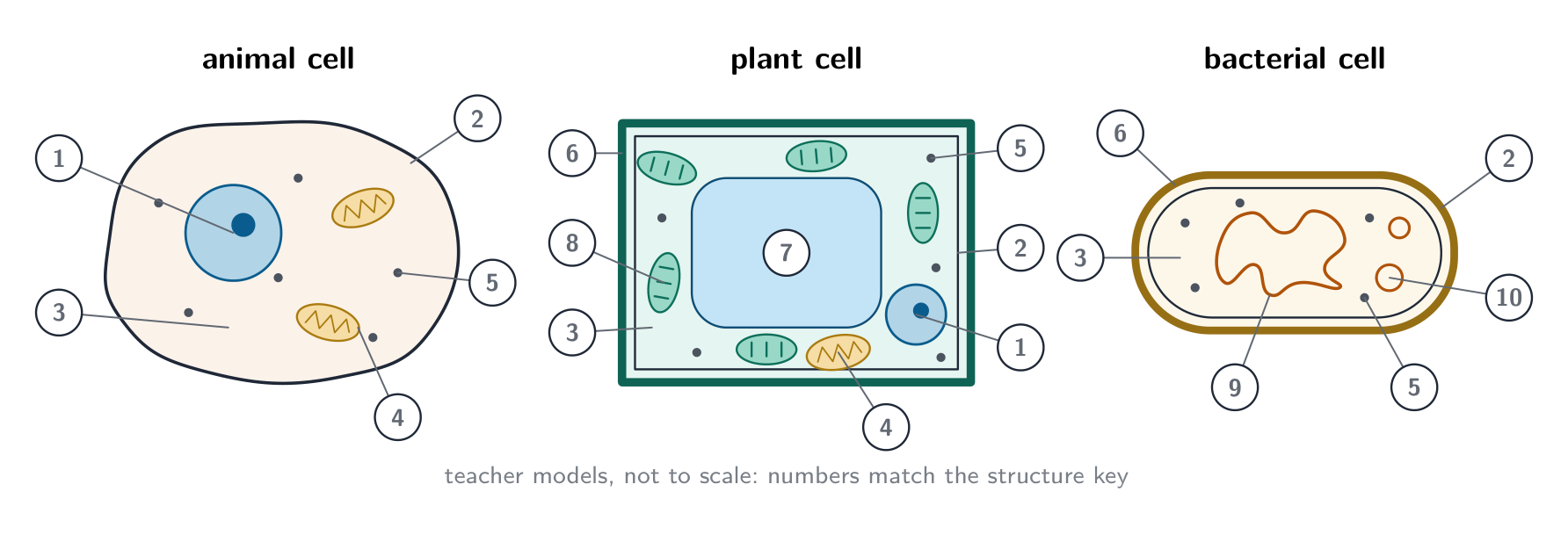
Eukaryotic 真核 cells, such as animal, plant and yeast cells, keep their genetic material inside a nucleus 细胞核. Prokaryotic 原核 cells, the bacteria, have no nucleus: their DNA is a single loop in the cytoplasm, and many also have small rings of DNA called plasmids. Bacterial cells are much smaller, typically 1 to 5 micrometres long, while most animal and plant cells are 10 to 100 micrometres.
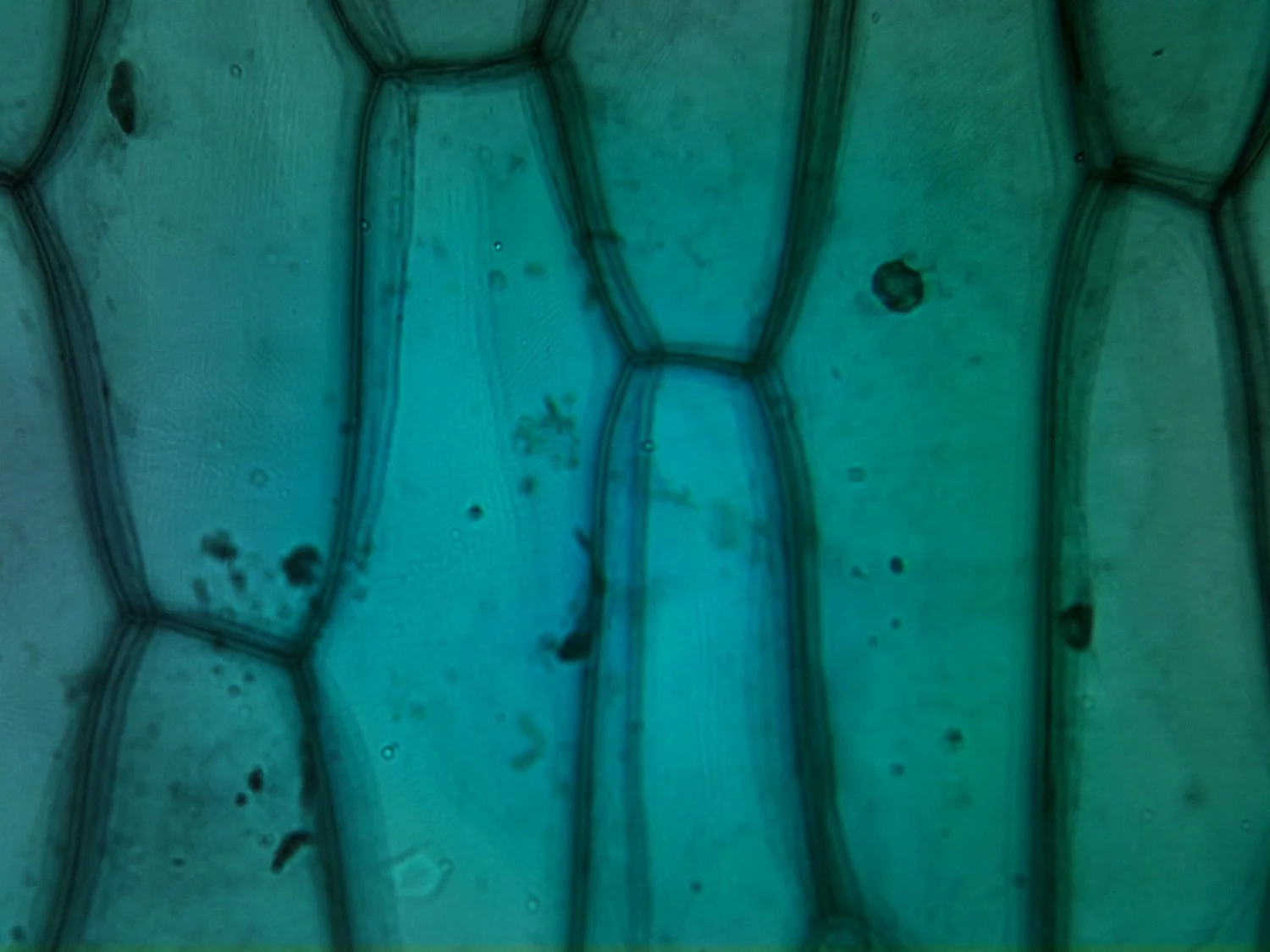
E. coli under an electron microscope: prokaryotic cells are much smaller and have no nucleusOnion epidermis cells under a light microscope: each plant cell has a cell wall and a nucleus
Parts of animal and plant cells.
The nucleus contains DNA and controls the cell's activities.
The cell membrane controls what enters and leaves the cell.
The cytoplasm 细胞质 is a jelly where many chemical reactions happen.
Each mitochondrion 线粒体 is where aerobic respiration releases energy.
Each ribosome 核糖体 is where proteins are made.
Plant cells also have:
a cell wall made of cellulose, which supports the cell;
a permanent vacuole 液泡 filled with cell sap, which keeps the cell firm;
in the green parts of the plant, a chloroplast 叶绿体 in which photosynthesis happens. Root cells are underground and have no chloroplasts.
Bacterial cells have a cell membrane, cytoplasm, ribosomes and a cell wall (not made of cellulose), but no nucleus, mitochondria or chloroplasts. A plasmid 质粒 is a small extra ring of DNA, which often carries genes such as those for antibiotic resistance.
An animal cell, a plant cell and a bacterial cell, not to scale; the numbers are listed in the key below
Key to the numbers: 1 nucleus, 2 cell membrane, 3 cytoplasm, 4 mitochondrion, 5 ribosome, 6 cell wall, 7 permanent vacuole, 8 chloroplast, 9 DNA loop, 10 plasmid.
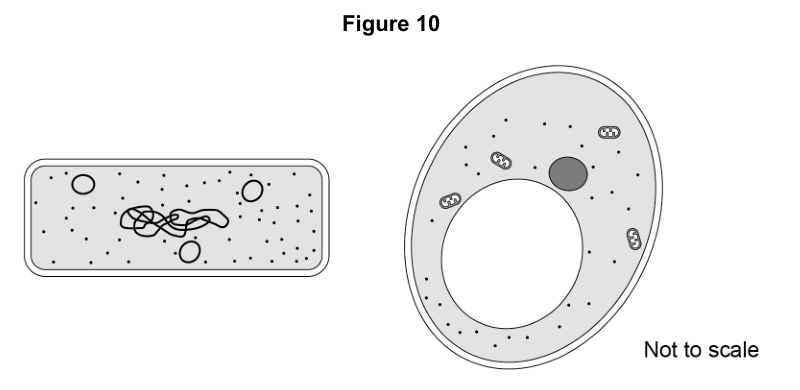
Worked example 1. A question shows a bacterial cell and a yeast cell. Name two structures in the yeast cell that are not in the bacterial cell. Answer: a nucleus and mitochondria (a permanent vacuole also scores). "The yeast cell is more complicated" earns nothing: name the structures.
A bacterial cell and a yeast cell, not to scale (AQA GCSE Biology Paper 1H, June 2025, Figure 10)
Describe plant, animal and bacterial cells, naming structures and their functions.
Relate specialised cells' structures to their functions.
Explain the importance of cell differentiation.
Calculate magnification, real size and image size, with standard form and prefixes.
Describe aseptic technique with reasons, bacterial division counts and zone areas (biology only).
Source: Cambridge International syllabus
Specialised cells 特化细胞 have features that suit their jobs. In an answer, give the feature and then explain how it helps.
Cell
Feature
How it helps
Sperm cell
tail; many mitochondria
swims to the egg; mitochondria release energy for swimming
Nerve cell
long axon; branched endings
carries impulses a long way; connects to many cells
Muscle cell
protein fibres; many mitochondria
the fibres contract; mitochondria release the energy needed
Root hair cell
long thin extension
large surface area to absorb water and mineral ions
Xylem cell
hollow tube; walls strengthened with lignin
water flows through; the walls do not collapse
Phloem cell
sieve plates; few cell contents
dissolved sugars flow from cell to cell
Differentiation 分化 is the process by which a cell gains the special structures it needs to do one job. Most animal cells differentiate early in development and then keep their type; cell division in adult animals is mainly for repair and replacement. Many plant cells can differentiate throughout the life of the plant.
Describe plant, animal and bacterial cells, naming structures and their functions.
Relate specialised cells' structures to their functions.
Explain the importance of cell differentiation.
Calculate magnification, real size and image size, with standard form and prefixes.
Describe aseptic technique with reasons, bacterial division counts and zone areas (biology only).
Source: Cambridge International syllabus
A light microscope 光学显微镜 uses light and lenses; it magnifies up to about 1500 times. An electron microscope 电子显微镜 uses a beam of electrons. Electron microscopes have a much greater magnification and resolving power 分辨能力 (resolution), the ability to show two points close together as separate. This is why they revealed ribosomes and the inside of mitochondria, which light microscopes cannot show. Making a blurred image bigger does not show more detail.
Magnification 放大倍数 has no unit. The image size and the real size must be in the same unit before you divide. Remember: 1 mm = 1000 µm (micrometres) and 1 µm = 1000 nm (nanometres).
Magnification = image size ÷ actual size
Worked example 2. A cell's image is 4.8 cm long at a magnification of ×1200. Find its real length in micrometres. $4.8\ \text{cm} = 48\ \text{mm} = 48\,000\ \mu\text{m}$, so real size $= \frac{48\,000}{1200} = 40\ \mu\text{m}$.
Worked example 3 (HT). A cylindrical structure has volume 24 500 000 nm³ and radius 125 nm. Its image is 4 mm long. Find the magnification, using $\pi = 3.14$. Real length $= \frac{V}{\pi r^2} = \frac{24\,500\,000}{3.14 \times 125^2} = 499.4$ nm. Image length $= 4$ mm $= 4\,000\,000$ nm. Magnification $= \frac{4\,000\,000}{499.4} = 8010$, written ×8010 with no unit. Keep the full value of the real length until the last step.
Required practical 1: using a light microscope. Place a thin specimen, such as onion skin stained with iodine, on a slide under a cover slip. Start with the lowest-power objective lens, focus with the coarse focus knob, then move to a higher power and use the fine focus. Draw what you actually see with clear, unshaded outlines, label the structures, and write the magnification (eyepiece × objective) or add a scale bar.
Describe plant, animal and bacterial cells, naming structures and their functions.
Relate specialised cells' structures to their functions.
Explain the importance of cell differentiation.
Calculate magnification, real size and image size, with standard form and prefixes.
Describe aseptic technique with reasons, bacterial division counts and zone areas (biology only).
Source: Cambridge International syllabus
Bacteria reproduce by binary fission 二分裂: one cell splits into two. In good conditions some bacteria divide as often as every 20 minutes. They can be grown in a liquid nutrient broth 营养肉汤 or as colonies 菌落 on agar 琼脂 gel.
$$\text{number of bacteria} = \text{starting number} \times 2^{\text{number of divisions}}$$
Worked example 4. One bacterium divides every 20 minutes. How many bacteria are there after 3 hours? Number of divisions $= 180 \div 20 = 9$, so the number is $1 \times 2^9 = 512$. (HT) In standard form, after 2 hours there are $2^6 = 64 = 6.4 \times 10^1$ bacteria. This assumes that the bacteria have enough food and space.
Aseptic technique.Aseptic technique 无菌操作 prevents contamination 污染 of the culture by unwanted microorganisms 微生物. Each step has a reason:
sterilise 灭菌 the Petri dishes 培养皿 and culture media 培养基 before use, to kill microorganisms already on them;
pass the inoculating loop 接种环 through a flame before use, to kill microorganisms on it;
lift the lid only slightly, so that microorganisms from the air do not fall in;
secure the lid with tape (but do not seal it all round), so that oxygen can still get in and harmful anaerobic bacteria do not grow;
store the dish upside down, so that drops of condensation do not fall onto the agar.
In school, cultures are kept at 25 °C or below, which reduces the growth of bacteria that could cause disease in humans. Hospital laboratories use 37 °C, body temperature, so cultures grow faster.
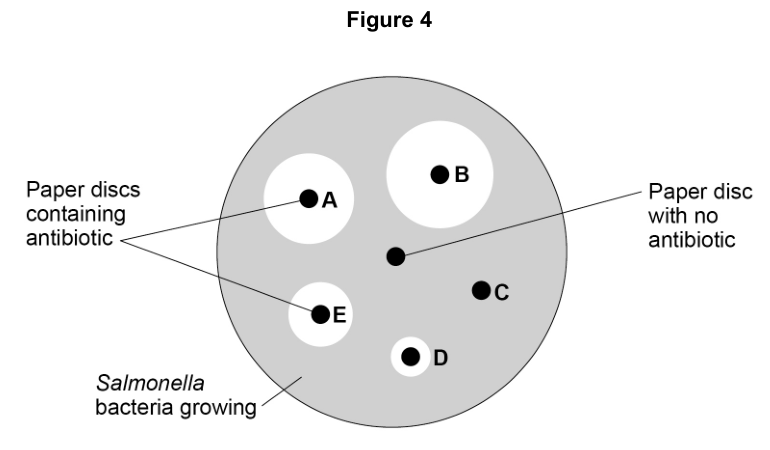
Antibiotic discs on a bacterial lawn: the bigger the clear zone, the more effective the antibiotic
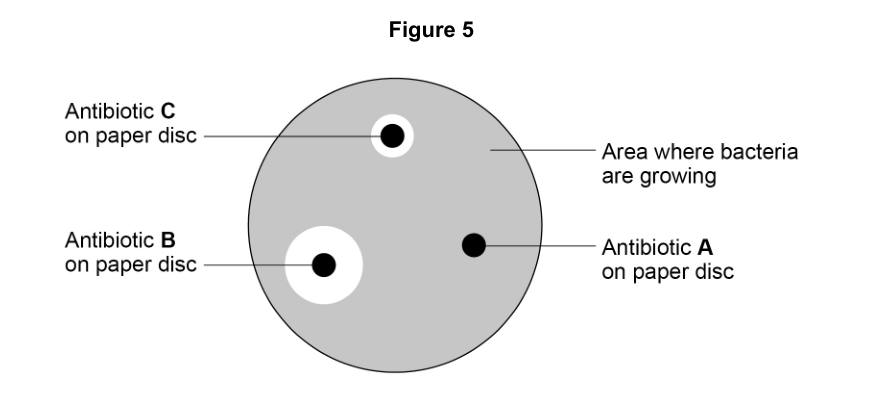
Required practical 2: antiseptics and antibiotics. Spread bacteria evenly over agar to make a "lawn". Put paper discs soaked in different antibiotics 抗生素 or antiseptics 消毒剂 on the agar, and one disc soaked in sterile water as a control 对照. After incubation, a clear zone forms around a disc where bacteria have been killed or stopped from growing. A bigger zone of inhibition 抑菌圈 means a more effective substance against that bacterium. The control shows that the paper disc alone does not stop growth.
Five antibiotics, A to E, and a control disc with no antibiotic (AQA GCSE Biology Paper 1H, June 2023, Figure 4)
Worked example 5. In a test, antibiotic C has a small clear zone around it. A student says the bacteria are resistant 耐药 to antibiotic C. Explain why the student is wrong. A clear zone, even a small one, shows that antibiotic C killed some bacteria or stopped their growth. If the bacteria were resistant, they would grow right up to the edge of the disc.
Antibiotic A has no clear zone, B a large one and C a small one (AQA GCSE Biology Paper 1H, June 2024, Figure 5)
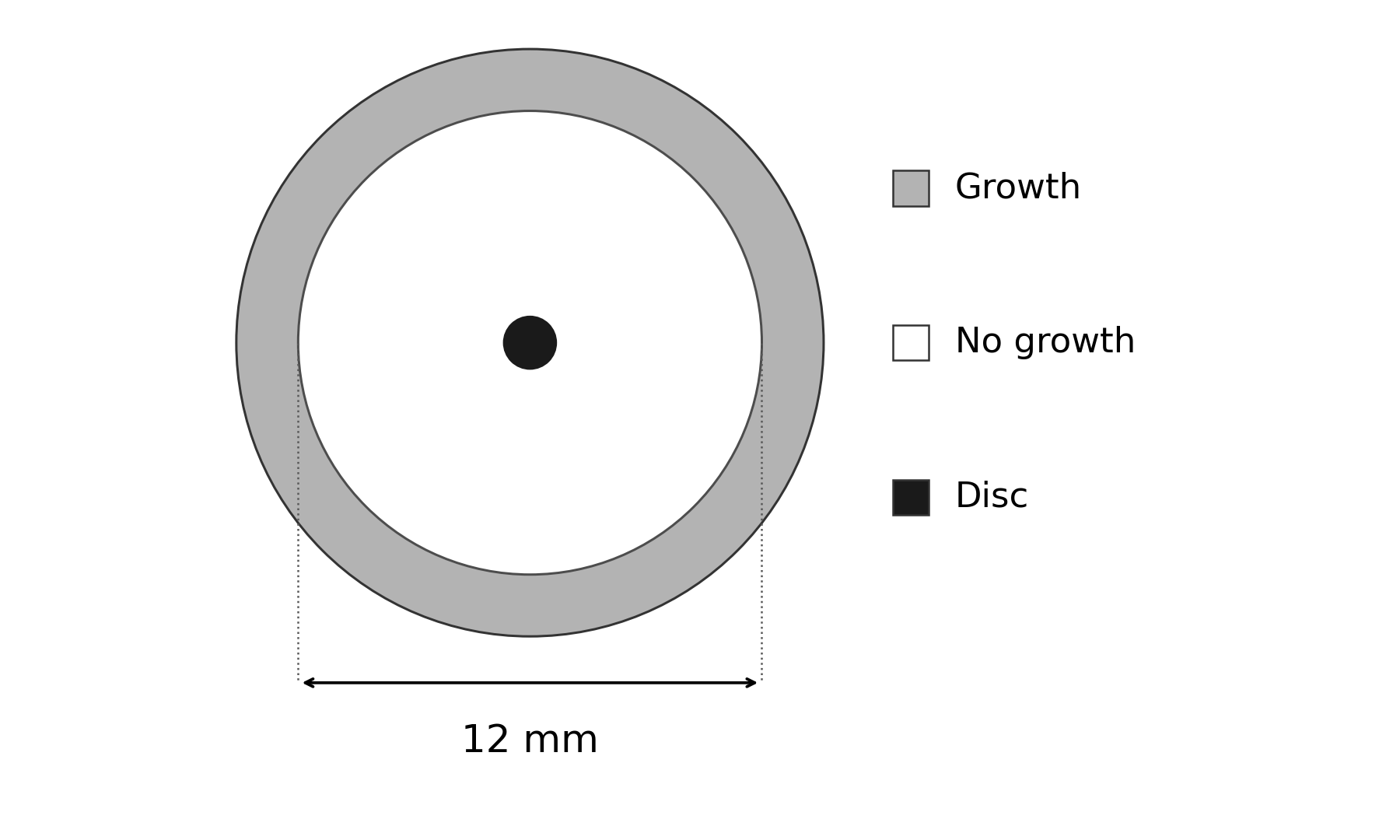
Worked example 6. A clear zone has a diameter of 12 mm. Find its area. The radius is $12 \div 2 = 6$ mm, so the area is $\pi r^2 = \pi \times 6^2 = 113$ mm² (3 s.f.). Using 12 mm as the radius would give an area four times too large.
Cell division and stem cells (AQA 8461 statements 4.1.2.1-4.1.2.3).
Describe chromosomes and their pairing in body cells.
Describe the cell cycle including the three overall stages and mitosis.
Describe stem cell function in embryos, adult animals and plant meristems.
Evaluate stem cell use in medicine and plant cloning, including risks and ethical objections.
Source: Cambridge International syllabus
The nucleus contains chromosomes 染色体, long molecules of DNA. Each chromosome carries many genes 基因. In body cells chromosomes are found in pairs: human body cells have 23 pairs, 46 chromosomes in all.
The cell cycle. The cell cycle 细胞周期 has three stages:
The cell grows, makes more ribosomes and mitochondria, and copies its DNA, so that each chromosome becomes two identical copies.
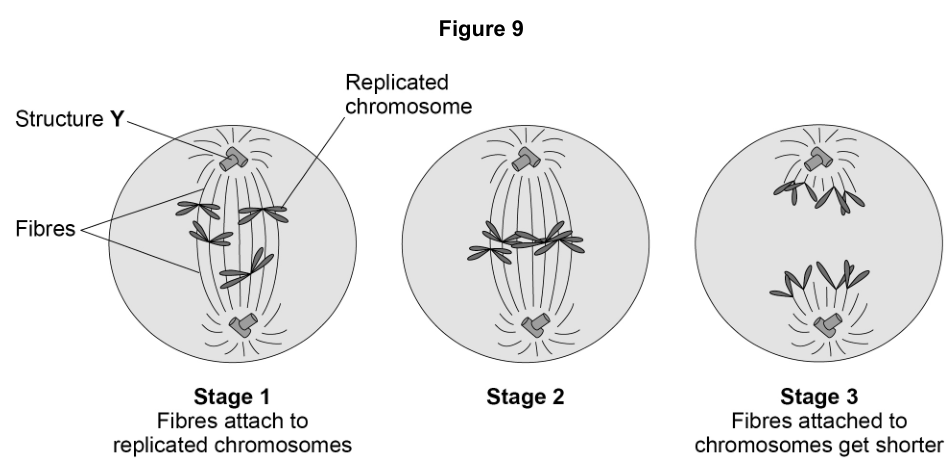
Mitosis 有丝分裂: one set of chromosomes is pulled to each end of the cell, and the nucleus divides.
The cytoplasm and cell membrane divide, forming two genetically identical daughter cells 子细胞.
Mitosis is used for growth and development, for repairing damage, and for asexual reproduction.
A stained onion root tip: several cells are caught at different stages of mitosis
Worked example 7. A drug stops the fibres in a cell attaching to the chromosomes. Explain how this stops the cell dividing. Without the fibres, the chromosomes cannot be pulled to each end of the cell, so the nucleus cannot divide into two. Such a drug can slow the growth of a tumour 肿瘤, where cells divide out of control. But it also slows normal dividing cells, which is why some cancer treatments cause hair loss.
Fibres pull the copied chromosomes apart during mitosis (AQA GCSE Biology Paper 1H, June 2024, Figure 9)
Cell division and stem cells (AQA 8461 statements 4.1.2.1-4.1.2.3).
Describe chromosomes and their pairing in body cells.
Describe the cell cycle including the three overall stages and mitosis.
Describe stem cell function in embryos, adult animals and plant meristems.
Evaluate stem cell use in medicine and plant cloning, including risks and ethical objections.
Source: Cambridge International syllabus
A stem cell 干细胞 is undifferentiated 未分化: it can divide to make more stem cells and can differentiate into other kinds of cell.
One unspecialised stem cell can differentiate into many specialised cell types
Source
What it can become
Human embryo
almost any type of human cell
Adult bone marrow 骨髓
many types, including blood cells, but fewer than embryonic cells
Plant meristem 分生组织 (root and shoot tips)
any type of plant cell, throughout the plant's life
Uses.Embryonic stem cells 胚胎干细胞 might one day replace faulty cells, for example insulin-making cells in diabetes or nerve cells in paralysis. In therapeutic cloning 治疗性克隆, an embryo is made with the same genes as the patient, so its stem cells are not rejected 排斥 by the patient's immune system. Meristem cells are used to clone plants quickly and cheaply, to save rare species from extinction, or to produce many identical crop plants with useful features such as disease resistance.
Risks and objections. Stem cells grown in a laboratory could carry viruses that pass to the patient. Some people have ethical 伦理 objections to using embryos: an embryo is destroyed when its stem cells are taken, and some believe an embryo has a right to life. For a full answer, give the reason, not just "religion".
Transport in cells (AQA 8461 statement 4.1.3, RP3).
Define diffusion, osmosis and active transport with examples and the energy distinction.
Explain factors affecting the rate of diffusion.
Calculate and compare surface area to volume ratios; explain exchange-surface adaptations.
Investigate the effect of solute concentration on plant tissue mass and calculate percentage change (RP3).
Source: Cambridge International syllabus
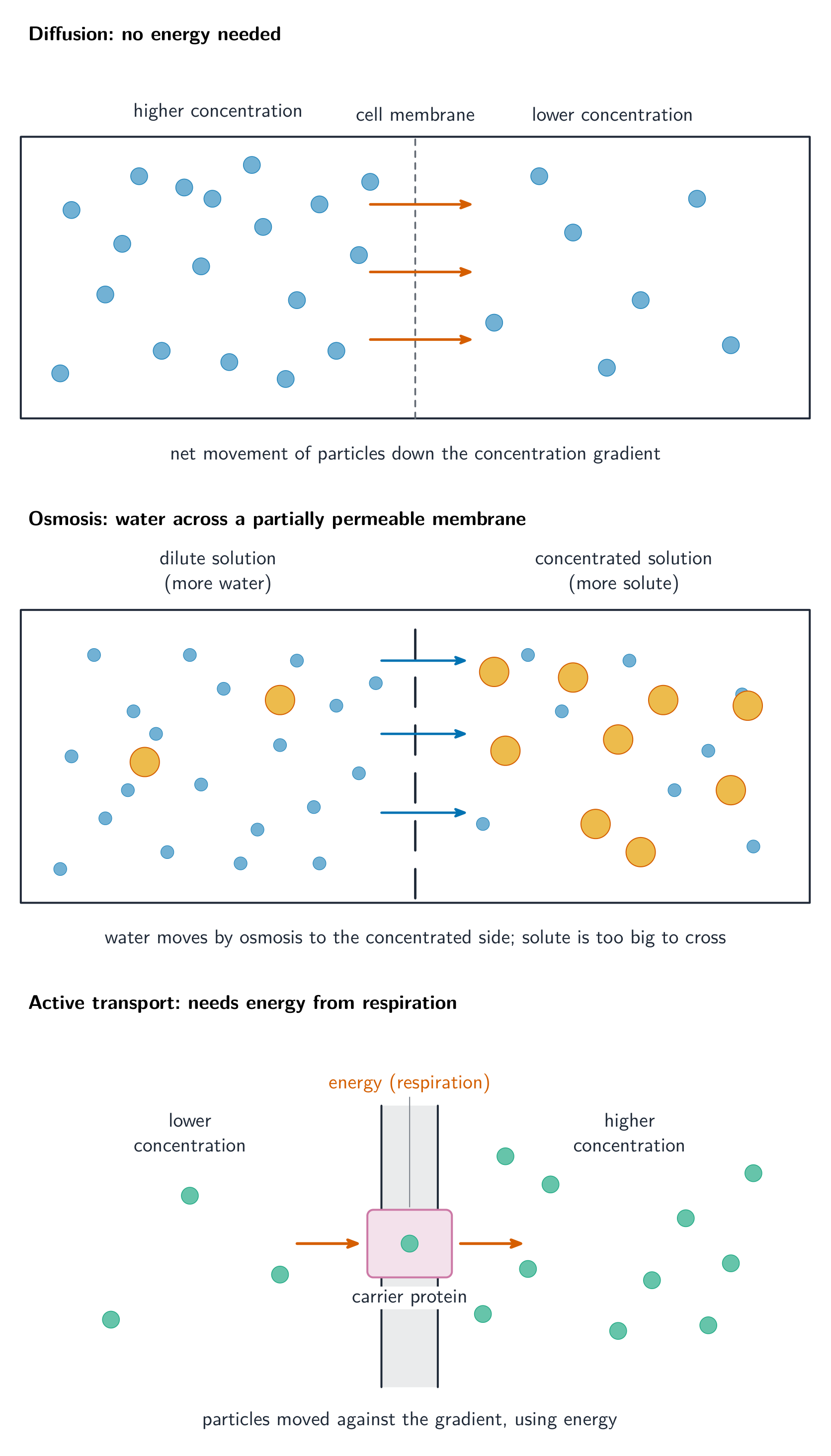
Diffusion 扩散 is the net movement of particles from an area of higher concentration to an area of lower concentration. Particles move in every direction, but more move down the concentration gradient 浓度梯度 than up it. Examples are oxygen and carbon dioxide in gas exchange 气体交换, and urea moving from cells into the blood plasma 血浆 to be taken to the kidneys. Diffusion is faster with a steeper concentration gradient, a higher temperature and a larger membrane surface area.
Osmosis 渗透 is the diffusion of water from a dilute solution to a more concentrated solution through a partially permeable membrane 部分透过性膜, which lets small water molecules through but not larger solute 溶质 molecules such as sugar.
A potato osmometer: sugar solution rises up the tube as water enters by osmosis
Active transport 主动运输 moves substances from a more dilute solution to a more concentrated solution, against the concentration gradient. It needs energy from respiration. Root hair 根毛 cells use it to absorb each mineral ion 矿物离子 from very dilute soil water, and the gut uses it to absorb sugar into the blood when the concentration in the gut is low.
Diffusion, osmosis and active transport compared in three panels.
Process
What moves
Direction
Energy from respiration?
Diffusion
any dissolved or gas particles
high → low concentration
no
Osmosis
water
dilute → concentrated solution
no
Active transport
particles such as ions
low → high concentration
yes
Required practical 3: osmosis in potato. Cut cylinders of potato of equal size from the same potato. Blot them dry, weigh each one, and put them in sugar or salt solutions of different concentrations, with the same volume of solution, for the same time and at the same temperature. Then blot and weigh again. Because the pieces start at slightly different masses, compare them using percentage change:
Worked example 8. A piece of potato goes from 2.5 g to 2.9 g: percentage change $= \frac{0.4}{2.5} \times 100 = +16\%$. Another goes from 3.0 g to 2.55 g: $\frac{-0.45}{3.0} \times 100 = -15\%$. Keep the minus sign for a loss.
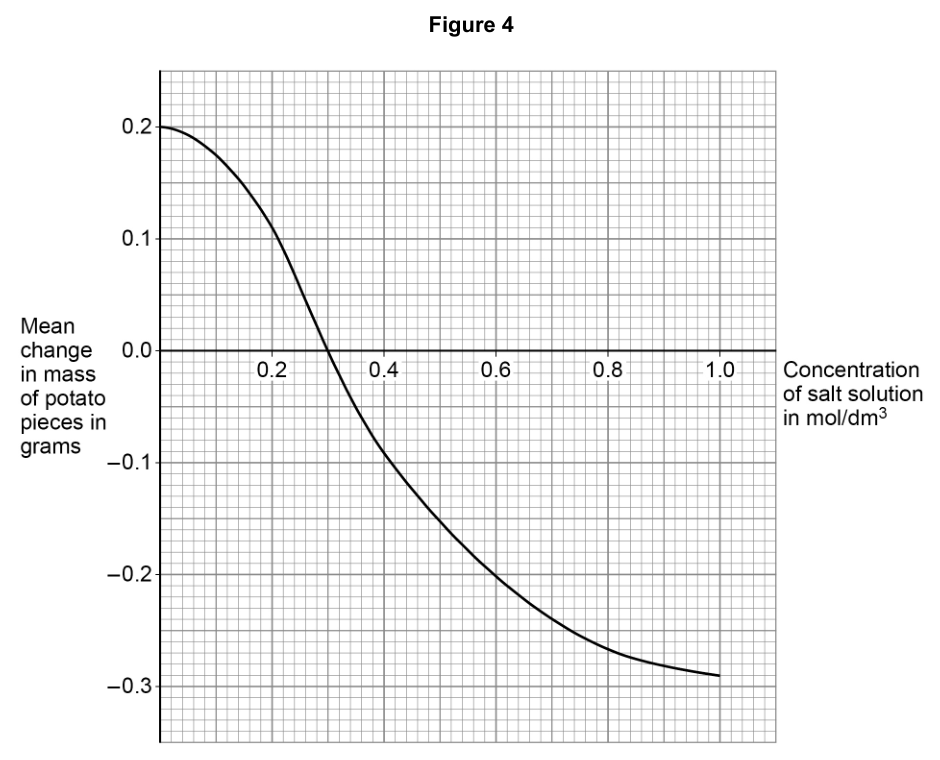
In distilled water the potato gains mass, because the solution inside its cells is more concentrated and water enters by osmosis. In a concentrated solution it loses mass, because water leaves. Where the graph crosses zero, there is no net movement of water: the solution outside has the same concentration as the cell sap. Water molecules still move both ways, but equally.
Mean change in mass of potato in grams against solution concentration (AQA GCSE Biology Paper 1H, June 2024, Figure 4)
Worked example 9. Using the graph, explain why the mass of potato decreases in a 0.6 mol/dm³ solution, and why it decreases more in a 1.0 mol/dm³ solution. In 0.6 mol/dm³ the solution outside is more concentrated than the cell sap, so water leaves the cells by osmosis. In 1.0 mol/dm³ the concentration gradient is steeper, so more water leaves in the same time.
Exchange surfaces and surface area to volume ratio
Syllabus
Transport in cells (AQA 8461 statement 4.1.3, RP3).
Define diffusion, osmosis and active transport with examples and the energy distinction.
Explain factors affecting the rate of diffusion.
Calculate and compare surface area to volume ratios; explain exchange-surface adaptations.
Investigate the effect of solute concentration on plant tissue mass and calculate percentage change (RP3).
Source: Cambridge International syllabus
A small single-celled organism can get all the oxygen it needs by diffusion through its surface. A large organism cannot, because it has much less surface for each unit of volume, and its inner cells are far from the surface. This is shown by the surface area to volume ratio 表面积与体积之比.
Worked example 10. A cube of side 2 mm has surface area $6 \times 2^2 = 24$ mm² and volume $2^3 = 8$ mm³, a ratio of $24 : 8 = 3 : 1$. A cube of side 4 mm has surface area 96 mm² and volume 64 mm³, a ratio of $1.5 : 1$. Doubling the side multiplies the area by 4 but the volume by 8, so the ratio halves. The larger cube has more surface in total, but less surface for each mm³ inside it.
Two cubes showing how doubling the side halves the surface-area-to-volume ratio.
So a multicellular 多细胞 organism needs exchange surfaces 交换表面 and a transport system, while a single-celled 单细胞 organism does not. Good exchange surfaces have:
a large surface area, so more substance crosses at once;
a thin membrane, so the diffusion path is short;
(in animals) a good blood supply, which carries substances away and keeps the gradient steep;
(for gas exchange) ventilation 通气, which brings in fresh air or water.
Examples are the alveoli 肺泡 in the lungs, surrounded by capillaries 毛细血管; the villi of the small intestine 小肠; fish gills 鳃; and plant roots and leaves.
AQA, GCSE Biology (8461) specification, section 4.1 Cell biology, and the required practical handbook.
R. Hooke, Micrographia (London, 1665), Observation XVIII, on cork.
A. van Leeuwenhoek, letter to the Royal Society of 9 October 1676, Philosophical Transactions 12 (1677).
AQA, GCSE Biology Paper 1 Higher (June 2023, 2024 and 2025), the antibiotic, cell division and osmosis questions, adapted.
1.3
Common errors
Saying all plant cells have chloroplasts; root cells do not.
Saying bacteria have no ribosomes or no cell wall; they have both.
Dividing image size by real size without first changing to the same unit, or giving magnification a unit.
Calling the water disc in RP2 a "control variable"; it is a control.
Using the diameter instead of the radius in $\pi r^2$.
Saying "water molecules stop moving" when there is no net osmosis.
Writing that active transport moves substances down the concentration gradient.
Saying a larger cube has a larger surface area to volume ratio.
1.3
Key terms
Eukaryotic cell: a cell with its DNA inside a nucleus.
Prokaryotic cell: a bacterial cell, with no nucleus.
Differentiation: the process by which a cell becomes specialised.
Magnification: how many times bigger the image is than the real object.
Aseptic technique: methods that stop unwanted microorganisms contaminating a culture.
Mitosis: the division of the nucleus that makes two identical nuclei.
Stem cell: an undifferentiated cell that can make more stem cells and other cell types.
Diffusion: the net movement of particles from higher to lower concentration.
Osmosis: the diffusion of water across a partially permeable membrane from a dilute to a concentrated solution.
Active transport: movement against a concentration gradient, using energy from respiration.
1.3
Check yourself
Name three structures found in plant cells but not in animal cells.
An image is 30 mm long and the magnification is ×500. Find the real length in µm.
Give the reason for each of these steps: flaming the inoculating loop; storing the Petri dish upside down.
One bacterium divides every 30 minutes. How many bacteria are there after 4 hours?
Describe the three stages of the cell cycle.
Give one benefit and one objection to using embryonic stem cells.
A potato piece goes from 4.0 g to 3.4 g. Calculate the percentage change in mass, and explain the change.
Answers: 1. Cell wall, permanent vacuole, chloroplasts. 2. $30\ \text{mm} = 30\,000\ \mu\text{m}$; $30\,000 \div 500 = 60\ \mu\text{m}$. 3. Flaming kills microorganisms on the loop, so they do not contaminate the culture; storing upside down stops condensation dripping onto the agar. 4. 8 divisions, so $2^8 = 256$. 5. The cell grows, makes more organelles and copies its DNA; mitosis pulls one set of chromosomes to each end and the nucleus divides; the cytoplasm and membrane divide to make two identical cells. 6. Benefit: they can become almost any cell type, so they could treat diseases such as diabetes; objection: the embryo is destroyed. 7. $\frac{-0.6}{4.0} \times 100 = -15\%$; the solution was more concentrated than the cell sap, so water left the cells by osmosis.
Explore
Water crosses; solute stays
At equal pressure, water moves toward the more concentrated ideal solution; this membrane retains solute.
Explore
Random motion and net diffusion
Particles move in both directions, with a net transfer down the concentration gradient.
Explore
Size changes surface area relative to volume
$\mathrm{SA:V}=\frac{6l^2}{l^3}$
As similar objects grow, volume increases faster than surface area.
Explore
Chromosomes separate before the cell divides
Chromosome separation and cell division are different events in the cell cycle.
Explore
Enlarge the image, preserve the real size
A 30 mm image of a 50 μm cell has magnification ×600. Resize the cell image and its 20 μm scale bar together, convert units consistently, and recover the same real cell size.
Interactive lessons on this topic
Work through it step by step, with instant-check exercises.