Skip to content

Organisation

AQA · GCSE · Biology · Topic 2

2.1

Organisation: from cells to systems

Cells form tissues, tissues form organs, organs form systems — and the digestive system, blood and plants each show the pattern. This reference covers AQA GCSE Biology 8461, topic 4.2 Organisation.

How the exam treats this topic:

  • Paper 1 carries Organisation. Required practicals: RP4 (food tests) and RP5 (pH and amylase rate).
  • You must evaluate heart-disease treatments and stem-cell/lifestyle risk data, and interpret graphs and tables of risk factors.
  • Recall exactly: the enzymes table, the heart's vessels, blood components, plant tissues, transpiration factors.
2.1

Principles of organisation

Syllabus

Principles of organisation and the digestive system (AQA 8461 statements 4.2.1-4.2.2.1, RP4, RP5).

  1. Order cells, tissues, organs, organ systems and organisms.
  2. Describe enzyme nature and lock-and-key action; relate activity to temperature and pH.
  3. Recall sites and actions of amylase, proteases and lipases, with word equations.
  4. Explain bile's two functions; test foods (RP4) and investigate pH on amylase (RP5).

Source: Cambridge International syllabus

Cells → tissues → organs → organ systems → organism.

  • A tissue 组织 is a group of cells with a similar structure and function.
  • An organ 器官 aggregates tissues performing specific functions.
  • Organ systems 器官系统 work together to form the whole organism.

The digestive system is the named example of an organ system.

Vocabulary Train
English
tissue/ˈtɪʃuː/
organ/ˈɔːɡən/
organ systems/ˈɔːɡən ˈsɪstəmz/
2.1

The human digestive system (4.2.2.1)

Syllabus

Principles of organisation and the digestive system (AQA 8461 statements 4.2.1-4.2.2.1, RP4, RP5).

  1. Order cells, tissues, organs, organ systems and organisms.
  2. Describe enzyme nature and lock-and-key action; relate activity to temperature and pH.
  3. Recall sites and actions of amylase, proteases and lipases, with word equations.
  4. Explain bile's two functions; test foods (RP4) and investigate pH on amylase (RP5).

Source: Cambridge International syllabus

Enzymes 酶 are biological catalysts: proteins with an active site whose shape fits one substrate — the lock and key model. Temperature and pH change the rate; far from the optimum the enzyme denatures (active site changes shape).

Enzyme Made in Acts on Products
amylase (a carbohydrase) salivary glands, pancreas, small intestine starch simple sugars (glucose)
protease stomach, pancreas, small intestine protein amino acids
lipase pancreas, small intestine lipids glycerol + 3 fatty acids

Digestive enzymes turn food into small soluble molecules that can be absorbed into the bloodstream. The products build new carbohydrates, lipids and proteins; some glucose is used in respiration.

Bile 胆汁: made in the liver, stored in the gall bladder. It is alkaline, neutralising hydrochloric acid from the stomach, and emulsifies fat into small droplets, increasing the surface area — both raise the rate of fat breakdown by lipase.

RP4 food tests (learn reagent, colour change, substance):

Test Reagent Positive result
sugars (reducing) Benedict's, heat blue → brick-red
starch iodine orange/brown → blue-black
protein Biuret blue → purple
lipids Sudan III red-stained layer on top

RP5 (pH and amylase): buffer solutions at pH values, amylase + starch, continuous sampling onto a spotting tile with iodine, record the time for the starch to disappear — shortest time = fastest rate at the optimum pH.
Vocabulary Train
English
enzyme/ˈenzaɪm/
Bile/baɪl/
2.2

The heart, blood vessels and blood (4.2.2.2–4.2.2.3)

Syllabus

The heart, blood vessels, blood and coronary heart disease (AQA 8461 statements 4.2.2.2-4.2.2.4).

  1. Describe the heart and double circulation with the five named vessels and the pacemaker cells.
  2. Relate artery, vein and capillary structure to function.
  3. Know plasma, red cells, white cells and platelets with their adaptations.
  4. Explain CHD and evaluate stents, statins, valves, transplants and artificial hearts.

Source: Cambridge International syllabus

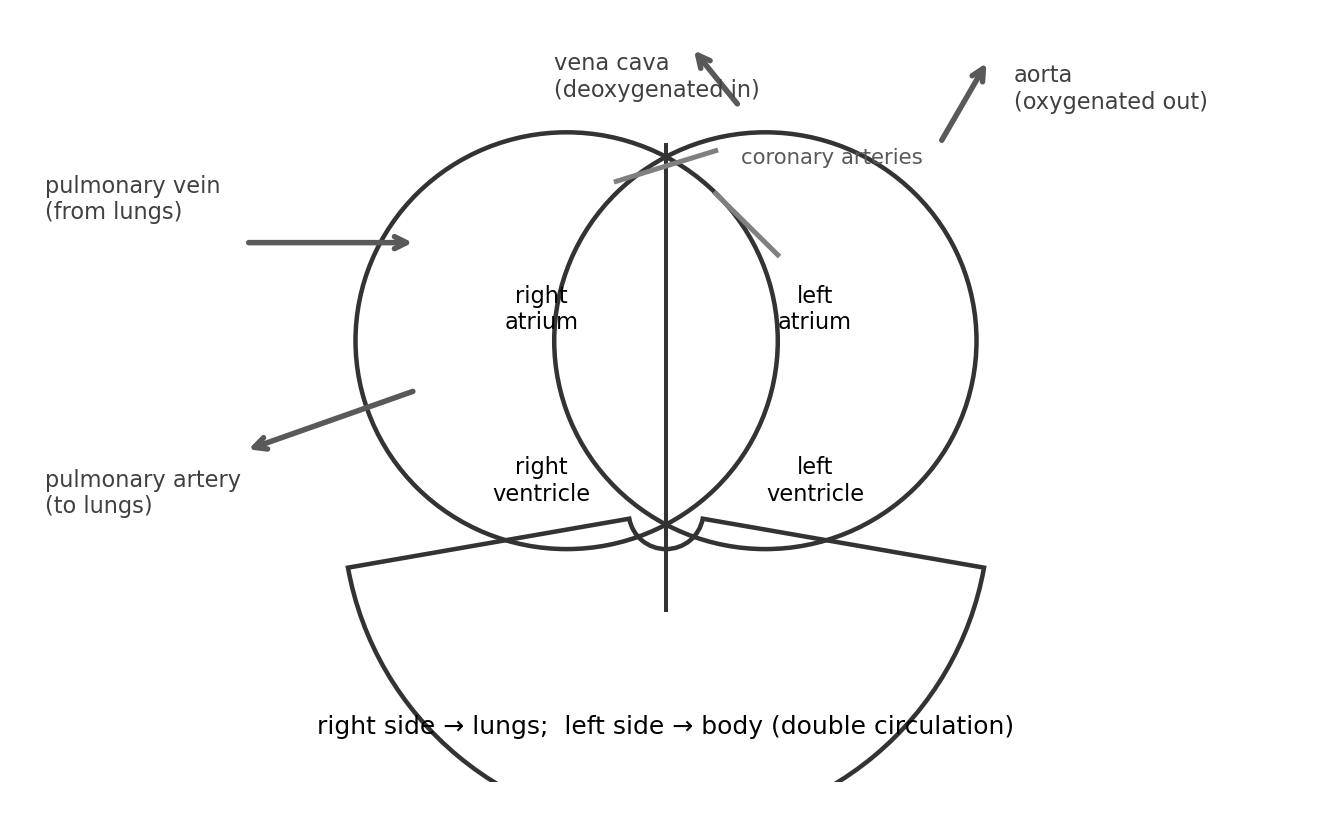
The human heart with its four chambers and the five named vessels.
Right side to the lungs; left side to the body.
  • The heart pumps blood in a double circulatory system: the right ventricle pumps blood to the lungs (gas exchange); the left ventricle pumps it around the rest of the body.
  • Vessels to know: aorta, vena cava, pulmonary artery, pulmonary vein, coronary arteries.
  • The resting heart rate is set by cells in the right atrium — the natural pacemaker; artificial pacemakers correct irregular rates.
  • Lungs: trachea → bronchi → alveoli 肺泡, surrounded by capillaries; alveoli are adapted by a large surface area, thin walls, good blood supply and ventilation.
Vessel Structure Function
artery thick, elastic, muscular walls; small lumen carries blood away at high pressure
vein thin walls, large lumen, valves returns blood at low pressure
capillary one cell thick exchange with tissues
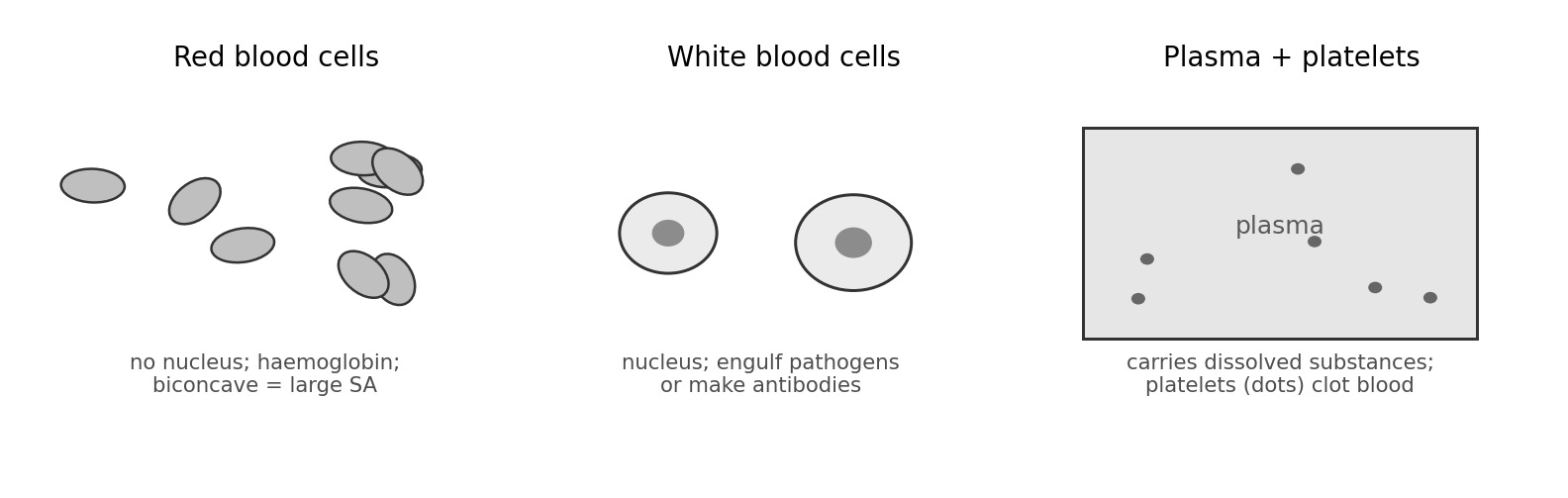
Red cells, white cells, plasma and platelets.

Blood is a tissue: plasma 血浆 (carries dissolved sugars, amino acids, CO₂, urea, hormones, and heat), red blood cells 红细胞 (no nucleus, packed with haemoglobin, biconcave — large surface area for oxygen transport), white blood cells 白细胞 (engulf pathogens or make antibodies), platelets 血小板 (clotting).

Vocabulary Train
English
alveoli/ˈælvɪɒli/
plasma/ˈplæzmə/
red blood cells/red blʌd selz/
white blood cells/waɪt blʌd selz/
platelets/ˈpleɪtlɪts/
2.2

Coronary heart disease (4.2.2.4) and treatments

Syllabus

The heart, blood vessels, blood and coronary heart disease (AQA 8461 statements 4.2.2.2-4.2.2.4).

  1. Describe the heart and double circulation with the five named vessels and the pacemaker cells.
  2. Relate artery, vein and capillary structure to function.
  3. Know plasma, red cells, white cells and platelets with their adaptations.
  4. Explain CHD and evaluate stents, statins, valves, transplants and artificial hearts.

Source: Cambridge International syllabus

In CHD layers of fatty material build up inside the coronary arteries, narrowing them — less blood, so less oxygen for the heart muscle. Evaluate each treatment with benefits and risks:

Treatment Benefit Risk/limitation
stents 支架 keeps the artery open, restores flow surgery risk; doesn't treat the cause
statins 他汀 reduce blood cholesterol, slowing fatty deposits long-term medication with side effects (liver)
valve replacement (biological or mechanical) restores one-way flow major surgery; mechanical need lifelong anti-clotting drugs
transplant (heart / heart and lungs) cures failure donor shortage; rejection — immunosuppressants
artificial heart keeps the patient alive while waiting, or lets the heart rest infection, clotting, bulky
Vocabulary Train
English
stents/stents/
statins/ˈstætɪnz/
2.3

Health, lifestyle and cancer (4.2.2.5–4.2.2.7)

Syllabus

Health, lifestyle and cancer (AQA 8461 statements 4.2.2.5-4.2.2.7).

  1. Define health and describe interactions between diseases and other factors.
  2. State risk factors with proven causal mechanisms for non-communicable diseases.
  3. Distinguish benign and malignant tumours and describe secondary tumours.
  4. Interpret risk-factor data, distinguishing correlation from causation.

Source: Cambridge International syllabus

Health is the state of physical and mental well-being — not just the absence of disease. Diet, stress and life situations affect both; different diseases interact (immune defects → more infections; viruses → some cancers; immune reactions trigger asthma; severe physical illness → depression).

Risk factors 危险因素 are linked to an increased rate of a disease — aspects of lifestyle or substances in the body/environment. A causal mechanism is proven for some, not others: diet/smoking/exercise → cardiovascular disease; obesity → Type 2 diabetes; alcohol → liver damage and brain function; smoking → lung disease and lung cancer; smoking and alcohol → unborn babies; carcinogens including ionising radiation → cancer. Interpret risk-factor data as correlation; proven mechanism makes it causation.

Cancer results from changes in cells producing uncontrolled growth and division:

  • Benign tumours: contained in one area, usually within a membrane; do not invade.
  • Malignant tumours (cancers) invade neighbouring tissues and spread in the blood to form secondary tumours.

Risk factors include lifestyle and, for some cancers, genes.

Vocabulary Train
English
Risk factors/rɪsk ˈfæktəz/
2.4

Plant tissues and transport (4.2.3)

Syllabus

Plant tissues, organs and transport (AQA 8461 statement 4.2.3).

  1. Relate plant tissues (epidermis, palisade, spongy, xylem, phloem, meristem, guard cells) to functions.
  2. Explain root hair, xylem and phloem adaptations and the processes of transpiration and translocation.
  3. Explain the effects of temperature, humidity, air movement and light intensity on transpiration rate.

Source: Cambridge International syllabus

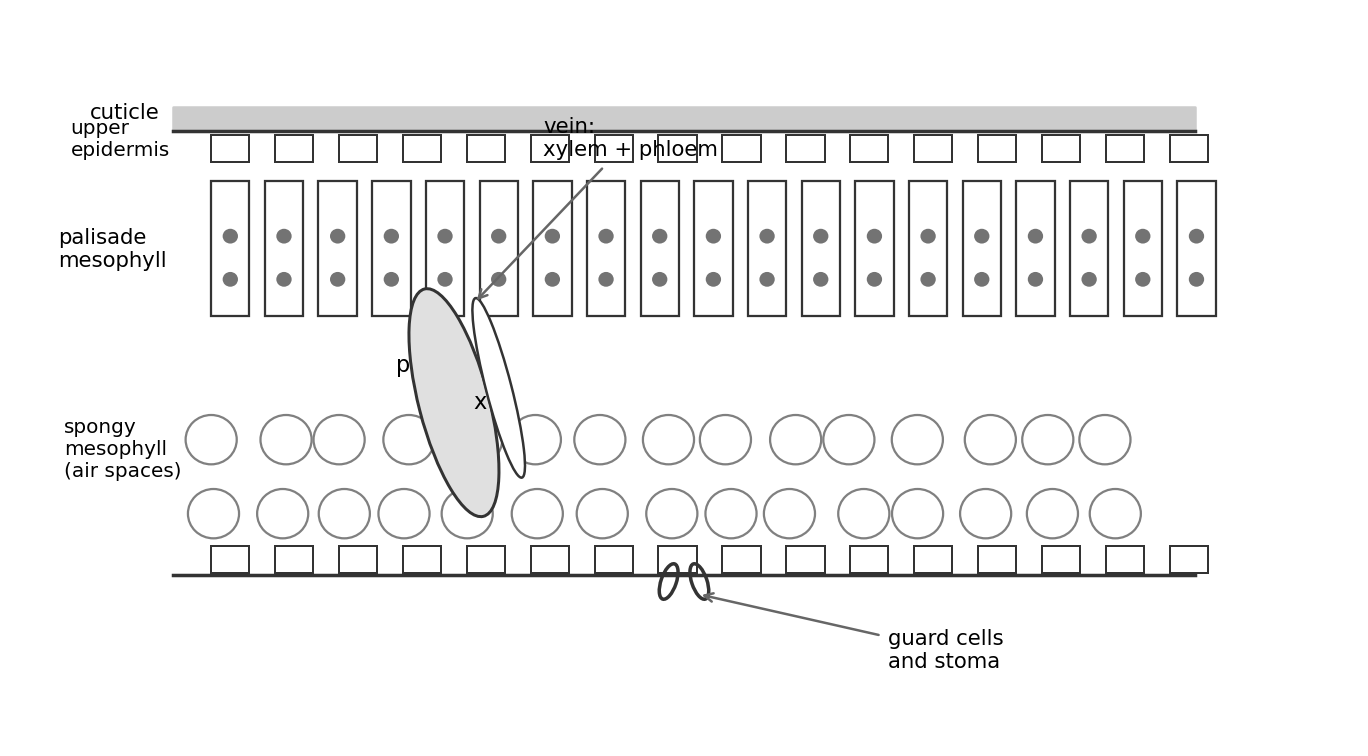
A leaf in cross-section with its tissues labelled.
Each tissue has one main job.
  • Epidermal tissue: protective covering; waxy cuticle on top.
  • Palisade mesophyll 栅栏组织: packed chloroplasts — most photosynthesis.
  • Spongy mesophyll: air spaces for gas exchange.
  • Xylem 木质部: hollow tubes strengthened by lignin — carries water and mineral ions from roots to leaves in the transpiration stream.
  • Phloem 韧皮部: sieve tubes — carries dissolved sugars from leaves to the rest of the plant (translocation 运输).
  • Meristem: at the growing tips of shoots and roots (stem cells).
  • Guard cells 保卫细胞 surround stomata 气孔, controlling gas exchange and water loss.
  • Root hair cells: large surface area; water enters by osmosis, mineral ions by active transport.

Transpiration 蒸腾作用 is the loss of water vapour from the leaves (mostly through stomata); it pulls the transpiration stream. The rate increases with: temperature ↑, air movement ↑, light intensity ↑ (stomata open); decreases with humidity ↑. Measure rate by water uptake with a potometer.

Vocabulary Train
English
palisade mesophyll/ˈpælɪseɪd ˈmesəfɪl/
Xylem/ˈzaɪləm/
Phloem/ˈfləʊɪm/
Guard cells/ɡɑːd selz/
stomata/ˈstəʊmətə/
Transpiration/trænspəˈreɪʃn/
translocation/trænsləʊˈkeɪʃn/
2.4

Checklist before you call this topic done

  • Order cells → tissues → organs → systems with one example each.
  • Enzyme table: name, site, substrate, products; lock and key; denaturing.
  • Bile: two functions with reasons; RP4 tests and colours; RP5 method.
  • Label the heart with all five named vessels; double circulation; pacemaker.
  • Artery/vein/capillary structure ↔ function; four blood components with adaptations.
  • CHD: cause + each treatment's benefit and risk.
  • Risk factors with causal mechanisms; benign vs malignant tumours.
  • Plant tissues and their jobs; xylem vs phloem; four transpiration factors.

More topics in AQA · GCSE · Biology

Log in or create account

IGCSE, A-Level & AP