Skip to content

Infection and response

AQA · GCSE · Biology · Topic 3

3.1

Infection and response: the war inside

Pathogens invade, defences respond, and medicine arms the fight. This reference covers AQA GCSE Biology 8461, topic 4.3 Infection and response.

How the exam treats this topic:

  • Paper 1 carries this topic; RP2 (antibiotics/antiseptics on agar) links from topic 1.
  • Monoclonal antibodies (4.3.2) and plant disease (4.3.3) are biology only, and monoclonals plus plant-disease detection are HT only.
  • Recall exactly: each named disease → pathogen type, symptoms and spread; the defence systems; the drug-testing stages.
Vocabulary Train
English
Pathogens/ˈpæθədʒnz/
3.1

Communicable diseases and pathogens (4.3.1.1)

Syllabus

Communicable diseases, pathogen types and named diseases (AQA 8461 statements 4.3.1.1-4.3.1.5).

  1. Explain how viruses, bacteria, protists and fungi spread in animals and plants, and how spread is reduced.
  2. Recall measles, HIV, TMV, Salmonella, gonorrhoea, rose black spot and malaria with pathogen type, spread, symptoms and control.

Source: Cambridge International syllabus

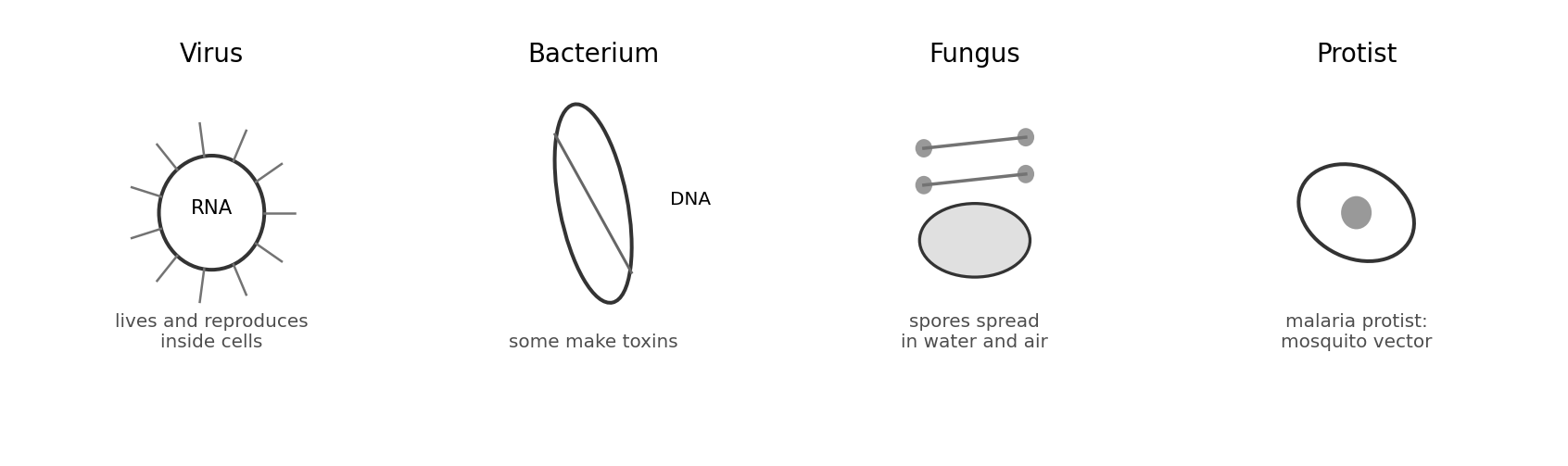
The four pathogen types with their key features.

Pathogens are microorganisms 病原体 causing infectious disease: viruses, bacteria, protists, fungi. They infect plants or animals and spread by direct contact, water or air. Bacteria may produce toxins 毒素 that damage tissues; viruses live and reproduce inside cells.

Reducing spread: hygiene (hand washing), sterilising wounds, clean water, sewage treatment, using condoms, vector control (mosquito nets, draining water).

Vocabulary Train
English
toxins/ˈtɒksɪnz/
3.1

Named diseases (4.3.1.2–4.3.1.5)

Syllabus

Communicable diseases, pathogen types and named diseases (AQA 8461 statements 4.3.1.1-4.3.1.5).

  1. Explain how viruses, bacteria, protists and fungi spread in animals and plants, and how spread is reduced.
  2. Recall measles, HIV, TMV, Salmonella, gonorrhoea, rose black spot and malaria with pathogen type, spread, symptoms and control.

Source: Cambridge International syllabus

Disease Pathogen Spread Symptoms/signs Control
measles virus droplet inhalation (sneezes, coughs) fever, red skin rash; can be fatal vaccination of young children
HIV virus sexual contact, exchange of body fluids (shared needles) flu-like illness; attacks immune cells → late-stage AIDS antiretroviral drugs; safe sex; clean needles
TMV (tobacco mosaic virus) virus (plants) contact between plants mosaic discolouration of leaves; reduced photosynthesis and growth resistant varieties; hygiene
Salmonella bacterium food ingested in unhygienic conditions fever, cramps, vomiting, diarrhoea (bacteria + toxins) poultry vaccinated (UK); hygienic food prep
gonorrhoea bacterium sexual contact thick yellow/green discharge, pain urinating antibiotics (resistance rising); condoms
rose black spot fungus (plants) spores in water/air black spots on leaves; leaves yellow and drop removing/burning leaves; fungicide
malaria protist mosquito vector recurrent fever; can be fatal nets; stopping mosquito breeding
3.2

Human defence systems and immunity (4.3.1.6–4.3.1.7)

Syllabus

Human defence systems, vaccination and drugs (AQA 8461 statements 4.3.1.6-4.3.1.9).

  1. Describe the non-specific defence systems and the three white blood cell actions.
  2. Explain vaccination in the individual and its population effect.
  3. Distinguish antibiotics from painkillers; explain why antibiotics cannot treat viruses; describe resistance.
  4. Describe drug discovery sources and the preclinical/clinical testing stages including double-blind trials.

Source: Cambridge International syllabus

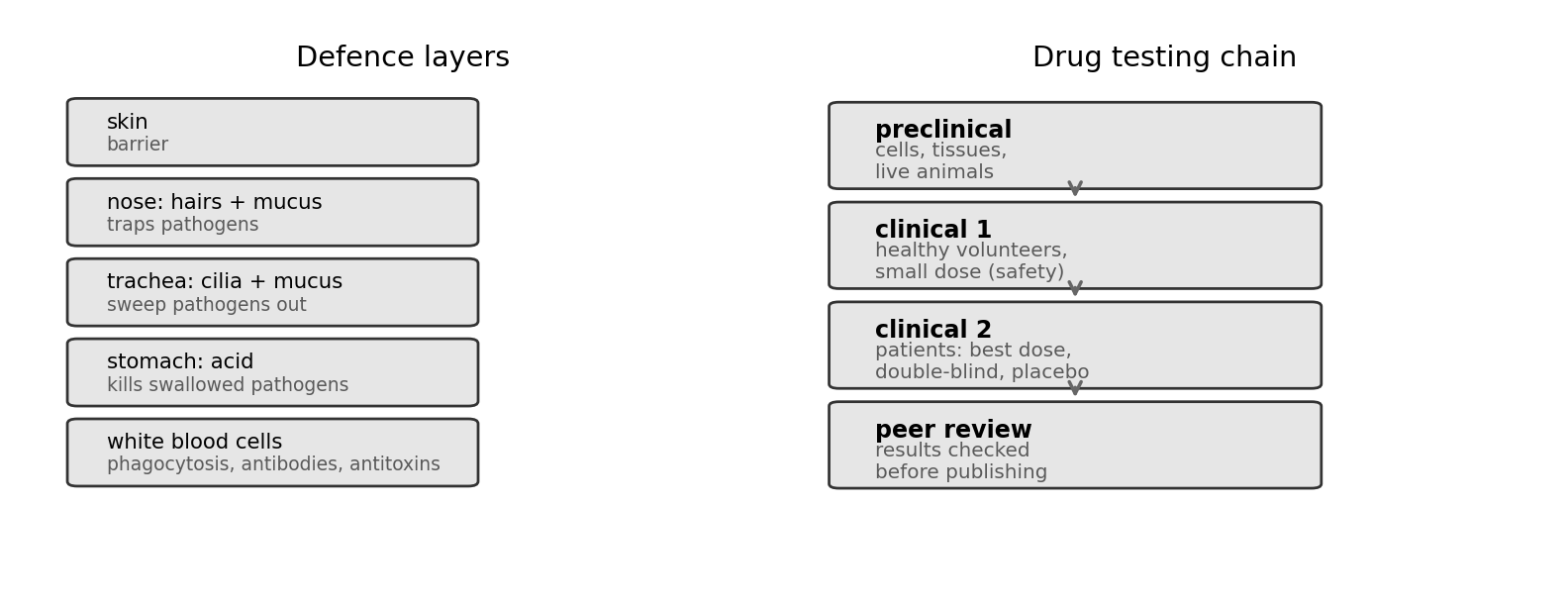
The defence layers and the drug-testing chain.

Non-specific defences: skin (barrier, scabbing); nose (hairs, mucus); trachea and bronchi (mucus, cilia); stomach (hydrochloric acid).

The immune system destroys pathogens that enter. White blood cells defend by:

  1. phagocytosis — engulfing 吞噬 pathogens;
  2. antibody production — proteins 抗体 that bind the specific antigen;
  3. antitoxin production — neutralising 抗毒素 toxins.

Vaccination 疫苗: small quantities of dead or inactive pathogen stimulate white blood cells to make antibodies; on re-infection, memory cells respond quickly with the correct antibodies, preventing infection. Herd effect: immunising a large proportion reduces the spread for everyone. Evaluate: benefits (epidemic control, e.g. measles) vs rare side effects.

Vocabulary Train
English
phagocytosis/ˌfæɡəsɪˈtəʊsɪs/
antibody production/ˈæntɪbɒdi prəˈdʌkʃn/
antitoxin production/ˌæntɪˈtɒksɪn prəˈdʌkʃn/
Vaccination/ˌvæksɪˈneɪʃn/
3.2

Antibiotics, painkillers and drug development (4.3.1.8–4.3.1.9)

Syllabus

Human defence systems, vaccination and drugs (AQA 8461 statements 4.3.1.6-4.3.1.9).

  1. Describe the non-specific defence systems and the three white blood cell actions.
  2. Explain vaccination in the individual and its population effect.
  3. Distinguish antibiotics from painkillers; explain why antibiotics cannot treat viruses; describe resistance.
  4. Describe drug discovery sources and the preclinical/clinical testing stages including double-blind trials.

Source: Cambridge International syllabus

  • Antibiotics 抗生素 (e.g. penicillin) cure bacterial disease by killing bacteria inside the body — specific antibiotics for specific bacteria. They cannot kill viruses (viruses live inside cells; killing them would damage body tissue). Resistance is a major concern — the race for new antibiotics.
  • Painkillers treat symptoms but do not kill pathogens.

Drug development: traditionally extracted from plants/microorganisms — digitalis from foxgloves (heart), aspirin from willow, penicillin from Penicillium mould (Fleming). Most new drugs are chemically synthesised, but starting points may still be plant chemicals.

Testing stages: preclinical (cells, tissues, live animals) → clinical trials on healthy volunteers (low dose, safety) then patients (optimum dose, effectiveness) → double-blind trials with a placebo; results peer-reviewed.

Vocabulary Train
English
Antibiotics/ˌæntɪbaɪˈɒtɪks/
3.3

Monoclonal antibodies (biology only, HT)

Syllabus

Monoclonal antibodies, biology only and HT (AQA 8461 statement 4.3.2).

  1. Describe hybridoma production of monoclonal antibodies.
  2. Describe uses in diagnosis, measurement, research and cancer treatment.

Source: Cambridge International syllabus

Monoclonal antibodies 单克隆抗体 are produced from a single clone of cells, specific to one binding site on one protein antigen. Producing them: stimulate mouse lymphocytes to make the antibody → fuse with a tumour cell to make a hybridoma 杂交瘤 — it divides AND makes the antibody → clone the hybridoma → collect and purify large amounts of one specific antibody.

Uses: pregnancy tests; measuring hormone/chemical levels in blood; detecting pathogens; research — fluorescent antibodies locate molecules; cancer treatment — antibody bound to a radioactive/toxic substance delivers it only to cancer cells.

Vocabulary Train
English
Monoclonal antibodies/ˈmɒnəʊklɒnl ˈæntɪbɒdiz/
hybridoma/ˌhaɪbrɪˈdəʊmə/
3.4

Plant disease (biology only)

Syllabus

Plant disease, biology only (AQA 8463 statement 4.3.3).

  1. Detect plant disease from signs and identify it by manual, laboratory or monoclonal tests.
  2. Explain nitrate and magnesium ion deficiencies.
  3. Describe physical, chemical and mechanical plant defence responses.

Source: Cambridge International syllabus

Detection (HT): stunted growth, spots on leaves, areas of decay, growths, malformed stems/leaves, discolouration, presence of pests.

Identification (HT): gardening manual/website; laboratory analysis; testing kits using monoclonal antibodies.

Named plant problems: TMV (viral), rose black spot (fungal), aphids 蚜虫 (insects).

Ion deficiencies: too little nitrate → stunted growth (nitrate needed for amino acids/protein); magnesium deficiency → chlorosis (yellow leaves 缺绿 — magnesium needed to make chlorophyll).

Defence responses: physical — cellulose cell walls, waxy cuticle, bark/dead layers; chemical — antibacterial chemicals, poisons; mechanical — thorns, hairs, drooping/curling leaves, mimicry.

Vocabulary Train
English
aphids/ˈeɪfɪdz/
chlorosis/ˈklɔːrəʊsiz/
3.4

Checklist before you call this topic done

  • Four pathogen types; three routes of spread; two ways to reduce each named disease's spread.
  • Recite the disease table: pathogen, spread, symptoms, control.
  • Four non-specific defences; three white-blood-cell actions.
  • Vaccination mechanism + population effect; antibiotic vs painkiller; why antibiotics fail on viruses.
  • Drug sources (foxglove, willow, Penicillium) and the preclinical/clinical stages with placebo and double-blind.
  • (HT, biology) Hybridoma production sequence and four monoclonal uses.
  • (Biology) Plant disease signs, identification methods, nitrate/magnesium deficiencies, three defence classes.

More topics in AQA · GCSE · Biology

Log in or create account

IGCSE, A-Level & AP