- Homeostasis 稳态 is the regulation of the internal conditions of a cell or organism, to maintain optimum conditions for enzyme action and all cell functions, in response to internal and external changes.
- The body controls blood glucose concentration, body temperature and water levels.
- Every automatic control system has: receptors (detect stimuli), coordination centres (brain, spinal cord, pancreas — receive and process information) and effectors (muscles or glands — bring about the response that restores optimum levels).
- Nervous responses are fast and short-lived; hormonal responses are slower but act for longer.
Homeostasis and response
AQA · GCSE · Biology · Topic 5
5.1
Homeostasis and response: keeping conditions steady
Vocabulary
Train
| English |
|---|
| Homeostasis/ˌhəʊmiːəˈstɑːsiz/ |
5.1
Homeostasis and the nervous system (4.5.1–4.5.2.1, RP7)
Syllabus
Homeostasis and the nervous system (AQA 8461 statements 4.5.1-4.5.2.1, RP7).
- Define homeostasis and name the three conditions the body controls.
- Describe receptors, coordination centres and effectors, and the stimulus-receptor-coordinator-effector-response pathway.
- Explain the reflex arc, including sensory neurone, synapse, relay neurone and motor neurone, and why reflexes are automatic and rapid.
- Describe RP7: the effect of a factor on human reaction time, with controls and data handling.
Source: Cambridge International syllabus
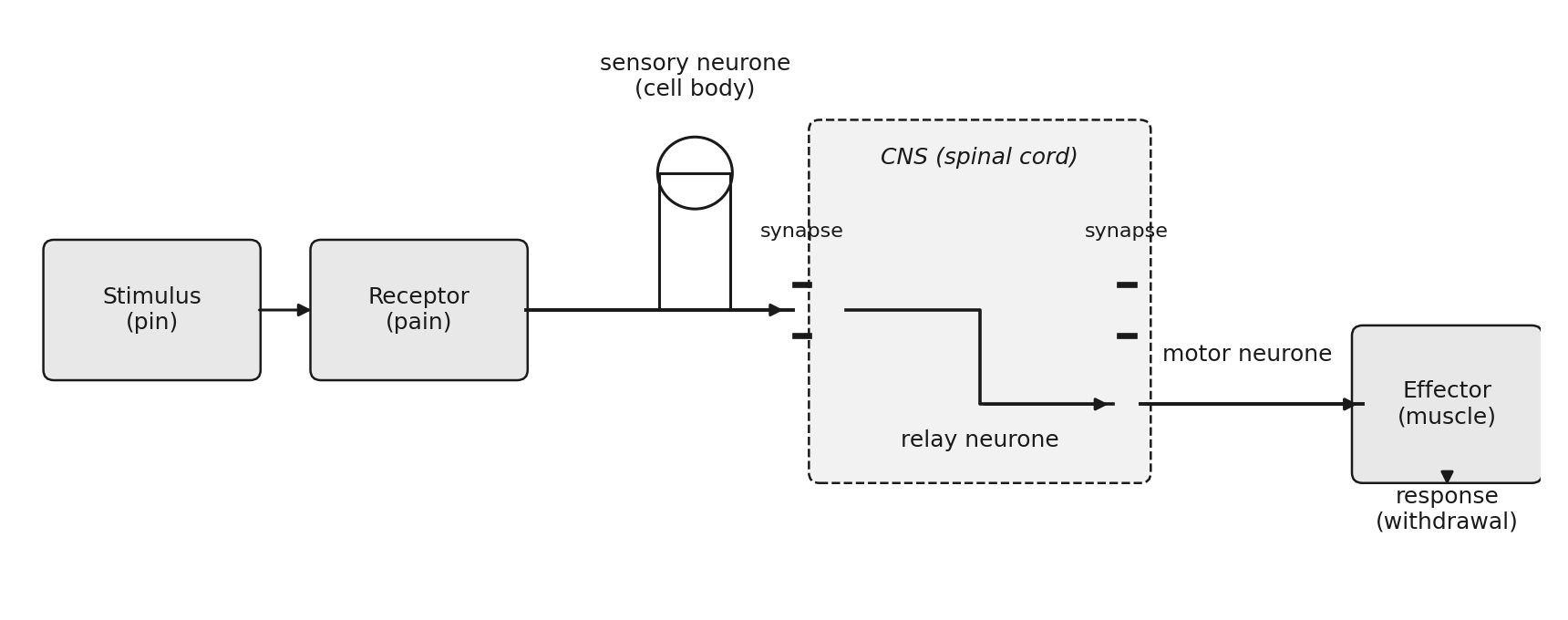
The pathway: stimulus → receptor → coordinator (CNS: brain + spinal cord) → effector (muscle contracts / gland secretes) → response.
Information passes along cells called neurones 神经元 as electrical impulses. The CNS coordinates the response of effectors.
The reflex arc — automatic and rapid protection that does not involve the conscious part of the brain:
stimulus → receptor → sensory neurone → synapse → relay neurone (in CNS) → synapse → motor neurone → effector → response.
At a synapse 突触 the electrical impulse arrives at the end of a neurone and a chemical is released; it diffuses across the gap and triggers an electrical impulse in the next neurone.
RP7 — reaction time: plan and investigate the effect of a factor (e.g. caffeine) on human reaction time. Drop a ruler between a partner's finger and thumb; measure the catch distance; convert to time (or use a computer test); control variables (same hand, same height); repeat and take a mean. Interpret reaction-time data from graphs and tables.
Vocabulary
Train
| English |
|---|
| neurone/ˈnjuːrəʊn/ |
| synapse/ˈsɪnæps/ |
5.2
The brain, the eye and temperature — biology only (4.5.2.2–4.5.2.4)
Syllabus
The brain, the eye and body temperature — biology only (AQA 8461 statements 4.5.2.2-4.5.2.4).
- Identify cerebral cortex, cerebellum and medulla with their functions, and (HT) difficulties of investigating and treating the brain.
- Relate eye structures to functions and explain accommodation for near and distant objects.
- Explain myopia and hyperopia and their correction with lenses and new technologies.
- Explain how vasodilation, sweating, vasoconstriction and shivering control body temperature (HT in context).
Source: Cambridge International syllabus
The brain (HT extra)
Identify on a diagram: cerebral cortex (consciousness, memory, language), cerebellum (balance, coordination of movement), medulla (heartbeat, breathing).
(HT) Difficulties of investigating and treating the brain: it is complex and delicate, easily damaged, and hard to access. Mapping methods: studying patients with brain damage, electrically stimulating regions, and MRI scanning. Evaluate benefits and risks of brain procedures.
The eye
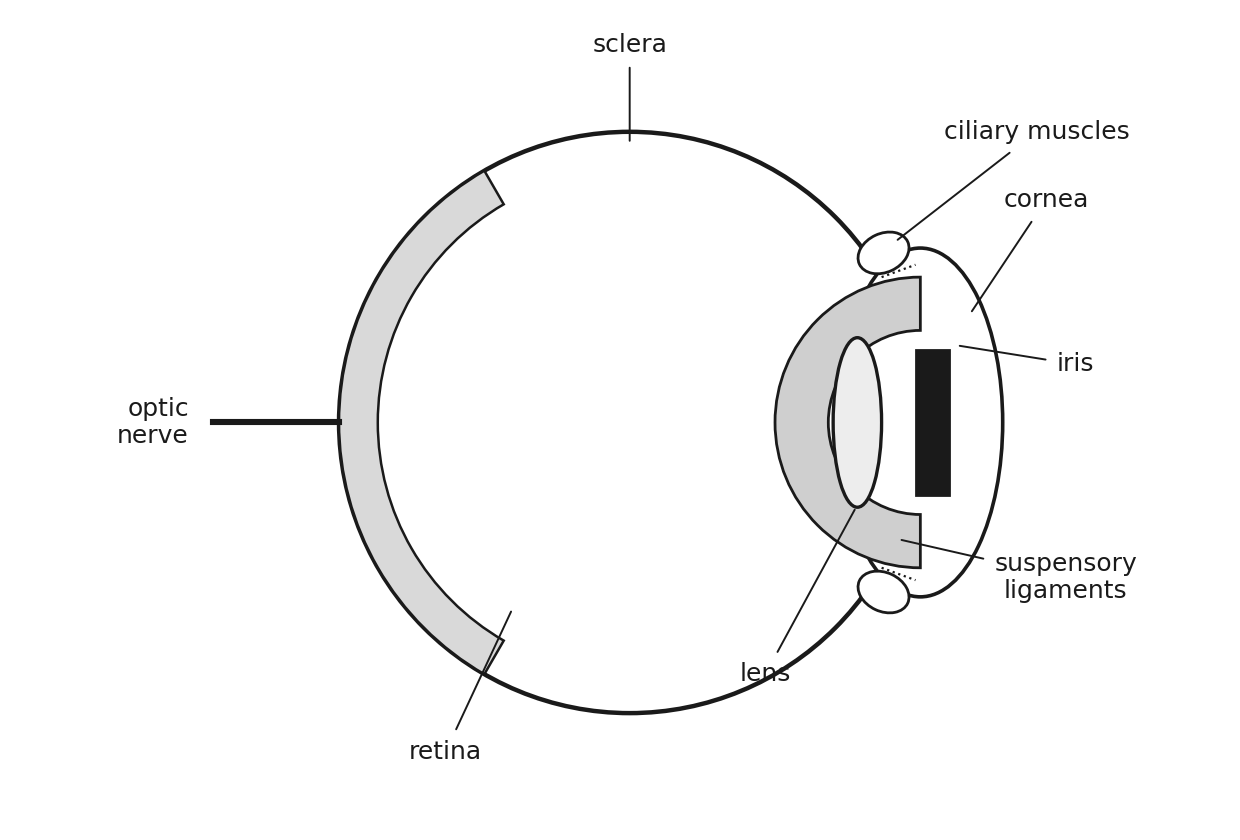
Identify and explain: retina 视网膜 (receptor cells sensitive to light intensity and colour), optic nerve (carries impulses from retina to brain), sclera (strong outer coat), cornea (refracts light), iris (coloured muscles controlling pupil size — reflex adaptation to dim/bright light), ciliary muscles and suspensory ligaments (control lens shape).
Accommodation 视觉调节 — changing lens shape to focus:
| near object | distant object | |
|---|---|---|
| ciliary muscles | contract | relax |
| suspensory ligaments | loosen | pulled tight |
| lens | thicker, refracts strongly | thin, refracts slightly |
Defects: myopia 近视 (short sight — distant objects focus in front of the retina; corrected with a concave lens), hyperopia 远视 (long sight — near objects focus behind the retina; convex lens). Treatments: spectacle lenses, contact lenses, laser surgery to reshape the cornea, replacement lens.
Control of body temperature
The thermoregulatory centre in the brain has receptors sensitive to blood temperature; skin receptors send impulses to it.
- Too hot: blood vessels dilate (vasodilation 血管舒张) — more blood near the surface transfers energy to the environment; sweat 汗液 produced — evaporating sweat transfers energy away.
- Too cold: blood vessels constrict (vasoconstriction 血管收缩); sweating stops; skeletal muscles contract (shivering — respiration transfers energy to warm the blood).
(HT) Explain in context how each mechanism lowers or raises temperature back to the optimum.
Vocabulary
Train
| English |
|---|
| retina/ˈretɪnə/ |
| accommodation/əˌkɒməˈdeɪʃn/ |
| myopia/maɪˈəʊpɪə/ |
| hyperopia/ˌhaɪpəˈrəʊpɪə/ |
| vasodilation/ˌvæsədɪˈleɪʃn/ |
| vasoconstriction/ˌvæsəkənˈstrɪkʃn/ |
| sweat/swet/ |
5.3
Hormonal coordination in humans (4.5.3)
Syllabus
Hormonal coordination in humans (AQA 8461 statements 4.5.3).
- Describe the endocrine system: glands, hormones, target organs, and the six named glands.
- Explain insulin control of blood glucose, (HT) glucagon and negative feedback, and compare Type 1 and Type 2 diabetes.
- (Bio) Describe water and nitrogen balance: kidneys, filtration and selective reabsorption, (HT) ADH, and dialysis vs transplant.
- (HT) Explain FSH, LH, oestrogen and progesterone interactions in the menstrual cycle, contraception methods and IVF.
- (HT) Explain adrenaline and thyroxine, with negative feedback.
Source: Cambridge International syllabus
The endocrine system is glands that secrete hormones 激素 directly into the bloodstream; blood carries them to target organs. Slower than nerves but longer-lasting. Identify on a body diagram: pituitary gland (brain's 'master gland'), pancreas, thyroid, adrenal gland, ovary, testes.
Blood glucose is monitored and controlled by the pancreas:
- Too high → pancreas secretes insulin 胰岛素 → glucose moves from blood into cells; in liver and muscle cells excess glucose is converted to glycogen 糖原 for storage.
- (HT) Too low → pancreas secretes glucagon 胰高血糖素 → glycogen converted back to glucose, released into the blood. Insulin–glucagon is a negative feedback 负反馈 cycle.
Diabetes: Type 1 — pancreas fails to produce enough insulin; uncontrolled high blood glucose; treated with insulin injections. Type 2 — body cells no longer respond to insulin; treated with a carbohydrate-controlled diet and exercise regime; obesity is a risk factor. Interpret graphs of blood glucose with and without diabetes.
Water and nitrogen balance — biology only
Water leaves via the lungs (exhalation) and the skin (sweat, with ions and urea) — no control over these. Excess water, ions and urea are removed by the kidneys in urine. Cells that lose or gain too much water by osmosis do not work efficiently. (HT) Excess amino acids from the diet are deaminated in the liver: ammonia (toxic) → urea 尿素 for safe excretion.
The kidneys filter the blood and selectively reabsorb glucose, some ions and water. (HT) If the blood is too concentrated, the pituitary releases ADH 抗利尿激素, which makes the kidney tubules more permeable, so more water is reabsorbed — negative feedback again.
Kidney failure: treated by transplant or dialysis — blood flows between partially permeable membranes in dialysis fluid with the right water/ion concentrations, so waste diffuses out while glucose and useful substances are retained; evaluate mechanical device vs transplant.
Hormones in human reproduction
Oestrogen 雌激素 (ovary) — main female hormone; at puberty eggs mature and one is released about every 28 days (ovulation 排卵). Testosterone 睾酮 (testes) — stimulates sperm production.
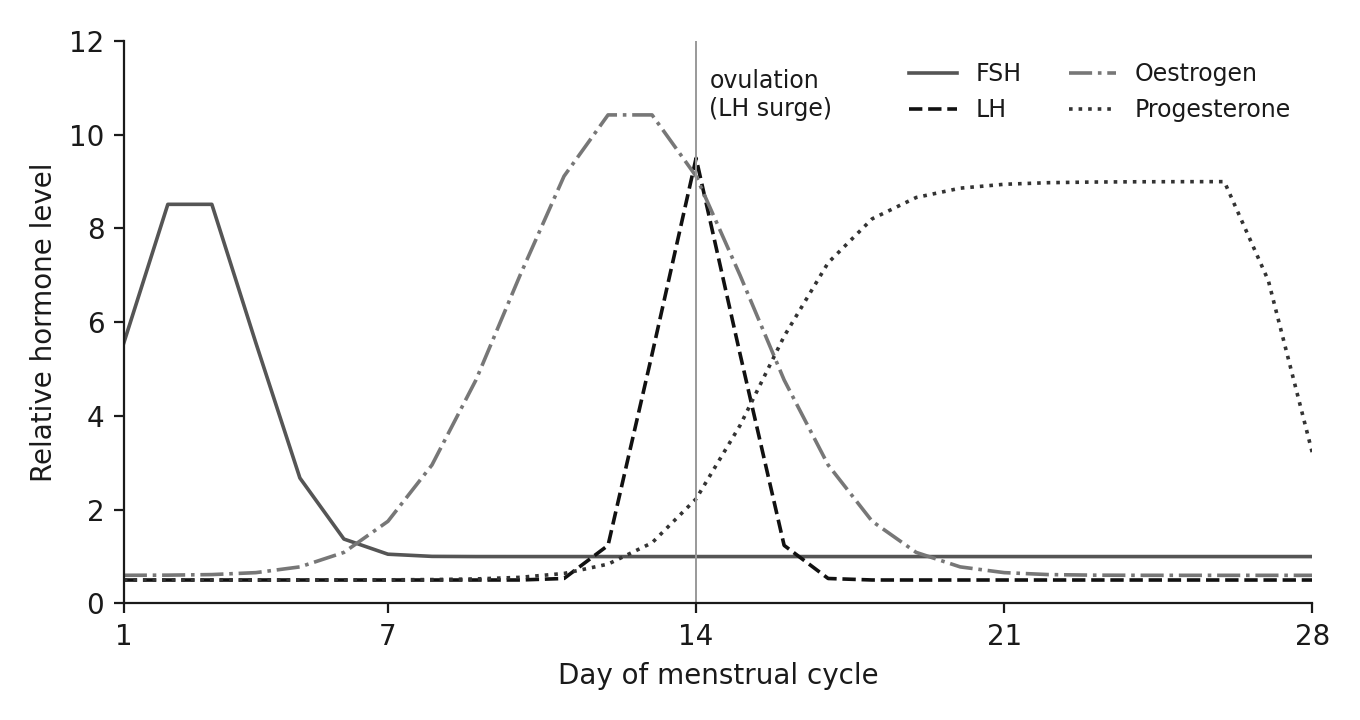
(HT) The menstrual cycle:
| Hormone | Source | Role |
|---|---|---|
| FSH | pituitary | causes an egg to mature in the ovary (in the follicle) |
| LH | pituitary | stimulates the release of the egg (ovulation) |
| Oestrogen | ovary (follicle) | maintains and builds the uterus lining; stimulates LH surge |
| Progesterone | ovary (corpus luteum) | maintains the uterus lining; inhibits FSH and LH |
(HT) Interpret hormone-level graphs across the cycle: FSH starts follicle growth → oestrogen rises → LH surge triggers ovulation (about day 14) → progesterone keeps the lining thick until it falls and the cycle restarts.
Contraception — evaluate hormonal and non-hormonal methods: oral contraceptives (inhibit FSH so no eggs mature), slow-release progesterone injection/implant/patch, barrier methods (condoms, diaphragm), intrauterine devices, spermicides, abstaining when an egg may be in the oviduct, sterilisation.
Infertility (HT): 'fertility drugs' (FSH + LH) stimulate eggs to mature. IVF: FSH and LH stimulate several eggs → eggs collected and fertilised with sperm in the laboratory → embryos grow to tiny balls of cells → one or two transferred to the uterus. Evaluate: emotionally/physically stressful, low success rates, risk of multiple births.
Negative feedback (HT): adrenaline (adrenal glands, fear/stress) increases heart rate and delivery of oxygen and glucose to brain and muscles — 'fight or flight'. Thyroxine (thyroid) stimulates the basal metabolic rate and is important in growth and development; its level is controlled by negative feedback. Interpret simple negative-feedback diagrams.
Vocabulary
Train
| English |
|---|
| hormone/ˈhɔːməʊn/ |
| insulin/ˈɪnsjuːlɪn/ |
| glycogen/ˈɡlaɪkədʒn/ |
| glucagon/ˈɡluːkæɡən/ |
| negative feedback/ˈneɡətɪv ˈfiːdbæk/ |
| urea/juːˈrɪə/ |
| ADH/ˌeɪ diː ˈeɪtʃ/ |
| oestrogen/ˈiːstrədʒn/ |
| ovulation/ˌɒvjʊˈleɪʃn/ |
| testosterone/teˈstɒstərəʊn/ |
5.4
Plant hormones — biology only (4.5.4)
Syllabus
Plant hormones — biology only (AQA 8461 statements 4.5.4, RP8).
- Explain phototropism and gravitropism by unequal auxin distribution in shoots and roots.
- Describe RP8: the effect of light or gravity on newly germinated seedlings, with length measurements and labelled drawings.
- (HT) Describe uses of auxins, gibberellins and ethene in agriculture, horticulture and the food industry.
Source: Cambridge International syllabus
Plants produce hormones to coordinate and control growth and responses to light (phototropism 向光性) and gravity (gravitropism 向地性/geotropism). Unequal distribution of auxin 生长素 causes unequal growth rates in roots and shoots — shoots bend towards light; roots grow downwards.
RP8: investigate the effect of light or gravity on newly germinated seedlings — record as length measurements and careful labelled biological drawings.
(HT) Gibberellins initiate seed germination; ethene controls cell division and fruit ripening.
(HT) Uses: auxins as weed killers, rooting powders and to promote growth in tissue culture; ethene to control ripening during storage and transport; gibberellins to end seed dormancy, promote flowering and increase fruit size. Consider the effect of weed killers on biodiversity.
Vocabulary
Train
| English |
|---|
| auxin/ˈɔːksɪn/ |
| phototropism/ˌfəʊtəʊˈtrəʊpɪzəm/ |
| gravitropism/ˈɡrævɪtrəʊpɪzəm/ |
5.4
Checklist before you call this topic done
- Define homeostasis; receptor–coordination centre–effector said in order; reflex arc drawn with synapse.
- Eye parts and accommodation table cold; myopia vs hyperopia with corrections.
- Temperature: vasodilation/sweat vs vasoconstriction/shivering, in context (HT).
- Insulin and (HT) glucagon with negative feedback; Type 1 vs Type 2 treatments.
- (Bio) kidney filtration + selective reabsorption; (HT) ADH; dialysis vs transplant.
- (HT) FSH–oestrogen–LH–progesterone interactions and graph; contraception list; IVF steps; adrenaline and thyroxine.
- (Bio) tropisms with auxin; RP8; (HT) the three hormone uses.