| English | 意味 |
|---|---|
| ionisation energy/ˌaɪənaɪˈzeɪʃn ˈenədʒi/ | イオン化エネルギー |
| gaseous/ˈɡeɪsɪəs/ | 気体 |
| nuclear charge/ˈnjuːklɪə tʃɑːdʒ/ | 核電荷 |
| atomic radius/əˈtɒmɪk ˈreɪdɪəs/ | 原子半径 |
| shielding/ˈʃiːldɪŋ/ | 遮蔽効果 |
| spin-pair repulsion/spɪn peə rɪˈpʌlʃn/ | スピン対反発 |
How tightly are electrons held?
- Ionisation energy 电离能 is the energy to pull electrons off gaseous 气态 atoms.
- Its trends and dips are powerful evidence for shells and sub-shells.
- It is a favourite exam topic.
First and successive ionisation energies
- The first ionisation energy removes one electron from each atom in a mole of gaseous atoms (unit $\text{kJ}/\text{mol}$):
$$\text{X}(\text{g}) \rightarrow \text{X}^{+}(\text{g}) + \text{e}^{-}$$
- Successive ionisation energies remove the next electron each time, e.g. $\text{X}^{+}(\text{g}) \rightarrow \text{X}^{2+}(\text{g}) + \text{e}^{-}$.
- Each successive value is larger — the electron leaves a more positive ion.
なぜイオン化エネルギーの定義では気体原子が指定されているのですか?
難易度 1/5 · 100 コイン + 今日初回完了時に小ボーナス付与
気体原子を使用することで粒子間の相互作用がないため、その値は原子自身の引力のみを測ることになります。
気体原子1モルから電子1モルを取り除くために必要なエネルギーが、最初の______エネルギーである。
難易度 1/5 · 100 コイン + 今日初回完了時に小ボーナス付与
外側の電子がどれだけ強く保持されているかを測ります。
successive イオン化エネルギーが前よりも大きくなるのはなぜか:
難易度 1/5 · 100 コイン + 今日初回完了時に小ボーナス付与
取り除くたびにイオンの正の電荷が強まり、次の電子はより強く保持されるようになります。
What it depends on
- nuclear charge 核电荷 — more protons → stronger pull → higher IE.
- atomic radius 原子半径 — outer electron further out → weaker pull → lower IE.
- shielding 屏蔽 — more inner shells → more shielding → lower IE.
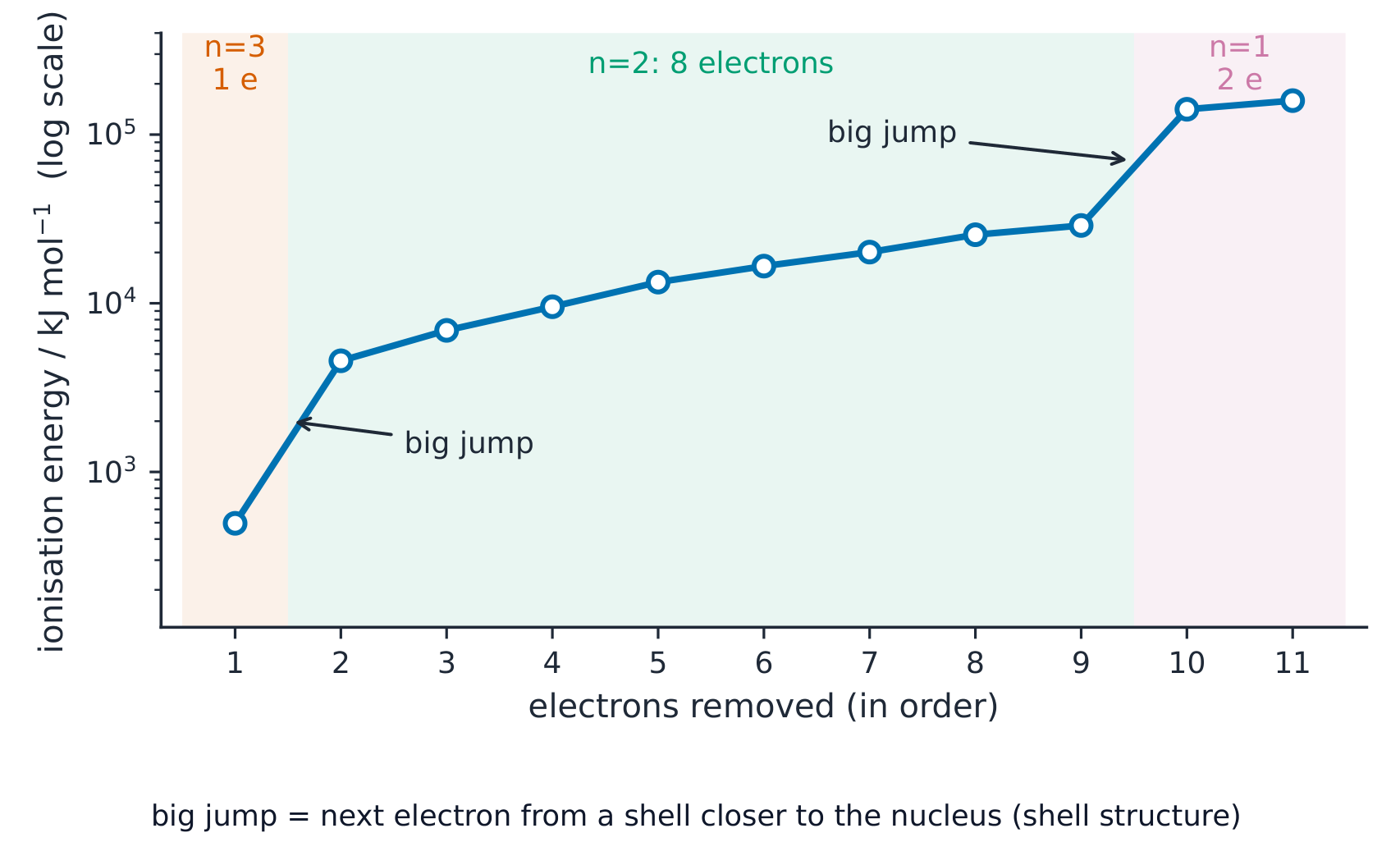
Successive ionisation energies of sodium: big jumps reveal the 2,8,1 shells
第一イオン化エネルギーを下げる変化はどれですか?
難易度 1/5 · 100 コイン + 今日初回完了時に小ボーナス付与
遮蔽効果の増加は外側の電子への引き付けを弱め、イオン化エネルギーを下げます。
各変化と第一イオン化エネルギーへの影響を対応させてください。
難易度 2/5 · 140 コイン + 今日初回完了時に小ボーナス付与
IE は核の引き付けによって上昇し、距離や遮蔽によって低下します。 successive イオン化は常に上昇します。
Trends and the tell-tale dips
- Across a period IE generally rises; down a group it falls.
- But two dips appear in Period 3 — evidence for sub-shells:
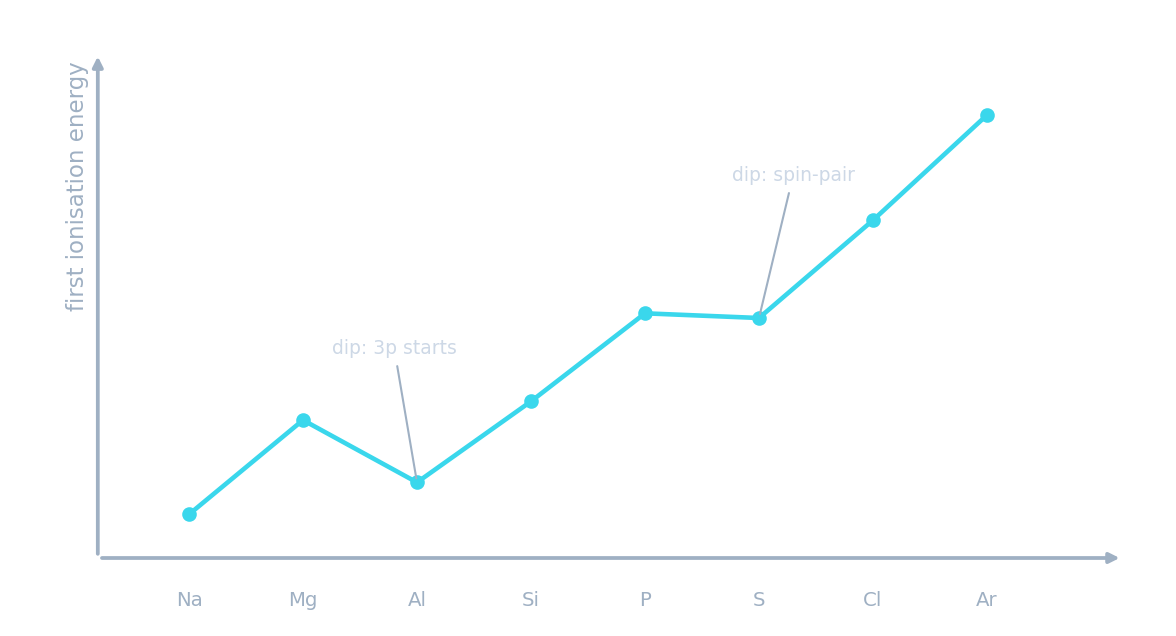
- Al dip: its electron comes from a higher-energy 3p sub-shell.
- S dip: a paired 3p electron is easier to remove (spin-pair repulsion 自旋成对排斥).
イオン化エネルギーの傾向と、その谷
第一イオン化エネルギーは一般に周期全体で上昇しますが、新しい p 副殻が始まる場所や、p 軌道のペアが初めて形成される場所で谷(DIPS)ができます。2つの典型的な谷を見つけるためにステップを進めてください。
アルミニウム(マグネシウムに対して)での第一イオン化エネルギーの谷はなぜ生じるのか:
難易度 1/5 · 100 コイン + 今日初回完了時に小ボーナス付与
Al の外側電子は 3p にあり(Mg の満たされた 3s よりもエネルギーが高いため)、取り除きやすい—これが谷となります。
Successive IE → shells
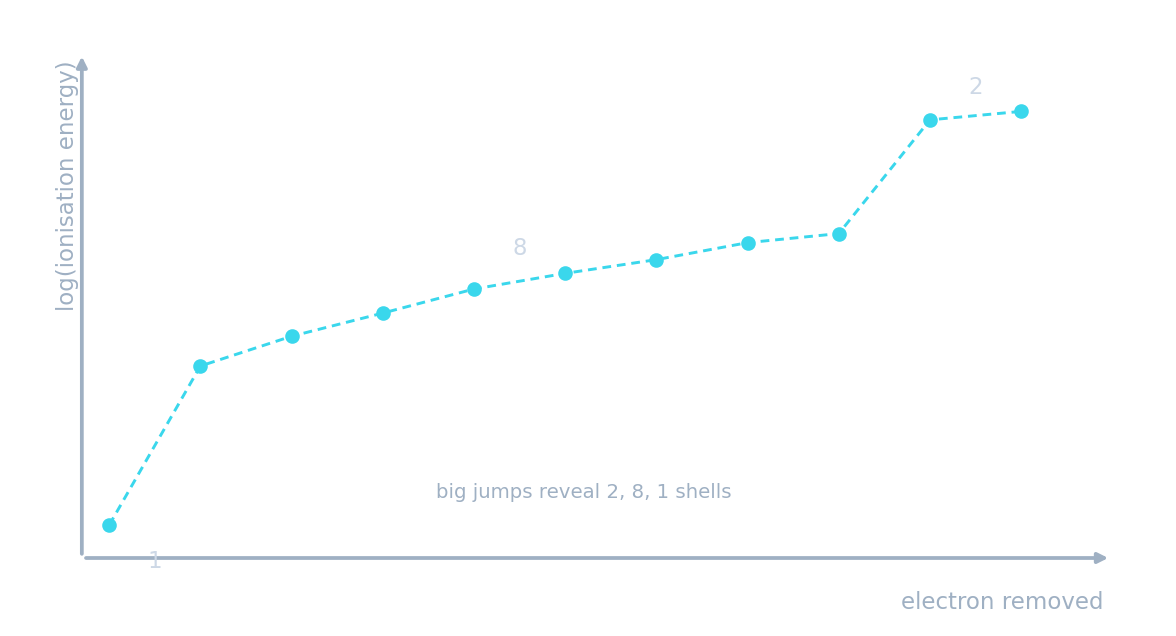
- Big jumps appear when the next electron must come from a shell closer in.
- Counting the electrons removed before the first big jump gives the element's group.
successive イオン化エネルギーでの大きな跳ね上がりは、次のとき起こります:
難易度 1/5 · 100 コイン + 今日初回完了時に小ボーナス付与
大きな跳ね上がりは内殻への移動を示します。最初の跳ね上がりの前の電子数を数えることで、最外殻の電子数(族)がわかります。
successive イオン化エネルギーでの大きな跳ね上がりは、新しい内殻への移動を示します。
難易度 1/5 · 100 コイン + 今日初回完了時に小ボーナス付与
跳ね上がりは殻構造を明らかにします。例えば、ナトリウムの successive IEs は 1, 次いで 8, さらに 2 に分断されます。
You've got it
- 1st IE: $\text{X}(\text{g}) \rightarrow \text{X}^{+}(\text{g}) + \text{e}^{-}$ (gaseous, $\text{kJ}/\text{mol}$); successive values keep rising
- IE depends on nuclear charge, radius, shielding
- across a period IE rises (dips at Al = 3p starts, S = spin-pair); down a group it falls
- big jumps in successive IE reveal the shell structure (and the group)