Skip to content · ⁨コンテンツへスキップ⁩
Subjects · ⁨科目⁩
  • 1 Present perfect vs past simple · ⁨現在完了形 vs 過去単純形⁩
    1.1

    確定された過去 vs 現在との関連

    English

    Both tenses refer to the past, but they differ based on whether a specific time is mentioned and whether there is a connection to the present:

    • Past Simple: The action ended at a definite time in the past and has no relevance to the present.
    • Present Perfect: No specific time is mentioned; it emphasizes the impact on or experience related to the present.

    我I 看saw 他him 昨天yesterday.

    I saw him yesterday. (Definite time → Past Simple)

    我I (完成时)have 看seen 那部that 电影film.

    I have seen that movie. (Experience, no specific time mentioned → Present Perfect)

    Note: Once definite past time markers such as yesterday, last week, in 2019, or ago appear, use the Past Simple, not the Present Perfect.

    日本語
    一般过去时 vs 现在完成时

    両方の時制は過去について語るが、違いは具体的な時間を指定しているかどうか、現在との関連があるかどうかである:

    • 一般过去時 (past simple):動作が確定した過去有时间に終了しており、現在とは関係がない。
    • 現在完成時 (present perfect):具体的な時間を言わず、現在への影響や経験を強調する。

    我I 看saw 他him 昨天yesterday.

    昨日彼に会った。(確定した時間 → 一般過去形)

    我I (完成时)have 看seen 那部that 电影film.

    あの映画を見た。(経験であり、いつ見たかは明言していない → 現在完了形)

    注意 yesterday、last week、in 2019、ago などの明確な過去時間が出たら、現在完了形を使わず、过去形を使う。

    1.2

    指標語

    English

    Pay attention to these words to help you determine which tense to use:

    • Past Simple: yesterday, last night, ... ago, in 2019, then, when.
    • Present Perfect: just, already, yet, ever, never, so far, recently, since, for.

    她She (完成时)has 刚刚just 到达arrived.

    She has just arrived. (just → Present Perfect)

    他们They 离开left 一an 小时hour 前ago.

    They left an hour ago. (ago → Past Simple)

    Note: Do not mix them within the same sentence: ~~I have seen him yesterday~~ ✗ → I saw him yesterday ✓.

    日本語

    これらの言葉に注意すると、どの時制を使うべきかが判る:

    • 过去形: yesterday、last night、… ago、in 2019、then、when。
    • 現在完了形: just、already、yet、ever、never、so far、recently、since、for。

    她She (完成时)has 刚刚just 到达arrived.

    彼女は今刚刚到着した。(just → 現在完了形)

    他们They 离开left 一an 小时hour 前ago.

    彼らは一時間前に去った。(ago → 过去形)

    注意 同じ文で混用しない: ~~I have seen him yesterday~~ ✗ → I saw him yesterday ✓。

    1.3

    been と gone

    English

    Both are forms related to go, but they have different meanings:

    • Have been to: Have visited (and returned) — indicates experience.
    • Have gone to: Have gone (and are still there / on the way).

    他He (完成时)has 去过been (介词)to 日本Japan.

    He has been to Japan. (Visited, and has returned now)

    她She (完成时)has 去了gone (介词)to (冠词)the 银行bank.

    She has gone to the bank. (Not here now, still over there)

    Note: Use been to for "have visited somewhere"; use gone to for "have gone and haven't returned yet".

    Common Errors

    • ❌ ~~When have you arrived?~~ → ✓ When did you arrive? — When asks for a specific past time, so the Past Simple must be used.
    • ❌ ~~I have finished it just now.~~ → ✓ I finished it just now. / I have just finished it. — Just now (a moment ago) pairs with the Past Tense; just (very recently) pairs with the Present Perfect.
    • ❌ ~~I lost my keys — can you help me look?~~ → ✓ I have lost my keys… — The keys have not been found yet, and the effect continues into the present, so the Present Perfect is more accurate.
    • ❌ ~~This is the first time I go there.~~ → ✓ This is the first time I have been there. — The pattern "the first time / the best time" is fixed with the Present Perfect: the first time / the best film I have ever seen.
    日本語

    どちらも go の関連形式だが意味が異なる:

    • have been to: 行ったことがある(既に帰っている)——経験を表す。
    • have gone to: 行ってまだそこにいる / 道中である。

    他He (完成时)has 去过been (介词)to 日本Japan.

    日本に行ったことがある。(行き、現在は帰ってきている)

    她She (完成时)has 去了gone (介词)to (冠词)the 银行bank.

    銀行に行った。(今はそこにいない、まだそこにいる)

    注意 "某地に行ったことがある"は been to; "行ってまだ戻っていない"は gone to。

    よくある間違い

    • ❌ ~~When have you arrived?~~ → ✓ When did you arrive? — when は具体的な過去の時間を尋ねるため、必ず过去形を使う。
    • ❌ ~~I have finished it just now.~~ → ✓ I finished it just now. / I have just finished it. — just now(さっき)は过去形とセット; just(ちょうど)は現在完了形とセット。
    • ❌ ~~I lost my keys — can you help me look?~~ → ✓ I have lost my keys… — 鍵は今見つかっておらず、その影響が現在に及んでいるため、現在完了形の方が適切。
    • ❌ ~~This is the first time I go there.~~ → ✓ This is the first time I have been there. — "初めて / 最良の"句型は現在完了形と固定されている: the first time / the best film I have ever seen。
  • 2 Present perfect continuous · ⁨現在完了進行形⁩
    2.1

    Structure (have/has + been + V-ing)

    English

    The Present Perfect Continuous emphasizes an action that started in the past and continues up to the present, and often implies it is still ongoing.

    Structure: 主语 + have / has + been + 动词-ing

    我I (完成时)have (进行)been 等待waiting (持续)for 一an 小时hour.

    I have been waiting for an hour. (May still be waiting)

    (天气it)It (完成时)has (进行)been 下雨raining 整all 天day.

    It has been raining all day.

    Note: Negative form: haven't / hasn't been + V-ing. Question form: Have / Has + subject + been + V-ing?

    日本語
    Present Perfect Continuous: Continuing until now

    The Present Perfect Continuous emphasizes an action that started in the past and continues up to the present, and often implies it is still ongoing.

    Structure: 主语 + have / has + been + 动词-ing

    我I (完成时)have (进行)been 等待waiting (持续)for 一an 小时hour.

    I have been waiting for an hour. (May still be waiting)

    (天气it)It (完成时)has (进行)been 下雨raining 整all 天day.

    It has been raining all day.

    Note: Negative form: haven't / hasn't been + V-ing. Question form: Have / Has + subject + been + V-ing?

    2.2

    Continuing Until Now

    English

    This tense focuses on the ongoing process and duration, and is frequently used with for and since:

    • For + duration: for two hours.
    • Since + starting point: since this morning.

    她She (完成时)has (进行)been 学习studying 自从since 九点nine.

    She has been studying since nine o'clock.

    Difference from Present Perfect:

    • Present Perfect Continuous: Emphasizes the process / duration (I have been reading —一直在读).
    • Present Perfect: Emphasizes the result / completion (I have read it — 读完了).

    Note: Stative verbs (know, like, be) generally do not use the continuous form: ~~I have been knowing~~ ✗ → I have known ✓.

    Common Errors

    • ❌ ~~I am waiting for an hour.~~ → ✓ I have been waiting for an hour. — To express "waiting for an hour and still waiting," the Present Perfect Continuous must be used; the Present Continuous cannot indicate how long something has already lasted.
    • ❌ ~~How long are you living here?~~ → ✓ How long have you been living here? — How long asks about duration, so it pairs with the Perfect (Continuous) tense.
    • ❌ ~~She has been finished her essay.~~ → ✓ She has finished her essay. — For active voice, simply use has/have + past participle (has finished); do not add been. Been is used in the continuous form (has been studying) or passive voice (Her essay has been finished, without an object), but never in an active perfect tense with an object.
    • ❌ ~~I have been reading three books this week.~~ → ✓ I have read three books this week. — To report a "completed quantity," use the Present Perfect; the continuous form only emphasizes the process, not the result.
    日本語

    This tense focuses on the ongoing process and duration, and is frequently used with for and since:

    • For + duration: for two hours.
    • Since + starting point: since this morning.

    她She (完成时)has (进行)been 学习studying 自从since 九点nine.

    She has been studying since nine o'clock.

    Difference from Present Perfect:

    • Present Perfect Continuous: Emphasizes the process / duration (I have been reading —一直在读).
    • Present Perfect: Emphasizes the result / completion (I have read it — 读完了).

    Note: Stative verbs (know, like, be) generally do not use the continuous form: ~~I have been knowing~~ ✗ → I have known ✓.

    Common Errors

    • ❌ ~~I am waiting for an hour.~~ → ✓ I have been waiting for an hour. — To express "waiting for an hour and still waiting," the Present Perfect Continuous must be used; the Present Continuous cannot indicate how long something has already lasted.
    • ❌ ~~How long are you living here?~~ → ✓ How long have you been living here? — How long asks about duration, so it pairs with the Perfect (Continuous) tense.
    • ❌ ~~She has been finished her essay.~~ → ✓ She has finished her essay. — For active voice, simply use has/have + past participle (has finished); do not add been. Been is used in the continuous form (has been studying) or passive voice (Her essay has been finished, without an object), but never in an active perfect tense with an object.
    • ❌ ~~I have been reading three books this week.~~ → ✓ I have read three books this week. — To report a "completed quantity," use the Present Perfect; the continuous form only emphasizes the process, not the result.
  • 3 Past perfect · ⁨過去完成時⁩
    3.1

    構造 (had + 過去分詞)

    English

    The Past Perfect expresses the "past of the past" — an action that was completed before a specific point in the past.

    Structure: 主语 + had + 过去分词(same for all persons)

    当...时When 我I 到达arrived (冠词), the 火车train (过去完成)had 离开left.

    By the time I arrived, the train had already left. (Left first, then arrived)

    她She (过去完成)had 完成finished 她的her 工作work 在...之前before 午饭lunch.

    She had finished her work before lunch.

    Note Contraction: I'd, she'd, they'd (= had).

    日本語
    過去完了形:過去の過去

    過去完了形 (past perfect) は「過去の過去」を表し、ある過去の時点以前に完了していた動作を示す。

    構造: 主语 + had + 过去分词(人称によらず同じ)

    当...时When 我I 到达arrived (冠词), the 火车train (过去完成)had 离开left.

    私が着いたとき、電車はもう出発していた。(先に出发し、後に到着した)

    她She (过去完成)had 完成finished 她的her 工作work 在...之前before 午饭lunch.

    彼女は昼食前に仕事を終えていた。

    注意 省略形: I'd、she'd、they'd (= had)。

    3.2

    二つの過去動作のうちより早い方

    English

    The past perfect tense is used along with the simple past tense to indicate which of two past events happened first or second:

    • The earlier event → Past Perfect Tense (had done).
    • The later event → Simple Past Tense (did).

    (冠词)The 电影film (过去完成)had 开始started 当...时when 我们we 到达got 那里there.

    We got there, and the movie had already started.

    Timeline Comparison: had started (earlier) → got there (later).

    Note The past perfect is only used when it is necessary to emphasize the sequence; for straightforward chronological narration, the simple past can be used for both actions.

    Common Errors

    • ❌ ~~After he had left, I had cleaned the room.~~ → ✓ After he had left, I cleaned the room. — Only the action that happened earlier takes the past perfect, not both.
    • ❌ ~~When I had arrived, the train left.~~ → ✓ When I arrived, the train had left. — Whichever happened first uses had done; reversing them reverses the timeline.
    • ❌ ~~I had seen this film.~~ (standalone sentence) → ✓ I have seen this film. — The past perfect requires a "past reference point"; without one, use the present perfect or simple past.
    • Remember strong signal words: by the time + simple past, the main clause usually takes the past perfect: By the time we arrived, the film had started.
    日本語

    過去完了形は一般過去形と併用されることが多く、二つの過去の出来事の前後関係を示す:

    • より早く起きた → 過去完了形(had done)。
    • 後に起きた → 过去形(did)。

    (冠词)The 电影film (过去完成)had 开始started 当...时when 我们we 到达got 那里there.

    私たちが着いたとき、映画はすでに始まっていた。

    時間の流れの比較: had started(より早い)→ got there(より遅い)。

    注意: 前後の順序を強調する場合のみ過去完了形を使用する。単に順序立てて叙述する場合は、すべて一般過去形でも構わない。

    よくある間違い

    • ❌ ~~After he had left, I had cleaned the room.~~ → ✓ After he had left, I cleaned the room. — より早い方の動詞だけが過去完了形であり、両方ともにするわけではない。
    • ❌ ~~When I had arrived, the train left.~~ → ✓ When I arrived, the train had left. — どちらが先に起きたかによって had done を使い、逆にしてしまうと順序が逆になる。
    • ❌ ~~I had seen this film.~~(単独の文)→ ✓ I have seen this film. — 過去完了形には「過去の基準点」が必要;基準がない場合は現在完了形または过去形を使う。
    • 重要なシグナルを覚える:by the time + 过去形、主節には過去完了形が多い:By the time we arrived, the film had started.
  • 4 used to
    4.1

    過去の習慣と状態

    English

    used to indicates habits that were done frequently in the past but are no longer done now, or past states.

    Structure: 主语 + used to + 动词原形

    我I 过去常used to 踢play 足球football.

    I used to play football. (I don't anymore now)

    (有)There 过去used to 有be 一家a 电影院cinema 这里here.

    There used to be a cinema here.

    Note used to refers only to the past; for current habits, use the simple present (I play football now).

    日本語
    used to:過去の習慣

    used to は過去に頻繁に行っていたが、今は行わない習慣や、過去の状態を表す。

    構造: 主语 + used to + 动词原形

    我I 过去常used to 踢play 足球football.

    私は以前サッカーをしていた。(今はしていない)

    (有)There 过去used to 有be 一家a 电影院cinema 这里here.

    ここには以前映画館があった。

    注意 used to は過去のみを表す;現在の習慣は现在形(I play football now)を使う。

    4.2

    否定文と疑問文

    English

    For negation and questions, auxiliary did is required, and used reverts to use:

    • Negation: didn't use to + base verb.
    • Question: Did + subject + use to + base verb ?

    我I (否定)didn't 过去use to 喜欢like 咖啡coffee.

    I didn't use to like coffee.

    (助动词)Did 你you 过去use to 住live 这里here?

    Did you use to live here?

    Note In negatives / questions it is use to (without d): ~~didn't used to~~ ✗ → didn't use to ✓.

    Common Errors

    • ❌ ~~I am used to play football.~~ → Do not mix up these two distinct structures: ✓ I used to play football. (Used to do, but don't now) vs ✓ I am used to playing football. (Accustomed to doing)— Here, to is a preposition followed by -ing; also note get used to (gradually becoming accustomed).
    • ❌ ~~I use to get up early.~~ (meaning current habit) → ✓ I usually get up early. — use to has no present tense form; use usually for current habits.
    • ❌ ~~She used to living in Shanghai.~~ → ✓ She used to live in Shanghai. — used to is followed by the base verb.
    日本語

    否定・疑問は did を補助動詞として使い、used を use に戻す:

    • 否定: didn't use to + 動詞原形。
    • 疑問: Did + 主語 + use to + 動詞原形 ?

    我I (否定)didn't 过去use to 喜欢like 咖啡coffee.

    私は以前コーヒーが好きではなかった。

    (助动词)Did 你you 过去use to 住live 这里here?

    あなたは以前ここに住んでいたか?

    注意 否定・疑問内は use to(dなし): ~~didn't used to~~ ✗ → didn't use to ✓。

    よくある間違い

    • ❌ ~~I am used to play football.~~ → 二つの表現を混同しない: ✓ I used to play football.(過去よく踢いたが、今は踢いていない) vs ✓ I am used to playing football.(踢くことに慣れている) — 後者の to は前置詞で -ing を受け取ります;また get used to(徐々に慣れる)もある。
    • ❌ ~~I use to get up early.~~(現在の習慣を言いたい場合)→ ✓ I usually get up early. — use to には現在形がなく、現在の習慣は usually を使う。
    • ❌ ~~She used to living in Shanghai.~~ → ✓ She used to live in Shanghai. — used to の後は動詞原形をとる。
  • 5 Future forms review · ⁨未来表現の復習⁩
    5.1

    will vs be going to

    English

    When talking about the future, will and be going to each have specific focuses:

    • will: spontaneous decisions, predictions, promises.
    • be going to: existing plans, predictions based on evidence.

    我I 觉得think (天气it)it 会will (是)be 冷cold.

    I think it's going to be cold. (Prediction → will)

    我们We (be)are 打算going to 搬move 家house.

    We are going to move house. (Plan → be going to)

    Note Spontaneous decisions made at the moment always take will: The bag is heavy — I'll carry it.

    日本語
    Future Forms: will / going to / continuous

    When talking about the future, will and be going to each have specific focuses:

    • will: spontaneous decisions, predictions, promises.
    • be going to: existing plans, predictions based on evidence.

    我I 觉得think (天气it)it 会will (是)be 冷cold.

    I think it's going to be cold. (Prediction → will)

    我们We (be)are 打算going to 搬move 家house.

    We are going to move house. (Plan → be going to)

    Note Spontaneous decisions made at the moment always take will: The bag is heavy — I'll carry it.

    5.2

    Present Continuous for Arrangements

    English

    The present continuous can express future arrangements that have already been booked/confirmed (often with specific times or locations):

    我I (be)am 见meeting (冠词)the 医生doctor 在at 三点three.

    I'm seeing the doctor at three o'clock. (Appointment confirmed)

    Note be going to emphasizes "intention," while the present continuous emphasizes "already arranged." They are often interchangeable.

    日本語

    The present continuous can express future arrangements that have already been booked/confirmed (often with specific times or locations):

    我I (be)am 见meeting (冠词)the 医生doctor 在at 三点three.

    I'm seeing the doctor at three o'clock. (Appointment confirmed)

    Note be going to emphasizes "intention," while the present continuous emphasizes "already arranged." They are often interchangeable.

    5.3

    Time Adverbial Clauses

    English

    In time clauses introduced by when, as soon as, before, after, until, even when referring to the future, use the simple present tense:

    我I 会will 打电话call 你you 当...时when 我I 到达arrive.

    I'll call you as soon as I arrive.

    等Wait 这里here 直到until (冠词)the 雨rain 停stops.

    Wait here until the rain stops.

    Note Do not use will in time clauses: ~~when I will arrive~~ ✗ → when I arrive ✓.

    Common Errors

    • ❌ ~~I will meeting him tomorrow.~~ → ✓ I will meet him. / I am meeting him. — will + base verb, be + -ing; these two structures cannot be combined.
    • ❌ ~~What will you do tonight?~~ (asking about someone else's arrangement) → ✓ What are you doing tonight? — For asking about established arrangements, the present continuous sounds more natural.
    • ❌ ~~I'll go to the dentist tomorrow — I booked it last week.~~ → ✓ I am going to the dentist tomorrow. — For things already scheduled, do not use the spontaneous decision marker will.
    • Use Shall for suggestions in questions: Shall we go? (Shall we go?) Shall I open the window? (Shall I open the window?)
    日本語

    In time clauses introduced by when, as soon as, before, after, until, even when referring to the future, use the simple present tense:

    我I 会will 打电话call 你you 当...时when 我I 到达arrive.

    I'll call you as soon as I arrive.

    等Wait 这里here 直到until (冠词)the 雨rain 停stops.

    Wait here until the rain stops.

    Note Do not use will in time clauses: ~~when I will arrive~~ ✗ → when I arrive ✓.

    Common Errors

    • ❌ ~~I will meeting him tomorrow.~~ → ✓ I will meet him. / I am meeting him. — will + base verb, be + -ing; these two structures cannot be combined.
    • ❌ ~~What will you do tonight?~~ (asking about someone else's arrangement) → ✓ What are you doing tonight? — For asking about established arrangements, the present continuous sounds more natural.
    • ❌ ~~I'll go to the dentist tomorrow — I booked it last week.~~ → ✓ I am going to the dentist tomorrow. — For things already scheduled, do not use the spontaneous decision marker will.
    • Use Shall for suggestions in questions: Shall we go? (Shall we go?) Shall I open the window? (Shall I open the window?)
  • 6 Conditionals · ⁨分岐処理(条件付き文)⁩
    6.1

    零条件文と第一条件文

    English
    • Zero Conditional (general truths): If + 一般现在时, 一般现在时.
    • First Conditional (future possibilities): If + 一般现在时, will + 动词原形.

    如果If 你you 加热heat 水water (它), it 沸腾boils.

    If you heat water, it boils. (General truth)

    如果If (天气it)it 下雨rains 我们, we 将will 留stay (在内)in.

    If it rains, we will stay at home. (Possible future)

    Note Use the simple present tense in the if-clause, even when referring to the future: ~~If it will rain~~ ✗ → If it rains ✓.

    日本語
    第一条件句と第二条件句
    • 零条件文(普遍真実):If + 一般现在时, 一般现在时。
    • 第一条件文(将来の事実の可能性):If + 一般现在时, will + 动词原形。

    如果If 你you 加热heat 水water (它), it 沸腾boils.

    水を加温すると沸騰する。(普遍的真理)

    如果If (天气it)it 下雨rains 我们, we 将will 留stay (在内)in.

    雨が降れば、家にいる。(将来の可能性)

    注意 if 節では一般現在時を用いる(将来のことでも): ~~If it will rain~~ ✗ → If it rains ✓。

    6.2

    第二条件文

    English

    The Second Conditional describes hypothetical situations regarding the present or future that are unreal or unlikely:

    Structure: If + 一般过去时, would + 动词原形

    如果If 我I 有had (冠词)a 很多lot (的)of 钱money 我, I 会would 旅行travel.

    If I had a lot of money, I would travel. (But I don't actually)

    Note In the Second Conditional, the verb be is typically standardized as were: If I were you, I would rest. (If I were you, I would rest.)

    日本語

    第二条件文は現在/将来の非現実的または低確率な仮定を扱います:

    構造: If + 一般过去时, would + 动词原形

    如果If 我I 有had (冠词)a 很多lot (的)of 钱money 我, I 会would 旅行travel.

    お金持ちだったら旅行したい。(実際には持っていない)

    注意 第二条件文では、be動詞は通常一律に were を用いる:If I were you, I would rest.(あなたが私なら、私は休むだろう。)*

    6.3

    unless

    English

    unless means "except if / if ... not", equivalent to if … not:

    你You 会will (是)be 迟到late 除非unless 你you 快点hurry.

    You'll be late unless you hurry. (= if you don't hurry)

    Note unless already contains a negative meaning, so do not add not afterwards: ~~unless you don't hurry~~ ✗.

    Common Errors

    • ❌ ~~If I would be rich, I would travel.~~ → ✓ If I were rich, I would travel. — would appears only in the main clause; use the past tense in the if-clause.
    • ❌ ~~If it rains, we would stay home.~~ → ✓ If it rains, we will stay home. / If it rained, we would stay home. — Do not mix First and Second Conditionals; the entire sentence must follow one pattern.
    • ❌ ~~If I was you, I would rest.~~ → While heard in spoken English, use ✓ If I were you for exams and writing.
    • Comma Rule: If the if-clause comes before, add a comma (If it rains**,** we stay in.); if it comes after, no comma is needed (We stay in if it rains.).
    日本語

    unless は「除非/もし~しないなら」という意味で、if … not に相当する:

    你You 会will (是)be 迟到late 除非unless 你you 快点hurry.

    你不快点就会迟到。(= if you don't hurry)

    注意 unless 自体に否定が含まれているため、後にnot を追加してはならない: ~~unless you don't hurry~~ ✗。

    よくある間違い

    • ❌ ~~If I would be rich, I would travel.~~ → ✓ If I were rich, I would travel. — would は主節のみで用い、if 節では過去時制を用いる。
    • ❌ ~~If it rains, we would stay home.~~ → ✓ If it rains, we will stay home. / If it rained, we would stay home. — 第一条件法則と第二条件法則を混在させてはならず、文全体で統一する必要がある。
    • ❌ ~~If I was you, I would rest.~~ — 会話では聞こえるが、試験や作文では ✓ If I were you を用いる。
    • カマのルール: if 節が前にある場合はカマをつける (If it rains**,** we stay in.)。後にある場合はつけない (We stay in if it rains.)。
  • 7 The passive · ⁨受動態⁩
    7.1

    一般現在形/過去形の受動態

    English

    The passive voice places the receiver of the action in the subject position, emphasizing "what happened to" rather than who performed the action.

    Structure: 主语 + be + 过去分词(the tense of be determines the sentence's tense)

    • Present Simple Passive: am / is / are + past participle.
    • Past Simple Passive: was / were + past participle.

    英语English (被动)is 说spoken 这里here.

    English is spoken here.

    (冠词)The 窗户window (被动)was 打破broken.

    The window was broken.

    Note Active to Passive: The object moves to the subject position, and the verb changes to be + past participle. They built it. → It was built.

    日本語
    能動態 → 受動態

    受動態 (the passive) は動作の対象を主語に置き、「どうされたか」を強調し、誰がしたかを重視しない。

    構造: 主语 + be + 过去分词(be の時制が文の時制を決定する)

    • 一般現在受動: am / is / are + 過去分詞。
    • 一般過去受動: was / were + 過去分詞。

    英语English (被动)is 说spoken 这里here.

    ここでは英語が話されている / ここでは英語を使っている。

    (冠词)The 窗户window (被动)was 打破broken.

    窓が割られた。

    注意 能動態から受動態への変換: 目的語を主語に前置き、動詞を be + 過去分詞に変える。They built it. → It was built.

    7.2

    by + 動作の実行者

    English

    To specify "by whom" the action was done, use by + agent:

    这This 书book (被动)was 写written 被by 鲁迅Lu Xun.

    This book was written by Lu Xun.

    When to use the passive?

    • When the doer is unknown or unimportant: The road was repaired.
    • To emphasize the receiver: The painting was bought by a museum.

    Note If the agent is unimportant, by … is often omitted: The shop is closed.

    Common Errors

    • ❌ ~~The window was broke. / The book was wrote by him.~~ → ✓ was broken / was written — Use the past participle for the passive, not the past simple; memorize the third column of irregular verbs.
    • ❌ ~~It was happened last night.~~ → ✓ It happened last night. — Intransitive verbs like happen, appear, and die do not have a passive form.
    • ❌ ~~My phone was stolen by someone.~~ → ✓ My phone was stolen. — by someone / by people is redundant; delete it directly.
    • Chinese says "I was born in…" using an active structure, but English always uses the passive: ✓ I was born in Chengdu.
    日本語

    「誰によって」されたかを明記したい場合、by + 動作の実行者を用いる:

    这This 书book (被动)was 写written 被by 鲁迅Lu Xun.

    この本は魯迅によって書かれた。

    受動態を使うのはいつか?

    • 誰がやったか不明、あるいは重要でない場合:The road was repaired.(道が修理された。)*
    • 対象を強調したい場合: The painting was bought by a museum. (この絵画は美術館によって購入された。)

    注意 実行者が重要でない場合、by … を省略することが多い: The shop is closed. (店は閉まっている。)

    よくある間違い

    • ❌ ~~The window was broke. / The book was wrote by him.~~ → ✓ was broken / was written — 受動態には過去分詞を使用し、過去形ではない;不規則動詞の第三列(過去分詞)は暗記しておくこと。
    • ❌ ~~It was happened last night.~~ → ✓ It happened last night. — happen、appear、die などの自動詞は受動態を持たない。
    • ❌ ~~My phone was stolen by someone.~~ → ✓ My phone was stolen. — by someone / by people は冗長であるため、そのまま削除する。
    • 「私は〇〇で生まれた」と日本語では能動態だが、英語では常に受動態を用いる: ✓ I was born in Chengdu.
  • 8 Reported speech · ⁨間接引用⁩
    8.1

    述语句の転記

    English

    Reported speech is used to report what someone said, without quotation marks. Common reporting verbs are said or told:

    • say is followed without the listener: He said (that) …
    • tell is followed with the listener: He told me (that) …

    他He 说said (连词)that 他he (过去)was 累tired.

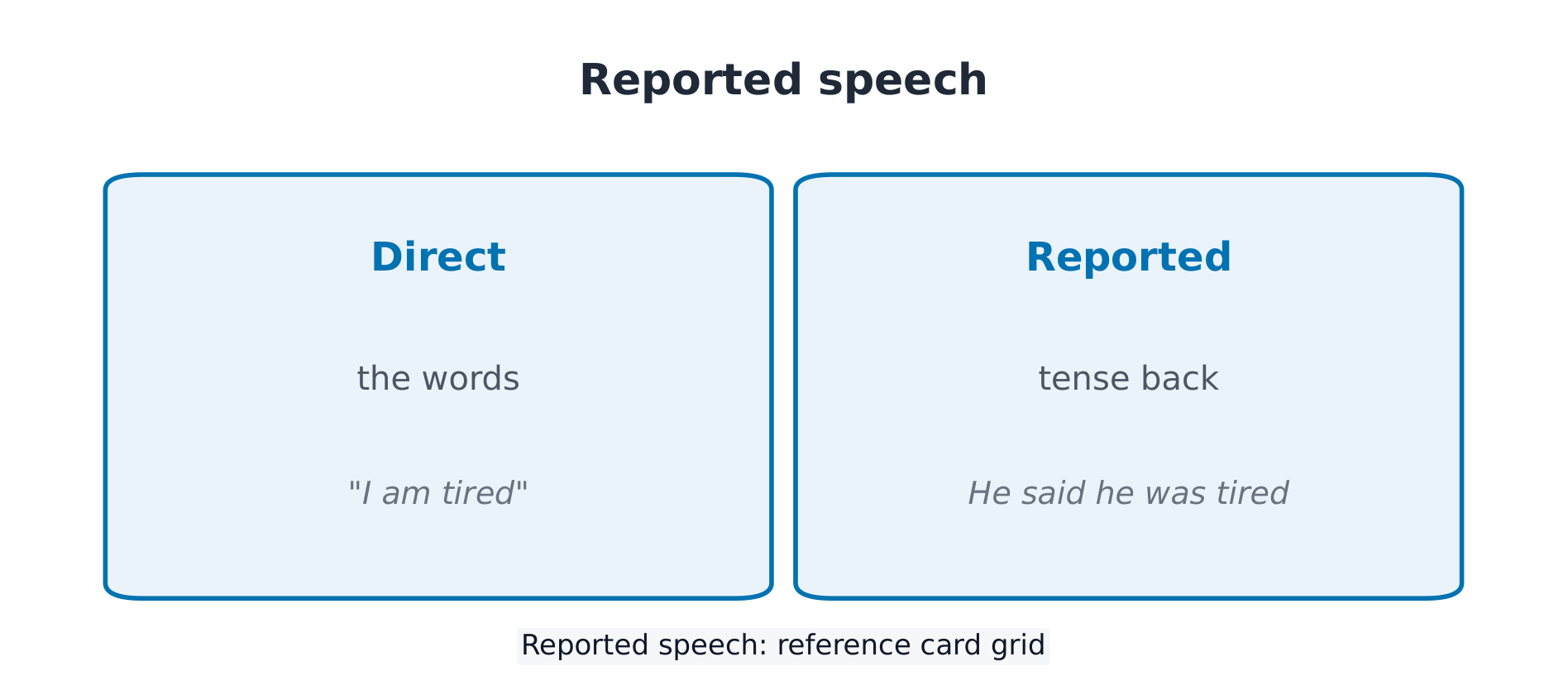
    He said he was tired. (Original quote: "I am tired.")

    Note that can be omitted: He said he was tired. The meaning remains the same.

    日本語
    直接引語 → 間接引語

    間接引語 (reported speech) は他人の発言を伝達するために用いられ、引用符は使わない。主に said または told を用いる:

    • say の後には聞き手を置かない: He said (that) …
    • tell の後には聞き手を置く: He told me (that) …

    他He 说said (连词)that 他he (过去)was 累tired.

    他说他累了。(元の言葉: "I am tired.")

    注意 that は省略可能: He said he was tired. としても意味は同じ。

    8.2

    時制の後退

    English

    When reporting, if the reporting verb is in the past tense (said / told), the tense in the reported clause usually shifts back one step:

    • am / is → was; are → were; do / does → did.
    • will → would; can → could; present perfect / past simple → past perfect.

    Direct Speech: "I will help you," she said.

    Indirect Speech:

    她She 说said 她she 会would 帮help 我me.

    She said she would help me. (will → would, I → she, you → me)

    Pronouns and time expressions also change: I → he / she, now → then, today → that day, tomorrow → the next day.

    Note If reporting a general truth, tenses need not shift: He said the sun rises in the east.

    Common Errors

    • ❌ ~~He said me the truth.~~ / ~~He told that he was busy.~~ → ✓ He told me… / He said (that)… — say does not take a listener, tell must take a listener; this is the opposite of common mistakes.
    • ❌ ~~He asked me where did I live.~~ → ✓ He asked me where I lived. — Reported questions must change to statement word order, removing did.
    • ❌ ~~She asked me that I was hungry.~~ → ✓ She asked me if / whether I was hungry. — Report yes/no questions using if / whether, not that.
    • ❌ ~~He said he will come tomorrow.~~ → ✓ He said he would come the next day. — Tenses and time expressions must shift together.
    日本語

    伝達時、引用動詞が過去形(said / told)の場合、節の時制は通常一つ後退する:

    • am / is → was; are → were; do / does → did。
    • will → would; can → could; 現在完了 / 一般過去 → 過去完了。

    直接引語: "I will help you," she said. (元の言葉)

    間接引語:

    她She 说said 她she 会would 帮help 我me.

    她说她会帮我。(will → would, I → she, you → me)

    人称代名詞と時間表現も変える: I → he / she, now → then, today → that day, tomorrow → the next day。

    注意 普遍的事実を伝達する場合は、時制をずらさなくてもよい: He said the sun rises in the east.

    よくある間違い

    • ❌ ~~He said me the truth.~~ / ~~He told that he was busy.~~ → ✓ He told me… / He said (that)… — say は聞き手を置かず、tell は必ず聞き手を置く。これは逆であることに注意。
    • ❌ ~~He asked me where did I live.~~ → ✓ He asked me where I lived. — 間接引語の疑問文は陳述語順に戻し、did を消す。
    • ❌ ~~She asked me that I was hungry.~~ → ✓ She asked me if / whether I was hungry. — 間接引語の一般疑問文には that を使い、if / whether を用いる。
    • ❌ ~~He said he will come tomorrow.~~ → ✓ He said he would come the next day. — 時制と時間表現は同時にずれる。
  • 9 Relative clauses · ⁨関係節⁩
    9.1

    who と which / that

    English

    Relative clauses provide additional information about a preceding noun. They are introduced by relative pronouns:

    • who: refers to people.
    • which: refers to things.
    • that: refers to either people or things (common in informal speech).

    (冠词)The 女人woman (关系代词)who 住lives 隔壁next door 是is 一名a 医生doctor.

    The woman living next door is a doctor.

    这This 是is (冠词)the 书book (关系代词)which 获得won (冠词)the 奖prize.

    That is the award-winning book.

    Note Relative pronouns go immediately after the noun they refer to, introducing supplementary information.

    日本語
    関係代詞: who/which/where/whose

    定语从句 (relative clauses) は前の名詞を補足説明するために用いられ、関係代詞で導かれる:

    • who: 人を指す。
    • which: 物を指す。
    • that: 人や物の両方を指す(口語で多用)。

    (冠词)The 女人woman (关系代词)who 住lives 隔壁next door 是is 一名a 医生doctor.

    隣に住んでいる女性は医者だ。

    这This 是is (冠词)the 书book (关系代词)which 获得won (冠词)the 奖prize.

    これが賞を受賞した本だ。

    注意: 関係代名詞はそれが指す名詞の後に置き、補足情報を導く。

    9.2

    where, when, whose

    English
    • where: refers to place. when: refers to time. whose: indicates possession ("'s").

    那是That's (冠词)the 镇town (在那里)where 我I 长大grew up.

    That is the town where I grew up.

    她是She's (冠词)the 作家writer (谁的)whose 书books 我I 喜爱love.

    She is the writer whose works I like.

    Note whose is followed directly by a noun (whose books), indicating "that person's books".

    日本語
    • where: 場所を指す。when: 時間を指す。whose: 所属(「……の」)を表す。

    那是That's (冠词)the 镇town (在那里)where 我I 长大grew up.

    あれ就是我长大的小镇。

    她是She's (冠词)the 作家writer (谁的)whose 书books 我I 喜爱love.

    彼女がその作家的所有作品が好きだ。

    注意 whose の後には直ちに名詞が続く (whose books)。「あの人の本」という意味になる。

    9.3

    関係代名詞の省略

    English

    When the relative pronoun acts as the object in the clause, it can be omitted (common in both speech and writing):

    (冠词)The 电影film 我们(that) we 看saw (是)was 很棒great.

    The movie (that) we watched was great.

    How to decide:

    • If the relative pronoun is the subject (followed immediately by a verb) → cannot omit.
    • If the relative pronoun is the object (followed by "subject + verb") → can omit.

    Note Must be retained when acting as subject: the man who called (cannot omit who).

    Common Errors

    • ❌ ~~The man which lives next door…~~ → ✓ The man who / that… — Do not use which for people.
    • ❌ ~~The book what I read…~~ → ✓ The book that / which I read… — English has no usage of what as a relative pronoun.
    • ❌ ~~This is the house which I live.~~ → ✓ …the house where I live / …the house which I live in. — When the clause lacks a preposition, either use where or supply the missing preposition.
    • ❌ ~~The friend who I met him yesterday…~~ → ✓ The friend who I met yesterday… — Since the relative pronoun already replaces the object, him / it cannot appear again in the clause.
    日本語

    関係代名詞が節内で目的語として機能する場合、省略できる(口語・筆記ともに一般的):

    (冠词)The 电影film 我们(that) we 看saw (是)was 很棒great.

    我们看的那部电影很棒。(that は省略可能)

    判断方法:

    • 関係代名詞が主語(直後に動詞が続く)→ 省略できない。
    • 関係代名詞が目的語(直後に「主語+動詞」が続く)→ 省略可能。

    注意 主語として機能する場合は必須である: the man who called (who は省略できない)。

    よくある間違い

    • ❌ ~~The man which lives next door…~~ → ✓ The man who / that… — 人を指す場合、which を使ってはならない。
    • ❌ ~~The book what I read…~~ → ✓ The book that / which I read… — 英語には関係代詞としてwhatを使う用法はありません。
    • ❌ ~~This is the house which I live.~~ → ✓ …the house where I live / …the house which I live in. — 節に前置詞が欠けている場合、either whereを使用するか、inを補います。
    • ❌ ~~The friend who I met him yesterday…~~ → ✓ The friend who I met yesterday… — 関係代詞がすでに目的語を表しているため、節の中にhimやitをもう一度使うことはできません。
  • 10 Modals of deduction · ⁨推論の情動動詞⁩
    10.1

    must and can't (Certainty)

    English

    Modal verbs can also express deduction. When you are very certain:

    • must: must be (definite positive deduction).
    • can't: can't be (definite negative deduction).

    她She 一定must 是be 累tired.

    She must be very tired. (Very certain)

    他He 不可能can't 是be 饿hungry 他; he 刚just 吃ate.

    He can't be hungry; he just ate.

    Note Use can't for negative deduction (impossible), not mustn't (which means "prohibited").

    日本語
    Modal Verbs of Deduction: Degree of Certainty

    Modal verbs can also express deduction. When you are very certain:

    • must: must be (definite positive deduction).
    • can't: can't be (definite negative deduction).

    她She 一定must 是be 累tired.

    She must be very tired. (Very certain)

    他He 不可能can't 是be 饿hungry 他; he 刚just 吃ate.

    He can't be hungry; he just ate.

    Note Use can't for negative deduction (impossible), not mustn't (which means "prohibited").

    10.2

    might, may, could (Possibility)

    English

    When you are not entirely sure, but only feel that something is possible:

    • might / may / could: possible, perhaps.

    (天气it)It 可能might 下雨rain 稍后later.

    It might rain later.

    他们They 可能may 在be (在)at 家home.

    They might be at home.

    Degree of Certainty Comparison:

    • Very certain: must (is) / can't (is not).
    • Uncertain: might / may / could (possible).

    Note All these modal verbs are followed by the base form of the verb: might be, must be (not might is).

    Common Errors

    • ❌ ~~It can be John at the door.~~ → ✓ It could / might be John. — Use could / might for speculation about a specific instance; can only indicates "general possibility."
    • ❌ ~~He might not can come.~~ → ✓ He might not be able to come. — Two modal verbs cannot be used together; replace the second with be able to / have to.
    • ❌ ~~Maybe he be late. / It may be rain.~~ → ✓ Maybe he is late. / It may rain. — maybe is an adverb and follows normal sentence structure; may is a modal verb and is followed by the base form. Do not mix them up.
    • ❌ ~~She must is tired.~~ → ✓ She must be tired. — A modal verb is always followed by the base form of the verb.
    日本語

    When you are not entirely sure, but only feel that something is possible:

    • might / may / could: possible, perhaps.

    (天气it)It 可能might 下雨rain 稍后later.

    It might rain later.

    他们They 可能may 在be (在)at 家home.

    They might be at home.

    Degree of Certainty Comparison:

    • Very certain: must (is) / can't (is not).
    • Uncertain: might / may / could (possible).

    Note All these modal verbs are followed by the base form of the verb: might be, must be (not might is).

    Common Errors

    • ❌ ~~It can be John at the door.~~ → ✓ It could / might be John. — Use could / might for speculation about a specific instance; can only indicates "general possibility."
    • ❌ ~~He might not can come.~~ → ✓ He might not be able to come. — Two modal verbs cannot be used together; replace the second with be able to / have to.
    • ❌ ~~Maybe he be late. / It may be rain.~~ → ✓ Maybe he is late. / It may rain. — maybe is an adverb and follows normal sentence structure; may is a modal verb and is followed by the base form. Do not mix them up.
    • ❌ ~~She must is tired.~~ → ✓ She must be tired. — A modal verb is always followed by the base form of the verb.
  • 11 Gerunds and infinitives · ⁨動名词と不定詞⁩
    11.1

    Verb + -ing

    English

    Some verbs are followed by a gerund (verb-ing). Common examples include: enjoy, like, love, hate, finish, stop, mind, suggest, avoid.

    我I 喜欢enjoy 阅读reading.

    I enjoy reading.

    她She 完成finished 做doing 她的her 作业homework.

    She finished her homework.

    Note A gerund functions as a noun; its form is verb-ing.

    日本語
    Verb followed by:-ing or to

    Some verbs are followed by a gerund (verb-ing). Common examples include: enjoy, like, love, hate, finish, stop, mind, suggest, avoid.

    我I 喜欢enjoy 阅读reading.

    I enjoy reading.

    她She 完成finished 做doing 她的her 作业homework.

    She finished her homework.

    Note A gerund functions as a noun; its form is verb-ing.

    11.2

    Verb + Infinitive

    English

    Other verbs are followed by an infinitive (to + base form). Common examples include: want, need, decide, hope, promise, learn, would like, plan.

    我I 想want (不定式)to 学learn 英语English.

    I want to learn English.

    他们They 决定decided (不定式)to 留下stay.

    They decided to stay.

    Note Some verbs accept both forms with similar meanings: like, love, start, begin. I like swimming. = I like to swim.

    日本語

    Other verbs are followed by an infinitive (to + base form). Common examples include: want, need, decide, hope, promise, learn, would like, plan.

    我I 想want (不定式)to 学learn 英语English.

    I want to learn English.

    他们They 决定decided (不定式)to 留下stay.

    They decided to stay.

    Note Some verbs accept both forms with similar meanings: like, love, start, begin. I like swimming. = I like to swim.

    11.3

    -ing after Prepositions

    English

    After a preposition (in, on, at, of, about, for, good at, interested in…), the verb must take the -ing form:

    她She's 擅长good at 画画drawing.

    She is good at painting.

    谢谢Thank you 因为for 帮助helping 我me.

    Thank you for helping me.

    Note The base form of a verb never follows a preposition: ~~good at draw~~ ✗ → good at drawing ✓.

    Common Errors

    • ❌ ~~I enjoy to read.~~ / ~~I want reading.~~ → ✓ I enjoy reading. / I want to read. — Which verb takes which form is fixed; memorize the collocations, do not swap them.
    • Distinguish the two meanings of stop: He stopped smoking. (Quit smoking) vs. He stopped to smoke. (Stopped what he was doing to go smoke)— The meanings are completely different.
    • ❌ ~~I look forward to see you.~~ → ✓ I look forward to seeing you. — Here, to is a preposition and is followed by -ing.
    • ❌ ~~Swim is good exercise.~~ → ✓ Swimming is good exercise. — When a verb acts as the subject, use the -ing form.
    日本語

    After a preposition (in, on, at, of, about, for, good at, interested in…), the verb must take the -ing form:

    她She's 擅长good at 画画drawing.

    She is good at painting.

    谢谢Thank you 因为for 帮助helping 我me.

    Thank you for helping me.

    Note The base form of a verb never follows a preposition: ~~good at draw~~ ✗ → good at drawing ✓.

    Common Errors

    • ❌ ~~I enjoy to read.~~ / ~~I want reading.~~ → ✓ I enjoy reading. / I want to read. — Which verb takes which form is fixed; memorize the collocations, do not swap them.
    • Distinguish the two meanings of stop: He stopped smoking. (Quit smoking) vs. He stopped to smoke. (Stopped what he was doing to go smoke)— The meanings are completely different.
    • ❌ ~~I look forward to see you.~~ → ✓ I look forward to seeing you. — Here, to is a preposition and is followed by -ing.
    • ❌ ~~Swim is good exercise.~~ → ✓ Swimming is good exercise. — When a verb acts as the subject, use the -ing form.
  • 12 too, enough, so, such
    12.1

    too と enough

    English

    too and enough indicate degree, but their position and meaning differ:

    • too + adjective = "too..." (negative excess), placed before the adjective.
    • enough = "sufficient," placed after the adjective and before the noun.

    这This 咖啡coffee 是is 太too 烫hot.

    This coffee is too hot.

    他He 不够isn't 大old 足够enough (不定式)to 开车drive.

    He isn't old enough to drive.

    Note enough comes after the adjective (old enough) but before the noun (enough money).

    日本語
    too と enough

    too と enough は程度を表しますが、位置と意味が異なります:

    • too + 形容詞 = 「あまりに〜すぎる」(否定的な過度)、形容詞の前に来ます。
    • enough = 「十分」、形容詞の後、名詞の前に来ます。

    这This 咖啡coffee 是is 太too 烫hot.

    このコーヒーは熱すぎる。

    他He 不够isn't 大old 足够enough (不定式)to 开车drive.

    彼は運転するほど大きくない。

    注意 enoughは形容詞の後(old enough)に来ますが、名詞の前(enough money)に来ます。

    12.2

    so と such

    English

    so and such both mean "so / such," used to intensify the tone:

    • so + adjective / adverb: so hot, so quickly.
    • such + (a/an) + (adjective) + noun: such a hot day.

    (冠词)The 电影film (是)was 如此so 无聊boring.

    That movie was so boring.

    (这)It 是was 如此such 一个a 好good 主意idea.

    That was really such a good idea.

    Note Follow so with an adjective (so good); follow such with a noun phrase (such a good idea).

    Common Errors

    • ❌ To praise "very happy" but say ~~I'm too happy!~~ → ✓ I'm so happy! — too carries a negative connotation ("excessively, to the point of being bad"); use so for praise and exclamation.
    • ❌ ~~The box is too much heavy.~~ → ✓ The box is much too heavy. — To intensify too, use much too; the word order is much first.
    • ❌ ~~The tea is too hot to drink it.~~ → ✓ The tea is too hot to drink. — In the too…to structure, the sentence subject serves as the object of drink, so do not write it.
    • ❌ ~~It was so a good idea.~~ → ✓ It was such a good idea. / The idea was so good. — If there is a noun, switch to such.
    日本語

    so と such はどちらも「それほど/そんな」という意味で、強調に使います:

    • so + 形容詞 / 副詞: so hot, so quickly。
    • such + (a/an) + (形容詞) + 名詞: such a hot day。

    (冠词)The 电影film (是)was 如此so 无聊boring.

    あの映画は退屈すぎる。

    (这)It 是was 如此such 一个a 好good 主意idea.

    それは本当によい案だ。

    注意 soの後に続くのは形容詞(so good)、suchの後に続くのは名詞句(such a good idea)です。

    よくある間違い

    • ❌ 褒めようとして「とても嬉しかった」と言おうとしたのに ~~I'm too happy!~~ → ✓ I'm so happy! — tooには「過剰で良くない」という否定的なニュアンスが含まれます。褒めたり感嘆したりするにはsoを使います。
    • ❌ ~~The box is too much heavy.~~ → ✓ The box is much too heavy. — tooを強化するにはmuch tooを使い、順序はmuchが先です。
    • ❌ ~~The tea is too hot to drink it.~~ → ✓ The tea is too hot to drink. — too…to構造では、文の主語がdrinkの目的語となるため、itを書き足しません。
    • ❌ ~~It was so a good idea.~~ → ✓ It was such a good idea. / The idea was so good. — 名詞が含まれる場合はsuchに変えます。

Log in or create account · ⁨ログインまたはアカウント作成⁩

IGCSE, A-Level & AP