English narration · English + 中文 subtitles burned in · 英語ナレーション・英語+中文字幕 burning-in
6.1
External influences · 外部要因
English
Every business is affected by external influences 外部影响 — things outside the business that it cannot control, such as the economy, the law and the environment. A good business watches these and plans for them.
explain the business cycle (growth, boom, recession, slump/recovery) and its effects on business
explain government economic objectives and how taxation, interest rates, inflation, unemployment and exchange rates affect business
日本語
景気循環(成長、好況、不況、恐慌/回復)と、それが企業に与える影響を説明する
政府の経済目標を説明し、税制、金利、インフレ、失業、為替レートが企業にどう影響するかを説明する
Source: Cambridge International syllabus · 出典: Cambridge International シラバス
English
The business cycle
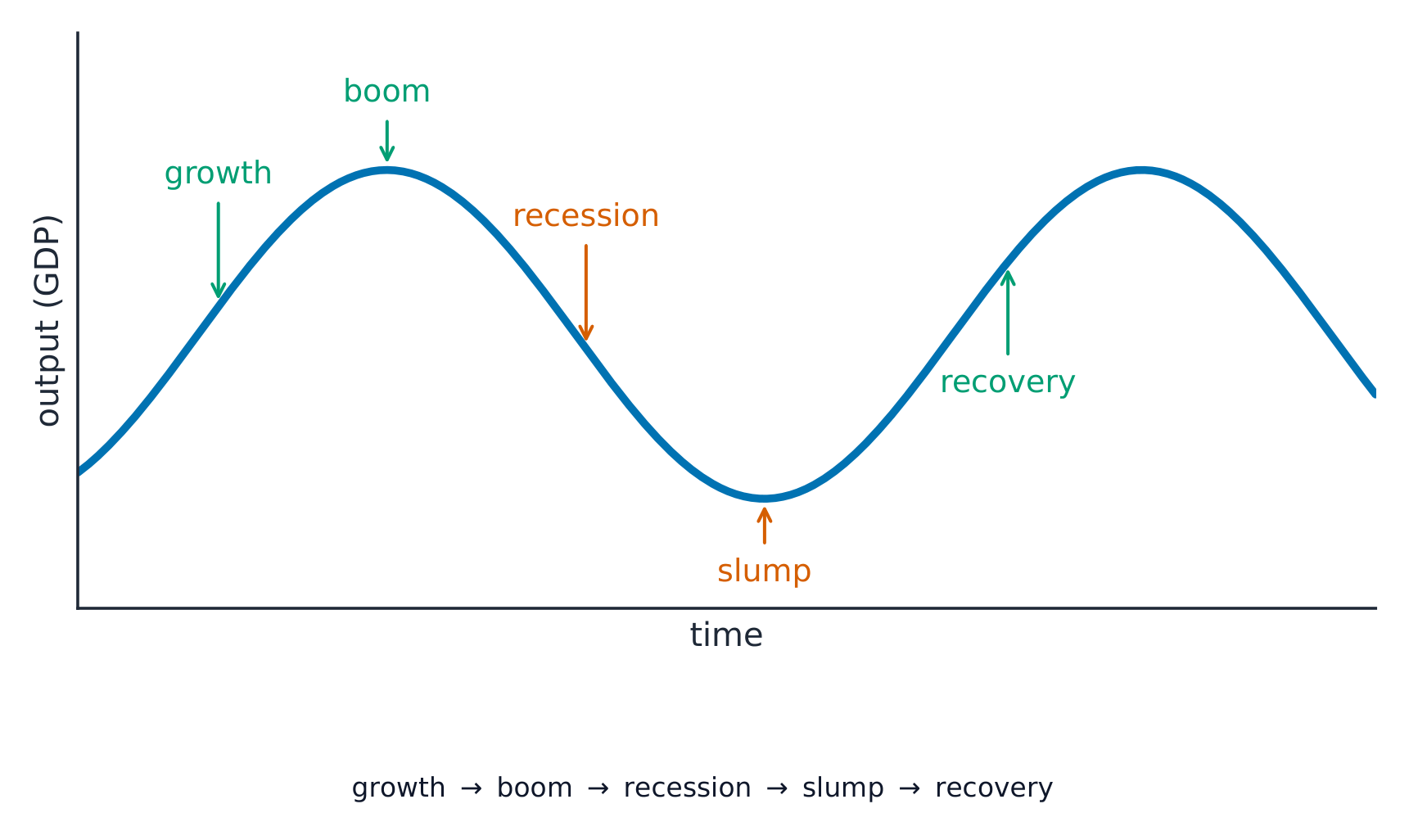
The economy does not grow at a steady pace. It moves in a repeating pattern called the business cycle 经济周期, with these stages.
Stage
What happens
Effect on business
growth 增长
the economy is rising; people spend more
sales and profit rise; firms expand and hire
boom 繁荣
spending is very high
prices and wages rise; shortages appear
recession 衰退
spending falls; the economy shrinks
sales and profit fall; firms cut jobs
slump 萧条
a deep, long recession
many firms close; high unemployment 失业
recovery 复苏
spending starts to rise again
sales slowly improve
In hard times a business may cut costs, lower prices, or sell cheaper products.
Government economic aims and how they affect business
Governments try to keep the economy healthy. Their main aims are stable prices, plenty of jobs, steady growth, and a stable currency. To manage the economy, a government uses or watches several economic factors. Each one affects every business.
Economic factor
What it is
Effect on business
taxation 税收
money the government takes from incomes and sales
higher tax leaves people with less to spend, and cuts business profit
interest rates 利率
the cost of borrowing money
higher rates make loans dearer, so firms borrow and invest less, and customers spend less
inflation 通货膨胀
a general rise in prices
costs rise; if wages chase prices, the country's goods can become too dear
unemployment
the number of people without work
high unemployment lowers sales, but workers are easier to hire
exchange rates 汇率
the price of one currency in another
a change makes imports and exports cheaper or dearer (see below)
explain external costs and external benefits of business activity and the meaning of sustainable development
explain how business activity can damage or protect the environment and the role of pressure groups
explain ethical business behaviour and the possible conflict between ethics and profit
日本語
事業活動による外部コストと外部便益、および持続可能な開発の意味を説明する
事業活動が環境を損なったり保護したりする方法、および圧力集団の役割を説明する
倫理的な事業行動を説明し、倫理と利益との間の潜在的な対立を説明する
Source: Cambridge International syllabus · 出典: Cambridge International シラバス
English
External costs and external benefits
When a business acts, other people can gain or lose.
external costs 外部成本 are costs paid by other people or by society, not by the business — for example pollution 污染, noise and heavy traffic.
external benefits 外部收益 are gains for others — for example new jobs and better roads.
Sustainable development
Sustainable development 可持续发展 means meeting today's needs without harming the ability of future people to meet their own needs. A business can harm the environment 环境 — through waste, pollution, and using up resources — or protect it, through recycling, clean energy and less packaging.
Pressure groups
A pressure group 压力团体 is a group that tries to influence businesses and governments, for example to cut pollution. Pressure groups use the media, protests and boycotts. A business may change its behaviour to avoid bad publicity.
Ethics and profit
Ethical behaviour 道德行为 means doing what is morally right, even when no law forces it — for example fair pay, safe products, and no child labour. Acting ethically can cost more in the short term, so it may conflict 冲突 with profit. But it can also win loyal customers and a good name, which raise profit in the long term.
Business and the international economy · 企業と国際経済
Syllabus · シラバス
English
explain globalisation, its importance to business and the reasons for it
explain the role of multinational companies and their benefits and drawbacks to a country
explain how changes in exchange rates affect businesses that import and export
日本語
グローバリゼーション、それがビジネスにとって重要な理由、およびその背景にある要因を説明する
多国籍企業の役割と、それらが一国にもたらすメリットとデメリットを説明する
為替レートの変化が輸入・輸出企業にどう影響するかを説明する
Source: Cambridge International syllabus · 出典: Cambridge International シラバス
English
Globalisation
Globalisation 全球化 is the growing trade and movement of goods, money and people between countries, so the world acts more and more like one single market. It has grown because of cheaper transport, better communication, the internet, and fewer trade barriers such as tariffs 关税 (taxes on imports).
Multinational companies
A multinational company 跨国公司 has operations — factories, branches, or offices — in more than one country. (Simply exporting to other countries is not enough; the firm must actually operate there.)
Benefits to a country
Drawbacks to a country
new jobs and training
profits may be sent out of the country
investment and new technology
local firms may be forced out of business
more choice and lower prices
resources may be used up, or the area polluted
more tax paid to the government
a large firm can have too much power
Exchange rates and trade
An exchange rate is the price of one currency in another. A change affects businesses that import 进口 (buy from abroad) and those that export 出口 (sell abroad).
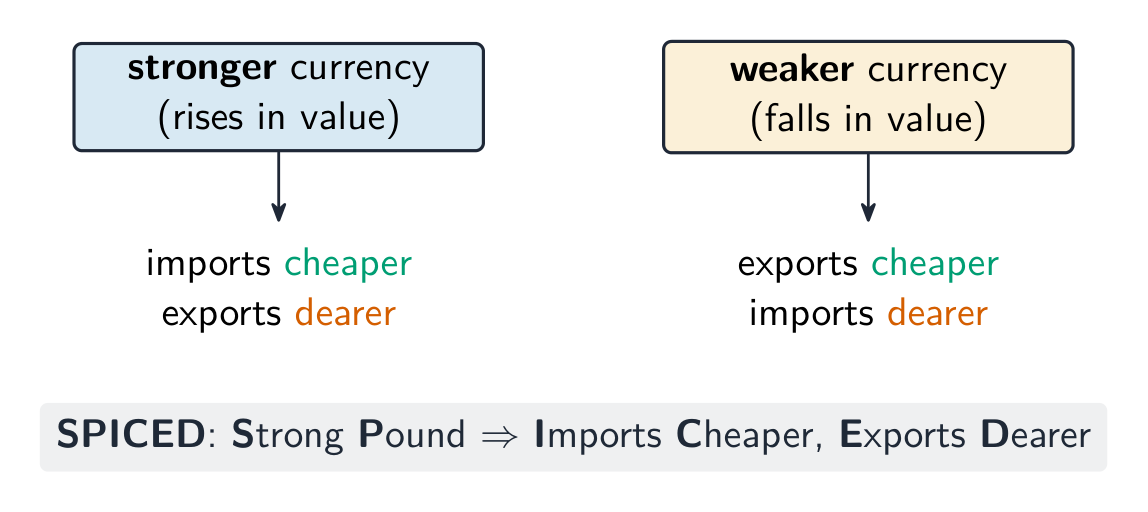
If the currency gets stronger (rises), exports become dearer for foreign buyers, so they sell less, while imports become cheaper.
If the currency gets weaker (falls), exports become cheaper and sell more, while imports become dearer.
A useful memory aid is SPICED: Strong Pound → Imports Cheaper, Exports Dearer.
Worked example. A UK firm exports a machine priced at £20,000. The exchange rate moves from £1 = 1.50 USD to £1 = 1.20 USD. What happens to the price a US buyer pays, and is that good for the exporter? Convert the UK price at each rate: at the old rate 20,000 × 1.50 = 30,000 USD; at the new rate 20,000 × 1.20 = 24,000 USD. The pound has weakened, so the machine is 6,000 USD cheaper abroad and the firm should sell more - good for an exporter. Check it against SPICED: a weak pound is the reverse of it, so exports are cheaper. Convert the actual figures rather than only reciting the mnemonic, and notice that the UK price never changed at £20,000 - it is the foreign price that moves.
Learn the business cycle (growth, boom, recession, slump, recovery) and how each stage changes sales, profit and jobs.
Trace each economic factor to the business: higher interest rates → dearer loans, so less borrowing and spending; higher tax → people have less to spend; inflation → higher costs.
External costs (pollution, noise) fall on other people, not the business; external benefits (new jobs, better roads) help others.
Use SPICED for exchange rates: Strong Pound → Imports Cheaper, Exports Dearer.
Ethical behaviour can cost more in the short term (so it may conflict with profit), but it can win loyal customers and a good name that raise profit later.
Type to search notes, lessons, code, vocabulary and past-paper questions across every subject. · すべての科目でノートImplemented、Implemented、コード、語彙、過去問問題を検索するために入力してください。