English
Learning Objective 2.1.A: Explain how internal and external factors influence perception.
- 2.1.A.1 Perception is influenced by whether one primarily relies on external sensory information (bottom-up processing) or internal prior expectations (top-down processing).
- 2.1.A.2 Schemas and perceptual sets are internal factors that filter perceptions of the world.
- 2.1.A.3 Contexts, experiences, and cultural experiences and expectations are external factors that filter perceptions of the world.
- 2.1.A.4 Perceptual principles proposed by Gestalt psychology (closure, figure and ground, proximity, and similarity) help explain how humans organize their perceptual world.
- 2.1.A.5 Attention is an interaction of sensation and perception that is affected by internal and external processes.
- 2.1.A.5.i Some experiences of attention can be selective, such as with the cocktail party effect, where people attend to mentions of their names or specific topics in loud or distracting environments.
- 2.1.A.5.ii Inattention can lead to a type of “blindness” to aspects of the environment. Change blindness occurs when changes to the environment are not perceived due to inattention.
Learning Objective 2.1.B: Explain how visual perceptual processes produce correct or incorrect interpretations of stimuli.
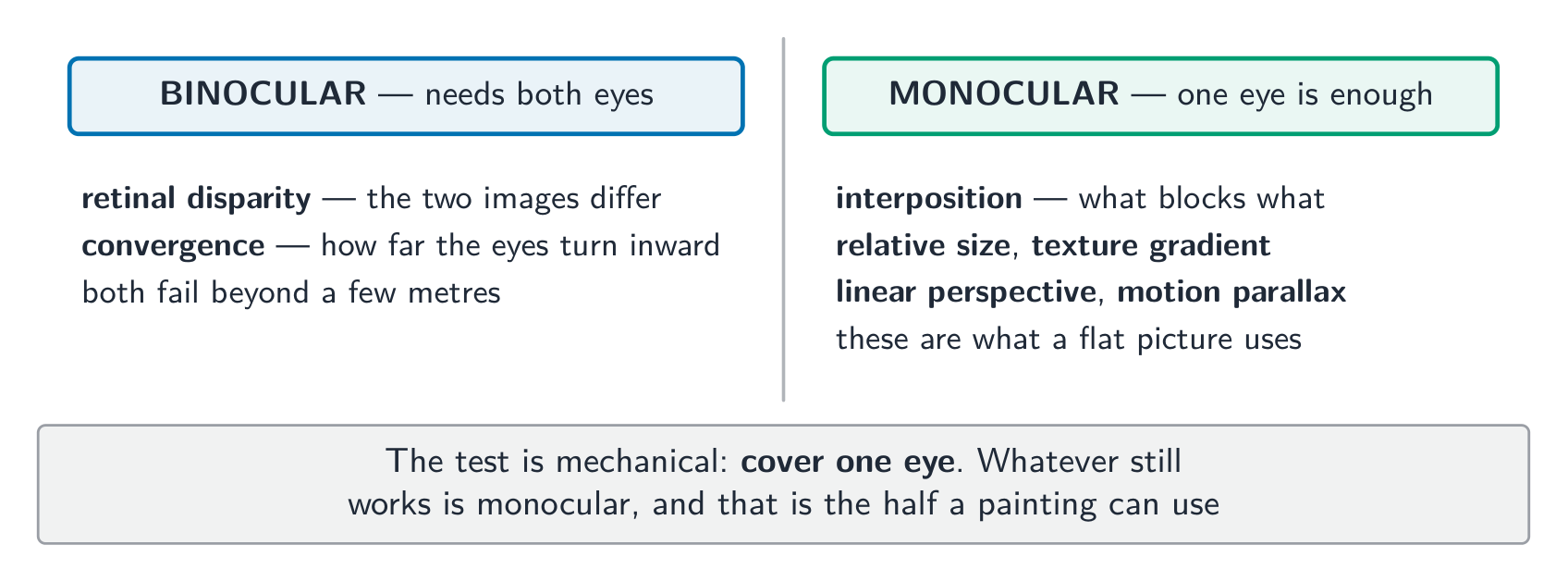
- 2.1.B.1 Binocular depth cues of retinal disparity (the difference between the images projecting onto the retina) and convergence (the merging of the retinal images by the brain) utilize images from each eye to provide perception of depth.
- 2.1.B.2 Monocular depth cues (relative clarity, relative size, texture gradient, linear perspective, and interposition) give the illusion of depth on flat or two-dimensional surfaces.
- Exclusion Statement: The AP Psychology Exam will only address the listed monocular depth cues in EK 2.1.B.2.
- 2.1.B.3 Visual perceptual constancies maintain the perception of an object even when the images of the object in the visual field change.
- 2.1.B.4 Apparent movement can be visually perceived even when objects are not actually moving.
日本語
学習目標 2.1.A: 内部要因と外部要因が知覚に与える影響について説明すること。
- 2.1.A.1 知覚は、主に外部の感覚情報(ボトムアップ処理)に依存するか、内部の事前の期待(トップダウン処理)に依存するかによって影響を受けます。
- 2.1.A.2 スキーマと知覚的セットは、世界への知覚をフィルタリングする内部要因です。
- 2.1.A.3 コンテキスト、経験、および文化的経験や期待は、世界への知覚をフィルタリングする外部要因です。
- 2.1.A.4 ゲシュタルト心理学が提唱した知覚原理(閉鎖、図形と背景、近接、類似性)は、人間がいかにして知覚的世界を組織するかを説明するのに役立ちます。
- 2.1.A.5 注意は、感覚と知覚の相互作用であり、内部・外部のプロセスの影響を受けます。
- 2.1.A.5.i 一部の注意体験は選択的であり、コックテルパーティー効果のように、人々は騒々しいまたは散漫な環境で自分の名前や特定のトピックの言及にだけ注意を向けることがあります。
- 2.1.A.5.ii 不注意は、環境の一部に対するある種の「盲目」を引き起こすことがあります。環境の変化が不注意のために感知されない場合に生じる変化盲目(Change blindness)があります。
学習目標 2.1.B: 視覚的な知覚プロセスが刺激に対して正しい解釈または誤った解釈を生み出す方法を説明すること。
- 2.1.B.1 網膜像の差異(網膜に投影される画像の差)と収束(脳による網膜画像の統合)という双眼性の奥行きの手がかりは、それぞれの眼からの画像を利用して奥深感を提供します。
- 2.1.B.2 単眼性の奥行きの手がかり(相対的な明瞭さ、相対的な大きさ、テクスチャ勾配、直線透視、重なり合い)は、平面的または二次元の表面に奥深感の錯覚を与えます。
- 除外事項: AP心理学試験では、EK 2.1.B.2 にリストされている単眼性の奥の手がかりのみを扱います。
- 2.1.B.3 視覚的な知覚の一定性は、視界における対象の画像が変わっても、対象の知覚を維持します。
- 2.1.B.4 対象が実際に動いていない場合でも、視覚的に移動しているように認識できる見かけの運動があります。