Skip to content · ⁨Lompat ke konten⁩
Subjects · ⁨Materi⁩

English Grammar · B1 · ⁨Tata Bahasa Bahasa Inggris · B1⁩

  • 1 Present perfect vs past simple
    1.1

    Past Simple vs Present Perfect

    English

    Both tenses refer to the past, but they differ based on whether a specific time is mentioned and whether there is a connection to the present:

    • Past Simple: The action ended at a definite time in the past and has no relevance to the present.
    • Present Perfect: No specific time is mentioned; it emphasizes the impact on or experience related to the present.

    我I 看saw 他him 昨天yesterday.

    I saw him yesterday. (Definite time → Past Simple)

    我I (完成时)have 看seen 那部that 电影film.

    I have seen that movie. (Experience, no specific time mentioned → Present Perfect)

    Note: Once definite past time markers such as yesterday, last week, in 2019, or ago appear, use the Past Simple, not the Present Perfect.

    Bahasa Indonesia
    Past Simple vs Present Perfect

    Kedua tenses ini membicarakan masa lalu, perbedaannya terletak pada apakah waktu spesifik disebutkan, apakah berkaitan dengan sekarang:

    • Past Simple: tindakan berakhir pada waktu lampau yang pasti, tidak berkaitan dengan sekarang.
    • Present Perfect: tidak menyebut waktu spesifik, menekankan dampak atau pengalaman terhadap sekarang.

    我I 看saw 他him 昨天yesterday.

    Saya melihatnya kemarin. (Waktu pasti → Simple Past)

    我I (完成时)have 看seen 那部that 电影film.

    Saya sudah menonton film itu. (Pengalaman, tidak disebut kapan → Present Perfect)

    Perhatian Jika muncul penanda waktu masa lalu yang pasti seperti yesterday, last week, in 2019, ago, dll., gunakan Simple Past Tense, bukan Present Perfect Tense.

    1.2

    Kata Penanda

    English

    Pay attention to these words to help you determine which tense to use:

    • Past Simple: yesterday, last night, ... ago, in 2019, then, when.
    • Present Perfect: just, already, yet, ever, never, so far, recently, since, for.

    她She (完成时)has 刚刚just 到达arrived.

    She has just arrived. (just → Present Perfect)

    他们They 离开left 一an 小时hour 前ago.

    They left an hour ago. (ago → Past Simple)

    Note: Do not mix them within the same sentence: ~~I have seen him yesterday~~ ✗ → I saw him yesterday ✓.

    Bahasa Indonesia

    Perhatikan kata-kata ini, dapat membantu Anda menentukan tenses mana yang digunakan:

    • Simple Past Tense: yesterday, last night, … ago, in 2019, then, when.
    • Present Perfect Tense: just, already, yet, ever, never, so far, recently, since, for.

    她She (完成时)has 刚刚just 到达arrived.

    Dia baru saja tiba. (just → Present Perfect Tense)

    他们They 离开left 一an 小时hour 前ago.

    Mereka sudah pergi sejak satu jam yang lalu. (ago → Simple Past Tense)

    Perhatian Jangan mencampur keduanya dalam satu kalimat: ~~I have seen him yesterday~~ ✗ → I saw him yesterday ✓.

    1.3

    been dan gone

    English

    Both are forms related to go, but they have different meanings:

    • Have been to: Have visited (and returned) — indicates experience.
    • Have gone to: Have gone (and are still there / on the way).

    他He (完成时)has 去过been (介词)to 日本Japan.

    He has been to Japan. (Visited, and has returned now)

    她She (完成时)has 去了gone (介词)to (冠词)the 银行bank.

    She has gone to the bank. (Not here now, still over there)

    Note: Use been to for "have visited somewhere"; use gone to for "have gone and haven't returned yet".

    Common Errors

    • ❌ ~~When have you arrived?~~ → ✓ When did you arrive? — When asks for a specific past time, so the Past Simple must be used.
    • ❌ ~~I have finished it just now.~~ → ✓ I finished it just now. / I have just finished it. — Just now (a moment ago) pairs with the Past Tense; just (very recently) pairs with the Present Perfect.
    • ❌ ~~I lost my keys — can you help me look?~~ → ✓ I have lost my keys… — The keys have not been found yet, and the effect continues into the present, so the Present Perfect is more accurate.
    • ❌ ~~This is the first time I go there.~~ → ✓ This is the first time I have been there. — The pattern "the first time / the best time" is fixed with the Present Perfect: the first time / the best film I have ever seen.
    Bahasa Indonesia

    Keduanya adalah bentuk turunan dari go, tetapi memiliki arti berbeda:

    • have been to: pernah pergi ke (sudah kembali) — menyatakan pengalaman.
    • have gone to: telah pergi ke (masih di sana / sedang dalam perjalanan).

    他He (完成时)has 去过been (介词)to 日本Japan.

    Dia pernah ke Jepang. (Pernah pergi, sekarang sudah kembali)

    她She (完成时)has 去了gone (介词)to (冠词)the 银行bank.

    Dia pergi ke bank. (Sekarang tidak di sini, masih berada di sana)

    Perhatian "Pernah pergi ke suatu tempat" menggunakan been to; "telah pergi tapi belum kembali" menggunakan gone to.

    Kesalahan Umum

    • ❌ ~~When have you arrived?~~ → ✓ When did you arrive? — when menanyakan waktu spesifik di masa lalu, harus menggunakan Simple Past Tense.
    • ❌ ~~I have finished it just now.~~ → ✓ I finished it just now. / I have just finished it. — just now (baru saja) dipasangkan dengan past tense; just (baru) dipasangkan dengan perfect tense.
    • ❌ ~~I lost my keys — can you help me look?~~ → ✓ I have lost my keys… — kunci saat ini belum ditemukan, dampaknya berlanjut hingga sekarang, sehingga Present Perfect Tense lebih tepat.
    • ❌ ~~This is the first time I go there.~~ → ✓ This is the first time I have been there. — pola "pertama kali / paling baik" selalu dipasangkan dengan Present Perfect Tense: the first time / the best film I have ever seen.
  • 2 Present perfect continuous
    2.1

    Struktur (have been + V-ing)

    English

    The Present Perfect Continuous emphasizes an action that started in the past and continues up to the present, and often implies it is still ongoing.

    Structure: 主语 + have / has + been + 动词-ing

    我I (完成时)have (进行)been 等待waiting (持续)for 一an 小时hour.

    I have been waiting for an hour. (May still be waiting)

    (天气it)It (完成时)has (进行)been 下雨raining 整all 天day.

    It has been raining all day.

    Note: Negative form: haven't / hasn't been + V-ing. Question form: Have / Has + subject + been + V-ing?

    Bahasa Indonesia
    Present Perfect Continuous: Berlangsung Hingga Sekarang

    Present Perfect Continuous menekankan bahwa suatu tindakan berlangsung dari masa lalu hingga sekarang, dan seringkali masih berlangsung.

    Struktur: 主语 + have / has + been + 动词-ing

    我I (完成时)have (进行)been 等待waiting (持续)for 一an 小时hour.

    Saya sudah menunggu selama satu jam. (Mungkin masih menunggu)

    (天气it)It (完成时)has (进行)been 下雨raining 整all 天day.

    Hujan sudah turun sepanjang hari.

    Perhatian Negatif: haven't / hasn't been + V-ing. Pertanyaan: Have / Has + subjek + been + V-ing?

    2.2

    Berlangsung Hingga Sekarang

    English

    This tense focuses on the ongoing process and duration, and is frequently used with for and since:

    • For + duration: for two hours.
    • Since + starting point: since this morning.

    她She (完成时)has (进行)been 学习studying 自从since 九点nine.

    She has been studying since nine o'clock.

    Difference from Present Perfect:

    • Present Perfect Continuous: Emphasizes the process / duration (I have been reading —一直在读).
    • Present Perfect: Emphasizes the result / completion (I have read it — 读完了).

    Note: Stative verbs (know, like, be) generally do not use the continuous form: ~~I have been knowing~~ ✗ → I have known ✓.

    Common Errors

    • ❌ ~~I am waiting for an hour.~~ → ✓ I have been waiting for an hour. — To express "waiting for an hour and still waiting," the Present Perfect Continuous must be used; the Present Continuous cannot indicate how long something has already lasted.
    • ❌ ~~How long are you living here?~~ → ✓ How long have you been living here? — How long asks about duration, so it pairs with the Perfect (Continuous) tense.
    • ❌ ~~She has been finished her essay.~~ → ✓ She has finished her essay. — For active voice, simply use has/have + past participle (has finished); do not add been. Been is used in the continuous form (has been studying) or passive voice (Her essay has been finished, without an object), but never in an active perfect tense with an object.
    • ❌ ~~I have been reading three books this week.~~ → ✓ I have read three books this week. — To report a "completed quantity," use the Present Perfect; the continuous form only emphasizes the process, not the result.
    Bahasa Indonesia

    Tenses ini berfokus pada proses berkelanjutan dan durasi, sering dikaitkan dengan for dan since:

    • for + durasi: for two hours.
    • since + titik awal: since this morning.

    她She (完成时)has (进行)been 学习studying 自从since 九点nine.

    Dia terus belajar sejak jam sembilan.

    Perbedaan dengan Present Perfect:

    • Present Perfect Continuous: menekankan proses/durasi (I have been reading — terus membaca).
    • Present Perfect Tense: menekankan hasil/penyelesaian (I have read it — selesai dibaca).

    Perhatian Kata kerja keadaan (know, like, be) umumnya tidak digunakan dalam bentuk continuous: ~~I have been knowing~~ ✗ → I have known ✓.

    Kesalahan Umum

    • ❌ ~~I am waiting for an hour.~~ → ✓ I have been waiting for an hour. — "Menunggu selama satu jam, masih menunggu" harus menggunakan Present Perfect Continuous; Present Continuous tidak bisa menyertakan "sudah berapa lama".
    • ❌ ~~How long are you living here?~~ → ✓ How long have you been living here? — how long menanyakan durasi, dipasangkan dengan tenses perfect (continuous).
    • ❌ ~~She has been finished her essay.~~ → ✓ She has finished her essay. — Active voice langsung menggunakan has/have + past participle (has finished), jangan tambahkan been. Been digunakan dalam continuous tense (has been studying) atau passive voice (Her essay has been finished, tanpa objek), tidak boleh digunakan dalam active perfect tense yang memiliki objek.
    • ❌ ~~I have been reading three books this week.~~ → ✓ I have read three books this week. — Menyebutkan "jumlah yang diselesaikan" menggunakan Present Perfect Tense; continuous hanya menekankan proses, bukan hasil.
  • 3 Past perfect
    3.1

    Struktur (had + past participle)

    English

    The Past Perfect expresses the "past of the past" — an action that was completed before a specific point in the past.

    Structure: 主语 + had + 过去分词(same for all persons)

    当...时When 我I 到达arrived (冠词), the 火车train (过去完成)had 离开left.

    By the time I arrived, the train had already left. (Left first, then arrived)

    她She (过去完成)had 完成finished 她的her 工作work 在...之前before 午饭lunch.

    She had finished her work before lunch.

    Note Contraction: I'd, she'd, they'd (= had).

    Bahasa Indonesia
    Past Perfect: Masa Lalu dari Masa Lalu

    Past Perfect Tense menyatakan "masa lalu dari masa lalu" — tindakan yang sudah selesai sebelum titik waktu tertentu di masa lalu.

    Struktur: 主语 + had + 过去分词(sama untuk semua orang)

    当...时When 我I 到达arrived (冠词), the 火车train (过去完成)had 离开left.

    Ketika saya tiba, kereta sudah berangkat. (Pertama berangkat, baru kemudian tiba)

    她She (过去完成)had 完成finished 她的her 工作work 在...之前before 午饭lunch.

    Dia sudah menyelesaikan pekerjaannya sebelum makan siang.

    Perhatian Singkatan: I'd, she'd, they'd (= had).

    3.2

    Yang terjadi lebih dulu di antara dua aksi di masa lalu

    English

    The past perfect tense is used along with the simple past tense to indicate which of two past events happened first or second:

    • The earlier event → Past Perfect Tense (had done).
    • The later event → Simple Past Tense (did).

    (冠词)The 电影film (过去完成)had 开始started 当...时when 我们we 到达got 那里there.

    We got there, and the movie had already started.

    Timeline Comparison: had started (earlier) → got there (later).

    Note The past perfect is only used when it is necessary to emphasize the sequence; for straightforward chronological narration, the simple past can be used for both actions.

    Common Errors

    • ❌ ~~After he had left, I had cleaned the room.~~ → ✓ After he had left, I cleaned the room. — Only the action that happened earlier takes the past perfect, not both.
    • ❌ ~~When I had arrived, the train left.~~ → ✓ When I arrived, the train had left. — Whichever happened first uses had done; reversing them reverses the timeline.
    • ❌ ~~I had seen this film.~~ (standalone sentence) → ✓ I have seen this film. — The past perfect requires a "past reference point"; without one, use the present perfect or simple past.
    • Remember strong signal words: by the time + simple past, the main clause usually takes the past perfect: By the time we arrived, the film had started.
    Bahasa Indonesia

    Past Perfect sering digunakan bersama dengan Simple Past untuk menunjukkan siapa yang terjadi lebih dulu di antara dua peristiwa di masa lalu:

    • Terjadi lebih dulu → Past Perfect Tense (had done).
    • Terjadi kemudian → Simple Past Tense (did).

    (冠词)The 电影film (过去完成)had 开始started 当...时when 我们we 到达got 那里there.

    Ketika kami sampai, film sudah mulai tayang.

    Garis Waktu Perbandingan: had started (lebih dulu) → got there (lebih lambat).

    Catatan: Past Perfect hanya digunakan jika perlu menekankan urutan kronologis; peristiwa yang diceritakan berurutan dapat menggunakan Simple Past saja.

    Kesalahan Umum

    • ❌ ~~After he had left, I had cleaned the room.~~ → ✓ After he had left, I cleaned the room. — Hanya tindakan yang lebih dulu yang menggunakan Past Perfect Tense, bukan keduanya.
    • ❌ ~~When I had arrived, the train left.~~ → ✓ When I arrived, the train had left. — Siapa yang terjadi lebih dulu, dia yang menggunakan had done; jika terbalik, urutan waktunya juga akan terbalik.
    • ❌ ~~I had seen this film.~~(kalimat tunggal)→ ✓ I have seen this film. — Past Perfect Tense memerlukan "titik rujukan masa lalu"; tanpa rujukan, gunakan Present Perfect Tense atau Simple Past Tense.
    • Ingat sinyal kuat: by the time + simple past, kalimat utama biasanya menggunakan Past Perfect Tense: By the time we arrived, the film had started.
  • 4 used to
    4.1

    Kebiasaan dan Keadaan di Masa Lalu

    English

    used to indicates habits that were done frequently in the past but are no longer done now, or past states.

    Structure: 主语 + used to + 动词原形

    我I 过去常used to 踢play 足球football.

    I used to play football. (I don't anymore now)

    (有)There 过去used to 有be 一家a 电影院cinema 这里here.

    There used to be a cinema here.

    Note used to refers only to the past; for current habits, use the simple present (I play football now).

    Bahasa Indonesia
    used to: kebiasaan masa lalu

    used to menyatakan kebiasaan yang sering dilakukan di masa lalu tetapi tidak lagi dilakukan sekarang, atau kondisi di masa lalu.

    Struktur: 主语 + used to + 动词原形

    我I 过去常used to 踢play 足球football.

    Dulu saya sering bermain sepak bola. (Sekarang tidak lagi)

    (有)There 过去used to 有be 一家a 电影院cinema 这里here.

    Di sini dulunya ada sebuah bioskop.

    Perhatian used to hanya berbicara tentang masa lalu; untuk kebiasaan sekarang, gunakan Simple Present Tense (I play football now).

    4.2

    Negasi dan Pertanyaan

    English

    For negation and questions, auxiliary did is required, and used reverts to use:

    • Negation: didn't use to + base verb.
    • Question: Did + subject + use to + base verb ?

    我I (否定)didn't 过去use to 喜欢like 咖啡coffee.

    I didn't use to like coffee.

    (助动词)Did 你you 过去use to 住live 这里here?

    Did you use to live here?

    Note In negatives / questions it is use to (without d): ~~didn't used to~~ ✗ → didn't use to ✓.

    Common Errors

    • ❌ ~~I am used to play football.~~ → Do not mix up these two distinct structures: ✓ I used to play football. (Used to do, but don't now) vs ✓ I am used to playing football. (Accustomed to doing)— Here, to is a preposition followed by -ing; also note get used to (gradually becoming accustomed).
    • ❌ ~~I use to get up early.~~ (meaning current habit) → ✓ I usually get up early. — use to has no present tense form; use usually for current habits.
    • ❌ ~~She used to living in Shanghai.~~ → ✓ She used to live in Shanghai. — used to is followed by the base verb.
    Bahasa Indonesia

    Negatif dan pertanyaan memerlukan bantuan did, dan ubah used kembali menjadi use:

    • Negatif: didn't use to + kata kerja dasar.
    • Pertanyaan: Did + subjek + use to + kata kerja dasar ?

    我I (否定)didn't 过去use to 喜欢like 咖啡coffee.

    Dulu saya tidak suka kopi.

    (助动词)Did 你you 过去use to 住live 这里here?

    Dulu Anda tinggal di sini?

    Perhatian Dalam negatif/pertanyaan tertulis use to (tanpa d): ~~didn't used to~~ ✗ → didn't use to ✓.

    Kesalahan Umum

    • ❌ ~~I am used to play football.~~ → Jangan mencampur dua ungkapan yang berbeda: ✓ I used to play football.(sering main bola di masa lalu, sekarang tidak) vs ✓ I am used to playing football.(terbiasa bermain) — to pada latter adalah preposisi yang diikuti -ing; ada juga get used to(secara bertahap terbiasa).
    • ❌ ~~I use to get up early.~~(ingin mengatakan kebiasaan sekarang)→ ✓ I usually get up early. — use to tidak memiliki bentuk present; kebiasaan sekarang menggunakan usually.
    • ❌ ~~She used to living in Shanghai.~~ → ✓ She used to live in Shanghai. — setelah used to diikuti oleh kata kerja dasar.
  • 5 Future forms review · ⁨Ulangi bentuk masa depan⁩
    5.1

    will vs be going to

    English

    When talking about the future, will and be going to each have specific focuses:

    • will: spontaneous decisions, predictions, promises.
    • be going to: existing plans, predictions based on evidence.

    我I 觉得think (天气it)it 会will (是)be 冷cold.

    I think it's going to be cold. (Prediction → will)

    我们We (be)are 打算going to 搬move 家house.

    We are going to move house. (Plan → be going to)

    Note Spontaneous decisions made at the moment always take will: The bag is heavy — I'll carry it.

    Bahasa Indonesia
    Bentuk future: will / going to / continuous

    Dalam membicarakan masa depan, will dan be going to masing-masing memiliki penekanan berbeda:

    • will: keputusan instan, prediksi, janji.
    • be going to: rencana yang sudah ada, prediksi berdasarkan bukti.

    我I 觉得think (天气it)it 会will (是)be 冷cold.

    Saya rasa akan dingin. (prediksi → will)

    我们We (be)are 打算going to 搬move 家house.

    Kami berencana pindah rumah. (rencana → be going to)

    Perhatian Keputusan mendadak harus menggunakan will: The bag is heavy — I'll carry it.

    5.2

    Present Continuous untuk Jadwal

    English

    The present continuous can express future arrangements that have already been booked/confirmed (often with specific times or locations):

    我I (be)am 见meeting (冠词)the 医生doctor 在at 三点three.

    I'm seeing the doctor at three o'clock. (Appointment confirmed)

    Note be going to emphasizes "intention," while the present continuous emphasizes "already arranged." They are often interchangeable.

    Bahasa Indonesia

    Present Continuous dapat menunjukkan jadwal masa depan yang sudah dijadwalkan (sering disertai waktu/tempat yang jelas):

    我I (be)am 见meeting (冠词)the 医生doctor 在at 三点three.

    Saya akan bertemu dokter pukul tiga. (Sudah dijadwalkan)

    Perhatian "be going to" menekankan "berencana", sedangkan present continuous menekankan "sudah dijadwalkan"; keduanya sering dapat saling menggantikan.

    5.3

    Anak Kalimat Keterangan Waktu

    English

    In time clauses introduced by when, as soon as, before, after, until, even when referring to the future, use the simple present tense:

    我I 会will 打电话call 你you 当...时when 我I 到达arrive.

    I'll call you as soon as I arrive.

    等Wait 这里here 直到until (冠词)the 雨rain 停stops.

    Wait here until the rain stops.

    Note Do not use will in time clauses: ~~when I will arrive~~ ✗ → when I arrive ✓.

    Common Errors

    • ❌ ~~I will meeting him tomorrow.~~ → ✓ I will meet him. / I am meeting him. — will + base verb, be + -ing; these two structures cannot be combined.
    • ❌ ~~What will you do tonight?~~ (asking about someone else's arrangement) → ✓ What are you doing tonight? — For asking about established arrangements, the present continuous sounds more natural.
    • ❌ ~~I'll go to the dentist tomorrow — I booked it last week.~~ → ✓ I am going to the dentist tomorrow. — For things already scheduled, do not use the spontaneous decision marker will.
    • Use Shall for suggestions in questions: Shall we go? (Shall we go?) Shall I open the window? (Shall I open the window?)
    Bahasa Indonesia

    Dalam klausa waktu yang dipimpin oleh when, as soon as, before, after, until, meskipun membicarakan masa depan, tetap gunakan simple present:

    我I 会will 打电话call 你you 当...时when 我I 到达arrive.

    Saya akan meneleponmu segera setelah tiba.

    等Wait 这里here 直到until (冠词)the 雨rain 停stops.

    Tunggu di sini hingga hujan berhenti.

    Perhatian dalam klausa waktu jangan gunakan will: ~~when I will arrive~~ ✗ → when I arrive ✓.

    Kesalahan Umum

    • ❌ ~~I will meeting him tomorrow.~~ → ✓ I will meet him. / I am meeting him. — will + bentuk dasar, be + -ing, dua struktur ini tidak boleh digabungkan.
    • ❌ ~~What will you do tonight?~~ (menanyakan rencana lawan bicara) → ✓ What are you doing tonight? — Menanyakan rencana yang sudah ada, menggunakan present continuous lebih natural.
    • ❌ ~~I'll go to the dentist tomorrow — I booked it last week.~~ → ✓ I am going to the dentist tomorrow. — Hal yang sudah dipesan lama-lama tidak menggunakan "keputusan seketika" yaitu will.
    • Pertanyaan saran menggunakan Shall: Shall we go? (Mari kita pergi?) Shall I open the window? (Apakah saya membuka jendela untukmu?)
  • 6 Conditionals · ⁨Kondisional⁩
    6.1

    Kalimat Bersyarat Nol dan Pertama

    English
    • Zero Conditional (general truths): If + 一般现在时, 一般现在时.
    • First Conditional (future possibilities): If + 一般现在时, will + 动词原形.

    如果If 你you 加热heat 水water (它), it 沸腾boils.

    If you heat water, it boils. (General truth)

    如果If (天气it)it 下雨rains 我们, we 将will 留stay (在内)in.

    If it rains, we will stay at home. (Possible future)

    Note Use the simple present tense in the if-clause, even when referring to the future: ~~If it will rain~~ ✗ → If it rains ✓.

    Bahasa Indonesia
    Kalimat Bersyarat Pertama dan Kedua
    • Kalimat Bersyarat Nol (kebenaran umum): If + 一般现在时, 一般现在时.
    • Kalimat Bersyarat Pertama (kemungkinan nyata di masa depan): If + 一般现在时, will + 动词原形.

    如果If 你you 加热heat 水water (它), it 沸腾boils.

    Jika air dipanaskan, air akan mendidih. (Kebenaran umum)

    如果If (天气it)it 下雨rains 我们, we 将will 留stay (在内)in.

    Jika hujan, kita akan tinggal di rumah. (Kemungkinan di masa depan)

    Perhatian dalam klausa if menggunakan simple present, meskipun membicarakan masa depan: ~~If it will rain~~ ✗ → If it rains ✓.

    6.2

    Kalimat Bersyarat Kedua

    English

    The Second Conditional describes hypothetical situations regarding the present or future that are unreal or unlikely:

    Structure: If + 一般过去时, would + 动词原形

    如果If 我I 有had (冠词)a 很多lot (的)of 钱money 我, I 会would 旅行travel.

    If I had a lot of money, I would travel. (But I don't actually)

    Note In the Second Conditional, the verb be is typically standardized as were: If I were you, I would rest. (If I were you, I would rest.)

    Bahasa Indonesia

    Kalimat Bersyarat Kedua membahas asumsi tentang kondisi saat ini/masa depan yang tidak nyata atau kurang mungkin terjadi:

    Struktur: If + 一般过去时, would + 动词原形

    如果If 我I 有had (冠词)a 很多lot (的)of 钱money 我, I 会would 旅行travel.

    Jika saya punya banyak uang, saya akan bepergian. (Padahal sebenarnya tidak punya)

    Perhatian dalam second conditional, kata kerja to be umumnya seragam menggunakan were: If I were you, I would rest. (Seandainya aku kamu, aku akan beristirahat.)

    6.3

    unless

    English

    unless means "except if / if ... not", equivalent to if … not:

    你You 会will (是)be 迟到late 除非unless 你you 快点hurry.

    You'll be late unless you hurry. (= if you don't hurry)

    Note unless already contains a negative meaning, so do not add not afterwards: ~~unless you don't hurry~~ ✗.

    Common Errors

    • ❌ ~~If I would be rich, I would travel.~~ → ✓ If I were rich, I would travel. — would appears only in the main clause; use the past tense in the if-clause.
    • ❌ ~~If it rains, we would stay home.~~ → ✓ If it rains, we will stay home. / If it rained, we would stay home. — Do not mix First and Second Conditionals; the entire sentence must follow one pattern.
    • ❌ ~~If I was you, I would rest.~~ → While heard in spoken English, use ✓ If I were you for exams and writing.
    • Comma Rule: If the if-clause comes before, add a comma (If it rains**,** we stay in.); if it comes after, no comma is needed (We stay in if it rains.).
    Bahasa Indonesia

    unless berarti "kecuali / jika tidak", setara dengan if … not:

    你You 会will (是)be 迟到late 除非unless 你you 快点hurry.

    Kamu terlambat kalau tidak buru-buru. (= if you don't hurry)

    Perhatian since secara langsung mengandung makna negatif, di belakangnya jangan tambahkan not: ~~unless you don't hurry~~ ✗.

    Kesalahan Umum

    • ❌ ~~If I would be rich, I would travel.~~ → ✓ If I were rich, I would travel. — would hanya muncul di kalimat utama; dalam klausa if gunakan past tense.
    • ❌ ~~If it rains, we would stay home.~~ → ✓ If it rains, we will stay home. / If it rained, we would stay home. — First dan Second Conditional tidak boleh dicampur aduk, harus disesuaikan satu kesatuan.
    • ❌ ~~If I was you, I would rest.~~ → Bisa terdengar dalam percakapan lisan, tetapi dalam ujian dan tulisan gunakan ✓ If I were you.
    • Aturan koma: Jika klausa if berada di depan, beri tanda koma (If it rains**,** we stay in.); jika di belakang, tidak perlu (We stay in if it rains.).
  • 7 The passive · ⁨Kalimat pasif⁩
    7.1

    Pasif Simple Present / Simple Past

    English

    The passive voice places the receiver of the action in the subject position, emphasizing "what happened to" rather than who performed the action.

    Structure: 主语 + be + 过去分词(the tense of be determines the sentence's tense)

    • Present Simple Passive: am / is / are + past participle.
    • Past Simple Passive: was / were + past participle.

    英语English (被动)is 说spoken 这里here.

    English is spoken here.

    (冠词)The 窗户window (被动)was 打破broken.

    The window was broken.

    Note Active to Passive: The object moves to the subject position, and the verb changes to be + past participle. They built it. → It was built.

    Bahasa Indonesia
    Aktif → Pasif

    Passive voice (the passive) menempatkan penerima tindakan sebagai subjek, menekankan "dibuat apa", bukan siapa yang membuatnya.

    Struktur: 主语 + be + 过去分词(tense to be menentukan tense kalimat)

    • Passive simple present: am / is / are + past participle.
    • Passive simple past: was / were + past participle.

    英语English (被动)is 说spoken 这里here.

    Bahasa Inggris berbicara di sini / Di sini menggunakan bahasa Inggris.

    (冠词)The 窗户window (被动)was 打破broken.

    Jendela itu telah dihancurkan.

    Perhatian aktif berubah pasif: objek maju menjadi subjek, kata kerja berubah menjadi be + past participle. They built it. → It was built.

    7.2

    by + pelaku tindakan

    English

    To specify "by whom" the action was done, use by + agent:

    这This 书book (被动)was 写written 被by 鲁迅Lu Xun.

    This book was written by Lu Xun.

    When to use the passive?

    • When the doer is unknown or unimportant: The road was repaired.
    • To emphasize the receiver: The painting was bought by a museum.

    Note If the agent is unimportant, by … is often omitted: The shop is closed.

    Common Errors

    • ❌ ~~The window was broke. / The book was wrote by him.~~ → ✓ was broken / was written — Use the past participle for the passive, not the past simple; memorize the third column of irregular verbs.
    • ❌ ~~It was happened last night.~~ → ✓ It happened last night. — Intransitive verbs like happen, appear, and die do not have a passive form.
    • ❌ ~~My phone was stolen by someone.~~ → ✓ My phone was stolen. — by someone / by people is redundant; delete it directly.
    • Chinese says "I was born in…" using an active structure, but English always uses the passive: ✓ I was born in Chengdu.
    Bahasa Indonesia

    Jika ingin menjelaskan "dibuat oleh siapa", gunakan by + pelaku tindakan:

    这This 书book (被动)was 写written 被by 鲁迅Lu Xun.

    Buku ini ditulis oleh Lu Xun.

    Kapan menggunakan pasif?

    • Tidak tahu atau tidak penting siapa yang membuatnya: The road was repaired. (Jalan telah diperbaiki.)
    • Ingin menekankan penerima tindakan: The painting was bought by a museum.

    Perhatian jika pelaku tidak penting, seringkali dihilangkan by …: The shop is closed. (Toko sudah tutup.)

    Kesalahan Umum

    • ❌ ~~The window was broke. / The book was wrote by him.~~ → ✓ was broken / was written — Pasif menggunakan past participle, bukan past tense; hafalkan kolom ketiga dari kata kerja tidak beraturan.
    • ❌ ~~It was happened last night.~~ → ✓ It happened last night. — Kata kerja intransitive seperti happen, appear, die tidak memiliki passive voice.
    • ❌ ~~My phone was stolen by someone.~~ → ✓ My phone was stolen. — by someone / by people adalah pemborosan kata, hapus saja.
    • Dalam bahasa Mandarin "Saya lahir di……" adalah active, dalam bahasa Inggris selalu menggunakan passive: ✓ I was born in Chengdu.
  • 8 Reported speech · ⁨Laporan ucapan⁩
    8.1

    Mengubah Kalimat Pernyataan Langsung

    English

    Reported speech is used to report what someone said, without quotation marks. Common reporting verbs are said or told:

    • say is followed without the listener: He said (that) …
    • tell is followed with the listener: He told me (that) …

    他He 说said (连词)that 他he (过去)was 累tired.

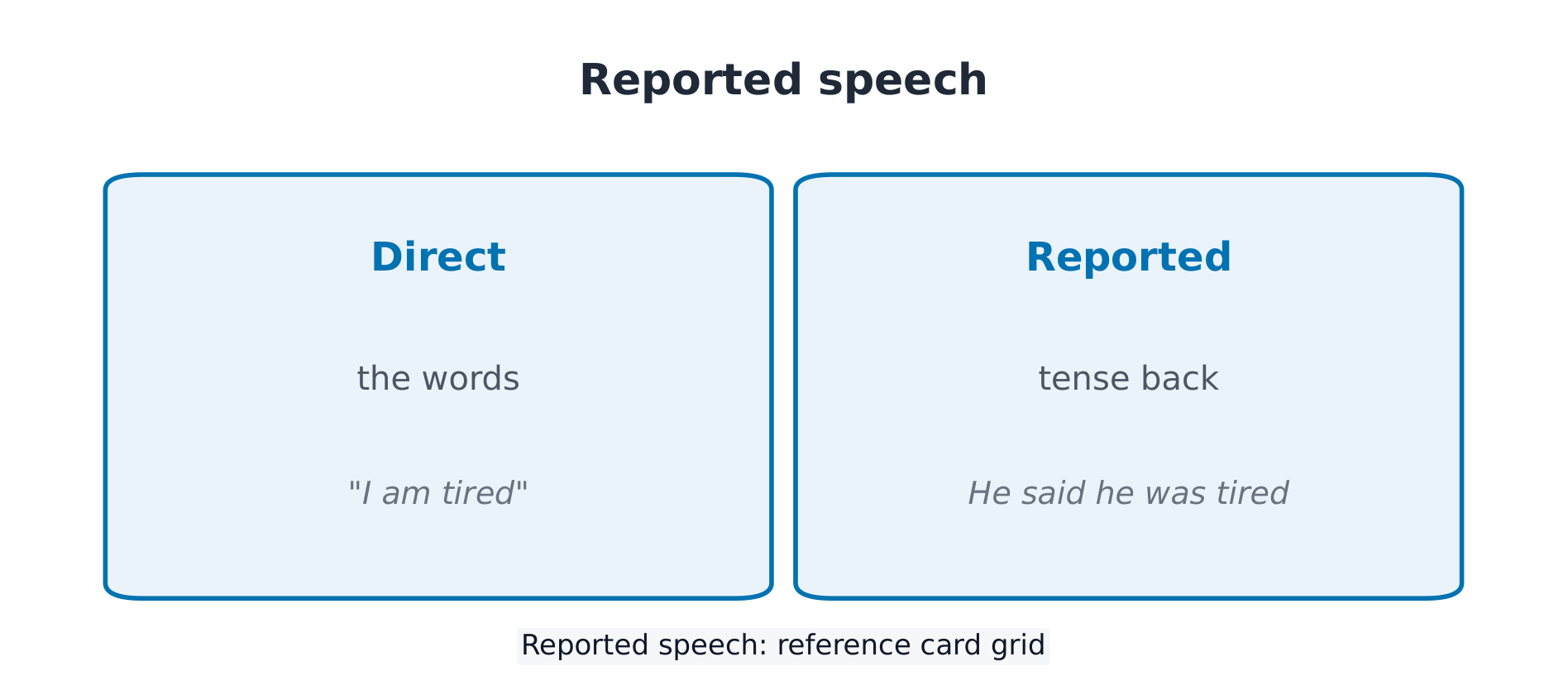
    He said he was tired. (Original quote: "I am tired.")

    Note that can be omitted: He said he was tired. The meaning remains the same.

    Bahasa Indonesia
    Langsung → Tidak Langsung

    Indirect speech (reported speech) digunakan untuk mengutip kembali ucapan orang lain, tanpa tanda kutip. Umumnya menggunakan said atau told:

    • say tidak diikuti oleh pendengar: He said (that) …
    • tell harus diikuti oleh pendengar: He told me (that) …

    他He 说said (连词)that 他he (过去)was 累tired.

    Dia mengatakan dia lelah. (ucapan asli: "I am tired.")

    Perhatian that dapat dihilangkan: He said he was tired. Maknanya sama.

    8.2

    Pergeseran Tenses

    English

    When reporting, if the reporting verb is in the past tense (said / told), the tense in the reported clause usually shifts back one step:

    • am / is → was; are → were; do / does → did.
    • will → would; can → could; present perfect / past simple → past perfect.

    Direct Speech: "I will help you," she said.

    Indirect Speech:

    她She 说said 她she 会would 帮help 我me.

    She said she would help me. (will → would, I → she, you → me)

    Pronouns and time expressions also change: I → he / she, now → then, today → that day, tomorrow → the next day.

    Note If reporting a general truth, tenses need not shift: He said the sun rises in the east.

    Common Errors

    • ❌ ~~He said me the truth.~~ / ~~He told that he was busy.~~ → ✓ He told me… / He said (that)… — say does not take a listener, tell must take a listener; this is the opposite of common mistakes.
    • ❌ ~~He asked me where did I live.~~ → ✓ He asked me where I lived. — Reported questions must change to statement word order, removing did.
    • ❌ ~~She asked me that I was hungry.~~ → ✓ She asked me if / whether I was hungry. — Report yes/no questions using if / whether, not that.
    • ❌ ~~He said he will come tomorrow.~~ → ✓ He said he would come the next day. — Tenses and time expressions must shift together.
    Bahasa Indonesia

    Saat mengutip, jika kata kerja pengutip menggunakan past tense (said / told), tense dalam klausa biasanya mundur satu langkah:

    • am / is → was; are → were; do / does → did.
    • will → would; can → could; present perfect / simple past → past perfect.

    Direct speech: "I will help you," she said. (ucapan asli)

    Tidak langsung:

    她She 说said 她she 会would 帮help 我me.

    Dia mengatakan dia akan membantu saya. (will → would, I → she, you → me)

    Pronoun dan kata keterangan waktu juga harus berubah: I → he / she, now → then, today → that day, tomorrow → the next day.

    Perhatian jika yang dikutip adalah fakta universal, tense tidak perlu mundur: He said the sun rises in the east.

    Kesalahan Umum

    • ❌ ~~He said me the truth.~~ / ~~He told that he was busy.~~ → ✓ He told me… / He said (that)… — say tidak diikuti pendengar, tell harus diikuti pendengar, persis sebaliknya.
    • ❌ ~~He asked me where did I live.~~ → ✓ He asked me where I lived. — Pertanyaan yang dikutip harus diubah kembali menjadi urutan kalimat deklaratif, did hilang.
    • ❌ ~~She asked me that I was hungry.~~ → ✓ She asked me if / whether I was hungry. — Pertanyaan yes/no yang dikutip menggunakan if / whether, jangan pakai that.
    • ❌ ~~He said he will come tomorrow.~~ → ✓ He said he would come the next day. — Tense dan kata keterangan waktu harus mundur bersamaan.
  • 9 Relative clauses · ⁨Klausa relatif⁩
    9.1

    who dengan which / that

    English

    Relative clauses provide additional information about a preceding noun. They are introduced by relative pronouns:

    • who: refers to people.
    • which: refers to things.
    • that: refers to either people or things (common in informal speech).

    (冠词)The 女人woman (关系代词)who 住lives 隔壁next door 是is 一名a 医生doctor.

    The woman living next door is a doctor.

    这This 是is (冠词)the 书book (关系代词)which 获得won (冠词)the 奖prize.

    That is the award-winning book.

    Note Relative pronouns go immediately after the noun they refer to, introducing supplementary information.

    Bahasa Indonesia
    Relative pronouns: who/which/where/whose

    Relative clause (定语从句) digunakan untuk memberikan penjelasan tambahan terhadap kata benda sebelumnya. Dipimpin oleh relative pronoun:

    • who: merujuk pada orang.
    • which: merujuk pada benda.
    • that: bisa merujuk pada orang maupun benda (sering digunakan dalam percakapan).

    (冠词)The 女人woman (关系代词)who 住lives 隔壁next door 是is 一名a 医生doctor.

    Tetangga perempuan itu adalah seorang dokter.

    这This 是is (冠词)the 书book (关系代词)which 获得won (冠词)the 奖prize.

    Itulah buku yang memenangkan penghargaan.

    Catatan: Kata ganti penghubung diletakkan setelah kata benda yang ditunjuknya, untuk memperkenalkan informasi tambahan.

    9.2

    where, when, whose

    English
    • where: refers to place. when: refers to time. whose: indicates possession ("'s").

    那是That's (冠词)the 镇town (在那里)where 我I 长大grew up.

    That is the town where I grew up.

    她是She's (冠词)the 作家writer (谁的)whose 书books 我I 喜爱love.

    She is the writer whose works I like.

    Note whose is followed directly by a noun (whose books), indicating "that person's books".

    Bahasa Indonesia
    • where: merujuk pada tempat. when: merujuk pada waktu. whose: menunjukkan kepemilikan ("……-nya").

    那是That's (冠词)the 镇town (在那里)where 我I 长大grew up.

    Itulah kota kecil tempat saya tumbuh besar.

    她是She's (冠词)the 作家writer (谁的)whose 书books 我I 喜爱love.

    Dialah penulis karya-karya yang saya sukai.

    Perhatian setelah whose langsung mengikuti kata benda (whose books), artinya "buku orang tersebut".

    9.3

    Penghapusan Kata Ganti Penghubung

    English

    When the relative pronoun acts as the object in the clause, it can be omitted (common in both speech and writing):

    (冠词)The 电影film 我们(that) we 看saw (是)was 很棒great.

    The movie (that) we watched was great.

    How to decide:

    • If the relative pronoun is the subject (followed immediately by a verb) → cannot omit.
    • If the relative pronoun is the object (followed by "subject + verb") → can omit.

    Note Must be retained when acting as subject: the man who called (cannot omit who).

    Common Errors

    • ❌ ~~The man which lives next door…~~ → ✓ The man who / that… — Do not use which for people.
    • ❌ ~~The book what I read…~~ → ✓ The book that / which I read… — English has no usage of what as a relative pronoun.
    • ❌ ~~This is the house which I live.~~ → ✓ …the house where I live / …the house which I live in. — When the clause lacks a preposition, either use where or supply the missing preposition.
    • ❌ ~~The friend who I met him yesterday…~~ → ✓ The friend who I met yesterday… — Since the relative pronoun already replaces the object, him / it cannot appear again in the clause.
    Bahasa Indonesia

    Ketika kata ganti penghubung berfungsi sebagai objek dalam klausa, dapat dihapus (umum dalam percakapan maupun tulisan):

    (冠词)The 电影film 我们(that) we 看saw (是)was 很棒great.

    Film yang kami tonton sangat bagus. (that dapat dihilangkan)

    Cara Menentukan:

    • Kata ganti penghubung berfungsi sebagai subjek (diikuti langsung oleh kata kerja) → tidak boleh dihapus.
    • Kata ganti penghubung berfungsi sebagai objek (diikuti oleh "subjek + kata kerja") → boleh dihapus.

    Perhatian ketika berfungsi sebagai subjek harus dipertahankan: the man who called (tidak boleh menghilangkan who).

    Kesalahan Umum

    • ❌ ~~The man which lives next door…~~ → ✓ The man who / that… — Merujuk pada orang jangan gunakan which.
    • ❌ ~~The book what I read…~~ → ✓ The book that / which I read… — Bahasa Inggris tidak menggunakan "what" sebagai kata ganti penghubung (relative pronoun).
    • ❌ ~~This is the house which I live.~~ → ✓ …the house where I live / …the house which I live in. — Ketika klausa kekurangan preposisi, gunakan "where" atau tambahkan kembali "in".
    • ❌ ~~The friend who I met him yesterday…~~ → ✓ The friend who I met yesterday… — Kata ganti penghubung telah menggantikan objek, sehingga "him / it" tidak boleh muncul lagi di dalam klausa tersebut.
  • 10 Modals of deduction · ⁨Modal deduksi⁩
    10.1

    must dan can't (Keyakinan)

    English

    Modal verbs can also express deduction. When you are very certain:

    • must: must be (definite positive deduction).
    • can't: can't be (definite negative deduction).

    她She 一定must 是be 累tired.

    She must be very tired. (Very certain)

    他He 不可能can't 是be 饿hungry 他; he 刚just 吃ate.

    He can't be hungry; he just ate.

    Note Use can't for negative deduction (impossible), not mustn't (which means "prohibited").

    Bahasa Indonesia
    Kata Kerja Modal untuk Spulasi: Tingkat Kepastian

    Kata kerja modals juga dapat menyatakan spulasi. Ketika Anda sangat yakin:

    • must: pasti (tebakan positif yang pasti).
    • can't: pasti bukan (tebakan negatif yang pasti).

    她She 一定must 是be 累tired.

    Dia pasti sangat lelah. (Sangat yakin)

    他He 不可能can't 是be 饿hungry 他; he 刚just 吃ate.

    Dia tidak mungkin lapar, dia baru saja makan.

    Perhatian Untuk menyatakan tebakan negatif, gunakan can't (tidak mungkin), jangan gunakan mustn't (yang berarti "dilarang").

    10.2

    might, may, could (Kemungkinan)

    English

    When you are not entirely sure, but only feel that something is possible:

    • might / may / could: possible, perhaps.

    (天气it)It 可能might 下雨rain 稍后later.

    It might rain later.

    他们They 可能may 在be (在)at 家home.

    They might be at home.

    Degree of Certainty Comparison:

    • Very certain: must (is) / can't (is not).
    • Uncertain: might / may / could (possible).

    Note All these modal verbs are followed by the base form of the verb: might be, must be (not might is).

    Common Errors

    • ❌ ~~It can be John at the door.~~ → ✓ It could / might be John. — Use could / might for speculation about a specific instance; can only indicates "general possibility."
    • ❌ ~~He might not can come.~~ → ✓ He might not be able to come. — Two modal verbs cannot be used together; replace the second with be able to / have to.
    • ❌ ~~Maybe he be late. / It may be rain.~~ → ✓ Maybe he is late. / It may rain. — maybe is an adverb and follows normal sentence structure; may is a modal verb and is followed by the base form. Do not mix them up.
    • ❌ ~~She must is tired.~~ → ✓ She must be tired. — A modal verb is always followed by the base form of the verb.
    Bahasa Indonesia

    Ketika Anda kurang yakin, hanya merasa ada kemungkinan:

    • might / may / could: mungkin, barangkali.

    (天气it)It 可能might 下雨rain 稍后later.

    Nanti mungkin akan hujan.

    他们They 可能may 在be (在)at 家home.

    Mereka mungkin di rumah.

    Perbandingan Tingkat Kepastian:

    • Sangat yakin: must (pasti ada) / can't (pasti tidak ada).
    • Tidak yakin: might / may / could (mungkin).

    Perhatian Semua kata kerja modal ini diikuti oleh kata kerja dasar: might be, must be (bukan might is).

    Kesalahan Umum

    • ❌ ~~It can be John at the door.~~ → ✓ It could / might be John. — Gunakan could/might untuk tebakan pada satu kejadian spesifik; "can" hanya menunjukkan "secara umum mungkin".
    • ❌ ~~He might not can come.~~ → ✓ He might not be able to come. — Dua kata kerja modal tidak boleh berurutan; gantilah dengan "be able to" atau "have to".
    • ❌ ~~Maybe he be late. / It may be rain.~~ → ✓ Maybe he is late. / It may rain. — "maybe" adalah keterangan, kalimat tetap normal; "may" adalah kata kerja modal, diikuti bentuk dasar. Jangan mencampur keduanya.
    • ❌ ~~She must is tired.~~ → ✓ She must be tired. — Setelah kata kerja modal selalu gunakan kata kerja dasar.
  • 11 Gerunds and infinitives
    11.1

    Kata Kerja + -ing

    English

    Some verbs are followed by a gerund (verb-ing). Common examples include: enjoy, like, love, hate, finish, stop, mind, suggest, avoid.

    我I 喜欢enjoy 阅读reading.

    I enjoy reading.

    她She 完成finished 做doing 她的her 作业homework.

    She finished her homework.

    Note A gerund functions as a noun; its form is verb-ing.

    Bahasa Indonesia
    Kata kerja setelahnya:-ing atau to

    Beberapa kata kerja diikuti oleh gerund (kata kerja-ing). Yang umum meliputi: enjoy, like, love, hate, finish, stop, mind, suggest, avoid.

    我I 喜欢enjoy 阅读reading.

    Saya suka membaca.

    她She 完成finished 做doing 她的her 作业homework.

    Dia sudah mengerjakan PR-nya.

    Perhatian Gerund (kata benda dari kata kerja) digunakan sebagai kata benda, bentuknya adalah kata kerja-ing.

    11.2

    Kata Kerja + Infinitive

    English

    Other verbs are followed by an infinitive (to + base form). Common examples include: want, need, decide, hope, promise, learn, would like, plan.

    我I 想want (不定式)to 学learn 英语English.

    I want to learn English.

    他们They 决定decided (不定式)to 留下stay.

    They decided to stay.

    Note Some verbs accept both forms with similar meanings: like, love, start, begin. I like swimming. = I like to swim.

    Bahasa Indonesia

    Kata kerja lain diikuti oleh infinitive (to + kata kerja dasar). Yang umum meliputi: want, need, decide, hope, promise, learn, would like, plan.

    我I 想want (不定式)to 学learn 英语English.

    Saya ingin belajar bahasa Inggris.

    他们They 决定decided (不定式)to 留下stay.

    Mereka memutuskan untuk tinggal.

    Perhatian Beberapa kata kerja bisa menerima keduanya dengan makna serupa: like, love, start, begin. I like swimming. = I like to swim.

    11.3

    Preposisi diikuti -ing

    English

    After a preposition (in, on, at, of, about, for, good at, interested in…), the verb must take the -ing form:

    她She's 擅长good at 画画drawing.

    She is good at painting.

    谢谢Thank you 因为for 帮助helping 我me.

    Thank you for helping me.

    Note The base form of a verb never follows a preposition: ~~good at draw~~ ✗ → good at drawing ✓.

    Common Errors

    • ❌ ~~I enjoy to read.~~ / ~~I want reading.~~ → ✓ I enjoy reading. / I want to read. — Which verb takes which form is fixed; memorize the collocations, do not swap them.
    • Distinguish the two meanings of stop: He stopped smoking. (Quit smoking) vs. He stopped to smoke. (Stopped what he was doing to go smoke)— The meanings are completely different.
    • ❌ ~~I look forward to see you.~~ → ✓ I look forward to seeing you. — Here, to is a preposition and is followed by -ing.
    • ❌ ~~Swim is good exercise.~~ → ✓ Swimming is good exercise. — When a verb acts as the subject, use the -ing form.
    Bahasa Indonesia

    Setelah preposisi (in, on, at, of, about, for, good at, interested in...), kata kerja harus menggunakan bentuk -ing:

    她She's 擅长good at 画画drawing.

    Dia pandai menggambar.

    谢谢Thank you 因为for 帮助helping 我me.

    Terima kasih telah membantuku.

    Perhatian Preposisi tidak pernah diikuti kata kerja dasar: ~~good at draw~~ ✗ → good at drawing ✓.

    Kesalahan Umum

    • ❌ ~~I enjoy to read.~~ / ~~I want reading.~~ → ✓ I enjoy reading. / I want to read. — Penataan mana kata kerja yang mengikuti bentuk apa bersifat tetap, hafalkan pasangan (collocation)-nya, jangan ditukar-tukar.
    • Bedakan dua arti stop: He stopped smoking. (berhenti merokok) vs He stopped to smoke. (berhenti dari aktivitas lain untuk merokok)— maknanya sangat berbeda.
    • ❌ ~~I look forward to see you.~~ → ✓ I look forward to seeing you. — "to" di sini adalah preposisi, diikuti oleh -ing.
    • ❌ ~~Swim is good exercise.~~ → ✓ Swimming is good exercise. — Kata kerja yang berfungsi sebagai subjek harus menggunakan bentuk -ing.
  • 12 too, enough, so, such
    12.1

    too dan enough

    English

    too and enough indicate degree, but their position and meaning differ:

    • too + adjective = "too..." (negative excess), placed before the adjective.
    • enough = "sufficient," placed after the adjective and before the noun.

    这This 咖啡coffee 是is 太too 烫hot.

    This coffee is too hot.

    他He 不够isn't 大old 足够enough (不定式)to 开车drive.

    He isn't old enough to drive.

    Note enough comes after the adjective (old enough) but before the noun (enough money).

    Bahasa Indonesia
    too dan enough

    too dan enough menyatakan tingkat/derajat, tetapi posisi dan artinya berbeda:

    • too + adjektif = "terlalu……" (kelebihan yang bernada negatif), diletakkan sebelum adjektif.
    • enough = "cukup", diletakkan setelah adjektif, sebelum kata benda.

    这This 咖啡coffee 是is 太too 烫hot.

    Kopi ini terlalu panas.

    他He 不够isn't 大old 足够enough (不定式)to 开车drive.

    Usianya belum cukup, sehingga tidak bisa mengemudi.

    Perhatian "enough" diletakkan setelah adjektif (old enough), tetapi sebelum kata benda (enough money).

    12.2

    so dan such

    English

    so and such both mean "so / such," used to intensify the tone:

    • so + adjective / adverb: so hot, so quickly.
    • such + (a/an) + (adjective) + noun: such a hot day.

    (冠词)The 电影film (是)was 如此so 无聊boring.

    That movie was so boring.

    (这)It 是was 如此such 一个a 好good 主意idea.

    That was really such a good idea.

    Note Follow so with an adjective (so good); follow such with a noun phrase (such a good idea).

    Common Errors

    • ❌ To praise "very happy" but say ~~I'm too happy!~~ → ✓ I'm so happy! — too carries a negative connotation ("excessively, to the point of being bad"); use so for praise and exclamation.
    • ❌ ~~The box is too much heavy.~~ → ✓ The box is much too heavy. — To intensify too, use much too; the word order is much first.
    • ❌ ~~The tea is too hot to drink it.~~ → ✓ The tea is too hot to drink. — In the too…to structure, the sentence subject serves as the object of drink, so do not write it.
    • ❌ ~~It was so a good idea.~~ → ✓ It was such a good idea. / The idea was so good. — If there is a noun, switch to such.
    Bahasa Indonesia

    so dan such keduanya berarti "begitu /那么", digunakan untuk memperkuat penekanan:

    • so + adjektif / keterangan: so hot, so quickly.
    • such + (a/an) + (adjektif) + kata benda: such a hot day.

    (冠词)The 电影film (是)was 如此so 无聊boring.

    Film itu terlalu membosankan.

    (这)It 是was 如此such 一个a 好good 主意idea.

    Itu benar-benar ide yang bagus.

    Perhatian "so" diikuti oleh adjektif (so good), "such" diikuti oleh frasa kata benda (such a good idea).

    Kesalahan Umum

    • ❌ Ingin memuji "sangat bahagia" tetapi berkata ~~I'm too happy!~~ → ✓ I'm so happy! — "too" memiliki nuansa negatif ("terlalu, sampai-sampai tidak baik"), pujiannya dan seruan menggunakan "so".
    • ❌ ~~The box is too much heavy.~~ → ✓ The box is much too heavy. — Untuk memperkuat "too" gunakan "much too", urutannya adalah "much" di depan.
    • ❌ ~~The tea is too hot to drink it.~~ → ✓ The tea is too hot to drink. — Dalam struktur too…to, subjek kalimat sudah menjadi objek dari "drink", jangan tulis "it" lagi.
    • ❌ ~~It was so a good idea.~~ → ✓ It was such a good idea. / The idea was so good. — Jika ada kata benda, ganti dengan "such".

Log in or create account · ⁨Masuk atau buat akun⁩

IGCSE, A-Level & AP