Ekonomi IGCSE (0455) memiliki enam topik: masalah ekonomi dasar, alokasi sumber daya, pengambil keputusan mikroekonomi, pemerintah dan makroekonomi, pembangunan ekonomi, dan perdagangan internasional. Terdapat dua kertas soal — satu pilihan ganda, satu terstruktur.
Kertas terstruktur menentukan nilai, dan diagram menentukan kertas terstruktur. Jawaban permintaan dan penawaran yang ditulis dalam bentuk paragraf tidak akan mendapatkan skor sebanding dengan jawaban yang sama yang dilengkapi dengan diagram berlabel dan arah pergeseran yang dinyatakan jelas.
Belajar menggambar setiap diagram dari halaman kosong — kedua sumbu diberi label, panah pergeseren ditandai. Saat ujian Anda sedang menggambar, bukan mengenali. Bagian bernilai tinggi meminta Anda untuk mengevaluasi, yang berarti menyatakan kapan jawaban Anda tidak akan berlaku.
understand the economic problem: finite (scarce) resources and unlimited wants
distinguish economic goods (scarce, have an opportunity cost) and free goods
understand that the economic problem forces consumers, workers, producers and governments to make choices
Bahasa Indonesia
pahami masalah ekonomi: sumber daya terbatas (langka) dan keinginan tak terbatas
bedakan barang ekonomi (langka, memiliki biaya peluang) dan barang gratis
pahami bahwa masalah ekonomi memaksa konsumen, pekerja, produsen, dan pemerintah untuk membuat pilihan
Source: Cambridge International syllabus · Sumber: Silabus Cambridge International
English
Economics is about how people use resources 资源 to meet their needs and wants. The main idea is simple. People want a lot, but there are not enough resources to make everything. This is the economic problem 经济问题.
Two facts cause the economic problem:
Resources are finite 有限的. There is only a limited amount of them.
People's wants 欲望 are unlimited. People always want more and better things.
Because wants are unlimited but resources are limited, resources are scarce 稀缺. We call this problem scarcity 稀缺性. Scarcity is the root of all economics.
Goods, services, and choices
We use resources to make goods 物品 (things you can touch, like food and phones) and services 服务 (jobs done for you, like a haircut or a bus ride).
Because resources are scarce, we cannot have everything. So everyone must make choices. Scarcity forces four groups to choose:
consumers 消费者 — people who buy and use goods and services. They choose what to buy.
workers 工人 — they choose which job to do.
producers 生产者, also called firms 企业 — they make goods and services. They choose what to produce.
governments 政府 — they choose what to provide and how to spend public money.
Economic goods and free goods
Most things are economic goods 经济物品. They are scarce, so making or using one means giving something else up. Economic goods have an opportunity cost 机会成本 (explained below).
A few things are free goods 免费物品. They are not scarce — there is enough for everyone and they cost nothing to use. Examples are the air you breathe and sunlight. A free good has no opportunity cost.
Be careful: a "free" sample or a "free" gift is not a free good. Resources were used to make it, so it is still an economic good.
Bahasa Indonesia
Ekonomi adalah tentang bagaimana orang menggunakan sumber daya untuk memenuhi kebutuhan dan keinginan mereka. Gagasan utamanya sederhana. Orang menginginkan banyak hal, tetapi sumber daya tidak cukup untuk membuat semuanya. Inilah masalah ekonomi.
Dua fakta menyebabkan masalah ekonomi:
Sumber daya bersifat terbatas. Jumlahnya hanya terbatas.
Keinginan manusia tidak terbatas. Manusia selalu menginginkan lebih banyak dan barang yang lebih baik.
Karena keinginan tidak terbatas tetapi sumber daya terbatas, sumber daya menjadi langka. Kita menyebut masalah ini kelangkaan. Kelangkaan adalah akar dari semua ilmu ekonomi.
Masalah ekonomi: kelangkaan memaksa pemilihan, dan setiap pilihan memiliki biaya peluang
Barang, jasa, dan pilihan
Kita menggunakan sumber daya untuk membuat barang (benda yang bisa disentuh, seperti makanan dan ponsel) dan jasa (tugas yang dilakukan untuk Anda, seperti potong rambut atau perjalanan bus).
Karena sumber daya langka, kita tidak bisa mendapatkan segalanya. Jadi setiap orang harus membuat pilihan. Kelangkaan memaksa empat kelompok untuk memilih:
konsumen — orang yang membeli dan menggunakan barang dan jasa. Mereka memilih apa yang akan dibeli.
pekerja — mereka memilih pekerjaan mana yang akan dikerjakan.
produsen, juga disebut perusahaan — mereka membuat barang dan jasa. Mereka memilih apa yang akan diproduksi.
pemerintah — mereka memilih apa yang akan disediakan dan bagaimana menghabiskan uang publik.
Barang ekonomi dan barang gratis
Sebagian besar benda adalah barang ekonomi. Mereka langka, jadi membuatnya atau menggunakannya berarti mengorbankan sesuatu yang lain. Barang ekonomi memiliki biaya peluang (dijelaskan di bawah ini).
Beberapa benda adalah barang gratis. Mereka tidak langka — ada cukup untuk semua orang dan tidak ada biayanya untuk digunakan. Contohnya adalah udara yang Anda hirup dan sinar matahari. Barang gratis tidak memiliki biaya peluang.
Hati-hati: sampel "gratis" atau hadiah "gratis" bukan barang gratis. Sumber daya digunakan untuk membuatnya, sehingga itu tetap merupakan barang ekonomi.
Explore · Jelajahi
Scarcity and choice · Kelangkaan dan pilihan
Limited resources mean producing more of one good costs some of the other — the opportunity cost, shown by the frontier. · Sumber daya terbatas berarti memproduksi lebih banyak satu barang mengorbankan sebagian dari barang lain — yaitu biaya peluang, ditunjukkan oleh kurva.
define the four factors of production: land, labour, capital and enterprise, with examples
state the reward to each factor (rent, wages, interest, profit)
explain the mobility of the factors of production and the causes of changes in their quantity and quality
Bahasa Indonesia
definisikan empat faktor produksi: tanah, tenaga kerja, modal, dan usaha, beserta contohnya
nyatakan imbalan untuk setiap faktor (sewa, upah, bunga, laba)
jelaskan mobilitas faktor produksi dan penyebab perubahan kuantitas dan kualitasnya
Source: Cambridge International syllabus · Sumber: Silabus Cambridge International
English
To make goods and services, firms use four types of resource. We call them the factors of production 生产要素.
The four factors
Factor
What it is
Example
land 土地
natural resources
fields, water, oil, forests
labour 劳动
human work
a teacher, a builder, a nurse
capital 资本
man-made things used to produce
machines, tools, factories
enterprise 企业家才能
organising the other three and taking risks
a person who starts a business
The person who provides enterprise is the entrepreneur 企业家. They bring the other factors together and risk their own money to start and run a business.
The reward to each factor
Each factor earns a reward 报酬 — the income it gets for being used:
Factor
Reward
land
rent 地租
labour
wages 工资
capital
interest 利息
enterprise
profit 利润
Mobility, quantity and quality
The mobility 流动性 of a factor means how easily it can move to a different use or place. A worker with many skills can change jobs easily, so labour is mobile. A worker with only one skill, or a factory that cannot be moved, is less mobile.
The quantity and quality of factors can change:
Quantity can rise or fall. The amount of labour grows if the birth rate rises or people move into the country to work. Land can be lost to the sea or gained by draining it.
Quality can rise. Training and education make labour better. New technology makes capital better. Higher quality means each factor can produce more.
Bahasa Indonesia
Untuk membuat barang dan jasa, perusahaan menggunakan empat jenis sumber daya. Kita sebut mereka sebagai faktor produksi.
Empat faktor produksi dan imbalan yang diterima masing-masing
Empat faktor
Faktor
Apa itu
Contoh
tanah
sumber daya alam
lahan pertanian, air, minyak, hutan
tenaga kerja
kerja manusia
guru, tukang bangunan, perawat
modal
buatan manusia yang digunakan untuk memproduksi
mesin, alat, pabrik
kewirausahaan
mengatur tiga lainnya dan mengambil risiko
seseorang yang memulai bisnis
Orang yang menyediakan kewirausahaan adalah wirausaha. Mereka menggabungkan faktor-faktor lain dan berisiko menggunakan uangnya sendiri untuk memulai dan menjalankan bisnis.
Tanah—sumber daya alam seperti lahan pertanian—adalah salah satu dari empat faktor produksi
Imbalan bagi setiap faktor
Setiap faktor menghasilkan imbalan — pendapatan yang diperolehnya karena digunakan:
Faktor
Imbalan
tanah
sewa
tenaga kerja
gaji
modal
bunga
kewirausahaan
laba
Mobilitas, kuantitas, dan kualitas
Mobilitas suatu faktor berarti seberapa mudah faktor tersebut dapat berpindah ke penggunaan atau tempat lain. Pekerja dengan banyak keterampilan dapat dengan mudah berganti pekerjaan, sehingga tenaga kerja bersifat mobile. Pekerja dengan hanya satu keterampilan, atau pabrik yang tidak dapat dipindahkan, kurang mobile.
Kuantitas dan kualitas faktor dapat berubah:
Kuantitas dapat naik atau turun. Jumlah tenaga kerja bertambah jika tingkat kelahiran meningkat atau orang pindah ke negara tersebut untuk bekerja. Tanah dapat hilang ke laut atau bertambah melalui pengeringan.
Kualitas dapat meningkat. Pelatihan dan pendidikan membuat tenaga kerja lebih baik. Teknologi baru membuat modal lebih baik. Kualitas yang lebih tinggi berarti setiap faktor dapat menghasilkan lebih banyak.
Explore · Jelajahi
Factors of production lab · Laboratorium faktor produksi
Sort real resources by the factor of production they represent. · Urutkan sumber daya riil berdasarkan faktor produksi yang mereka wakili.
define opportunity cost as the next best alternative given up when a choice is made
explain how opportunity cost influences decisions made by consumers, workers, producers and governments
Bahasa Indonesia
definisikan biaya peluang sebagai alternatif terbaik berikutnya yang dikorbankan ketika sebuah pilihan dibuat
jelaskan bagaimana biaya peluang mempengaruhi keputusan yang dibuat oleh konsumen, pekerja, produsen, dan pemerintah
Source: Cambridge International syllabus · Sumber: Silabus Cambridge International
English
The PPF and opportunity cost
When you choose one thing, you give up the next best choice. That is the real cost of your decision.
Opportunity cost is the next best alternative 替代选择 you give up when you make a choice.
It affects every decision-maker:
A consumer who buys a game gives up the book they could have bought instead.
A worker who takes one job gives up the pay of the next job they could have done.
A producer who makes more cars uses factors that could have made trucks.
A government that builds a hospital gives up the school it could have built with the same money.
Opportunity cost matters because resources are scarce. Every choice has a cost, even when no money changes hands.
Bahasa Indonesia
PPF dan biaya peluangKonsumen memilih apa yang akan dibeli di pasar ramai—kelangkaan memaksa semua orang untuk membuat pilihanMemilih satu hal berarti melepaskan alternatif terbaik berikutnya
Ketika Anda memilih satu hal, Anda melepaskan pilihan terbaik berikutnya. Itulah biaya nyata dari keputusan Anda.
Biaya peluang adalah alternatif terbaik berikutnya yang Anda korbankan saat Anda membuat pilihan.
Hal ini memengaruhi setiap pembuat keputusan:
Konsumen yang membeli permainan melepaskan buku yang bisa ia beli sebagai gantinya.
Pekerja yang mengambil satu pekerjaan melepaskan gaji dari pekerjaan berikutnya yang bisa dilakukannya.
Produsen yang membuat lebih banyak mobil menggunakan faktor yang seharusnya bisa membuat truk.
Pemerintah yang membangun rumah sakit mengorbankan sekolah yang dapat dibangunnya dengan dana yang sama.
Biaya peluang penting karena sumber daya terbatas. Setiap pilihan memiliki biaya, bahkan ketika tidak ada uang yang keluar masuk.
Explore · Jelajahi
Opportunity cost on the frontier · Biaya peluang pada kurva
Moving along the frontier, gaining more of one good always means giving up some of the other — that sacrifice is the opportunity cost. · Bergerak sepanjang kurva, mendapatkan lebih banyak satu barang selalu berarti mengorbankan sebagian dari barang lain — pengorbanan itulah biaya peluang.
Production possibility curve (PPC) diagrams · Diagram kurva kemungkinan produksi (KPP)
Syllabus · Silabus
English
draw and interpret a PPC showing the maximum combinations of two goods that can be produced
explain points on, inside and outside the curve and movements along the curve (opportunity cost)
explain causes of shifts in the PPC (changes in the quantity/quality of resources, economic growth or decline)
Bahasa Indonesia
gambar dan tafsirkan PPC yang menunjukkan kombinasi maksimum dua jenis barang yang dapat diproduksi
jelaskan titik-titik pada, di dalam, dan di luar kurva serta pergerakan sepanjang kurva (biaya peluang)
jelaskan penyebab pergeseran PPC (perubahan kuantitas/kualitas sumber daya, pertumbuhan atau kemunduran ekonomi)
Source: Cambridge International syllabus · Sumber: Silabus Cambridge International
English
A production possibility curve 生产可能性曲线 (PPC) shows the largest amounts of two goods a country can make when it uses all its resources fully.
Imagine an economy that makes only two types of good, one on each axis:
capital goods — used to make other goods, like machines.
consumer goods — used up by people, like food and clothes.
The PPC is the line joining every point where the economy uses all its resources to make the most it can.
Reading the diagram
Picture the two goods on the two axes. The PPC is a curve that bends from one axis down to the other (it usually bows outward, away from the corner):
A point on the curve: all resources are used fully. The economy makes the most it can.
A point inside the curve: resources are wasted or not all used — for example, there is unemployment 失业. The economy could make more.
A point outside the curve: this is impossible now. There are not enough resources to reach it.
Movements along the curve
If the economy already uses all its resources (a point on the curve), making more of one good means making less of the other. You must move factors from one good to the other. This is a trade-off 取舍.
The amount of the second good you give up is the opportunity cost of the extra first good. This is why the PPC is a clear picture of opportunity cost.
Worked example. An economy on its PPC makes 40 machines and 60 tonnes of food. To make 50 machines it must cut food to 45 tonnes. Give the opportunity cost of the extra machines. Then say what a point of 30 machines and 40 tonnes of food would tell you. The economy is already on the curve, so more of one good must mean less of the other: the 10 extra machines cost 60 − 45 = 15 tonnes of food. That lost food is the opportunity cost, so quote it in tonnes of food - never in money. The second point lies inside the curve, which means resources are idle or wasted, most likely through unemployment; from there the economy could make more of both goods, so moving out to the curve costs nothing at all. Opportunity cost only bites once you are on the curve.
Shifts of the curve
The whole curve can move:
It shifts outward (to the right) when the country can make more of both goods. This is economic growth 经济增长. Causes: more resources (a bigger workforce, more land discovered) or better-quality resources (training, new technology).
It shifts inward (to the left) when the country can make less. This is economic decline 经济衰退. Causes: fewer or worse resources — for example a war, a natural disaster, or using up non-renewable resources 不可再生资源 (resources like oil and coal that cannot be replaced once used).
Do not confuse the two. Moving from inside the curve to the curve (by using idle resources) is a short-term gain. Moving the whole curve outward is a long-term change.
Bahasa Indonesia
Sebuah kurva kemungkinan produksi (KPP) menunjukkan jumlah maksimal dua jenis barang yang dapat diproduksi suatu negara jika semua sumber dayanya digunakan sepenuhnya.
Bayangkan sebuah ekonomi yang hanya memproduksi dua jenis barang, satu di setiap sumbu:
barang modal — digunakan untuk membuat barang lain, seperti mesin.
barang konsumsi — habis digunakan oleh orang, seperti makanan dan pakaian.
KPP adalah garis yang menghubungkan setiap titik di mana ekonomi menggunakan semua sumber dayanya untuk memaksimalkan produksi.
Membaca diagram
Bayangkan kedua barang pada kedua sumbu tersebut. KPP adalah kurva yang melengkung dari satu sumbu ke sumbu lainnya (biasanya melengkung keluar menjauhi sudut):
Titik pada kurva: semua sumber daya digunakan sepenuhnya. Ekonomi memproduksi sebanyak mungkin.
Titik di dalam kurva: sumber daya terbuang atau tidak seluruhnya digunakan — misalnya terdapat pengangguran. Ekonomi seharusnya bisa memproduksi lebih banyak.
Titik di luar kurva: hal ini mustahil saat ini. Sumber daya tidak cukup untuk mencapainya.
Titik pada kurva menggunakan semua sumber daya; di dalam kurva ada sumber daya yang terbuang (mis. pengangguran); di luar kurva tidak mungkin dicapai dengan sumber daya hari ini.
Pergerakan sepanjang kurva
Jika ekonomi sudah menggunakan semua sumber dayanya (titik pada kurva), meningkatkan produksi satu barang berarti mengurangi produksi barang lainnya. Faktor produksi harus dialihkan dari satu barang ke barang lain. Ini adalah trade-off.
Jumlah barang kedua yang dikorbankan adalah biaya peluang dari tambahan barang pertama. Inilah sebabnya KPP merupakan gambaran jelas dari biaya peluang.
Contoh soal. Sebuah ekonomi yang berada pada KPP-nya memproduksi 40 mesin dan 60 ton makanan. Untuk memproduksi 50 mesin, produksi makanan harus dipotong menjadi 45 ton. Tentukan biaya peluang dari tambahan mesin tersebut. Kemudian jelaskan apa arti titik 30 mesin dan 40 ton makanan. Ekonomi sudah berada pada kurva, sehingga peningkatan satu barang harus diikuti penurunan barang lain: 10 mesin tambahan berharga 60 − 45 = 15 ton makanan. Makanan yang hilang ini adalah biaya peluang, jadi nyatakan dalam satuan ton makanan - jangan dalam uang. Titik kedua terletak di dalam kurva, yang berarti sumber daya menganggur atau terbuang, kemungkinan besar akibat pengangguran; dari sana ekonomi dapat memproduksi lebih banyak kedua jenis barang, sehingga berpindah keluar menuju kurva tidak memerlukan biaya apa pun. Biaya peluang baru terasa ketika Anda berada pada kurva.
Pergeseran kurva
Seluruh kurva dapat bergeser:
Bergeser ke luar (ke kanan) ketika negara mampu memproduksi lebih banyak kedua jenis barang. Ini adalah pertumbuhan ekonomi. Penyebab: lebih banyak sumber daya (tenaga kerja lebih besar, penemuan lahan baru) atau kualitas sumber daya yang lebih baik (pelatihan, teknologi baru).
Bergeser ke dalam (ke kiri) ketika negara mampu memproduksi lebih sedikit. Ini adalah penurunan ekonomi. Penyebab: sumber daya yang lebih sedikit atau lebih buruk — misalnya perang, bencana alam, atau penggunaan sumber daya tak terbarukan (sumber daya seperti minyak dan batu bara yang tidak dapat digantikan setelah digunakan).
Sumber daya yang lebih banyak atau lebih baik menggeser seluruh KPP ke luar (pertumbuhan); perang, bencana, atau penggunaan habis sumber daya menggesernya ke dalam (penurunan).
Jangan bingung dengan keduanya. Bergerak dari dalam kurva menuju kurva (dengan memanfaatkan sumber daya menganggur) adalah keuntungan jangka pendek. Menggeser seluruh kurva ke luar adalah perubahan jangka panjang.
Explore · Jelajahi
The production possibility curve · Kurva kemungkinan produksi
Move along the curve: making more of one good means making less of the other — that's opportunity cost. · Gerakkan sepanjang kurva: membuat lebih banyak barang yang baik berarti membuat lebih sedikit barang lainnya — itu adalah biaya peluang.
Scarcity (unlimited wants, limited resources) forces choice, and every choice has an opportunity cost — the next best alternative you give up.
Learn the four factors of production and the reward each earns: land–rent, labour–wages, capital–interest, enterprise–profit.
On a PPC, a point on the curve uses all resources fully, inside wastes some (e.g. unemployment), and outside is impossible for now. Moving along the curve shows opportunity cost.
Moving to the curve (using idle resources) is a short-term gain; shifting the whole curve outward is long-term economic growth from more or better resources.
Bahasa Indonesia
Kelangkaan (keinginan tak terbatas, sumber daya terbatas) memaksa pemilihan, dan setiap pilihan memiliki biaya peluang — alternatif terbaik berikutnya yang dikorbankan.
Hafal empat faktor produksi dan imbalannya masing-masing: tanah–sewa, tenaga kerja–gaji, modal–bunga, kewirausahaan–laba.
Pada KPP, titik pada kurva menggunakan semua sumber daya sepenuhnya, di dalam membuang sebagian (mis. pengangguran), dan di luar mustahil untuk sementara waktu. Bergerak sepanjang kurva menunjukkan biaya peluang.
Bergerak menuju kurva (menggunakan sumber daya menganggur) adalah keuntungan jangka pendek; menggeser seluruh kurva ke luar adalah pertumbuhan ekonomi jangka panjang akibat sumber daya yang lebih banyak atau lebih baik.
2
The allocation of resources · Alokasi sumber daya
explain how the market (price mechanism) allocates resources through the signalling, incentive and rationing functions of price
Bahasa Indonesia
definisikan mikroekonomi dan makroekonomi
jelaskan bagaimana pasar (mekanisme harga) mengalokasikan sumber daya melalui fungsi penanda, insentif, dan rasio harga
Source: Cambridge International syllabus · Sumber: Silabus Cambridge International
Economics is split into two parts:
microeconomics 微观经济学 — the study of single parts of the economy, such as one industry or one product.
macroeconomics 宏观经济学 — the study of the whole economy, like total jobs, prices, and growth.
A market 市场 is any place or system where buyers and sellers meet to trade. It does not need a building — it can be online or over the phone.
A stock exchange is a market: as buyers and sellers trade, their offers set the price of each share
When a market is free, no one is in charge of deciding what to make. Instead, the price mechanism 价格机制 (the free movement of prices) allocates 配置resources 资源 — it decides what is made, how, and for whom. Price does three jobs:
the signalling 信号 function — a price change tells buyers and sellers what is happening. A rising price signals "make more"; a falling price signals "make less".
the incentive 激励 function — a higher price gives firms 企业 a reason to produce more, because they can earn more.
the rationing 配给 function — when a product is scarce, its price rises. The high price shares out the limited amount to those willing to pay.
Explore · Jelajahi
How markets allocate resources · Bagaimana pasar mengalokasikan sumber daya
Price moves to where demand meets supply. That equilibrium price signals firms what to produce and rations goods to buyers. · Harga bergerak ke tempat permintaan bertemu penawaran. Harga keseimbangan itu memberi sinyal kepada perusahaan apa yang harus diproduksi dan merasionalkan barang kepada pembeli.
define demand and explain the law of demand (inverse relationship with price), ceteris paribus
draw demand curves and distinguish a movement along (change in price) from a shift (change in conditions of demand)
list the conditions of demand (income, tastes, price of substitutes and complements, population, advertising)
Bahasa Indonesia
definisikan permintaan dan jelaskan hukum permintaan (hubungan berbanding terbalik dengan harga), ceteris paribus
gambar kurva permintaan dan bedakan pergerakan sepanjang kurva (perubahan harga) dengan pergeseran (perubahan kondisi permintaan)
daftar kondisi permintaan (pendapatan, selera, harga barang substitusi dan komplementer, populasi, iklan)
Source: Cambridge International syllabus · Sumber: Silabus Cambridge International
Demand 需求 is the amount of a good 物品 that consumers 消费者 (buyers) are willing and able to buy at each price, in a period of time.
The law of demand 需求定律 says: when the price of a good rises, the quantity demanded falls; when the price falls, the quantity demanded rises. Price and quantity move in opposite directions — an inverse relationship 反向关系. This is true ceteris paribus 其他条件不变 (a Latin phrase meaning "all other things stay the same").
Movements and shifts
It helps to separate two ideas:
quantity demanded 需求量 — the amount bought at one price.
demand — the whole pattern of buying at every price.
On a demand diagram, price is on the up axis and quantity on the across axis. The demand curve 需求曲线 slopes downward from left to right: high price, low quantity; low price, high quantity.
A change in the good's own price causes a movement along the demand curve. You slide to a new point on the same line.
A change in any other condition causes a shift 移动 of the whole curve. A rightward shift means more is demanded at every price; a leftward shift means less.
Conditions of demand
These are the things (other than the good's own price) that shift the demand curve:
income 收入 — more income usually means more demand.
tastes 偏好 — if a good becomes popular, demand rises.
price of substitutes 替代品 — goods used instead of each other (tea and coffee). If coffee gets dearer, demand for tea rises.
price of complements 互补品 — goods used together (cars and fuel). If cars get dearer, demand for fuel falls.
population 人口 — more people means more demand.
advertising 广告 — good adverts raise demand.
The demand curve slopes down. A change in income, tastes, population or related prices shifts the whole curve; a change in the good's own price is a movement along it.
Explore · Jelajahi
Demand & supply · Permintaan & Penawaran
Demand slopes down — cheaper means more wanted. · Permintaan menurun — semakin murah, semakin banyak diminati.
define supply and explain the law of supply (direct relationship with price)
draw supply curves and distinguish a movement along from a shift
list the conditions of supply (costs of production, technology, taxes/subsidies, weather, number of firms)
Bahasa Indonesia
definisikan penawaran dan jelaskan hukum penawaran (hubungan searah dengan harga)
gambar kurva penawaran dan bedakan pergerakan sepanjang kurva dengan pergeseran
daftar kondisi penawaran (biaya produksi, teknologi, pajak/subsidi, cuaca, jumlah perusahaan)
Source: Cambridge International syllabus · Sumber: Silabus Cambridge International
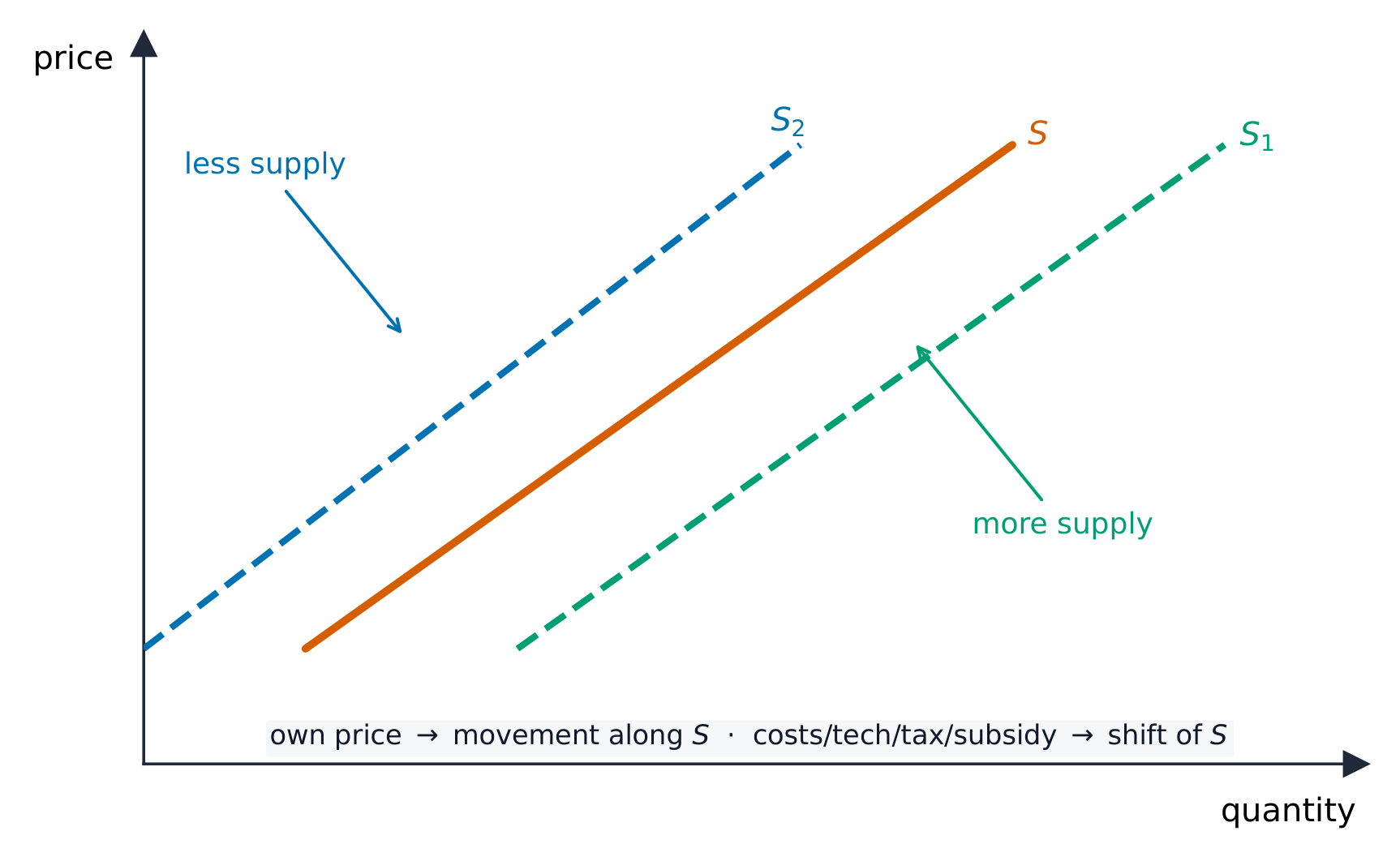
Supply shifts right: P falls, Q rises
Supply 供给 is the amount of a good that firms are willing and able to sell at each price, in a period of time.
The law of supply 供给定律 says: when the price rises, the quantity supplied rises too. Price and quantity move the same way — a direct relationship 正向关系. Firms supply more at a high price because they can earn more.
Movements and shifts
quantity supplied 供给量 — the amount offered at one price.
The supply curve 供给曲线 slopes upward from left to right.
A change in the good's own price → a movement along the curve.
A change in any other condition → a shift of the whole curve.
Conditions of supply
costs of production 生产成本 — if costs rise, firms supply less (curve shifts left).
technology 技术 — better technology lowers costs, so supply rises.
taxes and subsidies — a tax 税收 on a good raises firms' costs (supply falls); a subsidy 补贴 (money from the government) lowers costs (supply rises).
weather — important for farm goods.
number of firms — more firms means more supply.
The supply curve slopes up. Lower costs, better technology or a subsidy shift it right; higher costs or a tax shift it left.
Explore · Jelajahi
Demand & supply · Permintaan & Penawaran
Supply slopes up — dearer means more made. · Penyediaan naik — semakin mahal, semakin banyak diproduksi.
Source: Cambridge International syllabus · Sumber: Silabus Cambridge International
When a curve shifts, the crossing point moves, so price and quantity change:
Demand rises (shifts right): price rises and quantity rises.
Demand falls (shifts left): price falls and quantity falls.
Supply rises (shifts right): price falls and quantity rises.
Supply falls (shifts left): price rises and quantity falls.
Disequilibrium
If the price is not at equilibrium, the market is in disequilibrium 非均衡:
If price is below equilibrium, buyers want more than firms supply. This is excess demand 超额需求, also called a shortage 短缺. Buyers compete, so the price is pushed up until equilibrium returns.
If price is above equilibrium, firms supply more than buyers want. This is excess supply 超额供给, also called a surplus 过剩. Sellers cut the price until equilibrium returns.
Above the equilibrium price there is excess supply; below it there is excess demand (a shortage). Either way the price is pushed back to equilibrium.
Explore · Jelajahi
Demand & supply · Permintaan & Penawaran
A shift in demand or supply moves the equilibrium. · Sebuah pergeseran dalam permintaan atau penawaran menggerakkan keseimbangan.
define and calculate PED (% change in quantity demanded ÷ % change in price)
interpret values (elastic, inelastic, unit) and the determinants of PED
explain the relationship between PED and total revenue and the usefulness of PED to firms and government
Bahasa Indonesia
definisikan dan hitung PED (% perubahan kuantitas diminta ÷ % perubahan harga)
tafsirkan nilai (elastis, inelastis, unit) dan penentu PED
jelaskan hubungan antara PED dan total pendapatan serta kegunaan PED bagi perusahaan dan pemerintah
Source: Cambridge International syllabus · Sumber: Silabus Cambridge International
Elastic vs inelastic demand
Price elasticity of demand 需求价格弹性 measures how much the quantity demanded changes when the price changes.
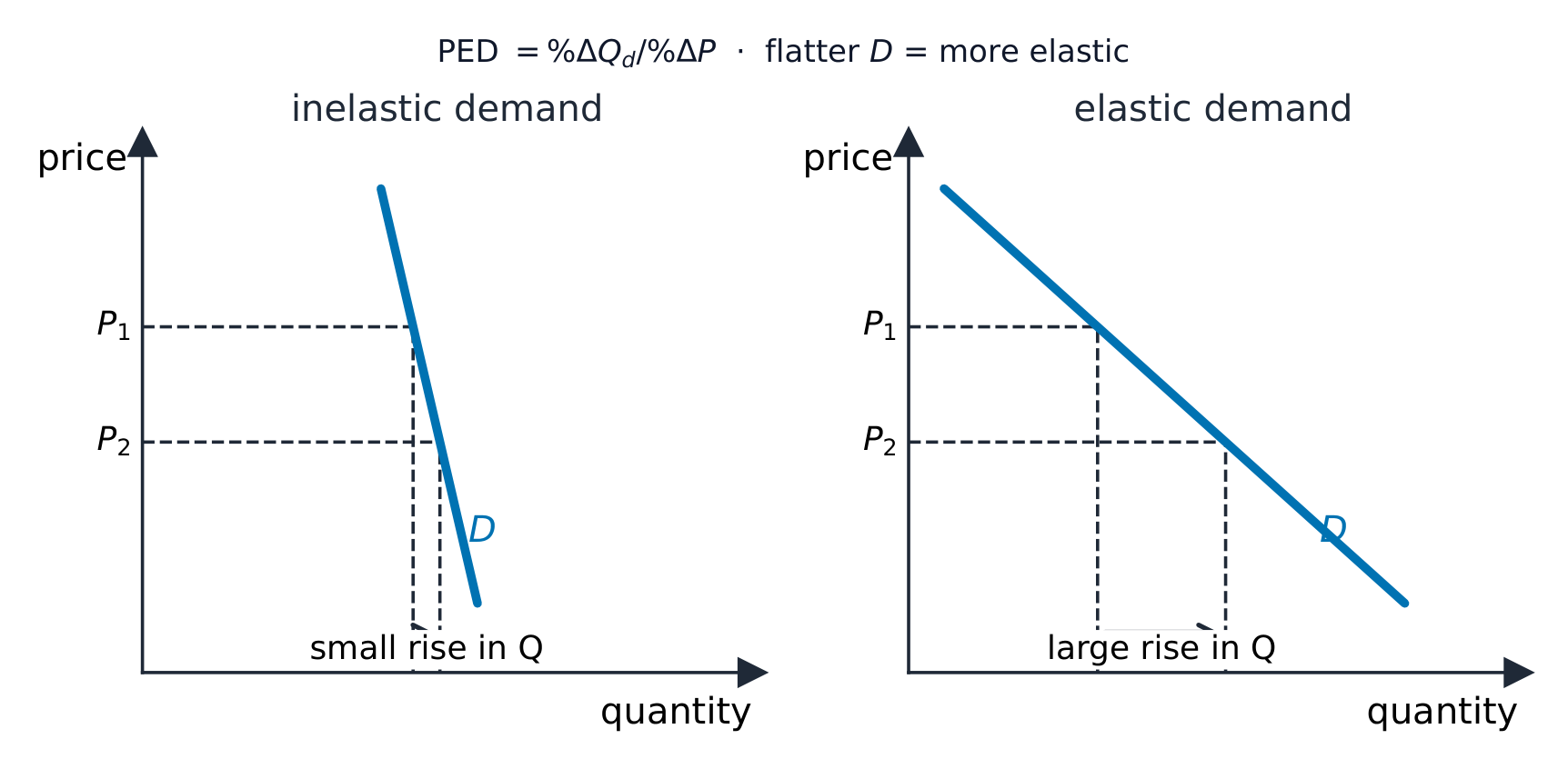
PED = (% change in quantity demanded) ÷ (% change in price)
(We usually ignore the minus sign and read the size of the number.) The determinants 决定因素 (the things that decide PED) include whether the good has close substitutes, whether it is a need or a luxury, and what share of income it takes.
Worked example. When the price of a good rises by 20%, the quantity demanded falls by 10%. Find the PED.
PED = (% change in quantity demanded) ÷ (% change in price) = 10 ÷ 20 = 0.5.
Because 0.5 is less than 1, demand is inelastic — the quantity changed by a smaller percentage than the price.
Reading the value
PED greater than 1: demand is elastic 富有弹性. Quantity changes by a large %. (Goods with many substitutes, like one brand of crisps.)
PED less than 1: demand is inelastic 缺乏弹性. Quantity changes by a small %. (Needs with few substitutes, like petrol or salt.)
PED equal to 1: unit elastic 单位弹性. Quantity changes by the same % as price.
When demand is inelastic (steep) a price change barely changes quantity; when it is elastic (shallow) the same change moves quantity a lot.
PED and total revenue
Total revenue 总收益 is the money a firm gets from sales: price × quantity sold. (To the buyer, the same money is total expenditure 总支出.) PED tells a firm what happens to revenue if it changes its price:
If demand is inelastic, raising the price raises total revenue (quantity falls only a little).
If demand is elastic, raising the price lowers total revenue (quantity falls a lot).
This is useful. A firm sets prices knowing how buyers will react. A government taxes inelastic goods (like cigarettes) because people keep buying them, so the tax raises a lot of money.
Worked example. A bus company sells 1,000 tickets a day at £2 each. It raises the price by 10% to £2.20, and daily sales fall by 5% to 950. Find the PED and what happens to total revenue.
PED = 5 ÷ 10 = 0.5, so demand is inelastic (less than 1).
old revenue = £2 × 1,000 = £2,000.
new revenue = £2.20 × 950 = £2,090.
Total revenue rose by £90. Because demand is inelastic, the price rose by a bigger percentage than the quantity fell, so raising the price raised revenue.
The same price rise raises revenue when demand is inelastic, but lowers it when demand is elastic
Explore · Jelajahi
Elasticity & total revenue · Elastisitas & pendapatan total
PED is the % change in quantity over the % change in price; whether it is above or below 1 decides how total revenue moves. · PED adalah persentase perubahan kuantitas dibagi persentase perubahan harga; apakah nilainya di atas atau di bawah 1 menentukan bagaimana pendapatan total bergerak.
Explore · Jelajahi
Demand & supply · Permintaan & Penawaran
Elasticity of demand is the steepness of the curve. · Elastisitas permintaan adalah kemiringan kurva.
explain how a market economy allocates resources through the price mechanism
explain the advantages and disadvantages of the market economic system
Bahasa Indonesia
jelaskan bagaimana ekonomi pasar mengalokasikan sumber daya melalui mekanisme harga
jelaskan keunggulan dan kelemahan sistem ekonomi pasar
Source: Cambridge International syllabus · Sumber: Silabus Cambridge International
In a market economy 市场经济, the price mechanism makes all the choices. There is no government planning. (The opposite is a planned economy 计划经济, where the government makes the choices.)
Advantages of the market system:
Prices guide resources to where they are wanted, without anyone planning.
Firms compete, so they cut costs and create new and better goods.
Consumers have wide choice.
Disadvantages:
Some useful goods are not made because they earn no profit.
The strong (rich firms and people) do well; the weak may be left with nothing.
Markets can fail (see below).
Explore · Jelajahi
How a market allocates · Bagaimana pasar mengalokasikan
In a market system, price moves to where demand meets supply — that price signal decides what gets made. Shift the curves and watch it settle. · Dalam sistem pasar, harga bergerak ke titik di mana permintaan bertemu dengan penawaran—sinyal harga ini yang menentukan apa yang diproduksi. Geser kurva dan perhatikan bagaimana harga menstabilkan diri.
define market failure as the inefficient allocation of resources
explain the causes: external costs and external benefits (social vs private costs/benefits), merit and demerit goods, public goods and the abuse of monopoly power
Bahasa Indonesia
definisikan kegagalan pasar sebagai alokasi sumber daya yang tidak efisien
jelaskan penyebabnya: biaya eksternal dan manfaat eksternal (biaya/manfaat sosial vs pribadi), barang merit dan demerit, barang publik, dan penyalahgunaan kekuatan monopoli
Source: Cambridge International syllabus · Sumber: Silabus Cambridge International
Market failure 市场失灵 happens when the price mechanism leads to an inefficient 低效率 use of resources — resources are not shared out in the best way for society. The main causes:
External costs and benefits
Pollution from a power station is an external cost — it falls on third parties, not just the producer
When you produce or consume something, the cost or benefit to you is not always the cost or benefit to everyone.
a private cost 私人成本 is the cost to the person doing the activity.
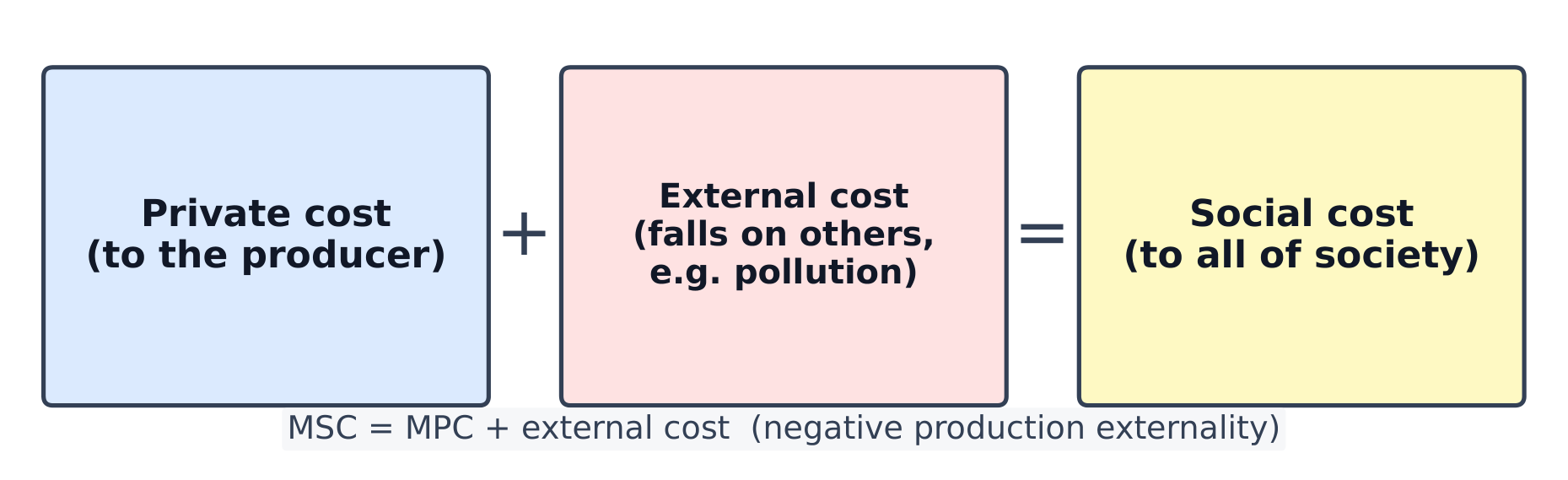
an external cost 外部成本 is a cost paid by other people — for example, smoke from a factory harms nearby families.
the social cost 社会成本 is the private cost plus the external cost (the cost to the whole of society).
In the same way:
a private benefit 私人效益 is the benefit to the person doing the activity.
an external benefit 外部效益 is a benefit that others get for free — for example, your neighbour's tidy garden is nice for you too.
the social benefit 社会效益 is the private benefit plus the external benefit.
Markets fail because firms and consumers only think about their private costs and benefits, not the external ones.
An external cost (e.g. pollution) falls on third parties, so the social cost is greater than the producer's private cost
Merit, demerit and public goods
merit goods 有益物品 are better for you than you realise, so the market makes too few (education, healthcare).
demerit goods 有害物品 are worse for you than you realise, so the market makes too many (cigarettes, alcohol).
public goods 公共物品 are things everyone can use and no one can be stopped from using, like street lights or national defence. The market makes none, because firms cannot charge for them.
A private good is rival and excludable (firms supply it); a public good is non-rival and non-excludable (the government must supply it)Merit and demerit goods are mis-judged because of information failure
Abuse of monopoly power
A monopoly 垄断 is a single firm that controls a market. With no competition, it can charge high prices and make poor-quality goods. This is another market failure.
Explore · Jelajahi
Demand & supply · Permintaan & Penawaran
Market failure: the free-market crossing isn't always best for society. · Kegagalan pasar: mekanisme pasar bebas tidak selalu memberikan hasil terbaik bagi masyarakat.
explain the features of a mixed economy (private sector and public sector)
explain methods of government intervention to address market failure: maximum and minimum prices, indirect taxes, subsidies, regulation and direct provision
evaluate the effects of intervention
Bahasa Indonesia
jelaskan ciri-ciri ekonomi campuran (sektor swasta dan sektor publik)
jelaskan metode intervensi pemerintah untuk mengatasi kegagalan pasar: harga maksimum dan minimum, pajak tidak langsung, subsidi, regulasi, dan penyediaan langsung
evaluasi efek dari intervensi tersebut
Source: Cambridge International syllabus · Sumber: Silabus Cambridge International
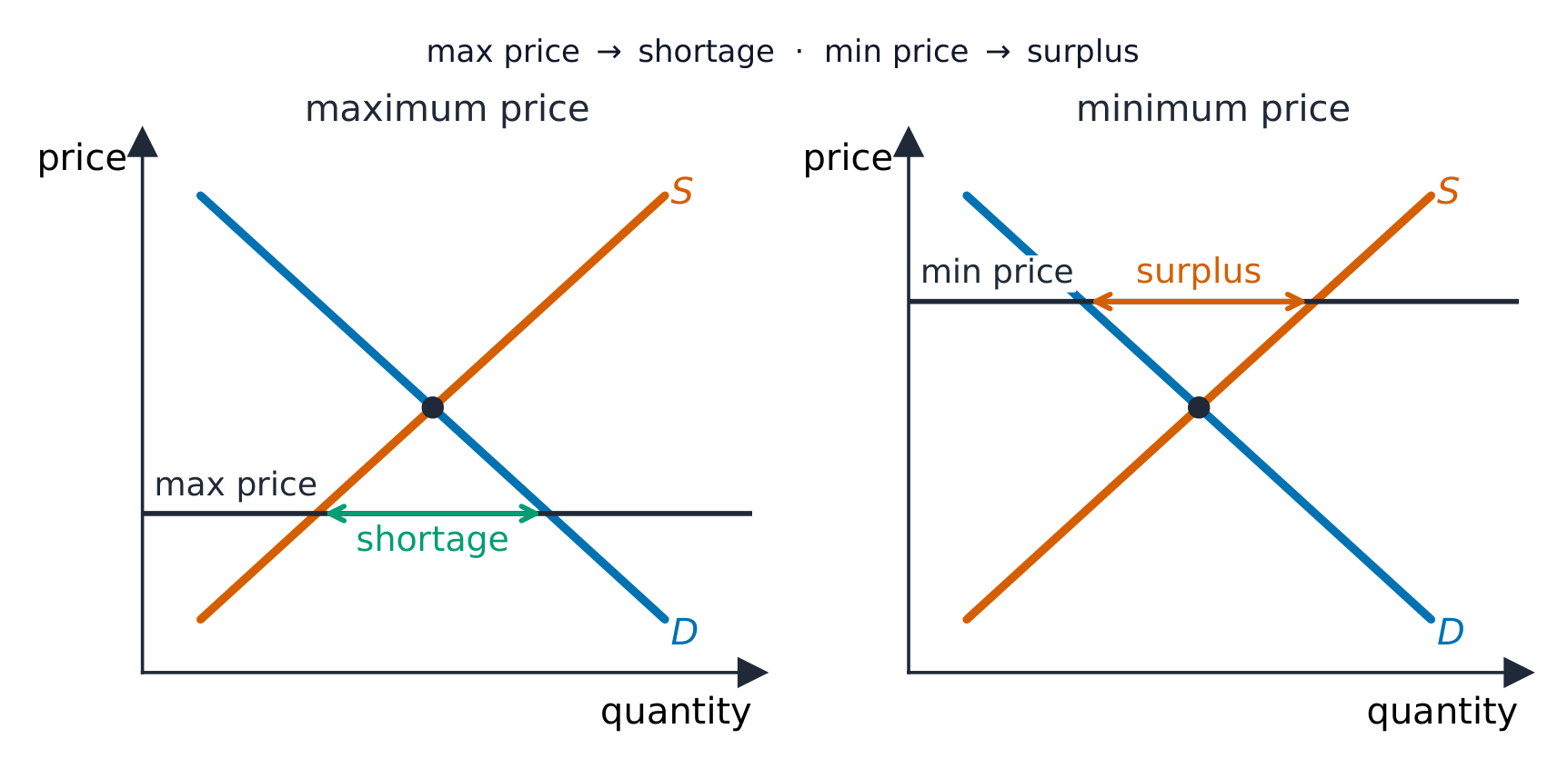
A maximum price creates a shortage
A mixed economy 混合经济 has both:
a private sector 私营部门 — firms owned by people, guided by the price mechanism.
a public sector 公共部门 — activity run by the government.
Most real economies are mixed; China's, for example, is a socialist market economy. The government steps in to correct market failure. This is government intervention 干预. The main methods:
Method
What it does
maximum price 最高价格
a price ceiling, set below equilibrium, to keep a good (like rent) cheap — but it causes a shortage
minimum price 最低价格
a price floor, set above equilibrium, to keep a price up (like a fair wage) — but it causes a surplus
indirect tax 间接税
a tax on a good (added to its price) to cut demand for demerit goods
subsidy
money paid to firms to cut the price and raise output of merit goods
regulation 监管
rules and laws, like banning smoking in public
direct provision 直接提供
the government makes and gives out goods itself, like state schools
A maximum price set below equilibrium causes a shortage; a minimum price set above equilibrium causes a surplus.
Judging intervention
Intervention can fix market failure, but it has costs. Taxes and rules cost money to collect and check. Governments can get things wrong too (this is called government failure). So you should always weigh the good effects against the bad ones before deciding.
Explore · Jelajahi
Economics case lab · Laboratorium kasus ekonomi
Classify real examples by the economic idea they show. · Klasifikasikan contoh nyata berdasarkan ide ekonomi yang ditampilkannya.
A change in a good's own price is a movement along the curve; a change in anything else (income, tastes, related prices) shifts the whole curve.
Equilibrium is where demand meets supply. Below it there is excess demand (a shortage, so price rises); above it there is excess supply (a surplus, so price falls).
PED = %ΔQ ÷ %ΔP. Demand is inelastic if PED < 1 (raising price raises revenue) and elastic if PED > 1 (raising price lowers revenue).
Market failure (external costs, merit/demerit/public goods, monopoly) means resources are used badly; the government corrects it with taxes, subsidies, rules and direct provision.
3
Microeconomic decision-makers · Pengambil keputusan mikroekonomi
state the functions of money (medium of exchange, store of value, unit of account, means of deferred payment) and the characteristics of money
explain the role of central banks and commercial banks
Bahasa Indonesia
nyatakan fungsi uang (media pertukaran, penampung nilai, satuan perhitungan, alat pembayaran yang ditangguhkan) dan karakteristik uang
jelaskan peran bank sentral dan bank komersial
Source: Cambridge International syllabus · Sumber: Silabus Cambridge International
English
Long ago, people swapped goods directly. This is called barter 物物交换. Barter is hard: you must find someone who has what you want and wants what you have. Money 货币 solves this problem.
The functions of money
Money does four jobs:
a medium of exchange 交换媒介 — you swap money for goods, so you do not need barter.
a store of value 价值储藏 — you can hold money now and spend it later, because it keeps its value.
a unit of account 记账单位 — money measures and compares the value of things (this is the price).
a means of deferred payment 延期支付手段 — you can buy now and pay later.
The characteristics of money
Good money must be:
durable 耐用的 — it lasts a long time.
portable 便于携带的 — easy to carry.
divisible 可分割的 — can be split into small amounts for small payments.
limited in supply, hard to copy, and accepted by everyone.
Banks
A central bank 中央银行 is the government's bank. It issues notes, looks after the banking system, and sets interest rates 利率. There is one in each country.
commercial banks 商业银行 are the ordinary banks that people and firms 企业 use. They keep savings safe, lend money, and let people pay each other.
Bahasa Indonesia
Dulu, orang menukar barang secara langsung. Ini disebut barter. Barter sulit: Anda harus menemukan seseorang yang memiliki apa yang Anda inginkan dan menginginkan apa yang Anda miliki. Uang memecahkan masalah ini.
Fungsi uang
Uang melakukan empat fungsi:
sarana pertukaran — Anda menukar uang dengan barang, sehingga tidak perlu barter.
alat penyimpan nilai — Anda dapat menyimpan uang sekarang dan menggunakannya nanti, karena nilainya tetap terjaga.
satuan hitung — uang mengukur dan membandingkan nilai barang (ini adalah harga).
sarana pembayaran tertunda — Anda dapat membeli sekarang dan membayar kemudian.
Empat fungsi uang: sarana pertukaran, alat penyimpan nilai, satuan hitung, dan sarana pembayaran tertundaUang — uang kertas dan koin — berfungsi sebagai sarana pertukaran, simpanan nilai, satuan akuntansi, dan sarana pembayaran tertunda
Ciri-ciri uang
Uang yang baik haruslah:
tahan lama — awet dalam penggunaan.
mudah dibawa — ringan dan praktis.
dapat dibagi — dapat pecah menjadi jumlah kecil untuk transaksi kecil.
terbatas jumlahnya, sulit ditiru, dan diterima semua orang.
Bank
bank sentral adalah bank pemerintah. Ia menerbitkan uang kertas, menjaga sistem perbankan, dan menetapkan suku bunga. Setiap negara memilikinya.
bank komersial adalah bank biasa yang digunakan masyarakat dan perusahaan. Mereka mengamankan tabungan, memberikan pinjaman, dan memudahkan transfer antar-pembeli.
Explore · Jelajahi
Economics case lab · Laboratorium kasus ekonomi
Classify real examples by the economic idea they show. · Klasifikasikan contoh nyata berdasarkan ide ekonomi yang ditampilkannya.
means of deferred payment/miːnz ɒv dɪˈfɜːd ˈpeɪmənt/
alat pembayaran tertunda
durable/ˈdjʊərəbl/
tahan lama
portable/ˈpɔːtəbl/
portabel
divisible/dɪˈvɪzɪbl/
dapat dibagi habis
central bank/ˈsentrəl bæŋk/
bank sentral
interest rate/ˈɪntrest reɪt/
suku bunga
commercial banks/kəˈmɜːʃl bæŋks/
bank komersial
firms/fɜːmz/
perusahaan
household/ˈhaʊshəʊld/
rumah tangga
saving/ˈseɪvɪŋ/
tabungan
borrowing/ˈbɒrəʊɪŋ/
peminjaman
3.2
Households · Rumah Tangga
Syllabus · Silabus
English
explain the influences on spending, saving and borrowing by households (income, interest rates, confidence)
Bahasa Indonesia
jelaskan pengaruh terhadap pengeluaran, tabungan, dan pinjaman oleh rumah tangga (pendapatan, tingkat bunga, kepercayaan)
Source: Cambridge International syllabus · Sumber: Silabus Cambridge International
English
A household 家庭 is a person or group living together and making money decisions. Each household must choose how much to spend, save, and borrow.
saving 储蓄 is income that is not spent now.
borrowing 借贷 is spending money you do not have yet, and paying it back later (usually with an extra charge).
Three main things change these choices:
income 收入 — with more income, people spend and save more.
interest rates — a higher interest rate makes saving more rewarding and borrowing dearer. So saving rises and borrowing falls.
confidence 信心 — if people feel sure about their jobs and the future, they spend and borrow more. If they are worried, they save more.
Bahasa Indonesia
Sebuah rumah tangga adalah individu atau kelompok yang hidup bersama dan mengambil keputusan keuangan. Setiap rumah tangga harus memilih berapa banyak untuk belanja, menabung, dan meminjam.
Sebuah rumah tangga dapat membelanjakan, menabung, atau membayar pajak dengan pendapatannya
tabungan adalah pendapatan yang tidak dibelanjakan saat ini.
pinjaman adalah spending uang yang belum dimiliki, dan membayarnya kembali kemudian (biasanya dengan tambahan biaya).
Tiga hal utama mengubah pilihan ini:
pendapatan — dengan pendapatan lebih tinggi, orang menghabiskan dan menabung lebih banyak.
suku bunga — suku bunga lebih tinggi membuat menabung lebih menguntungkan dan pinjaman lebih mahal. Jadi tabungan naik dan pinjaman turun.
keyakinan — jika orang merasa aman akan pekerjaan dan masa depan, mereka berbelanja dan meminjam lebih banyak. Jika cemas, mereka menabung lebih banyak.
Explore · Jelajahi
Economics case lab · Laboratorium kasus ekonomi
Classify real examples by the economic idea they show. · Klasifikasikan contoh nyata berdasarkan ide ekonomi yang ditampilkannya.
explain the factors that determine an individual's choice of occupation (wage and non-wage factors)
explain the reasons for differences in earnings (skills, qualifications, danger, trade unions, discrimination)
explain division of labour/specialisation and its advantages and disadvantages
Bahasa Indonesia
jelaskan faktor-faktor yang menentukan pilihan profesi seseorang (gaji dan faktor non-gaji)
jelaskan alasan perbedaan pendapatan (keahlian, kualifikasi, bahaya, serikat pekerja, diskriminasi)
jelaskan pembagian kerja/spesialisasi dan keuntungan serta kekurangannya
Source: Cambridge International syllabus · Sumber: Silabus Cambridge International
English
Choosing a job
When a worker chooses an occupation 职业 (a type of job), two kinds of factor matter:
wage factors — the pay. The wage 工资 is the money you earn. Higher pay attracts more workers.
non-wage factors — everything else: working hours, holidays, how safe or pleasant the job is, whether you enjoy the work, distance from home, and the chance to move up to a higher job.
Why workers earn different amounts
Workers are not all paid the same. The reasons include:
skill 技能 and qualifications 资格 — workers who are hard to replace, or who studied for years, earn more.
danger — risky or dirty jobs may pay more to attract workers.
trade unions 工会 — a trade union is a group of workers who join together to bargain for better pay and conditions. Strong unions can raise pay.
discrimination 歧视 — unfair treatment because of gender, race, or age can cause unfair pay gaps.
Division of labour
Division of labour 劳动分工 (also called specialisation 专业化) means splitting a job into small tasks, with each worker doing one task again and again.
Advantages: workers get faster and better at their one task; less time is wasted moving between tasks; this raises output.
Disadvantages: doing one task is boring, so workers may make mistakes or leave; if one worker is absent, the whole line can stop; each worker learns only one skill.
Bahasa Indonesia
Memilih pekerjaan
Ketika pekerja memilih pekerjaan (jenis kerja), dua jenis faktor berpengaruh:
faktor upah — gaji. Upah adalah uang yang Anda dapatkan. Gaji lebih tinggi menarik lebih banyak pekerja.
faktor non-upah — segalanya selain gaji: jam kerja, cuti, seberapa aman atau menyenangkan pekerjaannya, apakah Anda menyukainya, jarak dari rumah, dan peluang promosi ke posisi lebih tinggi.
Mengapa pekerja mendapat bayaran berbeda
Pekerja tidak dibayar sama rata. Alasannya meliputi:
Upah bergantung pada keterampilan, kesulitan pekerjaan, dan permintaan
keterampilan dan kualifikasi — pekerja yang sulit digantikan atau yang belajar bertahun-tahun mendapat upah lebih tinggi.
bahaya — pekerjaan berisiko atau kotor mungkin membayar lebih untuk menarik pekerja.
serikat pekerja — serikat pekerja adalah kelompok pekerja yang bergabung untuk bernegosiasi guna mendapatkan upah dan kondisi kerja yang lebih baik. Serikat pekerja yang kuat dapat meningkatkan upah.
diskriminasi — perlakuan tidak adil karena gender, ras, atau usia dapat menyebabkan kesenjangan upah yang tidak adil.
Pembagian Kerja
Pembagian kerja (juga disebut spesialisasi) berarti memecah pekerjaan menjadi tugas-tugas kecil, di mana setiap pekerja melakukan satu tugas berulang kali.
Keuntungan: pekerja menjadi lebih cepat dan mahir pada satu tugasnya; lebih sedikit waktu terbuang berpindah antar tugas; hal ini meningkatkan produksi.
Kerugian: melakukan satu tugas itu membosankan, sehingga pekerja mungkin membuat kesalahan atau keluar; jika satu pekerja absen, seluruh lini produksi bisa berhenti; setiap pekerja hanya menguasai satu keterampilan.
Pembagian kerja: memecah pekerjaan menjadi tugas-tugas kecil yang diulang meningkatkan output per pekerja
Explore · Jelajahi
Economics case lab · Laboratorium kasus ekonomi
Classify real examples by the economic idea they show. · Klasifikasikan contoh nyata berdasarkan ide ekonomi yang ditampilkannya.
classify firms by size and explain why some firms remain small and why/how firms grow (mergers: horizontal, vertical, conglomerate)
explain the causes of business failure
Bahasa Indonesia
klasifikasikan perusahaan berdasarkan ukuran dan jelaskan mengapa beberapa perusahaan tetap kecil dan bagaimana/kenapa perusahaan tumbuh (merger: horizontal, vertikal, konglomerat)
jelaskan penyebab kegagalan bisnis
Source: Cambridge International syllabus · Sumber: Silabus Cambridge International
English
Economies of scale: average cost falls
The size of firms
Firms come in many sizes, from one person to huge companies. We can measure size by the number of workers, the amount of capital 资本 used, or the output.
Some firms stay small because: the market 市场 is small; the product is personal (like a hairdresser); the owner wants to stay in control; or there is little money to grow.
How firms grow
Firms grow by selling more, or by joining with other firms. When two firms join, it is a merger 合并 (or takeover). There are three types:
horizontal merger 横向合并 — two firms at the same stage of the same industry join (two car makers).
vertical merger 纵向合并 — two firms at different stages of the same industry join (a car maker and a tyre maker). "Backward" is towards the supplier; "forward" is towards the seller.
conglomerate merger 混合合并 — two firms in different industries join (a car maker and a food company).
Business failure
Firms can suffer business failure 企业倒闭 (they close down) for many reasons: costs too high, too few sales, poor management, too many rivals, not enough cash, or a fall in demand 需求.
Bahasa Indonesia
Skala ekonomi: biaya rata-rata turun
Ukuran perusahaan
Perusahaan memiliki berbagai ukuran, dari satu orang hingga perusahaan raksasa. Kita dapat mengukur ukuran dengan jumlah pekerja, jumlah modal yang digunakan, atau output.
Beberapa perusahaan tetap kecil karena: pasar kecil; produk bersifat personal (seperti penata rambut); pemilik ingin tetap mengontrol; atau ada sedikit dana untuk berkembang.
Cara perusahaan tumbuh
Perusahaan tumbuh dengan menjual lebih banyak, atau dengan bergabung dengan perusahaan lain. Ketika dua perusahaan bergabung, itu disebut merger (atau akuisisi). Ada tiga jenis:
merger horizontal — dua perusahaan pada tahap yang sama dalam industri yang sama bergabung (dua pabrikan mobil).
merger vertikal — dua perusahaan pada tahap yang berbeda dalam industri yang sama bergabung (sebuah pabrikan mobil dan pabrikan ban). "Mundur" menuju pemasok; "majulah" menuju penjual.
merger konglomerat — dua perusahaan di industri yang berbeda bergabung (pabrikan mobil dan perusahaan makanan).
Tiga jenis integrasi: horizontal (tahap sama), vertikal (tahap berbeda dalam satu industri), dan konglomerat (industri berbeda)
Kegagalan bisnis
Perusahaan dapat mengalami kegagalan bisnis (menutup) karena banyak alasan: biaya terlalu tinggi, penjualan terlalu sedikit, manajemen buruk, terlalu banyak pesaing, uang kas tidak cukup, atau penurunan permintaan.
Explore · Jelajahi
Firm objective lab · Labu tujuan perusahaan
Classify real firm decisions by the objective they reveal. · Klasifikasikan keputusan perusahaan nyata berdasarkan tujuan yang ditunjukkannya.
distinguish labour-intensive and capital-intensive production and explain productivity
explain demand for and supply of factors of production and economies and diseconomies of scale
Bahasa Indonesia
bedakan produksi intensif tenaga kerja dan intensif modal serta jelaskan produktivitas
jelaskan permintaan dan penawaran faktor produksi serta skala ekonomi dan diseconomies of scale
Source: Cambridge International syllabus · Sumber: Silabus Cambridge International
English
Labour-intensive and capital-intensive
labour-intensive 劳动密集型 production uses a lot of labour 劳动 (many workers) and little machinery — for example, hand-made crafts.
capital-intensive 资本密集型 production uses a lot of capital (machines) and few workers — for example, a modern car factory.
Productivity
Productivity 生产率 means output per worker (or per machine) in a set time. Higher productivity means each worker makes more, so the cost of each unit falls. Training, better machines, and good management all raise productivity.
Demand for and supply of factors
Firms buy factors of production 生产要素 (land 土地, labour, capital, and enterprise 企业家才能). The price and amount of each factor are set by its own demand and supply, just like any market. For example, if many firms want skilled workers, the wage for those workers rises.
Economies and diseconomies of scale
As a firm grows and makes more, the cost of each unit can change:
economies of scale 规模经济 — as output rises, the average cost of each unit falls. Reasons: buying materials in bulk is cheaper, big machines work more efficiently, and large firms borrow money cheaply.
diseconomies of scale 规模不经济 — if a firm grows too big, the average cost of each unit starts to rise. Reasons: a huge firm is hard to manage, messages travel slowly, and workers may feel less important.
These can be internal (caused by the firm's own size) or external (caused by the whole industry growing).
Bahasa Indonesia
Intensif tenaga kerja dan intensif modal
Produksi intensif tenaga kerja menggunakan banyak tenaga kerja (banyak pekerja) dan sedikit mesin — misalnya, kerajinan tangan.
Produksi intensif modal menggunakan banyak modal (mesin) dan sedikit pekerja — misalnya, pabrik mobil modern.
Garis perakitan mobil bersifat intensif modal (banyak mesin, sedikit pekerja) dan menggunakan pembagian kerja — setiap pekerja mengulang satu tugas
Produktivitas
Produktivitas berarti output per pekerja (atau per mesin) dalam waktu tertentu. Produktivitas yang lebih tinggi berarti setiap pekerja memproduksi lebih banyak, sehingga biaya per unit turun. Pelatihan, mesin yang lebih baik, dan manajemen yang baik semuanya meningkatkan produktivitas.
Permintaan dan penawaran faktor produksi
Perusahaan membeli faktor produksi (tanah, tenaga kerja, modal, dan wirausaha). Harga dan jumlah setiap faktor ditentukan oleh permintaan dan penawarannya sendiri, seperti pasar lainnya. Misalnya, jika banyak perusahaan mencari pekerja terampil, upah bagi pekerja tersebut naik.
Skala ekonomi dan disekonomi skala
Seiring perusahaan tumbuh dan memproduksi lebih banyak, biaya per unit dapat berubah:
skala ekonomi — saat output meningkat, biaya rata-rata per unit turun. Alasannya: membeli bahan baku dalam jumlah besar lebih murah, mesin besar bekerja lebih efisien, dan perusahaan besar meminjam uang dengan murah.
disekonomi skala — jika perusahaan tumbuh terlalu besar, biaya rata-rata per unit mulai naik. Alasannya: perusahaan yang sangat besar sulit dikelola, pesan berjalan lambat, dan pekerja mungkin merasa kurang penting.
Biaya rata-rata turun seiring pertumbuhan perusahaan (skala ekonomi), mencapai titik terendah, lalu naik jika tumbuh terlalu besar (disekonomi skala).
Hal ini bisa bersifat internal (disebabkan oleh ukuran perusahaan itu sendiri) atau eksternal (disebabkan oleh pertumbuhan seluruh industri).
Explore · Jelajahi
Factors of production lab · Laboratorium faktor produksi
Sort real resources by the factor of production they represent. · Urutkan sumber daya riil berdasarkan faktor produksi yang mereka wakili.
Firms' costs, revenue and objectives · Biaya, pendapatan, dan tujuan perusahaan
Syllabus · Silabus
English
define and calculate fixed, variable, total and average costs
define and calculate total and average revenue
explain the objectives of firms (profit, survival, growth, social objectives)
Bahasa Indonesia
definisikan dan hitung biaya tetap, variabel, total, dan rata-rata
definisikan dan hitung total dan rata-rata pendapatan
jelaskan tujuan perusahaan (laba, kelangsungan hidup, pertumbuhan, tujuan sosial)
Source: Cambridge International syllabus · Sumber: Silabus Cambridge International
English
Costs
A cost 成本 is money a firm spends to produce. Costs split into:
fixed costs 固定成本 — costs that do not change with output, such as rent and insurance. You pay them even if you make nothing.
variable costs 可变成本 — costs that change with output, such as materials and power. More output means more variable cost.
total cost 总成本 — fixed cost plus variable cost.
average cost 平均成本 — the cost of each unit: total cost divided by the number of units made.
Revenue
Revenue 收益 is the money a firm gets from selling its goods.
total revenue 总收益 — the price multiplied by the quantity sold.
average revenue 平均收益 — total revenue divided by the quantity sold (this is the same as the price).
Profit and other objectives
Profit 利润 is what is left after costs:
profit = total revenue − total cost
Worked example. A firm has fixed costs of £2,000 and variable costs of £3 per unit. It makes 500 units and sells them at £10 each. Find its total cost, total revenue, profit and average cost.
variable cost = 3 × 500 = £1,500, so total cost = 2,000 + 1,500 = £3,500.
total revenue = 10 × 500 = £5,000.
profit = 5,000 - 3,500 = £1,500.
average cost = total cost ÷ units = 3,500 ÷ 500 = £7 per unit.
The firm makes a profit because the price (£10) is above the average cost (£7).
Most firms want as much profit as possible. But firms can have other objectives 目标:
survival 生存 — a new firm first just wants to stay open.
growth 增长 — getting bigger, to gain economies of scale and market power.
social objectives — some firms aim to help people or protect the environment, not only to earn profit.
Bahasa Indonesia
Biaya
Biaya adalah uang yang dikeluarkan perusahaan untuk memproduksi barang. Biaya terbagi menjadi:
biaya tetap — biaya yang tidak berubah seiring output, seperti sewa dan asuransi. Anda membayarnya meskipun tidak memproduksi apa pun.
biaya variabel — biaya yang berubah seiring output, seperti bahan dan listrik. Output lebih banyak berarti biaya variabel lebih besar.
total biaya — biaya tetap ditambah biaya variabel.
biaya rata-rata — biaya setiap unit: total biaya dibagi dengan jumlah unit yang diproduksi.
Biaya tetap tetap sama saat output meningkat; biaya variabel meningkat; total biaya adalah biaya tetap ditambah variabel, sehingga selisih antara total dan biaya variabel adalah biaya tetap.
Penerimaan
Pendapatan adalah uang yang diterima perusahaan dari penjualan barangnya.
total pendapatan — harga dikalikan dengan jumlah yang terjual.
pendapatan rata-rata — total pendapatan dibagi dengan jumlah yang terjual (ini sama dengan harga).
Laba dan tujuan lain
Laba adalah sisa setelah dikurangi biaya:
laba = total pendapatan − total biaya
Contoh terpecahkan. Suatu perusahaan memiliki biaya tetap sebesar £2,000 dan biaya variabel sebesar £3 per unit. Perusahaan memproduksi 500 unit dan menjualnya seharga £10 per unit. Temukan total biaya, total pendapatan, laba, dan rata-rata biaya.
biaya variabel = 3 × 500 = £1,500, sehingga total biaya = 2,000 + 1,500 = £3,500.
total pendapatan = 10 × 500 = £5,000.
laba = 5,000 - 3,500 = £1,500.
rata-rata biaya = total biaya ÷ jumlah unit = 3,500 ÷ 500 = £7 per unit.
Perusahaan mendapatkan keuntungan karena harga (£10) berada di atas biaya rata-rata (£7).
Sebagian besar perusahaan menginginkan keuntungan sebesar mungkin. Namun, perusahaan dapat memiliki tujuan lain:
kelangsungan hidup — perusahaan baru pertama kali hanya ingin tetap buka.
pertumbuhan — menjadi lebih besar, untuk memperoleh efisiensi skala dan kekuatan pasar.
tujuan sosial — beberapa perusahaan bertujuan membantu masyarakat atau melindungi lingkungan, bukan hanya mencari keuntungan.
Explore · Jelajahi
A firm's cost curves · Kurva biaya perusahaan
Change output and see how average cost falls then rises — and where marginal cost crosses it. · Ubah output dan lihat bagaimana biaya rata-rata turun lalu naik — dan di mana biaya marjinal memotongnya.
describe the characteristics of competitive markets and monopoly
explain the advantages and disadvantages of competition for consumers and firms
Bahasa Indonesia
deskripsikan karakteristik pasar kompetitif dan monopoli
jelaskan keuntungan dan kerugian persaingan bagi konsumen dan perusahaan
Source: Cambridge International syllabus · Sumber: Silabus Cambridge International
English
Markets differ by how many firms there are and how hard it is for new firms to join.
Competitive markets
A competitive market has many firms selling similar goods, and it is easy for new firms to enter. This is strong competition 竞争. In such a market:
firms must keep prices low and quality high, or buyers go elsewhere.
firms work hard to cut costs and make new products.
This is good for consumers: low prices, wide choice, and good quality.
Monopoly
A monopoly 垄断 is a market with only one firm, or one firm that controls most of it. New firms find it hard to enter because of barriers to entry 进入壁垒 — for example, very high start-up costs, or the one firm controlling key supplies.
In a monopoly:
the firm can charge high prices, because buyers have no other choice.
there is little pressure to improve quality or cut costs.
but a large monopoly may gain economies of scale, and may use its profit to pay for research.
Competition versus monopoly
Consumers
Firms
competition
lower prices, more choice, better quality
lower profit; must work hard to survive
monopoly
higher prices, less choice
higher profit and an easy life, but may grow lazy
Bahasa Indonesia
Pasar berbeda berdasarkan jumlah perusahaan yang ada dan seberapa sulit bagi perusahaan baru untuk bergabung.
Pasaran merangkumi dari monopoli (satu penjual) hingga persaingan sempurna (banyak)
Pasar kompetitif
Pasar kompetitif memiliki banyak perusahaan yang menjual barang serupa, dan mudah bagi perusahaan baru untuk masuk. Ini adalah persaingan yang kuat. Di pasar seperti ini:
perusahaan harus mempertahankan harga rendah dan kualitas tinggi, jika tidak pembeli akan pergi ke tempat lain.
perusahaan bekerja keras untuk mengurangi biaya dan membuat produk baru.
Ini baik bagi konsumen: harga rendah, pilihan luas, dan kualitas bagus.
Di pasar kompetitif banyak perusahaan menjual barang serupa, sehingga masing-masing harus menjaga harga rendah dan kualitas tinggi untuk memenangkan pelanggan
Monopoli
Monopoli adalah pasar yang hanya memiliki satu perusahaan, atau satu perusahaan yang menguasai sebagian besar pasar. Perusahaan baru kesulitan masuk karena hambatan masuk — misalnya, biaya awal yang sangat tinggi, atau satu perusahaan menguasai pasokan kunci.
Dalam monopoli:
perusahaan dapat menetapkan harga tinggi, karena pembeli tidak punya pilihan lain.
ada sedikit tekanan untuk meningkatkan kualitas atau mengurangi biaya.
namun monopoli besar dapat memperoleh efisiensi skala, dan mungkin menggunakan keuntungannya untuk membiayai penelitian.
Persaingan versus monopoli
Konsumen
Perusahaan
persaingan
harga lebih rendah, lebih banyak pilihan, kualitas lebih baik
keuntungan lebih rendah; harus bekerja keras untuk bertahan
monopoli
harga lebih tinggi, lebih sedikit pilihan
keuntungan lebih tinggi dan hidup mudah, tetapi bisa menjadi malas
Explore · Jelajahi
Economics case lab · Laboratorium kasus ekonomi
Classify real examples by the economic idea they show. · Klasifikasikan contoh nyata berdasarkan ide ekonomi yang ditampilkannya.
Money's four functions: a medium of exchange, a store of value, a unit of account, and a means of deferred payment.
Key formulas: profit = total revenue − total cost; total revenue = price × quantity; average cost = total cost ÷ number of units.
Fixed costs do not change with output (rent, insurance); variable costs do (materials, power). Total cost = fixed + variable.
Economies of scale make average cost fall as a firm grows; growing too big brings diseconomies of scale (average cost rises).
Know the merger types: horizontal (same stage of the same industry), vertical (different stages of one industry), conglomerate (different industries).
Bahasa Indonesia
Empat fungsi uang: sarana pertukaran, penyimpan nilai, satuan perhitungan, dan alat pembayaran tertunda.
Rumus utama: keuntungan = pendapatan total − biaya total; pendapatan total = harga × kuantitas; biaya rata-rata = biaya total ÷ jumlah unit.
Biaya tetap tidak berubah seiring output (sewa, asuransi); biaya variabel berubah (bahan baku, listrik). Biaya total = tetap + variabel.
Efisiensi skala membuat biaya rata-rata turun saat perusahaan tumbuh; tumbuh terlalu besar membawa disefisiensi skala (biaya rata-rata naik).
Kenali jenis merger: horizontal (tahap yang sama dalam industri yang sama), vertikal (tahap berbeda dalam satu industri), konglomerat (industri berbeda).
4
Government and the macroeconomy · Pemerintah dan makroekonomi
Government macroeconomic aims · Tujuan makroekonomi pemerintah
Syllabus · Silabus
English
state the macroeconomic aims of government (economic growth, full employment/low unemployment, price stability, balance of payments stability, redistribution of income)
explain why aims may conflict
Bahasa Indonesia
nyatakan tujuan makroekonomi pemerintah (pertumbuhan ekonomi, lapangan kerja penuh/tingkat pengangguran rendah, stabilitas harga, stabilitas neraca pembayaran, redistribusi pendapatan)
jelaskan mengapa tujuan-tujuan tersebut dapat saling bertentangan
Source: Cambridge International syllabus · Sumber: Silabus Cambridge International
English
Governments try to manage the whole economy — the macroeconomy 宏观经济. They have five main aims:
economic growth 经济增长 — the economy makes more goods and services each year.
full employment 充分就业 — almost everyone who wants a job has one, so unemployment 失业 is low.
price stability 价格稳定 — prices rise only slowly, so inflation 通货膨胀 is low.
balance of payments 国际收支 stability — the money flowing in and out of the country (from trade) is roughly even.
redistribution of income 收入再分配 — sharing income more fairly, so the gap between rich and poor is not too wide.
These aims can conflict 冲突 (work against each other). For example, fast growth can pull prices up, causing inflation. Cutting unemployment can do the same. So a government must balance its aims.
Bahasa Indonesia
Pemerintah berusaha mengelola seluruh ekonomi — makroekonomi. Mereka memiliki lima tujuan utama:
Lima tujuan utama: pertumbuhan, pengangguran rendah, harga stabil, stabilitas neraca pembayaran, pendapatan adil
pertumbuhan ekonomi — ekonomi menghasilkan lebih banyak barang dan jasa setiap tahunnya.
pekerjaan penuh — hampir semua orang yang ingin bekerja sudah mendapat pekerjaan, sehingga pengangguran rendah.
stabilitas harga — harga naik perlahan saja, sehingga inflasi rendah.
stabilitas neraca pembayaran — uang yang mengalir masuk dan keluar negara (dari perdagangan) kira-kira seimbang.
redistribusi pendapatan — membagikan pendapatan lebih adil, sehingga kesenjangan antara kaya dan miskin tidak terlalu lebar.
Tujuan-tujuan ini dapat bertentangan (saling menentang). Misalnya, pertumbuhan cepat dapat mendorong harga naik, menyebabkan inflasi. Mengurangi pengangguran juga bisa berdampak sama. Jadi pemerintah harus menyeimbangkan tujuannya.
Tiga kelompok alat kebijakan pemerintah untuk mengelola makroekonomi
Government policy moves aggregate demand against aggregate supply to steer output and the price level. · Kebijakan pemerintah menggerakkan permintaan agregat melawan penawaran agregat untuk mengarahkan output dan tingkat harga.
4.2
Fiscal policy · Kebijakan fiskal
Syllabus · Silabus
English
define fiscal policy (government spending and taxation) and the government budget (surplus, deficit, balance)
distinguish direct and indirect taxes and progressive, regressive and proportional taxes
explain the effects of fiscal policy on government macroeconomic aims
Bahasa Indonesia
definisikan kebijakan fiskal (pengeluaran pemerintah dan perpajakan) serta anggaran pemerintah (surplus, defisit, seimbang)
bedakan pajak langsung dan tidak langsung serta pajak progresif, regresif, dan proporsional
jelaskan efek kebijakan fiskal terhadap tujuan makroekonomi pemerintah
Source: Cambridge International syllabus · Sumber: Silabus Cambridge International
English
Fiscal policy 财政政策 means the government changing two things to manage the economy:
government spending 政府支出 — money the government spends, for example on schools, hospitals, and roads.
taxation 税收 — money the government takes from people and firms.
The government budget 预算 sets spending against tax. There are three outcomes:
a budget deficit 预算赤字 — spending is more than the tax raised, so the government must borrow.
a budget surplus 预算盈余 — the tax raised is more than spending.
a balanced budget — the two are equal.
Types of tax
Taxes are grouped in two ways. By what is taxed:
a direct tax 直接税 is paid straight to the government from income 收入 or profit 利润 (income tax, corporation tax).
an indirect tax 间接税 is added to the price of goods and paid when you spend (a sales tax).
By how the rate changes with income:
a progressive tax 累进税 takes a bigger % from higher incomes. This helps redistribute income.
a regressive tax 累退税 takes a smaller % from higher incomes, so it hits the poor harder.
a proportional tax 比例税 takes the same % from everyone.
What fiscal policy does
To boost the economy (raise growth and jobs), the government can spend more or cut taxes. This raises total demand 需求 — but if demand grows too fast, it can cause inflation.
To slow the economy (fight inflation), the government can spend less or raise taxes. This lowers demand, but can raise unemployment.
Bahasa Indonesia
Kebijakan fiskal berarti pemerintah mengubah dua hal untuk mengelola ekonomi:
pengeluaran pemerintah — uang yang dibelanjakan pemerintah, misalnya untuk sekolah, rumah sakit, dan jalan.
pajak — uang yang diambil pemerintah dari masyarakat dan perusahaan.
Anggaran pemerintah menetapkan pengeluaran berbanding pajak. Ada tiga kemungkinan hasil:
defisit anggaran — pengeluaran melebihi pajak yang diterima, sehingga pemerintah harus meminjam.
surplus anggaran — pajak yang diterima melebihi pengeluaran.
anggaran seimbang — keduanya sama.
Jenis pajak
Pajak dikelompokkan dalam dua cara. Berdasarkan apa yang dikenakan pajak:
pajak langsung dibayarkan langsung kepada pemerintah dari pendapatan atau laba (pajak penghasilan, pajak badan usaha).
pajak tidak langsung ditambahkan ke harga barang dan dibayar saat Anda berbelanja (pajak penjualan).
Berdasarkan bagaimana tarif berubah seiring pendapatan:
pajak progresif mengambil persentase lebih besar dari pendapatan tinggi. Ini membantu mendistribusikan ulang pendapatan.
pajak regresif mengambil persentase lebih kecil dari pendapatan tinggi, sehingga memberatkan orang miskin lebih berat.
pajak proporsional mengambil persentase sama dari semua orang.
Di bawah pajak progresif, tingkat rata-rata naik seiring pendapatan; di bawah pajak regresif, ia turun; di bawah pajak proporsional, ia tetap sama.
Apa yang dilakukan kebijakan fiskal
Untuk menghidupkan ekonomi (meningkatkan pertumbuhan dan lapangan kerja), pemerintah dapat menambah pengeluaran atau memotong pajak. Ini meningkatkan permintaan total — tetapi jika permintaan tumbuh terlalu cepat, dapat menyebabkan inflasi.
Untuk memperlambat ekonomi (melawan inflasi), pemerintah dapat mengurangi pengeluaran atau menaikkan pajak. Ini menurunkan permintaan, tetapi dapat meningkatkan pengangguran.
Explore · Jelajahi
Fiscal policy shifts AD · Kebijakan fiskal menggeser AD
Spending more or taxing less shifts aggregate demand right — raising output, but also the price level. · Mengeluarkan lebih banyak atau memungut pajak lebih sedikit menggeser permintaan agregat ke kanan — meningkatkan output, tetapi juga tingkat harga.
4.3
Monetary policy · Kebijakan moneter
Syllabus · Silabus
English
define monetary policy (interest rates, money supply) and the role of the central bank
explain the effects of changes in interest rates on the economy
Bahasa Indonesia
definisikan kebijakan moneter (suku bunga, jumlah uang beredar) dan peran bank sentral
jelaskan efek perubahan suku bunga terhadap perekonomian
Source: Cambridge International syllabus · Sumber: Silabus Cambridge International
English
Monetary policy 货币政策 is the central bank 中央银行 changing interest rates 利率 (and the money supply 货币供给) to manage the economy. The interest rate is the cost of borrowing and the reward for saving.
Lower interest rates: borrowing is cheaper, so people and firms spend and invest 投资 more. Demand rises, giving more growth and jobs — but maybe more inflation.
Higher interest rates: borrowing is dearer, so spending falls. Demand falls, giving less inflation — but maybe more unemployment.
Bahasa Indonesia
Kebijakan moneter adalah bank sentral yang mengubah suku bunga (dan penawaran uang) untuk mengelola ekonomi. Suku bunga adalah biaya peminjaman dan imbalan untuk menabung.
Suku bunga lebih rendah: peminjaman menjadi lebih murah, sehingga masyarakat dan perusahaan spending dan investasi lebih banyak. Permintaan meningkat, memberikan pertumbuhan dan lapangan kerja lebih banyak — tetapi mungkin inflasi juga meningkat.
Suku bunga lebih tinggi: peminjaman menjadi lebih mahal, sehingga pengeluaran menurun. Permintaan turun, memberikan inflasi lebih rendah — tetapi mungkin pengangguran juga meningkat.
Bank sentral menjalankan kebijakan moneter: ia menetapkan suku bunga untuk mengelola permintaan, inflasi, dan pertumbuhan
Explore · Jelajahi
Monetary policy shifts AD · Kebijakan moneter menggeser AD
Lower interest rates encourage borrowing and spending, shifting aggregate demand right. · Suku bunga yang lebih rendah mendorong peminjaman dan pengeluaran, menggeser permintaan agregat ke kanan.
define supply-side policy (education and training, privatisation, deregulation, incentives)
explain the effects of supply-side policy on government macroeconomic aims
Bahasa Indonesia
definisikan kebijakan sisi penawaran (pendidikan dan pelatihan, privatisasi, deregulasi, insentif)
jelaskan efek kebijakan sisi penawaran terhadap tujuan makroekonomi pemerintah
Source: Cambridge International syllabus · Sumber: Silabus Cambridge International
English
Supply-side policy 供给侧政策 tries to raise the amount the economy can produce. It improves the quantity and quality of the factors of production 生产要素. Methods include:
education and training — better skills raise productivity 生产率.
privatisation 私有化 — selling state-owned firms to private owners, who may run them better.
deregulation 放松管制 — removing rules that hold firms back.
incentives 激励 — lower taxes on income and profit, so people work harder and firms invest more.
Supply-side policy can raise growth and jobs and lower inflation at the same time. Its weakness is that it works slowly.
Bahasa Indonesia
Kebijakan sisi penawaran mencoba meningkatkan jumlah yang dapat diproduksi oleh ekonomi. Kebijakan ini meningkatkan kuantitas dan kualitas faktor produksi. Metodenya meliputi:
pendidikan dan pelatihan — keterampilan yang lebih baik meningkatkan produktivitas.
privatisasi — menjual perusahaan milik negara kepada pemilik swasta, yang mungkin mengelolanya dengan lebih baik.
pelonggaran regulasi — menghapus aturan yang menghambat perusahaan.
insentif — pajak yang lebih rendah atas pendapatan dan laba, sehingga orang bekerja lebih keras dan perusahaan berinvestasi lebih banyak.
Kebijakan sisi penawaran dapat meningkatkan pertumbuhan dan lapangan kerja serta menurunkan inflasi secara bersamaan. Kelemahannya adalah kebijakan ini berjalan lambat.
Explore · Jelajahi
Economics case lab · Laboratorium kasus ekonomi
Classify real examples by the economic idea they show. · Klasifikasikan contoh nyata berdasarkan ide ekonomi yang ditampilkannya.
4.5
Economic growth · Pertumbuhan ekonomi
Syllabus · Silabus
English
define economic growth as an increase in real GDP; define GDP and real GDP
describe the business cycle (boom, recession, slump, recovery)
explain the causes, consequences (costs and benefits) of economic growth and recession
Bahasa Indonesia
definisikan pertumbuhan ekonomi sebagai peningkatan PDB riil; definisikan PDB dan PDB riil
jelaskan penyebab, akibat (biaya dan manfaat) dari pertumbuhan ekonomi dan resesi
Source: Cambridge International syllabus · Sumber: Silabus Cambridge International
English
Economic growth is a rise in real GDP.
GDP (gross domestic product 国内生产总值) is the total value of all goods and services a country produces in a year. Real 实际 GDP is GDP after the effect of rising prices is removed, so it shows the true change in output.
Worked example. A country's real GDP was £500 billion last year and £515 billion this year. Find the rate of economic growth.
economic growth = (515 - 500) ÷ 500 × 100 = 3%.
Because this uses real GDP (with the effect of rising prices taken out), the 3% is a true rise in output, not just higher prices. If prices had risen but output had not, real GDP — and so growth — would be zero.
The business cycle
Real GDP does not rise smoothly. It moves through a business cycle 经济周期 with four stages:
boom 繁荣 — fast growth; output and jobs are high, but prices rise quickly.
recession 衰退 — output falls and jobs are lost. (A recession is often defined as falling real GDP for six months.)
slump 萧条 — the bottom of the cycle; very low output and high unemployment.
recovery 复苏 — output starts to rise again.
Causes and effects
Growth comes from more or better factors of production: investment in new machines, a bigger or more skilled workforce, and new technology.
Good effects: higher incomes, more jobs, better living standards 生活水平, and more tax for the government to spend.
Bad effects: prices may rise (inflation); the gap between rich and poor may grow; and there may be more pollution and use of scarce resources.
A recession brings the opposite: lower incomes, more unemployment, and business failures.
Bahasa Indonesia
Pertumbuhan ekonomi adalah kenaikan PDB riil.
PDB (produk domestik bruto) adalah total nilai semua barang dan jasa yang diproduksi suatu negara dalam satu tahun. PDB riil adalah PDB setelah efek kenaikan harga dihapuskan, sehingga menunjukkan perubahan sebenarnya dalam output.
Contoh soal. PDB riil suatu negara adalah £500 miliar tahun lalu dan £515 miliar tahun ini. Hitung tingkat pertumbuhan ekonomi.
Karena ini menggunakan PDB riil (dengan efek kenaikan harga dihilangkan), angka 3% merupakan kenaikan sejati dalam output, bukan sekadar kenaikan harga. Jika harga naik tetapi output tidak berubah, PDB riil — dan karenanya pertumbuhan — akan nol.
Investasi dalam bangunan baru dan modal, terlihat dari lanskap Shanghai Pudong, mendorong pertumbuhan ekonomi
Siklus bisnis
PDB riil tidak naik secara mulus. Ia bergerak melalui siklus bisnis dengan empat tahap:
boom — pertumbuhan cepat; output dan lapangan kerja tinggi, tetapi harga naik dengan cepat.
resesi — output turun dan terjadi kehilangan lapangan kerja. (Resesi sering didefinisikan sebagai penurunan PDB riil selama enam bulan.)
slump — titik terendah siklus; output sangat rendah dan pengangguran tinggi.
pemulihan — output mulai naik kembali.
PDB riil bergerak melalui boom, resesi, slump, dan pemulihan di sekitar tren yang meningkatnya.
Penyebab dan dampak
Pertumbuhan berasal dari faktor produksi yang lebih banyak atau lebih baik: investasi dalam mesin baru, tenaga kerja yang lebih besar atau lebih terampil, dan teknologi baru.
Dampak positif: pendapatan lebih tinggi, lapangan kerja lebih banyak, standar hidup yang lebih baik, dan pajak lebih banyak bagi pemerintah untuk dibelanjakan.
Dampak negatif: harga bisa naik (inflasi); kesenjangan antara kaya dan miskin bisa melebar; serta mungkin ada lebih banyak polusi dan penggunaan sumber daya yang langka.
Resesi membawa kebalikannya: pendapatan lebih rendah, pengangguran lebih tinggi, dan kebangkrutan usaha.
Explore · Jelajahi
Economic growth · Pertumbuhan ekonomi
Growth shifts the whole frontier outward — the economy can now produce more of both goods. · Pertumbuhan menggeser seluruh batas ke arah luar — ekonomi kini dapat menghasilkan lebih banyak kedua jenis barang.
Employment and unemployment · Tenaga kerja dan pengangguran
Syllabus · Silabus
English
define and measure unemployment (claimant count, labour force survey)
explain the types of unemployment (frictional, structural, cyclical/demand-deficient) and their causes
explain the consequences of unemployment and the patterns/changes in employment
Bahasa Indonesia
definisikan dan ukur pengangguran (claimant count, labour force survey)
jelaskan jenis-jenis pengangguran (frictional, struktural, siklis/diminimalkan permintaan) dan penyebabnya
jelaskan akibat pengangguran dan pola/perubahan dalam lapangan kerja
Source: Cambridge International syllabus · Sumber: Silabus Cambridge International
English
Measuring unemployment
Unemployment is people who can work and want to work, but cannot find a job. There are two ways to measure it:
the claimant count 失业救济申领人数 — it counts people who claim unemployment benefit 失业救济金. It misses those who want work but cannot claim.
the labour force survey 劳动力调查 — a survey that counts people who are not working but are looking for work and are ready to start.
The labour force 劳动力 is everyone who is working plus everyone who is unemployed (and looking for work).
Worked example. A country has 24 million people in work and 2 million people who are unemployed and looking for work. Find the labour force and the unemployment rate.
labour force = 24 + 2 = 26 million.
unemployment rate = 2 ÷ 26 × 100 = 7.7%.
People who are not looking for work (for example retired people or full-time students) are counted in neither figure, so a fall in the rate is good news only if it means more people found jobs, not that they stopped looking.
Types of unemployment
frictional unemployment 摩擦性失业 — short-term unemployment between jobs (a worker who just left one job and is looking for the next).
structural unemployment 结构性失业 — a whole industry shrinks and workers' skills are no longer wanted (for example, coal miners after the mines close).
cyclical unemployment 周期性失业 — caused by a recession, when total demand is low so firms need fewer workers. (It is also called demand-deficient unemployment.)
Effects of unemployment
workers lose income and may lose their skills.
the country loses the output those workers could have made.
the government pays more in benefits and collects less in tax.
crime and poor health may rise.
Sectors and the changing pattern of employment
The economy has three sectors:
the primary sector 第一产业 extracts raw materials (farming, fishing, mining);
the secondary sector 第二产业 makes things (manufacturing, construction);
the tertiary sector 第三产业 provides services (banking, tourism, retail, transport).
As a country develops, jobs shift primary → secondary → tertiary. Early on most work is farming; industrialisation moves workers into factories; then deindustrialisation 去工业化 and rising incomes grow the service sector, so most jobs end up tertiary. Modern economies also see more part-time and flexible work.
Bahasa Indonesia
Mengukur pengangguran
Pengangguran adalah orang-orang yang mampu bekerja dan ingin bekerja, tetapi tidak dapat menemukan pekerjaan. Ada dua cara untuk mengukurnya:
penghitungan klaim — menghitung orang yang mengklaim tunjangan pengangguran. Metode ini melewatkan mereka yang ingin bekerja tetapi tidak berhak mengklaim tunjangan.
survei angkatan kerja — survei yang menghitung orang-orang yang tidak bekerja namun mencari pekerjaan dan siap memulai.
Angkatan kerja adalah semua orang yang bekerja ditambah semua orang yang menganggur (dan sedang mencari pekerjaan).
Contoh soal. Suatu negara memiliki 24 juta orang yang bekerja dan 2 juta orang yang menganggur serta mencari pekerjaan. Hitunglah angkatan kerja dan tingkat pengangguran.
angkatan kerja = 24 + 2 = 26 juta.
tingkat pengangguran = 2 ÷ 26 × 100 = 7,7%.
Orang-orang yang tidak mencari pekerjaan (misalnya pensiunan atau mahasiswa penuh waktu) tidak dihitung dalam kedua angka tersebut, sehingga penurunan tingkat pengangguran hanyalah kabar baik jika artinya lebih banyak orang mendapatkan pekerjaan, bukan karena mereka berhenti mencari.
Jenis pengangguran
pengangguran friksional — pengangguran jangka pendek antar pekerjaan (seorang pekerja yang baru saja meninggalkan satu pekerjaan dan sedang mencari pekerjaan berikutnya).
pengangguran struktural — seluruh industri menyusut dan keterampilan para pekerja tidak lagi dibutuhkan (contohnya, penambang batu bara setelah tambang ditutup).
pengangguran siklikal — disebabkan oleh resesi, ketika permintaan total rendah sehingga perusahaan membutuhkan lebih sedikit pekerja. (Ini juga disebut pengangguran akibat kekurangan permintaan.)
Pengangguran berarti orang yang ingin bekerja tidak dapat menemukannyaEmpat jenis pengangguran: friksional (antar-pekerjaan), struktural (keterampilan tidak lagi cocok), siklikal (permintaan rendah saat resesi) dan musiman
Dampak pengangguran
pekerja kehilangan pendapatan dan mungkin kehilangan keterampilan mereka.
negara kehilangan output yang bisa dihasilkan oleh para pekerja tersebut.
pemerintah membayar lebih banyak tunjangan dan mengumpulkan lebih sedikit pajak.
kriminalitas dan kesehatan buruk mungkin meningkat.
Sektor dan pola ketenagakerjaan yang berubah
Ekonomi memiliki tiga sektor:
sektor primer mengekstraksi bahan mentah (pertanian, perikanan, pertambangan);
sektor sekunder membuat barang (manufaktur, konstruksi);
sektor tersier menyediakan layanan (perbankan, pariwisata, ritel, transportasi).
Sebuah negara berkembang, pekerjaan beralih dari primer → sekunder → tersier. Awalnya sebagian besar kerja adalah pertanian; industrialisasi memindahkan pekerja ke pabrik; kemudian deindustrialisasi dan peningkatan pendapatan memperluas sektor jasa, sehingga sebagian besar pekerjaan berakhir di sektor tersier. Ekonomi modern juga melihat lebih banyak pekerjaan paruh waktu dan fleksibel.
Antrian panjang orang — pengangguran adalah orang yang bersedia dan mampu bekerja namun tidak dapat menemukan pekerjaan
Explore · Jelajahi
Development chain lab · Laboratorium rantai pengembangan
Follow how policy and resources can change living standards. · Ikuti bagaimana kebijakan dan sumber daya dapat mengubah standar hidup.
define inflation and deflation and explain how they are measured (Consumer Prices Index)
explain the causes (demand-pull and cost-push) and the consequences of inflation and deflation
Bahasa Indonesia
definisikan inflasi dan deflasi serta jelaskan cara pengukuran mereka (Indeks Harga Konsumen)
jelaskan penyebab (demand-pull dan cost-push) dan akibat inflasi dan deflasi
Source: Cambridge International syllabus · Sumber: Silabus Cambridge International
English
Inflation is a rise in the average level of prices over time. The opposite — falling prices — is deflation 通货紧缩.
Measuring inflation
Inflation is measured by the Consumer Prices Index 消费者价格指数 (CPI). We pick a "basket" of goods a typical family buys, give each good a weight 权重 (a bigger weight for things people spend more on), and track how the price of the whole basket changes each year.
Worked example. A country's Consumer Prices Index (CPI) was 100 last year and 104 this year. Find the rate of inflation.
inflation rate = (104 - 100) ÷ 100 × 100 = 4%.
Prices rose by 4% on average. If next year the index reaches 107, the inflation rate is (107 - 104) ÷ 104 × 100 = 2.9%. Prices are still rising, but more slowly — a smaller inflation rate is not the same as deflation, because for deflation the index itself would have to fall.
Causes
demand-pull 需求拉动 inflation — total demand grows faster than the economy can supply, so prices are pulled up.
cost-push 成本推动 inflation — firms' costs rise (wages, materials), so they raise prices to cover them.
Effects of inflation
money loses purchasing power 购买力 — each unit of money buys less.
savings become worth less.
firms must keep changing prices on labels and lists, which costs time and money.
the country's goods become dearer than other countries' goods, which hurts exports.
Deflation
Falling prices sound good, but deflation can be harmful. People put off buying, hoping for lower prices later. So demand falls, firms cut output, and unemployment rises.
Bahasa Indonesia
Inflasi adalah kenaikan rata-rata tingkat harga seiring berjalannya waktu. Kebalikannya — penurunan harga — adalah deflasi.
Mengukur inflasi
Inflasi diukur melalui Indeks Harga Konsumen (IHK). Kami memilih "keranjang" barang yang dibeli keluarga tipikal, memberikan setiap barang bobot (bobot lebih besar untuk hal-hal yang lebih banyak dihabiskan orang), dan melacak bagaimana perubahan harga seluruh keranjang setiap tahun.
Contoh terlatih. Indeks Harga Konsumen (IHK) suatu negara adalah 100 tahun lalu dan 104 tahun ini. Temukan tingkat inflasinya.
tingkat inflasi = (104 - 100) ÷ 100 × 100 = 4%.
Harga naik rata-rata sebesar 4%. Jika tahun depan indeks mencapai 107, tingkat inflasinya adalah (107 - 104) ÷ 104 × 100 = 2,9%. Harga masih naik, tetapi lebih lambat — tingkat inflasi yang lebih kecil bukan sama dengan deflasi, karena untuk deflasi indeks itu sendiri harus turun.
Penyebab
inflasi tarik permintaan — total permintaan tumbuh lebih cepat daripada kemampuan ekonomi untuk menyuplai, sehingga harga ditarik naik.
inflasi dorong biaya — biaya perusahaan meningkat (gaji, bahan baku), sehingga mereka menaikkan harga untuk menutupinya.
Dua penyebab inflasi: tarik permintaan (permintaan berlebih) dan dorong biaya (biaya meningkat)
Dampak inflasi
uang kehilangan daya beli — setiap unit uang membeli lebih sedikit.
tabungan menjadi kurang bernilai.
perusahaan harus terus mengubah harga pada label dan daftar, yang memakan waktu dan uang.
barang-barang negara tersebut menjadi lebih mahal dibandingkan barang negara lain, yang merugikan ekspor.
Deflasi
Penurunan harga terdengar bagus, namun deflasi bisa berbahaya. Orang menunda pembelian, berharap harga lebih rendah nanti. Akibatnya, permintaan turun, perusahaan mengurangi produksi, dan pengangguran meningkat.
When aggregate demand rises faster than supply, the price level is pulled up — that is inflation. Push demand and watch prices climb. · Ketika permintaan agregat naik lebih cepat daripada pasokan, tingkat harga ditarik naik — itulah inflasi. Dorong permintaan dan saksikan harga melonjak.
redistribution of income/ˌriːˌdɪstrɪˈbjuːʃn ɒv ˈɪŋkʌm/
redistribusi pendapatan
conflict/ˈkɒnflɪkt/
bertentangan
Fiscal policy/ˈfɪskl ˈpɒlɪsi/
Kebijakan fiskal
government spending/ˈɡʌvənmənt ˈspendɪŋ/
belanja pemerintah
taxation/tækˈseɪʃn/
perpajakan
budget/ˈbʌdʒɪt/
bajet
budget deficit/ˈbʌdʒɪt ˈdefɪsɪt/
defisit anggaran
budget surplus/ˈbʌdʒɪt ˈsɜːpləs/
surplus anggaran
direct tax/daɪˈrekt tæks/
pajak langsung
income/ˈɪŋkʌm/
pendapatan
profit/ˈprɒfɪt/
laba
indirect tax/ɪndaɪˈrekt tæks/
pajak tidak langsung
progressive tax/prəˈɡresɪv tæks/
pajak progresif
regressive tax/rɪˈɡresɪv tæks/
pajak regresif
proportional tax/prəˈpɔːʃənl tæks/
pajak proporsional
demand/dɪˈmænd/
permintaan
Monetary policy/ˈmʌnɪtəri ˈpɒlɪsi/
Kebijakan moneter
4.7
Exam tips · Tips ujian
English
Learn the government's five aims (growth, low unemployment, low inflation, balance of payments, fair incomes) — they can conflict, e.g. fast growth can pull up inflation.
Fiscal policy = government spending and taxes; monetary policy = the central bank changing interest rates; supply-side policy = raising what the economy can produce.
Key rates: unemployment rate = unemployed ÷ labour force × 100; inflation rate = change in CPI ÷ old CPI × 100; growth = change in real GDP ÷ old real GDP × 100.
Deflation (falling prices) can be harmful, because people delay buying, so demand and jobs fall.
Bahasa Indonesia
Pelajari lima tujuan pemerintah (pertumbuhan, pengangguran rendah, inflasi rendah, neraca pembayaran, pendapatan adil) — mereka dapat bertentangan, mis. pertumbuhan cepat dapat menarik inflasi naik.
Kebijakan fiskal = pengeluaran pemerintah dan pajak; kebijakan moneter = bank sentral mengubah suku bunga; kebijakan sisi penawaran = meningkatkan apa yang ekonomi dapat produces.
Suku kunci: tingkat pengangguran = pengangguran ÷ tenaga kerja × 100; tingkat inflasi = perubahan IHK ÷ IHK lama × 100; pertumbuhan = perubahan PDB riil ÷ PDB riil lama × 100.
Deflasi (penurunan harga) dapat berbahaya, karena orang menunda pembelian, sehingga permintaan dan lapangan kerja menurun.
explain the indicators of living standards (real GDP per head, Human Development Index — HDI)
compare living standards and income distribution within and between countries and the limitations of comparisons
Bahasa Indonesia
jelaskan indikator standar hidup (PDB riil per kapita, Indeks Pembangunan Manusia — HDI)
bandingkan standar hidup dan distribusi pendapatan di dalam dan antar negara serta keterbatasan perbandingan
Source: Cambridge International syllabus · Sumber: Silabus Cambridge International
English
"Living standards" means how well people live — their income, health, education, and quality of life.
Indicators of living standards
An indicator 指标 is a number we use to measure something. Two indicators of living standards 生活水平 are common.
Real GDP per head is the main one. GDP (gross domestic product 国内生产总值) is the total value of goods and services a country makes in a year. Real 实际 means after rising prices are taken out. Per head 人均 means divided by the number of people. So real GDP per head shows the average output — and roughly the average income 收入 — of each person. Higher real GDP per head usually means higher living standards.
Worked example. A country produces real GDP of £600 billion and has a population of 50 million people. Find its real GDP per head.
real GDP per head = 600 billion ÷ 50 million = £12,000 per person.
This is only an average. It does not show how the income is shared: the same £12,000 average could hide most people being much poorer while a few are very rich. That is why HDI, below, adds health and education.
The Human Development Index 人类发展指数 (HDI) is a wider measure. It combines three things: income per head, education (years of schooling), and health (measured by life expectancy 预期寿命 — how long people are expected to live). HDI gives a fuller picture than GDP alone.
Limits of the comparison
Comparing living standards is not simple:
GDP per head is an average. It hides the income distribution 收入分配 — a country can have a high average but a few rich people and many poor people.
it leaves out unpaid work, and work in the hidden economy.
it does not measure pollution, free time, or safety.
prices and money differ between countries, so the same income buys different amounts.
This is why HDI, which adds health and education, is often a better guide.
Bahasa Indonesia
"Standar hidup" berarti bagaimana kehidupan manusia — pendapatan, kesehatan, pendidikan, dan kualitas hidup mereka.
Indikator standar hidup
Sebuah indikator adalah angka yang kita gunakan untuk mengukur sesuatu. Dua indikator standar hidup umum digunakan.
PDB per kapita riil adalah yang utama. PDB (produk domestik bruto) adalah total nilai barang dan jasa yang diproduksi suatu negara dalam setahun. Riil berarti setelah kenaikan harga dikurangkan. Per kapita berarti dibagi dengan jumlah penduduk. Jadi PDB per kapita riil menunjukkan output rata-rata — dan kira-kira pendapatan rata-rata — setiap orang. PDB per kapita riil yang lebih tinggi biasanya berarti standar hidup yang lebih tinggi.
Contoh terlatih. Suatu negara menghasilkan PDB riil sebesar £600 miliar dan memiliki populasi 50 juta jiwa. Temukan PDB per kapita riil-nya.
PDB riil per kapita = 600 miliar ÷ 50 juta = £12,000 per orang.
Ini hanyalah rata-rata. Hal ini tidak menunjukkan bagaimana pendapatan dibagikan: rata-rata £12,000 yang sama bisa menyembunyikan fakta bahwa sebagian besar orang jauh lebih miskin sementara beberapa orang sangat kaya. Oleh karena itu HDI, di bawah, menambahkan kesehatan dan pendidikan.
Indeks Pembangunan Manusia (HDI) adalah ukuran yang lebih luas. Ini menggabungkan tiga hal: pendapatan per kapita, pendidikan (tahun sekolah), dan kesehatan (diukur oleh harapan hidup — berapa lama seseorang diharapkan hidup). HDI memberikan gambaran lebih utuh daripada PDB saja.
HDI menggabungkan pendapatan (PNB per kapita), pendidikan (tahun sekolah) dan kesehatan (harapan hidup) menjadi satu angka antara 0 dan 1
Keterbatasan perbandingan
Membandingkan standar hidup tidak sederhana:
PDB per kapita adalah rata-rata. Ini menyembunyikan distribusi pendapatan — sebuah negara bisa memiliki rata-rata tinggi tetapi hanya beberapa orang kaya dan banyak orang miskin.
meninggalkan pekerjaan tanpa bayaran, dan pekerjaan di ekonomi tersembunyi.
tidak mengukur polusi, waktu luang, atau keamanan.
harga dan mata uang berbeda antar negara, sehingga pendapatan yang sama membeli jumlah yang berbeda.
Itulah sebabnya HDI, yang menambahkan kesehatan dan pendidikan, sering kali menjadi panduan yang lebih baik.
Explore · Jelajahi
Economics case lab · Laboratorium kasus ekonomi
Classify real examples by the economic idea they show. · Klasifikasikan contoh nyata berdasarkan ide ekonomi yang ditampilkannya.
5.2
Poverty · Kemiskinan
Syllabus · Silabus
English
distinguish absolute and relative poverty and explain the causes of poverty
explain policies to alleviate poverty and redistribute income
Bahasa Indonesia
bedakan kemiskinan absolut dan relatif serta jelaskan penyebab kemiskinan
jelaskan kebijakan untuk mengurangi kemiskinan dan mendistribusikan ulang pendapatan
Source: Cambridge International syllabus · Sumber: Silabus Cambridge International
English
Poverty 贫困 is when people cannot afford a basic standard of living. There are two types:
absolute poverty 绝对贫困 — people cannot afford even the basics: enough food, clean water, shelter, and clothing.
relative poverty 相对贫困 — people are poor compared with others in the same country. They can afford the basics but much less than most people around them.
Causes of poverty
low income, low wages 工资, or no job (unemployment).
poor education and poor health, which make it hard to get good work.
old age, or having many children to support.
Policies to reduce poverty
economic growth 经济增长 — a growing economy creates jobs and income.
redistribute 再分配 income — use progressive taxes on the rich to pay for help for the poor.
a minimum wage 最低工资 — a legal lowest wage, so low-paid workers earn more.
state benefits 福利 — money paid by the government to the poor, old, or unemployed.
better state education and healthcare, so the poor can improve their lives.
Bahasa Indonesia
Kemiskinan adalah ketika orang tidak mampu membiayai standar hidup dasar. Ada dua jenis:
kemiskinan absolut — orang tidak mampu membiayai bahkan kebutuhan dasar: makanan yang cukup, air bersih, tempat tinggal, dan pakaian.
kemiskinan relatif — orang miskin dibandingkan dengan orang lain di negara yang sama. Mereka mampu memenuhi kebutuhan dasar tetapi jauh lebih sedikit dibandingkan sebagian besar orang di sekitar mereka.
Dua jenis kemiskinan: absolut (tidak mampu membiayai kebutuhan dasar) dan relatif (miskin dibandingkan dengan orang lain di negara yang sama)Kemiskinan absolut: di permukiman informal banyak orang kekurangan kebutuhan dasar seperti perumahan aman, air bersih, dan sanitasi
Penyebab kemiskinan
pendapatan rendah, upah rendah, atau tidak ada pekerjaan (pengangguran).
pendidikan buruk dan kesehatan buruk, yang membuat sulit mendapatkan pekerjaan layak.
usia tua, atau memiliki banyak anak yang harus ditanggung.
Kebijakan untuk mengurangi kemiskinan
pertumbuhan ekonomi — ekonomi yang tumbuh menciptakan lapangan kerja dan pendapatan.
mengalokasikan ulang pendapatan — gunakan pajak progresif untuk orang kaya guna membiayai bantuan bagi orang miskin.
upah minimum — upah terendah yang ditetapkan undang-undang, sehingga pekerja berpenghasilan rendah mendapatkan lebih banyak.
tunjangan negara — uang yang dibayarkan pemerintah kepada orang miskin, lansia, atau pengangguran.
pendidikan dan kesehatan negara yang lebih baik, agar orang miskin dapat meningkatkan kehidupan mereka.
Explore · Jelajahi
Economics case lab · Laboratorium kasus ekonomi
Classify real examples by the economic idea they show. · Klasifikasikan contoh nyata berdasarkan ide ekonomi yang ditampilkannya.
Human Development Index/ˈhjuːmən dɪˈveləpmənt ˈɪndeks/
Indeks Pembangunan Manusia
life expectancy/laɪf ekˈspektənsi/
angka harapan hidup
income distribution/ˈɪŋkʌm ˌdɪstrɪˈbjuːʃn/
distribusi pendapatan
poverty/ˈpɒvəti/
kemiskinan
absolute poverty/ˈæbsəluːt ˈpɒvəti/
kemiskinan absolut
relative poverty/ˈrelətɪv ˈpɒvəti/
kemiskinan relatif
wages/ˈweɪdʒɪz/
upah
economic growth/ˌiːkəˈnɒmɪk ɡrəʊθ/
pertumbuhan ekonomi
redistribute/ˌriːˈdɪstrɪbjuːt/
mendistribusikan kembali
minimum wage/ˈmɪnɪməm weɪdʒ/
upah minimum
benefits/ˈbenɪfɪts/
manfaat
5.3
Population · Kependudukan
Syllabus · Silabus
English
explain the factors affecting population growth (birth rate, death rate, net migration) and the structure of a population (population pyramids)
explain the effects of changes in the size and structure of population (e.g. ageing population) on an economy
Bahasa Indonesia
jelaskan faktor-faktor yang memengaruhi pertumbuhan penduduk (angka kelahiran, angka kematian, migrasi bersih) dan struktur penduduk (piramida penduduk)
jelaskan efek perubahan ukuran dan struktur penduduk (misalnya populasi menua) terhadap perekonomian
Source: Cambridge International syllabus · Sumber: Silabus Cambridge International
English
A country's population 人口 is the number of people living in it. Three things change its size.
the birth rate 出生率 — the number of births each year for every 1000 people.
the death rate 死亡率 — the number of deaths each year for every 1000 people.
migration 移民 — people moving between countries. immigration 迁入 is people moving in; emigration 迁出 is people moving out. Net migration 净移民 is immigration minus emigration.
The population grows when births plus immigration are more than deaths plus emigration.
Worked example. In one year a country has 800,000 births, 500,000 deaths, 300,000 immigrants and 100,000 emigrants. Find the net migration and the total change in population.
net migration = immigration - emigration = 300,000 - 100,000 = 200,000 (a net gain).
total change = natural change + net migration = 300,000 + 200,000 = 500,000.
So the population grew by 500,000 people that year.
Population structure
The population structure 人口结构 is how the population is split by age and sex. We often draw it as a population pyramid 人口金字塔 — a chart with age groups stacked up, males on one side and females on the other.
An ageing population
In many richer countries the ageing population 人口老龄化 is a big change: people live longer and have fewer children, so the share of old people rises. Effects:
fewer workers compared with the number of retired people, so each worker must support more people.
the government spends more on pensions and healthcare.
it may need higher taxes, or workers from other countries, to fill the gap.
Bahasa Indonesia
Kependudukan suatu negara adalah jumlah penduduk yang tinggal di sana. Tiga hal mengubah ukurannya.
angka kelahiran — jumlah kelahiran setiap tahun untuk setiap 1000 penduduk.
angka kematian — jumlah kematian setiap tahun untuk setiap 1000 penduduk.
migrasi — perpindahan penduduk antar negara. Imigrasi adalah perpindahan penduduk masuk; emigrasi adalah perpindahan penduduk keluar. Migrasi bersih adalah imigrasi dikurangi emigrasi.
Penduduk bertambah ketika kelahiran ditambah imigrasi lebih besar daripada kematian ditambah emigrasi.
Contoh terpecahkan. Dalam satu tahun suatu negara memiliki 800,000 kelahiran, 500,000 kematian, 300,000 imigran dan 100,000 emigran. Temukan migrasi bersih dan perubahan total populasi.
perubahan alami = kelahiran - kematian = 800,000 - 500,000 = 300,000.
perubahan total = perubahan alami + migrasi bersih = 300,000 + 200,000 = 500,000.
Jadi populasi bertambah 500,000 orang pada tahun tersebut.
Populasi suatu negara bertambah jika kelahiran ditambah imigrasi lebih besar daripada kematian ditambah emigrasi
Struktur penduduk
Struktur penduduk adalah bagaimana penduduk dibagi berdasarkan usia dan jenis kelamin. Kita sering menggambarkannya sebagai piramida penduduk — grafik dengan kelompok usia yang ditumpuk, laki-laki di satu sisi dan perempuan di sisi lain.
Negara berkembang memiliki piramida berlandasan lebar dan muda; negara maju lebih berbentuk kolom dengan bagian atas yang lebih lebar (penduduk menua).
Penduduk menua
Di banyak negara kaya, penduduk menua merupakan perubahan besar: orang hidup lebih lama dan memiliki lebih sedikit anak, sehingga proporsi orang tua meningkat. Dampaknya:
lebih sedikit pekerja dibandingkan jumlah pensiunan, sehingga setiap pekerja harus menanggung lebih banyak orang.
pemerintah menghabiskan lebih banyak dana untuk pensiun dan kesehatan.
mungkin perlu menaikkan pajak atau mendatangkan pekerja dari negara lain untuk menutupi kekurangan tersebut.
Dampak utama dari penduduk menua
Explore · Jelajahi
Development chain lab · Laboratorium rantai pengembangan
Follow how policy and resources can change living standards. · Ikuti bagaimana kebijakan dan sumber daya dapat mengubah standar hidup.
Differences in economic development between countries · Perbedaan pembangunan ekonomi antar negara
Syllabus · Silabus
English
explain the differences in economic development between countries (income, productivity, population, resources, education, health, debt, trade)
explain how these differences affect living standards and the relationship between developed and developing economies
Bahasa Indonesia
jelaskan perbedaan pembangunan ekonomi antar negara (pendapatan, produktivitas, penduduk, sumber daya, pendidikan, kesehatan, utang, perdagangan)
jelaskan bagaimana perbedaan ini memengaruhi standar hidup dan hubungan antara ekonomi maju dan berkembang
Source: Cambridge International syllabus · Sumber: Silabus Cambridge International
English
Economic development 经济发展 means a rise in people's well-being, not just more output. We often split the world into developed countries 发达国家 (rich, like Japan or Germany) and developing countries 发展中国家 (poorer, with lower incomes).
Why countries differ
income — developed countries have much higher income per head.
productivity 生产率 — developed countries use more capital and skill, so each worker produces more. In many developing countries, farmers do subsistence farming 自给农业 (growing food just for their own family), which produces little to sell.
population — developing countries often have higher birth rates and younger populations.
resources, education, and health — better schools, hospitals, and use of resources all raise development.
debt 债务 — many developing countries owe large amounts of money, and paying it back leaves less for schools and hospitals.
trade 贸易 — developed countries trade more, and often sell higher-value goods.
How developed and developing countries are linked
The two groups depend on each other. Developing countries sell raw materials and cheap goods to developed countries, and buy machines and skills from them. Trade, aid, and investment from richer countries can help poorer countries develop — but developing countries can also become too dependent on them.
Bahasa Indonesia
Pembangunan ekonomi berarti peningkatan kesejahteraan masyarakat, bukan hanya peningkatan output. Kita sering membagi dunia menjadi negara maju (kaya, seperti Jepang atau Jerman) dan negara berkembang (lebih miskin, dengan pendapatan lebih rendah).
Ekonomi maju: pendapatan tinggi mendukung kota modern kantor, keuangan, dan jasa
Mengapa negara berbeda
pendapatan — negara maju memiliki pendapatan per kapita jauh lebih tinggi.
produktivitas — negara maju menggunakan lebih banyak modal dan keterampilan, sehingga setiap pekerja menghasilkan lebih banyak. Di banyak negara berkembang, petani melakukan pertanian subsisten (menanam makanan hanya untuk keluarga sendiri), yang menghasilkan sedikit untuk dijual.
kependudukan — negara berkembang seringkali memiliki angka kelahiran yang lebih tinggi dan struktur penduduk yang lebih muda.
sumber daya, pendidikan, dan kesehatan — sekolah yang lebih baik, rumah sakit, dan pemanfaatan sumber daya semuanya meningkatkan pembangunan.
utang — banyak negara berkembang berhutang dalam jumlah besar, dan membayar utang tersebut menyisakan kurang dana untuk sekolah dan rumah sakit.
perdagangan — negara maju berdagang lebih banyak, dan sering menjual barang bernilai lebih tinggi.
Bagaimana negara maju dan berkembang saling terkait
Kedua kelompok saling bergantung. Negara berkembang menjual bahan mentah dan barang murah kepada negara maju, dan membeli mesin serta keahlian dari mereka. Perdagangan, bantuan, dan investasi dari negara kaya dapat membantu negara miskin berkembang — tetapi negara berkembang juga bisa menjadi terlalu bergantung padanya.
Explore · Jelajahi
Development chain lab · Laboratorium rantai pengembangan
Follow how policy and resources can change living standards. · Ikuti bagaimana kebijakan dan sumber daya dapat mengubah standar hidup.
5.4
Exam tips · Tips ujian
English
Real GDP per head = GDP ÷ population, but it is an average that hides how income is shared. HDI adds health and education for a fuller picture.
A population grows when births + immigration is greater than deaths + emigration. Net migration = immigration − emigration.
An ageing population means fewer workers for each retired person, so more government spending on pensions and healthcare.
Distinguish absolute poverty (cannot afford basic needs like food and shelter) from relative poverty (poor compared with others in the same country).
Bahasa Indonesia
PDB per kapita riil = PDB ÷ penduduk, namun ini adalah rata-rata yang menyembunyikan bagaimana pendapatan dibagikan. HDI menambahkan aspek kesehatan dan pendidikan untuk gambaran yang lebih lengkap.
Penduduk bertambah ketika kelahiran + imigrasi lebih besar daripada kematian + emigrasi. Migrasi bersih = imigrasi − emigrasi.
Penduduk menua berarti lebih sedikit pekerja untuk setiap pensiunan, sehingga pengeluaran pemerintah lebih besar untuk pensiun dan kesehatan.
Bedakan kemiskinan absolut (tidak mampu memenuhi kebutuhan dasar seperti makanan dan tempat tinggal) dari kemiskinan relatif (miskin dibandingkan dengan orang lain di negara yang sama).
6
International trade and globalisation · Perdagangan internasional dan globalisasi
explain specialisation at national level and the benefits and disadvantages of free international trade
explain the role of free trade in raising living standards
Bahasa Indonesia
jelaskan spesialisasi pada tingkat nasional serta manfaat dan kerugian perdagangan internasional bebas
jelaskan peran perdagangan bebas dalam meningkatkan standar hidup
Source: Cambridge International syllabus · Sumber: Silabus Cambridge International
Countries trade 贸易 with each other: they sell some goods and buy others. Just as one worker can focus on one task, a whole country can focus on making the goods it is best at. This is specialisation 专业化 at a national level.
Each country makes what it is best at, then tradesExports are sold abroad; imports are bought from abroadA container port: countries specialise and trade huge volumes of goods by sea
When a country specialises, it sells the goods it makes well (exports 出口) and buys the goods other countries make well (imports 进口).
Free trade
Free trade 自由贸易 means trade between countries with no barriers — no taxes or limits on imports. Its benefits:
countries can buy some goods more cheaply from abroad than by making them at home.
consumers get a wider choice of goods.
firms can sell to bigger markets, so they gain economies of scale.
more competition makes domestic 国内的 firms (firms in your own country) work harder and improve.
All of this can raise living standards 生活水平: lower prices and more goods for everyone.
Free trade also has disadvantages:
domestic firms may not be able to compete 竞争 with cheaper foreign goods, so they close. This causes job losses.
a country can become too dependent 依赖 on other countries for important goods.
new, small industries may never grow if they face strong foreign rivals from the start.
Explore · Jelajahi
Specialisation and trade · Spesialisasi dan perdagangan
By specialising where its opportunity cost is lowest and trading, a country can consume beyond its own frontier. · Dengan menspesialisasikan diri pada opportunity cost terendahnya dan berdagang, suatu negara dapat mengonsumsi melebihi frontier-nya sendiri.
define globalisation and explain the role and impact of multinational companies (benefits and drawbacks to host countries)
describe methods of trade protection (tariffs, quotas, subsidies, embargoes) and the reasons for and consequences of protection
Bahasa Indonesia
definisikan globalisasi dan jelaskan peran serta dampak perusahaan multinasional (manfaat dan kerugian bagi negara tuan rumah)
deskripsikan metode proteksi perdagangan (tarif, kuota, subsidi, embargo) dan alasan serta akibat proteksi
Source: Cambridge International syllabus · Sumber: Silabus Cambridge International
Globalisation 全球化 is the way the world's economies are becoming more and more joined together — through trade, travel, the internet, and firms working across borders.
Multinational companies
A multinational company 跨国公司 (MNC) is a firm that produces in more than one country — for example, a car maker with factories in several countries. The country an MNC sets up in is the host country 东道国.
Benefits to the host country: new jobs, investment, new skills and technology, and more tax.
Drawbacks: profits may flow back to the MNC's home country; local firms may be pushed out; and some MNCs pay low wages or pollute (for example, by sending waste to poorer countries).
Trade protection
Trade protection 贸易保护 is a government putting up barriers to limit imports and protect its own firms. The main methods:
a tariff 关税 — a tax on imports, which makes them dearer.
a quota 配额 — a limit on the amount of a good that can be imported.
a subsidy 补贴 — money paid to domestic firms so they can sell more cheaply than foreign rivals.
an embargo 禁运 — a total ban on trade in a good, or with a country.
The four main methods of trade protection
Reasons for protection: to protect jobs; to protect an infant industry 幼稚产业 (a new industry too small to compete yet); to stop dumping 倾销 (foreign firms selling below cost to destroy local rivals); and to raise government revenue from tariffs.
But protection has costs. Prices rise and choice falls for consumers; protected firms stay weak and lazy; and other countries may hit back with their own barriers — a trade war.
A tariff raises the price from the world price to "world price + tariff": domestic supply rises, demand falls, imports shrink, and the shaded box is the government's tariff revenue
Explore · Jelajahi
Trade restrictions in the market · Pembatasan perdagangan di pasar
A tariff raises the price of imports, shifting effective supply and protecting home producers at consumers' expense. · Tarif menaikkan harga impor, menggeser pasokan efektif dan melindungi produsen domestik dengan biaya konsumen.
define the exchange rate and explain how it is determined by demand and supply of currency (floating system)
explain the causes and consequences of changes in the exchange rate (appreciation and depreciation) for the economy
Bahasa Indonesia
definisikan nilai tukar dan jelaskan bagaimana nilai ditentukan oleh permintaan dan penawaran mata uang (sistem mengambang)
jelaskan penyebab dan akibat perubahan nilai tukar (apresiasi dan depresiasi) bagi perekonomian
Source: Cambridge International syllabus · Sumber: Silabus Cambridge International
Exchange rates: appreciation
The exchange rate 汇率 is the price of one currency 货币 in terms of another — for example, £1 = 1.30 US dollars.
How the rate is set
In a floating exchange rate 浮动汇率 system, the rate is set by the demand 需求 for and supply 供给 of the currency, just like any market.
if more people want a currency — to buy that country's exports, or to invest there — demand for it rises, so its price (the exchange rate) rises.
for example, if a country's interest rates rise, foreigners want to save money there, so demand for its currency rises and the rate goes up.
The exchange rate is set where demand for the currency meets supply. If demand falls ($D \to D_1$), the rate falls — a depreciation.
Appreciation and depreciation
appreciation 升值 — the currency rises in value (it buys more foreign money).
depreciation 贬值 — the currency falls in value.
A change in the rate changes the price of exports and imports:
if a currency appreciates (rises), its exports become dearer for foreigners and its imports become cheaper. So exports fall and imports rise.
if a currency depreciates (falls), its exports become cheaper for foreigners and its imports become dearer. So exports rise and imports fall.
How a change in the exchange rate affects exports and imports
Worked example. The exchange rate is £1 = 1.30 US dollars. (a) A UK firm sells a machine for £2,000 — what is its price to a US buyer? (b) A US laptop costs 650 dollars — what does it cost a UK buyer?
To change pounds into dollars you multiply by the rate; to change dollars into pounds you divide. Now suppose the pound appreciates to £1 = 1.50 dollars. The same £2,000 machine then costs a US buyer 2,000 × 1.50 = 3,000 dollars — dearer than before, which is why a stronger pound makes a country's exports harder to sell abroad.
Explore · Jelajahi
The foreign-exchange market · Pasar valuta asing
A currency is bought and sold like any good. More demand for it raises its exchange rate — it appreciates. · Sebuah mata uang dibeli dan dijual seperti barang apa pun. Permintaan yang lebih tinggi untuknya menaikkan kurs valuta asing — ia mengalami apresiasi.
describe the structure of the current account (trade in goods, trade in services, primary income, secondary income)
explain the causes and consequences of, and policies to correct, a current account deficit or surplus
Bahasa Indonesia
deskripsikan struktur akun berjalan (perdagangan barang, perdagangan jasa, pendapatan primer, pendapatan sekunder)
jelaskan penyebab, akibat, dan kebijakan untuk memperbaiki defisit atau surplus akun berjalan
Source: Cambridge International syllabus · Sumber: Silabus Cambridge International
The balance of payments 国际收支 is a record of all the money flowing into and out of a country. Its main part is the current account 经常账户, which has four sections:
Exports above imports is a surplus; below is a deficit
trade in goods 货物贸易 — exports and imports of physical goods (cars, food, oil).
trade in services 服务贸易 — exports and imports of services (tourism, banking, shipping).
primary income 初次收入 — wages, interest, and profit earned from abroad.
secondary income 二次收入 — money sent with nothing given in return, such as aid and gifts.
Cargo ships carry goods between countries — the trade-in-goods part of the current account
Deficit and surplus
a current account deficit 逆差 — more money flows out than in (the country buys more from abroad than it sells).
a current account surplus 顺差 — more money flows in than out.
Correcting a deficit
A country with a large deficit must borrow money or sell assets to pay for it. To correct a deficit, a government can:
cut total demand, so people buy fewer imports.
let the currency depreciate, to make exports cheaper and imports dearer.
use trade protection (tariffs and quotas) to cut imports.
use supply-side policy to improve the competitiveness 竞争力 of its firms, so exports rise.
Explore · Jelajahi
Current account flow · Arus akun berjalan
Track exports, imports and income flows into the current account. · Lacak ekspor, impor, dan arus pendapatan ke dalam akun berjalan.
To convert currency: pounds → dollars, multiply by the rate; dollars → pounds, divide by the rate.
When a currency appreciates, its exports become dearer and its imports cheaper (so exports fall, imports rise); a depreciation does the opposite.
Trade protection (tariffs, quotas, subsidies, embargoes) can protect jobs and infant industries, but it raises prices, cuts choice, and can start a trade war.
A current account deficit means more money flows out than in. It can be reduced by cutting demand, letting the currency depreciate, or improving competitiveness.
Pick one and the site follows you — notes, papers, videos and practice all open on it. · Pilih satu dan situs mengikuti Anda — catatan, kertas, video, dan latihan semua terbuka di sana.
Type to search notes, lessons, code, vocabulary and past-paper questions across every subject. · Ketik untuk mencari catatan, pelajaran, kode, kosakata, dan pertanyaan soal lama di setiap mata pelajaran.