English
Learning Objective 4.1.A: Explain how attribution theory applies to behavior and mental processes.
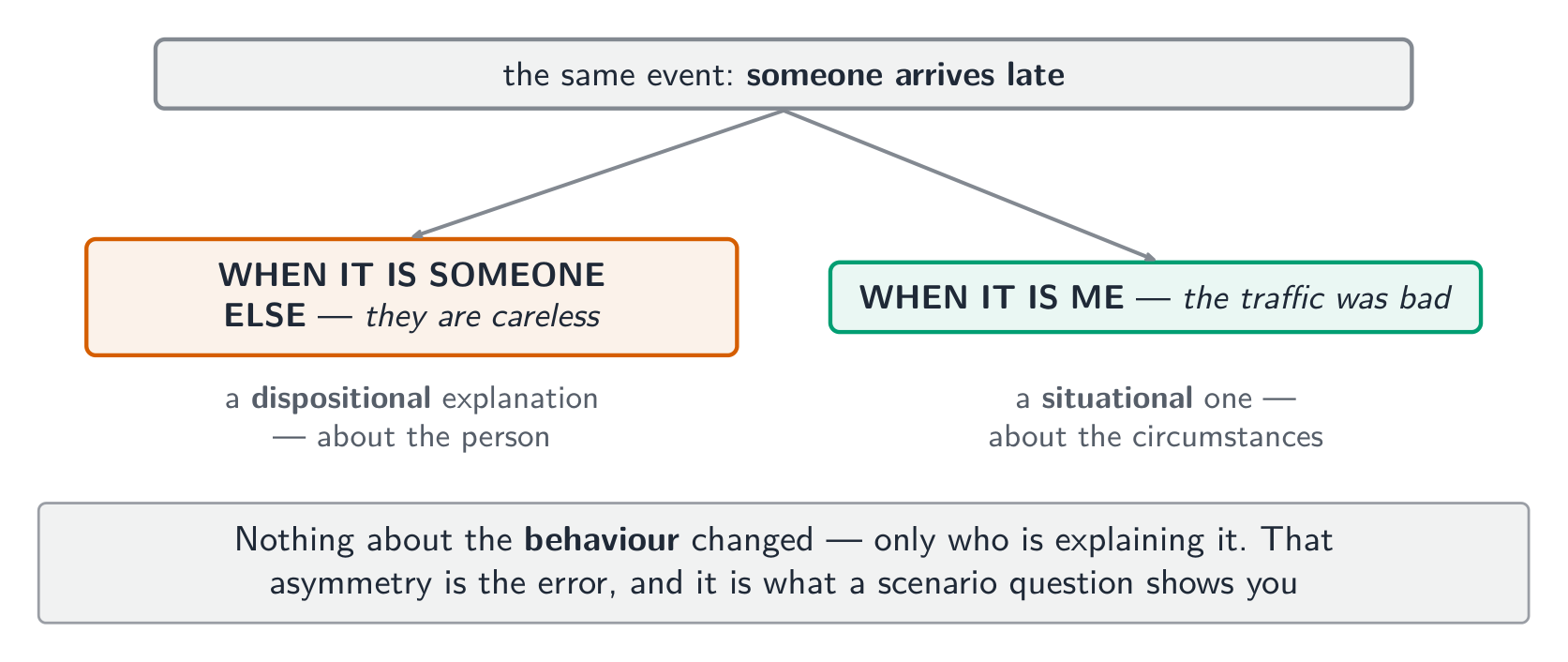
- 4.1.A.1 Attributions are how people explain behavior and mental processes of themselves and others. Dispositional attributions relate to internal qualities of others (such as intelligence or personality) while situational attributions relate to external circumstances that are experienced.
- 4.1.A.2 People demonstrate a predictable pattern of attributions called explanatory style. Explanatory style is how people explain good and bad events in their lives and in the lives of others. Explanatory style can be optimistic or pessimistic.
- 4.1.A.3 People are subject to biases in their attributions. Those biases include actor/ observer bias, fundamental attribution error, and self-serving bias, all of which can affect behavior and mental processes.
Learning Objective 4.1.B: Explain how locus of control (internal and external) applies to behavior and mental processes.
Learning Objective 4.1.C: Explain how person perception applies to behavior and mental processes.
- 4.1.C.1 People’s perception of how much they like something can be influenced by the mere exposure effect. The mere exposure effect occurs when people are exposed to a stimulus repeatedly over time, which causes them to like the stimulus more.
- 4.1.C.2 People can behave in ways that elicit behaviors from others that confirm their beliefs or perceptions about themselves or others (self-fulfilling prophecy).
- 4.1.C.3 Social comparison is a type of person perception that occurs when people evaluate themselves based on comparisons to other members of society or social circles. Social comparison can be upward or downward. People often judge their own sense of deprivation relative to others (relative deprivation).
Bahasa Indonesia
Tujuan Pembelajaran 4.1.A: Jelaskan bagaimana teori atribusi diterapkan pada perilaku dan proses mental.
- 4.1.A.1 Atribusi adalah cara orang menjelaskan perilaku dan proses mental diri sendiri dan orang lain. Atribusi disposisional berkaitan dengan kualitas internal orang lain (seperti kecerdasan atau kepribadian), sedangkan atribusi situasional berkaitan dengan keadaan eksternal yang dialami.
- 4.1.A.2 Orang-orang menunjukkan pola atribusi yang dapat diprediksi yang disebut gaya penjelasan. Gaya penjelasan adalah cara orang menjelaskan peristiwa baik maupun buruk dalam hidup mereka dan dalam hidup orang lain. Gaya penjelasan bisa bersifat optimis atau pesimis.
- 4.1.A.3 Orang-orang rentan terhadap bias dalam atribusi mereka. Bias-bias tersebut meliputi bias aktor/pengamat, kesalahan atribusi fundamental, dan bias melayani diri sendiri, yang semuanya dapat memengaruhi perilaku dan proses mental.
Tujuan Pembelajaran 4.1.B: Jelaskan bagaimana locus of control (internal dan eksternal) diterapkan pada perilaku dan proses mental.
Tujuan Pembelajaran 4.1.C: Jelaskan bagaimana persepsi orang diterapkan pada perilaku dan proses mental.
- 4.1.C.1 Persepsi seseorang tentang seberapa besar mereka menyukai sesuatu dapat dipengaruhi oleh efek paparan semata. Efek paparan semata terjadi ketika seseorang terpapar pada sebuah stimulus secara berulang-ulang seiring waktu, yang menyebabkan mereka lebih menyukai stimulus tersebut.
- 4.1.C.2 Orang-orang dapat berperilaku sedemikian rupa sehingga memicu perilaku dari orang lain yang mengonfirmasi keyakinan atau persepsi mereka tentang diri sendiri atau orang lain (propetisi pemenuhan diri).
- 4.1.C.3 Perbandingan sosial adalah jenis persepsi orang yang terjadi ketika seseorang mengevaluasi dirinya sendiri berdasarkan perbandingan dengan anggota masyarakat atau lingkaran sosial lainnya. Perbandingan sosial dapat bersifat naik atau turun. Orang sering menilai rasa kekurangan mereka relatif terhadap orang lain (kekurangan relatif).