דלג לתוכן
נושאים

OxfordAQA · International GCSE · Physics

תרגול כל המילים
  • 1

    3.1 · Forces and their effects

    תוכנית לימוד תגיע בקרוב

    חומר עזר

    כוחות והשפעותיהם

    כל דחיפה, משיכה והחזקה בעולם היא כוח — והנושא הראשון של OxfordAQA מארגן אותם: אינטראקציות מגע ואי-מגע, סקאלרים מול וקטורים, שלושת חוקי ניוטון, בטיחות ברכבים, ורעיונות ההרחבה P של תנע, מהירות סופית, מרכז מסה ומומנטים.

    פיזיקה אוקספורדAQA International GCSE 9203, נושא 3.1 (גרסה 5.1, מבחנים מ2018 ומעלה). ניסוחים המסומנים ב-(P) הם רק לבחון 2; פרטי הבחון נמצאים בתוכנית ההוראה. רכיבי הדוגמה הקיימים בתיק הם 9203-92031 ו9203-92032 — תרגול הדוגמה בחבילה זו מסומן תמיד כך.

    כוחות והתفاعלים שלהם

    גופים מתאימים דרך כוחות שדה ללא מגע (משיכה, חשמל סטטי, מגנטיות) וכוחות מגע (חיכוך, התנגדות אוויר, מתיחה, כוח תמיכה). חיכוך פועל בין שני משטחים, מעכב תנועה ועשוי לחמם אותם; התנגדות האוויר היא חיכוך עם זורם.
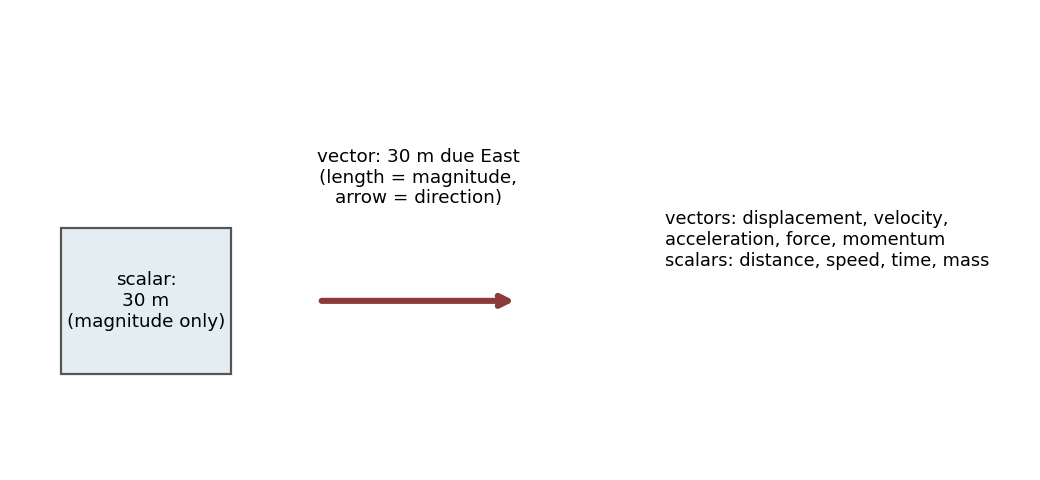
    סקאלר הוא בעל גודל בלבד; וקטור הוא חץ שאורךו הוא הגודל וכיוונו הוא הכיוון של החץ.

    סקלרים הם בעלי גודל בלבד (מרחק, מהירות, זמן); וקטורים מוסיפים כיוון (הזזה, מהירות, תאוצה, כוח, תנע) וניתן לצייר אותם כחצים. משקל הוא כוח המשיכה: $W = m \times g$.

    כוחות יכולים לשנות צורה — למתוח, לכופף, לדחס. עיוותים אלסטיים מתאוששים; אי-אלסטיים אינם (P). קפיץ שנמתח מאחסן אנרגיה פוטנציאלית אלסטית, ובמתחת לגבול היחסיות:

    $$F = k \times e$$

    מעשה נדרש: לבדוק כוח מול הארכה בקפיץ (לתלות משקולות, לשרטט את הקו, השיפוע = k).

    תנועה וחוקי ניוטון

    מהירות היא שיפוע גרף מרחק-זמן; מהירות מוסיפה כיוון: $v = s/t$ (שימושי גם למהירויות ממוצעות). תאוצה היא קצב שינוי המהירות: $a = \Delta v/t$ — מתוך שיפוע גרף מהירות-זמן, whose שטח נותן את המרחק שהתקבל. שינוי כיוון במהירות קבועה הוא עדיין תאוצה.

    שני מחליקי קרח דוחפים זה את זה: הכוחות על כל אחד שווים והפוכים — חוק השלישי של ניוטון.
    • חוק ראשון של ניוטון: כוח תוצרת אפס → מנוחה נשארת מנוחה, תנועה שומרת את מהירותה.
    • חוק שני של ניוטון: $F = m \times a$ בכיוון הכוח התוצרת.
    • חוק שלישי של ניוטון: גופים המתאימים מפעילים כוחות שווים והפוכים זה על זה.

    תוצרות: כוחות הפוכים או מקבילים מתחברים לאורך קו; שני כוחות קופלאריים מתאחדים באמצעות ציור בקנה מידה (שרטוט בקנה מידה, ראש בזנב).

    (P) תנע, בטיחות ומהירות סופית

    $$p = m \times v \qquad F = \frac{\Delta p}{t}$$

    תנע שמר בנעול סגור — התנגשויות ופיצוצים משתפים סך כולל קבוע. בטיחות ברכב: כריות אוויר, חגורות בטיחות, מוטות התנגשות צדדית, אזורי קריסה, מיטות התנגשות, משטחי שעשועיים מרופדים ומגני אופניים כולם מאריכים את הזמן של ההתנגשות, כך שבאותו שינוי תנע הכוח קטן יותר.

    במהירות יציבה הכוח הנוע מדוזן עם כוחות ההתנגדות. מרחק עצירה = זמן תגובה + מרחק בלימה; זמן תגובה גדל עם עייפות, הסחת דעת, סמים ואלכוהול; כוח הבלימה חייב לגדול עם המהירות, ותאוצות שליליות גדולות מחממות את בלמי הרוח. בלימה ממרת את אנרגיית הקינטיקה של הרכב לחימום הבלמים (עבודת חיכוך); מרחק בלימה מתארך בדרכים רטובות או קפואות ובבלמים או צמיגים שחוקים.

    גוף הנופל דרך זורם מאיצ עד שההתנגדות שווה למשקלו — מהירות סופית; מצנח们 מגבירים את ההתנגדות כדי להקטין את מהירות הסופית, וסטרמלינינג (צורת כריש, עיצוב רכב) מקטין את ההתנגדות כדי להגביר את המהירות המקסימלית.
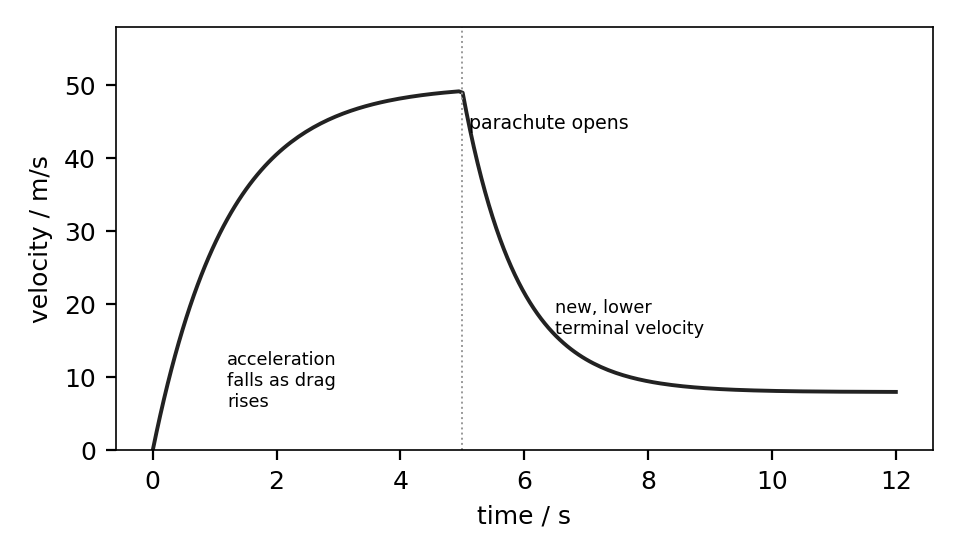
    מהירות מול זמן לצנחן: מהירות סופית ראשונה, ואחר כך נמוכה יותר לאחר פתיחה.

    (P) מרכז כובד ומומנטים

    מרכז הכובד הוא הנקודה בה ניתן לחשוב שהמסה של גוף מרוכזת; גוף תלוי בחופשיות יתייצב כך שמרכז הכובד יהיה מתחת לנקודת התלייה, ומרכז הכובד של גוף סימטרי נמצא על ציר הסימטריה. למצוא אותו בגיליון לא סדיר, תלו אותו משתי נקודות ושרטו קווים אנכיים.

    $$M = F \times d$$

    לגוף מאוזן יש שוויון בין המומנטים הכוללים בשעון ובנגד כיוון השעון; מנופים הם מכפלי כוח. אם קו הפעולה של המשקל חוצה מחוץ לבסיס, המומנט הכולל הופך את הגוף (רכבים, צעצועי איזון).
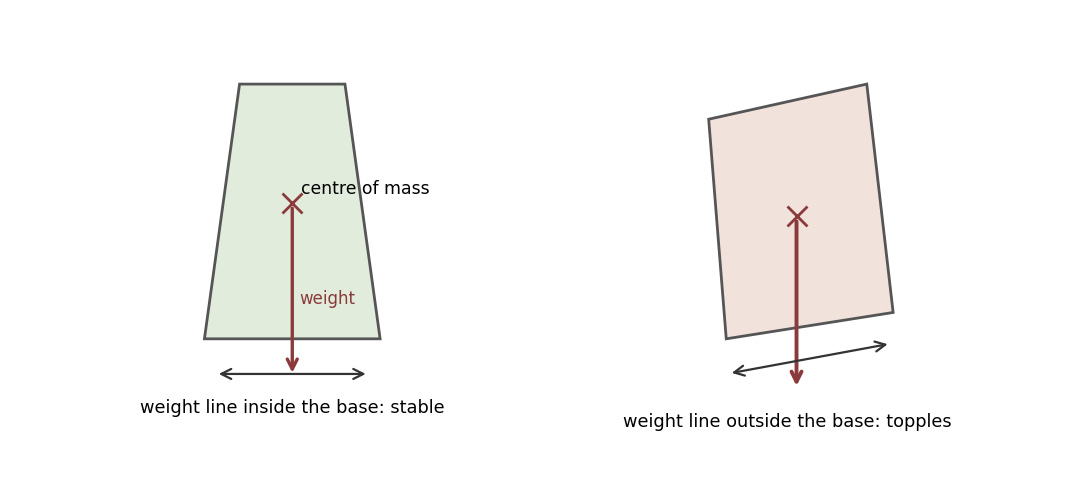
    בלוק יציב בעל קו משקל בתוך הבסיס; בלוק נוטה עם קו מחוץ לבסיס מתהפך.

    בדוק את עצמך

    1. נתנו דוגמה אחת לכל כוח מגע וכוח שאינו מגע.
    2. אילו מהאלמנטים הבאים הם וקטורים: מהירות, זזה, זמן, כוח?
    3. נסחו את משפט הקפיץ ואת שם הקבוע שלו.
    4. נסחו את חוקי ניוטון השלושה במשפט אחד כל אחד.
    5. רכב בעל מסה 900 kg מאיץ בקצב 2 m/s². חשבו את הכוח הכולל.
    6. ציינו שני גורמים המאריכים את מרחק החשיבה ושניים המאריכים את מרחק ההפרעה.
    7. (P) הסבירו כיצד אזור קריסה מגן על הנוסעים, באמצעות F = Δp/t.
    8. (P) מדוע מטפס עם מצנח מקבל מהירות סופית נמוכה יותר לאחר פתיחת המצנח?
    9. (P) היכן נמצא מרכז הכובד של גוף סימטרי?
    10. (P) כוח בעוצמה 250 N פועל במרחק 0.4 m ממנוף. חשבו את המומנט שלו.

    תשובות: 1 מגע — חיכוך/מתח/התנגדות אוויר/רגולר; שאינו מגע — כבידה/חשמלי סטטי/מגנטי; 2 זזה וכוח; 3 $F = ke$, קבוע הקפיץ (N/m); 4 ראשון — חוסר כוח כולל פירושו חוסר שינוי במהירות; שני — $F = ma$ בכיוון הכוח הכולל; שלישי — אינטראקציות נותנות כוחות שווים והפוכים; 5 $F = 900 \times 2 = 1800$ N; 6 חשיבה — עייפות, הפרעות, סמים/אלכוהול (כל שניים); הפרעה — כבישים רטבים או קפואים, בלמיים או צמיגים שחוקים (כל שניים); 7 (P) אזור הקריסה מאריך את זמן ההתנגשות; עבור אותו שינוי תנע, $F = \Delta p/t$ קטן יותר, ולכן פחות כוח מגיע לנוסעים; 8 (P) המצנח מגדיל מאוד את ההתנגדות, ולכן ההתנגדות מאזנת את המשקל במהירות נמוכה הרבה יותר; 9 (P) על ציר הסימטריה שלו; 10 (P) $M = 250 \times 0.4 = 100$ N m.
    מילון מונחים
    English עברית
    friction/ˈfrɪkʃn/ חיכוך
    scalar/ˈskeɪlə/ גודל סקלארי
    vector/ˈvektə/ גודל וקטורי
    momentum/məʊˈmentəm/ תנועה
    terminal velocity/ˈtɜːmɪnl vəˈlɒsɪti/ מהירות סופית
    centre of mass/ˈsentə ɒv mæs/ מרכז מסה
    moment/ˈməʊmənt/ מומנט
  • 2

    3.2 · Energy

    תוכנית לימוד תגיע בקרוב

    חומר עזר

    English

    Energy: the accountant of physics

    Nothing destroys energy — it is only moved between stores and partly dissipated into less useful forms. OxfordAQA's second topic builds the accounting: work and power, the three energy-store equations, conservation with Sankey diagrams, and the choices behind national energy resources.

    OxfordAQA International GCSE Physics 9203, topic 3.2 (Version 5.1). Statements marked (P) are Paper-2-only.

    Forces and energy

    $$W = F \times d \qquad E_e = \tfrac{1}{2}ke^2 \qquad E_p = mgh \qquad E_k = \tfrac{1}{2}mv^2 \qquad P = \frac{E}{t}$$

    Work 功 is done when a force moves its point of application through a distance; work against friction transfers energy by heating (shuttle re-entry, meteorites, brakes). A stretched spring stores elastic potential energy $\frac{1}{2}ke^2$; a raised mass stores gravitational potential energy mgh; a moving mass carries kinetic energy ½mv² — doubling mass doubles it, doubling speed quadruples it (the road-safety link). Power 功率 is the rate of energy transfer.

    Worked check. A 1500 kg car at 20 m/s brakes to rest: KE removed $= \frac{1}{2} \times 1500 \times 400 = 300\,000$ J — all transferred to heating the brakes. Lifting it 2 m at g = 10 N/kg stores $1500 \times 10 \times 2 = 30\,000$ J.

    Energy transfers and dissipation

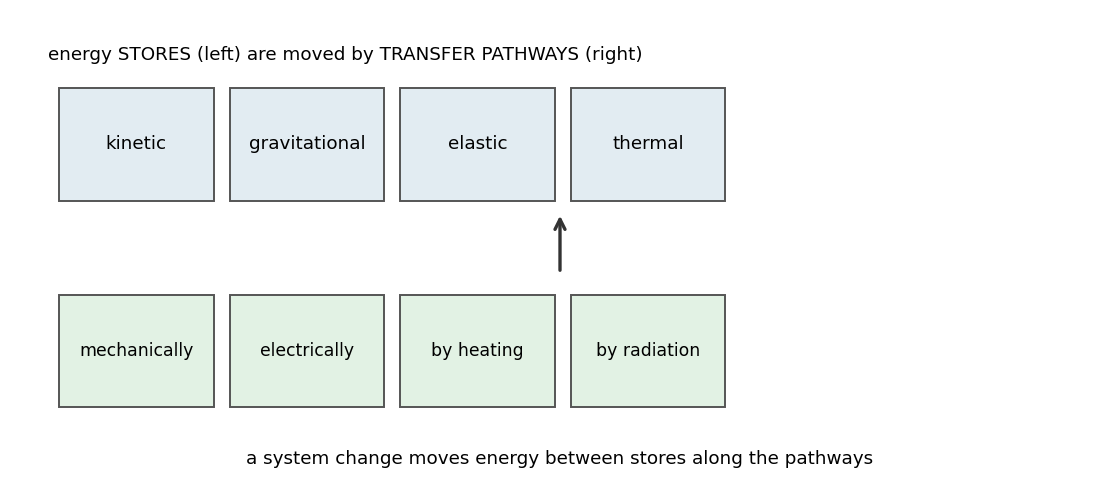
    Energy stores on top, transfer pathways below; a system change moves energy between stores.

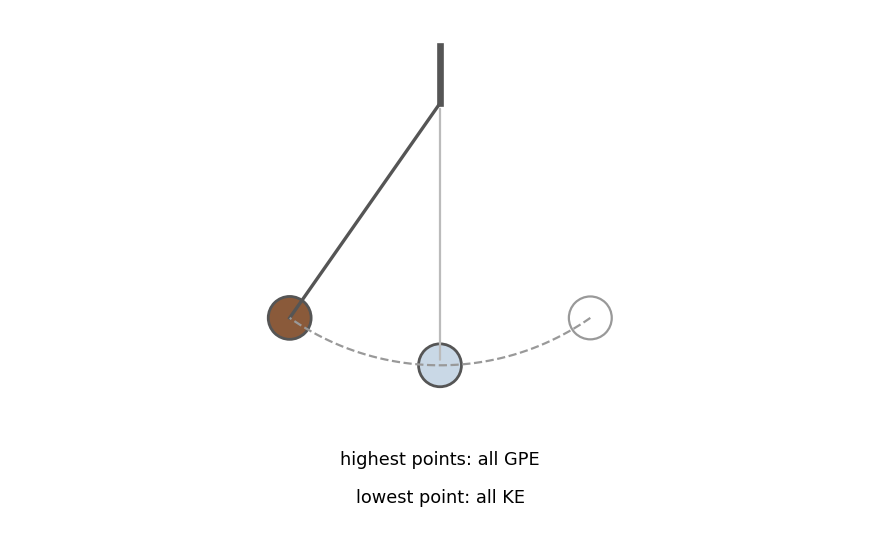
    When a system changes, energy is transferred — usefully, stored, or dissipated 耗散 ("wasted") into less useful stores; it is never created or destroyed. Friction and air resistance dissipate energy by heating. (P) A pendulum swaps kinetic and gravitational potential energy each swing.

    A pendulum: all GPE at the top of each swing, all KE at the bottom.
    $$\text{efficiency} = \frac{\text{useful energy out}}{\text{total energy in}} \times 100\% \ (=\frac{\text{useful power out}}{\text{total power in}})$$

    Sankey diagrams show the redistribution: arrows split in proportion to the energy flows (draw them to scale — width ∝ energy).

    Worked check. A 60 W lamp gives 6 W of light: efficiency 效率 $= 6/60 \times 100 = 10\%$.

    Energy resources

    Fuels are chosen for ease of storage, energy content and safety; some transfer more of their energy usefully than others. National generation trades renewability against cost, reliability and the environmental cost of extraction, use and disposal.

    Four renewable technologies with one advantage and one drawback each.

    Check yourself

    1. Calculate the work done by a 50 N force moving 4 m.
    2. Calculate the elastic energy in a spring (k = 200 N/m) stretched 0.15 m.
    3. A 2 kg book is lifted 3 m at g = 10 N/kg. Calculate the GPE gained.
    4. What happens to the kinetic energy of a car when it brakes?
    5. A motor transfers 800 J in 20 s. Calculate its power.
    6. State the efficiency equation in energy and power forms.
    7. A lamp gives out 12 J of light for every 100 J in. Calculate the efficiency.
    8. What does a Sankey diagram's arrow width show?
    9. Give one advantage and one drawback of wind power.
    10. What does "dissipated" mean?

    Answers: 1 $W = 50 \times 4 = 200$ J; 2 $E_e = \frac{1}{2} \times 200 \times 0.0225 = 2.25$ J; 3 $E_p = 2 \times 10 \times 3 = 60$ J; 4 it is transferred to thermal energy of the brakes and surroundings by the friction force (the brakes heat up); 5 $P = 800/20 = 40$ W; 6 useful energy out ÷ total energy in (×100 %); equally useful power out ÷ total power in; 7 $12/100 \times 100 = 12\%$; 8 the energy flowing in that direction — width is proportional to energy; 9 renewable with no fuel or emissions; unreliable output with visual impact; 10 transferred to less useful stores (often waste heat), so it cannot readily do what we want.

    מילון מונחים
    English עברית
    work/wɜːk/ עבודה
    power/ˈpaʊə/ הספק
    dissipation/ˌdɪsɪˈpeɪʃn/ פיזור
    efficiency/ɪˈfɪʃənsi/ יעילות
  • 3

    3.3 · Waves

    תוכנית לימוד תגיע בקרוב

    חומר עזר

    English

    Waves: carrying energy and information

    Waves move energy from a source to a receiver without moving matter — light to an eye, sound to an ear, radio to a phone. This topic builds the wave model (frequency, wavelength, speed), then applies it across the electromagnetic spectrum, to sound and (P) ultrasound, reflection, refraction with total internal reflection, and (P) lenses and the eye.

    OxfordAQA International GCSE Physics 9203, topic 3.3 (Version 5.1). Statements marked (P) are Paper-2-only.

    General properties of waves

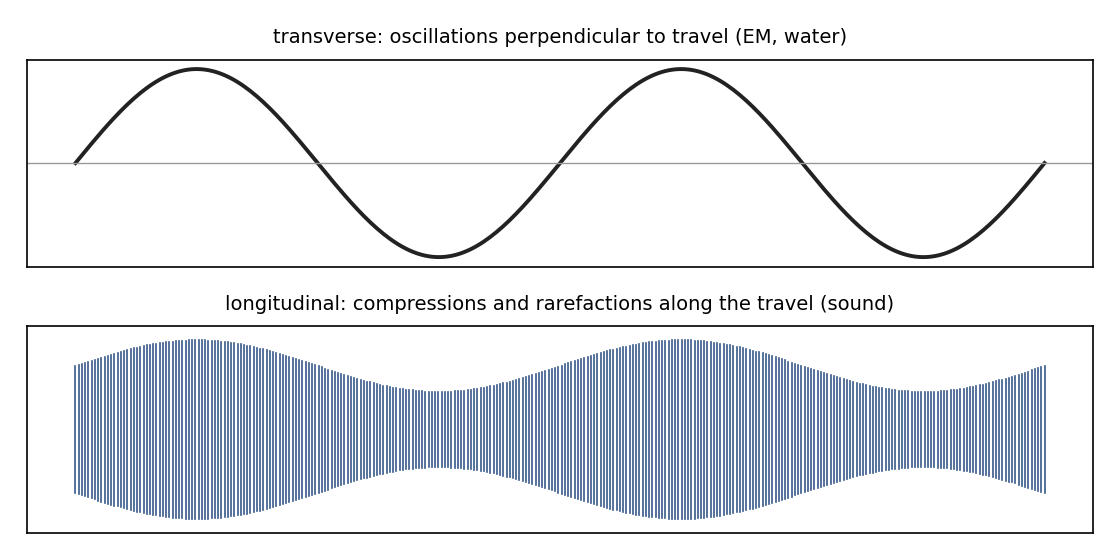
    Transverse waves oscillate across their travel; longitudinal waves compress along it.

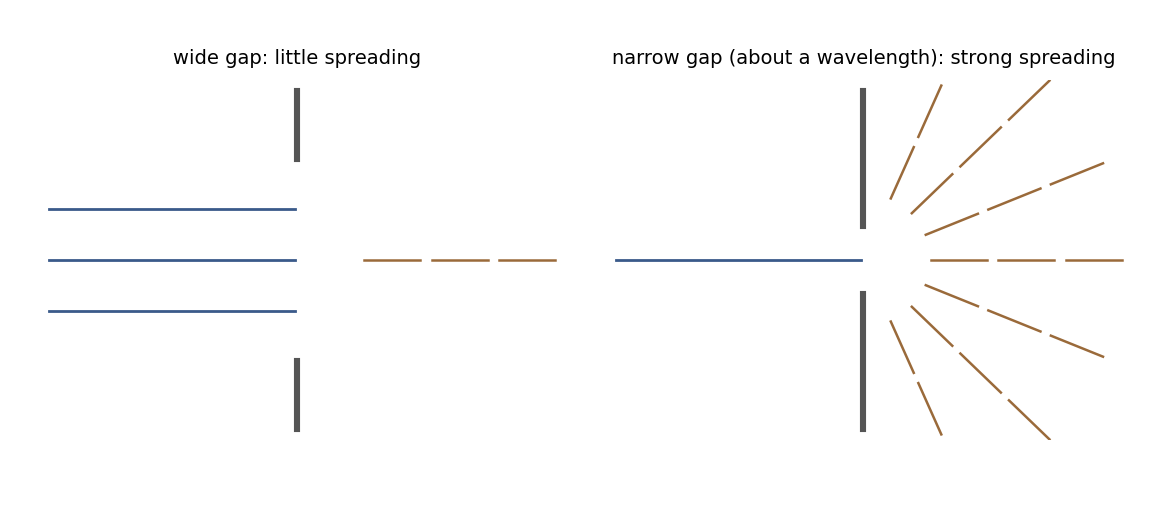
    Transverse 横波: oscillations perpendicular to travel — electromagnetic and water waves. Longitudinal 纵波: oscillations parallel, as compressions and rarefactions — sound; mechanical waves may be either. At a boundary, waves are reflected, transmitted or absorbed; refraction 折射 comes from a change of velocity between media, and diffraction 衍射 spreads waves through a gap — strongly when the gap is comparable to the wavelength.

    A wide gap gives little spreading; a gap near the wavelength spreads strongly.

    Amplitude, wavelength, frequency, period and wavefront define any wave, and:

    $$v = f \times \lambda$$

    Worked check. A water wave of frequency 2 Hz and wavelength 1.5 m travels at $2 \times 1.5 = 3$ m/s.

    The electromagnetic spectrum

    One continuous family, all transverse, all at the same speed in vacuum, ordered from radio (10⁴ m and beyond) down to gamma (10⁻¹⁵ m). Visible light is the narrow band our eyes detect — different wavelengths are different colours. Every object emits and absorbs infrared; (P) hotter objects radiate more and at higher frequencies (black-body radiation), dark matt surfaces absorb and emit best, light shiny ones reflect.

    Uses: radio — TV and radio including Bluetooth; microwaves — phones, satellite TV; infrared — remotes, night vision, heating; visible — photography, fibre optics; UV — security marking; X-rays — medical imaging; gamma — sterilising instruments and food. Hazards: microwaves heat tissue; infrared burns; UV causes skin cancer and blindness; X-rays kill cells in high doses; gamma causes mutations — limit exposure time and distance, and shield.

    X-rays: very short wavelength, high energy, ionising; they affect photographic film, are absorbed by metal and bone, and are transmitted by soft tissue — the basis of CT, fracture and dental imaging, and of cancer treatment (with careful monitoring of workers' doses).

    Sound and ultrasound

    Sound is longitudinal, vibrating a medium, heard between 20 Hz and 20 000 Hz; pitch follows frequency, loudness follows amplitude. Sound reflects (echoes) and diffracts. (P) Ultrasound 超声波 lies above 20 kHz: at a boundary between media it partially reflects, and the echo time locates the boundary:

    $$s = v \times t$$

    Worked check. An ultrasound pulse returns from a fetus boundary after $6.0 \times 10^{-5}$ s (speed 1500 m/s in tissue): boundary depth $= 1500 \times 6.0\times10^{-5}/2 = 4.5$ cm — divide by two for the round trip. Uses: prenatal scanning, breaking kidney stones.

    Reflection and refraction

    Law of reflection: angle of incidence = angle of reflection, measured from the normal. A plane mirror gives a virtual, upright, laterally inverted image; construct ray diagrams with the normal drawn in. (P) Light entering a denser medium slows and bends towards the normal; into a less dense one, away; a prism disperses white light into a spectrum. Refractive index compares speeds:

    $$n = \frac{\text{speed of light in vacuum}}{\text{speed in the medium}} = \frac{\sin i}{\sin r} \qquad \sin c = \frac{1}{n}$$

    Beyond the critical angle in the denser medium, light is totally internally reflected — how optical fibres carry visible light and infrared for medicine (endoscopes) and communications. Required practical: refraction of light by different substances.

    Lenses and the eye (P)

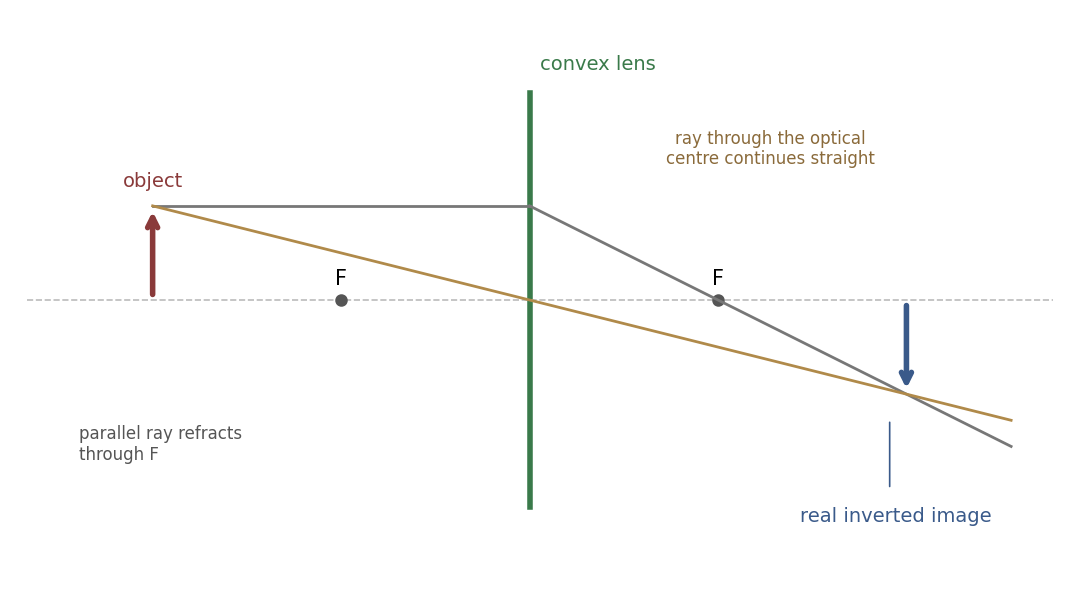
    A convex (converging) lens brings parallel rays to the principal focus (focal length from the lens); a concave (diverging) lens spreads them as if from the focus. Images are described as larger/smaller, upright/inverted, real/virtual — ray diagrams on graph paper show them, and magnification = image height ÷ object height. A converging lens held close acts as a magnifying glass (virtual, upright, enlarged).

    A convex lens forms a real, inverted image of an object beyond the focus.

    The eye: retina (detector), cornea (main refraction), variable-focus lens, pupil/iris (aperture), ciliary muscle and suspensory ligaments (change lens shape). Near point ≈ 25 cm; far point at infinity. Long sight (eyeball too short) is corrected with a convex lens; short sight (too long) with a concave lens; lasers can reshape the cornea in surgery. Against a camera: the eye focuses by changing lens shape, the camera by changing the lens–film distance; the retina plays the CCD's role.

    Check yourself

    1. Give the oscillation directions of transverse and longitudinal waves, with one example of each.
    2. State v = fλ and calculate the speed of a 500 Hz wave of wavelength 0.68 m.
    3. When is diffraction strongest through a gap?
    4. Order the EM spectrum by increasing frequency.
    5. Which surfaces best absorb infrared?
    6. State the frequency range of human hearing.
    7. (P) An ultrasound echo returns in 0.0001 s from 15 cm deep. What is the speed?
    8. State the law of reflection and the nature of a plane-mirror image.
    9. (P) Glass has n = 1.5. Calculate the critical angle.
    10. (P) Which lens corrects short sight, and why?

    Answers: 1 perpendicular — light; parallel, compressions — sound; 2 $v = 500 \times 0.68 = 340$ m/s; 3 gap ≈ one wavelength; 4 radio → microwave → IR → visible → UV → X-ray → gamma; 5 dark, matt; 6 20 Hz–20 kHz; 7 (P) $v = 0.3/10^{-4} = 3000$ m/s (round trip).

    Answers continued: 8 i = r; virtual, upright, laterally inverted; 9 (P) $\sin c = 1/1.5$, $c \approx 41.8°$; 10 (P) a concave lens — it spreads light so the too-long eye focuses it on the retina.

    מילון מונחים
    English עברית
    transverse wave/trænsˈvɜːs weɪv/ גל רוחבי
    longitudinal wave/ˌlɒŋɡɪˈtjuːdɪnl weɪv/ גל אורכי
    refraction/rɪˈfrækʃn/ שבירה
    diffraction/dɪˈfrækʃn/ עקיפה
    ultrasound/ˌʊltrəˈsaʊnd/ אולטרסאונד
  • 4

    3.4 · Particle model of matter

    תוכנית לימוד תגיע בקרוב

    חומר עזר

    English

    The particle model of matter

    Everything is particles. Their energy, separation and motion explain the states of matter, heating and cooling, and why bridges need gaps. OxfordAQA's fourth topic builds the model and quantifies it: specific heat capacity, the (P) latent heats, evaporation, energy-transfer design and thermal expansion.

    OxfordAQA International GCSE Physics 9203, topic 3.4 (Version 5.1). Statements marked (P) are Paper-2-only.

    Kinetic theory

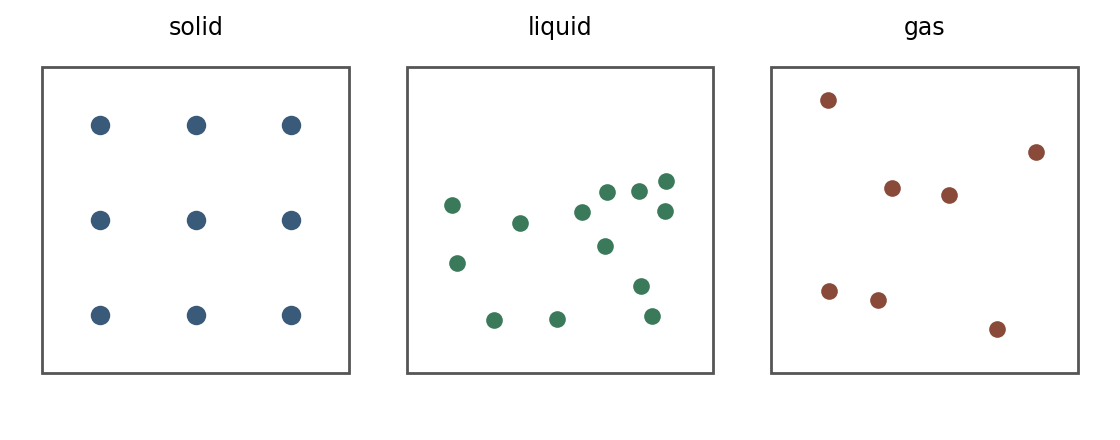
    Solids: fixed, touching particles; liquids: touching but disordered; gases: far apart and fast.

    Specific heat capacity 比热容 c is the energy to raise 1 kg of a substance by 1 °C:

    $$E = m \times c \times \Delta\theta$$

    Worked check. Heating 1.5 kg of water ($c = 4200$) by 40 °C: $E = 1.5 \times 4200 \times 40 = 252\,000$ J.

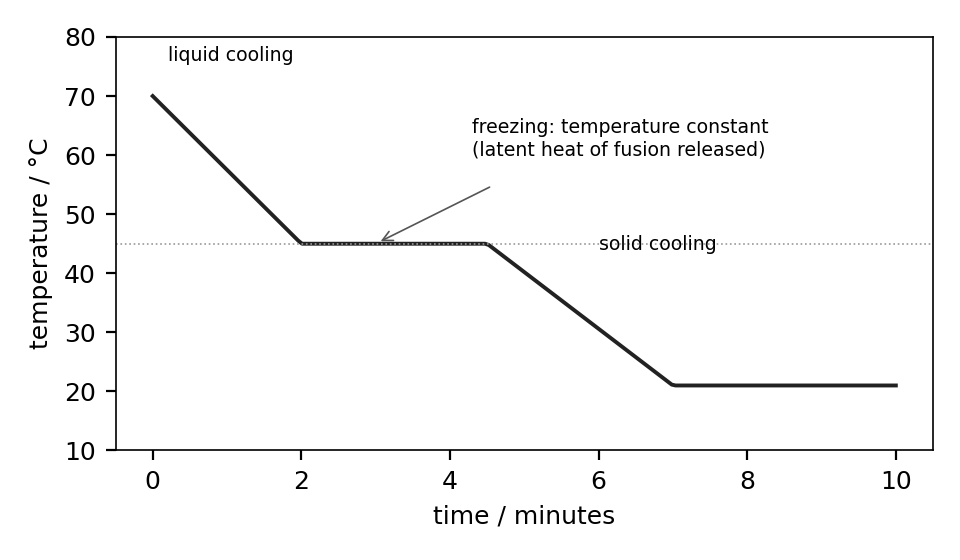
    (P) Changing state needs energy with no temperature change: latent heat of vaporisation 汽化热 $E = m \times L_V$ (liquid → vapour) and latent heat of fusion 熔化热 $E = m \times L_F$ (solid → liquid). Impurities change melting and boiling points. Required practical (P): a cooling curve for stearic acid.

    A cooling curve: the plateau while freezing releases latent heat at constant temperature.

    Energy transfers and particle motion

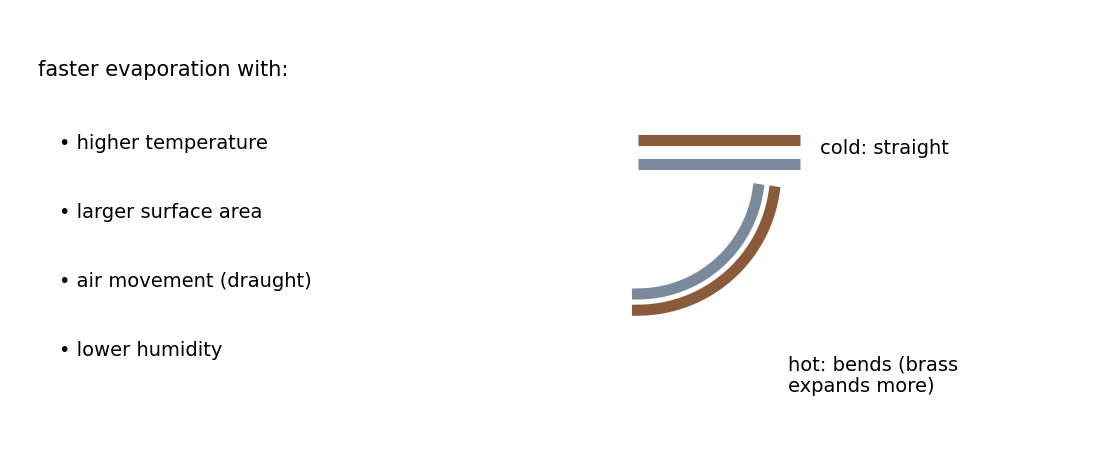
    Conduction 传导 passes energy along a solid by particle vibration, helped by free electrons in metals; insulators lack both. Convection 对流 circulates fluid: particles gain energy, move apart, the fluid becomes less dense and rises, cooler fluid sinks. Evaporation 蒸发 turns fast surface molecules to vapour, cooling what remains — faster with higher temperature, larger surface area, draughts and lower humidity; condensation reverses it.

    Evaporation factors and the bimetallic strip that bends on heating.

    The rate of energy transfer by heating grows with surface area and volume, the material, the surface in contact, and the temperature difference. Design follows: cooling fins maximise area; animals' relative ear size matches climate. Most substances expand when heated — a hazard for roofs and bridges (gaps and rollers), useful in the bimetallic-strip thermostat that bends as one metal expands more and breaks a circuit.

    Check yourself

    1. Describe the particle arrangement in a liquid.
    2. Define specific heat capacity.
    3. Calculate the energy to heat 2 kg of aluminium (c = 900) by 30 °C.
    4. (P) Why does the temperature stay constant while a substance freezes?
    5. (P) 0.5 kg of a substance has L_F = 330 000 J/kg. Calculate the energy to melt it.
    6. Explain conduction in metals, naming the extra carriers.
    7. Explain why warm water rises.
    8. Give three factors that speed evaporation.
    9. Give one hazard and one use of thermal expansion.
    10. Why do cooling fins have large surface area?

    Answers: 1 particles touch but arranged randomly, moving past each other; 2 the energy needed to change the temperature of 1 kg of the substance by 1 °C; 3 $E = 2 \times 900 \times 30 = 54\,000$ J; 4 (P) the energy released as bonds form (latent heat of fusion) leaves at the same rate energy is removed, so the particles' kinetic energy is unchanged; 5 (P) $E = 0.5 \times 330\,000 = 165\,000$ J; 6 vibrating particles pass energy to neighbours, and free electrons carry energy quickly through the metal; 7 the warmer particles move apart, making that water less dense than its surroundings, so it rises; 8 higher temperature, larger surface area, air movement over the surface (also lower humidity); 9 hazard — expansion of bridges/roofs needs gaps; use — the bending bimetallic strip in a thermostat; 10 larger area transfers energy to the surroundings faster by heating.

    מילון מונחים
    English עברית
    specific heat capacity/spəˈsɪfɪk hiːt kəˈpæsɪti/ קיבולת חום סגולית
    latent heat of vaporisation/ˈleɪtənt hiːt ɒv ˌveɪpəraɪˈzeɪʃn/ חום סמוי של אידוי
    latent heat of fusion חום סמוי של התמזגות
    conduction/kənˈdʌkʃn/ הולכה
    convection/kənˈvekʃn/ התכנסות
    evaporation/ɪˌvæpəˈreɪʃn/ אידוי
  • 5

    3.5 · Electricity and magnetism

    תוכנית לימוד תגיע בקרוב

    חומר עזר

    חשמל ומגנטיות

    חשמל הוא מטען בזרימה, מונחה בהפרש פוטנציאל, מיוחס על ידי כל רכיב — וכל זרם יוצר שדה מגנטי. הנושא הגדול ביותר של OxfordAQA בונה את ערכת הכלים למעגל, התנהגויות הרכיבים, והמגנטים האלקטריים הבאים.

    OxfordAQA International GCSE Physics 9203, נושא 3.5 (גרסה 5.1). ניסוחים המסומנים (P) הם רק במבחן-2-.

    מעגלים חשמליים

    מתכות מוליכות משום שיש להן אלקטרונים חופשיים; (P) איזון מטענים בודד הוא חשמל סטטי, המשתחרר כאשר נוצר מסלול הולכה (ברק). הזרם הוא קצב זרימת המטען:

    $$I = \frac{Q}{t} \qquad V = \frac{E}{Q} \qquad V = I \times R$$

    מתח דוחה מטענים במעגל; הפרש פוטנציאלים על רכיב מודד את האנרגיה המועברת ליחידת מטען (וולט = ג'ול לקולון). יש ללמוד את הסמלים הסטנדרטיים — מתג, נורת תאורה, פייוז, תא, סוללה, דיודה, נגד, נגד משתנה, תרמיסטור, LDR, LED, אמפרמטר ווולטמטר.

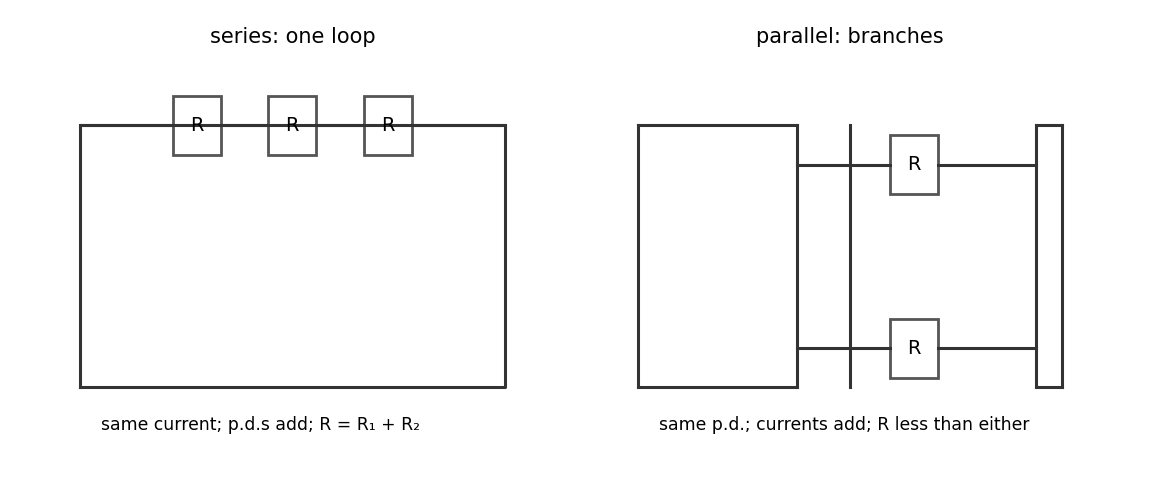
    סדרתי: מעגל אחד, אותה זרם, הנגדים מחברים. מקביל: ערוצים משתפים את ההפרש הפוטנציאלים, הזרמים מחברים.

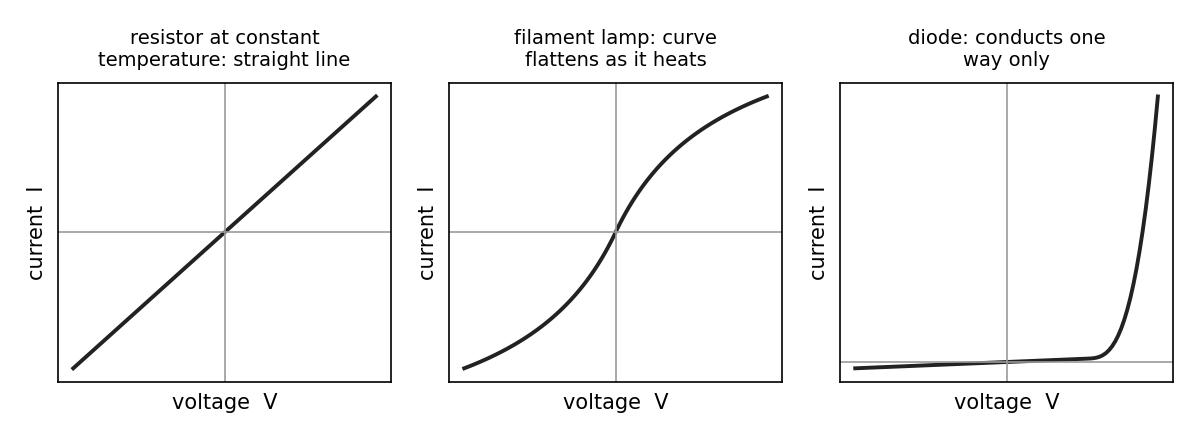
    בטמפרטורה קבועה הגרף V–I של נגד הוא קו ישר (אומוני); נורת להב מתעקמת כשהיונים שלה רועשים יותר עם הטמפרטורה; דיודה מוליכה רק קדימה; (P) נגד התרמיסטור יורד כשהטמפרטורה עולה (בתרמוסטטים); נגד ה-LDR יורד כשהאור עולה (תאורה אוטומטית); LED פולט אור קדימה וחוסך אנרגיה לעומת נורות להב ו-CFL.

    שלוש מאפיינות ה-V-I הנדרשות.

    סדרתי: אותו זרם, ההפרשים הפוטנציאליים מתחלקים, הנגדים מחברים. מקביל: אותו הפרש פוטנציאלים, הזרמים מתפצלים, הנגד המשולב פחות מכל אחד מהם. מטענים הנפגעים ברשת מחממים כל נגד.

    אימון פתור. נורת 230 V צורכת 0.25 A: $R = 230/0.25 = 920\ \Omega$. שני נגדים 4 Ω בסדרתי על 12 V נושאים $I = 12/8 = 1.5$ A; במקביל, $R = 2\ \Omega$ והמקור נותן $I = 12/2 = 6$ A.

    מגנטיות ואלקטרומגנטיות

    קוטבים: כמו-כמו דוחה, לא-כמו-כמו מושך — כוחות ללא מגע. קווי שדה עוברים N ל-S מחוץ למגנט; קוטבים נגדים מולם נותנים שדה אחיד ביניהם. מגנט מושרה מושך בזמן שהוא בשדה ואובד את מגנטיותו בהסרתו; שדה כדור הארץ מאפשר למצפן ניווט.

    חוט נושא זרם יש לו קווי שדה מעגליים סביבו (זרם חזק יותר → שדה חזק יותר; הפוך זרם → הפוך כיוון). סולנואיד מתמקד את השדה; עם ליבת ברזל רך הוא אלקטרומגנט — ניתן להפעלה, מתכוונן, משמש במנופי מכרות, ממסרים ונעילות דלתות. מעשי נדרש: הגורמים הקובעים את חוזק האלקטרומגנט.

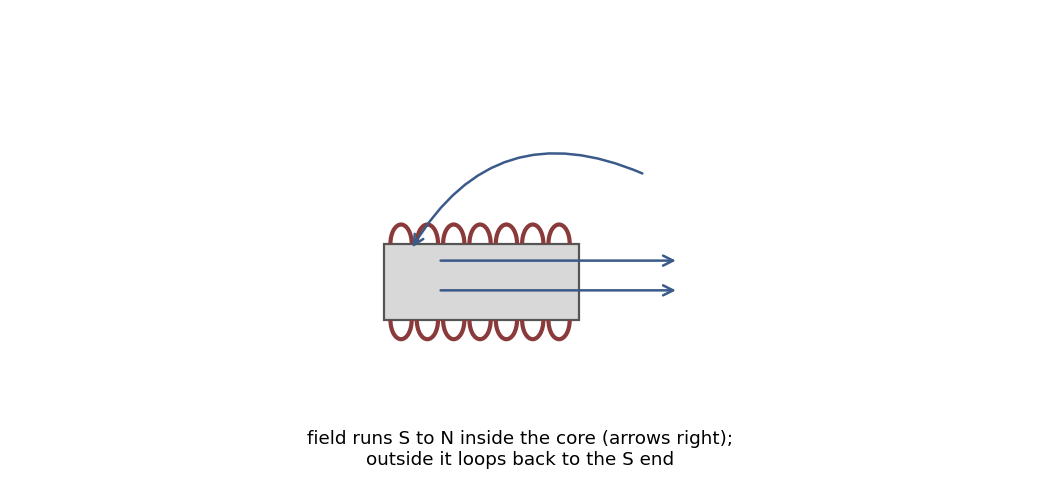
    סולנואיד על ליבת ברזל רך: שדה האלקטרומגנט הוא כמו שדה מקט, אך ניתן להפעלה.

    בדוק את עצמך

    1. מדוע מתכות מוליכות?
    2. נסח את הקשר בין זרם, מטען וזמן עם יחידות.
    3. חשב את המטען הזורם כאשר 2 A עובר למשך 30 s.
    4. נסח את צורת ה-V-I עבור נגד בטמפרטורה קבועה ועבור נורת להב.
    5. (P) מה קורה לנגד התרמיסטור כשהטמפרטורה עולה?
    6. נסח את חוקי הזרם וההפרש הפוטנציאלי לסדרתי ולמקביל.
    7. חשב את R עבור מקור 12 V הדוחה 0.5 A.
    8. נסח את חוק הקוטבים וכיוון קווי השדה מחוץ למגנט.
    9. מהו מגנט מופעל?
    10. ציין שתי דרכים לחזק אלקטרומגנט.

    תשובות: 1 הם מכילים אלקטרונים חופשיים המוזרים כאשר מיושמת מתח; 2 Q = It, מטען בקולון = זרם באמפר × זמן בשניות; 3 Q = 2 × 30 = 60 C; 4 קו ישר העובר דרך הראשית; עקומת S המישורשת ככל שהזרם (ועל כן הטמפרטורה) עולה; 5 (P) הוא יורד — משמש בתרמוסטטים; 6 סדרתי — אותו זרם בכל מקום, המתחים נסכמים; מקביל — אותו מתח על הענפים, הזרמים נסכמים; 7 R = 12/0.5 = 24 Ω; 8 קוטבים זהים דוחים, שונים מושכים; מ-N ל-S מחוץ למגנט; 9 חומר מגנטי הופך למגנט רק בזמן הנמצא בשדה — משיכה בלבד, מאבד את רוב המגנטיות בהסרת השדה; 10 יותר פיתולים בסליל; זרם גדול יותר (גם ליבת ברזל רך).

    מילון מונחים
    English עברית
    solenoid/ˈsəʊlənɔɪd/ סולנוئיד
    electromagnet/ɪˌlektrəʊˈmæɡnɪt/ מגנט חשמלי
  • 6

    3.6 · Generating and distributing electricity and household use

    תוכנית לימוד תגיע בקרוב

    חומר עזר

    English

    Generating and distributing electricity

    Move a magnet, move a current — a p.d. appears. OxfordAQA's sixth topic runs the full chain from the generator effect through the national grid's transformers to the appliances and safety systems of the home. All statements in this topic are Paper-2 (P).

    OxfordAQA International GCSE Physics 9203, topic 3.6 (Version 5.1) — entirely (P) content.

    Generating electricity (P)

    The generator effect 发电机效应 induces a p.d. across a conductor that moves through a magnetic field, or sits in a changing field. Reverse the motion or the polarity and the induced p.d. reverses; the induced current's own field opposes the change. The p.d. grows with faster movement, stronger field, more turns and larger coil area.

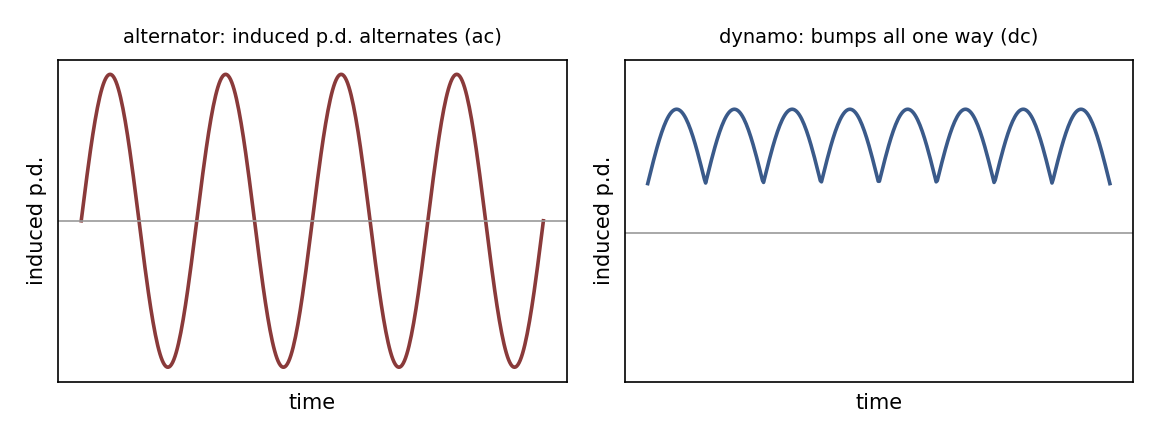
    An alternator spins a coil in a field to make a.c.; a dynamo gives d.c. — know the p.d.–time graphs. Power stations spin turbines to turn coils between magnets.

    An alternator's induced p.d. alternates; a dynamo's bumps point one way.

    Transmission, transformers and the home (P)

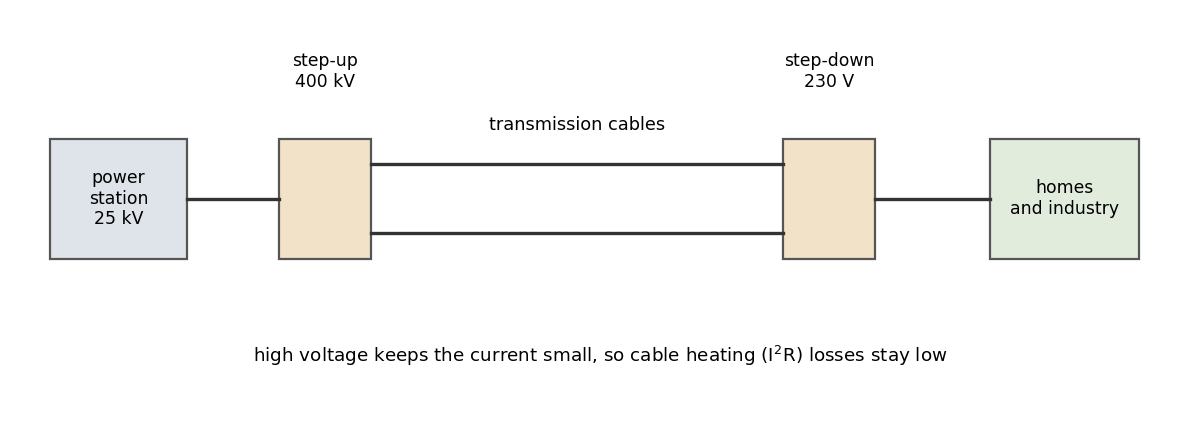
    From the station to the socket, every watt travels the same chain of coils and cables.

    Power station, step-up transformer, high-voltage cables, step-down transformer, consumers.

    For a given power, high transmission voltage means low current and so little cable heating. A transformer 变压器 is two coils on a soft-iron core: alternating current in the primary makes a changing field that induces a p.d. in the secondary.

    $$\frac{V_p}{V_s} = \frac{n_p}{n_s} \qquad V_p I_p = V_s I_s \ (100\%)$$

    Step-up before the lines, step-down after; switch-mode transformers (50–200 kHz) are small and light — phone chargers.

    Worked check. A transformer steps 25 kV up to 400 kV with 1000 primary turns: $n_s = 1000 \times 400/25 = 16\,000$ turns. At 100 MW the line current is $I = P/V = 10^8/(4 \times 10^5) = 250$ A.

    Cells give d.c.; mains is a.c. with fixed frequency and voltage — read period and frequency from oscilloscope-style traces. Safety: earthing 接地 drains fault current from metal casings; a fuse 保险丝 melts or a circuit breaker trips on excess current — the breaker is faster and resettable; double-insulated appliances need no earth.

    The motor effect (P)

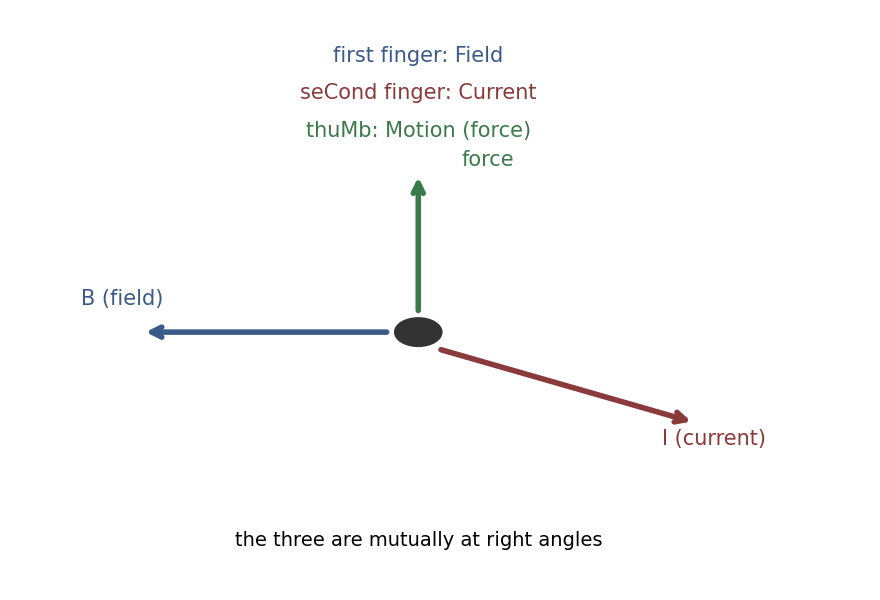
    A current-carrying wire across a magnetic field feels a force (zero if parallel to it). Force grows with stronger field, bigger current and more wire in the field; reverse either to reverse the force — Fleming's left-hand rule 左手定则 predicts the direction.

    Fleming's left-hand rule: field, current and force mutually at right angles.

    A current-carrying coil in a field rotates — the electric motor.

    Transferring electrical energy (P)

    $$P = \frac{E}{t} \qquad P = I \times V \qquad E = V \times Q \qquad E\,(\mathrm{kWh}) = P\,(\mathrm{kW}) \times t\,(\mathrm{h})$$

    Appliance labels give power; compute the current to choose a fuse, and the energy in kilowatt-hours for billing (E = Pt; cost = kWh × price per unit, read from meter readings).

    Worked check. A 2.0 kW heater for 3 h uses 6.0 kWh; at 0.9 per kWh that costs 5.4. A 230 V, 1.1 kW kettle draws I = 1100/230 ≈ 4.8 A — fit a 5 A or 13 A fuse (next rating above).

    Check yourself

    1. State two ways to induce a p.d. in a conductor.
    2. Give three factors that increase the size of an induced p.d.
    3. Sketch the p.d.–time graphs of an alternator and a dynamo.
    4. Why does the grid transmit at high voltage?
    5. A transformer has 200 primary and 3000 secondary turns on 12 V a.c. Calculate the secondary p.d.
    6. State the turns-ratio and power equations for a 100 % efficient transformer.
    7. Explain how earthing and a fuse protect a user together.
    8. State Fleming's left-hand rule.
    9. Calculate the current of a 230 V, 2.3 kW heater, and a sensible fuse.
    10. Calculate the energy in kWh used by a 1.5 kW kettle in 20 minutes.

    Answers: 1 move the conductor through a field; place it in a changing magnetic field; 2 faster motion; stronger field; more turns (also larger coil area); 3 alternator — a sine wave about zero; dynamo — humps all above (or all below) the axis; 4 for the same power the current is smaller, so I²R heating losses in the cables are far lower; 5 $V_s = 12 \times 3000/200 = 180$ V; 6 $V_p/V_s = n_p/n_s$ and $V_p I_p = V_s I_s$; 7 the earth wire gives the fault current a path to earth, and the surge blows the fuse, disconnecting the live wire; 8 first finger Field, second finger Current, thumb Motion — mutually at right angles; 9 I = 2300/230 = 10 A — use a 13 A fuse; 10 t = 1/3 h, so E = 1.5 × 1/3 = 0.5 kWh.

    מילון מונחים
    English עברית
    generator effect אפקט גנרטור
    transformer/trænsˈfɔːmə/ מתחלף (טרנספורמר)
    earthing הארקה
    fuse/fjuːz/ פיוז
    left-hand rule/left hænd ruːl/ כלל היד השמאלית
  • 7

    3.7 · Nuclear physics

    תוכנית לימוד תגיע בקרוב

    חומר עזר

    English

    Nuclear physics

    The nucleus is a millionth of the atom yet holds nearly all its mass — and unstable nuclei pour out energy as radiation, fission fragments, or the fusion that lights the stars. OxfordAQA's seventh topic covers the nuclear model, the three radiations, half-life, contamination versus irradiation, reactors and (P) fusion.

    OxfordAQA International GCSE Physics 9203, topic 3.7 (Version 5.1). Statements marked (P) are Paper-2-only.

    Atomic structure

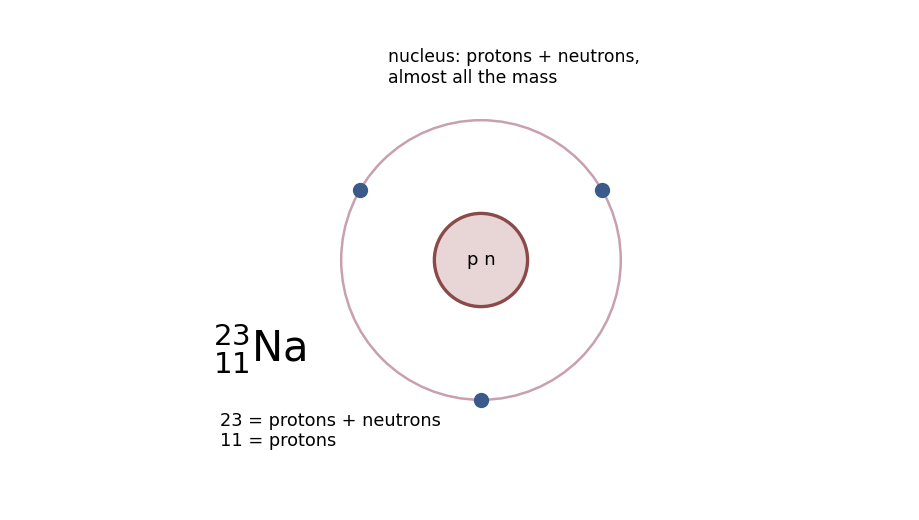
    An atom is about 10⁻¹⁰ m across: a tiny positive nucleus (protons and neutrons, nearly all the mass) with electrons around it — Rutherford's alpha-scattering evidence for the concentrated nucleus. Proton mass 1 charge +1; neutron mass 1 charge 0; electron charge −1, negligible mass. A neutral atom has equal protons and electrons; atoms lose or gain electrons to become ions.

    Nuclear notation: mass number and proton number.

    ${}^{A}_{Z}X$: A = mass number (protons + neutrons), Z = proton number; isotopes share Z and differ in neutrons.

    Ionising radiation from the nucleus

    Unstable nuclei decay randomly, unaffected by chemistry or physics, emitting:

    Radiation Nature Ionising Range in air
    alpha 2p + 2n (helium nucleus) strongest a few cm
    beta-minus fast electron (neutron → proton) medium tens of cm
    gamma electromagnetic wave weakest metres
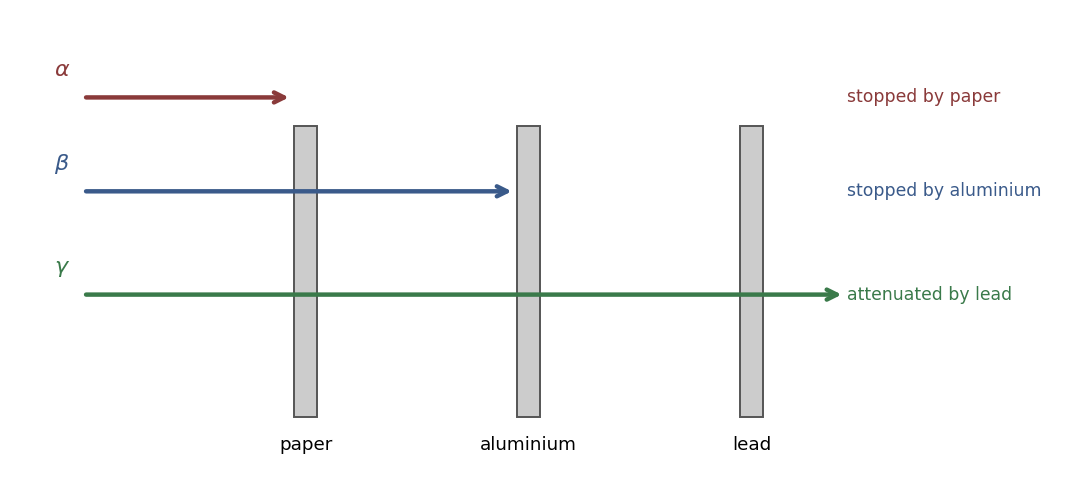
    Penetration: alpha stopped by paper, beta by aluminium, gamma attenuated by lead.

    Nuclear equations conserve mass number and charge: ${}^{238}_{92}U \rightarrow\, {}^{234}_{90}Th +\, {}^{4}_{2}He$ (alpha); ${}^{14}_{6}C \rightarrow\, {}^{14}_{7}N +\, {}^{0}_{-1}e$ (beta). Background radiation comes from rocks, space, food and medical devices. (P) The half-life 半衰期 is the time for half the nuclei (or half the count rate) to decay — most unstable nuclei have short half-lives; the least unstable last millennia. Contamination 沾污 (radioactive atoms on you) is a lasting hazard; irradiation 照射 exposes without making you radioactive. Dangers: mutations, cell and tissue damage.

    Nuclear fission and (P) fusion

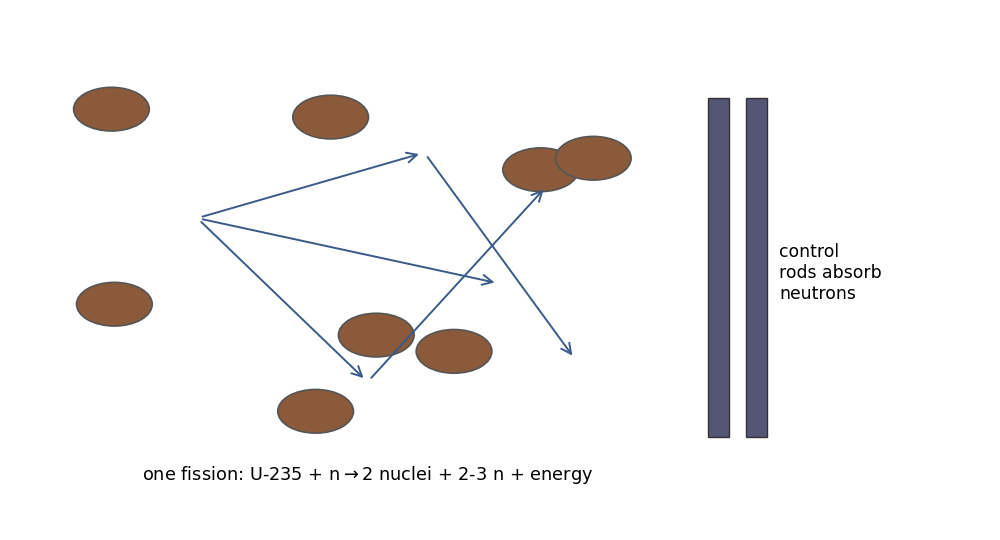
    Fission 裂变 splits a large unstable nucleus: U-235 or Pu-239 absorbs a neutron, splits into two smaller nuclei with 2–3 neutrons and far more energy than any chemical reaction. Neutrons striking further nuclei give a chain reaction; in a reactor control rods absorb neutrons to hold one fission per neutron.

    A chain reaction with control rods absorbing neutrons.

    Radioactive waste stays dangerous for times set by its half-life — a managed-disposal cost of nuclear power. (P) Fusion 聚变 joins two light nuclei into a heavier one, converting mass to energy: it powers the stars, but positive nuclei repel, so it needs extreme temperature and pressure.

    Check yourself

    1. Give the relative masses and charges of the proton, neutron and electron.
    2. In ${}^{19}_{9}F$, how many protons and neutrons?
    3. What did alpha scattering reveal about the atom?
    4. Name the three radiations and their natures.
    5. Which radiation is stopped by paper, and which penetrates aluminium?
    6. Balance the alpha decay of ${}^{226}_{88}Ra$.
    7. (P) Define half-life.
    8. (P) Explain the difference between contamination and irradiation.
    9. What do control rods do in a reactor?
    10. (P) Why does fusion need extreme temperatures?

    Answers: 1 proton 1/+1; neutron 1/0; electron negligible/−1; 2 9 protons, 10 neutrons; 3 mass and positive charge concentrate in a tiny nucleus — most alphas pass, a few bounce; 4 alpha — helium nucleus; beta — fast electron; gamma — EM wave; 5 alpha; gamma (needs thick lead); 6 ${}^{226}_{88}Ra \rightarrow\, {}^{222}_{86}Rn +\, {}^{4}_{2}He$; 7 (P) the time for half the nuclei (or the count rate) to halve; 8 (P) contamination — radioactive material on you, a hazard until removed; irradiation — exposure to radiation, ending when the source leaves; 9 absorb neutrons, holding the chain to one fission per neutron — steady; 10 (P) positive nuclei repel; they must collide at enormous speed to fuse.

    מילון מונחים
    English עברית
    half-life/hɑːf laɪf/ חצי חיים
    contamination/kənˌtæmɪˈneɪʃn/ זיהום
    irradiation/ˌɪreɪdɪˈeɪʃn/ קרינה
    fission/ˈfɪʃn/ סדק
    fusion/ˈfjuːʒn/ היתוך
  • 8

    3.8 · Space physics

    תוכנית לימוד תגיע בקרוב

    חומר עזר

    פיזיקת חלל

    כוח הכבידה אוסף אבק לכוכבים, כוכבים מזגים אלמנטים, והזזה לאדום של גלאקסיות מרחוק מעידה שהיקום כולו מתרחש מתחילתו 14 מיליארד שנים לפני כן. הנושא האחרון של OxfordAQA מסכם את הקורס עם מחזורי חיי כוכבים, מסלולים והוכחות לתפיסת המהגדלה.

    OxfordAQA International GCSE Physics 9203, נושא 3.8 (גרסה 5.1). הבעות המסומנות (P) הן רק לבחינת Paper-2-.

    מחזור חיי כוכב

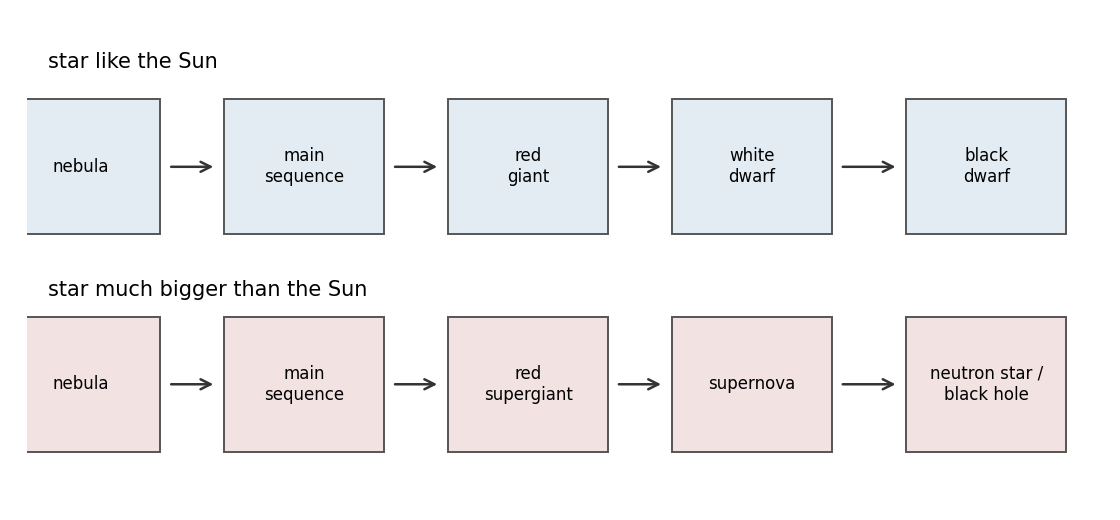
    שתי מסלולים: כוכבים כמו השמש נסתיימים ככוכבי ענק שחורים; כוכבים מאסיביים נסתיימים בסופרנובה וכוכבי ניוטרונים או חורים שחורים.

    כוכבים נוצרים כאשר כוח כבידה שואף אבק וגז (בעיקר מימן והליום) יחד — גושים קטנים יותר הופכים לפלנטות. בתקופת ה-סדרה הראשית הארוכה, מימן מזוג להליום בגרעין והכבידה מאזנת כוחות החוצה. ככל שהכוכב מאסיבי יותר, כך ליבתו חמה יותר וכן הגרעינים הכבדים ביותר שהוא יכול לבנות באמצעות מיזוג.

    כאשר מימן נגמר, המסה קובעת את הסוף. כוכב כמו השמש מתנפח לענק אדום, משליך שכבותיו, והליבה החשופה מתקררת מענק לבן לענק שחור. כוכב מאסיבי מתנפח לענק על אדום, מזג אלמנטים כבדים יותר (פחמן, חנקן, חמצן), ואז מתפוצץ כסופרנובה — מפזר את האלמנטים (אלמנטים כבדים יותר מברזל נוצרים בפיצוץ עצמו) — ומשאיר אחריו כוכב ניוטרונים או חור שחור. המיזוג בכוכבים ובסופרנובות יצר כל אלמנט הטבעי הקיים: היקום המוקדם הכיל רק מימן.

    מערכת השמש ותנועה מסלולית

    מערכת השמש: שמונה פלנטות מקיפות את השמש, בנוסף לירחים, אסטרואידים, פלנטות ננסיים ושביטים. שביל החלב הוא אחת ממיליארדים של גלאקסיות, כל אחת עם אלפי מיליארדי כוכבים. לוויינים מלאכותיים מקיפים את כדור הארץ במסלולי גיאוסטציונריים או מסלולי קוטב נמוכים.

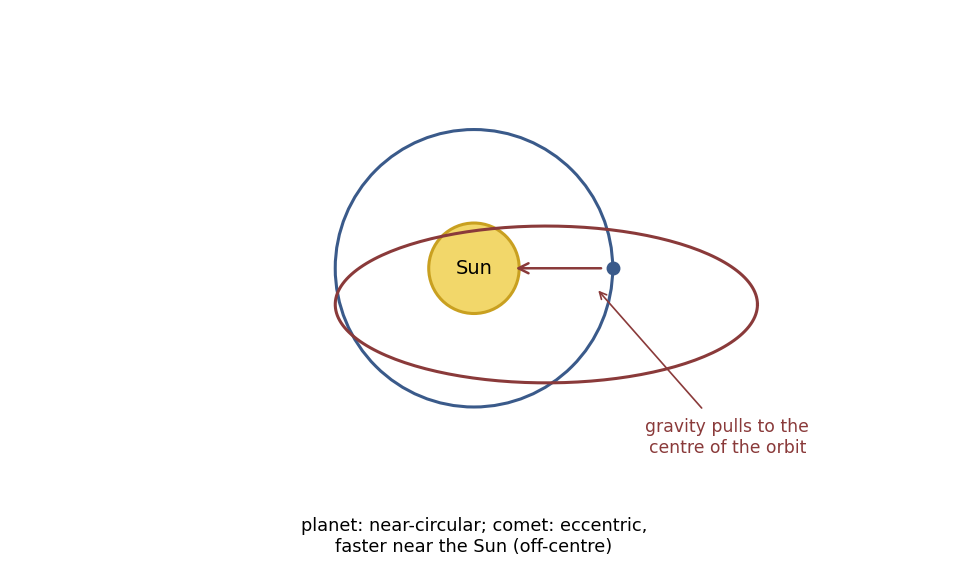
    מסלול קרוב לעגול של פלנטה ומסלול אקצנטרי של שביט, כאשר כוח הכבידה מספק את המשיכה המרכזית.

    כוח הכבידה מספק אתכוח המרכז: הוא פועל לכיוון המרכז, משנה את כיוון התנועה (המהירות) ללא שינוי במהירות. הפרש גדול יותר פירושו כבידה חלשה יותר, ולכן מהירות מסלול נמוכה יותר: כדי להישאר ברדיוס מסוים, לוויין חייב לנוע במהירות המתאימה — שינוי במהירות משנה את רדיוס המסלול.

    הזזה לאדום והיקום הנמתח (P)

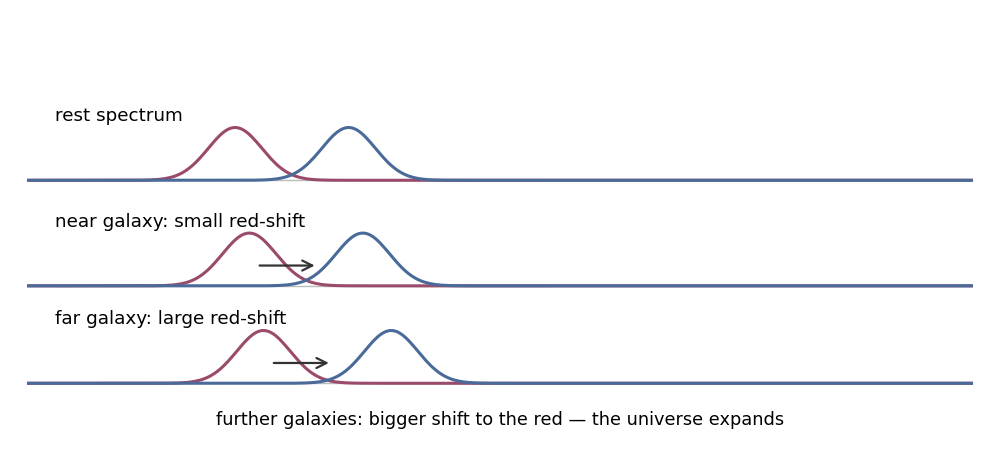
    שלושה ספקטרום: ככל שהגלאקסיה רחוקה יותר, כך ההזזה לאדום גדולה יותר.

    מקור גל נע משנה את אורך הגל הנצפה (אפקט דופלר): מקורות הנ удаляющиеся מתיחים גלים — אורך גל ארוך יותר, תדר נמוך יותר. ככל שהגלאקסיה רחוקה יותר, כך היא נ удаля faster וכל כך ההזזה לאדום גדולה יותר — החלל עצמו נמתח, ומעיד על התחלה קטנה מאוד: המהגדלה. רקע הקרינה המיקרוגלי הקוסמי — קרינה הממלאת את היקום מהרגעים לאחר ההתחלה — הוא העמוד השני; תפיסת המהגדלה היא כרגע התפיסה היחידה שמסבירה אותה.

    בדוק את עצמך

    1. מה שואף אבק וגז לכוכבים?
    2. מה קורה בליבת כוכב בסדרה ראשית?
    3. ספרו שלושה שלבים שעובר כוכב כמו השמש לאחר הסדרה הראשית.
    4. אילו כוכבים הופכים לסופרנובה?
    5. היכן נוצרים יסודות כבדים מברזל?
    6. ציין שני סוגי מסלולים ללוויין מלאכותי.
    7. מדוע לוויין במסלול גבוה יותר נע לאט יותר?
    8. (P) מה קורה לאורך הגל כאשר המקור שלו מתרחק?
    9. (P) ציין שני סוגי ההוכחה למפץ הגדול.
    10. (P) מהי הקרינה המיקרוגלית הקוסמית (CMBR)?

    תשובות: 1 משיכה כבידתית; 2 גרעיני מימן פונדו למימן, משחררים אנרגיה, כאשר הכבידה מאוזנת; 3 ענק אדום, ננפה לבנה, ננפה שחורה (שלושה שלבים לאחר הסדרה הראשית); 4 כוכבים כבדים משמעותית יותר מהשמש; 5 בפיצוצי סופרנובה; 6 גיאוסטציונרי וקוטבי נמוך; 7 הכבידה חולשת עם ההתרחקות, ולכן הכוח הצנטריפטי — והמהירות הנדרשת ממנו — היא קטנה יותר; 8 (P) הוא מתאריך (הזזה אדומה), ותדירות התצפית יורדת; 9 (P) הזזה אדומה של גלקסיות העולה עם המרחק, והרקע המיקרוגלי הקוסמי; 10 (P) קרינה אלקטרומגנטית הממלאת את היקום, שנותרה מעט לאחר המפץ הגדול.

    מילון מונחים
    English עברית
    red-shift/red ʃɪft/ הזזה לאדום
    Big Bang/bɪɡ bæŋ/ מפץ הגדול
    cosmic microwave background/ˈkɒzmɪk ˈmaɪkrəʊweɪv ˈbækɡraʊnd/ רקע מיקרוגלי קוסמי

היכנס או צור חשבון

IGCSE, A-Level & AP