The particle model of matter
Everything is particles. Their energy, separation and motion explain the states of matter, heating and cooling, and why bridges need gaps. OxfordAQA's fourth topic builds the model and quantifies it: specific heat capacity, the (P) latent heats, evaporation, energy-transfer design and thermal expansion.
OxfordAQA International GCSE Physics 9203, topic 3.4 (Version 5.1). Statements marked (P) are Paper-2-only.
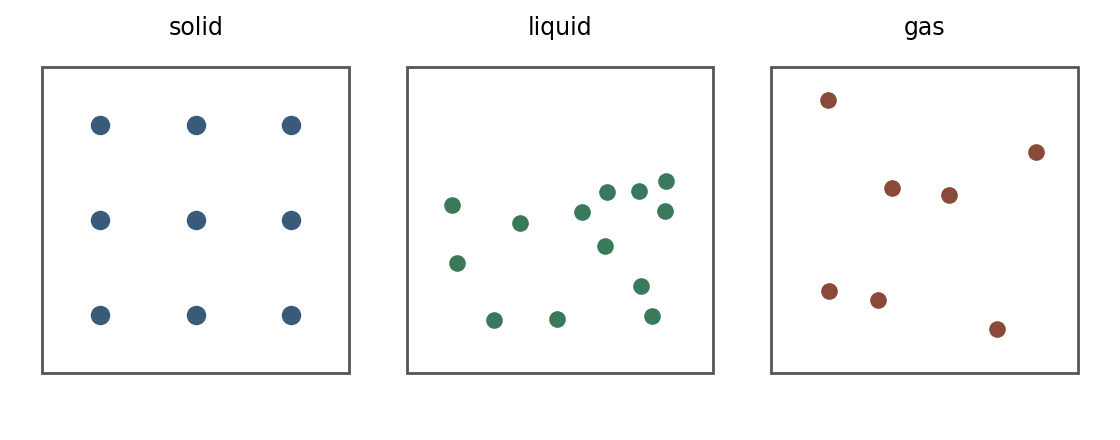
Kinetic theory
Specific heat capacity 比热容 c is the energy to raise 1 kg of a substance by 1 °C:
Worked check. Heating 1.5 kg of water ($c = 4200$) by 40 °C: $E = 1.5 \times 4200 \times 40 = 252\,000$ J.
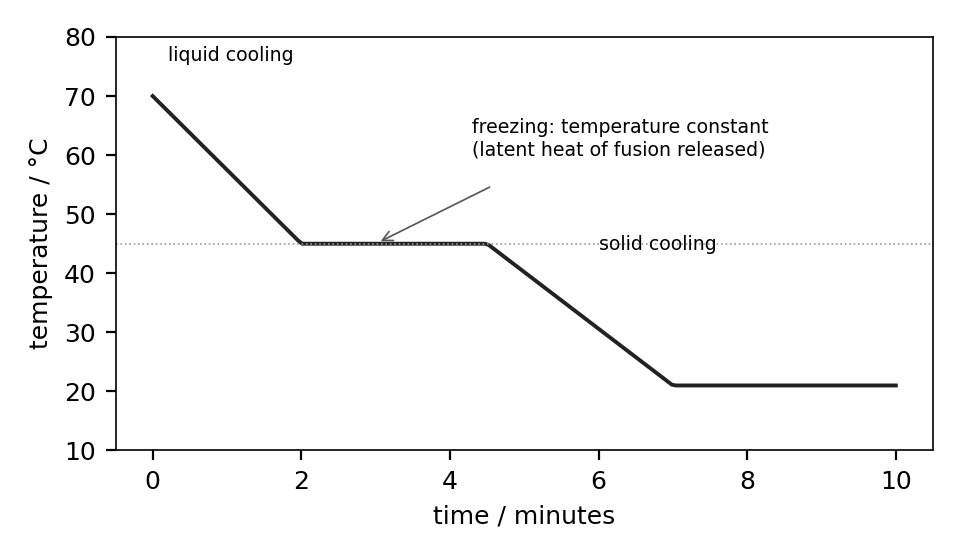
(P) Changing state needs energy with no temperature change: latent heat of vaporisation 汽化热 $E = m \times L_V$ (liquid → vapour) and latent heat of fusion 熔化热 $E = m \times L_F$ (solid → liquid). Impurities change melting and boiling points. Required practical (P): a cooling curve for stearic acid.
Energy transfers and particle motion
Conduction 传导 passes energy along a solid by particle vibration, helped by free electrons in metals; insulators lack both. Convection 对流 circulates fluid: particles gain energy, move apart, the fluid becomes less dense and rises, cooler fluid sinks. Evaporation 蒸发 turns fast surface molecules to vapour, cooling what remains — faster with higher temperature, larger surface area, draughts and lower humidity; condensation reverses it.
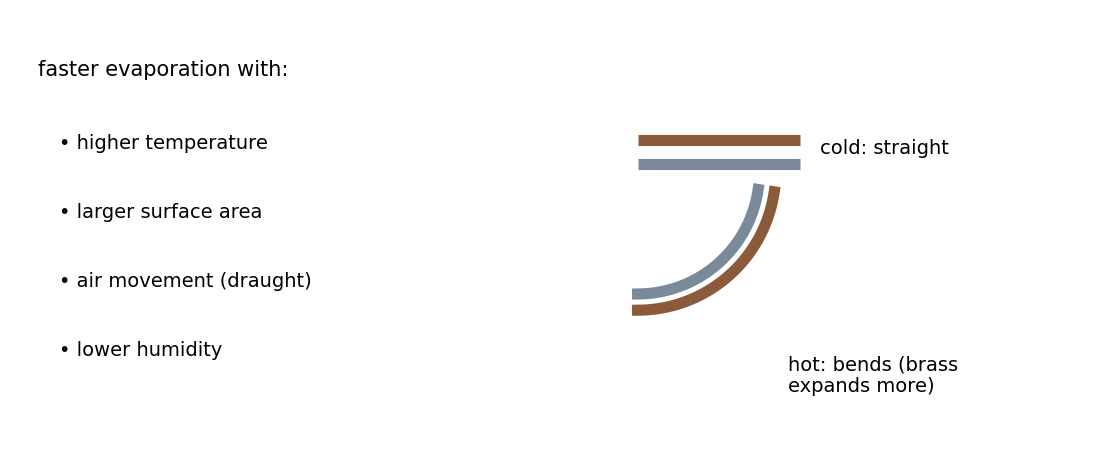
The rate of energy transfer by heating grows with surface area and volume, the material, the surface in contact, and the temperature difference. Design follows: cooling fins maximise area; animals' relative ear size matches climate. Most substances expand when heated — a hazard for roofs and bridges (gaps and rollers), useful in the bimetallic-strip thermostat that bends as one metal expands more and breaks a circuit.
Check yourself
- Describe the particle arrangement in a liquid.
- Define specific heat capacity.
- Calculate the energy to heat 2 kg of aluminium (c = 900) by 30 °C.
- (P) Why does the temperature stay constant while a substance freezes?
- (P) 0.5 kg of a substance has L_F = 330 000 J/kg. Calculate the energy to melt it.
- Explain conduction in metals, naming the extra carriers.
- Explain why warm water rises.
- Give three factors that speed evaporation.
- Give one hazard and one use of thermal expansion.
- Why do cooling fins have large surface area?
Answers: 1 particles touch but arranged randomly, moving past each other; 2 the energy needed to change the temperature of 1 kg of the substance by 1 °C; 3 $E = 2 \times 900 \times 30 = 54\,000$ J; 4 (P) the energy released as bonds form (latent heat of fusion) leaves at the same rate energy is removed, so the particles' kinetic energy is unchanged; 5 (P) $E = 0.5 \times 330\,000 = 165\,000$ J; 6 vibrating particles pass energy to neighbours, and free electrons carry energy quickly through the metal; 7 the warmer particles move apart, making that water less dense than its surroundings, so it rises; 8 higher temperature, larger surface area, air movement over the surface (also lower humidity); 9 hazard — expansion of bridges/roofs needs gaps; use — the bending bimetallic strip in a thermostat; 10 larger area transfers energy to the surroundings faster by heating.