Generating and distributing electricity
Move a magnet, move a current — a p.d. appears. OxfordAQA's sixth topic runs the full chain from the generator effect through the national grid's transformers to the appliances and safety systems of the home. All statements in this topic are Paper-2 (P).
OxfordAQA International GCSE Physics 9203, topic 3.6 (Version 5.1) — entirely (P) content.
Generating electricity (P)
The generator effect 发电机效应 induces a p.d. across a conductor that moves through a magnetic field, or sits in a changing field. Reverse the motion or the polarity and the induced p.d. reverses; the induced current's own field opposes the change. The p.d. grows with faster movement, stronger field, more turns and larger coil area.
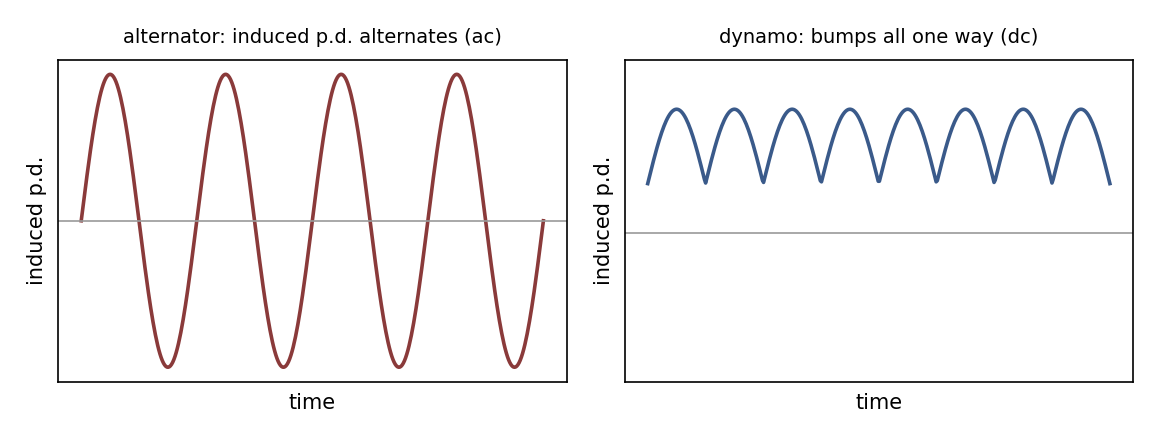
An alternator spins a coil in a field to make a.c.; a dynamo gives d.c. — know the p.d.–time graphs. Power stations spin turbines to turn coils between magnets.
Transmission, transformers and the home (P)
From the station to the socket, every watt travels the same chain of coils and cables.
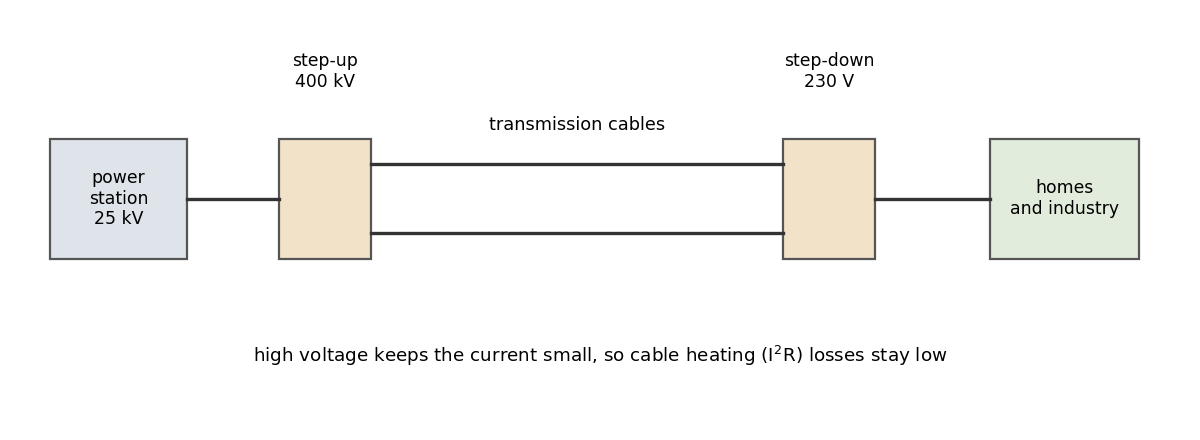
For a given power, high transmission voltage means low current and so little cable heating. A transformer 变压器 is two coils on a soft-iron core: alternating current in the primary makes a changing field that induces a p.d. in the secondary.
Step-up before the lines, step-down after; switch-mode transformers (50–200 kHz) are small and light — phone chargers.
Worked check. A transformer steps 25 kV up to 400 kV with 1000 primary turns: $n_s = 1000 \times 400/25 = 16\,000$ turns. At 100 MW the line current is $I = P/V = 10^8/(4 \times 10^5) = 250$ A.
Cells give d.c.; mains is a.c. with fixed frequency and voltage — read period and frequency from oscilloscope-style traces. Safety: earthing 接地 drains fault current from metal casings; a fuse 保险丝 melts or a circuit breaker trips on excess current — the breaker is faster and resettable; double-insulated appliances need no earth.
The motor effect (P)
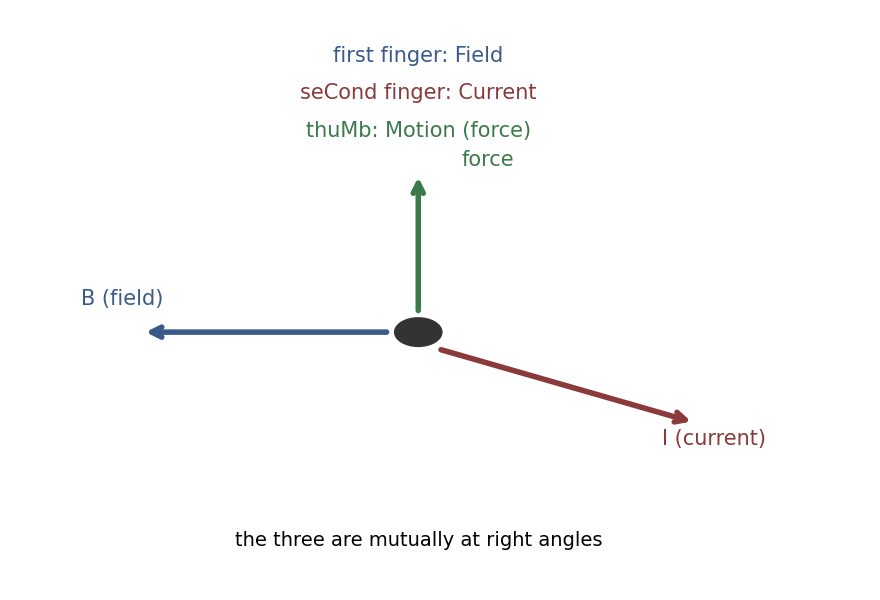
A current-carrying wire across a magnetic field feels a force (zero if parallel to it). Force grows with stronger field, bigger current and more wire in the field; reverse either to reverse the force — Fleming's left-hand rule 左手定则 predicts the direction.
A current-carrying coil in a field rotates — the electric motor.
Transferring electrical energy (P)
Appliance labels give power; compute the current to choose a fuse, and the energy in kilowatt-hours for billing (E = Pt; cost = kWh × price per unit, read from meter readings).
Worked check. A 2.0 kW heater for 3 h uses 6.0 kWh; at 0.9 per kWh that costs 5.4. A 230 V, 1.1 kW kettle draws I = 1100/230 ≈ 4.8 A — fit a 5 A or 13 A fuse (next rating above).
Check yourself
- State two ways to induce a p.d. in a conductor.
- Give three factors that increase the size of an induced p.d.
- Sketch the p.d.–time graphs of an alternator and a dynamo.
- Why does the grid transmit at high voltage?
- A transformer has 200 primary and 3000 secondary turns on 12 V a.c. Calculate the secondary p.d.
- State the turns-ratio and power equations for a 100 % efficient transformer.
- Explain how earthing and a fuse protect a user together.
- State Fleming's left-hand rule.
- Calculate the current of a 230 V, 2.3 kW heater, and a sensible fuse.
- Calculate the energy in kWh used by a 1.5 kW kettle in 20 minutes.
Answers: 1 move the conductor through a field; place it in a changing magnetic field; 2 faster motion; stronger field; more turns (also larger coil area); 3 alternator — a sine wave about zero; dynamo — humps all above (or all below) the axis; 4 for the same power the current is smaller, so I²R heating losses in the cables are far lower; 5 $V_s = 12 \times 3000/200 = 180$ V; 6 $V_p/V_s = n_p/n_s$ and $V_p I_p = V_s I_s$; 7 the earth wire gives the fault current a path to earth, and the surge blows the fuse, disconnecting the live wire; 8 first finger Field, second finger Current, thumb Motion — mutually at right angles; 9 I = 2300/230 = 10 A — use a 13 A fuse; 10 t = 1/3 h, so E = 1.5 × 1/3 = 0.5 kWh.