Nuclear physics
The nucleus is a millionth of the atom yet holds nearly all its mass — and unstable nuclei pour out energy as radiation, fission fragments, or the fusion that lights the stars. OxfordAQA's seventh topic covers the nuclear model, the three radiations, half-life, contamination versus irradiation, reactors and (P) fusion.
OxfordAQA International GCSE Physics 9203, topic 3.7 (Version 5.1). Statements marked (P) are Paper-2-only.
Atomic structure
An atom is about 10⁻¹⁰ m across: a tiny positive nucleus (protons and neutrons, nearly all the mass) with electrons around it — Rutherford's alpha-scattering evidence for the concentrated nucleus. Proton mass 1 charge +1; neutron mass 1 charge 0; electron charge −1, negligible mass. A neutral atom has equal protons and electrons; atoms lose or gain electrons to become ions.
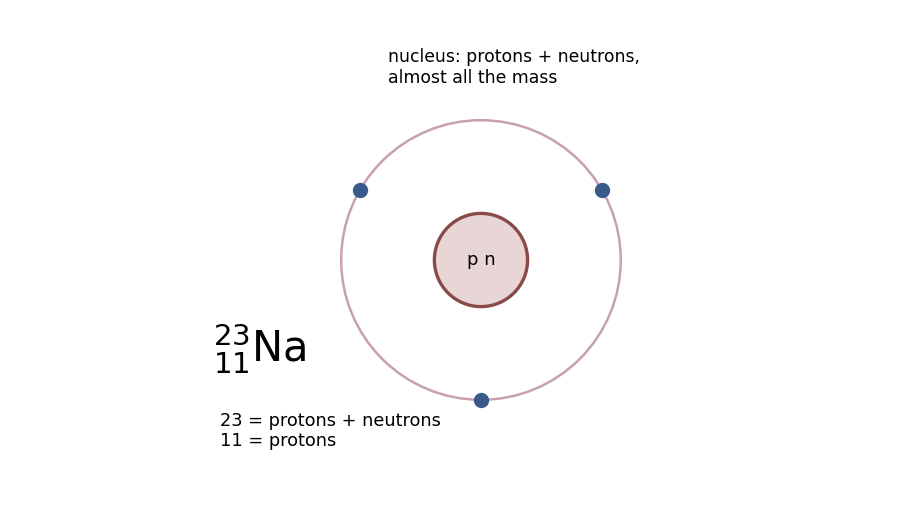
${}^{A}_{Z}X$: A = mass number (protons + neutrons), Z = proton number; isotopes share Z and differ in neutrons.
Ionising radiation from the nucleus
Unstable nuclei decay randomly, unaffected by chemistry or physics, emitting:
| Radiation | Nature | Ionising | Range in air |
|---|---|---|---|
| alpha | 2p + 2n (helium nucleus) | strongest | a few cm |
| beta-minus | fast electron (neutron → proton) | medium | tens of cm |
| gamma | electromagnetic wave | weakest | metres |
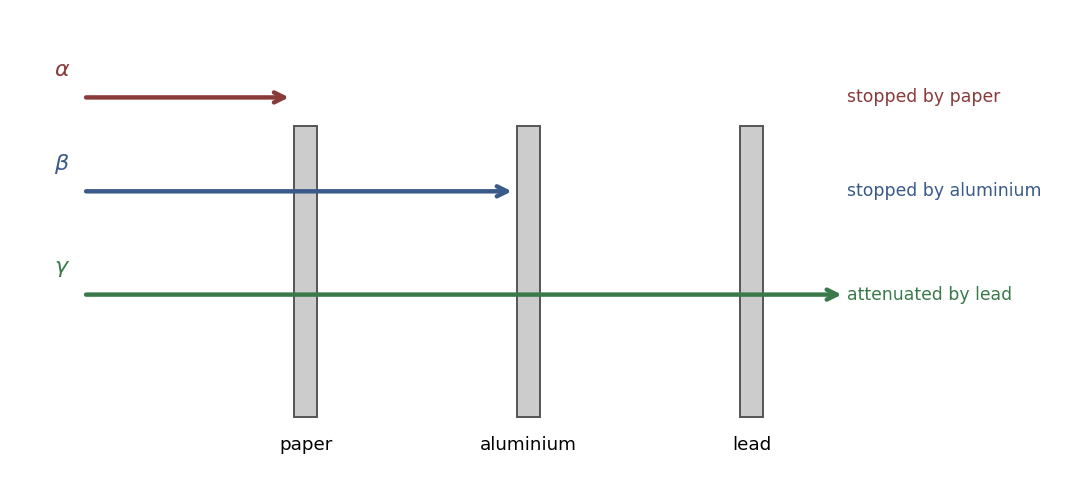
Nuclear equations conserve mass number and charge: ${}^{238}_{92}U \rightarrow\, {}^{234}_{90}Th +\, {}^{4}_{2}He$ (alpha); ${}^{14}_{6}C \rightarrow\, {}^{14}_{7}N +\, {}^{0}_{-1}e$ (beta). Background radiation comes from rocks, space, food and medical devices. (P) The half-life 半衰期 is the time for half the nuclei (or half the count rate) to decay — most unstable nuclei have short half-lives; the least unstable last millennia. Contamination 沾污 (radioactive atoms on you) is a lasting hazard; irradiation 照射 exposes without making you radioactive. Dangers: mutations, cell and tissue damage.
Nuclear fission and (P) fusion
Fission 裂变 splits a large unstable nucleus: U-235 or Pu-239 absorbs a neutron, splits into two smaller nuclei with 2–3 neutrons and far more energy than any chemical reaction. Neutrons striking further nuclei give a chain reaction; in a reactor control rods absorb neutrons to hold one fission per neutron.
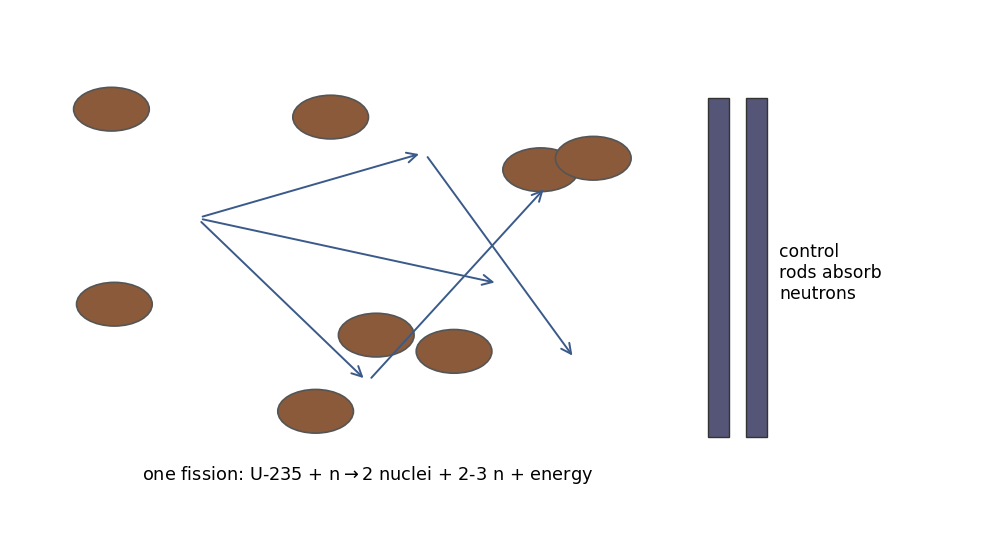
Radioactive waste stays dangerous for times set by its half-life — a managed-disposal cost of nuclear power. (P) Fusion 聚变 joins two light nuclei into a heavier one, converting mass to energy: it powers the stars, but positive nuclei repel, so it needs extreme temperature and pressure.
Check yourself
- Give the relative masses and charges of the proton, neutron and electron.
- In ${}^{19}_{9}F$, how many protons and neutrons?
- What did alpha scattering reveal about the atom?
- Name the three radiations and their natures.
- Which radiation is stopped by paper, and which penetrates aluminium?
- Balance the alpha decay of ${}^{226}_{88}Ra$.
- (P) Define half-life.
- (P) Explain the difference between contamination and irradiation.
- What do control rods do in a reactor?
- (P) Why does fusion need extreme temperatures?
Answers: 1 proton 1/+1; neutron 1/0; electron negligible/−1; 2 9 protons, 10 neutrons; 3 mass and positive charge concentrate in a tiny nucleus — most alphas pass, a few bounce; 4 alpha — helium nucleus; beta — fast electron; gamma — EM wave; 5 alpha; gamma (needs thick lead); 6 ${}^{226}_{88}Ra \rightarrow\, {}^{222}_{86}Rn +\, {}^{4}_{2}He$; 7 (P) the time for half the nuclei (or the count rate) to halve; 8 (P) contamination — radioactive material on you, a hazard until removed; irradiation — exposure to radiation, ending when the source leaves; 9 absorb neutrons, holding the chain to one fission per neutron — steady; 10 (P) positive nuclei repel; they must collide at enormous speed to fuse.