Forces and their effects
Every push, pull and hold in the world is a force — and OxfordAQA's first topic organises them: contact and non-contact interactions, scalars against vectors, Newton's three laws, vehicle safety, and the P-extension ideas of momentum, terminal velocity, centre of mass and moments.
OxfordAQA International GCSE Physics 9203, topic 3.1 (Version 5.1, exams 2018 onwards). Statements marked (P) are Paper-2-only; paper details are in the specification's scheme of assessment. The specimen components on file are 9203-92031 and 9203-92032 — specimen practice in this package is always labelled as such.
Forces and their interactions
Objects interact by non-contact field forces (gravity, electrostatics, magnetism) and contact forces (friction, air resistance, tension, normal contact force). Friction 摩擦 acts between two surfaces, impedes motion and may heat them; air resistance is friction with a fluid.
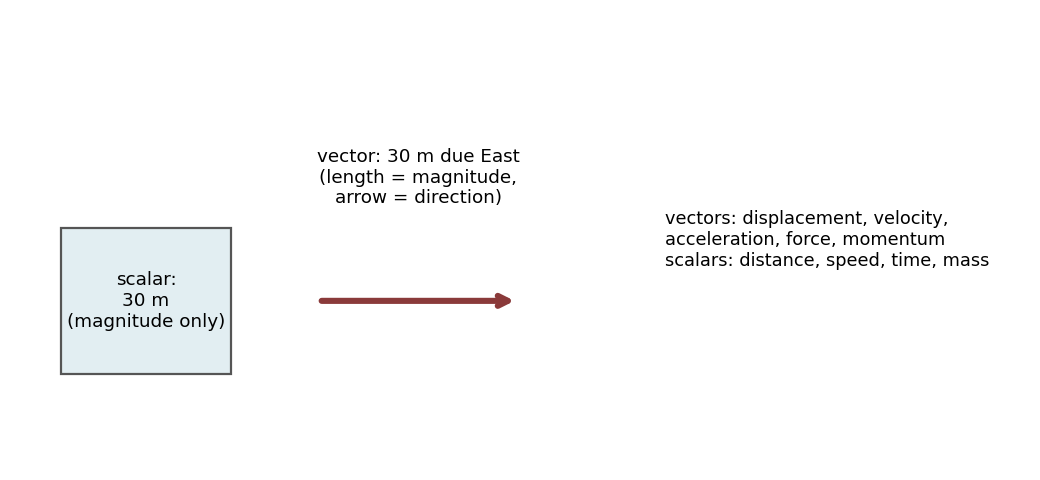
Scalars 标量 have magnitude only (distance, speed, time); vectors 矢量 add direction (displacement, velocity, acceleration, force, momentum) and can be drawn as arrows. Weight is the force of gravity: $W = m \times g$.
Forces can change shape — stretching, bending, compressing. Elastic distortions recover; inelastic ones do not (P). A stretched spring stores elastic potential energy, and below the limit of proportionality:
Required practical: investigate force against extension for a spring (hang masses, plot the line, gradient = k).
Motion and Newton's laws
Speed is the gradient of a distance–time graph; velocity adds direction: $v = s/t$ (usable for average speeds too). Acceleration is the rate of change of velocity: $a = \Delta v/t$ — from the gradient of a velocity–time graph, whose area gives distance travelled. Changing direction at constant speed is still acceleration.

- Newton's First Law: zero resultant force → rest stays rest, motion keeps its velocity.
- Newton's Second Law: $F = m \times a$ in the direction of the resultant.
- Newton's Third Law: interacting objects exert equal, opposite forces on each other.
Resultants: opposite or parallel forces add along a line; two coplanar forces combine by scale drawing (drawn to scale, head to tail).
(P) Momentum, safety and terminal velocity
Momentum 动量 is conserved in a closed system — collisions and explosions share a fixed total. Car safety: airbags, seat belts, side-impact bars, crumple zones, crash mats, cushioned playground surfaces and cycle helmets all lengthen the time of impact, so for the same momentum change the force is smaller.
At a steady speed the driving force balances resistive forces. Stopping distance = thinking + braking distance; reaction time grows with tiredness, distraction, drugs and alcohol; braking force must grow with speed, and large decelerations overheat brakes. Braking converts the vehicle's kinetic energy into heating the brakes (friction work); braking distance lengthens on wet or icy roads and with worn brakes or tyres.
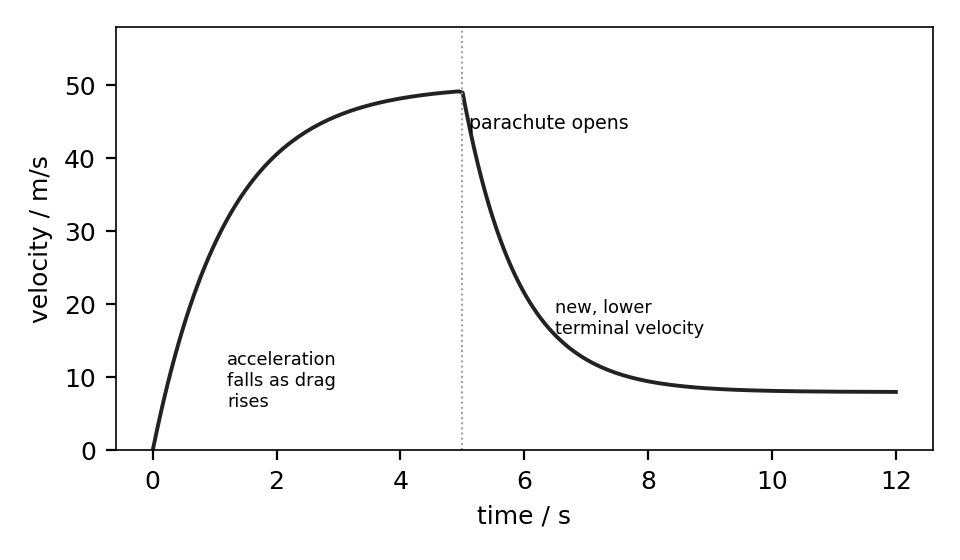
An object falling through a fluid accelerates until drag equals weight — terminal velocity 终末速度; parachutes raise drag to cut the terminal velocity, and streamlining (a shark's shape, a car's design) reduces drag to raise the maximum speed.
(P) Centre of mass and moments
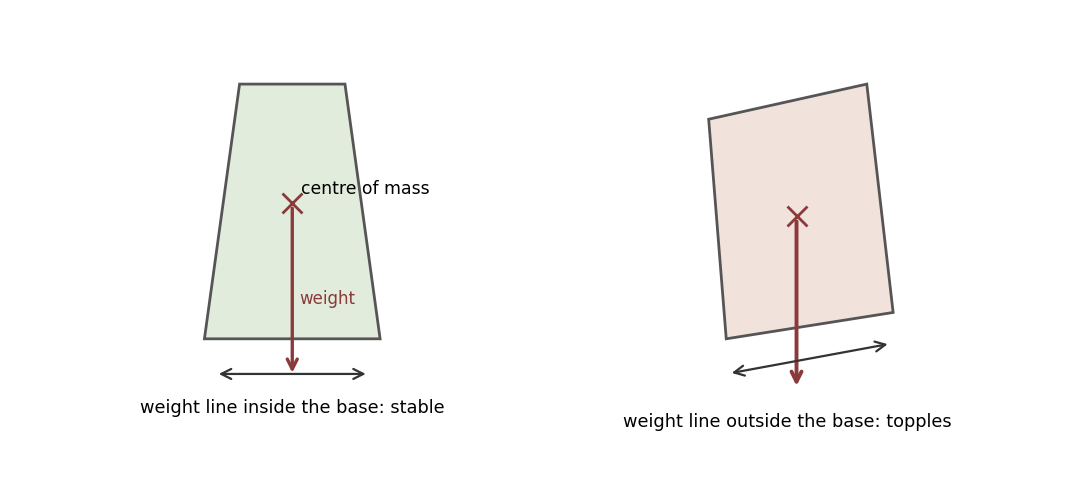
The centre of mass 质心 is where an object's mass may be thought concentrated; a freely suspended object rests with it below the suspension point, and a symmetrical object's centre of mass lies on the axis of symmetry. Find it for an irregular lamina by suspending it from two points and drawing plumb lines.
A balanced object has equal total clockwise and anticlockwise moments 力矩; levers are force multipliers. If the weight's line of action falls outside the base, the resultant moment topples the object (vehicles, balancing toys).
Check yourself
- Give one example each of a contact and a non-contact force.
- Which of these are vectors: speed, displacement, time, force?
- State the spring equation and the name of its constant.
- State Newton's three laws in one sentence each.
- A 900 kg car accelerates at 2 m/s². Calculate the resultant force.
- Name two factors that lengthen thinking distance and two that lengthen braking distance.
- (P) Explain how a crumple zone protects passengers, using F = Δp/t.
- (P) Why does a parachutist reach a lower terminal velocity after opening the parachute?
- (P) Where is the centre of mass of a symmetrical object?
- (P) A 250 N force acts 0.4 m from a pivot. Calculate its moment.
Answers: 1 contact — friction/tension/air resistance/normal; non-contact — gravity/electrostatic/magnetic; 2 displacement and force; 3 $F = ke$, the spring constant (N/m); 4 first — no resultant force means no change in velocity; second — $F = ma$ in the resultant's direction; third — interactions give equal and opposite forces; 5 $F = 900 \times 2 = 1800$ N; 6 thinking — tiredness, distractions, drugs/alcohol (any two); braking — wet or icy roads, worn brakes or tyres (any two); 7 (P) the crumple zone lengthens the collision time; for the same momentum change, $F = \Delta p/t$ is smaller, so less force reaches the passengers; 8 (P) the parachute greatly increases drag, so drag balances weight at a much lower speed; 9 (P) on its axis of symmetry; 10 (P) $M = 250 \times 0.4 = 100$ N m.