דלג לתוכן
נושאים

AQA · GCSE · Biology

תרגול כל המילים
  • 1

    ביולוגיה תאית

    1.1

    Cell biology: the unit of life

    Every living thing is built from cells, and the differences between them decide what each can do. This reference covers AQA GCSE Biology 8461, topic 4.1 Cell biology.

    How the exam treats this topic:

    • Paper 1 (4.1–4.4) carries Cell biology. Required practicals: RP1 (light microscope), RP2 (antiseptics/antibiotics on agar, biology only) and RP3 (osmosis in plant tissue).
    • Culturing microorganisms is biology only; standard-form answers for bacterial numbers are HT only.
    • Calculations the exam demands: magnification (image ÷ real), real size from image and magnification, area by πr², percentage change in mass, surface-area-to-volume ratio, bacterial division counts.
    1.1

    Cell structure: eukaryotes and prokaryotes

    סיילבוס

    מבנה תא, התמחות, מיקרוסקופיה ותרבות (AQA 8461 נקודות 4.1.1.1-4.1.1.6, RP1, RP2).

    1. תאר תאים צמחיים, בעלי חיים וחלקיקים, ומינה מבנים ותפקידיהם.
    2. קשר בין מבני תאים מיוחדים לתפקודיהם.
    3. הסבר על חשיבות ההתמחות התאית.
    4. חשב הגדלה, גודל אמיתי וגודל תמונה, עם ספרות סטנדרטית ופריפים.
    5. תאר טכניקה אseptית עם סיבות, ספירת חלוקת חיידקים ושטחי אזורים (ביולוגיה בלבד).

    מקור: הסיילבוס הבינלאומי של קמבריד'ג'

    An animal cell, a plant cell and a bacterial cell with their key structures labelled.
    Learn the labels — the exam asks you to name and function them.
    Structure Function
    nucleus genetic material (DNA); controls the cell
    cytoplasm jelly where reactions happen
    cell membrane controls what enters and leaves
    mitochondria aerobic respiration releases energy
    ribosomes protein synthesis
    chloroplast (plant) photosynthesis
    permanent vacuole (plant) cell sap, keeps the cell firm
    cell wall (plant, cellulose) strength and support
    • Eukaryotic 真核 cells (plant and animal): genetic material enclosed in a nucleus.
    • Prokaryotic 原核 cells (bacteria) are much smaller; cytoplasm and cell membrane surrounded by a cell wall; genetic material is not in a nucleus — a single DNA loop plus one or more plasmids (small rings of DNA).

    Scale: use the prefixes centi (10⁻²), milli (10⁻³), micro (10⁻⁶), nano (10⁻⁹) and order-of-magnitude comparisons in standard form.

    מילון מונחים אימון
    English עברית
    eukaryotic/ˌjuːkərɪˈɒtɪk/ אוקאריטי
    prokaryotic/ˌprɒkərɪˈɒtɪk/ פרוקאריטי
    1.1

    Cell specialisation, differentiation and microscopy

    סיילבוס

    מבנה תא, התמחות, מיקרוסקופיה ותרבות (AQA 8461 נקודות 4.1.1.1-4.1.1.6, RP1, RP2).

    1. תאר תאים צמחיים, בעלי חיים וחלקיקים, ומינה מבנים ותפקידיהם.
    2. קשר בין מבני תאים מיוחדים לתפקודיהם.
    3. הסבר על חשיבות ההתמחות התאית.
    4. חשב הגדלה, גודל אמיתי וגודל תמונה, עם ספרות סטנדרטית ופריפים.
    5. תאר טכניקה אseptית עם סיבות, ספירת חלוקת חיידקים ושטחי אזורים (ביולוגיה בלבד).

    מקור: הסיילבוס הבינלאומי של קמבריד'ג'

    Specialised cells relate structure to function (learn one feature ↔ one advantage each):

    Cell Adaptation Function
    sperm cell tail for swimming, many mitochondria, acrosome with enzymes fertilisation
    nerve cell long axon, insulating sheath carrying impulses
    muscle cell many proteins fibres, many mitochondria contraction
    root hair cell large surface area, thin wall absorbing water and minerals
    xylem cell hollow, lignified walls, no end walls transporting water
    phloem cell sieve plates, few organelles transporting sugars

    Differentiation 分化: cells acquire different sub-cellular structures to become specialised. Animal cells differentiate mostly at an early stage; plant cells throughout life. In mature animals, cell division is mainly for repair and replacement.

    Microscopy: a light microscope uses lenses; an electron microscope has much higher magnification and resolving power 分辨能力, so far more sub-cellular structures could be seen and understood.

    $$\text{magnification} = \frac{\text{size of image}}{\text{size of real object}}$$

    Worked example. A cell image is 4.8 cm wide at magnification ×1200.

    • Convert first: $4.8\ \text{cm} = 4.8\times10^{-2}$ m $= 48\,000\ \mu\text{m}$.
      $$\text{real size} = \frac{\text{image size}}{\text{magnification}} = \frac{48\,000\ \mu\text{m}}{1200} = 40\ \mu\text{m}$$

    RP1: observe, draw and label plant and animal cells with a magnification scale included (e.g. a scale bar or the printed magnification).

    מילון מונחים אימון
    English עברית
    Differentiation/ˌdɪfəˌrenʃɪˈeɪʃn/ התמיינות
    resolving power/rɪˈzɒlvɪŋ ˈpaʊə/ יכולת פירוק
    1.1

    Culturing microorganisms (biology only)

    סיילבוס

    מבנה תא, התמחות, מיקרוסקופיה ותרבות (AQA 8461 נקודות 4.1.1.1-4.1.1.6, RP1, RP2).

    1. תאר תאים צמחיים, בעלי חיים וחלקיקים, ומינה מבנים ותפקידיהם.
    2. קשר בין מבני תאים מיוחדים לתפקודיהם.
    3. הסבר על חשיבות ההתמחות התאית.
    4. חשב הגדלה, גודל אמיתי וגודל תמונה, עם ספרות סטנדרטית ופריפים.
    5. תאר טכניקה אseptית עם סיבות, ספירת חלוקת חיידקים ושטחי אזורים (ביולוגיה בלבד).

    מקור: הסיילבוס הבינלאומי של קמבריד'ג'

    Bacteria multiply by binary fission 二分裂 as often as once every 20 minutes with enough nutrients and a suitable temperature. They grow in nutrient broth or as colonies on agar gel.

    Aseptic technique 无菌操作 (each point earns a mark — know the why):

    • sterilise Petri dishes and culture media before use — kills unwanted microorganisms;
    • flame the inoculating loop before transferring bacteria — kills contaminants on the loop;
    • secure the lid with adhesive tape and store upside down — stops airborne contamination and condensation dripping;
    • in schools, incubate at a maximum of 25 °C — prevents growth of pathogens harmful to humans.

    Worked example (division count). One bacterium divides every 20 minutes for 3 hours.

    • 3 hours = 180 min = 9 division times; number $= 2^9 = 512$.

    Worked example (zone area). A clear zone of radius 4 mm around an antibiotic disc.

    $$A = \pi r^2 = \pi \times 4^2 = 50\ \text{mm}^2\ \text{(2 s.f.)}$$

    RP2: effect of antiseptics/antibiotics on bacterial growth — measure zones of inhibition with a ruler (several diameters, mean, ÷2), controls with no substance.

    מילון מונחים אימון
    English עברית
    binary fission/ˈbaɪnəri ˈfɪʃn/ חלוקה בינארית
    Aseptic technique/æˈseptɪk tekˈniːk/ טכניקה אseptית
    1.2

    Cell division: chromosomes, mitosis and the cell cycle

    סיילבוס

    חילוק תא ותאי גזע (AQA 8461 נקודות 4.1.2.1-4.1.2.3).

    1. תאר כרומוזומים והתאמתם בתאי גוף.
    2. תאר את מחזור התא כולל שלושת השלבים הכלליים והמיטוזה.
    3. תאר את תפקוד תאי הגזע ב эмбриונים, בעלי חיים מבוגרים ובמריסטמות צמחים.
    4. שקול שימוש בתאי גזע ברפואה ובשכפול צמחים, כולל סיכונים והתנגדויות אתיות.

    מקור: הסיילבוס הבינלאומי של קמבריד'ג'

    • The nucleus contains chromosomes 染色体 made of DNA; each chromosome carries many genes; body cells have chromosomes in pairs (humans: 23 pairs).
    • The cell cycle: DNA replicates → growth (more ribosomes and mitochondria) → mitosis 有丝分裂 (one set of chromosomes pulled to each end; nucleus divides) → cytoplasm and membranes divide → two identical cells.

    Mitosis matters for growth and development of multicellular organisms, and repair. Recognise contexts where mitosis is occurring (a growing root tip, healing skin, a tumour).

    מילון מונחים אימון
    English עברית
    chromosomes/ˈkrəʊməsəʊmz/ כרומוזומים
    mitosis/maɪˈtəʊsɪs/ מיטוזה
    1.2

    Stem cells

    סיילבוס

    חילוק תא ותאי גזע (AQA 8461 נקודות 4.1.2.1-4.1.2.3).

    1. תאר כרומוזומים והתאמתם בתאי גוף.
    2. תאר את מחזור התא כולל שלושת השלבים הכלליים והמיטוזה.
    3. תאר את תפקוד תאי הגזע ב эмбриונים, בעלי חיים מבוגרים ובמריסטמות צמחים.
    4. שקול שימוש בתאי גזע ברפואה ובשכפול צמחים, כולל סיכונים והתנגדויות אתיות.

    מקור: הסיילבוס הבינלאומי של קמבריד'ג'

    A stem cell 干细胞 is an undifferentiated cell that can give rise to many more of the same type and, by differentiation, to other cell types.

    Source Can become
    embryo most types of human cell
    adult bone marrow many cells, including blood cells
    plant meristems any type of plant cell, throughout life

    Uses and evaluation (the credited pairs — benefit and risk/objection):

    • Medicine: potential treatment for diabetes and paralysis; therapeutic cloning makes an embryo with the patient's own genes, so cells are not rejected.
    • Risks/ethics: transfer of viral infection; ethical and religious objections to using embryos.
    • Plants: meristem clones — rare species preserved from extinction; disease-resistant crops cloned quickly and economically.
    מילון מונחים אימון
    English עברית
    stem cell/stem sel/ תא גזעי
    1.3

    Transport in cells

    סיילבוס

    הובלה בתאים (AQA 8461 נקודה 4.1.3, RP3).

    1. הגדר תרופה, אוסמוזה והובלה פעילה עם דוגמאות והבחנה באנרגיה.
    2. הסבר גורמים המשפיעים על קצב התרופה.
    3. חשב והשוו יחסי שטח פנימי למסה; הסבר התאמות במשטחי החלפה.
    4. בדוק את השפעת ריכוז המומס על מסת רקמת צמח וחשב שינוי אחוזי (RP3).

    מקור: הסיילבוס הבינלאומי של קמבריד'ג'

    Process Direction Energy Examples
    diffusion 扩散 high → low concentration (net) no O₂/CO₂ in gas exchange; urea from cells to blood plasma
    osmosis 渗透 water from dilute → concentrated solution through a partially permeable membrane no water into plant cells
    active transport 主动运输 low → high (against the gradient) yes — from respiration mineral ions into root hairs; glucose from gut to blood

    Rate of diffusion increases with: concentration gradient, temperature, surface area of the membrane.

    Diffusion, osmosis and active transport compared in three panels.
    Direction and energy separate the three processes.
    Two cubes showing how doubling the side halves the surface-area-to-volume ratio.
    Bigger organisms need exchange surfaces.

    Surface area to volume ratio: single-celled organisms have a large SA:V — enough exchange across the surface alone. Multicellular organisms need exchange surfaces and a transport system. Exchange surfaces are effective by: large surface area, thin membrane (short diffusion path), (animals) good blood supply, (animals, gas exchange) ventilation.

    Adapted exchange surfaces to know: small intestine and lungs in mammals, gills in fish, roots and leaves in plants.

    Worked example (SA:V). A cube of side 2 mm: SA $= 6\times2^2 = 24$ mm², V $= 8$ mm³, SA:V $= 3:1$. A cube of side 4 mm: SA $= 96$, V $= 64$, SA:V $= 1.5:1$ — doubling the side halves the ratio.

    RP3 (osmosis): potato pieces (same surface area, blotted dry, exact masses) in a range of sugar or salt solutions; measure percentage change in mass:

    $$\%\ \text{change} = \frac{\text{change in mass}}{\text{initial mass}} \times 100$$

    Interpretation: gain in dilute solutions (water enters); no change where the solution matches the cell concentration; loss in concentrated solutions (water leaves). Control variables: volume of solution, temperature, time, surface area.

    מילון מונחים אימון
    English עברית
    diffusion/dɪˈfjuːʒn/ פיזור
    osmosis/ɒzˈməʊsɪs/ אוסמוזה
    active transport/ˈæktɪv ˈtrænspɔːt/ הובלה פעילה
    1.3

    Checklist before you call this topic done

    • Label animal, plant and bacterial cells; match every structure to its function.
    • Specialised cells: one structural feature linked to one function each.
    • Magnification, real size and image size — convert units before dividing.
    • Aseptic technique whys; binary-fission counts; πr² zones (RP1, RP2).
    • Cell cycle stages and where mitosis occurs; stem cell sources with benefits and risks.
    • Diffusion, osmosis, active transport: direction, energy, examples; the three rate factors.
    • SA:V calculations; four exchange-surface features; percentage change in mass (RP3).
  • 2

    ארגון

    2.1

    ארגון: מתאים למערכות

    תאים יוצרים רקמות, רקמות יוצרות איברים, איברים יוצרים מערכות – ומערכת העיכול, הדם והצמחים מציגים כל אחד את הדפוס הזה. פרט זה מכסה AQA GCSE Biologia 8461, נושא 4.2 ארגון.

    כיצב המבחן מטפל בנושא זה:

    • מס' 1 כולל את נושא הארגון. ניסויים חובה: RP4 (מבחני מזון) ו-RP5 (pH וקצב אמילאז).
    • עליך להעריך טיפולים למחלות לב ולנתח נתוני סיכונים הקשורים לתאי גזע/סגנון חיים, וכן לפרש גרפים וטבלאות של גורמי סיכון.
    • להיזכר במדויק: טבלת האנזימים, כלי הלב, רכיבי הדם, רקמות צמחים וגורמי אידוי-היערות (טרנספיציה).
    מילון מונחים אימון
    English עברית
    enzyme/ˈenzaɪm/ אנזים
    tissue/ˈtɪʃuː/ רקמה
    organ/ˈɔːɡən/ איבר
    organ systems/ˈɔːɡən ˈsɪstəmz/ מערכות איברים
    Bile/baɪl/ נוזל מרה
    alveoli/ˈælvɪɒli/ אלבוליות
    plasma/ˈplæzmə/ פלזמה
    red blood cells/red blʌd selz/ תאי דם אדומים
    white blood cells/waɪt blʌd selz/ תאי דם לבנים
    platelets/ˈpleɪtlɪts/ פלאטות דם
    stents/stents/ סטנטים
    statins/ˈstætɪnz/ סטטינים
    Risk factors/rɪsk ˈfæktəz/ גורמי סיכון
    palisade mesophyll/ˈpælɪseɪd ˈmesəfɪl/ בלוטה מסודרת
    Xylem/ˈzaɪləm/ עץ
    Phloem/ˈfləʊɪm/ קליפה פנימית
    Guard cells/ɡɑːd selz/ תאי שמירה
    stomata/ˈstəʊmətə/ נקבוביות נשימה
    Transpiration/trænspəˈreɪʃn/ אידוי
    translocation/trænsləʊˈkeɪʃn/ העברה
    2.1

    עקרונות הארגון

    סיילבוס

    עקרונות ארגון ומערכת העיכול (AQA 8461 ניסוחים 4.2.1-4.2.2.1, RP4, RP5).

    1. סדר תאים, רקמות, איברים, מערכות איברים ובעלי חיים.
    2. תאר את טבע האנזימה ופעולת מנעול-מפתח; קשר פעילות לטמפרטורה ול-pH.
    3. זכר מקומות ופעולות של אמילאז, פרוטאזות וליפאזות, עם משוואות מילים.
    4. הסבר שתי פונקציות של נוזל הכיתרה; בדיקת מזונות (RP4) ובדיקת השפעת pH על אמילאז (RP5).

    מקור: הסיילבוס הבינלאומי של קמבריד'ג'

    תאים → רקמות → איברים → מערכות איברים → אורגניזם.

    • רקמה היא קבוצת תאים בעלת מבנה ותפקוד דומים.
    • איבר הוא אוסף רקמות המבצע פונקציות ספציפיות.
    • מערכות איברים פועלות יחד כדי ליצור את האורגניזם השלם.

    מערכת העיכול היא הדוגמה המפורשת למערכת איברים.

    2.1

    מערכת העיכול האנושית (4.2.2.1)

    סיילבוס

    עקרונות ארגון ומערכת העיכול (AQA 8461 ניסוחים 4.2.1-4.2.2.1, RP4, RP5).

    1. סדר תאים, רקמות, איברים, מערכות איברים ובעלי חיים.
    2. תאר את טבע האנזימה ופעולת מנעול-מפתח; קשר פעילות לטמפרטורה ול-pH.
    3. זכר מקומות ופעולות של אמילאז, פרוטאזות וליפאזות, עם משוואות מילים.
    4. הסבר שתי פונקציות של נוזל הכיתרה; בדיקת מזונות (RP4) ובדיקת השפעת pH על אמילאז (RP5).

    מקור: הסיילבוס הבינלאומי של קמבריד'ג'

    אנזימים הם זרז ביולוגיים: חלבונים עם אתר פעיל שמבנהו מתאים לסובסטראט אחד — מודל מנעול ומפתח. טמפרטורה ו-pH משנים את הקצב; הרחק מהמיטום האנזים מתפרק (האתר הפעיל משנה צורה).

    אנזים נוצר ב- פועל על מוצרים
    אמילאז (קריטוקסייד) בלוטות חוליות, לבלב, מעי דק עמלאן פחמימות פשוטות (גלוקוז)
    פרוטאז קיבה, לבלב, מעי דק חלבון חומצות אמינו
    ליפאז לבלב, מעי דק שומנים גליצרול + 3 חומצות שומן

    אנזימי עיכול ממירים מזון למולקולות קטנות ומומסות שיכולות להיות ספוגות לזרם הדם. המוצרים בונים פחמימות, שומנים וחלבונים חדשים; חלק מהגלוקוז משמש בתהליך הנשימה.

    נוזל מרה: נוצר ב-כבד, מאוחסן ב-כיס המרה. הוא בסיסי, ומנטרל את חומצה הידרוכלורית מהקיבה, וכן מ emulsifies שומן לגופיות קטנות, מגדיל את השטח הפנימי — שתי פעולות אלו מעלות את קצב פירוק השומן על ידי ליפאז.

    מבחני מזון RP4 (ללמוד את הריאגנט, השינוי בצבע והחומר):

    מבחן ריאגנט תוצאה חיובית
    סוכרים (מפחיתים) בנדיקט, חימום כחול → אדום-לבני
    עמלאן יוד כתום/חום-זהוב → כחול-שחור
    חלבון ביורט כחול → סגול
    שומנים סודן III שכבה צבועה באדום בחלק העליון

    RP5 (pH ואמילאז): פתרונות מרצף בערכי pH, אמילאז + עמילן, דגימה רציפה על משטח נקודות עם יוד, הקלטת הזמן להיעלמות העמילן — זמן קצר ביותר = קצב מהיר ביותר בטווח ה-pH האופטימלי.

    2.2

    הלב, כלי הדם והדם (4.2.2.2–4.2.2.3)

    סיילבוס

    לב, כלי דם, דם ומחלת לב coronary (AQA 8461 ניסוחים 4.2.2.2-4.2.2.4).

    1. תאר את הלב ואת מחזור הדם הכפול עם חמישה כלי דם נקובים ותאי הקצב.
    2. קשר מבנה עורקים, ורידים ושיעריות לפונקציה שלהן.
    3. היכרות עם פלזמה, תאי דם אדומים, תאי דם לבנים וצליות עם ההתאמויות שלהן.
    4. הסבר CHD והערכת סטנטים, סטטינים, שקפידים, שתלים ולב מלאכותי.

    מקור: הסיילבוס הבינלאומי של קמבריד'ג'

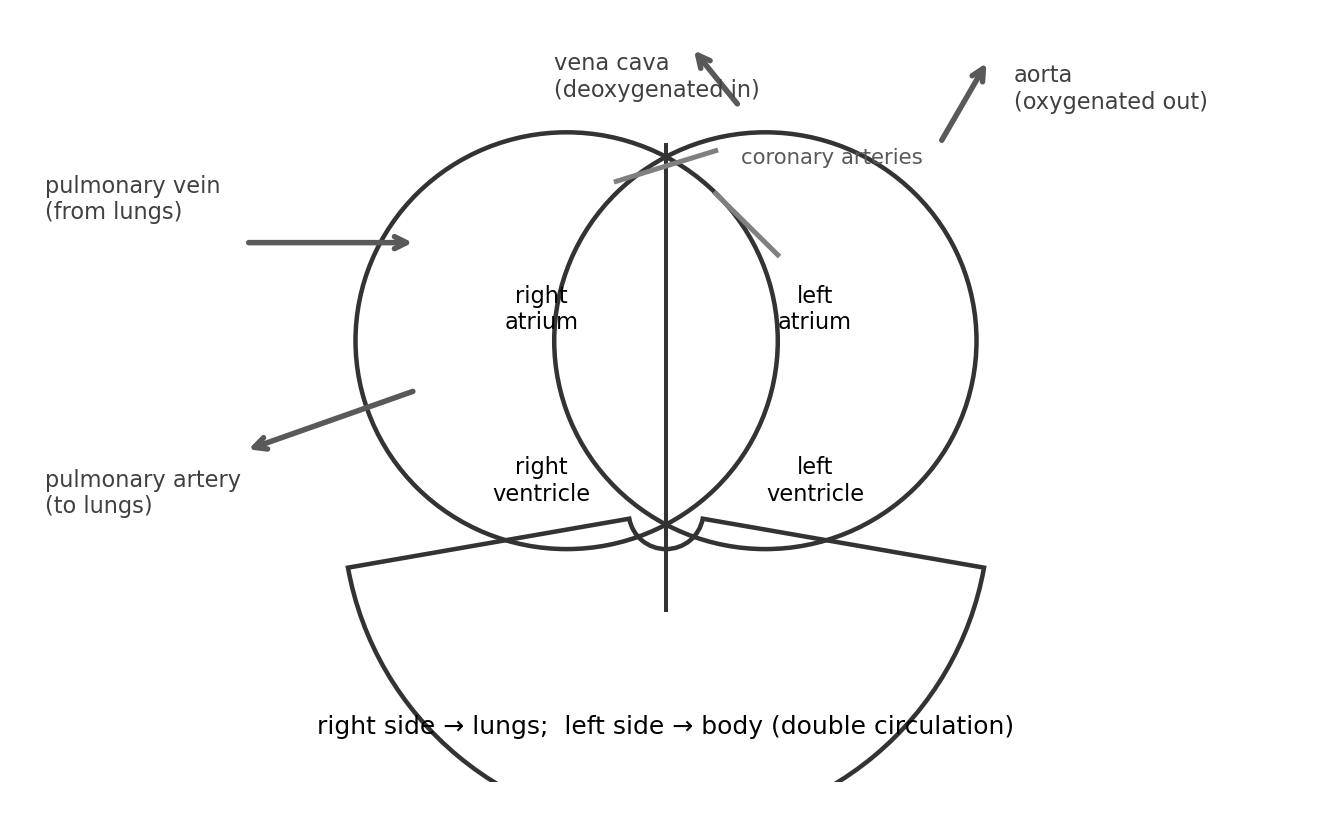
    הלב האנושי עם ארבע החדרים וחמישה כלי דם המכונים.
    הצד הימני לריאות; הצד השמלי לגוף.
    • הלב מדחס את הדם במערכת מחזורית דו-שלבית: החדר הימני מדחס את הדם לריאות (החלפת גזים); החדר השמלי מדחס אותו בכל שאר הגוף.
    • כלי דם שיש לדעת: אורטה, ונה תחתונה, ערום ריאתי, ונה ריאתית, ערומים קורונריים.
    • קצב לב רגעי נקבע על ידי תאים בחדר הימני — המופע הטבעי; מופעים מלאכותיים מתקנים קצבים לא סדירים.
    • ריאות: קנה האוויר → ברונחות → אלвеולים, המוקפים בשרידיות; אלveoli מותאמות על ידי שטח פני גדול, דפנות דקות, אספקת דם טובה ונשימה.
    כלי דם מבנה פונקציה
    ערום דפנות עבות, אלסטיות, שריריות; פתח קטן מעביר דם רחוק בלחץ גבוה
    ונה דפנות דקות, פתח גדול, שסתומים מחזירה דם בלחץ נמוך
    שרידית עובי תאי אחד החלפה עם רקמות
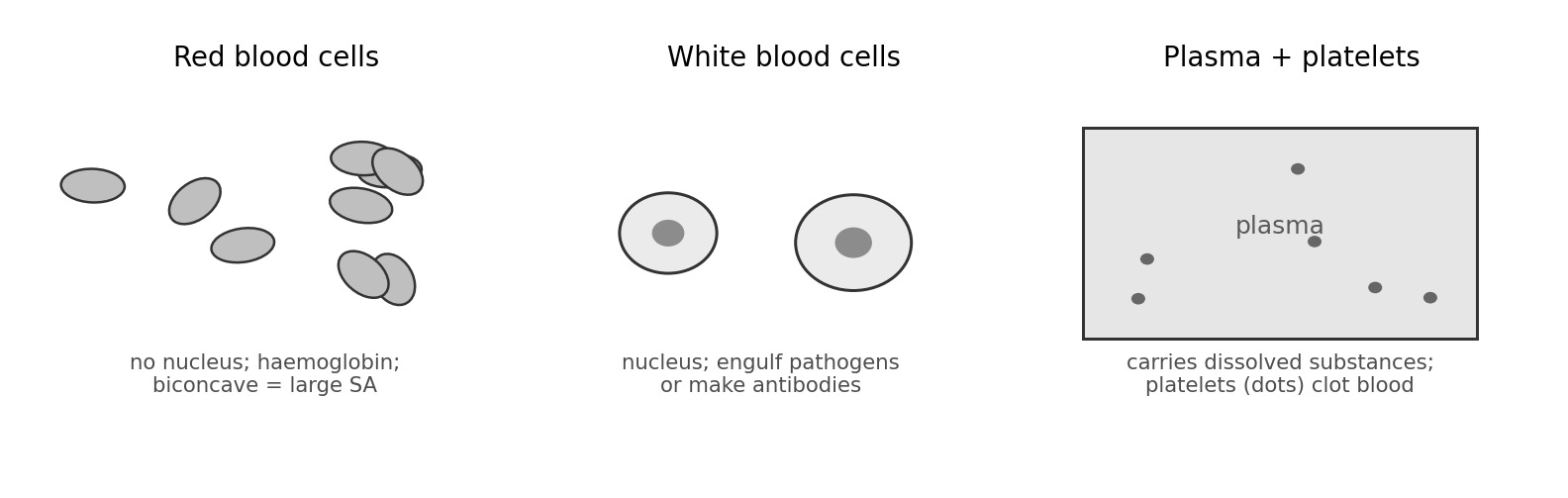
    תאי דם אדומים, תאי דם לבנים, פלזמה וצלעיות.

    הדם הוא רקמה: פלזמה (מעבירה סוכרים מומסים, חומצות אמינו, CO₂, מרה, הורמונים וחום), תאי דם אדומים (ללא גרעין, מלאים בהמוגלובין, בצורת צלחתית — שטח פני גדול למעבר חמצן), תאי דם לבנים (בולעים חיידקים או מייצרים אנטיגורים), צלעיות (קרישת דם).

    2.2

    מחלת לב קורונרית (4.2.2.4) וטיפולים

    סיילבוס

    לב, כלי דם, דם ומחלת לב coronary (AQA 8461 ניסוחים 4.2.2.2-4.2.2.4).

    1. תאר את הלב ואת מחזור הדם הכפול עם חמישה כלי דם נקובים ותאי הקצב.
    2. קשר מבנה עורקים, ורידים ושיעריות לפונקציה שלהן.
    3. היכרות עם פלזמה, תאי דם אדומים, תאי דם לבנים וצליות עם ההתאמויות שלהן.
    4. הסבר CHD והערכת סטנטים, סטטינים, שקפידים, שתלים ולב מלאכותי.

    מקור: הסיילבוס הבינלאומי של קמבריד'ג'

    ב-CHD שכבות של חומר שומני מצטברות בתוך הערומים הקורונריים, צימצום הנקב שלהם — דם פחות, ולכן חמצן פחות לשריר הלב. שערך כל טיפול עם יתרונות וסיכונים:

    טיפול יתרון סיכון/מגבלה
    סטנטים שומר על הערום פתוח, משחזר זרימה סיכון ניתוח; אינו מטפל בתסמנת
    סטטינים מפחיתים כולסטרול בדם, מאטילים הפקעות שומניות תרופה לטווח ארוך עם תופעות לוואי (כבד)
    החלפת שסתום (ביולוגית או מכנית) משחזרת זרימה חד-כיוונית ניתוח כירורגי מורכב; שסתומים מכניים דורשים טיפול אנטי-קרישתי לאורך חיים
    השתלה (לב / לב וריאות) מטפלת בכשל מחסור בתורמים; דחייה — תרופות דיכוי חיסוני
    לב מלאכותי משמר את חיי המטופל בזמן ההמתנה, או מאפשר ללב להירגע זיהום, קרישה, נפח גדול
    2.3

    בריאות, אורח חיים סרטן (4.2.2.5–4.2.2.7)

    סיילבוס

    בריאות, סגנון חיים וסרטן (AQA 8461 ניסוחים 4.2.2.5-4.2.2.7).

    1. הגדר בריאות ותאר אינטראקציות בין מחלות וגורמים אחרים.
    2. ציין גורמי סיכון עם מכניזמים סיבתיים מוכחים למחלות לא-מדבקות.
    3. הבדל בין גידולים benign לממalignant ותאר גידולים משניים.
    4. פרשנת נתוני גורמי סיכון, בהבחנה בין קורלציה לסיבתיות.

    מקור: הסיילבוס הבינלאומי של קמבריד'ג'

    בריאות היא מצב של רווחה פיזית ונפשית — ולא רק היעדר מחלה. תזונה, מתח ותנאי חיים משפיעים על שניהם; מחלות שונות מקיימות אינטראקציות (פגמי חיסון → זיהומים מוגברים; וירוסים → חלק מהסרטנים; תגובות חיסוניות מגרות אסטמה; מחלה פיזית חמורה → דיכאון).

    גורמי סיכון קשורים לשיעור מוגבר של מחלה — היבטים של אורח חיים או חומרים בגוף/סביבה. מנגנון סיבתי הוכח לחלק מהם, ולא לאחרים: תזונה/סי smoking/פעילות גופנית → מחלות לב וכלי דם; השמנת יתר → סוכרת מסוג 2; אלכוהול → פגיעה בכבד ותפקוד המוח; סי smoking → מחלת ריאה וסרטן ריאה; סי smoking ואלכוהול → עוברים לשפכים; קרצינוגנים כולל קרינה יונים → סרטן. יש לפרש נתוני גורמי סיכון כקורלציה; מנגנון סיבתי מוכח הופך אותם לסבבתי."

    סרטן נובע משינויים בתאים המובילים לגידול וחלוקה בלתי נשלטים:

    • גידולים שפירים: מוגבלים לאזור אחד, לרוב בתוך ממברנה; אינם פולשים.
    • גידולים סרטניים (סרטנים) פולשים לרקמות שכנות ומתפשטים בדם ליצירתגידולים משני."

    גורמי הסיכון כוללים אורח חיים ובמקרה של חלק מהסרטנים, גנים."

    2.4

    רקמות צמחים והובלה (4.2.3)

    סיילבוס

    רקמות, איברים והובלה בצמחים (AQA 8461 ניסוח 4.2.3).

    1. קשר בין רקמות צמח (אפידרמיס, פלישית, ספוגית, עצב שדרה, עצב פלואם, מריסטמה, תאי שמירה) לפונקציותיהן.
    2. הסבר על התאמת שיער השורש, עצב שדרה ועצב פלואם, ותהליכי ההתנפחות והעברה.
    3. הסבר על השפעת הטמפרטורה, הלחות, תנועת האוויר ועוצמת האור על קצב ההתנפחות.

    מקור: הסיילבוס הבינלאומי של קמבריד'ג'

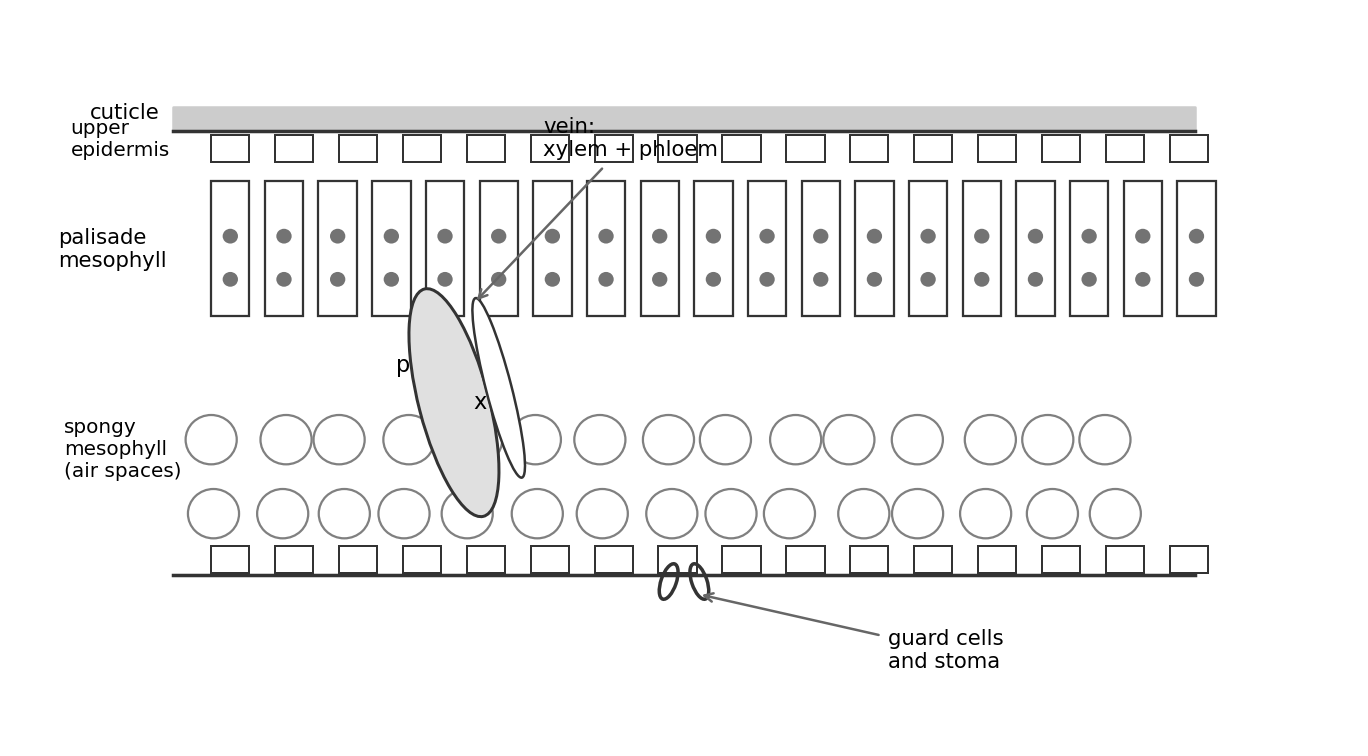
    עלה במבט רוחב עם הרקמות מסומנות.
    לכל רקמה יש משימה ראשית אחת.
    • רקמת אפידרמיס: כיסוי מגן; קטיקה שעוויתית למעלה.
    • מצע פלסודי: פלסטידים צפופים — הרוב בפוטוסינתזה.
    • מצע ספוגי: חללי אוויר להחלפת גזים.
    • קסילמה: צינורות חלולים מחוזקים בליגנין — מעבירה מים ויוני מינרלים מהשורשים לעלים בזרם האידוי."
    • פלואמה: צינורות מסננת — מעבירה סוכרים מומסים מהעלים לכל שאר הצמח (העברה)."
    • מריסטמה: בקצוות הגדלים של הענפים והשורשים (תאי גזע).
    • תאי שמירה מקיפים נקבוביות, ושולטים בהחלפת גזים ואובדן מים.
    • תאי שורש: שטח פנים גדול; מים נכנסים באמצעות אוזמוזה, יוני מינרלים באמצעות הובלה פעילה.

    אידוי הוא איבוד אדים ממימניות (בעיקר דרך נקבוביות); הוא גורם למשיכת זרם האידוי. הקצב עולה עם: טמפרטורה ↑, תנועת אוויר ↑, עוצמת אור ↑ (פתיחת נקבוביות); יורד עם לחות ↑. ניתן למדוד את הקצב על ידי כניסת מים באמצעות פוטומטר.

    2.4

    רשימת בדיקה לפני סיום נושא זה

    • סדר תאים → רקמות → איברים → מערכות עם דוגמה אחת לכל קטגוריה.
    • טבלת אנזימים: שם, מקום, מצע, מוצרים; מנגנון מנעול ומפתח; שינוי מבנה.
    • נוזל מרה: שתי פונקציות עם הסבר; בדיקות RP4 וצבעים; שיטת RP5.
    • תווית את הלב עם כל חמש כלי הדם המפורטים; מחזור כפול; מופע לבבי.
    • מבנה ↔ פונקציה של עורקים/ורידים/כלי דם; ארבע רכיבי דם עם התאמות.
    • מחלת לב קורונרית: סיבה + יתרון וסיכון בכל טיפול.
    • גורמי סיכון עם מנגנוני סיבתיות; גידולים שפירים לעומת סרטניים.
    • רקמות צמחים ותפקידיהם; קסילמה לעומת פלואמה; ארבעה גורמי אידוי.
  • 3

    זיהום ותגובה

    3.1

    זיהום ותגובה: המלחמה בפנים

    מחוללי מחלות פולשים, הגנות מגיבות, והרפואה מאיישת את הלחימה. מסמך זה מכסה AQA GCSE Biologie 8461, נושא 4.3 זיהום ותגובה.

    כיצב המבחן מטפל בנושא זה:

    • המסמך 1 כולל נושא זה; RP2 (אנטיביוטיקה/חומרי חיטוי על אגר) מקושר לנושא 1.
    • אנטיגופים מונוקלונליים (4.3.2) ומחלות צמחים (4.3.3) הם ביולוגיה בלבד, ואנטיגופים מונוקלונליים וזיהוי מחלות צמחים הם HT בלבד.
    • לשנן במדויק: כל מחלה מפורטת → סוג מחולל מחלה, תסמינים והתפשטות; מערכות ההגנה; שלבי בדיקת תרופות.
    3.1

    מחלות קושרות ומחוללי מחלה (4.3.1.1)

    סיילבוס

    מחלות מועברות, סוגי מחוללים ומחלות נקובות (AQA 8461 התייחסויות 4.3.1.1-4.3.1.5).

    1. הסבר על אופן התפשטות וירוסים, חיידקים, פרוטיסטים ועדשות בבעלי חיים ובצמחים, ואופן הפחתת התפשטות זו.
    2. זיכרון של חיסבת ילדים, HIV, TMV, סלמונלה, גונוריאה, כתם שחור בושת ומלריה עם סוג מחולל, אופן התפשטות, סימנים ושליטה.

    מקור: הסיילבוס הבינלאומי של קמבריד'ג'

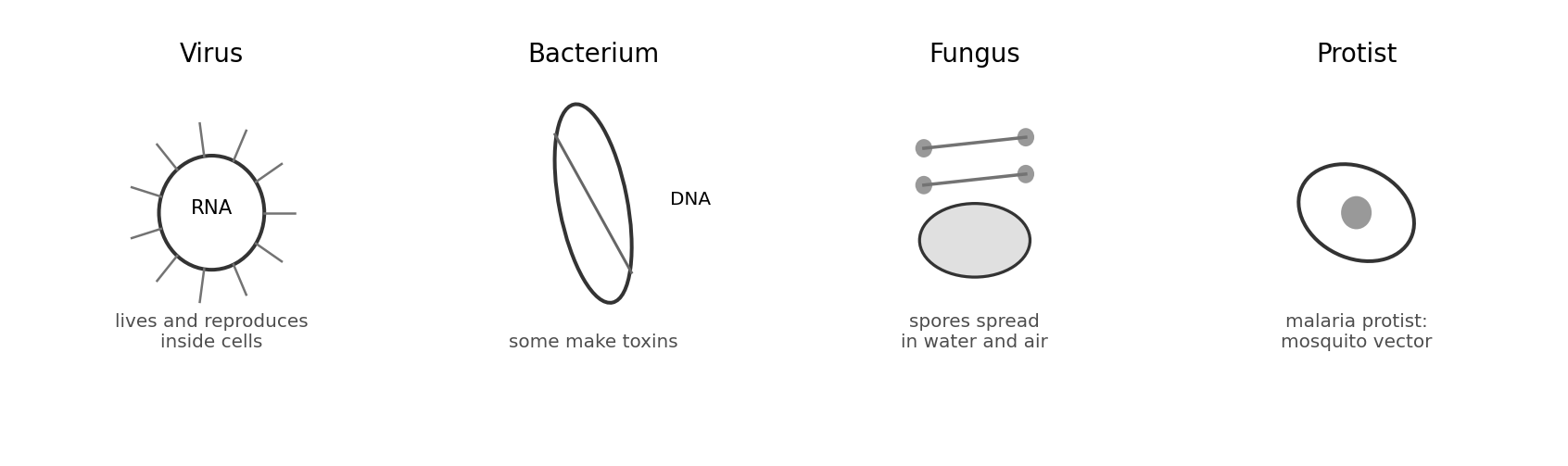
    ארבעת סוגי מחוללי המחלה עם המאפיינים המרכזיים שלהם.

    מחוללי מחלה הם מיקרואורגניזמים הגורמים למחלת זיהומית: וירוסים, חיידקים, פרוטיסטים, פטריות. הם מזהמים צמחים או בעלי חיים והתפשטותם היא באמצעות מגע ישיר, מים או אוויר. חיידקים עשויים לייצר רעלים הפוגעים ברקמות; וירוסים חיים ומתרבים בתוך תאים.

    צמצום התפשטות: היגיינה (שטיפת ידיים), חיטוי פצעים, מים נקיים, טיפול במי ביוב, שימוש בקונדום, שליטה בנשאים (רשתות נגד יתושים, ניקוז מים).

    מילון מונחים אימון
    English עברית
    Pathogens/ˈpæθədʒnz/ מחוללים מחלות
    toxins/ˈtɒksɪnz/ רעלים
    phagocytosis/ˌfæɡəsɪˈtəʊsɪs/ פיגוציטוז
    antibody production/ˈæntɪbɒdi prəˈdʌkʃn/ ייצור אנטיבodies
    antitoxin production/ˌæntɪˈtɒksɪn prəˈdʌkʃn/ ייצור אנטיטוקסין
    Vaccination/ˌvæksɪˈneɪʃn/ חימון
    Antibiotics/ˌæntɪbaɪˈɒtɪks/ אנטיביוטיקה
    Monoclonal antibodies/ˈmɒnəʊklɒnl ˈæntɪbɒdiz/ אנטיבודי מונוקלונלי
    hybridoma/ˌhaɪbrɪˈdəʊmə/ היברידומה
    aphids/ˈeɪfɪdz/ אפידים
    chlorosis/ˈklɔːrəʊsiz/ כלורוזיס (הצהבת עלים)
    3.1

    מחלות מפורטות (4.3.1.2–4.3.1.5)

    סיילבוס

    מחלות מועברות, סוגי מחוללים ומחלות נקובות (AQA 8461 התייחסויות 4.3.1.1-4.3.1.5).

    1. הסבר על אופן התפשטות וירוסים, חיידקים, פרוטיסטים ועדשות בבעלי חיים ובצמחים, ואופן הפחתת התפשטות זו.
    2. זיכרון של חיסבת ילדים, HIV, TMV, סלמונלה, גונוריאה, כתם שחור בושת ומלריה עם סוג מחולל, אופן התפשטות, סימנים ושליטה.

    מקור: הסיילבוס הבינלאומי של קמבריד'ג'

    מחלה חוליה התפשטות סימנים/עזרים שליטה
    אדמת וירוס שאיבת טיפות (שעמוטים, שיעולים) חום, נחשת עור אדומה; עלולה להיות קטלנית חיסון לילדים צעירים
    HIV וירוס מגע מיני, החלפת נוזלי גוף (מחטי משותפים) מחלת דמוית שפעת; תקיפת תאי חיסון → AIDS בשלב מאוחר תרופות אנטי-וירוסיות; מין בטיחותי; מחטי נקיים
    TMV (וירוס מוזאיקת העגבניה) וירוס (צמחים) מגע בין צמחים צביעה מוזאיקית של עליים; הפחתה בפוטוסינתזה ובגודל זני עמידים; היגיינה
    סלמונלה חיידק בליעת מזון בתנאים לא היגייניים חום, כואבה, הקאות, אובדן נוזלים (חיידקים + רעלים) חיסון עופות (בריטניה); הכנות מזון היגייניות
    גוניאה חיידק מגע מיני הפרשות צהובות/ירוקות עבות, כאב במשתן אנטיביוטיקה (עמידות הולכת ועולה); קונדומים
    כתם שחור בוורדים פטרייה (צמחים) ספורות במים/אוויר כתמים שחורים על עליים; עליים מצהיבים ונופלים הסרת/שריפת עליים; פטריתיד
    malaria פרוטיסט נישאת יתוש חום חוזר; עלולה להיות קטלנית רשתות; מניעת הרביעה של יתושים
    3.2

    מערכות הגנה ואימוניות בגוף האדם (4.3.1.6–4.3.1.7)

    סיילבוס

    מערכות הגנה אנושיות, חיסון ותרופות (AQA 8461 התייחסויות 4.3.1.6-4.3.1.9).

    1. תיאור מערכות ההגנה הלא-ספציפיות ושלוש פעולות תאי הדם הלבנים.
    2. הסבר על חיסון באדם ובשפיעתו אוכלוסיתית.
    3. הבחנה בין אנטיביוטיקה למרגעי כאב; הסבר מדוע אנטיביוטיקה אינה יכולה לטפל בווירוסים; תיאור עמידות.
    4. תיאור מקורות גילוי תרופות ושלבי המבחן הקליני/הקליני כולל ניסויים עיוורים כפולים.

    מקור: הסיילבוס הבינלאומי של קמבריד'ג'

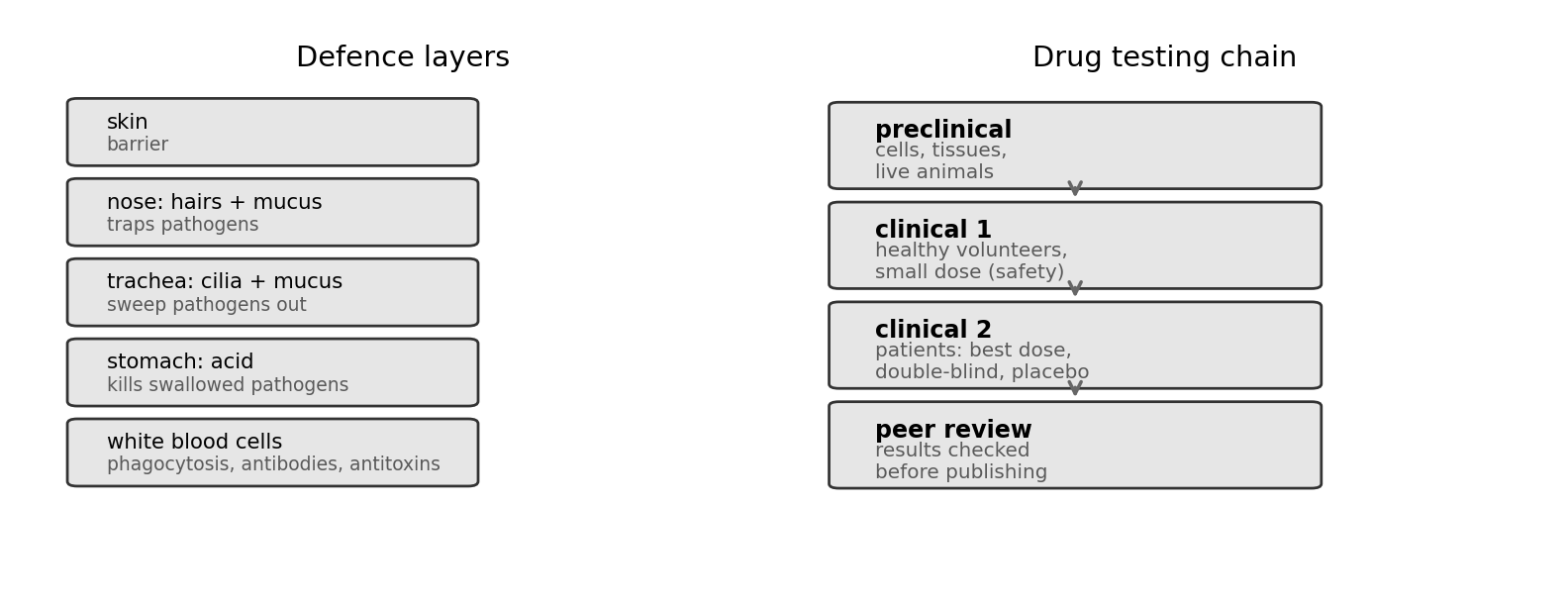
    שכבות ההגנה והשרשרת לבדיקת תרופות.

    הגנות לא ספציפיות: עור (מחסום, קרישה); אף (שיער, ריר); קרקפת וברונchias (ריר, סיסים); בטן (חומצה הידרוכלורית).

    מערכת החיסון משמידה חוליות שנכנסו לגוף. תאי דם לבנים מגנים באמצעות:

    1. פגוציטוז — בליעת חוליות;
    2. ייצור אנטי-גוף — חלבונים הקושרים את האנטיגן הספציפי;
    3. ייצור אנטיטוקסין — נייטרול רעלים.

    חיסון: כמויות קטנות של חוליה מתה או לא פעילה מגרה תאי דם לבנים לייצר אנטי-גופים; בעת חידוש זיהום, תאי זיכרון מגיבים מהר עם האנטי-גופים הנכונים, ומ preventing the infection. השפעת עדר: חיסון אחוז גדול מקטין את ההתפשטות עבור כולם. הערכה: יתרונות (שליטה בהתפרצות, למשל אדמת) לעומת תופעות לוואי נדירות.

    3.2

    אנטיביוטיקה, תרופות להקלת כאב ופיתוח תרופות (4.3.1.8–4.3.1.9)

    סיילבוס

    מערכות הגנה אנושיות, חיסון ותרופות (AQA 8461 התייחסויות 4.3.1.6-4.3.1.9).

    1. תיאור מערכות ההגנה הלא-ספציפיות ושלוש פעולות תאי הדם הלבנים.
    2. הסבר על חיסון באדם ובשפיעתו אוכלוסיתית.
    3. הבחנה בין אנטיביוטיקה למרגעי כאב; הסבר מדוע אנטיביוטיקה אינה יכולה לטפל בווירוסים; תיאור עמידות.
    4. תיאור מקורות גילוי תרופות ושלבי המבחן הקליני/הקליני כולל ניסויים עיוורים כפולים.

    מקור: הסיילבוס הבינלאומי של קמבריד'ג'

    • אנטיביוטיקה (למשל פניצילין) מרפא מחלות חיידקיות על ידי הרג חיידקים בתוך הגוף — אנטיביוטיקה ספציפית לחיידקים ספציפיים. הן לא יכולות להרגי וירוסים (וירוסים חיים בתוך תאים; הרגם יהרוס רקמות גוף). עמידות היא דאגה עיקרית – המרוץ לאנטיביוטיקות חדשות.
    • תרופות להקלת כאב מטפלות בסימנים אך אינן הורגות חוליות.

    פיתוח תרופות: מסורתית נוצרו מהצמחים/מיקרואורגניזמים — דיגיטליס מדאודנט (לב), אספירין מעץ ות, פניצילין מעובש פניציליום (פלמינג). רוב התרופות החדשות מותקנות כימית, אך נקודות התחלה עשויות עדיין להיות חומרים צמחיים.

    שלבי בדיקה: פרה-קליניים (תאים, רקמות, בעלי חיים) → ניסויים קליניים על מתנדבים בריאים (מינון נמוך, בטיחות) ולאחר מכן על מטופלים (מינון אופטימלי, יעילות) → ניסויים כפולים עיוורים עם פלאצ'בו; תוצאות עוברות ביקורת מקצועית.

    3.3

    אנטיבodies מונוקלונליים (ביולוגיה בלבד, HT)

    סיילבוס

    נוגדנים מונוקלונליים, ביולוגיה בלבד ו-HT (AQA 8461 התייחסות 4.3.2).

    1. תיאור ייצור נוגדנים מונוקלונליים על ידי היברידומה.
    2. תיאור שימושים באבחון, מדידה, מחקר וטיפול בסרטן.

    מקור: הסיילבוס הבינלאומי של קמבריד'ג'

    אנטיבodies מונוקלונליים מיוצרים מאחדו של תאים, ספציפיים לאחד אתר הקשר על אחד חלבון אנטיגן. ייצורם: גירוי למפוליציטים עכבר ליצירת האנטיבody → מיזוג עם תא סרטני ליצירת היברידומה — הוא מתחלק AND מייצר את האנטיbody → השתלת ההיברידומה → איסוף וחיבור כמויות גדולות של אנטיbody ספציפי אחד.

    שימושים: בדיקות הריון; מדידת רמות הורמונים/חומרים בדם; זיהוי מחלות; מחקר — אנטיbodies פלואורסצנטיים ממוקמים מולקולות; טיפול בסרטן — אנטיbody קשור לחומר רדיואקטיבי/רעיל מספק אותו רק לתאי הסרטן.

    3.4

    מחלות צמחים (ביולוגיה בלבד)

    סיילבוס

    מחלת צמחים, ביולוגיה בלבד (AQA 8463 התייחסות 4.3.3).

    1. זיהוי מחלת צמחים מתוך סימנים ומיפויה באמצעות מבחנים ידניים, מעבדתיים או מונוקלונליים.
    2. הסבר על מחסור ביוני ניטרט ומגנזיום.
    3. תיאור תגובות הגנה פיזיות, כימיות ומכניות בצמחים.

    מקור: הסיילבוס הבינלאומי של קמבריד'ג'

    זיהוי (HT): צמיחה מעוכבת, כתמים על עלים, אזורים של ריקבון, גידולים, גבעולים/עלים מעוותים, דהיית צבע, נוכחות מזיקים.

    זיהוי (HT): מדריך/אתר גינון; ניתוח מעבדה; ערכוני בדיקה המשתמשים ב-אנטיbodies מונוקלונליים.

    בעיות צמחים ממונות: TMV (וירוס), כתם שחור לוורדים (פטריות), אפרפרית (חרקים).

    חוסר יונים: מינון נמוך מדי של ניטראט → צמיחה מעוכבת (ניטראט נדרש ל-חומצות אמינו/חלבון); חוסר מגנזיום → כלורוזיס (עלים צהובים — מגנזיום נדרש ליצירת כלורופיל).

    תגובות הגנה: פיזיקלי — קירות תאי תאית, עטיפה שעוונית, קליפה/שכבות מתות; כימי — חומרים אנטיבקטריאליים, רעלים; מכני — שיאים, שערות, התעלפות/התקלפות עלים, הדמייה.

    3.4

    רשימת בדיקה לפני סיום נושא זה

    • ארבעה סוגי מחוללים; שלושה דרכי התפשטות; שתי דרכים להפחתת התפשטות כל מחלה ממונת.
    • לזכור את טבלת המחלות: מחולל, התפשטות, סימפטומים, שליטה.
    • ארבע הגנות לא ספציפיות; שלוש פעולות של תאי לבן.
    • מנגנון החיסון + אפקט אוכלוסייתי; אנטיביוטיקה לעומת משכך כאב; מדוע אנטיביוטיקה נכשלת נגד וירוסים.
    • מקורות תרופות (כוס אדמה, ערבה, פניציליום) ושלב הפרה-קליני/קליני עם פלאצ'בו וכפול עיוור.
    • (HT, ביולוגיה) תהליך ייצור היברידומה וארבעה שימושים לאנטיbodies מונוקלונליים.
    • (ביולוגיה) סימני מחלת צמח, שיטות זיהוי, חוסר ניטראט/מגנזיום, שלוש קטגוריות הגנה.
  • 4

    ביאו-אנרגטיקה

    4.1

    Bioenergetics: photosynthesis and respiration

    Plants capture the Sun's energy; every cell releases it again. This reference covers AQA GCSE Biology 8461, topic 4.4 Bioenergetics.

    How the exam treats this topic:

    • Paper 1 carries Bioenergetics. RP6: light intensity and the rate of photosynthesis using pondweed.
    • Limiting-factor graphs with two or three factors, the inverse square law and greenhouse economics are HT only.
    • Equations are word equations — know the symbol forms too (CO₂, H₂O, O₂, C₆H₁₂O₆).
    4.1

    Photosynthesis (4.4.1.1)

    סיילבוס

    פוטוסינתזה (AQA 8461 התייחסויות 4.4.1.1-4.4.1.2, RP6).

    1. כתיבת משוואות המילים והסמלים לפוטוסינתזה, ותיאורה בתהליך אנדותרמי.
    2. הסבר כיצד עוצמת האור, ריכוז CO2 וטמפרטורה מגבילים את קצב הפוטוסינתזה, כולל פרשנות גרפים של גורמים מגבילים.
    3. (HT) שימוש בקשר ההפוך-ריבועי בין עוצמת אור למרחק, ונימוקים כלכליים לגבי חממות.
    4. תיאור RP6: עוצמת אור וקצב הפוטוסינתזה עם צמח בריכה, הבקרות וחישוב הקצב.

    מקור: הסיילבוס הבינלאומי של קמבריד'ג'

    $$\text{carbon dioxide} + \text{water} \xrightarrow{\ \text{light}\ } \text{glucose} + \text{oxygen}$$
    $$6\,\text{CO}_2 + 6\,\text{H}_2\text{O} \rightarrow \text{C}_6\text{H}_{12}\text{O}_6 + 6\,\text{O}_2$$

    Photosynthesis is an endothermic 吸热 reaction: energy is transferred from the environment to the chloroplasts by light.

    מילון מונחים אימון
    English עברית
    endothermic/ˌendəʊˈθɜːmɪk/ תגובה אנדותרמית
    4.1

    Rate of photosynthesis and limiting factors (4.4.1.2)

    סיילבוס

    פוטוסינתזה (AQA 8461 התייחסויות 4.4.1.1-4.4.1.2, RP6).

    1. כתיבת משוואות המילים והסמלים לפוטוסינתזה, ותיאורה בתהליך אנדותרמי.
    2. הסבר כיצד עוצמת האור, ריכוז CO2 וטמפרטורה מגבילים את קצב הפוטוסינתזה, כולל פרשנות גרפים של גורמים מגבילים.
    3. (HT) שימוש בקשר ההפוך-ריבועי בין עוצמת אור למרחק, ונימוקים כלכליים לגבי חממות.
    4. תיאור RP6: עוצמת אור וקצב הפוטוסינתזה עם צמח בריכה, הבקרות וחישוב הקצב.

    מקור: הסיילבוס הבינלאומי של קמבריד'ג'

    Rate of photosynthesis against one limiting factor at a time.
    Each curve rises then flattens where another factor limits.

    Rate increases with: light intensity, CO₂ concentration, temperature (to the enzyme optimum), and the amount of chlorophyll.

    Reading single-factor graphs: the flat top means something else has become the limiting factor 限制因素. (HT) On two- or three-factor graphs, decide which factor is limiting at each point.

    (HT) Inverse square law: doubling the distance from the lamp quarters the light intensity:

    $$\text{light intensity} \propto \frac{1}{\text{distance}^2}$$

    (HT) Greenhouse economics: adding heat, light or CO₂ raises the rate — but each costs money; the grower adds the cheapest factor that is limiting, up to the point where extra yield no longer pays.

    RP6 set-up: pondweed under an inverted funnel in a beaker, with a lamp at a measured distance.

    RP6: pondweed in water at different lamp distances; count the oxygen bubbles per minute (or collect the gas); control temperature and CO₂ (sodium hydrogencarbonate); repeat and mean; rate = bubbles ÷ time.

    Worked example. Bubbles: 30 per minute at 10 cm; at 20 cm the light intensity is a quarter, so expect about 8 per minute (if light is still limiting).

    מילון מונחים אימון
    English עברית
    limiting factor/ˈlɪmɪtɪŋ ˈfæktə/ גורם מגביל
    4.1

    Uses of glucose (4.4.1.3)

    סיילבוס

    פוטוסינתזה (AQA 8461 התייחסויות 4.4.1.1-4.4.1.2, RP6).

    1. כתיבת משוואות המילים והסמלים לפוטוסינתזה, ותיאורה בתהליך אנדותרמי.
    2. הסבר כיצד עוצמת האור, ריכוז CO2 וטמפרטורה מגבילים את קצב הפוטוסינתזה, כולל פרשנות גרפים של גורמים מגבילים.
    3. (HT) שימוש בקשר ההפוך-ריבועי בין עוצמת אור למרחק, ונימוקים כלכליים לגבי חממות.
    4. תיאור RP6: עוצמת אור וקצב הפוטוסינתזה עם צמח בריכה, הבקרות וחישוב הקצב.

    מקור: הסיילבוס הבינלאומי של קמבריד'ג'

    Glucose from photosynthesis is used for:

    • respiration;
    • converted to insoluble starch for storage;
    • fat or oil for storage;
    • cellulose for cell walls;
    • amino acids for protein — this also needs nitrate ions from the soil.
    4.2

    Respiration (4.4.2.1)

    סיילבוס

    נשימה ומטבוליזם (הצהרות AQA 8461 4.4.1.3, 4.4.2.1-4.4.2.3).

    1. ציין חמישה שימושים לגלוקוז מהפוטוסינתזה.
    2. השווה נשימה אווירית ואנאירובית בשריר ובשמרים, עם משוואות מילוליות, וחשיבות כלכלית של תהליך התססה.
    3. הסבר על תגובת הגוף לאימון ועל (HT) חוב חמצן ותפקיד הכבד.
    4. הגדר מטבוליזם ורשום את התגובות שהוא כולל.

    מקור: הסיילבוס הבינלאומי של קמבריד'ג'

    Respiration is an exothermic 放热 reaction occurring continuously in living cells, transferring the energy for: building larger molecules, movement, and keeping warm.

    Aerobic Anaerobic (muscle) Anaerobic (plant/yeast)
    oxygen needed not needed not needed
    equation glucose + oxygen → CO₂ + water glucose → lactic acid glucose → ethanol + CO₂
    energy much more much less much less

    Anaerobic respiration in yeast is fermentation 发酵, economically important in bread (CO₂ makes it rise) and alcoholic drinks.

    מילון מונחים אימון
    English עברית
    exothermic/eɡzəˈðɜːmɪk/ תגובה אקסותרמית
    fermentation/fɜːmənˈteɪʃn/ תסיסה
    4.2

    Response to exercise (4.4.2.2)

    סיילבוס

    נשימה ומטבוליזם (הצהרות AQA 8461 4.4.1.3, 4.4.2.1-4.4.2.3).

    1. ציין חמישה שימושים לגלוקוז מהפוטוסינתזה.
    2. השווה נשימה אווירית ואנאירובית בשריר ובשמרים, עם משוואות מילוליות, וחשיבות כלכלית של תהליך התססה.
    3. הסבר על תגובת הגוף לאימון ועל (HT) חוב חמצן ותפקיד הכבד.
    4. הגדר מטבוליזם ורשום את התגובות שהוא כולל.

    מקור: הסיילבוס הבינלאומי של קמבריד'ג'

    During exercise the heart rate, breathing rate and breath volume increase to deliver more oxygenated blood to muscles. If oxygen supply is insufficient, muscles switch to anaerobic respiration: incomplete glucose oxidation builds up lactic acid 乳酸 → fatigue; an oxygen debt 氧债 builds.

    (HT) Blood carries lactic acid to the liver, which converts it back to glucose. The oxygen debt is the extra oxygen needed after exercise to react with and remove the accumulated lactic acid.

    מילון מונחים אימון
    English עברית
    oxygen debt/ˈɒksɪdʒn det/ חוב חמצן
    lactic acid/ˈlæktɪk ˈæsɪd/ חומצה לקטית
    4.2

    Metabolism (4.4.2.3)

    סיילבוס

    נשימה ומטבוליזם (הצהרות AQA 8461 4.4.1.3, 4.4.2.1-4.4.2.3).

    1. ציין חמישה שימושים לגלוקוז מהפוטוסינתזה.
    2. השווה נשימה אווירית ואנאירובית בשריר ובשמרים, עם משוואות מילוליות, וחשיבות כלכלית של תהליך התססה.
    3. הסבר על תגובת הגוף לאימון ועל (HT) חוב חמצן ותפקיד הכבד.
    4. הגדר מטבוליזם ורשום את התגובות שהוא כולל.

    מקור: הסיילבוס הבינלאומי של קמבריד'ג'

    Metabolism 代谢 is the sum of all reactions in a cell or body; respiration fuels them. It includes:

    • glucose → starch, glycogen, cellulose;
    • glycerol + 3 fatty acids → lipids;
    • glucose + nitrate ions → amino acids → proteins;
    • respiration;
    • breakdown of excess protein → urea for excretion.
    מילון מונחים אימון
    English עברית
    Metabolism/məˈtæbəlɪzəm/ מטבוליזם
    4.2

    Checklist before you call this topic done

    • Write the photosynthesis word and symbol equations; say endothermic + light→chloroplasts.
    • Explain the four rate factors; read flattening single-factor graphs; (HT) inverse square law and greenhouse economics.
    • Describe RP6 with its controls and the rate calculation.
    • List five uses of glucose (with nitrate for protein).
    • Compare aerobic with both anaerobic equations; name fermentation's two products and uses.
    • Exercise: three increases; lactic acid and oxygen debt; (HT) the liver's role.
    • Define metabolism with its five strands.
  • 5

    הומיאוסטאזה ותגובה

    5.1

    Homeostasis and response: keeping conditions steady

    • Homeostasis 稳态 is the regulation of the internal conditions of a cell or organism, to maintain optimum conditions for enzyme action and all cell functions, in response to internal and external changes.
    • The body controls blood glucose concentration, body temperature and water levels.
    • Every automatic control system has: receptors (detect stimuli), coordination centres (brain, spinal cord, pancreas — receive and process information) and effectors (muscles or glands — bring about the response that restores optimum levels).
    • Nervous responses are fast and short-lived; hormonal responses are slower but act for longer.
    מילון מונחים אימון
    English עברית
    Homeostasis/ˌhəʊmiːəˈstɑːsiz/ הומיאוסטאזיס
    5.1

    Homeostasis and the nervous system (4.5.1–4.5.2.1, RP7)

    סיילבוס

    הומאוסטאז והמערכת העצבית (הצהרות AQA 8461 4.5.1-4.5.2.1, RP7).

    1. הגדר הומאוסטאז וציין שלושה מצבים שבהם הגוף מבצע בקרה.
    2. תאר קולטים, מרכזי קואורדינציה ואפקטורים, ואת מסלול הגירוי-קולט-מרכז-אפקטור-תגובה.
    3. הסבר על קשת הרפלקס, כולל נוירון סנסורי, סינפסה, נוירון מעביר ונוירון מוטורי, ולמה רפלקסים הם אוטומטיים ומהירים.
    4. תיאור RP7: השפעת גורם על זמן תגובה אנושי, עם בקרות וטיפול בנתונים.

    מקור: הסיילבוס הבינלאומי של קמבריד'ג'

    The pathway: stimulus → receptor → coordinator (CNS: brain + spinal cord) → effector (muscle contracts / gland secretes) → response.

    Information passes along cells called neurones 神经元 as electrical impulses. The CNS coordinates the response of effectors.

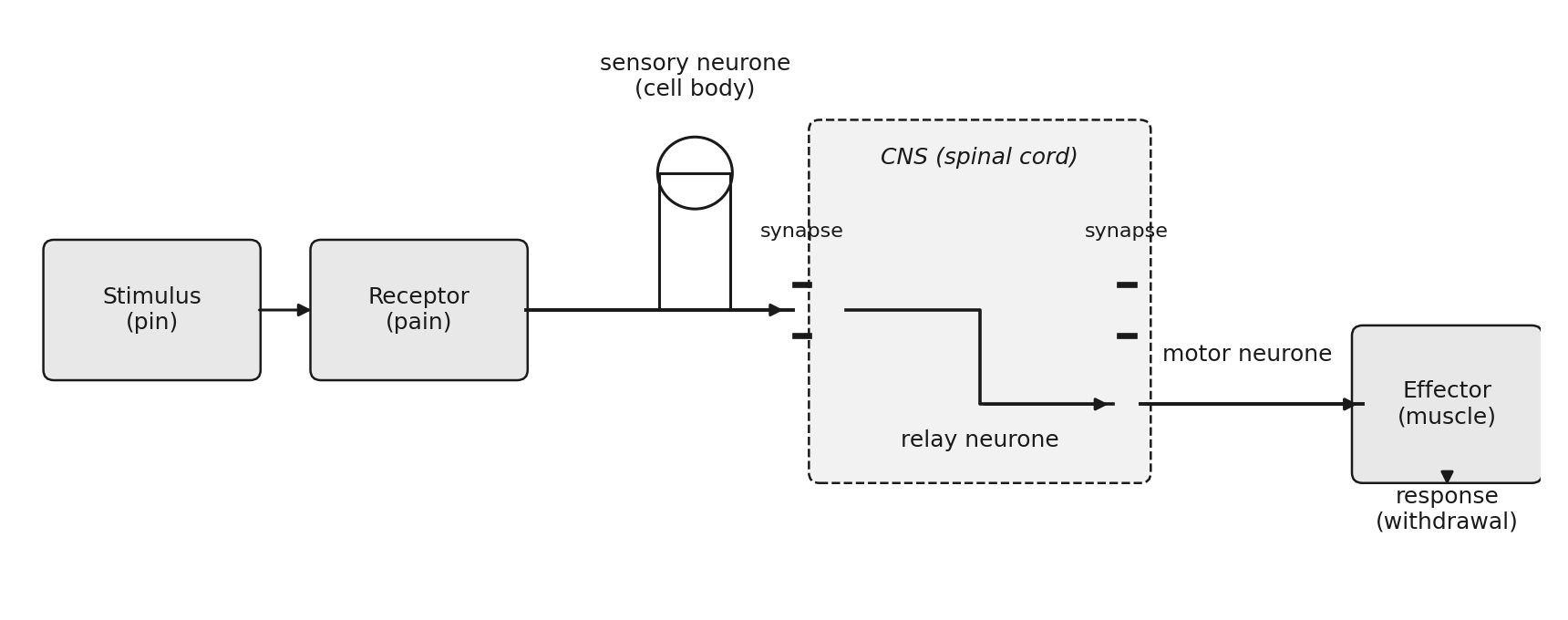
    The reflex arc: stimulus to receptor, sensory neurone with cell body, relay neurone in the CNS, motor neurone to the effector, with synapses between neurones.

    The reflex arc — automatic and rapid protection that does not involve the conscious part of the brain:

    stimulus → receptor → sensory neurone → synapse → relay neurone (in CNS) → synapse → motor neurone → effector → response.

    At a synapse 突触 the electrical impulse arrives at the end of a neurone and a chemical is released; it diffuses across the gap and triggers an electrical impulse in the next neurone.

    RP7 — reaction time: plan and investigate the effect of a factor (e.g. caffeine) on human reaction time. Drop a ruler between a partner's finger and thumb; measure the catch distance; convert to time (or use a computer test); control variables (same hand, same height); repeat and take a mean. Interpret reaction-time data from graphs and tables.

    מילון מונחים אימון
    English עברית
    neurone/ˈnjuːrəʊn/ נוירון
    synapse/ˈsɪnæps/ סינפסה
    5.2

    The brain, the eye and temperature — biology only (4.5.2.2–4.5.2.4)

    סיילבוס

    המוח, העין וטמפרטורת הגוף — ביולוגיה בלבד (הצהרות AQA 8461 4.5.2.2-4.5.2.4).

    1. זיהוי קליפת המוח, המוח הקטן והגשר עם פונקציותיהם, ו(HT) קשיים בחקירה וטיפול במוח.
    2. קשר בין מבני העין לפונקציותיהם והסבר על התאמה לעצמים קרובים ורחוקים.
    3. הסבר על קוצר ראייה וראייה יתר ותיקונם בעזרת עדשות וטכנולוגיות חדשות.
    4. הסבר כיצד הרחבת כלי דם, הזעה, הצמצום של כלי דם ורעידות שומר על טמפרטורת הגוף (HT בהקשר).

    מקור: הסיילבוס הבינלאומי של קמבריד'ג'

    The brain (HT extra)

    Identify on a diagram: cerebral cortex (consciousness, memory, language), cerebellum (balance, coordination of movement), medulla (heartbeat, breathing).

    (HT) Difficulties of investigating and treating the brain: it is complex and delicate, easily damaged, and hard to access. Mapping methods: studying patients with brain damage, electrically stimulating regions, and MRI scanning. Evaluate benefits and risks of brain procedures.

    The eye

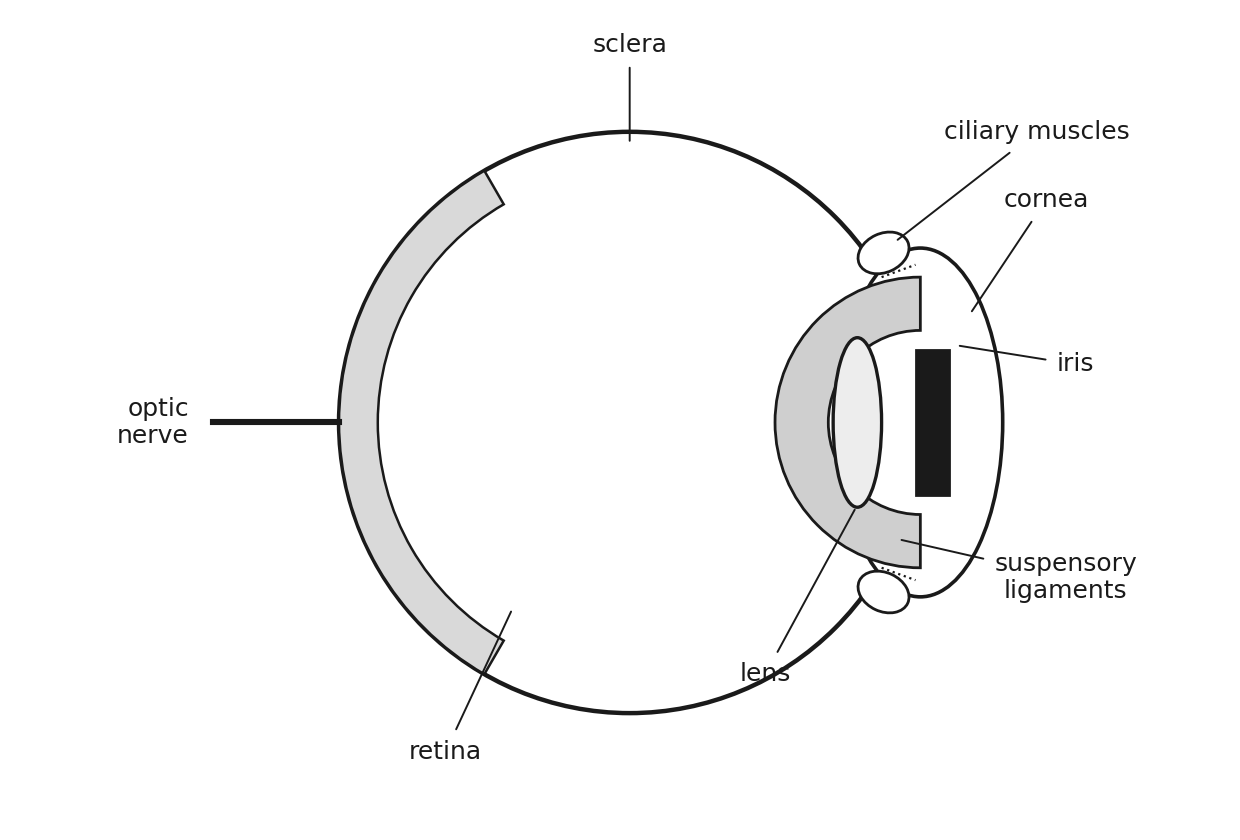
    Vertical section of the eye: sclera, cornea, iris, lens, ciliary muscles, suspensory ligaments, retina and optic nerve.

    Identify and explain: retina 视网膜 (receptor cells sensitive to light intensity and colour), optic nerve (carries impulses from retina to brain), sclera (strong outer coat), cornea (refracts light), iris (coloured muscles controlling pupil size — reflex adaptation to dim/bright light), ciliary muscles and suspensory ligaments (control lens shape).

    Accommodation 视觉调节 — changing lens shape to focus:

    near object distant object
    ciliary muscles contract relax
    suspensory ligaments loosen pulled tight
    lens thicker, refracts strongly thin, refracts slightly

    Defects: myopia 近视 (short sight — distant objects focus in front of the retina; corrected with a concave lens), hyperopia 远视 (long sight — near objects focus behind the retina; convex lens). Treatments: spectacle lenses, contact lenses, laser surgery to reshape the cornea, replacement lens.

    Control of body temperature

    The thermoregulatory centre in the brain has receptors sensitive to blood temperature; skin receptors send impulses to it.

    • Too hot: blood vessels dilate (vasodilation 血管舒张) — more blood near the surface transfers energy to the environment; sweat 汗液 produced — evaporating sweat transfers energy away.
    • Too cold: blood vessels constrict (vasoconstriction 血管收缩); sweating stops; skeletal muscles contract (shivering — respiration transfers energy to warm the blood).

    (HT) Explain in context how each mechanism lowers or raises temperature back to the optimum.

    מילון מונחים אימון
    English עברית
    retina/ˈretɪnə/ רשתית
    accommodation/əˌkɒməˈdeɪʃn/ הסתגלות עין
    myopia/maɪˈəʊpɪə/ קוצר ראייה
    hyperopia/ˌhaɪpəˈrəʊpɪə/ קוצר ראייה (היפרופיה)
    vasodilation/ˌvæsədɪˈleɪʃn/ רחבת כלי דם
    vasoconstriction/ˌvæsəkənˈstrɪkʃn/ צרבת כלי דם
    sweat/swet/ זיעה
    5.3

    Hormonal coordination in humans (4.5.3)

    סיילבוס

    קואורדינציה הורמונלית באדם (הצהרות AQA 8461 4.5.3).

    1. תיאור המערכת האנדוקרינית: בלוטות, הורמונים, איברי יעד, ושש הבלוטות הנקובות.
    2. הסבר על בקרת אינסולין ברמת הגלוקוז בדם, (HT) גלוקגון ומשוב שלילי, והשוואה בין דיאבטיס מסוג 1 לדיאבטיס מסוג 2.
    3. (Bio) תיאור מאזן מים וחנקן: כליה, סינון ורישום נבחר, (HT) ADH, והשוואה בין דיאליזה לתרומת כליה.
    4. (HT) הסבר על האינטראקציה בין FSH, LH, אסטרוגן ופרוגסטרון במחזור החודשי, שיטות מניעת הריון ו-IVF.
    5. (HT) הסבר על אדרנלין ותירוקסין, יחד עם משוב שלילי.

    מקור: הסיילבוס הבינלאומי של קמבריד'ג'

    The endocrine system is glands that secrete hormones 激素 directly into the bloodstream; blood carries them to target organs. Slower than nerves but longer-lasting. Identify on a body diagram: pituitary gland (brain's 'master gland'), pancreas, thyroid, adrenal gland, ovary, testes.

    Blood glucose is monitored and controlled by the pancreas:

    • Too high → pancreas secretes insulin 胰岛素 → glucose moves from blood into cells; in liver and muscle cells excess glucose is converted to glycogen 糖原 for storage.
    • (HT) Too low → pancreas secretes glucagon 胰高血糖素 → glycogen converted back to glucose, released into the blood. Insulin–glucagon is a negative feedback 负反馈 cycle.

    Diabetes: Type 1 — pancreas fails to produce enough insulin; uncontrolled high blood glucose; treated with insulin injections. Type 2 — body cells no longer respond to insulin; treated with a carbohydrate-controlled diet and exercise regime; obesity is a risk factor. Interpret graphs of blood glucose with and without diabetes.

    Water and nitrogen balance — biology only

    Water leaves via the lungs (exhalation) and the skin (sweat, with ions and urea) — no control over these. Excess water, ions and urea are removed by the kidneys in urine. Cells that lose or gain too much water by osmosis do not work efficiently. (HT) Excess amino acids from the diet are deaminated in the liver: ammonia (toxic) → urea 尿素 for safe excretion.

    The kidneys filter the blood and selectively reabsorb glucose, some ions and water. (HT) If the blood is too concentrated, the pituitary releases ADH 抗利尿激素, which makes the kidney tubules more permeable, so more water is reabsorbed — negative feedback again.

    Kidney failure: treated by transplant or dialysis — blood flows between partially permeable membranes in dialysis fluid with the right water/ion concentrations, so waste diffuses out while glucose and useful substances are retained; evaluate mechanical device vs transplant.

    Hormones in human reproduction

    Oestrogen 雌激素 (ovary) — main female hormone; at puberty eggs mature and one is released about every 28 days (ovulation 排卵). Testosterone 睾酮 (testes) — stimulates sperm production.

    (HT) The menstrual cycle:

    Hormone Source Role
    FSH pituitary causes an egg to mature in the ovary (in the follicle)
    LH pituitary stimulates the release of the egg (ovulation)
    Oestrogen ovary (follicle) maintains and builds the uterus lining; stimulates LH surge
    Progesterone ovary (corpus luteum) maintains the uterus lining; inhibits FSH and LH
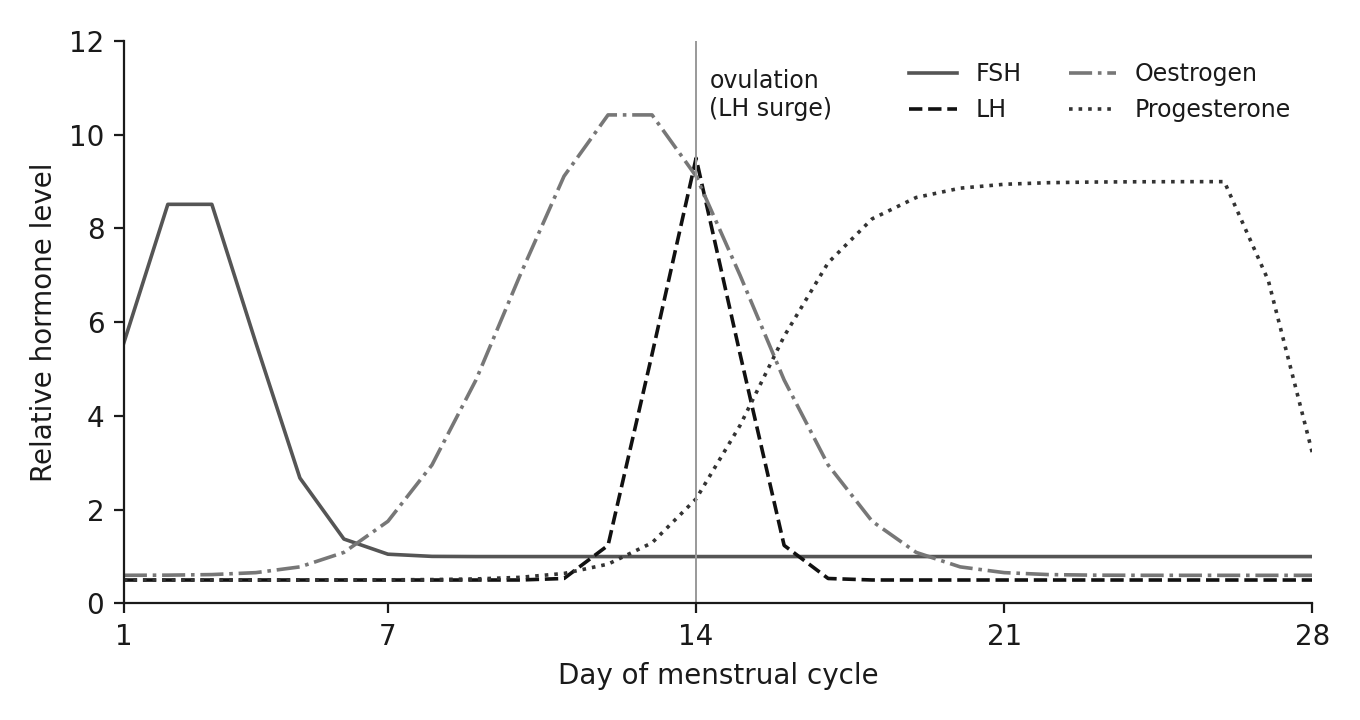
    Hormone levels through the 28-day menstrual cycle: FSH early, an oestrogen rise, the day-14 LH surge and ovulation, then progesterone.

    (HT) Interpret hormone-level graphs across the cycle: FSH starts follicle growth → oestrogen rises → LH surge triggers ovulation (about day 14) → progesterone keeps the lining thick until it falls and the cycle restarts.

    Contraception — evaluate hormonal and non-hormonal methods: oral contraceptives (inhibit FSH so no eggs mature), slow-release progesterone injection/implant/patch, barrier methods (condoms, diaphragm), intrauterine devices, spermicides, abstaining when an egg may be in the oviduct, sterilisation.

    Infertility (HT): 'fertility drugs' (FSH + LH) stimulate eggs to mature. IVF: FSH and LH stimulate several eggs → eggs collected and fertilised with sperm in the laboratory → embryos grow to tiny balls of cells → one or two transferred to the uterus. Evaluate: emotionally/physically stressful, low success rates, risk of multiple births.

    Negative feedback (HT): adrenaline (adrenal glands, fear/stress) increases heart rate and delivery of oxygen and glucose to brain and muscles — 'fight or flight'. Thyroxine (thyroid) stimulates the basal metabolic rate and is important in growth and development; its level is controlled by negative feedback. Interpret simple negative-feedback diagrams.

    מילון מונחים אימון
    English עברית
    hormone/ˈhɔːməʊn/ הורמון
    insulin/ˈɪnsjuːlɪn/ אינסולין
    glycogen/ˈɡlaɪkədʒn/ גליקוגן
    glucagon/ˈɡluːkæɡən/ גלוקגון
    negative feedback/ˈneɡətɪv ˈfiːdbæk/ משוב שלילי
    urea/juːˈrɪə/ אוריה
    ADH/ˌeɪ diː ˈeɪtʃ/ אנטי-דיורטית הורמון (ADH)
    oestrogen/ˈiːstrədʒn/ אסטרוגן
    ovulation/ˌɒvjʊˈleɪʃn/ פריסת ביצה
    testosterone/teˈstɒstərəʊn/ טסטוסטרון
    5.4

    Plant hormones — biology only (4.5.4)

    סיילבוס

    הורמונים צמחיים — ביולוגיה בלבד (AQA 8461 פריטי הבעה 4.5.4, RP8).

    1. הסבר על פוטוטרופיזם וגרביטרופיזם באמצעות חלוקה לא שווה של אוקסינים בצלע ובשורש.
    2. תיאור RP8: השפעת האור או הכובד על צמחים זרועים חדשים, עם מדידות אורך ושרטוטים מסומנים.
    3. (HT) תיאור שימושים של אוקסינים, גיברללינים ואיתן בחקלאות, בגידול צמחים ובתעשיית המזון.

    מקור: הסיילבוס הבינלאומי של קמבריד'ג'

    Plants produce hormones to coordinate and control growth and responses to light (phototropism 向光性) and gravity (gravitropism 向地性/geotropism). Unequal distribution of auxin 生长素 causes unequal growth rates in roots and shoots — shoots bend towards light; roots grow downwards.

    RP8: investigate the effect of light or gravity on newly germinated seedlings — record as length measurements and careful labelled biological drawings.

    (HT) Gibberellins initiate seed germination; ethene controls cell division and fruit ripening.

    (HT) Uses: auxins as weed killers, rooting powders and to promote growth in tissue culture; ethene to control ripening during storage and transport; gibberellins to end seed dormancy, promote flowering and increase fruit size. Consider the effect of weed killers on biodiversity.

    מילון מונחים אימון
    English עברית
    auxin/ˈɔːksɪn/ אוקסין
    phototropism/ˌfəʊtəʊˈtrəʊpɪzəm/ פוטוטרופיזם
    gravitropism/ˈɡrævɪtrəʊpɪzəm/ גרביטרופיזמה
    5.4

    Checklist before you call this topic done

    • Define homeostasis; receptor–coordination centre–effector said in order; reflex arc drawn with synapse.
    • Eye parts and accommodation table cold; myopia vs hyperopia with corrections.
    • Temperature: vasodilation/sweat vs vasoconstriction/shivering, in context (HT).
    • Insulin and (HT) glucagon with negative feedback; Type 1 vs Type 2 treatments.
    • (Bio) kidney filtration + selective reabsorption; (HT) ADH; dialysis vs transplant.
    • (HT) FSH–oestrogen–LH–progesterone interactions and graph; contraception list; IVF steps; adrenaline and thyroxine.
    • (Bio) tropisms with auxin; RP8; (HT) the three hormone uses.
  • 6

    ירושיות, מגוון ואבולוציה

    6.1

    Inheritance, variation and evolution: passing it on

    • Sexual reproduction mixes genetic information; asexual reproduction clones it. Meiosis halves chromosomes for gametes; fertilisation restores them.
    • DNA → genes → alleles → phenotype: the Punnett square turns this into probabilities.
    • Natural selection changes inherited characteristics across generations. Selective breeding, genetic engineering and cloning (biology only) use different mechanisms. Fossils and resistant bacteria provide evolutionary evidence; classification uses evidence of relationships.
    6.1

    Reproduction, DNA and genomes (4.6.1.1–4.6.1.5)

    סיילבוס

    Reproduction, DNA and genomes (AQA 8461 statements 4.6.1.1-4.6.1.5).

    1. Compare sexual and asexual reproduction, with the named organisms that use both.
    2. Explain how meiosis halves the chromosome number and fertilisation restores it, and trace embryo development.
    3. Describe DNA, genes and the genome, and discuss the importance of the human genome.
    4. (Bio) Describe DNA's nucleotide structure and the base code; (HT) protein synthesis and the effect of mutations.

    מקור: הסיילבוס הבינלאומי של קמבריד'ג'

    Sexual reproduction — fusion of male and female gametes (sperm + egg in animals; pollen + egg in flowering plants). Meiosis forms gametes; mixing of genetic information gives variety in offspring. Asexual reproduction — one parent, no fusion, mitosis only: genetically identical offspring (clones 克隆).

    Meiosis: one parent cell's chromosomes are copied, then two divisions give four genetically different gametes, each with a single set of chromosomes.

    Meiosis 减数分裂: in reproductive organs, copies of the genetic information are made first, then the cell divides twice to form four gametes, each with a single set of chromosomes — all genetically different. Fertilisation restores the normal number; the new cell divides by mitosis and cells differentiate as the embryo develops.

    (Bio) Sexual vs asexual: sexual gives variation — a survival advantage if the environment changes, and the variation selective breeding uses; asexual needs no mate (time and energy efficient), is faster, and produces many identical offspring when conditions are favourable. Malarial parasites: asexual in the human host, sexual in the mosquito; many fungi: asexual spores + sexual; strawberry plants: sexual seeds + asexual runners; daffodils: bulb division.

    DNA and the genome: DNA is a polymer of two strands forming a double helix, held in the nucleus as chromosomes. A gene 基因 is a small section of DNA that codes for a sequence of amino acids → a specific protein. The genome 基因组 is the entire genetic material of the organism. Importance of the human genome: searching for genes linked to disease; understanding and treating inherited disorders; tracing human migration patterns from the past.

    (Bio) DNA structure: a polymer of four different nucleotides 核苷酸 — common sugar + phosphate group + one of four bases — A 腺嘌呤, C 胞嘧啶, G 鸟嘌呤, T 胸腺嘧啶; alternating sugar–phosphate backbone; a sequence of three bases codes for one amino acid, and the base order controls the amino-acid order of the protein.

    (HT Bio) Protein synthesis: on ribosomes, from a template; carrier molecules bring specific amino acids in the correct order; the chain folds into a unique shape that lets the protein work as an enzyme, hormone or structural protein (e.g. collagen). In complementary strands C pairs with G, T with A. Mutations change the base sequence: a mutation may leave the protein unchanged, alter it slightly, or change its shape so an enzyme no longer fits its substrate or a structural protein loses strength. Variants in non-coding DNA can switch genes on and off, changing how genes are expressed.

    Apply the reproduction and DNA knowledge

    Try first — strawberries. Seeds form after fertilisation; runners form without gamete fusion. Identify the two routes and explain which may help a population survive a new disease.

    Worked reasoning. Seeds result from sexual reproduction: meiosis makes gametes and fertilisation mixes genetic information. Variation means some offspring may resist the disease. Runners form by mitosis from one parent: clones, apart from mutation. Asexual reproduction needs no mate and is fast in favourable conditions; neither route guarantees survival.

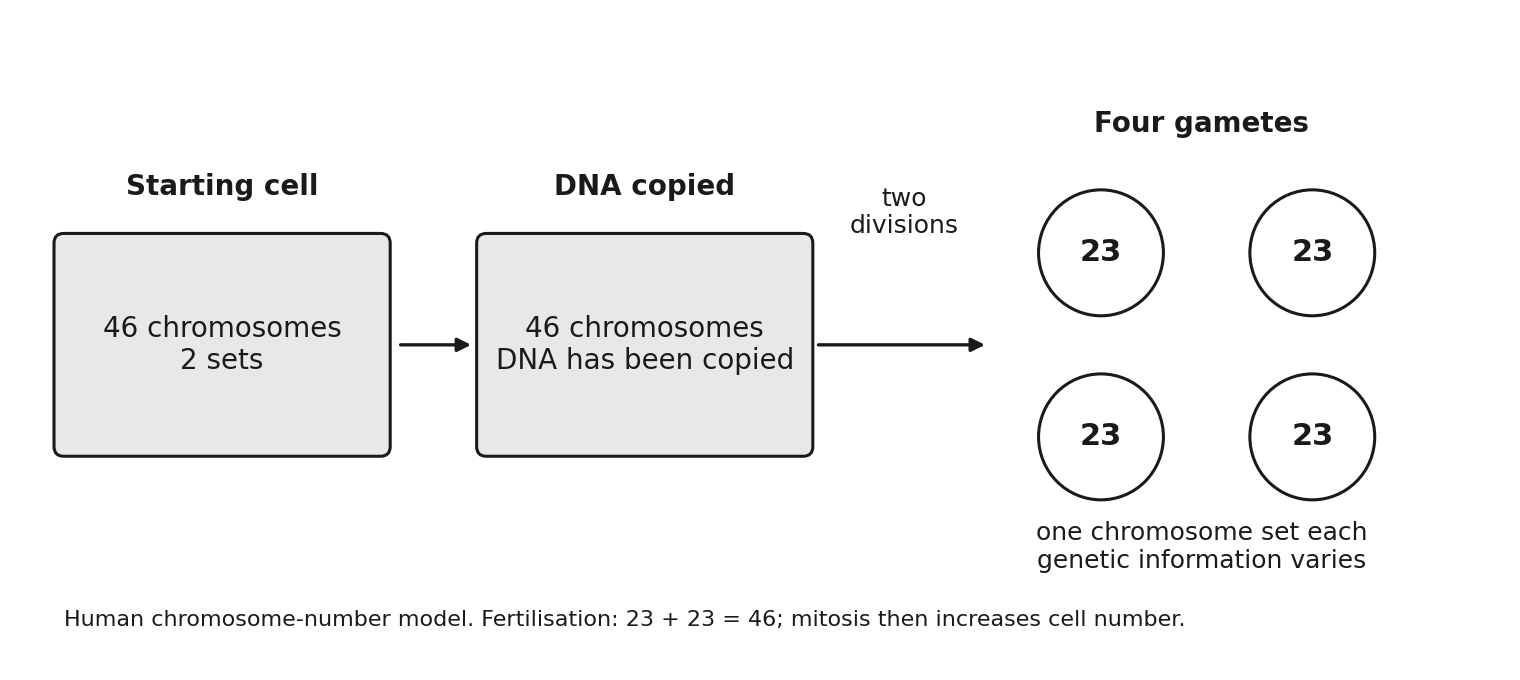
    Try first — chromosome number. A human cell has 46 chromosomes before meiosis. Predict the number of gametes, their chromosome number, the number after fertilisation and the division growing the embryo.

    Worked reasoning. DNA is copied before two divisions form four gametes, each with 23 chromosomes (one set). DNA copying does not change the count to 92 chromosomes at that point. Fertilisation combines 23 + 23 = 46; mitosis increases embryo cell number and cells differentiate. The diagram models chromosome numbers, not the stages of meiosis.

    Try first — scale and code. Distinguish a gene, chromosome and genome. (HT Bio) Write the bases complementary to A C G T and explain whether a mutation must stop an enzyme working.

    Worked reasoning. A gene is a DNA section coding an amino-acid sequence for a protein; a chromosome contains a long DNA molecule and many genes; a genome is all the organism’s genetic material. Complementary bases are T G C A. At ribosomes, a template and carrier molecules determine the amino-acid order; the chain folds. A mutation may leave the protein unchanged or change its shape and function. Non-coding variants can change whether genes are expressed.

    מילון מונחים אימון
    English עברית
    meiosis/meɪˈəʊsɪs/ מיוזיס
    clone/kləʊn/ קלוני
    gene/dʒiːn/ גן
    genome/ˈdʒiːnəʊm/ גנום
    nucleotide/ˈnjuːklɪɒtaɪd/ ניאוטיניד
    6.2

    Genetic inheritance, disorders and sex determination (4.6.1.6–4.6.1.8)

    סיילבוס

    יורשות גנטיות, הפרעות וקביעת מין (AQA 8461 פריטי הבעה 4.6.1.6-4.6.1.8).

    1. הגדרת גמטה, כרומוזום, גן, אלל, דומיננטי, רצסיבי, הומוזיגוטי, היטרוזיגוטי, גנוטיפ ופנוטיפ.
    2. השלמה ופרשנות טבלאות פונט ושבחי משפחה, עם יחסים והסתברויות.
    3. הסבר על יורשת רב-אצבעות ופיברוזיס קיסטי, ושיפוט נושאים הקשורים בבדיקת עוברים.
    4. קביעת מין באמצעות צלב XX/XY, כולל יחסים.

    מקור: הסיילבוס הבינלאומי של קמבריד'ג'

    Learn the terms: gamete 配子 (sex cell), chromosome 染色体 (DNA structure), gene (section coding a protein), allele 等位基因 (a form of a gene), dominant 显性 (expressed with one copy), recessive 隐性 (expressed only with two), homozygous 纯合 (two same alleles), heterozygous 杂合 (two different), genotype 基因型 (alleles present), phenotype 表现型 (characteristics expressed).

    Single-gene examples: fur colour in mice; red-green colour blindness. Most characteristics result from multiple genes interacting.

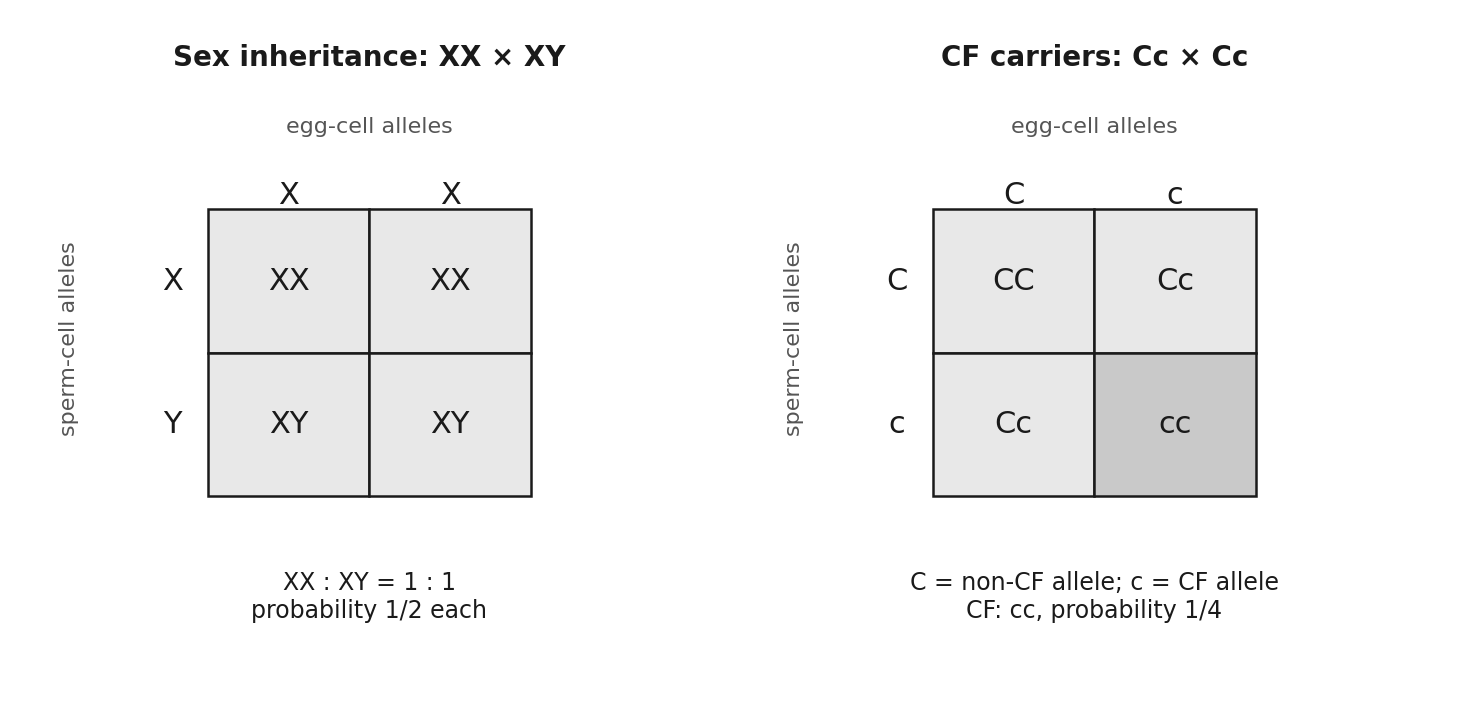
    Punnett squares and crosses: complete a Punnett square, extract ratios (e.g. 3:1, 1:1) and probabilities from genetic crosses and family trees. (HT) Construct a cross from parent genotypes and predict outcomes with probability.

    Inherited disorders: polydactyly 多指症 (extra fingers or toes) — dominant allele; cystic fibrosis 囊性纤维化 (a disorder of cell membranes) — recessive allele. Make informed judgements about the economic, social and ethical issues of embryo screening.

    Left: the XX × XY sex cross giving a 1:1 ratio. Right: two cystic-fibrosis carriers (Cc × Cc), with a 1/4 probability of cc.

    Sex determination: body cells have 23 pairs of chromosomes; 22 pairs control characteristics, one pair carries the sex genes — female XX, male XY. A sex cross (X×X, X×Y) gives a 1:1 ratio, 50 % chance each.

    From terms to family inference and probabilities

    Try first — terminology. D causes dominant polydactyly; d does not. Classify Dd and predict its phenotype and gamete alleles.

    Worked reasoning. Dd is heterozygous (two different alleles); DD and dd are homozygous. Genotype means the alleles present; phenotype means the characteristics expressed. Dd is affected because one D is expressed. “Dominant” does not mean stronger or more common. Gametes contain D or d, not Dd.

    Guided family inference — adapted from AQA June 2024 Paper 2H Q06.2. An affected father and unaffected mother have an unaffected son. Deduce the father’s genotype before reading the answer.

    Worked reasoning. The mother and son are dd. The father passed d to his son, but must also carry D because he is affected. Therefore he is Dd. The child’s genotype supplies evidence that the father’s phenotype alone cannot provide.

    Construct a cross (HT). Two unaffected CF carriers are Cc and Cc. Each produces gametes C or c. Combining them gives CC, Cc, Cc, cc: probability of CF = 1/4; probability of being a carrier = 1/2. Carriers do not have CF in this recessive model. The separate XX × XY cross gives XX, XX, XY, XY: probability 1/2 each in the GCSE sex-determination model.

    Exam transfer — adapted from AQA June 2024 Paper 2H Q06.3. An affected mother Dd and unaffected father dd have three unaffected sons. Construct a cross and predict whether the fourth child will be affected.

    Worked reasoning. Egg alleles D/d combine with sperm alleles d/d to give Dd, dd, Dd, dd. Two of four equally likely combinations are affected: probability = 2/4 = 1/2. Earlier births do not change this probability. The four boxes describe possible combinations, not four promised children.

    Evaluate — teacher-written screening scenario. Screening can identify embryos with the CF genotype, but treatment is costly and some embryos may not be used. A biological benefit is identifying cc embryos to inform the couple’s decisions. Cost can limit access and creates funding choices. Some families object to selecting or not using embryos; others prioritise reducing inherited disease. An informed judgement uses the stated evidence and recognises different values.

    מילון מונחים אימון
    English עברית
    gamete/ˈɡæmiːt/ גמטה
    chromosome/ˈkrəʊməsəʊm/ כרומוזום
    allele/əˈliːl/ אלל
    dominant/ˈdɒmɪnənt/ דומיננטי
    recessive/rɪˈsesɪv/ רסיסיבי
    homozygous/ˌhɒməˈzɪɡəs/ הומוזיגוטי
    heterozygous/ˌhetrəˈzɪɡəs/ הטרוזיגוטי
    genotype/ˈdʒenətaɪp/ גנוטיפ
    phenotype/ˈfenətaɪp/ פנוטיפ
    polydactyly/ˌpɒlɪˈdæktili/ פולידקטיליה
    cystic fibrosis/ˈsɪstɪk fɪˈbrəʊsɪs/ פיברוזיס כיסטית
    6.3

    Variation, selective breeding, genetic engineering and cloning (4.6.2)

    סיילבוס

    התגלגלות, גידול נבחר, הנדסה גנטית וריבים (AQA 8461 פריטי הבעה 4.6.2).

    1. תיאור האינטראקציה בין גנום לסביבה ושלושה גורמי התגלגלות, ואתר של מוטציה.
    2. הסבר על אבולוציה באמצעות בחירה טבעית ויצירת מינים חדשים.
    3. תיאור גידול ממוקד, שימושיו וסיכון ההתאבקות.
    4. תיאור הנדסה גנטית עם (HT) שלביו העיקריים, יתרונותיו, הסיכונים וההתנגדויות.
    5. (Bio) תיאור תרבות רקמות, חיתוכים, השתלת עוברים וריפוי תאים בוגרים.

    מקור: הסיילבוס הבינלאומי של קמבריד'ג'

    Variation 变异 — differences between individuals in a population — comes from genes inherited (genetic), conditions of development (environmental), or a combination. There is usually extensive genetic variation within a population; all genetic variants arise from mutations — most have no effect on the phenotype, some influence it, very few determine it. A rare mutation giving a new phenotype suited to an environmental change can change the species rapidly.

    Evolution: a change in the inherited characteristics of a population over time, through natural selection 自然选择, which may result in a new species. All species evolved from simple life forms that first developed over three billion years ago. Natural selection: variation → the phenotype best suited to the environment survives and breeds → those characteristics are passed on. If two populations become so different they cannot interbreed to produce fertile offspring, two new species have formed.

    Selective breeding (artificial selection): choose parents with the desired characteristic from a mixed population → breed → choose the best offspring → repeat over many generations. Uses: disease resistance in food crops; animals with more meat or milk; dogs with gentle natures; large or unusual flowers. Risk: inbreeding 近交 — breeds prone to disease or inherited defects.

    Genetic engineering: modifying the genome by introducing a gene from another organism to give a desired characteristic — GM crops resistant to insect attack or herbicides (increased yields); bacteria engineered to make human insulin. (HT) Steps: enzymes isolate the required gene → inserted into a vector (bacterial plasmid or virus) → vector inserts the gene into the required cells → transferred early in development so the organism develops with the desired characteristic. Weigh benefits (medicine, agriculture) against risks (wild-flower and insect populations, unexplored health effects) and ethical objections.

    (Bio) Cloning: tissue culture — small groups of plant cells grown into identical new plants (preserving rare species; nurseries); cuttings — simple, older gardeners' method; embryo transplants — splitting unspecialised cells of a developing animal embryo into identical embryos placed in host mothers; adult cell cloning — nucleus removed from an unfertilised egg cell → nucleus from an adult body cell inserted → electric shock makes it divide into an embryo → ball of cells placed in the womb.

    Apply variation, selection and biotechnology

    Start with variation — teacher-written seedling case. Seedlings differ in inherited disease resistance. Genetically identical plants grow to different heights under different light conditions. Identify genetic and environmental variation, then explain what may happen during a disease outbreak.

    Worked reasoning. Resistance alleles provide genetic variation; light conditions can cause environmental differences in height. Phenotype often depends on both. Resistant plants may survive the disease and reproduce more successfully, passing favourable alleles to offspring. Over generations, resistance alleles can become more common. Mutations change DNA; they do not occur because an organism needs a particular change.

    Exam transfer — adapted from AQA June 2024 Paper 2H Q01.2. Describe natural selection using insects that already vary in inherited insecticide resistance.

    Worked reasoning. The insecticide is a selection pressure: more susceptible insects die. Resistant survivors reproduce and pass resistance alleles to offspring. The population’s inherited characteristics change across generations; an individual does not evolve just by being sprayed. Speciation requires populations to become unable to interbreed to produce fertile offspring.

    Compare mechanisms — teacher-written crop case. A grower wants inherited disease resistance without transferring a gene. Select resistant parents from a mixed population, breed them, select resistant offspring and repeat over many generations. This is selective breeding, not natural selection or genetic engineering. Repeatedly breeding close relatives risks inherited defects and reduced genetic variation.

    Linked exam explanation — adapted from AQA June 2024 Paper 2H Q09.1. GM soya plants resist glyphosate. Explain how spraying the field can increase yield.

    Worked reasoning. Glyphosate kills weeds but the resistant crop survives. Less competition gives the crop more light, water and mineral ions. More light and water can support photosynthesis, producing glucose for respiration and building biomass. Nitrate ions support amino-acid and protein synthesis. Link resources to growth and harvested yield; “GM means higher yield” omits the mechanism. These are authored explanation points checked against the scheme, not an official model or a guaranteed score.

    HT — follow a gene. Enzymes isolate a required gene (for example, human insulin). Insert it into a vector such as a bacterial plasmid; use the vector to introduce it into the required cells. The modified cells express the gene and produce the substance. For a developing animal or plant, introduce the gene early so the organism develops with the desired characteristic.

    Evaluate — teacher-written GM scenario. An insect-resistant crop suffers less target-pest damage, but a study reports fewer nearby non-target insects without establishing why. Reduced damage may improve harvest. The insect decline raises a food-web concern; compare modified and unmodified fields while accounting for habitat and pesticide use. Association alone does not prove the inserted gene caused the decline. Judge the particular modification and evidence.

    Biology — choose and order cloning methods. A nursery can use tissue culture to grow plants from small groups of cells, or cuttings from a parent plant. Embryo transplants split cells before they specialise and place identical embryos into host mothers. Adult cell cloning removes an unfertilised egg’s nucleus, inserts an adult body-cell nucleus, stimulates division with an electric shock, and transfers the ball of cells to a womb. The adult body-cell donor supplies the nuclear genetic information. Environmental differences can still affect a clone’s phenotype.

    מילון מונחים אימון
    English עברית
    variation/ˌveərɪˈeɪʃn/ משתנה
    natural selection/ˈnætʃərəl sɪˈlekʃn/ בחירה טבעית
    inbreeding/ˈɪnbriːdɪŋ/ אינסואל
    adenine/ˈædəniːn/ אדנין
    cytosine/ˈsaɪtəsaɪn/ ציטוזין
    guanine/ˈɡwɑːnaɪn/ גואנין
    thymine/ˈθaɪmaɪn/ תימין
    6.4

    Evolution, genetics and evidence (4.6.3, biology only)

    סיילבוס

    אבולוציה, גנטיקה וממצאים (AQA 8461 נקודות 4.6.3, ביולוגיה בלבד).

    1. תיאור תורת דארווין, סיבה לקבלתה בהדרגה ותורת למארק.
    2. תיאור התרומות של וואלס ומנדל וגידול הגנטיקה.
    3. הסבר על מאובנים ויצירתם, סיבה לחוסר המלאכותי במאגר, גורמי הכחדה ועצי אבולוציה.
    4. הסבר על חיידקים עמידים לאנטיביוטיקה ואופן האטת ההתנגדות.

    מקור: הסיילבוס הבינלאומי של קמבריד'ג'

    (Bio) Darwin's theory: wide variation within a species; individuals best suited to the environment survive to breed; the useful characteristics are passed on. Published in On the Origin of Species (1859). Accepted only gradually: it challenged the idea that God made all living things; insufficient evidence at publication; the mechanism of inheritance was unknown for another 50 years. Lamarck's rival theory — that changes acquired during an organism's lifetime are inherited — is now known to be wrong in almost all cases.

    (Bio) Wallace: independently proposed evolution by natural selection; joint 1858 publications with Darwin prompted Darwin to publish; best known for warning colouration and pioneering work on speciation — the steps by which new species arise.

    (Bio) Mendel and the growth of genetics: mid-19th-century breeding experiments showed each characteristic is inherited through 'units' passed unchanged to descendants; late 19th century — chromosomes observed in cell division; early 20th century — the units behave like chromosomes → genes on chromosomes; mid-20th century — DNA structure determined and gene function worked out. Mendel's work was unrecognised in his lifetime.

    (Bio) Evidence for evolution: genes show characteristics pass to offspring; fossils; antibiotic resistance in bacteria.

    (Bio) Fossils form when parts do not decay (a decay condition is absent), when parts are replaced by minerals as they decay, or as preserved traces (footprints, burrows, rootlet traces). Early soft-bodied life left few traces, mostly destroyed by geological activity — so science cannot be certain how life began. Extinction means no individuals of a species remain — causes include new diseases, new predators, competition, environmental change, catastrophic events. Evolutionary trees use current classification data and fossil data.

    (Bio) Resistant bacteria: mutations produce genetic variants; some are resistant to a particular antibiotic. Susceptible bacteria are killed, while resistant survivors reproduce quickly and pass on resistance genes. The resistant strain becomes more common and can spread (for example, MRSA). This population change is evidence for evolution. Resistance can make infection harder to treat; it does not mean every antibiotic is ineffective or that people have no immune defence. Reducing inappropriate prescribing and unnecessary agricultural antibiotic use reduces avoidable selection pressure. Developing new antibiotics takes time and resources.

    Try first — resistance explanation. A population contains susceptible and resistant variants before antibiotic exposure. Explain why resistant bacteria become more common, and correct “the antibiotic makes every bacterium mutate because it needs resistance”.

    Worked reasoning. Genetic variation already exists; mutations are not directed by need. Antibiotic exposure selects survivors. Resistant bacteria reproduce and pass resistance genes to offspring, increasing their share of the population. Selection and inheritance explain the change without claiming that every individual becomes resistant.

    Use historical and fossil evidence

    Explain the history (Biology). Darwin and Wallace independently proposed natural selection; their joint writings appeared in 1858 and Darwin published his book in 1859. Acceptance was gradual: the theory challenged prevailing creation beliefs, some scientists found the evidence insufficient, and inheritance mechanisms were unknown. Mendel’s plant breeding suggested inherited units. His work’s importance was recognised after his death; later chromosome behaviour, genes on chromosomes and DNA structure connected these units to physical mechanisms.

    Apply speciation — teacher-written case. A barrier separates a population into different habitats. Different selection pressures favour different variants; survivors reproduce and pass favourable alleles to offspring. Mutations supply genetic variants. Over many generations the populations may diverge. Separation alone does not prove a new species: inability to interbreed to produce fertile offspring is the stated species criterion.

    Interpret evidence — teacher-written fossil case. A footprint preserved in rock is a trace fossil; a shell replaced by minerals illustrates mineral replacement. Conditions that prevent decay can also preserve remains. Soft-bodied organisms may leave no trace, and geological activity destroys fossils. An incomplete record still supplies evidence of past organisms and change. A species missing from one site is not necessarily extinct: extinction means no living individuals remain anywhere.

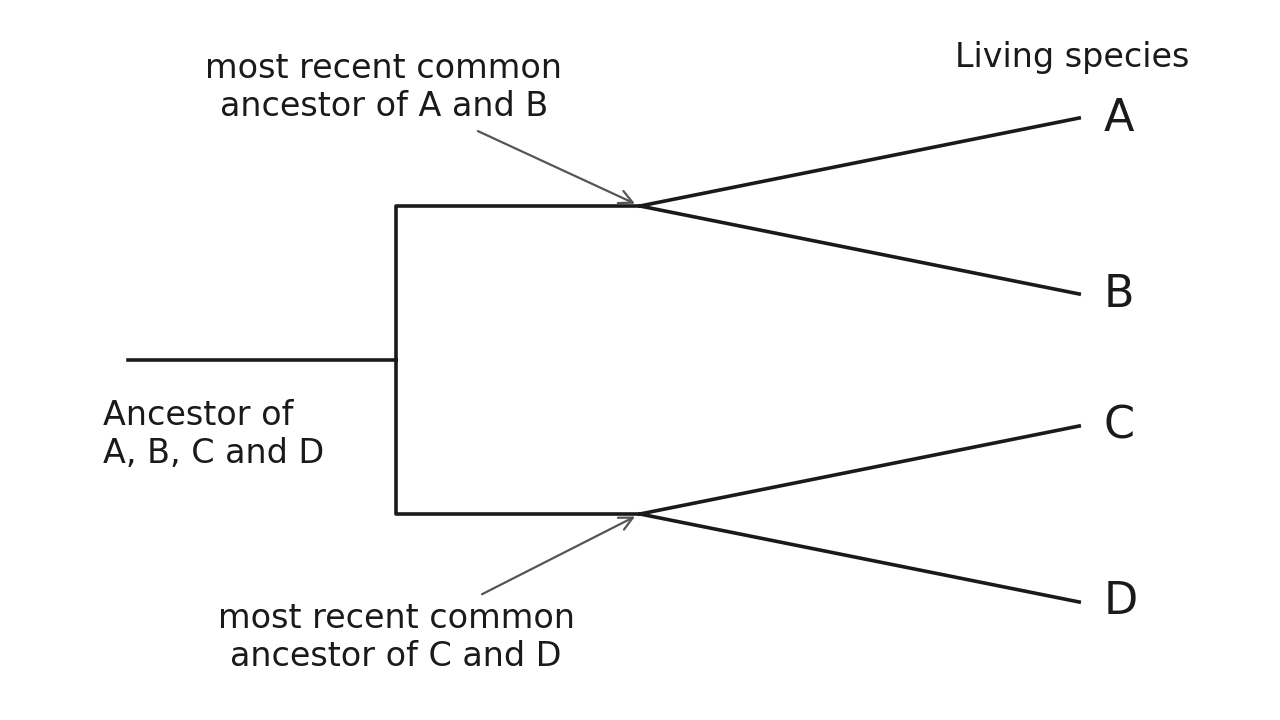
    Read the diagram. Trace A and B back to their first shared fork: this is their most recent common ancestor. A and C share the older ancestor of all four species, so A and B are more closely related. This is a schematic without a time scale; do not infer dates from branch lengths or relationships from vertical spacing. Trees use classification and fossil evidence.

    6.5

    Classification of living organisms (4.6.4)

    סיילבוס

    מיון אורגניזמים חיים (AQA 8461 נקודה 4.6.4).

    1. תיאור מערכת ליניאוס ושימוש בשם מדעי דו-חלקי.
    2. תיאור מערכת שלושת הדומיינים של ווז ומה שהניע אותה.
    3. פרשנות עצי אבולוציה באמצעות מיון ומאובנים.

    מקור: הסיילבוס הבינלאומי של קמבריד'ג'

    Linnaeus: classification by structure and characteristics into kingdom, phylum, class, order, family, genus, species; organisms named by the binomial system (genus + species).

    Three-domain system (Carl Woese), from chemical-analysis evidence: archaea (a distinct domain of prokaryotes, including many organisms from extreme environments), bacteria (true bacteria), eukaryota (protists, fungi, plants, animals). Improvements in microscopes and biochemistry drove the new models.

    An evolutionary tree: branches from a common ancestor; identify the first shared fork when tracing two tips back to their most recent common ancestor; drawn lengths here are not a time scale.

    Evolutionary trees show how scientists believe organisms are related — interpret them using classification and fossil data.

    Apply classification. In Panthera leo and Panthera tigris, Panthera identifies the shared genus; the second word distinguishes the species within it. The ranks are kingdom → phylum → class → order → family → genus → species. New microscopy and chemical-analysis evidence can reveal relationships that external appearance does not show, leading to revised classification. Woese’s three domains are archaea, bacteria and eukaryota.

    Final retrieval. Without the answers, explain (1) how 23-chromosome gametes restore 46 at fertilisation; (2) the next affected-child probability for Dd × dd after three unaffected births; (3) how antibiotic exposure changes a bacterial population. Check: two gamete sets combine; the cross gives a 1/2 probability independently at each birth; resistant survivors reproduce and pass on resistance genes. Then use the earlier worked examples to retrieve gene transfer, cloning order and common ancestry.

    6.5

    Checklist before you call this topic done

    • Meiosis (four gametes, halved number) vs mitosis; sexual vs asexual advantages with named organisms.
    • All ten genetics terms; Punnett squares with ratios; polydactyly vs cystic fibrosis; XX/XY cross 1:1.
    • (Bio) DNA nucleotides and bases; (HT) protein synthesis and mutations.
    • Variation three sources; natural selection sequence; selective breeding steps and inbreeding risk; (HT) genetic engineering steps; (Bio) four cloning methods.
    • (Bio) Darwin/Wallace/Mendel history, fossil formation and why the record is incomplete, MRSA story, Linnaeus ranks and the three domains.
  • 7

    אקולוגיה

    7.1

    Ecology: communities, cycles and human impacts

    • The Sun's energy passes through ecosystems; carbon and water cycle between the living and non-living world.
    • Communities compete and depend on each other; adaptations fit organisms to their conditions.
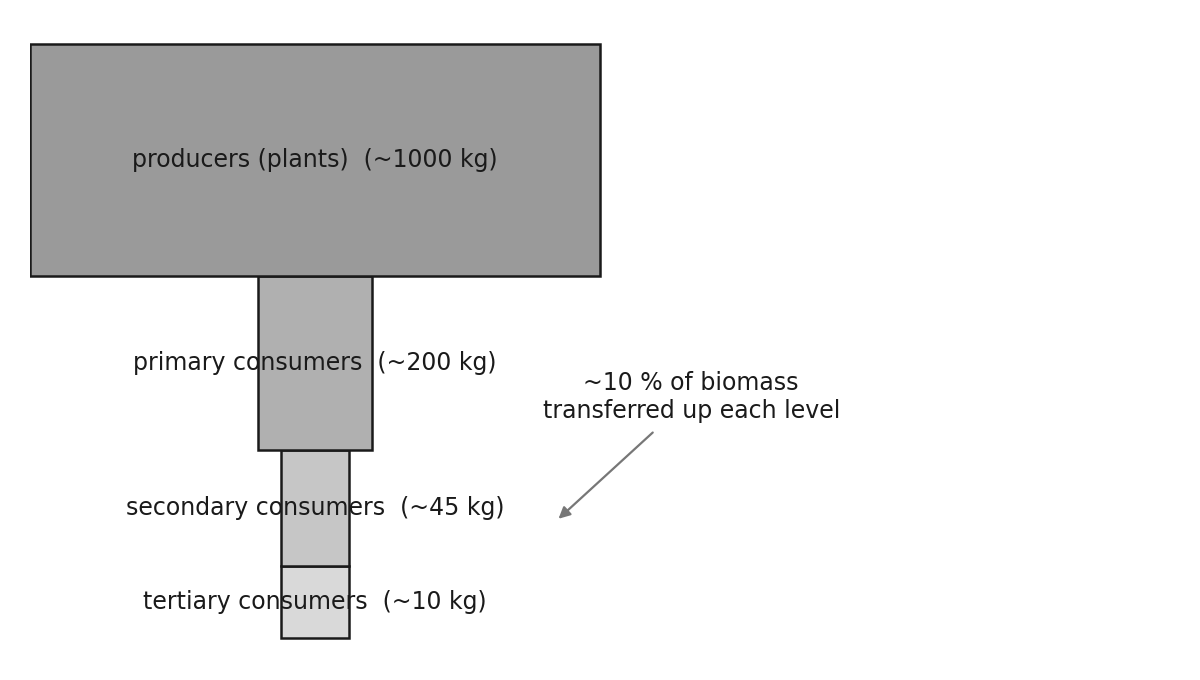
    • Human activity — waste, land use, deforestation, global warming — threatens biodiversity, and trophic-level biology (bio only) explains why food chains are short.
    7.1

    Adaptations, interdependence and competition (4.7.1)

    סיילבוס

    הסתגלויות, תלות הדדית ותחרות (AQA 8461 נקודה 4.7.1).

    1. תיאור רמות הארגון באקוסיסטמה והגדרת אקוסיסטמה, קהילה, גורמים ביוטיים ואבייטיים.
    2. הצעת גורמים עליהם צמחים ובעלי חיים מתחרים, והסבר על תלות הדדית.
    3. הסבר כיצד שינויים בגורמים אבייטיים וביוטיים נתונים משפיעים על הקהילה.
    4. הסבר על הסתגלויות מבניות, התנהגותיות ותפקודיות, וקיצוניות.

    מקור: הסיילבוס הבינלאומי של קמבריד'ג'

    An ecosystem 生态系统 is the interaction of a community of living organisms (biotic 生物因子) with the non-living (abiotic factor 非生物因子) parts of their environment. Levels of organisation: individual → population → community → ecosystem.

    Competition 竞争: plants compete for light, space, water and mineral ions; animals compete for food, mates and territory. Interdependence 相互依赖: each species depends on others for food, shelter, pollination, seed dispersal — remove one species and the whole community can be affected.

    Abiotic factors affecting a community: light intensity, temperature, moisture levels, soil pH and mineral content, wind intensity and direction, carbon dioxide levels (plants), oxygen levels (aquatic animals). Biotic factors : availability of food, new predators arriving, new pathogens, one species outcompeting another until numbers fall too low to breed. Explain the effect of a change in any of these from given data.

    Adaptations 适应性 — features that enable survival in normal conditions — are structural (shape/body), behavioural (actions) or functional (processes, e.g. camouflage chemistry, venom). Extremophiles 极端微生物 live in extreme environments — high temperature, pressure or salt — e.g. bacteria in deep-sea vents.

    מילון מונחים אימון
    English עברית
    ecosystem/ˈiːkəʊsɪstəm/ אקו-מערכת
    biotic factor/baɪˈɒtɪk ˈfæktə/ גורם ביולוגי
    abiotic factor/ˌæbɪˈɒtɪk ˈfæktə/ גורם בלתי-ביולוגי
    competition/ˌkɒmpəˈtɪʃn/ תחרות
    interdependence/ˌɪntədɪˈpendəns/ תלות הדדית
    adaptation/ˌædæpˈteɪʃn/ הסתגלות
    extremophile/ekˈstreməfaɪl/ קיצוניסט
    7.2

    Organisation of an ecosystem and material cycles (4.7.2, RP9/RP10)

    סיילבוס

    ארגון אקוסיסטמה ומחזורי חומרים (AQA 8461 נקודה 4.7.2, RP9/RP10).

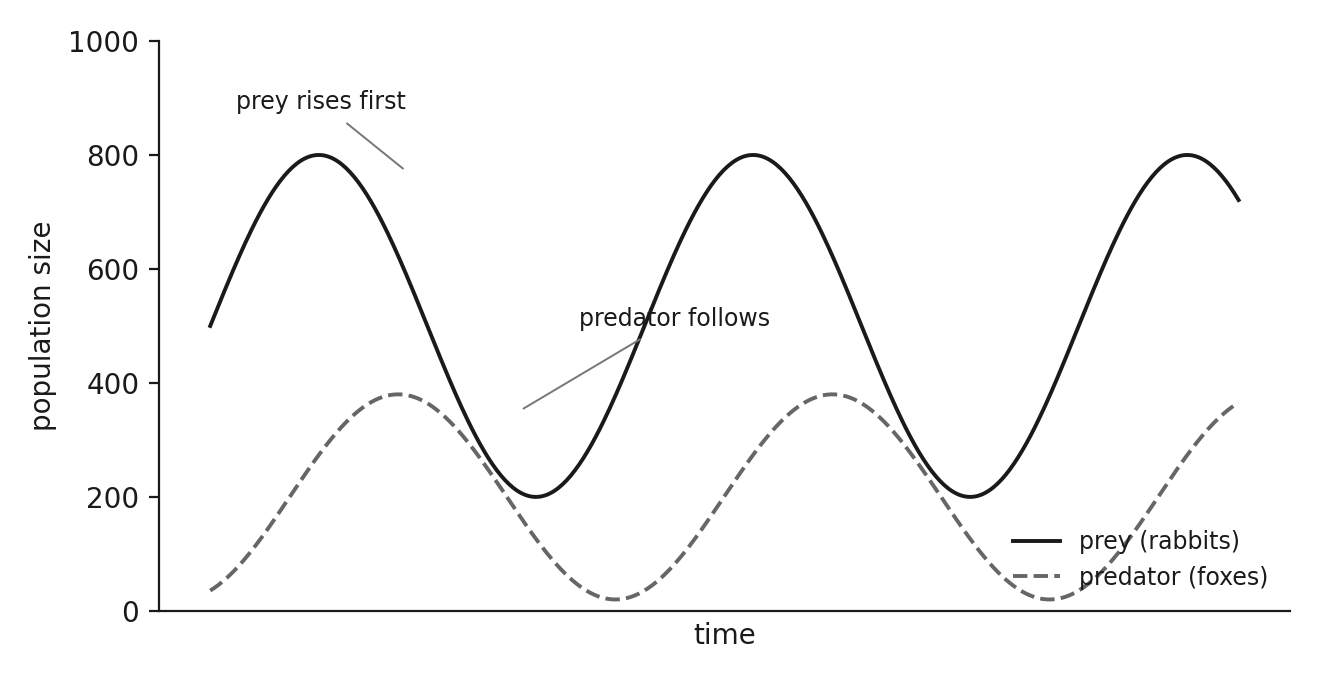
    1. שימוש במונחי שרשרת מזון מהמייצר עד הצרכן הטירטי ואישור מחזורי טורף-טרף.
    2. תאר דגימת RP9 באמצעות מסלולים וריבועים, עם ממוצע, מודוס ומחצית.
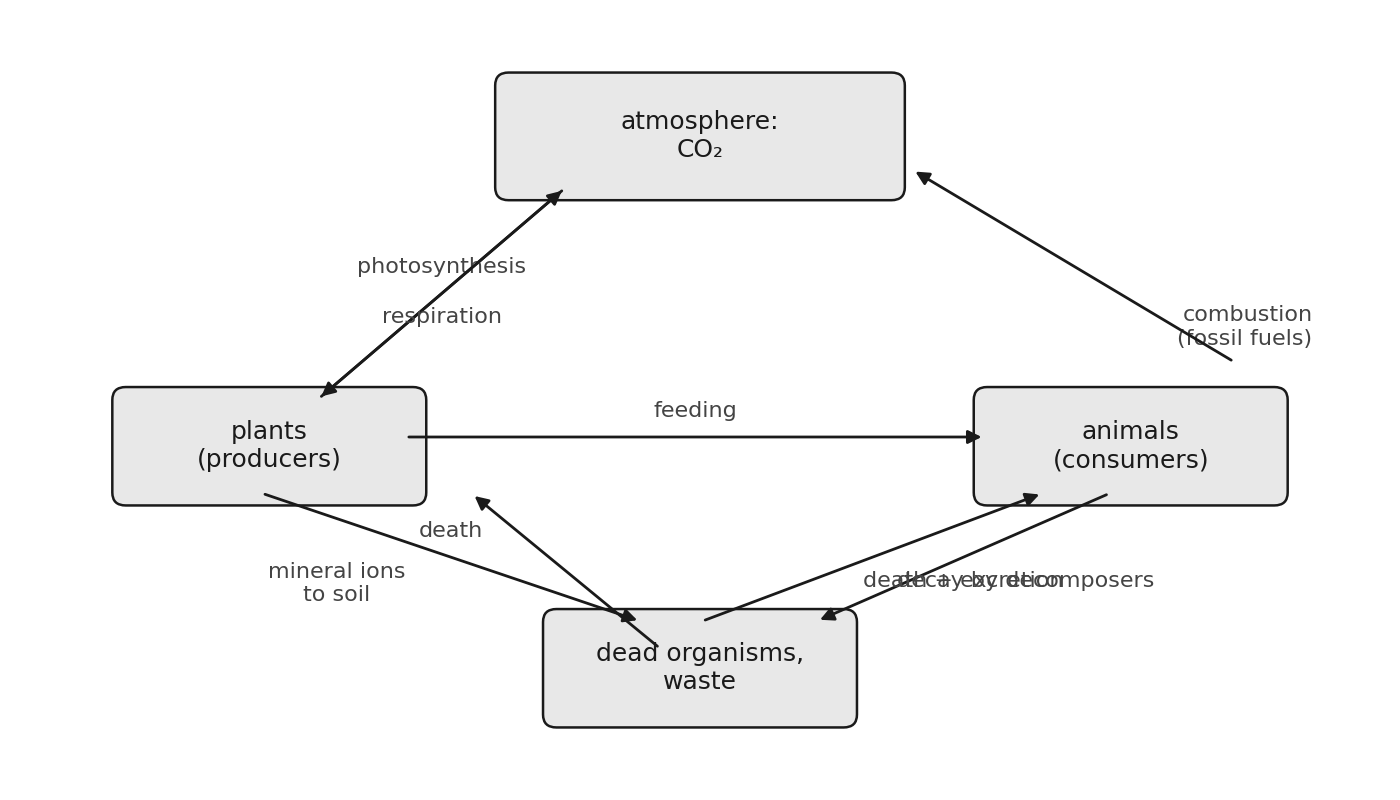
    3. הסבר את מחזורי הפחמן והמים ותפקיד המיקרואורגניזמים.
    4. (ביולוגיה) הסבר כיצד טמפרטורה, מים וחמצן משפיעים על קצב פירוק, עם RP10 וביוגז.

    מקור: הסיילבוס הבינלאומי של קמבריד'ג'

    Photosynthetic organisms are the producers 生产者 of biomass for life on Earth. Food chains: producer (green plant/alga making glucose by photosynthesis) → primary consumers 初级消费者 → secondary consumers 次级消费者 → tertiary consumers 三级消费者. A predator-prey cycle: prey numbers rise first, the predator population follows with a delay, and both oscillate.

    Predators kill and eat prey; in a stable community their numbers rise and fall in cycles — interpret the classic predator–prey graph (prey rises first, predator follows).

    Sampling (RP9): transects and quadrats measure the distribution and abundance of species; calculate mean, mode, median of abundance; plot graphs with suitable scales.

    The carbon cycle: photosynthesis takes CO2 into plants, feeding passes carbon to animals, decay by decomposers returns it, with respiration and combustion releasing CO2.

    Carbon cycle: returns carbon from organisms to the atmosphere as carbon dioxide for photosynthesis — respiration (plants, animals, decomposers), decay, combustion. Water cycle: evaporation and precipitation provide fresh water before it drains to the sea. Microorganisms recycle materials — returning carbon to the atmosphere as CO₂ and mineral ions to the soil. The nitrogen cycle is NOT required.

    (Bio) Decomposition (RP10): temperature, water and oxygen affect the rate of decay. Gardeners and farmers provide optimum conditions for rapid decay 腐解 of waste into compost — a natural fertiliser. Anaerobic decay produces methane — biogas generators. RP10: effect of temperature on the rate of decay of fresh milk by measuring pH change.

    (HT Bio) Environmental change: temperature, water availability, atmospheric-gas composition — changes may be seasonal, geographic or human-caused — shift the distribution of species.

    מילון מונחים אימון
    English עברית
    producer/prəˈdjuːsə/ יצרן
    primary consumer/ˈpraɪməri kənˈsuːmə/ צרכן ראשוני
    secondary consumer/ˈsekəndəri kənˈsuːmə/ צרכן משני
    tertiary consumer/ˈtɜːʃjəri kənˈsuːmə/ צרכן טרטיארי
    decomposition/ˌdiːkɒmpəˈzɪʃn/ פירוק
    7.3

    Biodiversity and human interactions (4.7.3)

    סיילבוס

    מגוון ביולוגי ואינטראקציות אנושיות (הצהרת AQA 8461 ⟨4.7.3).

    1. הגדר מגוון ביולוגי והסבר מדוע הוא יציב מערכות אקולוגיות.
    2. הסבר כיצד פסולת, שימוש בקרקע, גזירת יערות ומחמום עולמי מפחיתים מגוון ביולוגי.
    3. תאר תוכניות שומרות על מגוון ביולוגי.

    מקור: הסיילבוס הבינלאומי של קמבריד'ג'

    Biodiversity 生物多样性 is the variety of all different species on Earth or within an ecosystem; it stabilises ecosystems by reducing the dependence of one species on another, and our own future relies on maintaining it.

    • Waste management: population growth and living standards increase resource use and waste → pollution 污染 in water (sewage, fertiliser, toxic chemicals), air (smoke, acidic gases) and on land (landfill, toxic chemicals) — killing plants and animals.
    • Land use: building, quarrying, farming and dumping waste reduce land for other species; destroying peat bogs for garden compost destroys habitat and biodiversity, and decaying or burnt peat releases CO₂.
    • Deforestation in tropical areas: land for cattle and rice fields, crops for biofuels.
    • Global warming: rising atmospheric CO₂ and methane contribute to global warming; describe biological consequences (distribution shifts, migration changes, biodiversity loss).

    Maintaining biodiversity — programmes reducing negative human effects: breeding programmes for endangered species; protection and regeneration of rare habitats; field margins and hedgerows reintroduced in single-crop areas; reduced deforestation and CO₂ emissions; recycling rather than landfill.

    מילון מונחים אימון
    English עברית
    biodiversity/ˌbaɪəʊdaɪˈvɜːsɪti/ מגוון ביולוגי
    pollution/pəˈluːʃn/ זיהום
    7.4

    Trophic levels and food security — biology only (4.7.4–4.7.5)

    סיילבוס

    רמות טרופיות ואבטחת מזון, ביוlogia בלבד (הצהרות AQA 8461 ⟨4.7.4-4.7.5).

    1. ציין את הרמות הטרופיות, תאר פירקים ובנה פירמידות של ביומסה.
    2. הסבר איבוד ביומסה בין רמות וחשב יעילות העברה.
    3. תאר גורמים ביולוגיים המאיימים על אבטחת מזון.
    4. הערך טכניקות חקלאיות, דיג בר קיימה ותפקיד הביוטכנולוגיה.

    מקור: הסיילבוס הבינלאומי של קמבריד'ג'

    Trophic levels: 1 producers (plants, algae); 2 primary consumers (herbivores); 3 secondary consumers (carnivores eating herbivores); 4 tertiary consumers (carnivores eating carnivores). Apex predators have no predators. Decomposers secrete enzymes onto dead material and absorb the small soluble food molecules.

    A pyramid of biomass with producers at the bottom and about 10 percent of biomass passing to each level above.

    Pyramids of biomass: trophic level 1 at the bottom; construct from data. Transfer of biomass: producers transfer ~1 % of incident light energy into biomass; only ~10 % of biomass passes from each level to the next — losses from egested faeces (not all ingested material is absorbed) and waste (CO₂ and water from respiration, water and urea in urine); glucose used in respiration. Calculate efficiency by percentage or fraction of mass.

    Food security 粮食安全 — having enough food for the population — is threatened by: rising birth rate; changing diets in developed countries; new pests and pathogens; environmental changes (famine when rains fail); the cost of agricultural inputs; conflicts affecting water or food availability.

    Farming techniques improve efficiency by restricting energy transfer from food animals to the environment — limiting movement and controlling temperature; high-protein feeds increase growth. Weigh these against ethical objections to intensive farming.

    Sustainable fisheries: maintain fish stocks where breeding continues — control net size and fishing quotas .

    Role of biotechnology: culturing microorganisms for food — Fusarium fungus grown on glucose syrup in aerobic conditions produces mycoprotein 菌蛋白 (protein-rich, vegetarian); GM bacteria produce insulin; GM crops such as golden rice add food or nutritional value.

    מילון מונחים אימון
    English עברית
    food security/fuːd sɪˈkjʊərɪti/ ביטחון תזונתי
    mycoprotein/ˈmaɪkəprəʊtiːn/ חלבון פטריות
    7.4

    Checklist before you call this topic done

    • Definitions chain: ecosystem, community, abiotic/biotic factors with examples.
    • Plant vs animal competition; interdependence consequences; three adaptation types + extremophiles.
    • Food-chain vocabulary; predator–prey cycle read off a graph; RP9 sampling with mean/mode/median.
    • Carbon and water cycles with decomposers' role; (bio) decay factors + biogas + RP10.
    • Four human threats + five biodiversity programmes named.
    • (Bio) Trophic levels, pyramid shape, 10 % rule with efficiency calculation.
    • (Bio) Six food-security threats; efficiency farming, net size and quotas, mycoprotein, golden rice.

היכנס או צור חשבון

IGCSE, A-Level & AP