Skip to content · ⁨דלג לתוכן⁩
Subjects · ⁨נושאים⁩

AP Drawing · ⁨ציור - AP⁩

Tips · ⁨טיפים⁩

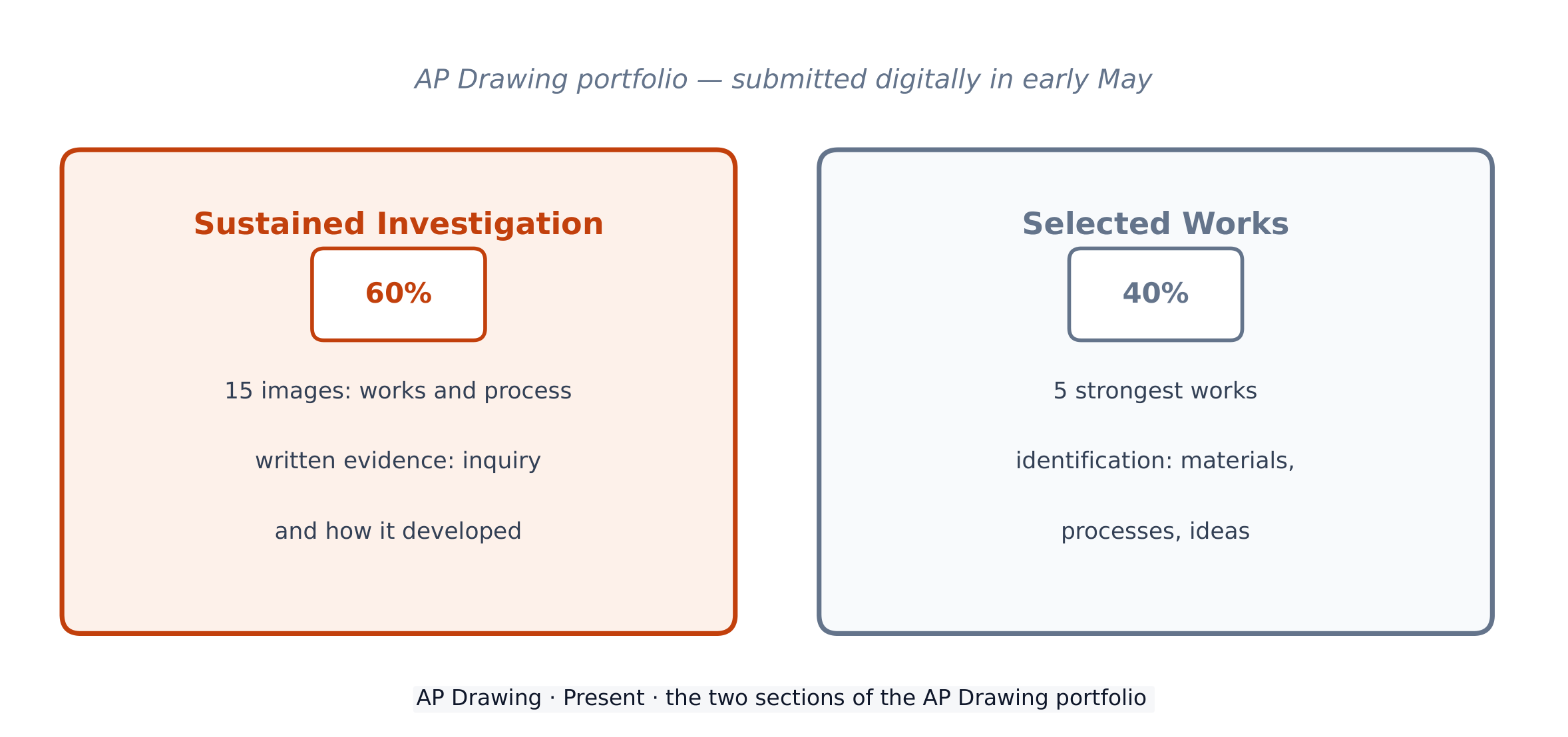
AP Drawing הוא קורס תיק עבודות, ולא קורס מבחן. אתם מגישים חמישה עשר עבודות נבחרות המדגימות מיומנויות ציור – יצירת סימנים, איכות קו, הרכבה, משטח ואור – וחקירה מתמשכת של חמישה עשר תמונות עם הוכחה כתובה לכיצד שאלת חקירה אחת התפתחה.

ציור כאן רחב יותר מאשר עפרון על נייר. ציור בשמן, הדפסה ועבודה דיגיטלית כולם מותרים, בתנאי שהחלטות הציור הן הבסיס שעליו העבודה בנויה.

החקירה המתמשכת מעניקה נקודות לפיתוח גלוי. שמרו על הניסויים והכשלונות, צלמו ותארכו כל שלב, וכתבו את שאלת החקירה בצורה מספיק ספציפית כדי שתהיה אפשרות להוכיח התקדמות.

קורס תיק עבודות ולא מבחן: ההערות מכסות את מה שהחלקים חקירה מתמשכת ועבודות נבחרות דורשים, כולל כיצד תשובות כתובות מוערכות. הארכיון כולל את מדריך ההערכה המפורסם ולא מבחנים ישנים.

Train all vocabulary · ⁨תרגול כל המילים⁩
  • 1

    Line and Mark-Making · ⁨קו ויצירת סימנים⁩

    Watch lesson · ⁨צפה בשיעור⁩
    1.1

    Line Quality · ⁨איכות הקו⁩

    Syllabus · ⁨סיילבוס⁩
    English

    Focus: Line quality is how a line looks and feels — the first drawing skill the AP rubric names is mark-making.

    • A line can be thick or thin, dark or light, smooth or rough, fast or slow.
    • Weighted line changes thickness along its length: press harder where a form turns away or carries weight.
    • Confident lines are drawn from the shoulder and elbow, not only the fingers.
    • Lost-and-found lines fade out and reappear — the viewer's eye completes the edge.
    • Line direction carries feeling: horizontal is calm, vertical is firm, diagonal is active.
    • Examiners read line quality instantly — scratchy, timid lines and one confident stroke tell different stories.
    עברית

    מיקוד: איכות קו היא כיצד קו נראה ומרגיש — המיומן הראשון שהרובריק AP מציין הוא יצירת סימנים.

    • קו יכול להיות עבה או דק, כהה או בהיר, חלק או מחוספס, מהיר או איטי.
    • קו משוקל משנה עובי לאורך אורכו: לחץ חזק יותר כאשר פורמה מתרחבת או נושאת משקל.
    • קווים בטוחים מצוירים מהכתף והמרפק, ולא רק מהאצבעות.
    • קווים מאבדים-נמצאים דוהים ומופיעים מחדש — עיני הצופה ממלאות את הקצה.
    • כיוון הקו נושא תחושה: אופקי שקט, אנכי יציב, אלכסוני פעיל.
    • בוחנים קוראים איכות קו מיידית — קווים שחוקים, פחדניים וקו בטוח אחד מספרים סיפורים שונים.

    Source: College Board AP Course and Exam Description · ⁨מקור: תיאור הקורס והמבחן של College Board AP⁩

    English

    Line quality 线条质感 is how a line looks and feels. The AP Drawing rubric names mark-making 笔触 first in its list of drawing skills, and line is the most basic mark.

    • A line can be thick or thin, dark or light, smooth or rough, fast or slow.
    • A weighted line 轻重线条 changes thickness along its length. Press harder where a form turns away from the light or carries weight.
    • Lost-and-found lines 虚实线条 fade out and come back. The viewer's eye completes the missing edge.
    • Confident lines come from the shoulder and elbow, not only the fingers.

    Line direction carries feeling: horizontal lines feel calm, vertical lines feel firm, and diagonal lines feel active. Examiners read line quality instantly, so practise until your lines look decided, not timid.

    עברית

    איכות הקו היא האופן שבו קו נראה ומרגיש. תנאי הדימוי ב-AP Drawing מזכירים את יצירת סימנים כראשונה ברשימת המיומנויות, והקו הוא הסימן הבסיסי ביותר.

    • קו יכול להיות עבה או דק, כהה או בהיר, חלק או מחוספס, מהיר או איטי.
    • קו משוקל משנה עובי לאורך אורכו. לחץ חזק יותר כאשר פורמה מסתדרת מהאור או נושאת משקל.
    • קווים נעלמים-נמצאים מתbledים וחוזרים. עין הצופה משלימה את הקצה החסר.
    • קווים בטוחים יוצאים מהכתף והמפרק, ולא רק מהאצבעות.
    איכויות קו: קווים אחידים, משוקלים, נעלמים-נמצאים ואמפרסיוניסטיים בהשוואה
    אותו קצה מצויר בארבעה אופנים: קו אחיד, קו משוקל, קו נעלם-נמצא וקו אמפרסיוניסטי מהיר

    כיוון הקו נושא תחושה: קווים אופקיים מרגישים רגועים, אנכיים מרגישים יציבים, אלכסוניים מרגישים פעילים. בוחנים קוראים איכות קו מיידית, לכן תרגל עד שהקווים שלך ייראו נחוש, ולא פחדן.

    Vocabulary · ⁨מילון מונחים⁩ Train · ⁨אימון⁩
    English עברית
    line quality/laɪn ˈkwɒlɪti/ איכות קו
    mark-making/mɑːk ˈmeɪkɪŋ/ יוצר סימנים
    weighted line/ˈweɪtɪd laɪn/ קו משוקלל
    lost-and-found lines/lɒst ænd faʊnd laɪnz/ קווים לאבוד-נמצא
    contour line/ˈkɒntʊə laɪn/ קו מתאר
    blind contour/blaɪnd ˈkɒntʊə/ מתאר עיוור
    cross-contour lines/krɒs ˈkɒntʊə laɪnz/ קווי צלב-מתאר
    gesture drawing/ˈdʒestʃə ˈdrɔːɪŋ/ ציור תנועה
    line of action/laɪn ɒv ˈækʃn/ קו פעולה
    1.2

    Contour Drawing · ⁨ציור קווי⁩

    Syllabus · ⁨סיילבוס⁩
    English

    Focus: Contour drawing follows the edges of a form slowly and carefully — it trains eye-hand coordination.

    • A contour line traces the outer edge and the inner edges (folds, creases, overlaps) of a subject.
    • In blind contour you draw without looking at the paper — pure observation practice.
    • Cross-contour lines travel across the surface of a form, like latitude lines on a globe, and describe volume.
    • Draw slowly: match the speed of your eye moving along the edge with the speed of your pencil.
    • Overlapping contours (one edge passing in front of another) create instant depth.
    • Contour studies make strong Sustained Investigation process pages — they show observation skill.
    עברית

    מיקוד: ציור קווי מתאר עוקב אחרי קצוות הפורמה לאט ובזהירות — זה מאמן סנכרון עין-יד.

    • קו מתאר מעקב את הקצה החיצוני והקצוות הפנימיים (קפלים, קמטים, חפיפה) של הנושא.
    • ב-קו מתאר עיוור אתה מצייר מבלי להסתכל על הנייר — תרגול תצפית טהור.
    • קווים צלב-מתארים עוברים על פני הפורמה, כמו קווי רוחב בכדור הארץ, ומתארים נפח.
    • צייר לאט: התאם את מהירות העיניים שלך הנעות לאורך הקצה עם מהירות העט שלך.
    • קווים מתארים חופפים (קצה אחד עובר לפני אחר) יוצרים עומק מיידי.
    • מחקרי קו מתאר יוצרים עמודות תהליך חקירה מתמשכת חזקות — הם מראים מיומנות תצפית.

    Source: College Board AP Course and Exam Description · ⁨מקור: תיאור הקורס והמבחן של College Board AP⁩

    English

    A contour line 轮廓线 traces the edges of a form — the outer edge and the inner edges made by folds, creases, and overlaps. Contour drawing is slow, careful looking.

    • Match the speed of your eye moving along the edge with the speed of your pencil.
    • In blind contour 盲画轮廓 you draw without looking at the paper. It feels strange, but it trains pure observation.
    • Cross-contour lines 横截轮廓线 travel across the surface of a form, like latitude lines on a globe. They describe volume, not edges.
    • Overlapping contours create instant depth: one edge passing in front of another says "this is closer".

    Contour studies make strong process pages for the Sustained Investigation because they show real observation skill.

    עברית

    קו היקפי מעקב את הגבולות של פורמה — הגבול החיצוני והגבולות הפנימיים שנוצרו מקמטים, קמעים וחפיפה. ציור קווי הוא מבט איטי וזהיר.

    • התאם את מהירות העיניים שלך הנעות לאורך הגבול למהירות העיפרון.
    • ב-היקף עיוור אתה מצויר ללא מבט על הנייר. זה מרגיע זר, אך מאמן תצפית טהורה.
    • קווים היקפים צולבים עוברים על פני השטח של פורמה, כמו קווי רוחב בכדור הארץ. הם מתארים נפח, לא גבולות.
    • היקפים חופפים יוצרים עומק מיידי: קצה העובר לפני אחר אומר "זה קרוב יותר".

    מחקרי היקף יוצרים עמודות תהליך חזקות לחקירה מתמשכת כי הם מראים מיומנות תצפית אמיתית.

    חיוך וקוטר ממחקר מורה: צורות קו נוצרות במבט רציף
    ג'סטר והיקף ממחקר של אמן: קו מנציח פורמה במבט רציף
    1.3

    Gesture Drawing · ⁨ציור ג'סטר⁩

    Syllabus · ⁨סיילבוס⁩
    English

    Focus: Gesture drawing captures the energy, movement, and weight of a subject in seconds — before any detail.

    • A gesture drawing takes 30 seconds to 3 minutes; it looks for the action line running through the pose.
    • Draw the whole subject at once — big loose lines from the shoulder — never one polished corner.
    • Look for the line of action first: one curve that summarises the pose's movement.
    • Gesture is about what the subject is doing, not what it looks like.
    • Daily gesture pages build speed and confidence, and they photograph well as process evidence.
    • Long drawings usually start as a gesture: energy first, structure second, detail last.
    עברית

    מיקוד: ציור תנועה (Gesture drawing) תופס את האנרגיה, התנועה והמשקל של סובייקט בתוך שניות — לפני שהתפרטים מתחילים.

    • ציור תנועה לוקח 30 שניות עד 3 דקות; הוא מחפש את הקו הפועל העובר דרך ההצגה.
    • צייר את כל הסובייקט בבת אחת — קווים גדולים ומרופפים מהכתף — לעולם פינה אחת מעוצבת היטב.
    • חפש תחילה את קו הפועל: עקומה אחת שמסכמת את התנועה של ההצגה.
    • ציור תנועה עוסק ב-מה הסובייקט עושה, ולא במראה החיצוני שלו.
    • עמודים יומיים עם ציורי תנועה בונים מהירות וביטחון, והם מצולמים היטב כעדות לתהליך היצירה.
    • ציורים ארוכים מתחילים בדרך כלל כג'סטור: אנרגיה קודם, מבנה לאחר מכן, פרטים אחרון.

    Source: College Board AP Course and Exam Description · ⁨מקור: תיאור הקורס והמבחן של College Board AP⁩

    English

    Gesture drawing 动态速写 captures the energy, movement, and weight of a subject in seconds — before any detail.

    • A gesture drawing takes 30 seconds to 3 minutes. Draw the whole subject at once with big, loose lines.
    • Look for the line of action 动势线 first: one curve that summarises the movement of the pose.
    • Gesture asks what the subject is doing, not what it looks like.
    • Long drawings usually start as a gesture: energy first, structure second, detail last.

    Daily gesture pages build speed and confidence, and they photograph well as evidence of practice.

    עברית

    ציור ג'ש תופס את האנרגיה, התנועה והמשקל של הנושא בשניות — לפני שמתחילים לפרט.

    • איור בחיוך לוקח 30 שניות עד 3 דקות. צייר את כל הנושא בבת אחת עם קווים גדולים ורפים.
    • חפש קודם כל את קו הפעולה: עיקול אחד שמסכם את התנועה של ההצגה.
    • ג'ש שואל מה הנושא עושה, לא איך הוא נראה.
    • ציורים ארוכים מתחילים בדרך כלל כג'סטור: אנרגיה קודם, מבנה לאחר מכן, פרטים אחרון.

    דפי ג'ש יומיים בונים מהירות וביטחון, והם מצלמים היטב כעדות למאמץ.

    ג'ש תופס פעולה בכמה קווים לפני שמתחילים לפרט
    ג'ש תופס פעולה בכמה קווים לפני שמתחילים לפרט
    1.4

    Hatching and Cross-Hatching · ⁨הצללה וצילוב⁩

    Syllabus · ⁨סיילבוס⁩
    English

    Focus: Hatching builds value with parallel lines; cross-hatching layers a second direction on top.

    • Closer, darker lines read as darker value; wider spacing reads as lighter value.
    • Cross-hatching adds layers at new angles — each layer deepens the tone step by step.
    • Curve the hatch lines around the form (cross-contour hatching) so the shading also describes volume.
    • Keep a consistent angle inside one plane; change angle when the plane changes — edges stay crisp.
    • Pen-and-ink drawing depends on hatching because ink has no grey — value comes only from line density.
    • Hatching shows control of mark-making and light and shade, two named AP drawing skills, in one technique.
    עברית

    מיקוד: השראה בונה ערכי גוון באמצעות קווים מקבילים; מחצלת מוסיפה שכבה נוספת בכיוון משלים.

    • קווים קרובים וכהים יותר נתפסים כערך כהה יותר; רווח רחב יותר מתפרש כערך בהיר יותר.
    • מחצלת מוסיפה שכבות בזוויות חדשות — כל שכבה מעמיקה את הגוון צעד אחר צעד.
    • כיפל את קווי ההשראה סביב הצורה (השראה קונטורית) כדי שהצללה תבטא גם נפח.
    • שמור על זווית אחידה בתוך מישור אחד; שינה את הזווית כאשר המישור משתנה — הקצוות נשארים חדים.
    • ציור בעט ובדיו תלוי בהשראה מכיוון לדיו אין גוון אפור — הערכים נובעים רק מצפיפות הקווים.
    • השראה מדגישה שליטה ב-יצירת סימנים ובאור וצל, שני מיומנויות ציור AP מוגדרות, בטכניקה אחת.

    Source: College Board AP Course and Exam Description · ⁨מקור: תיאור הקורס והמבחן של College Board AP⁩

    English
    Building value with marks

    Hatching 排线 builds tone with parallel lines. Cross-hatching 交叉排线 layers a second set of lines at a new angle on top.

    • Closer, darker lines read as darker value 明度; wider spacing reads as lighter value.
    • Each cross-hatched layer deepens the tone step by step — build darkness gradually.
    • Curve the lines around the form (cross-contour hatching) so the shading also describes volume.
    • Keep one angle inside one plane; change the angle when the plane changes, and edges stay crisp.
    • Pen-and-ink drawing depends on hatching, because ink has no grey: value comes only from line density.
    עברית
    בניית ערך באמצעות סימנים

    השתלה בונה גוון באמצעות קווים מקבילים. משתלה משכבת שכבה שנייה של קווים בזווית חדשה מעליו.

    ציור מפורט בסגנון מורים ישנים של זוג ידיים מחוברות, עם דגש בעזרת קווי דיו צפופים ועדינים על נייר בצבע אפור-כחול
    דירר בנה ידיים אלו מתוך השתלות מקבילות ומשתלות עדינות; ככל שהקווים קרובים יותר ומצטלבים, הגוון כהה יותר והסימנים השטוחים הופכים לצורה תלת-ממדית
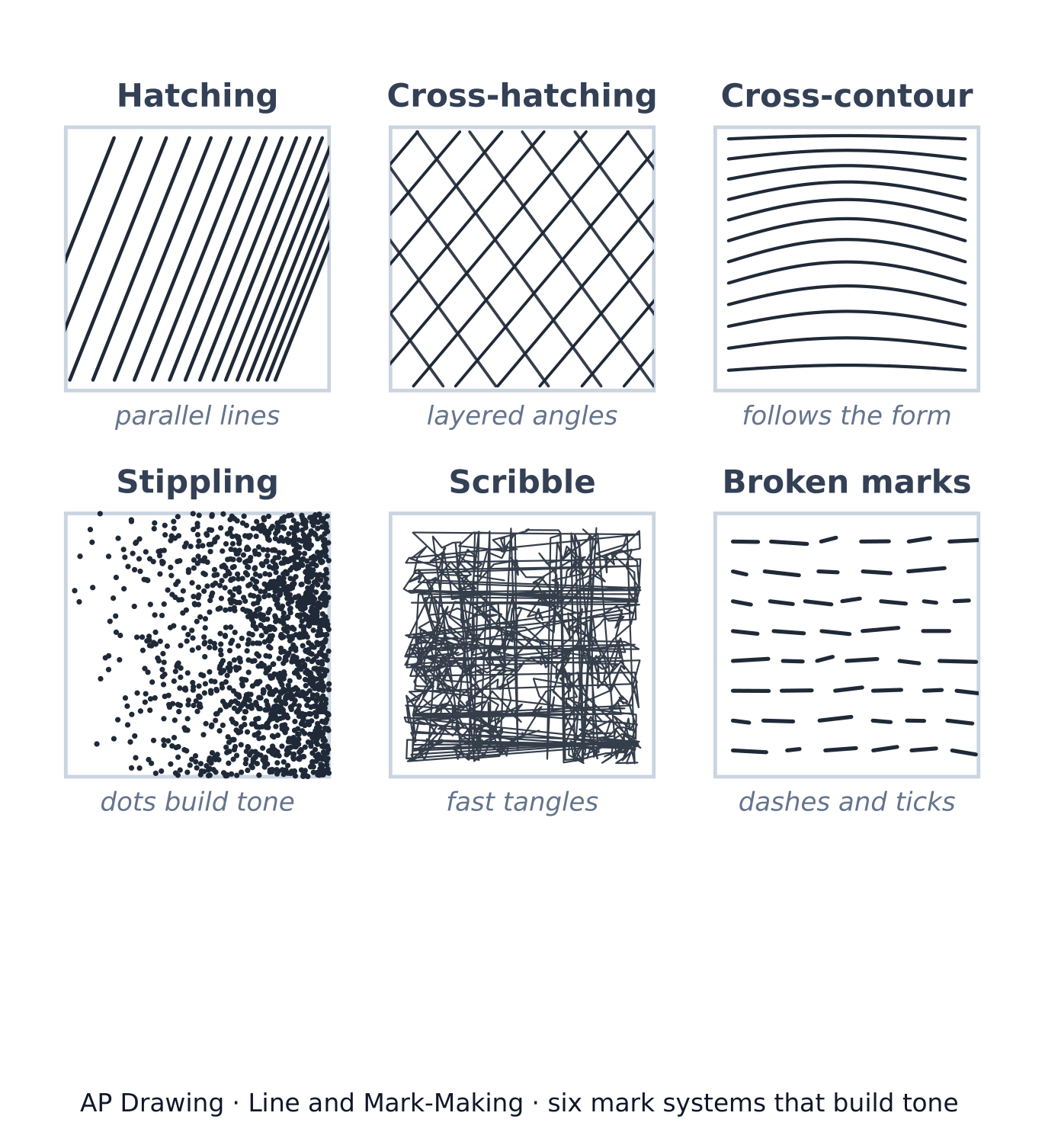
    שישה מערכות סימונים: הצללה, צילוב, צילוב קוטר, נקודות, טשטוש וסימנים שברים
    שש דרכים לבנות גוון באמצעות סימנים; סימנים קרובים וצפופים יותר נתפסים כגוון כהה יותר
    • קווים קרובים וכהים יותר נתפסים כערך כהה יותר; רווח רחב יותר מתפרש כערך בהיר יותר.
    • כל שכבת משתלה מעמיקה את הגוון צעד אחר צעד — בנה כהות בהדרגה.
    • כיוון את הקווים סביב הצורה (משתלת קו-תוהו) כך שהצלליות גם הן מתארות נפח.
    • שמור על זווית אחת בתוך מישור אחד; שינה את הזווית כאשר המישור משתנה, והקצוות יישארו חדדים.
    • ציור בדיו ותל תלוי בהשתלה, מכיוון לדיו אין אפור: הערך מגיע רק בצפיפות הקווים.
    Explore · ⁨חקור⁩

    Which mark system is it? · ⁨אילו מערכת סימנים זו?⁩

    Hatching uses parallel lines, cross-hatching layers a second angle, stippling builds tone from dots, and scribble uses fast tangles. Naming mark systems helps you choose and describe your own. · ⁨השראה משתמש בקווים מקבילים, השראה מוצלבת מוסיפה שכבה נוספת בזווית שונה, נקודותיות בונה גוון מתוך נקודות, ושטוטוקה משתמש בקשרים מהירים. הכנת שמות למערכות השראה עוזרת לך לבחור ולתאר את משלך.⁩

    Vocabulary · ⁨מילון מונחים⁩ Train · ⁨אימון⁩
    English עברית
    hatching/ˈhætʃɪŋ/ צריחה
    cross-hatching/krɒs ˈhætʃɪŋ/ צריחת רשת
    value/ˈvæljuː/ ערך
    stippling/ˈstɪplɪŋ/ נקודותיות
    scribble/ˈskrɪbl/ שרטוט
    additive/ˈædɪtɪv/ סכתי
    subtractive/sʌbˈtræktɪv/ חריטה
    surface/ˈsɜːfɪs/ משטח
    actual texture/ˈæktʃuːəl ˈtekstʃə/ מרקם אמיתי
    implied texture/ɪmˈplaɪd ˈtekstʃə/ מרקם משוקל
    frottage/ˈfrɒtɪdʒ/ פרוטאז'
    tooth/tuːθ/ שין
    expressive lines/ekˈspresɪv laɪnz/ קווים מבטאים
    distortion/dɪˈstɔːʃn/ עיוות
    voice/vɔɪs/ קול
    1.5

    Stippling, Scribbling, and Alternative Marks · ⁨נקודות, קשקוש סימנים חלופיים⁩

    Syllabus · ⁨סיילבוס⁩
    English

    Focus: Beyond hatching there is a whole vocabulary of marks — dots, scribbles, dashes, smears — each with its own texture and speed.

    • Stippling builds tone from dots: dense dots read dark, sparse dots read light — slow but very controllable.
    • Scribble (or scumbled) marks are fast tangles of line — lively, good for fur, foliage, and energy.
    • Dashes, ticks, and broken marks suggest texture without outlining every detail.
    • Marks can be additive (adding material) or subtractive (lifting material out with an eraser).
    • Try one subject rendered in four different mark systems — a classic experimentation page.
    • A personal mark vocabulary is part of your artistic voice — examiners look for it across the portfolio.
    עברית

    מיקוד: מעבר להשראה קיים אוסף סימנים שלם — נקודות, שריטות, פסיקים, מריחות — לכל אחד מהם מרקם ומהירות משלו.

    • נקודות בונות גוון מתוך נקודות: נקודות צפופות נתפסות ככהות, נקודות מרווחות נתפסות בהירות — איטי אך נשלט מאוד.
    • שריטות (או סימונים רעשניים) הן קשרי קווים מהירים — תוססים, טובים לפרוות, עלי צמחים ואנרגיה.
    • פסי קו, סימנים קצרים וסימנים שבורים מציעים טקסטורה מבלי לצייר כל פרט.
    • סימנים יכולים להיות הוספתיים (הוספת חומר) או חסרי (הסרת חומר באמצעות מחק).
    • נסה לסובייקט אחד המוצג בארבעה מערכות סימנים שונות — עמוד ניסויים קלאסי.
    • אוסף סימנים אישי הוא חלק מקול האמנותי שלך — בוחנים מחפשים אותו לאורך התיק.

    Source: College Board AP Course and Exam Description · ⁨מקור: תיאור הקורס והמבחן של College Board AP⁩

    English

    Beyond hatching there is a whole vocabulary of marks — dots, tangles, dashes, smears — each with its own texture and speed.

    • Stippling 点画 builds tone from dots: dense dots read dark, sparse dots read light. Slow, but very controllable.
    • Scribble 乱线 marks are fast tangles of line — lively and good for fur, foliage, and energy.
    • Dashes, ticks, and broken marks suggest texture without outlining every detail.
    • Marks can be additive 加法 (putting material on) or subtractive 减法 (lifting material off with an eraser).
    • A classic experimentation page: one subject rendered in four different mark systems.
    עברית

    מעבר לקווי שחיקה ישנו整个 ווקבולרי של סימנים — נקודות, סגסוגתים, מקשים, מריחות — כל אחד עם הטקסטורה והמהירות הייחודית שלו.

    • נקודות בונות גוון מתוך נקודות: נקודות צפופות נתפרשות ככהות, נקודות דלילות נתפרשות בהירות. איטי אך מבוקר מאוד.
    • סימני קשקוש הם סגסוגות מהירות של קווים — תוססים ומעולים לפרוות, עלים ואנרגיה.
    • פסי קו, סימנים קצרים וסימנים שבורים מציעים טקסטורה מבלי לצייר כל פרט.
    • סימנים יכולים להיות צומחים (הוספת חומר) או חסרים (הרמת חומר באמצעות מחק).
    • דף ניסויי קלאסי: נושא אחד המוצג בארבע שיטות סימון שונות.
    1.6

    Texture and Surface · ⁨טקסטורה ומשטח⁩

    Syllabus · ⁨סיילבוס⁩
    English

    Focus: Surface is a named AP drawing skill: how the drawing's physical texture and the depicted texture work together.

    • Actual texture is the real surface of the work (rough paper, layered charcoal, collage); implied texture is drawn illusion.
    • Frottage (rubbing over a textured surface) transfers real texture into a drawing.
    • Paper tooth (roughness) changes every mark: the same pencil reads differently on smooth and rough paper.
    • Contrast of textures — smooth skin against rough cloth — makes both read more strongly.
    • Build texture with the logic of the material: short strokes for fur, long strokes for hair, broken marks for stone.
    • Describing texture convincingly is visual evidence of observation and material control.
    עברית

    מיקוד: משטח הוא מיומן ציור AP שמו: כיצד הטקסטורה הפיזית של הציור והטקסטורה המוצגת עובדים יחד.

    • טקסטורה אמיתית היא המשטח האמיתי של היצירה (נייר מחוספס, פחם שכבתי, קולאז'); טקסטורה משוקעת היא אילוזיה מצוירת.
    • פרוטאג' (שפשוף מעל משטח מרקם) מעביר טקסטורה אמיתית לתוך הציור.
    • שיני נייר (מחוספס) משנים כל סימן: אותו עיפרון נראה אחרת על ני חלק ועל נייר מחוספס.
    • ניגוד בין טקסטורות — עור חלק מול בד מחוספס — גורם לשניהן להתפרש בחוזקה רבה יותר.
    • בנה טקסטורה לפי לוגיקת החומר: קוצרים לפרווה, ארוכים לשיער, סימנים שבורים לאבן.
    • תיאור טקסטורה במנוכחות הוא עדות ויזואלית לתצפית ולשליטה בחומר.

    Source: College Board AP Course and Exam Description · ⁨מקור: תיאור הקורס והמבחן של College Board AP⁩

    English

    Surface 画面质感 is a named AP drawing skill: the physical texture of the drawing and the drawn illusion of texture work together.

    • Actual texture 实际肌理 is the real surface of the work — rough paper, layered charcoal, collage. Implied texture 视觉肌理 is drawn illusion.
    • Frottage 拓印法 (rubbing over a textured surface) transfers real texture into a drawing.
    • Paper tooth 纸纹 changes every mark: the same pencil reads differently on smooth and rough paper.
    • Contrast of textures — smooth skin against rough cloth — makes both read more strongly.
    • Build texture with the logic of the material: short strokes for fur, long strokes for hair, broken marks for stone.
    עברית

    משטח הוא מיומן ציור AP מוגדר: הטקסטורה הפיזית של הציור והאשליה המצוירת של טקסטורה עובדות יחד.

    • טקסטורה אמיתית היא המשטח האמיתי של העבודה — נייר מחוספס, פחם שכבתי, קולאז'. טקסטורה משוערת היא אשליית ציור.
    • פרוטאג' (שפשוף מעל משטח מרקם) מעביר טקסטורה אמיתית לתוך הציור.
    • שיני הנייר משנה את כל סימן: אותו עיפרון נקרא אחרת על נייר חלק לעומת נייר מחוספס.
    • ניגוד בין טקסטורות — עור חלק מול בד מחוספס — גורם לשניהן להתפרש בחוזקה רבה יותר.
    • בנה טקסטורה לפי לוגיקת החומר: קוצרים לפרווה, ארוכים לשיער, סימנים שבורים לאבן.
    1.7

    Expressive Mark-Making · ⁨יצירת סימנים מבטית⁩

    Syllabus · ⁨סיילבוס⁩
    English

    Focus: Marks carry emotion: the same subject drawn with angry, calm, or nervous marks tells three different stories.

    • Expressive lines exaggerate speed, pressure, and direction to communicate feeling, not just describe form.
    • Käthe Kollwitz's heavy charcoal and Egon Schiele's tense contours show how marks are the meaning.
    • Choose the mark to match the idea: soft graphite for quiet subjects, aggressive ink for conflict.
    • Distortion and exaggeration are legitimate drawing decisions when they serve intent — 'accurate' is not the only goal.
    • The AP rubric rewards ideas made visual: expressive marks link technique to meaning.
    • Test the same composition in two mark styles and write one sentence on which supports your inquiry better.
    עברית

    מיקוד: סימנים נושאים רגש: אותו נושא המצויר עם סימנים כועסים, רגועים או עצבי מספר שלושה סיפורים שונים.
    • קווים מבטחים מגזימים מהירות, לחץ וכיוון כדי להעביר תחושה, לא רק ל描述 צורה.
    • הפחם הכבד של קתה קוליביץ' והקוטים המתוחים של אגון שיילे מראים כיצד הסימנים הם המשמעות.
    • בחרו את הסימן כדי להתאים הרעיון: גרפיט רך לנושאים שקטים, דיו אגרסיבי לסכסוך.
    • עיוות וגיזום הם החלטות ציור חוקיות כאשר הם משרתים כוונה – "דיוק" אינו המטרה היחידה.
    • הרובריק של AP מעריך רעיונות שהופכו לוויזואליים: סימנים מבטחים מקשרים בין טכניקה למשמעות.
    • בדיק את אותה קומפוזיציה בשני סגנונות סימנים וכתוב משפט אחד על איזה מהם תומך את השאלה שלך טוב יותר.

    Source: College Board AP Course and Exam Description · ⁨מקור: תיאור הקורס והמבחן של College Board AP⁩

    English

    Marks carry emotion. The same subject drawn with angry, calm, or nervous marks tells three different stories.

    • Expressive lines 表现性线条 exaggerate speed, pressure, and direction to communicate feeling, not just to describe form.
    • Käthe Kollwitz's heavy charcoal and Egon Schiele's tense contours show how the marks themselves carry the meaning.
    • Choose the mark to match the idea: soft graphite for quiet subjects, aggressive ink for conflict.
    • Distortion 变形 and exaggeration are legitimate drawing decisions when they serve your intent — "accurate" is not the only goal.
    • A personal mark vocabulary is part of your artistic voice 个人风格. Examiners look for it across the whole portfolio.
    עברית

    סימנים נושאים עמוס. אותו נושא המצויר עם סימנים זועמים, שקטים או עצבניים מספר שלוש סיפורים שונים.

    • קווים מבטיים מגזימים מהירות, לחץ וכיוון כדי להעביר תחושה, ולא רק כדי לתאר צורה.
    • הפחם הכבד של קטה קולביץ והקוטים המתוחים של אגון שיילे מראים כיצד הסימנים עצם נושאים את המשמעות.
    • בחרו את הסימן כדי להתאים הרעיון: גרפיט רך לנושאים שקטים, דיו אגרסיבי לסכסוך.
    • עיוות וגיזום הם החלטות ציור לגיטימיות כאשר הן משרתות את הכוונה שלך — "דיוק" אינו המטרה היחידה.
    • ווקבולרי סימנים אישי הוא חלק מה-קול האמנותי שלך. בוחנים מחפשים אותו לאורך כל תיק העבודות.
    1.7

    Exam tips · ⁨טיפים לבחינות⁩

    English
    • Line quality is judged at a glance — one page of confident, varied strokes tells a scorer more than an hour of timid rendering. Warm up before every serious drawing.
    • Show the systems, not just the results: a portfolio image of hatching, stippling, and cross-contour studies is direct visual evidence of the mark-making skill the rubric names.
    • Photograph marks close up. A detail shot of your best passage of marks proves a skill that a full view only suggests.
    • Blind contour and gesture pages belong in your process images — they show observation and practice, exactly what the Sustained Investigation rubric asks to see.
    • Match marks to meaning in your written evidence: one sentence like "scratchy graphite lines echo the anxiety of exam season" links technique to idea, which is what scorers reward.
    עברית
    • איכות הקו נשפטת במבט ראשון — עמודה אחת של קוצרים בטוחים ומגוונים מספר לבוקר יותר מאשר שעה של עיבוד פחדני. התחמם לפני כל ציור רציני.
    • הראה את המערכות, לא רק את התוצאות: תמונת תיק עבודות של שחיקות, נקודות ומחקרי קו-קונטור היא עדות ויזואלית ישירה למיומן יצירת הסימנים שמצוין בקריטריונים.
    • צלם סימנים מקרוב. צילום פרט של האזור הטוב ביותר בסימנים שלך מוכיח מיומן שצילום כולל מציע רק.
    • דפי קו עיוור ומבנה שייכים לתמונות התהליך שלך — הם מראים תצפית ותרגול, בדיוק מה שרובריקת החקירה המתמשכת דורש לראות.
    • התאם ציונים למשמעות בעדפות הכתובות שלך: משפט אחד כמו "קווים גרפיט מחוספסים חוזים את חרדת עונת המבחנים" מקשר טכניקה לרעיון, וזה מה שהמגזרים מעריכים.
  • 2

    Value, Light, and Form · ⁨ערך, אור וצורה⁩

    Watch lesson · ⁨צפה בשיעור⁩
    2.1

    The Value Scale · ⁨סולם הערכים⁩

    Syllabus · ⁨סיילבוס⁩
    English

    Focus: Value is lightness and darkness — the backbone of drawing, because we see form as light before we see colour.

    • A value scale runs from white through greys to black; a 9-step scale is the classic exercise.
    • Most beginners draw too light and too narrow — push the darks so the full range is used.
    • High-key drawings use mostly light values (airy, soft); low-key drawings use mostly dark values (heavy, dramatic).
    • Squint at the subject: squinting removes detail and shows the big value shapes.
    • Local value (how light the object's own surface is) is separate from lighting (how much light falls on it).
    • Control of the value scale is direct visual evidence of the AP skill light and shade.
    עברית

    מיקוד: ערך הוא בהירות וחושך – עמוד השדרות של הציור, כי אנחנו רואים צורה כבהירות לפני שאנחנו רואים צבע.

    • סולם ערכים נע מאלבן דרך אפורים לשחור; סולם 9-שלבים הוא התרגול הקלאסי.
    • רוב המתחילים מציירים בהיר מדי וצר מדי – דחוף את השחורים כדי שהטווח המלא ישמש.
    • ציורים עלי-ערכים משתמשים בערכים בהירים ברובם (אווירי, רך); ציורים תחת-ערכים משתמשים בערכים כהים ברובם (כבד, דרמטי).
    • הצמצם את העיניים בנושא: הצמצם מסיר פרטים ומראה את צורות הערך הגדולות.
    • ערך מקומי (כמה פני השטח של האובייקט בהירים באופן טבעי) נפרד מתאורה (כמה אור נופל עליו).
    • שליטה בסולם הערכים היא עדות ויזואלית ישירה למיומן AP אור וצל.

    Source: College Board AP Course and Exam Description · ⁨מקור: תיאור הקורס והמבחן של College Board AP⁩

    English
    The value scale

    Value 明度 is lightness and darkness — the backbone of drawing, because we see form as light before we see colour.

    • A value scale 明度阶 runs from white through greys to black. Drawing a smooth 9-step scale is the classic control exercise.
    • Most beginners draw too light and use too narrow a range. Push the darks so the drawing uses the full scale.
    • High-key 高调 drawings use mostly light values and feel airy; low-key 低调 drawings use mostly dark values and feel heavy or dramatic.
    • Local value 固有明度 is how light the object's own surface is; lighting is how much light falls on it. Keep the two ideas separate.
    • Squint 眯眼 at the subject: squinting removes detail and shows the big value shapes.
    עברית
    סולם הערכים

    ערך (Value) הוא בהירות וחושך — הגב התומך של הציור, כי אנחנו רואים נפח כהבהרה לפני שאנחנו רואים צבע.

    • סולם ערכים נע בין לבן דרך אפורים ועד שחור. ציור סולם חלק ב-9 שלבים הוא תרגול הבקרה הקלאסי.
    • רוב המתחילים מצירים מדי קל מדי ומשתמשים בטווח ערכים צר מדי. לחץ על השחורים כדי שהציור ישתמש בסולם המלא.
    • ציורים בהירים (High-key) משתמשים בעיקר בערכים בהירים ונוטים להיראות אווריריים; ציורים כהים (Low-key) משתמשים בעיקר בערכים כהים ונוטים להירדות כבדים או דרמטיים.
    • ערך מקומי הוא כמה פני השטח של האובייקט עצמו בהירים; תאורה היא כמה אור נופל עליהם. שמור על הפרדה בין שתי הרעיונות הללו.
    • עקום/סמן (Squint) לעבר הנושא: עקימה מסירה פרטים ומראה את צורות הערך הגדולות.
    Vocabulary · ⁨מילון מונחים⁩ Train · ⁨אימון⁩
    English עברית
    value/ˈvæljuː/ ערך
    value scale/ˈvæljuː skeɪl/ סולם ערכים
    high-key/haɪ kiː/ תמונה בהירה (היי-קי)
    low-key/ləʊ kiː/ תמונה כהה (לו-קי)
    local value/ˈləʊkl ˈvæljuː/ ערך מקומי
    squint/skwɪnt/ סמיכה
    highlight/ˈhaɪlaɪt/ אור דולק
    halftone/ˈhɑːftəʊn/ טון ביניים (האלף-טון)
    core shadow/kɔː ˈʃædəʊ/ צל ליבה
    reflected light/rɪˈflektɪd laɪt/ אור מחזיר
    cast shadow/kæst ˈʃædəʊ/ צל מוטל
    2.2

    Light Logic: How Light Describes Form · ⁨לוגיקת האור: איך אור מתאר נפח⁩

    Syllabus · ⁨סיילבוס⁩
    English

    Focus: One light source creates a predictable pattern of light and shadow — learn the pattern and any form becomes drawable.

    • The six zones: highlight, light, halftone, core shadow, reflected light, and cast shadow.
    • The core shadow is the darkest band on the form, where the surface turns fully away from the light.
    • Reflected light bounces back into the shadow side — it is always darker than any lit halftone.
    • The cast shadow is darkest and sharpest where it meets the object, softer and lighter further away.
    • Shadow edges tell the story: hard edges = sharp turn or cast shadow; soft edges = gradual turn.
    • Check the logic, not just the look: every value must be explainable by the light's direction.
    עברית

    מיקוד: מקור אור אחד יוצר תבנית של אור וצל — למד את התבנית וכל צורה תהיה ניתנת לציור.

    • ששת האזורי: נקודת זוהר, אור, אפור ביניים, צל ליבה, אור מחזר וצל זרוק.
    • צל הליבה הוא הפס רך הכהה ביותר על הצורה, שם המשטח פונה לחלוטין מהאור.
    • אור מחזיר קופץ חזרה לתוך צל העומק — הוא תמיד כהה יותר מכל גוון ביניים מואר.
    • צל המוטל הוא הכהה והחד ביותר כאשר נפגש עם האובייקט, והופך לרך ולבהיר ככל שמרחקו גדל.
    • קצוות הצל מספרים את הסיפור: קצוות קשים = סיבוב חד או צל מוטל; קצוות רכים = סיבול עדין.
    • בדוק את הלוגיקה, לא רק את המראה: כל גוון חיוני להיות ניתן להסבר על ידי כיוון האור.

    Source: College Board AP Course and Exam Description · ⁨מקור: תיאור הקורס והמבחן של College Board AP⁩

    English
    Light logic: how light describes form

    One light source creates a predictable pattern of light and shadow. Learn the pattern, and any form becomes drawable.

    • The six zones: highlight 高光, light, halftone 中间调, core shadow 明暗交界线, reflected light 反光, and cast shadow 投影.
    • The core shadow is the darkest band on the form, where the surface turns fully away from the light.
    • Reflected light bounces back into the shadow side — but it is always darker than any lit halftone.
    • The cast shadow is darkest and sharpest where it meets the object, then softer and lighter further away.
    • Shadow edges tell the story: hard edges mean a sharp turn or a cast shadow; soft edges mean a gradual turn.
    עברית
    לוגיקת האור: כיצד האור מתאר תצורה

    מקור אור אחד יוצר דפוס של אור וצל מתקבל מראש. למד את הדפוס, והכל נפח נהיה ניתן לציור.

    כדור תחת מקור אור אחד, עם ששת אזורי האור מסומנים
    מקור אור אחד, ששת אזורי: נקודת זוהר, אור, אפור ביניים, צל ליבה, אור מחזר וצל זרוק
    • ששת האזורי: נקודת זוהר, אור, אפור ביניים, צל ליבה, אור מחזר וצל זרוק.
    • צל הליבה הוא הפס הכהה ביותר על הנפח, שם השטח מסתובב במלואו הרחק מהאור.
    • אור מחזר קופץ חזרה לתוך הצל, אך הוא תמיד כהה מאשר כל אפור ביניים מואר.
    • הצל הזרוק הוא הכהה והחד ביותר שם הוא פוגש באובייקט, ואז נהיה רך ובהיר יותר ככל שהוא רחוק יותר.
    • קצוות הצל מספרים את הסיפור: קצוות קשים משמעות סיבוב חד או צל זרוק; קצוות רכים משמעות סיבוב הדרגתי.
    Explore · ⁨חקור⁩

    Which zone of light? · ⁨אילו אזור תאורה זה?⁩

    One light source makes six zones. The core shadow is the darkest band on the form; reflected light stays darker than any lit halftone; the cast shadow is sharpest where it meets the object. · ⁨מקור אור יחיד יוצר שישה אזורים. צל הליבה הוא הפס darker ביותר על הפורמה; האור הנשלף נשאר כהה יותר מכל חצי-גוון תאורה; הצל המוטל חד ביותר כאשר הוא פוגע באובייקט.⁩

    2.3

    Rendering Form · ⁨עיבוד נפח⁩

    Syllabus · ⁨סיילבוס⁩
    English

    Focus: Rendering means building smooth, believable volume — turning flat shapes into spheres, cylinders, and boxes.

    • Every complex subject simplifies into basic forms: sphere, cylinder, cube, cone — render those first.
    • Work dark to light or light to dark consistently; jumping around destroys the value structure.
    • Blend with intention: stumps and fingers smooth values, but preserved mark-making often reads stronger than over-blending.
    • Keep the lit side and shadow side clearly separated — form collapses when halftones creep into shadow.
    • A drawing of white objects (eggs, cups, cloth) is the classic rendering test: value comes only from light.
    • Rendered form demonstrates several AP drawing skills at once: light and shade, surface, and mark-making.
    עברית

    מיקוד: ביצוע (Rendering) פירונו בניית נפח חלק ואמינים — ההיפוך של צורות שטוחות לכדורים, צילינדרים ומלבנים.

    • כל נושא מורכב מתפשט לצורות בסיסיות: כדור, צילינדר, קובייה, חרוט — בצע אותן תחילה.
    • עבוד מכהה לאור או מאור לכהה באופן עקבי; הקפיצה בין הגוונים הורסת את מבנה הערכים.
    • ערבב במטרה: סטמפים ואצבעות מחליקים את הגוונים, אך שמירה על טביעת חותם לעיתים קרובות נקראת חזקה יותר מערבול מוגזם.
    • שמור על הפרדה ברורה בין צד המואר לצד בצל — הצורה מתמוטטת כאשר גווני הביניים זורמים לתוך הצל.
    • ציור של אובייקטים לבנים (ביצים, כוסות, בד) הוא הבחינה הקלאסית לביצוע: הערך נובע רק מאור.
    • צורה מבוצעת מדגימה מספר מיומנויות ציור AP בו-זמנית: אור וצל, משטח, וטביעת חותם.

    Source: College Board AP Course and Exam Description · ⁨מקור: תיאור הקורס והמבחן של College Board AP⁩

    English

    Rendering 塑造 means building smooth, believable volume — turning flat shapes into spheres, cylinders, and boxes.

    • Every complex subject simplifies into basic forms 基本形体: sphere, cylinder, cube, cone. Render those first.
    • Work dark-to-light or light-to-dark consistently; jumping around destroys the value structure.
    • Blend with intention: a blending stump 擦笔 smooths values, but preserved marks often read stronger than over-blending.
    • Keep the lit side and the shadow side clearly separated. Form collapses when halftones creep into the shadow.
    • A drawing of white objects (eggs, cups, cloth) is the classic rendering test: all the value comes from light alone.
    עברית

    עיבוד (Rendering) פירונו בניית נפח חלק ואמין — המרת צורות שטוחות לכדורים, צילינדרים ותיבות.

    • כל נושא מורכב מתמקד לצורות בסיס: כדור, צילינדר, קוביה, חרוט. הצגו אותן תחילה.
    • עבוד כהה-לאור או אור-כהה באופן עקבי; קפיצות בין השכבות מרסות את מבנה הערכים.
    • ערבבו במתכווננות: עטות שפיכה מחליקות ערכים, אך סימנים שמורים לעיתים קרובות נקראים חזקים יותר מאשר ערבוב יתר.
    • שמרו על הפרדה ברורה בין צד המואר לצד בצל. הצורה מתמוטטת כאשר גווני ביניים חודרים לתוך הצל.
    • איור של אובייקטים לבנים (ביצים, כוסות, בד) הוא מבחן ההצגה הקלאסי: כל הערך מגיע רק מאור.
    Vocabulary · ⁨מילון מונחים⁩ Train · ⁨אימון⁩
    English עברית
    rendering/ˈrendərɪŋ/ ביצוע / השחזה
    basic forms/ˈbeɪsɪk fɔːmz/ צורות בסיסיות
    blending stump/ˈblendɪŋ stʌmp/ פונץ' ערבוב
    chiaroscuro/ˌtʃaɪərəˈskjʊərəʊ/ שחור-לבן (קיארוסקורו)
    tenebrism/ˈtenɪbrɪzəm/ טנברוזמיה
    focal point/ˈfəʊkl pɔɪnt/ נקודת מיקוד
    toned paper/təʊnd ˈpeɪpə/ נייר גוון
    2.4

    Chiaroscuro and High-Contrast Drawing · ⁨שאריאסקורו ואיור בעל ניגודיות גבוהה⁩

    Syllabus · ⁨סיילבוס⁩
    English

    Focus: Chiaroscuro ('light-dark') uses strong value contrast for drama — the language of Caravaggio and Rembrandt.

    • A single strong light against deep shadow pushes the subject forward and sets the mood.
    • Tenebrism is extreme chiaroscuro: most of the image sinks into darkness, one area blazes.
    • Reserve the strongest contrast for the focal point — contrast attracts the eye first.
    • Charcoal and ink wash suit chiaroscuro because they reach rich, deep darks quickly.
    • Working on toned paper with white and black media makes the light logic explicit.
    • High-contrast studies photograph impressively — strong candidates for Selected Works.
    עברית

    מיקוד: קיארוסקורו ('אור-צל') משתמש בניגוד גוונים חזק ליצירת דרמה — השפה של קרבאג'ו ורמברנט.

    • מקור אור חזק אחד מול צל עמוק דוחף את הנושא קדימה ומגדיר את האווירה.
    • טניברוזם הוא כיארוסקורו קיצוני: רוב התמונה שקועה בחושך, ואזור אחד בוהק.
    • שמור על הניגוד החזק ביותר עבור נקודת המוקד - ניגוד מושך את העין תחילה.
    • פחם וצבע מים מתאימים לקיארוסקורו משום שהם מגיעים לגוונים כהים עשירים ועמוקים במהירות.
    • עבודה על נייר בגוון עם מדיה לבנה ושחורה הופכת את לוגיקת האור למפורשת.
    • מחקרי ניגוד גבוה מצלמים באופן מרשים — מועמדים חזקים לעבודות שנבחרו.

    Source: College Board AP Course and Exam Description · ⁨מקור: תיאור הקורס והמבחן של College Board AP⁩

    English

    Chiaroscuro 明暗对照法 ("light-dark") uses strong value contrast for drama — the language of Caravaggio and Rembrandt.

    • A single strong light against deep shadow pushes the subject forward and sets the mood.
    • Tenebrism 暗色调主义 is extreme chiaroscuro: most of the image sinks into darkness while one area blazes.
    • Save the strongest contrast for the focal point 视觉焦点 — contrast attracts the eye first.
    • Charcoal and ink wash suit chiaroscuro because they reach rich, deep darks quickly.
    • Working on toned paper 有色纸 with black and white media makes the light logic explicit.
    עברית

    שאר-אסקורו ("אור-חושך") משתמש בניגודיות ערכים חזקה ליצירת דרמה — זו השפה של קאראווג'יו ורמברנדט.

    איור דיוקן רך ומוצל של גבר יושב, בנוי מגווני אפור חלקים ללא קווים מחוספסים
    דיוקן בקרין קונטה של סורא נבנה מערך רך בלבד, ללא קו חיצוני כמעט; הנייר המחוספס תופס את הקרין ומעניק גווני אפור קטיפתיים
    • מקור אור חזק אחד מול צל עמוק דוחף את הנושא קדימה ומגדיר את האווירה.
    • טנברוזם הוא קיארוסקורו קיצוני: רוב התמונה שקועה בחושך בעוד אזור אחד זוהר.
    • שמרו על הניגוד החזק ביותר לנקודת המוקד — ניגודיות מושכת את העין תחילה.
    • פחם וצבע מים מתאימים לקיארוסקורו משום שהם מגיעים לגוונים כהים עשירים ועמוקים במהירות.
    • עבודה על נייר בגוון עם חומרים שחורים ולבנים הופכת את הלוגיקה האורית למפורשת.
    2.5

    Tonal Composition and Notan · ⁨הרכבה טונית ונוטאן⁩

    Syllabus · ⁨סיילבוס⁩
    English

    Focus: Notan is the design of light and dark shapes — a drawing works or fails at thumbnail size before any detail.

    • Reduce the scene to 2-3 flat values (a notan study): if the pattern reads clearly, the composition is strong.
    • Thumbnail sketches (5-8 cm) let you test several value plans in minutes.
    • Group values: many small lights scattered everywhere feel noisy; connected value shapes feel designed.
    • Place the darkest dark against the lightest light at the focal point.
    • A clear value hierarchy — one dominant value, one secondary, one accent — organises the whole page.
    • Keep the thumbnails in your process journal: they are ideal Sustained Investigation evidence of planning.
    עברית

    מיקוד: נוטן הוא עיצוב צורות בהירות וכהות — שרטוט מצליח או נכשל בגודל תמונה מיניאטורית לפני הוספת כל פרט.

    • הפוך את הסצנה ל-2-3 ערכים שטוחים (עיון נוטן): אם הדפוס קריא, ההרכבה חזקה.
    • איורי תמונה מינימליים (5-8 ס"מ) מאפשרים לבדוק מספר תוכניות ערך בשעות ספורות.
    • קבץ ערכים: הרבה אורות קטנים מפוזרים בכל מקום נראים רועשים; צורות ערך מחוברות נרא מעוצבות.
    • מיקם את הכהה ביותר מול האור הגבוה ביותר בנקודת המוקד.
    • היררכיה ברורה של ערכים — ערך בולט אחד, ערך משני ואחד דגש — מארגנות את כל העמוד.
    • שמור את התמונות המיניאטוריות ביומן התהליך שלך: הן עדת חקירה מתמשכת אידיאלית לתכנון.

    Source: College Board AP Course and Exam Description · ⁨מקור: תיאור הקורס והמבחן של College Board AP⁩

    English

    Notan 明暗构成 is the design of light and dark shapes. A drawing works or fails at thumbnail size, before any detail exists.

    • Reduce the scene to 2-3 flat values. If the pattern still reads clearly, the composition is strong.
    • Thumbnail sketches 小稿 (5-8 cm) let you test several value plans in minutes.
    • Group your values: many small lights scattered everywhere feel noisy; connected value shapes feel designed.
    • Place the darkest dark against the lightest light at the focal point.
    • A clear value hierarchy — one dominant value, one secondary, one accent — organises the whole page.
    עברית

    נוטאן הוא העיצוב של צורות אור וצל. איור מצליח או נכשל בגודל תמונה מינימלי, לפני שקיים כל פרט.

    שתי תמונות מינימליות של נוטאן: דגם ערך מחובר נקרא בבירור, ערכים מפוזרים נקראים כרעש
    צמצמו את הסצנה לשני או שלושה ערכים: צורות ערך מחוברות נקראות בבירור; נקודות מפוזרות נקראות כרעש
    • צמצמו את הסצנה ל-2-3 ערכים שטוחים. אם הדגם עדיין נקרא בבירור, ההרכבה חזקה.
    • איורי תמונה מינימליים (5-8 ס"מ) מאפשרים לבדוק מספר תוכניות ערך בשעות ספורות.
    • קבצו את הערכים שלכם: הרבה אורות קטנים מפוזרים בכל מקום מרגיש כמו רעש; צורות ערך מחוברות מרגישות כמו עיצוב.
    • מיקם את הכהה ביותר מול האור הגבוה ביותר בנקודת המוקד.
    • היררכיה ברורה של ערכים — ערך בולט אחד, ערך משני ואחד דגש — מארגנות את כל העמוד.
    Vocabulary · ⁨מילון מונחים⁩ Train · ⁨אימון⁩
    English עברית
    notan/ˈnəʊtn/ נותן
    thumbnail sketches/ˈθʌmneɪl ˈsketʃɪz/ סקיצות מיניאטוריות
    toned ground/təʊnd ɡraʊnd/ רקע מוגוון
    lift out/lɪft aʊt/ הרמה החוצה
    subtractive drawing/sʌbˈtræktɪv ˈdrɔːɪŋ/ ציור חריטי
    kneaded eraser/ˈniːdɪd ɪˈreɪzə/ מחק נמתח
    experimentation/ekˌsperɪmənˈteɪʃn/ ניסויים
    2.6

    Toned Grounds and Subtractive Drawing · ⁨רקע עם גוון וציור חסרי⁩

    Syllabus · ⁨סיילבוס⁩
    English

    Focus: Starting from a toned ground lets you draw both directions: darker with media, lighter with an eraser.

    • Cover the paper with an even charcoal or graphite tone, then lift out lights with a kneaded eraser.
    • Subtractive drawing treats the eraser as a drawing tool — pulling light out of dark.
    • Toned or grey paper gives a ready-made middle value: add darks and white highlights only.
    • The mid-tone start forces value decisions early — nothing hides behind white paper.
    • Erasers make marks too: a dragged kneaded eraser leaves soft light strokes, a hard eraser leaves crisp ones.
    • This process shows experimentation with materials and processes — exactly what the CED asks you to document.
    עברית

    מיקוד: התחלה מרקע מוגון מאפשרת לשרטט בשתי הכיוונים: כהות עם חומר, בהירות עם מחק.

    • כיס את הנייר בטון פחם או גרפיט אחיד, ואז הסר אורות בעזרת מחק דביק.
    • שרטוט חסרי טיפול במחק ככלי שרטוט — חילוץ אור מתוך כהות.
    • נייר מוגון או אפור מספק ערך ביניים מוכן מראש: הוסף רק כהות והדגשות לבנות.
    • ההתחלה בגוון אמצעי מכתיבה בחירה מוקדמת בערך — אין מה להסתיר מאחורי נייר לבן.
    • מחקים יוצרים סימנים גם הם: מחק דביק שנמשך משאיר קווים בהירים רכים, מחק קשיח משאיר קווים חדים.
    • תהליך זה מראה ניסויינות בחומרים ובתהליכים — בדיוק מה שה-CED מבקש ממך להסדיר.

    Source: College Board AP Course and Exam Description · ⁨מקור: תיאור הקורס והמבחן של College Board AP⁩

    English

    Starting from a toned ground 有色底 lets you draw in both directions: darker with media, lighter with an eraser.

    • Cover the paper with an even charcoal or graphite tone, then lift out 提白 the lights with an eraser.
    • Subtractive drawing 减法素描 treats the eraser as a drawing tool — pulling light out of dark.
    • A kneaded eraser 可塑橡皮 moulds to any shape: dab for soft lights, drag for soft strokes; a hard eraser cuts crisp lights.
    • Toned or grey paper gives a ready-made middle value: you add only the darks and the white highlights.
    • The mid-tone start forces value decisions early — nothing can hide behind white paper.
    • This process is visible experimentation 实验 with materials — exactly what the CED asks you to document.
    עברית

    התחלה מרקע בעל גוון מאפשרת לך לצייר בשני כיוונים: כהות עם חומר, בהירות עם מחק.

    • כיסוי הנייר בגוון פחם או גרפיט אחיד, ולאחר מכן הוצאת האזורים בהירים באמצעות מחק.
    • שרטוט חסרי טיפול במחק ככלי שרטוט — חילוץ אור מתוך כהות.
    • מחק גמיש מתעצב לכל צורה: לחיצה לעמומה נעימה, גרידה לקווים רכים; מחק קשיח יוצר אזורי בהירות חדים.
    • נייר בצבע או אפור מספק ערך בינוני מוכן מראש: תוסיף רק את הכהות וההדגשים הלבנים.
    • ההתחלה עם גוון בינוני מחייבת החלטות ערכים מוקדם — אין מה להסתתר מאחורי נייר לבן.
    • תהליך זה מהווה ניסוי גלוי בחומרים — בדיוק מה שה-CED מבקש ממך לתעד.
    2.6

    Exam tips · ⁨טיפים לבחינות⁩

    English
    • Full value range is a score signal. Scorers see weak, grey-on-grey drawings constantly; a confident black-to-white range stands out immediately.
    • Get the core shadow and reflected light right — they are what separates students who understand light logic from students who copy photos.
    • Include one white-object study in your practice images: value control with no local colour to hide behind is unmistakable visual evidence of the light and shade skill.
    • Photograph dark drawings carefully. Charcoal darks crush to a black mush in bad light; recheck the value range on screen before submitting.
    • Keep your notan thumbnails and submit a page of them as a process image — planning evidence directly supports the Sustained Investigation rubric.
    עברית
    • טווח ערכים מלא הוא סימן לציון. המכשירים רואים שרטוטים חלשים, אפור-על-אפור באופן שגרתי; טווח מלא משחור ללבן עולה על הפנים מיד.
    • קבל את הצל התוך-גופי והאור הנפץ נכון — הם מה שמפריד בין סטודנטים המבינים את לוגיקת האור לבין סטודנטים שמעתיקים תמונות.
    • כלול תרגיל אחד של חפץ לבן בתמונות האימון שלך: שליטה בערכים ללא צבע מקומי להסתיר מאחוריו היא ראיה ויזואלית בלתי ניתנת לספק לגבי מיומנות האור והצל.
    • צלם שרטוטים כהים בזהירות. צללים של פחם מתכווץ לשחור רטוב באור רע; בדוק מחדש את טווח הערכים במסך לפני השליחה.
    • שמור על התמונות הקטנות Notan שלך ושלוח עמוד שלהם כתמונת תהליך — עדות לתכנון תומכת ישירות בקריטריון החקירה המתמשכת.
  • 3

    Space, Depth, and Proportion · ⁨מרחב, עומק ומידות⁩

    Watch lesson · ⁨צפה בשיעור⁩
    3.1

    Measuring and Sighting · ⁨מדידה וקיפוף⁩

    Syllabus · ⁨סיילבוס⁩
    English

    Focus: Sighting is measuring the subject with your pencil at arm's length — the observational drawing survival skill.

    • Hold the pencil at full arm's length, lock the elbow, close one eye: now it is a ruler and a protractor.
    • Pick one unit (often the head, or a cup's height) and measure everything in that unit: comparative measurement.
    • Check angles by rotating the pencil to match an edge, then carrying that angle to the paper.
    • Plumb lines (vertical checks) and level lines (horizontal checks) locate landmarks above and below each other.
    • Draw envelope shapes first: the big simple shape that contains the whole subject, then divide it.
    • Measured accuracy is visual evidence of space and proportion control in the AP rubric's drawing skills.
    עברית

    מיקוד: מצפייה היא מדידת הנושא באמצעות עפרון במרחק זרוע — מיומנות הבقاء בשרטוט תצפיתי.

    • החזק את העפרון בזרוע פרוסה לחלוטין, נעל את המרפק, סגור עין אחת: עכשיו זו סרגל ומדד זוויות.
    • בחר יחידה אחת (לרוב הראש, או גובה כוס) ומדוד את הכל ביחידה זו: מדידה השוואתית.
    • בדוק זוויות על ידי סיבוב העפרון כדי להתאים לקצה, ולאחר מכן העבר את הזווית זו אל הנייר.
    • קו אנכי (בדיקות אנכיות) וקווים אופקיים (בדיקות אופקיות) ממוקמים נקודות עניין אחת מעל השנייה.
    • שרטט צורות מעטפת קודם: הצורה הגדולה והפשוטה שכוללת את כל הנושא, ואז חלק אותה.
    • דיוק במדידה הוא ראיה ויזואלית של שליטה ב-מרחב וב-יחסים בתקני AP למיומנויות שרטוט.

    Source: College Board AP Course and Exam Description · ⁨מקור: תיאור הקורס והמבחן של College Board AP⁩

    English

    Sighting 目测 means measuring the subject with your pencil at arm's length — the survival skill of observational drawing.

    • Hold the pencil at full arm's length with a locked elbow and one eye closed: now it is a ruler and a protractor.
    • Pick one unit (often the head, or a cup's height) and measure everything in that unit — comparative measurement 比较测量.
    • Check angles by rotating the pencil to match an edge, then carrying that angle to the paper.
    • A plumb line 铅垂线 (an imagined vertical) shows which landmarks sit exactly above or below each other.
    • Draw the envelope 外包形 first: the big simple shape that contains the whole subject, then divide it.
    עברית

    קיפוף (Sighting) פירונו מדידת הנושא באמצעות עפרון במרחק זרוע — מיומנות ההישרדות של הציור התצפיתי.

    • החזק את העפרון בזרוע פרוסה במלואה עם מרפק נעול ועין אחת סגולה: עכשיו הוא מטרה ומדד זוויות.
    • בחר יחידת מדידה אחת (לרוב הראש, או גובה כוס) ומדוד את הכל ביחידה זו — מדידה השוואתית.
    • בדוק זוויות על ידי סיבוב העפרון כדי להתאים לקצה, ולאחר מכן העבר את הזווית זו אל הנייר.
    • קו אנכי מדומה (plumb line) מראה אילו נקודות מפתח נמצאות בדיוק מעל או מתחת לאחרות.
    • צייר את המעטפת (envelope) תחילה: הצורה הגדולה והפשוטה שכוללת את הנושא כולו, ולאחר מכן חלק אותה.
    Vocabulary · ⁨מילון מונחים⁩ Train · ⁨אימון⁩
    English עברית
    sighting/ˈsaɪtɪŋ/ תצפית
    comparative measurement/kəmˈpærətɪv ˈmeʒəmənt/ מדידה השוואתית
    plumb line/plʌm laɪn/ דיון
    envelope/ˈenvələʊp/ מעטפת
    linear perspective/ˈlɪnɪə pəˈspektɪv/ פרספקטיבה ליניארית
    horizon line/həˈraɪzn laɪn/ קו אופק
    vanishing point/ˈvænɪʃɪŋ pɔɪnt/ נקודת היעלמות
    3.2

    One-Point Perspective · ⁨פרספקטיבה בנקודה אחת⁩

    Syllabus · ⁨סיילבוס⁩
    English

    Focus: Linear perspective turns the picture plane into a window: in one-point, all depth lines meet at a single vanishing point.

    • The horizon line is the viewer's eye level — everything above it we look up at, everything below we look down on.
    • Lines parallel to the picture plane stay true; lines going into the scene converge to the vanishing point.
    • Equal spaces look smaller as they recede — use the diagonal trick to divide receding space evenly.
    • One-point suits rooms, streets, and corridors seen straight-on.
    • Objects overlap and rise toward the horizon as they get further away — perspective plus overlap is depth doubled.
    • Perspective errors are easy to spot: check every depth line actually aims at the point.
    עברית

    מיקוד: פרספקטיבה ליניארית הופכת את מישור התמונה לחלון: בפרספקטיבת נקודה אחת, כל קווי העומק נפגשים בנקודת היעלם אחת.

    • קו האופק הוא רמת עיני הצופה — כל מה שמעליו אנו צופים אליו, וכל מה שמתחתיו אנו צופים עליו.
    • קווים המקבילים למישור התמונה נשארים כשהם; קווים הנכנסים לפנים בתוך הסצנה מתכנסים לנקודת הכניסה.
    • מרווחים שווים נראים קטנים ככל שהם מתרחקים — השתמש בטריק הדיאגונלי כדי לחלק את המרחב המתרחק באופן אחיד.
    • תרשימות נקודה אחת מתאימה לחדרים, רחובות ומסדרונות הנראים ישירות מולך.
    • אובייקטים חופפים ועולים לעבר האופק ככל שהם מתרחקים — תרשימות פלוס חפיפה הם עומק כפול.
    • טעויות תרשימות קלות לזיהוי: בדוק שכל קו עומק מכוון בפועל לנקודה.

    Source: College Board AP Course and Exam Description · ⁨מקור: תיאור הקורס והמבחן של College Board AP⁩

    English
    One-point perspective

    Linear perspective 线性透视 treats the picture as a window. In one-point perspective, all lines going into the depth meet at a single point.

    • The horizon line 视平线 is the viewer's eye level. We look down on everything below it and up at everything above it.
    • Lines parallel to the picture surface stay true; lines going into the scene converge to the vanishing point 灭点.
    • Equal spaces look smaller as they recede. Use diagonals to divide receding space evenly.
    • One-point perspective 一点透视 suits rooms, streets, and corridors seen straight-on.
    • Perspective plus overlap 遮挡 is depth doubled: near edges cover far edges.
    עברית
    Perspectiva de un punto de fuga

    פרספקטיבה ליניארית תופסת את התמונה כחלון. בפרספקטיבה בנקודה אחת, כל הקווים המובילים לעומק נפגשים בנקודה אחת.

    כביש מדברי ארוך וישר המוביל ישירות לאופק, קצוותיו הצרים לנקודה אחת
    כביש מדברי ישר: שני קצוותיו נראים כאילו מתמזגים בנקודת היעלום האחת באופק, בדיוק כמו פרספקטיבה בנקודה אחת שציור מחקה כדי להציג עומק
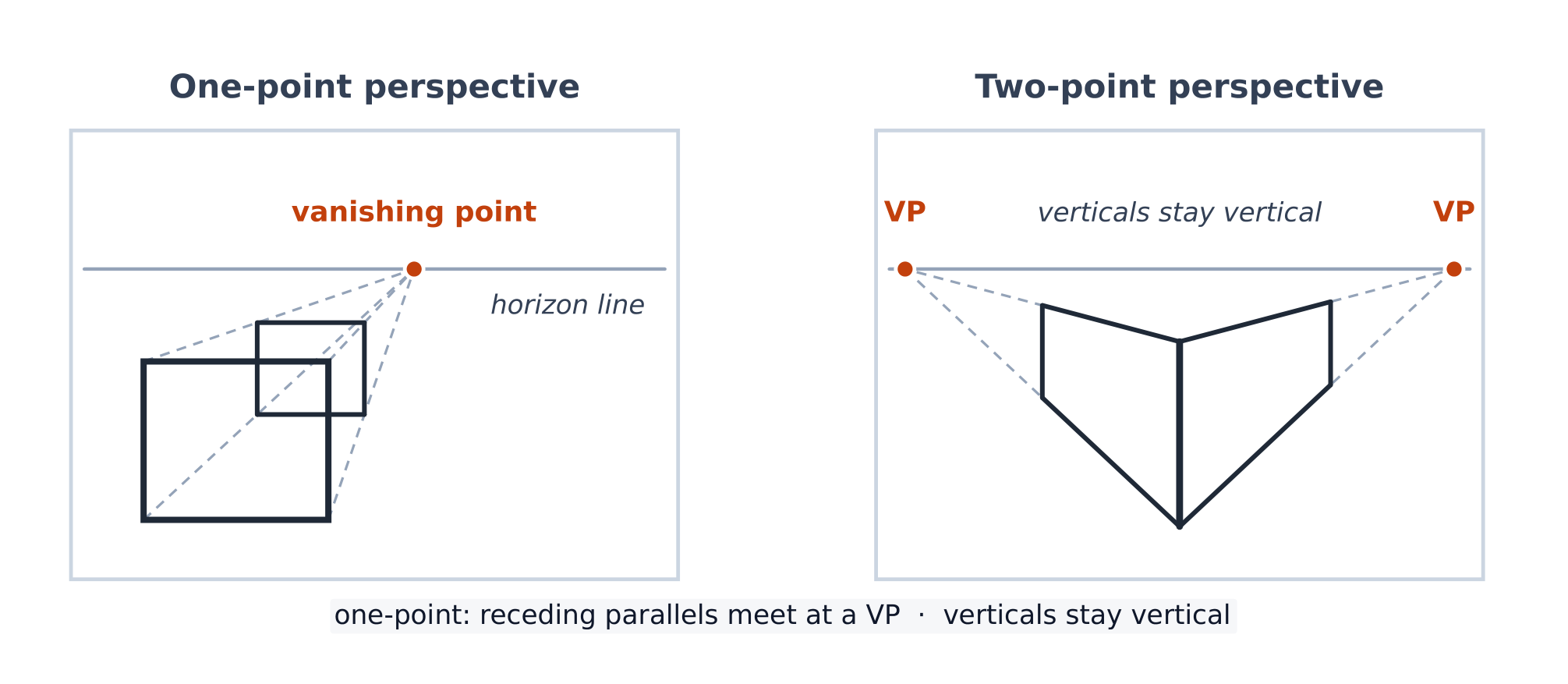
    פרספקטיבה בנקודה אחת ושתי נקודות: קו אופק, נקודות יעלום וקצוות מתכנסים
    משמאל: פרספקטיבה בנקודה אחת — קווי העומק נפגשים בנקודת יעלום אחת. מימין: פרספקטיבה בשתי נקודות — כל סדרה של קצוות מתמזגת בנקודה משלה
    • קו האופק הוא גובה עיני הצופה. אנחנו מסתכלים מלמעלה על הכל שממתחת לו ומלמטה על הכל שמעליו.
    • קווים המקבילים למשטח התמונה נשארים כפי שהם; קווים הלוכים לתוך הסצנה מתכנסים ל-נקודת היעלום.
    • מרחקים שווים נראים קטנים יותר ככל שהם מתרחקים. השתמשו באלכסונים לחלוקת מרחב הנסוג באופן שווה.
    • פרספקטיבה בנקודה אחת מתאימה חדרים, רחובות ומסדרונות הנראים ישירות.
    • פרספקטיבה פלוס חפיפה היא עומק כפול: קצוות קדמיים מכסים קצוות אחוריים.
    Vocabulary · ⁨מילון מונחים⁩ Train · ⁨אימון⁩
    English עברית
    one-point perspective/wʌn pɔɪnt pəˈspektɪv/ פרספקטיבה בנקודה אחת
    overlap/ˌəʊvəˈlæp/ חפיפה
    3.3

    Two-Point and Three-Point Perspective · ⁨פרספקטיבה בשתי נקודות ושלוש נקודות⁩

    Syllabus · ⁨סיילבוס⁩
    English

    Focus: Turn the subject at an angle and you need two vanishing points; look steeply up or down and you need a third.

    • In two-point, verticals stay vertical; both sets of horizontal edges converge to left and right points on the horizon.
    • Keep both vanishing points far apart (often off the paper) — close points create fisheye distortion.
    • Three-point adds a vertical vanishing point: skyscrapers from below (looking up) or street scenes from a rooftop (looking down).
    • Boxes drawn in perspective become the scaffolding for everything: buildings, books, vehicles, even heads.
    • Cast shadows and reflections follow the same perspective system as the objects that make them.
    • A perspective grid underdrawing keeps complex scenes consistent — construct lightly, render on top.
    עברית

    מיקוד: סובב את הנושא בזווית ואתה זקוק לשתי נקודות כניסה; צפה בגובה רב או נמוך והנחה ואתה זקוק לשלישית.

    • בתרשימות דו-נקודתית, אנכים נשארים אנכיים; שתי סדרות של קצוות אופקיים מתכנסים לנקודות שמאל וימין על האופק.
    • שמור על שתי נקודות הכניסה רחוקות זו מזו (לעיתים מחוץ לנייר) — נקודות קרובות יוצרות עיוות מסוג דג עיניים.
    • תרשימות תלת-נקודתית מוסיפה נקודת כניסה אנכית: גורדי שחקים מבסיס (צפייה כלמעלה) או סצנות רחוב מרופף (צפייה כלמטה).
    • קופסאות המצוירות בפרספקטיבה הופכות למסגרת עזר לכל דבר: מבנים, ספרים, רכבים, ואף ראשים.
    • צללים נפולים והשתקפים עוקבים אחרי אותה מערכת תרשימות כמו האובייקטים היוצרים אותם.
    • רשת תרשימות כמבנה בסיס שומרת על תסריטים מורכבים בעקביים — בנה בקלות, הצל בראשונה.

    Source: College Board AP Course and Exam Description · ⁨מקור: תיאור הקורס והמבחן של College Board AP⁩

    English
    Two-point perspective

    Turn the subject at an angle and you need two-point perspective 两点透视; look steeply up or down and you need a third point.

    • In two-point, verticals stay vertical; the two sets of horizontal edges converge to a left and a right vanishing point on the horizon.
    • Keep the two points far apart — often off the paper. Points placed too close create a fisheye distortion.
    • Three-point perspective 三点透视 adds a vertical vanishing point: a skyscraper from below, or a street from a rooftop.
    • Boxes drawn in perspective become scaffolding for everything: buildings, books, vehicles, even heads.
    • Cast shadows and reflections obey the same perspective system as the objects that make them.
    עברית
    פרספקטיבה בשתי נקודות

    הפכו את הנושא בזווית ותצטרכו פרספקטיבה בשתי נקודות; הסתכלו בחריפות למעלה או למטה ותצטרכו נקודה שלישית.

    • בפרספקטיבה בשתי נקודות, אנכיים נשארות אנכיות; שתי סדרות הקצוות האופקיים מתכנסות לנקודת יעלום שמאלית ונקודת יעלום ימנית באופק.
    • שמרו על שתי הנקודות רחוקות זו מזו — לעיתים מחוץ לנייר. נקודות המוצבות צמוד מדי יוצרות עיוות דמוי עדשת עין הדג.
    • פרספקטיבה בשלוש נקודות מוסיפה נקודת יעלום אנכית: גורד שחקים מבטא, או רחוב מגג.
    • קופסאות המצוירות בפרספקטיבה הופכות לסקירה לכל דבר: מבנים, ספרים, רכבים, אף ראשים.
    • צללים ורפלקסים פועלים לפי אותו מערכת פרספקטיבה כמו האובייקטים היוצרים אותם.
    Vocabulary · ⁨מילון מונחים⁩ Train · ⁨אימון⁩
    English עברית
    two-point perspective/tuː pɔɪnt pəˈspektɪv/ פרספקטיבה בשתי נקודות
    three-point perspective/θriː pɔɪnt pəˈspektɪv/ פרספקטיבה בשלוש נקודות
    foreshortening/fɔːˈʃɔːtənɪŋ/ הכנסה קיצורית
    cross-sections/krɒs ˈsekʃnz/ חיתוכים רוחביים
    3.4

    Foreshortening · ⁨היצטמצות⁩

    Syllabus · ⁨סיילבוס⁩
    English

    Focus: Foreshortening is perspective applied to a single form pointing toward you — lengths compress dramatically.

    • A pointing arm may appear one-third of its true length: draw the apparent shape, not the known one.
    • Overlap is the key signal: the hand overlaps the forearm, the forearm overlaps the upper arm.
    • Think in cross-sections: imagine rings around the form (like a wireframe) to feel how it turns toward you.
    • Measure foreshortened lengths by sighting — knowledge lies, observation tells the truth.
    • Classic practice: draw a figure lying down feet-first (like Mantegna's Dead Christ).
    • Strong foreshortening is high-difficulty visual evidence — examiners recognise the skill immediately.
    עברית

    מיקוד: הקיצור הפונקצינלי הוא תרשימות המיושמת על צורה יחידה המכוונת אליו — אורכים מתכווצים באופן משמעותי.

    • זרוע המכוונת עשויה להיראות כשליש מאורכה האמיתי: צייר את הצורה הנראית, לא את הידועה.
    • חפיפה היא אות המפתח: היד חופפת על הזרוע, והזרוע חופפת על הירך.
    • חשב בחתכים רוחביים: מדמיין טבעות סביב הצורה (כמו שלדת תיל) כדי להרגיש כיצד היא פונה אליך.
    • מדוד אורכים מקוצרים על ידי נקודת ייחוס — ידע עלול לשרת, תצפית אומרת אמת.
    • אימון קלאסי: צייר דמות שוכבת רגליים קדימה (כמו במ画作 המשיח המת של מנטנגנה).
    • הקיצור פונקצינלי חזק הוא עדות ויזואלית ברמת קושי גבוהה — בוחנים מזהים את המיומנות מיד.

    Source: College Board AP Course and Exam Description · ⁨מקור: תיאור הקורס והמבחן של College Board AP⁩

    English

    Foreshortening 透视缩短 is perspective applied to a single form pointing toward you — lengths compress dramatically.

    • A pointing arm may appear one-third of its true length. Draw the apparent shape, not the length you know.
    • Overlap is the key signal: the hand overlaps the forearm, the forearm overlaps the upper arm.
    • Think in cross-sections 横截面: imagine rings around the form, like a wireframe, to feel how it turns toward you.
    • Measure foreshortened lengths by sighting — memory lies, observation tells the truth.
    • The classic practice piece: a figure lying down, drawn feet-first, like Mantegna's Dead Christ.
    עברית

    היצטמצות היא פרספקטיבה המיושמת על צורה בודדת המכוונת לעברך — האורכים מתכווצים באופן דרמטי.

    • זרוע המכוונת עשויה להיראות כשליש מאורכה האמיתי. שרטט את הצורה הנראית, לא את האורך שמכיר.
    • חפיפה היא אות המפתח: היד חופפת על הזרוע, והזרוע חופפת על הירך.
    • חשוב בחתכים: בדמיין טבעות סביב הצורה, כמו שלד תילי, כדי להרגיש איך היא פונה אליך.
    • מדוד אורכים מוצטמים באמצעות נקודת ייחוס — הזיכרון מטעה, התצפית אומרת את האמת.
    • החלק הקלאסי לתרגול: דמות שוכבת, המשוטטת מכיוון הרגליים, כמו ב"הנוצר המת" של מנטנג'ה.
    3.5

    Atmospheric Perspective · ⁨פרספקטיבה אטמוספרית⁩

    Syllabus · ⁨סיילבוס⁩
    English

    Focus: Atmospheric (aerial) perspective creates depth without lines: distant things are lighter, cooler, softer, and less detailed.

    • Air scatters light, so contrast fades with distance — the far mountain is a pale flat shape.
    • Foreground: darkest darks, sharpest edges, most texture; background: narrow value range, soft edges.
    • Reserve full black and full white for the foreground; the distance lives in the middle greys.
    • Detail density is a depth cue by itself — render the near leaf, suggest the far tree.
    • Combine linear and atmospheric perspective for maximum depth in landscape and cityscape drawing.
    • This is the AP skill space made visible through light and shade — two rubric skills in one device.
    עברית

    מיקוד: פרספקטיבה אטמוספרית (אווירית) יוצרת עומק ללא קווים: דברים הרחוקים נראים בהירים יותר, קרים יותר, רכים יותר ופחות מפורטים.

    • האוויר מפזר אור, ולכן הניגודיות מתעמעמת ככל שהדבר רחוק יותר — ההר הרחוק הוא צורה שטוחה וכהה.
    • רקע קדמי: הגוונים הכהים העמוקים ביותר, הקצוות החדים ביותר והטקסטורה המופרדת ביותר; רקע רחוק: טווח גוונים צר וקצוות רכים.
    • שמרו על השחור המלא והלבן המלא עבור הרקע הקדמי; המרחב הרחוק חי בגווני האפור האמצעיים.
    • צפיפות פרטים היא אינדיקטור לעומק בעצמו — ציירו את העלה הקרוב, ורמזו על העץ הרחוק.
    • שילבו פרספקטיבה ליניארית ואטמוספרית לקבלת עומק מקסימלי בציורי נוף וערי.
    • זוהי מיומנות AP מרחב הפוכה לעין דרך אור וצל — שתי מיומנויות מסמך ציונים במכשיר אחד.

    Source: College Board AP Course and Exam Description · ⁨מקור: תיאור הקורס והמבחן של College Board AP⁩

    English
    Atmospheric perspective

    Atmospheric perspective 空气透视 creates depth without any lines: distant things become lighter, cooler, softer, and less detailed.

    • Air scatters light, so contrast fades with distance. The far mountain is a pale, flat shape.
    • Foreground: darkest darks, sharpest edges, most texture. Background: a narrow value range and soft edges.
    • Save full black and full white for the foreground; the distance lives in the middle greys.
    • Detail density is a depth cue by itself: render the near leaf, suggest the far tree.
    • Combine linear and atmospheric perspective for maximum depth in landscape drawing.
    עברית
    Perspectiva atmosférica

    פרספקטיבה אטמוספרית יוצרת עומק ללא כל קווים: דברים הרחוקים הופכים לקלים יותר, קרים יותר, רכים יותר ופחות מפורטים.

    • האוויר מפזר אור, ולכן ניגודיות מתעמעמת עם המרחק. ההר הרחוק הוא צורה בהירה ומשטחית.
    • קדמה: הכהות הכהה ביותר, הקצוות החדים ביותר, הטקסטורה העשירה ביותר. רקע: טווח ערכים צר וקצוות רכים.
    • שמור את השחור המוחלט והלבן המוחלט לקדמה; המרחק חי בסדרת הגוונים האמצעיים.
    • צפיפות פרטים היא סימן עומק בפני עצמו: הדמיין את העלה הקרוב, הרמז על העץ הרחוק.
    • שלב פרספקטיבה ליניארית ואטמוספרית עבור עומק מקסימלי בציור נוף.
    שכבות גבולי הררים מתעמעמות עם המרחק: פרספקטיבה אטמוספרית מקרה ומבהירה צורות רחוקות
    שכבות גבולי הררים מתעמעמות עם המרחק: פרספקטיבה אטמוספרית מקרה ומבהירה צורות רחוקות
    Explore · ⁨חקור⁩

    Which depth cue is at work? · ⁨איזה סמן עומק פועל כאן?⁩

    Drawings create depth several ways at once: linear perspective (lines converge), atmospheric perspective (distance fades and softens), overlap (near covers far), and foreshortening (forms compress toward you). · ⁨ציורים יוצרים עומק בדרכים שונות בו-זמנית: פרספקטיבה ליניארית (קווים נפגשים), פרספקטיבה אטמוספרית (המרחק דוהה ומתרכך), חפיפה (קרוב מכסה רחוק), וכיווץ פרספקטיבי (פורמות מתכווצות לכיוונך).⁩

    Vocabulary · ⁨מילון מונחים⁩ Train · ⁨אימון⁩
    English עברית
    atmospheric perspective/ˌætməsˈferɪk pəˈspektɪv/ פרספקטיבה אטמוספרית
    composition/ˌkɒmpəˈzɪʃn/ הרכבה
    picture plane/ˈpɪktʃə pleɪn/ מישור התמונה
    rule of thirds/ruːl ɒv θɜːdz/ חוק השלישים
    negative space/ˈneɡətɪv speɪs/ מרחב שלילי
    figure-ground relationship/ˈfɪɡə ɡraʊnd rɪˈleɪʃənʃɪp/ יחס צורה-רקע
    viewfinder/ˈvjuːfaɪndə/ מצלם
    viewpoint/ˈvjuːpɔɪnt/ נקודת מבט
    3.6

    Composition and the Picture Plane · ⁨הרכבה ומשטח התמונה⁩

    Syllabus · ⁨סיילבוס⁩
    English

    Focus: Composition — how everything is arranged inside the picture's edges — is a named AP drawing skill and the first thing a scorer sees.

    • The picture plane has edges: what you crop out is as expressive as what you keep in.
    • The rule of thirds places focal points on the third-lines — safer than dead centre.
    • Control the figure-ground relationship: negative space is a designed shape, not leftover paper.
    • Lead the eye with paths: lines, value contrast, and detail act as arrows toward the focal point.
    • Vary the viewpoint — eye level is neutral; a low or high viewpoint makes an ordinary subject fresh.
    • Test compositions with a viewfinder or phone camera crop before committing to the page.
    עברית

    מיקוד: הרכבה — כיצד כל הדברים מסודרים בתוך גבולות התמונה — היא מיומנות ציור AP מוגדרת והדבר הראשון שהמכיר רואה.

    • למישור התמונה יש קצוות: מה שחתכת הוא בעל ביטוי זהה למה שהשארת בתוך.
    • חוק השלישים מציב נקודות מיקוד על הקווים השלישיים — זה בטוח יותר מאשר באמצע בדיוק.
    • שלטו ביחס דמות-רקע: המרחב השלילי הוא צורה מעוצבת, ולא נייר שנותר חסר.
    • מדדו את העין עם מסלולים: קווים, ניגודיות גוונים ופרטים פועלים כחצים המכוונים לנקודת המיקוד.
    • שינו את זווית הצפייה; גובה העיניים הוא ניטרלי, אך זווית נמוכה או גבוהה הופכת נושא רגיל למשהו חדש.
    • בדקו הרכבות באמצעות מצלמת טלפון או קרום תמונה לפני שאתם מתחילים לצייר בדף.

    Source: College Board AP Course and Exam Description · ⁨מקור: תיאור הקורס והמבחן של College Board AP⁩

    English

    Composition 构图 — the arrangement of everything inside the picture's edges — is a named AP drawing skill and the first thing a scorer sees.

    • The picture plane 画面 has edges: what you crop out is as expressive as what you keep in.
    • The rule of thirds 三分法 places focal points on the third-lines — stronger than dead centre.
    • Design the negative space 负空间: the empty shapes around the subject are shapes you drew, not leftovers.
    • The figure-ground relationship 图底关系 must stay readable: the eye should always know what is subject and what is background.
    • Lead the eye with paths — lines, value contrast, and detail act as arrows toward the focal point.
    • Test crops with a viewfinder 取景框 (or a phone camera) before committing to the page. Change the viewpoint 视点: eye level is neutral; low or high angles make ordinary subjects fresh.
    עברית

    הרכבה — סידור הכל בתוך גבולות התמונה — היא מיומנות ציור AP שם ודבר ראשון שהמחשב/מבקר רואה.

    • למישור התמונה יש קצוות: מה שחתכת הוא בעל ביטוי זהה למה שהשארת בתוך.
    • חוק השלישים מיקם נקודות מיקוד על קווי השליש — חזק יותר מאמצע מדויק.
    • עצב אתהמרחב השלילי: הצורות הריקות סביב הנושא הן צורות ששרטטת, לא שאריות.
    • הקשר אובייקט-רקע חייב להיות קריא: העין תמיד תדע מה הוא הנושא ומה הוא הרקע.
    • נהג בעיניים באמצעות מסלולים — קווים, ניגוד ערכים ופרטים פועלים כחצים המכוונים לנקודת המוקד.
    • בדוק חיתוכים באמצעות מבטא (או מצלמת טלפון) לפני שתקבע על הדף. שינה את זווית המבט: רמת העיניים היא ניטרלית; זוויות נמוכות או גבוהות הופכות נושאים שגרתיים למשהו חדש.
    3.7

    Drawing the Figure and Portrait · ⁨ציור דמות ואיש⁩

    Syllabus · ⁨סיילבוס⁩
    English

    Focus: The figure combines every drawing skill at once — proportion, gesture, form, and likeness under one deadline.

    • The classic adult figure stands about 7.5 heads tall; the halfway point is near the hip, not the waist.
    • In the head, eyes sit at the halfway line of the skull — the beginner error is placing them too high.
    • Start with gesture and the big masses (ribcage, pelvis, skull); features and fingers come last.
    • Sight-size checks save likeness: compare distances between landmarks, not memorised rules alone.
    • Hands and feet earn their reputation — draw them as simple geometric mittens/wedges first, then divide.
    • Figure and portrait work is a portfolio staple: it demonstrates observation, proportion, and nerve.
    עברית

    מיקוד: הדמות משלבת כל מיומנות ציור בו-זמנית — פרופורציות, ג'סטר, פורמה ודמיון תחת גבול זמן אחד.

    • הדמות המבוגרת הקלאסית עומדת בגובה של כ-7.5 ראשים; הנקודה האמצעית נמצאת סמוך לירך, לא למותניים.
    • בראש, העיניים יושבות בקו האמצעי של הגולגולת — הטעות הנפוצה של מתחילים היא להציב אותן גבוה מדי.
    • התחל בגסטה ובמסה הגדולה (סגליה, אגן, גולגולת); מאפיינים ואצבעות מגיעים לבסוף.
    • בדיקות sight-size שומרות על הדמיון: השוו מרחקים בין סימני אופי, ולא רק כללים שנשמעו בשינה.
    • ידיים ורגליים מייצרות את שם הרע שלהן — ציירו אותן ככפפות/משולשים גיאומטריים פשוטים תחילה, ואז חלקו.
    • עבודת דמות ודיוקן היא חלק בלתי נפרד מתיק העבודות: היא מדגימה יכולת תצפית, פרופורציה והרזעה.

    Source: College Board AP Course and Exam Description · ⁨מקור: תיאור הקורס והמבחן של College Board AP⁩

    English

    The human figure combines every drawing skill at once: proportion 比例, gesture, form, and likeness under one deadline.

    • The classic adult figure stands about 7.5 heads tall; the halfway point of the body is near the hip, not the waist.
    • In the head, the eyes sit at the halfway line 中线 of the skull — beginners always place them too high.
    • Start with gesture and the big masses (ribcage, pelvis, skull); features and fingers come last.
    • Check likeness with landmark distances, not memorised rules alone — every face bends the average.
    • Draw hands and feet as simple geometric mittens and wedges first, then divide them into parts.
    עברית

    הדמות האנושית משלבת כל מיומנות ציור בו-זמנית: ממדים, גסטה, צורה ומצגת תחת אחריות אחת.

    ממדי דמות וראש: דמות עומדת בגובה כ-7.5 ראשים; עיניים בקו האמצעי של הגולגולת
    הדמות הקלאסית של מבוגר היא בגובה כ-7.5 ראשים; בראש, העיניים יושבות בקו האמצעי
    • הדמות הקלאסית של מבוגר עומדת בגובה כ-7.5 ראשים; הנקודה האמצעית של הגוף נמצאת קרוב לירך, לא למותן.
    • בראש, העיניים יושבות בקו האמצעי של הגולגולת — מתחילים תמיד מניחים אותן גבוה מדי.
    • התחל בגסטה ובמסה הגדולה (סגליה, אגן, גולגולת); מאפיינים ואצבעות מגיעים לבסוף.
    • בדוק מחוייכות באמצעות מרחקי סימני דרכים, ולא רק על פי כללים שנזכרו מנפאם — כל פנים מעוות את הממוצע.
    • צייר ידיים ורגליים ככפפות גיאומטריות פשוטות וקילוסים תחילה, ולאחר מכן חלק אותן לחלקים.
    Vocabulary · ⁨מילון מונחים⁩ Train · ⁨אימון⁩
    English עברית
    proportion/prəˈpɔːʃn/ יחסים פרופורציונליים
    halfway line/ˈhɑːfweɪ laɪn/ קו אמצע
    3.7

    Exam tips · ⁨טיפים לבחינות⁩

    English
    • Perspective errors are the easiest mistakes for a scorer to spot — check every depth line actually aims at its vanishing point before you render.
    • Include one strong observational space (an interior, a stairwell, a street) in the portfolio: it demonstrates the space skill the rubric names, unmistakably.
    • Foreshortening is high-value evidence. One convincing foreshortened limb or object tells scorers you draw what you see, not what you remember.
    • Crop like a designer. Before starting, test three viewfinder crops and pick the one with the strongest negative space — composition is judged at first glance.
    • Use atmospheric perspective in graphite too, not just paint: softening far edges with a kneaded eraser is quick and reads as skill.
    עברית
    • שגיאות פרספקטיבה הן הטעויות הקלות ביותר להבחין בהן על ידי מהדר — בדוק שכל קו עומק מכוון באמת לנקודת ההיעלום לפני שהערכת.
    • כלול מרחב תצפתי חזק אחד (פנים, מעלת מדרגות, רחוב) בתיק העבודות: הוא מדגים את מיומנות המרחב שמפורטת בסכמת הניקוד, ללא ספק.
    • הכנסה היא עדות בעלת ערך גבוה. איבר או חפץ מוכנסים אחדים ומשכנעים מספרים למהדרים שאתה מצייר מה שאתה רואה, לא מה שאתה זוכר.
    • חתוך כמו מעצב. לפני שמתחילים, בדוק שלושה חיתוכים במבטא ובחר את זה עם המרחב השלילי החזק ביותר — ההרכבה נשפטת ממבט ראשון.
    • שתמש בפרספקטיבה אטמוספרית גם בגרפיט, לא רק בצבע: הרخמת קצוות רחוקים באמצעות מחיקה עיסית היא מהירה ונתפסת כמיומנות.
  • 4

    Drawing Media and Processes · ⁨חומרי ציור ותהליכים⁩

    Watch lesson · ⁨צפה בשיעור⁩
    4.1

    Graphite · ⁨גרפיט⁩

    Syllabus · ⁨סיילבוס⁩
    English

    Focus: Graphite is the everyday drawing medium — precise, erasable, and capable of a full (if silvery) value range.

    • Grades run hard to soft: 9H (palest, hardest) through HB to 9B (darkest, softest).
    • Hard grades suit construction lines and fine detail; soft grades build rich darks fast.
    • Graphite gets shiny when layered heavily — deepest blacks may need charcoal or carbon pencil instead.
    • Vary the grip: writing grip for detail, overhand grip for broad, light shading from the arm.
    • Woodless graphite sticks and powder cover big areas; erasers then carve lights back out.
    • A full-value graphite still life is the classic control test — worth one polished example in any portfolio.
    עברית

    מיקוד: גרפיט הוא חומר השרטוט היומיומי – מדויק, ניתן למחיקה ויכול להציג טווח ערכים מלא (אם כי כסוף).

    • הדרגות נעות קשיחות עד רכות: 9H (הבהיר ביותר, הקשיח ביותר) דרך HB ועד 9B (הכהה ביותר, הרך ביותר).
    • ציונים קשים מתאימים לקווי מבנה ולפרטים עדינים; ציונים רכים בונים גוון כהה עשיר במהירות.
    • גרפיט מתבריק כאשר משתמשים בו בשכבות עבות; שחורים עמוקים עשויים לדרוש פחם או עיפרון פחם במקום זאת.
    • שינו את האחיזה: אחיזת כתיבה עבור פרטים, אחיזת יד עליונה לגבישה רחבה וקלה מהיד.
    • מקלות גרפיט ללא עץ ואבקה מכסים אזורים גדולים; מחקים משמשים אחר כך לחשוף אור.
    • עדיין-חיים בגרפיט בעל טווח ערכים מלא הוא מבחן בקרה קלאסי — שווה דוגמה מאולצת אחת בכל תיק עבודות.

    Source: College Board AP Course and Exam Description · ⁨מקור: תיאור הקורס והמבחן של College Board AP⁩

    English

    Graphite 石墨 is the everyday drawing medium — precise, erasable, and capable of a full (if silvery) value range.

    • Pencil grades 硬度等级 run hard to soft: 9H (palest, hardest) through HB to 9B (darkest, softest).
    • Hard grades suit construction lines and fine detail; soft grades build rich darks fast.
    • Heavy graphite turns shiny. For the deepest blacks, switch to charcoal or a carbon pencil 炭笔.
    • Vary the grip: the writing grip for detail, the overhand grip 横握 for broad, light shading from the arm.
    • Woodless graphite sticks and graphite powder cover big areas; erasers then carve the lights back out.
    • A full-value graphite still life is the classic control test — worth one polished example in any portfolio.
    עברית

    גרפיט הוא חומר הציור היומיומי — מדויק, ניתן למחיקה ויכול להשיג טווח ערכים מלא (אם כי כסוף).

    דרגות גרפיט מקשיחות 2H עד רכות 8B, עם הערך שמגיע כל אחת מהן *דרגות עפרה: דרגות קשות נשארות בהירות ומדויקות; דרגות רכות מגיעות לגוונים כהים עשירים במהירות

    • דרגות עפרה דרגות נעות מקשה לרכה: 9H (בהירות, קשות ביותר) דרך HB ועד 9B (כהות, רכות ביותר).
    • ציונים קשים מתאימים לקווי מבנה ולפרטים עדינים; ציונים רכים בונים גוון כהה עשיר במהירות.
    • גרפיט בכמות גדולה הופך למבריק. כדי להשיג את השחורים העמוקים ביותר, מעבר לפחם או לעיפרון פחמי. *
    • שנו את האחיזה: אחיזת כתיבה לפרטים, ואחיזה מעלית לגווני אור רחבים וקלים מהיד.
    • מוטות גרפיט ללא עץ ואבקת גרפיט מכסים אזורים גדולים; מחחקים מנתקים לאחר מכן את האור חזרה.
    • עדיין-חיים בגרפיט בעל טווח ערכים מלא הוא מבחן בקרה קלאסי — שווה דוגמה מאולצת אחת בכל תיק עבודות.
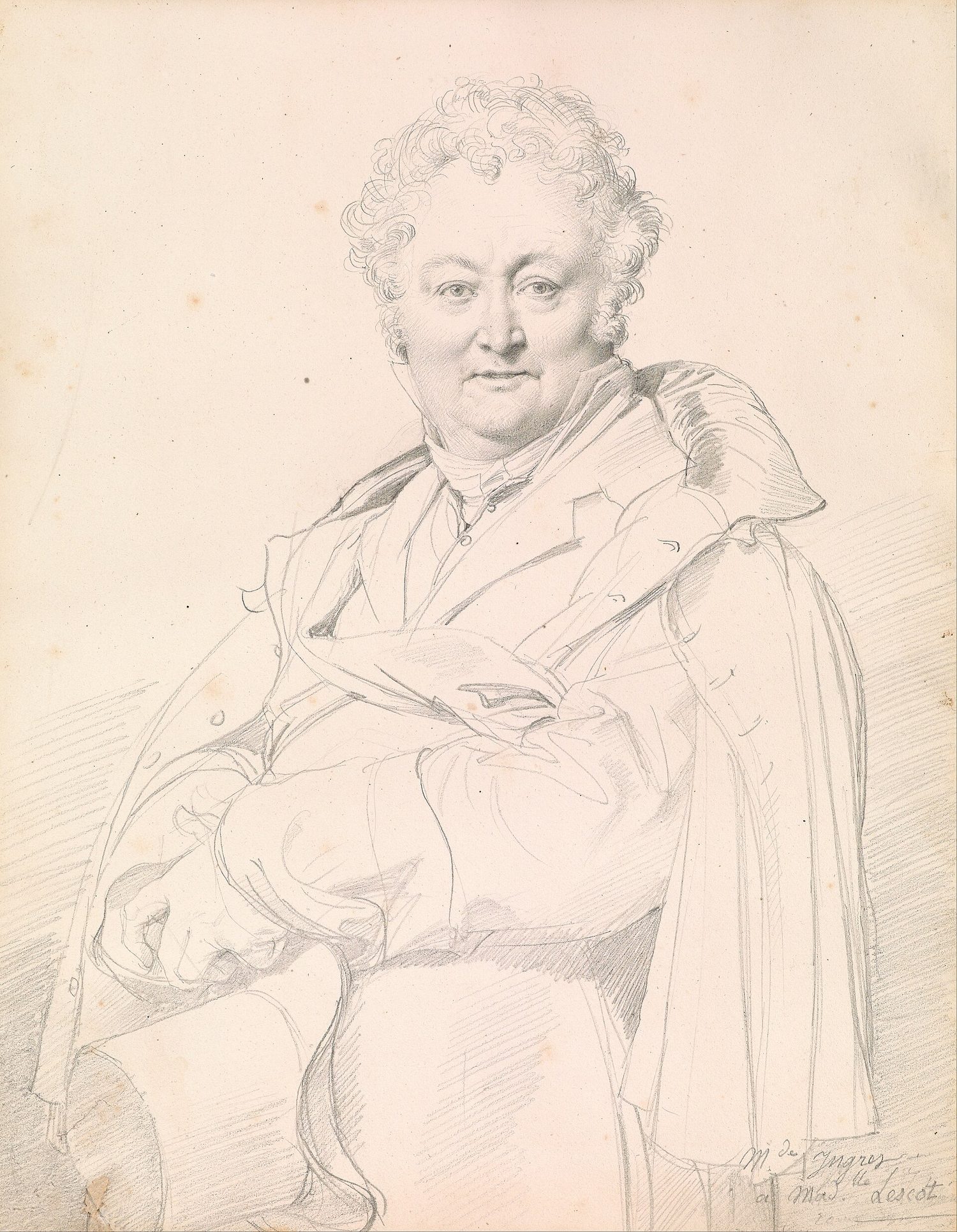
    דיוקן גרפיט של אינגראס: קו בציון קשה מדויק וגוון נשלט מתארים את הצורה בצורה ברורה
    דיוקן גרפיט של אינגראס: קו בציון קשה מדויק וגוון נשלט מתארים את הצורה בצורה ברורה
    Vocabulary · ⁨מילון מונחים⁩ Train · ⁨אימון⁩
    English עברית
    graphite/ˈɡræfaɪt/ גרפיט
    grades/ɡreɪdz/ דרגות
    carbon pencil/ˈkɑːbən ˈpensl/ עיפרון פחם
    overhand grip/ˌəʊvəˈhænd ɡrɪp/ אחיזת יד עליונה
    4.2

    Charcoal and Conté · ⁨פחם וקונטה⁩

    Syllabus · ⁨סיילבוס⁩
    English

    Focus: Charcoal is fast, bold, and deeply black — the medium of gesture, chiaroscuro, and large-scale drawing.

    • Vine/willow charcoal is soft and dusts off easily (great for starts); compressed charcoal is dense and permanent.
    • Charcoal loves toned and textured paper; it blends with stumps, cloth, and the side of the hand.
    • Conté crayons (sanguine, sepia, black, white) are waxier — crisper lines, classic figure-drawing look.
    • Work big: charcoal rewards shoulder-scale marks that graphite cannot make.
    • Fixative stops smudging — spray lightly in layers, and always in ventilation.
    • The trio of white conté + sanguine + black on toned paper (trois crayons) is a proven portfolio look.
    עברית

    מיקוד: פחם הוא מהיר, אמיץ ושחור עמוק – חומר השרטוט של הבעה, קיארוסקורו ושרטוט בקנה מידה גדול.

    • פחם גזם/עריגה הוא רך ומתפורר בקלות (מצוין להתחלת עבודה); פחם דחוס הוא צפוף ונשאר לנצח.
    • פחם אוהב נייר בגוון ובמרקם; הוא מתמזג עם סטומפים, בד וחלק החיצוני של היד.
    • צרירות קונטה (סנגווין, ספיה, שחור, לבן) יותר שעוותיות – קווים חדים יותר, מראה קלאסי לשרטוט דמויות.
    • עובדים בקנה מידה גדול: הפחם מעניק תוצאה לקווים בגודל כתף שאין אפשרי לגרפיט ליצור.
    • פיקסטיב מונע התמזגות – ריססו בשכבות דקות, תמיד באווריר.
    • השילוב של קונטה לבן + סנגווין + שחור על נייר בגוון (trois crayons) הוא מראה מוכח בתיק עבודות.

    Source: College Board AP Course and Exam Description · ⁨מקור: תיאור הקורס והמבחן של College Board AP⁩

    English

    Charcoal 木炭 is fast, bold, and deeply black — the medium of gesture, chiaroscuro, and large-scale drawing.

    • Vine charcoal 柳条木炭 is soft and dusts off easily, perfect for starts; compressed charcoal 压缩木炭 is dense and permanent.
    • Charcoal loves toned and textured paper. Blend it with stumps, cloth, or the side of your hand.
    • Conté 炭精条 crayons (sanguine, sepia, black, white) are waxier: crisper lines and the classic figure-drawing look.
    • Work big — charcoal rewards shoulder-scale marks that graphite cannot make.
    • Fixative 定画液 stops smudging. Spray lightly, in layers, and always with ventilation.
    • White conté plus sanguine 血色红棕 and black on toned paper (the trois crayons look) is a proven portfolio classic.
    עברית

    פחם הוא מהיר, נועז ושחור עמוק — המדיה של ג'שיר, כיארוסקורו ורישום בקנה מידה גדול.

    • פחם ענף הוא רך ומתפורר בקלות, מושלם להתחלה; פחם דחוס הוא צפוף ובלתי נמחק.
    • פחם אוהב נייר בטון ובמרקם. ערבבו עם סטומפים, בד או בצד ידכם.
    • פסטל קונטה (סנגווין, ספיה, שחור, לבן) הם שעווניים יותר: קווים חדשים יותר והמראה הקלאסי של רישום דמות.
    • עבדו בגודל גדול — פחם משמח על סימני קנה מידת כתף שאין לגרפיט יכול ליצור.
    • פיקסטיב מונע התמרחות. רססו קלות, בשכבות, ותמיד באוורור.
    • קונטה לבן פלוס סנגווין ושחור על נייר בטון (המראה של trois crayons) הוא קלאסיקה מוכחת בתיק עבודות.
    עריכת עדיין-חיים בפחם: מדיה רכות בונות צורות גוון רחבות לפני הפרטים
    עריכה של עדיין-חיים בפחם: מדיה רכות בונות צורות גוון רחבות לפני הפרטים
    Explore · ⁨חקור⁩

    Which medium behaves like this? · ⁨איזה חומר מתנהג כך?⁩

    Each drawing medium has a personality: graphite is precise and silvery, charcoal is fast and deeply black, ink commits without erasing, and pastel is almost pure pigment. · ⁨לכל חומר ציור יש אישיות: גרפיט הוא מדויק וכסוף, פחם הוא מהיר ושחור עמוק, דיו מחייב ללא מחיקה, ופסטל הוא כמעט פיגמנט טהור.⁩

    Vocabulary · ⁨מילון מונחים⁩ Train · ⁨אימון⁩
    English עברית
    charcoal/ˈtʃɑːkəʊl/ פחם
    vine charcoal/vaɪn ˈtʃɑːkəʊl/ פחם גפן
    compressed charcoal/kəmˈprest ˈtʃɑːkəʊl/ פחם דחוס
    conté/kɒnˈteɪ/ קונטה
    fixative/ˈfɪksətɪv/ מייצב
    sanguine/ˈsæŋɡwɪn/ סנגווין
    4.3

    Ink: Pen, Brush, and Wash · ⁨דיו: עט, מברשת ושטיפה⁩

    Syllabus · ⁨סיילבוס⁩
    English

    Focus: Ink commits — no erasing — which is exactly why it builds decisiveness and mark confidence.

    • Dip pens and fineliners build value by hatching and stippling; nib pressure varies the line's weight.
    • Brush and ink swings from hairline to broad stroke in one gesture — the most expressive line tool.
    • Ink wash (diluted ink applied in layers) works like watercolour: light washes first, darks last.
    • Combine a waterproof line with wet washes, or a water-soluble line that bleeds — two different looks.
    • East Asian ink painting (shuǐmò) treats the single loaded brushstroke as the whole discipline.
    • Mistakes become decisions in ink: incorporate them or design around them — strong process-journal material.
    עברית

    מיקוד: דיו מחייב – אין מחיקה – ולכן בדיוק这是因为 זה בונה נחישות וביטחון בשערטוט.

    • עטים שקועים ופיינלינרים בונים ערך באמצעות השוראה ונקודות; לחץ על הדיבה משנה את עובי הקו.
    • מברשת ודיו עוברות בקלות מהקו הדק של קו שיער לקו רחב במכה אחת — כלי הקו המביע ביותר.
    • שטיפת דיו (דיו מדולל המיושם בשכבות) פועלת כמו ציור מים: תחילה שכבות בהירות, לבסוף כהות.
    • שלב קו עמיד במים עם גלישות רטובות, או קו מומס במים שמסתפח – שני מראה שונים.
    • ציור דיו מזרח אסייתי (shuǐmò) מתייחס לכל המברשת המטענת ככלי המקצוע כולו.
    • שגיאות הופכות להחלטות באינק: שילב אותן או עצב סביבן — חומר מצוין ליומן תהליך חזק.

    Source: College Board AP Course and Exam Description · ⁨מקור: תיאור הקורס והמבחן של College Board AP⁩

    English

    Ink 墨水 commits — there is no erasing — and that is exactly why it builds decisiveness and mark confidence.

    • Dip pens and fineliners build value by hatching and stippling; nib 笔尖 pressure varies the line's weight.
    • Brush and ink 毛笔墨线 swings from hairline to broad stroke in one gesture — the most expressive line tool.
    • Ink wash 淡彩 (diluted ink applied in layers) works like watercolour: light washes first, darks last.
    • A waterproof line under wet washes keeps its edge; a water-soluble line bleeds — two different looks, both useful.
    • East Asian ink painting 水墨画 treats the single loaded brushstroke as a whole discipline of control.
    • Mistakes become decisions in ink: incorporate them or design around them — strong material for the process journal.
    עברית

    דיו מחייב — אין מחיקה — והוא בדיוק לכך שהוא בונה החלטיות וביטחון בסימן.

    • עטים שקועים ופיינליינרים בונים גוון באמצעות הדקנות ונקודות; לחץ חוד משנה את עובי הקו.
    • מברשת ודיו עוברות בקלות מהקו הדק של קו שיער לקו רחב במכה אחת — כלי הקו המביע ביותר.
    • שטיפת דיו (דיו מדולל המיושם בשכבות) פועלת כמו ציור מים: תחילה שכבות בהירות, לבסוף כהות.
    • קו עמיד למים מתחת לשטיפות לחות שומר על הגבול שלו; קו התומס במים דולג — שני סגנונות שונים, שניהם שימושיים.
    • ציור דיו ממזרח אסיה טיפוס במכה אחת מטעון בדיו כמשגרת שלמה של שליטה.
    • טעויות הופכות החלטות בדיו: שילבו אותן או עצבו סביבן — חומר חזק ליומן התהליך.
    עט רמברנלט ודיו חום עם שטיפה: קו נחוץ וגווני שכבה ללא מחק
    עט רמברנלט ודיו חום עם שטיפה: קו נחוץ וגווני שכבה ללא מחק
    Vocabulary · ⁨מילון מונחים⁩ Train · ⁨אימון⁩
    English עברית
    ink/ɪŋk/ דיו
    nib/nɪb/ קצה עט
    brush and ink/brʌʃ ænd ɪŋk/ מברשת ודיו
    ink wash/ɪŋk wɒʃ/ שטיפת דיו
    ink painting/ɪŋk ˈpeɪntɪŋ/ ציור בדיו
    dry colour media/draɪ ˈkʌlə ˈmiːdiːə/ חומרי צבע יבשים
    colored pencil/ˈkʌləd ˈpensl/ עט צבעוני
    burnishing/ˈbɜːnɪʃɪŋ/ הברקה
    complement/ˈkɒmplɪmənt/ משלים
    soft pastel/sɒft ˈpæstl/ פסטל רך
    oil pastel/ɔɪl ˈpæstl/ פסטל שמנתי
    sgraffito/ˈesɡræfiːtəʊ/ סגראפיטו
    painting/ˈpeɪntɪŋ/ ציור
    grisaille/ˈɡrɪseɪl/ גריזאיל
    monotype/ˈmɒnəʊtaɪp/ מונוטייפ
    relief prints/rɪˈliːf prɪnts/ הדפסי תבליט
    intaglio/ɪnˈtæɡlɪəʊ/ אינטרגלו
    resist/rɪˈzɪst/ התנגדות
    gesso/ˈdʒesəʊ/ ג'סו
    synthesis/ˈsɪnθəsɪs/ סינתזה
    sketchbook/ˈsketʃbʊk/ מחברת עריכה
    master copy/ˈmæstə ˈkɒpɪ/ עתיקת אמן
    practice/ˈpræktɪs/ אימון
    4.4

    Colored Pencil and Pastel · ⁨עיפרון צבעוני ופסטל⁩

    Syllabus · ⁨סיילבוס⁩
    English

    Focus: Colour enters drawing through dry colour media — layered, optical, and fully allowed in the AP Drawing portfolio.

    • Colored pencil builds colour in transparent layers; burnishing (heavy final layer) fuses them glossy and solid.
    • Layer complements to grey a colour down instead of reaching for black — shadows stay alive.
    • Soft pastel is pure pigment: paint-like colour with drawing gestures, blended or left in strokes.
    • Oil pastel is creamy and resists smudging; it layers into sgraffito (scratch-through) effects.
    • Toned paper unifies pastel work — let the ground colour breathe between strokes.
    • Value still rules: get the values right and almost any hue choice works; get them wrong and no hue can save it.
    עברית

    מיקוד: צבע נכנס לציור דרך חומרי צבע יבשים — שכבות, אופטיות ומותרות לחלוטין בתיק הארץ AP Drawing.

    • עפר צבעוני בונה צבע בשכבות שקופות; גישום (שכבה סופית כבדה) מאחד אותן למראה מבריק ומוצק.
    • השתמש בצבעים משלימים כדי להדמיט צבע במקום לפנות לשחור — הצללים נשארים חיים.
    • פסטה רכה היא פיגמנט טהור: צבע כמו ציור עם גישות ציור, משולבת או נשארת במריחות.
    • פסטה שמנונית היא קרמית ועמידה בפני כתמים; היא משתלבת ליצירת אפקטים של סגראפיטו (שריטה דרך השכבות).
    • נייר טון מאחד את העבודה בפסטה — תן לצבע הבסיס להשתחרר בין המריחות.
    • עדיין הערכים (Value) שולטים: קבל את הערכים הנכונים וכמעט כל בחירת גוון תעבוד; קבל אותם לא נכון ואף גוון לא יציל זאת.

    Source: College Board AP Course and Exam Description · ⁨מקור: תיאור הקורס והמבחן של College Board AP⁩

    English

    Colour enters drawing through dry colour media 干性彩色媒介 — layered, luminous, and fully allowed in the AP Drawing portfolio.

    • Colored pencil 彩色铅笔 builds colour in transparent layers; burnishing 压光 (a heavy final layer) fuses them into a glossy, solid surface.
    • Grey a colour down by layering its complement 互补色 instead of reaching for black — the shadows stay alive.
    • Soft pastel 软色粉 is almost pure pigment: paint-like colour applied with drawing gestures, blended or left in strokes.
    • Oil pastel 油画棒 is creamy and smudge-resistant; layered, it can be scratched through — sgraffito 刮画法.
    • Toned paper unifies pastel work: let the ground colour breathe between the strokes.
    • Value still rules. Get the values right and almost any hue works; get them wrong and no hue can save the drawing.
    עברית

    צבע נכנס לציור דרך חומרים יבשים — משוכבת, זוהר, ומותר לחלוטין בתיק העבודה AP Drawing.

    • עיפרון צבעוני בונה צבע בשכבות שקופות; מישוש (שכבה סופית כבדה) מאחד אותן למשטח מבריק ומוצק.
    • להבהיר צבע על ידי השכבה של המשלים שלו במקום לפנות לשחור — הצללים נשארים חיים.
    • פסטל רך הוא כמעט פיגמנט טהור: צבע דמוי ציור שמן המיושם בתנועות ציור, מעורבל או מותא בשפכת.
    • פסטל שמנוני קרמי ועמיד למריחות; משוכבת, ניתן לגרד אותו — סגראפיטו.
    • נייר בגוון מאחד את עבודת הפסטל: תנו לצבע הבסיס לנשום בין השפכות.
    • גוון עדיין שולט. קבלו את הגוונים נכון וכל גוון צבע יעבוד; קבלו אותם לא נכון ואף גוון צבע לא יציל את הציור.
    פסטל דהגה: חומרי צבע רכים בונים אור ותוך עם תנועות ציור
    פסטל דהגה: חומרי צבע רכים בונים אור ותוך עם תנועות ציור
    4.5

    Paint and Printmaking as Drawing · ⁨ציור והדפסה כציור⁩

    Syllabus · ⁨סיילבוס⁩
    English

    Focus: The AP Drawing portfolio welcomes painting and printmaking — when mark-making and drawing skills lead the work.

    • Monochrome painting (oil, acrylic, watercolour grisaille) is drawing with a brush: value, edge, and gesture.
    • Watercolour over a drawn line keeps the drawing visible — line carries structure, wash carries light.
    • Monotype (paint on a plate, printed once) gives painterly, unrepeatable drawing marks.
    • Relief and intaglio prints (linocut, drypoint, etching) are mark-making systems: every value is built from cut or scratched lines.
    • Choose the process because it serves your inquiry — then say so in the written evidence.
    • If the work's visual language is line, tone, and mark, it belongs in Drawing; if it is colour-shape design, 2-D may fit better.
    עברית

    מיקוד: תיק הארץ AP Drawing מקבל בברכה ציור והדפסה — כאשר יצירת סימנים ויכולות הציור מובילות את העבודה.

    • ציור מונוכרומטי (שמן, אקריליק, צבע מים גריזאי) הוא ציור עם מברשת: ערכים, קצה וגישה.
    • צבע מים מעל קו מצויר משאיר את הציור נראה: הקו נושא את המבנה, הצביעה נושאת את האור.
    • מונוטיפ (צבע על לוח, הדפסה אחת) נותן סימני ציור יוצאי דופן ולא חוזרים על עצמם.
    • הדפסות בתור ובמצוק (לינוקאט, דרייפוינט, איטצ'ינג) הן מערכות יצירת סימנים: כל ערך נבנה מקווים חתוכים או שרוטות.
    • בחר בתהליך משום שהוא משרת את החקירה שלך — ולאחר מכן כתוב זאת בעדות הכתובה.
    • אם השפה הוויזואלית של העבודה היא קו, גוון וסימן, היא שייכת לציור; אם היא עיצוב צבע-צורה, ייתכן ש-2-D מתאים יותר.

    Source: College Board AP Course and Exam Description · ⁨מקור: תיאור הקורס והמבחן של College Board AP⁩

    English

    The AP Drawing portfolio welcomes painting 绘画 and printmaking — when mark-making and drawing skills lead the work.

    • Monochrome painting (a grisaille 灰调单色画 in oil, acrylic, or watercolour) is drawing with a brush: value, edge, and gesture.
    • Watercolour over a drawn line keeps the drawing visible — the line carries structure, the wash carries light.
    • A monotype 独幅版画 (paint on a plate, printed once) gives painterly, unrepeatable drawing marks.
    • Relief prints 凸版画 (linocut) and intaglio 凹版画 (drypoint, etching) are mark-making systems: every value is built from cut or scratched lines.
    • Choose the process because it serves your inquiry — then say so in the written evidence.
    • If the work's visual language is line, tone, and mark, it belongs in Drawing; if it is colour-shape design, the 2-D portfolio fits better.
    עברית

    תיק העבודה AP Drawing מקבל ציור והדפסה — כאשר היכולת ליצור סימנים ויכולות הציור מובילות את העבודה.

    • ציור חד-גוני (גריזיי) בשמן, אקריליק או צבע מים הוא ציור עם מברשת: גוון, קצה ותנועה.
    • צבע מים מעל קו המצויר שומר על הנראות של הרישום — הקו נושא את המבנה, והגוון נושא את האור.
    • מונוטייפ (צבע על לוח, הדפסה אחת) נותן סימני רישום טכניים בלתי חזירים.
    • הדפסות תבליט (לינוקאט) ואינטרגלו (קוצץ יבש, חריט) הן מערכות ליצירת סימנים: כל ערך נבנה מקווים חרוטים או מחוטטים.
    • בחר בתהליך משום שהוא משרת את החקירה שלך — ולאחר מכן כתוב זאת בעדות הכתובה.
    • אם השפה הויזואלית של העבודה היא קו, גוון וסימן, היא שייכת לרישום; אם היא עיצוב צבע-צורה, תיק ה-2-D מתאים יותר.

    חריט של רמברנפט: הדפסה כרישום — כל ערך נבנה מקווים מחוטטים *חריט של רמברנפט: הדפסה כרישום — כל ערך נבנה מקווים מחוטטים

    4.6

    Mixed Media and Experimental Surfaces · ⁨מדיה מעורבת ומשטחים ניסיוניים⁩

    Syllabus · ⁨סיילבוס⁩
    English

    Focus: Combining media and preparing your own grounds turns the surface itself into a drawing decision.

    • Classic pairs: ink line over wash, charcoal over acrylic ground, pastel over watercolour, collage under drawing.
    • Resists (wax, masking fluid) protect lights; gesso grounds let wet media sit on almost any support.
    • Draw on non-white supports: kraft paper, book pages, maps, fabric — the ground becomes part of the meaning.
    • Test combinations on scraps first and glue the tests into the journal — perfect experimentation evidence.
    • Layering must stay archival enough to photograph well — heavy buildup can glare under lights.
    • The CED's synthesis of materials, processes, and ideas (CED 2.B) is exactly this: media choices that embody the idea.
    עברית

    מיקוד: שילוב מדיה והכנת בסיסים משלכם הופכים את המשטח עצמו להחלטת ציור.

    • זוגות קלאסיים: קו אינק מעל צביעה, פחם מעל בסיס אקרילי, פסטה מעל צבע מים, קולאז' מתחת לציור.
    • ריזיסטים (שעווה, נוזל הסוואה) מגנים על האורות; ג'יסו מאפשר למדיה רטובה לשבת על כמעט כל תומך.
    • שרטטו על תומכים שאינם לבנים: נייר קרפט, דפי ספרים, מפות, בד — הרקע הופך לחלק מהמשמעות.
    • בדיקו שילובים בפסולת קודם לכן והדביקו את הבדיקות ביומן — זהו עדה מושלמת למערכות ניסוי.
    • השכבות חייבות להיות יציבות לארכיון כך שיהיה אפשר לצלם אותן היטב; הצטברות כבדה מדי עלולה להחזיר אור מתחת לתאורה.
    • השילוב של חומרים, תהליכים ורעיונות של CED (CED 2.B) הוא בדיוק זה: בחירת מדיה המבטאת את הרעיון.

    Source: College Board AP Course and Exam Description · ⁨מקור: תיאור הקורס והמבחן של College Board AP⁩

    English

    Combining media and preparing your own grounds turns the surface itself into a drawing decision.

    • Classic pairs: ink line over wash, charcoal over an acrylic ground, pastel over watercolour, collage under drawing.
    • A resist 防染法 (wax, masking fluid) protects the lights; gesso 石膏底料 lets wet media sit on almost any support.
    • Draw on non-white supports: kraft paper, old book pages, maps, fabric — the ground becomes part of the meaning.
    • Test combinations on scraps first and glue the tests into your journal — perfect experimentation evidence.
    • Keep layering stable enough to photograph well: heavy, glossy buildup can glare under lights.
    • The CED's synthesis 综合 of materials, processes, and ideas is exactly this: media choices that embody the idea.
    עברית

    שילוב מדיה והכנת רקע משלך הופך את המשטח עצמו להחלטת רישום.

    מפת חומרי ציור: יבש לרטוב מצד, קו לערך מטה *מקום מגורי המדיה: מיובש למרטי, מונהג-קו עד מונהג-גוון — מדיה מעורבת משלבת פינות במפה זו

    • זוגות קלאסיים: קו דיו על גוון מים, פחם על רקע אקרילי, פסטל על צבע מים, קולאז' מתחת לרישום.
    • ריזיסט (שומן, נוזל מסוך) מגן על האזורים בהירים; ג'סו מאפשר למדיה מרטי לשבת על כמעט כל תמיכה.
    • רשם על תמיכות שאינן לבנות: נייר קרפט, דפי ספרים ישנים, מפות, בד — הרקע הופך לחלק מהמשמעות.
    • בודק שילובים על פסולת קודם ולדבק את הבדיקות ביומן שלך — זהו עדה מצוינת לניסוי.
    • שמור על יציבות בשכבות כדי לצלם היטב: הצטברות כבדה ומבריקה עלולה להרהיב באור.
    • ה-סינתזה של CED בחומרים, תהליכים ורעיונות היא בדיוק זה: בחירות מדיה שמביעות את הרעיון.
    4.7

    Sketchbooks and Daily Practice · ⁨מחברות טיוטה ותרגול יומי⁩

    Syllabus · ⁨סיילבוס⁩
    English

    Focus: The sketchbook is the engine of the course: daily low-pressure drawing compounds into skill and into portfolio evidence.

    • Short daily sessions beat rare marathons — 20 focused minutes a day transforms a year.
    • Fill pages with studies: hands, cups, corners of rooms, copies of master drawings, colour tests.
    • Date pages and add one-line notes — a dated sketchbook is documentation of growth over time.
    • Master copies (Dürer, Rubens, Kollwitz, Hokusai) teach mark systems from the inside; label them as studies.
    • Photograph strong sketchbook spreads properly: process images are legitimate Sustained Investigation images.
    • Treat some pages as experiments you expect to fail — the CED rewards visible practice, experimentation, and revision.
    עברית

    הדגשה: מחברת הטרז היא המנוע של הקורס: שרטוט יומיומי ללא לחץ מצטבר ליצירת מיומנות ולעדויות לפורטפוליו.

    • סיעות קצרות ויומיות טובות יותר מאירועים נדירים וממושכים — 20 דקות של ריכוז יומי משנים את השנה.
    • מלאו דפים בלימודי ציור: ידיים, כוסות, פינות של חדרים, העתקות של שרטוטי מאסטרים, בדיקות צבע.
    • תארכו דפים והוסיפו הערות בקו אחד; מחברת טריז עם תאריך מהווה מסמכות של התפתחות לאורך זמן.
    • העתקות של מאסטרים (דירר, רובנס, קולביץ', הוקוסאי) מלמדות מערכות סימון מבפנים; סימנו אותן כלימודי ציור.
    • צלם עריצי מחברת חזקים באופן תקין: תמונות תהליכי עבודה הן תוכן מוסכם לחקירה מתמשכת.
    • התנהגו לכמה דפים כניסויים שמצפיים שהם יכשלו — ה-CED משבח מאמץ גלוי, ניסויים ועריכה.

    Source: College Board AP Course and Exam Description · ⁨מקור: תיאור הקורס והמבחן של College Board AP⁩

    English

    The sketchbook 速写本 is the engine of the course: daily low-pressure drawing compounds into skill — and into portfolio evidence.

    • Short daily sessions beat rare marathons. Twenty focused minutes a day transforms a year.
    • Fill pages with studies: hands, cups, corners of rooms, colour tests, and copies of master drawings.
    • Date every page and add one-line notes — a dated sketchbook is documentation of growth over time.
    • A master copy 临摹 (Dürer, Rubens, Kollwitz, Hokusai) teaches a mark system from the inside; label it clearly as a study.
    • Photograph strong sketchbook spreads properly: process images are legitimate Sustained Investigation images.
    • Treat some pages as experiments you expect to fail — the CED rewards visible practice 练习, experimentation, and revision.
    עברית

    מחברת הטיוטה היא המנוע של הקורס: רישום יומי ללא לחץ מצטבר למיומנות — וגם לעדת תיק.

    • מושבים יומיים קצרים טובים ממרתונים נדירים. עשרים דקות ממוקדים ביום הופכים שנה.
    • מלא דפים בעבודות: ידיים, כוסות, פינות חדרים, בדיקות צבע והעתקים של שרטוטי אמן.
    • תאריך כל דף והוסף הערות בשורה אחת — מחברת שרטוט מאוררכת היא מסמך המעיד על התפתחות לאורך זמן.
    • העתק מאמן (דירר, רובנס, קולביץ', הוקוסאי) מלמד מערכת סימנים מפנים פנימי; סמן את העבודה בבירור כמחקר.
    • צלם עריצי מחברת חזקים באופן תקין: תמונות תהליכי עבודה הן תוכן מוסכם לחקירה מתמשכת.
    • התנהג לכמה דפים כניסויים שמצפית להיכשל מהם — ה-CED מעריך אימון גלוי, ניסוי ושינוי.
    4.7

    Exam tips · ⁨טיפים לבחינות⁩

    English
    • Name materials precisely in written evidence — "compressed charcoal and white conté on toned paper" reads as expertise; "pencil and stuff" reads as guesswork.
    • Show at least two media families across the portfolio (for example graphite plus ink wash): range of material control is easy, visible evidence.
    • One ink piece is worth including — the medium's no-eraser honesty shows decisiveness that scorers recognise instantly.
    • Fix charcoal before photographing. A smudged transit mark across a finished drawing is a silly way to lose the craft impression.
    • Sketchbook spreads photograph beautifully as process images — pick spreads that show tests and notes, not just finished mini-drawings.
    עברית
    • שם חומרים במדויק בתיעוד כתוב – "פחם דחוס וקונטה לבן על נייר בגוון" נשמע כמו מומחיות; "עפר ודברים" נשמע כמו השערה.
    • הראה לפחות שתי משפחות חומרים בתיק העבודות (למשל עפר וערב דיו): מגוון שליטה בחומר הוא קל להבנתו ותיעוד גלוי.
    • חלק דיו אחד שווה לכלול – האמתיות של חומר שאינו ניתן למחיקה מראה החלטיות שהמכירים מזהים מיד.
    • תקן את הפחם לפני הצילום. סימן מטושטש על גבי עבודה גמורה הוא דרך טופה לאבד את רושם היצירתיות.
    • עריצי מחברת מצולמים בצורה יפה כתמונות תהליך – בחר עריצים המראים בדיקות והערות, לא רק שרטוטים מיניאטוריים גמורים.
  • 5

    Investigate: Inquiry and the Artistic Process · ⁨חקירה: מחקר ותהליך יצירתי⁩

    Watch lesson · ⁨צפה בשיעור⁩
    5.1

    Inquiry and Asking Questions · ⁨חקירה ושאלות⁩

    Syllabus · ⁨סיילבוס⁩
    English

    Focus: Inquiry is the intentional process of questioning that guides exploration and discovery over time. (CED Big Idea 1)

    • A workable inquiry is open, personal, and visual — answerable through drawing, not through a paragraph.
    • 'How can line weight express my grandmother's hands aging?' beats 'I will draw hands.'
    • Strong questions generate the next drawing: each work answers a little and asks a little more.
    • Test a question by listing ten works it could produce — fewer than five means it is too narrow.
    • Questions may evolve mid-investigation; document the turn in your journal and written evidence.
    • The Sustained Investigation is scored on how clearly works relate to and develop the stated inquiry.
    עברית

    הדגשה: חקירה היא תהליך מכוון של השאלה המנחה חקר ותגליות לאורך זמן. (רעיון גדול של CED 1)

    • חקירה פעילה היא פתוחה, אישית וויזואלית – ניתנת לעיבוד דווקא דרך שרטוט, ולא דרך פרagraf.
    • השאלה 'איך יכולה עובי קו לבטא הזדקנות של ידי נטתי?' טובה יותר מ'אני אצייר ידיים'.
    • שאלות חזקות מייצרות את השרטוט הבא: כל עבודה עונה מעט ושואל מעט יותר.
    • בדוק שאלה על ידי רשימת עשר עבודות שהיא יכולה לייצר; פחות מחמישה אומר שהיא צרה מדי.
    • השאלות עשויות להשתנות במהלך החקירה; תיעדו את השינוי ביומן ובעדויות כתב.
    • החקירה המתמשכת מוערכת לפי עד כמה העבודות קשורות ומפתחות את החקירה המוגדרת.

    Source: College Board AP Course and Exam Description · ⁨מקור: תיאור הקורס והמבחן של College Board AP⁩

    English

    Inquiry 探究 is the intentional process of questioning that guides exploration and discovery over time — the engine of CED Big Idea 1.

    • A workable inquiry is open, personal, and visual — answerable through drawing, not through a paragraph.
    • "How can line weight express my grandmother's hands aging?" beats "I will draw hands."
    • Strong questions generate the next drawing: each work answers a little and asks a little more.
    • Test a question by listing ten works it could produce. Fewer than five means it is too narrow.
    • Questions may evolve mid-investigation — document the turn in your journal and written evidence.
    • The Sustained Investigation 持续探究 is scored on how clearly the works relate to and develop the stated inquiry.
    עברית

    חקירה היא תהליך מכוון של השאלה המנחה חקירה וגילוי לאורך זמן – המנוע של הרעיון המרכזי CED Big Idea 1.

    מחזור החקירה: שאל, חקור, תוצר, השתקפות ושאל שוב
    החקירה היא לולאה: כל שרטוט עונה מעט ושואל מעט יותר
    • חקירה פעילה היא פתוחה, אישית וויזואלית – ניתנת לעיבוד דווקא דרך שרטוט, ולא דרך פרagraf.
    • "איך משקל קו יכול לבטא הזדקנות ידידי הגר"ה?" טוב יותר מ"אצייר ידיים".
    • שאלות חזקות מייצרות את השרטוט הבא: כל עבודה עונה מעט ושואל מעט יותר.
    • בדוק שאלה על ידי פירט של עשר עבודות שהיא יכולה ליצור. פחות מחמש אומרת שהיא צרה מדי.
    • שאלות עשויות להתפתח במהלך החקירה – תעד את השינוי ביומן ובתיעוד הכתוב שלך.
    • ה-חקירה המתמשכת מוערכת בהתאם לכמה שהעבודות מקשרות ומפתחות את החקירה המוגדרת.
    Explore · ⁨חקור⁩

    Workable inquiry, or not yet? · ⁨האם חקירה אמינה או שלא עוד?⁩

    A workable inquiry is open, personal, and answerable through drawing itself. Questions that are closed, borrowed, or non-visual stall an investigation. · ⁨חקירה ניתנת לטיפול היא פתוחה, אישית ומשיבה דרך הציור עצמו. שאלות סגורות, מושאלות או לא ויזואליות תוקפות את החקירה.⁩

    Vocabulary · ⁨מילון מונחים⁩ Train · ⁨אימון⁩
    English עברית
    inquiry/ɪnˈkwaɪəri/ חקירה
    Sustained Investigation/səˈsteɪnd ɪnˌvestɪˈɡeɪʃn/ חקירה מתמשכת
    experiences/ekˈspɪərɪənsɪz/ חוויות
    observation/ɒbzəˈveɪʃn/ צפייה
    materials/məˈtɪərɪəlz/ חומרים
    processes/ˈprəʊsesɪz/ תהליכים
    ideas/aɪˈdɪəz/ רעיונות
    context/ˈkɒntekst/ הקשר
    master drawings/ˈmæstə ˈdrɔːɪŋz/ שליטה בציורים
    critique/krɪˈtiːk/ ביקורת
    visual evidence/ˈvɪʒuːəl ˈevɪdəns/ ראיות ויזואליות
    revision/rɪˈvɪʒn/ עריכה מחדש
    documentation/ˌdɒkjuːmənˈteɪʃn/ תיעוד
    process journal/ˈprəʊses ˈdʒɜːnl/ יומן תהליך
    5.2

    Sources of Ideas and Experiences · ⁨מקורות רעיונות וחוויות⁩

    Syllabus · ⁨סיילבוס⁩
    English

    Focus: Artists' experiences — surroundings, memory, culture, research — inform why, how, and what they draw. (CED 1.A)

    • Ideas come from direct observation, personal history, other disciplines, and other artists' work.
    • Document experiences as they happen: photos, thumbnail sketches, notes, collected objects.
    • Ordinary subjects carry authority — the kitchen table you know beats a fantasy castle you don't.
    • Research feeds drawing: anatomy pages, historical costume, botanical structure all sharpen observation.
    • Cultural sources (calligraphy, textiles, architecture) bring personal context into mark and composition choices.
    • Keep a source wall or folder; when momentum dips, the collected material restarts it.
    עברית

    הדגשה: חוויות של אמנים — סביבה, זיכרון, תרבות, מחקר — מחדשות מדוע, איך ומה הם מציירים. (CED 1.A)

    • רעיונות מגיעים ממחקר ישיר, היסטוריה אישית, תחומים אחרים ועבודות של אמנים אחרים.
    • תעדו חוויות בזמן אמת: צילומים, טיוטות קטנות, הערות, פריטים שנאספו.
    • נושאים רגילים נושאים סמכות — שולחן המטבח שאתם מכירים טוב יותר מאשר טירת פנטזיה שלא הכרתם.
    • מחקר מזין את הציור: דפי אנטומיה, לבוש היסטורי, מבנה בוטני מחדדים את הobservation.
    • מקורות תרבותיים (קליגרפיה, טקסטיל, ארכיטקטורה) מביאים הקשר אישי לבחירות בקשר ובהרכבה.
    • שמרו קיר מקורות או תיקייה; כאשר ההנעה פוחתת, החומר האסוף מחדש אותה.

    Source: College Board AP Course and Exam Description · ⁨מקור: תיאור הקורס והמבחן של College Board AP⁩

    English

    Artists' experiences 经验 — surroundings, memory, culture, research — inform why, how, and what they draw. (CED 1.A)

    • Ideas come from direct observation 观察, personal history, other school subjects, and other artists' work.
    • Document experiences as they happen: photos, thumbnail sketches, notes, collected objects.
    • Ordinary subjects carry authority: the kitchen table you know beats a fantasy castle you don't.
    • Research feeds drawing — anatomy pages, historical costume, botanical structure all sharpen observation.
    • Cultural sources (calligraphy, textiles, architecture) bring personal context into mark and composition choices.
    • Keep a source wall or folder; when momentum dips, the collected material restarts it.
    עברית

    ניסיונות של אמנים – הסביבה, הזיכרון, התרבות, המחקר – מכוונים את מה, איך ולמה הם משרטטים. (CED 1.A)

    • רעיונות נובעים מתצפית ישירה, היסטוריה אישית, נושאים אחרים בבית הספר ועבודות של אמנים אחרים.
    • תעדו חוויות בזמן אמת: צילומים, טיוטות קטנות, הערות, פריטים שנאספו.
    • נושאים רגילים נחשבים למוסמכים: שולחן המטבח שמכירים טוב יותר ממושל בלתי-אמיתי שאינו מכיר.
    • מחקר מזין את הציור — דפי אנטומיה, לבוש היסטורי ומבנה בוטני משפרים את יכולת התצפית.
    • מקורות תרבותיים (קליגרפיה, טקסטיל, ארכיטקטורה) מביאים הקשר אישי לבחירות בקשר ובהרכבה.
    • שמרו קיר מקורות או תיקייה; כאשר ההנעה פוחתת, החומר האסוף מחדש אותה.
    5.3

    Materials, Processes, and Ideas · ⁨חומרים, תהליכים ורעיונות⁩

    Syllabus · ⁨סיילבוס⁩
    English

    Focus: The CED's three working components: materials (substances), processes (actions), ideas (concepts) — drawings happen where they meet.

    • Every work is a decision triangle: what it is made of, how it is made, why it is made.
    • Let one corner lead: an idea can demand a material (rust drawings about decay) or a material can spark an idea.
    • Change one component at a time to see its effect — the fair-test habit works in the studio too.
    • Name all three in written evidence: scorers look for the connection explicitly.
    • Charcoal-on-torn-paper and fineliner-on-mylar are different statements, not just different looks.
    • This triad vocabulary comes straight from the CED glossary — use the exact words in your writing.
    עברית

    מיקוד: שלושת רכיבי העבודה של CED: חומרים (חומרים), תהליכים (פעולות), רעיונות (קונספציות) — הציורים נוצרים במקום שבו הם נפגשים.

    • כל יצירה היא משולש החלטות: מה היא עשויה ממנו, איך היא נוצרה, למה היא נוצרה.
    • תן לזווית אחת להוביל: רעיון יכול לדורש חומר (ציורים על חלודה אודות דעיכה) או חומר יכול לעורר רעיון.
    • שינוי רכיב אחד בכל פעם כדי לראות את השפעתו — הרגל של ניסוי הוגן עובד גם בסטודיו.
    • ציין את השלושה באמצעות מסמך כתוב: המבקר מחפש את הקשר במפורש.
    • פחם על נייר קרוע ומכניס דק על מיילר הן הצהרות שונות, ולא רק מראה שונה.
    • משפט הטריוויה הזה מגיע ישירות מהמילון של CED – השתמש במילים המדויקות בכתב שלך.

    Source: College Board AP Course and Exam Description · ⁨מקור: תיאור הקורס והמבחן של College Board AP⁩

    English

    The CED names three working components: materials 材料 (physical substances), processes 过程 (actions), and ideas 想法 (concepts). Drawings happen where they meet.

    • Every work is a decision triangle: what it is made of, how it is made, why it is made.
    • Let one corner lead. An idea can demand a material (rust drawings about decay), or a material can spark an idea.
    • Change one component at a time to see its effect — the fair-test habit works in the studio too.
    • Name all three in your written evidence: scorers look for the connection explicitly.
    • Charcoal on torn paper and fineliner on smooth film are different statements, not just different looks.
    • This vocabulary comes straight from the CED glossary — use the exact words in your writing.
    עברית

    ה-CED מונה שלושה רכיבי עבודה: חומרים (חומרים פיזיקליים), תהליכים (פעולות) ו-רעיונות (מושגים). ציורים נוצרים במפגש שלהם.

    • כל יצירה היא משולש החלטות: מה היא עשויה ממנו, איך היא נוצרה, למה היא נוצרה.
    • תנו לזווית אחת להוביל. רעיון יכול לדרוש חומר (ציורי חלודה על דעיכה), או חומר יכול לגרור רעיון.
    • שינוי רכיב אחד בכל פעם כדי לראות את השפעתו — הרגל של ניסוי הוגן עובד גם בסטודיו.
    • שמו את שלושתם בעדות הכתובה שלכם: מוקדים מחפשים במפורש את הקשר.
    • פחם על נייר קרוע ופיינלינר על סרט חלק הם הצהרות שונות, לא רק מראה שונה.
    • וקאבלרי זה מגיע ישירות מהגלוסר של ה-CED — השתמשו במילים המדויקות בכתיבתכם.
    5.4

    Drawing in Context · ⁨ציור בהקשר⁩

    Syllabus · ⁨סיילבוס⁩
    English

    Focus: Drawings mean more when you know when, where, and why they were made — context is an investigation tool. (CED 1.C)

    • Study master drawings as working documents: Leonardo's studies, Dürer's engravings, Rembrandt's ink landscapes.
    • Every tradition has a drawing language — Chinese ink line, Persian miniature, Renaissance chiaroscuro, manga screen-tone.
    • Ask of any drawing: what was it for — study, record, plan, or finished statement?
    • Historical technique is free training: copying a hatching system teaches decisions no video can.
    • Place your own work in context: which artists share your question, and how is your answer different?
    • Contextual notes in the journal strengthen written evidence and show intellectual depth.
    עברית

    מיקוד: לציורים יש ערך רב יותר כשיודעים מתי, היכן ולמה נוצרו – ההקשר הוא כלי לחקירה. (CED 1.C)

    • למד ציורי מאסטר כתעודות עבודה: עיונים של לאונרדו, הדפסים של דירר, נוף דיו של רמברנדט.
    • לכל מסורת יש שפת ציור משלה – קו דיו סיני, מיניאטורה פרסית, כיארוסקורו רנסנסי, טון מסך מאנגה.
    • שאל לגבי כל ציור: מה הוא היה מיועד לו – לימוד, שימור, תוכנית או הצהרה גמורה?
    • טכניקה היסטורית היא אימון חינם: העתקת מערכת שחזורות מלמדת החלטות שאין וידאו יכול להעביר.
    • שמו את היצירה שלכם בהקשר: אילו אמנים משתפים את השאלה שלכם, ואיך התשובה שלכם שונה?
    • הערות הקשר ביומן מחזקות את העדות הכתובה ומראות עומק אינטלקטואלי.

    Source: College Board AP Course and Exam Description · ⁨מקור: תיאור הקורס והמבחן של College Board AP⁩

    English

    Drawings mean more when you know when, where, and why they were made. Context 语境 is an investigation tool. (CED 1.C)

    • Study master drawings 大师素描 as working documents: Leonardo's studies, Dürer's engravings, Rembrandt's ink landscapes.
    • Every tradition has a drawing language — Chinese ink line, Persian miniature, Renaissance chiaroscuro, manga screentone.
    • Ask of any drawing: what was it for — a study, a record, a plan, or a finished statement?
    • Historical technique is free training: copying a hatching system teaches decisions no video can.
    • Place your own work in context: which artists share your question, and how is your answer different?
    • Contextual notes in the journal strengthen written evidence and show intellectual depth.
    עברית

    ציורים זוכים משמעות גדולה יותר כשידוע מתי, איפה ולמה הם נוצרו. הקשר הוא כלי חקירה. (CED 1.C)

    • עיינו בציורי מאסטר כמסמכי עבודה: עיונותיו של ליאוনারדו, הדפסי האנרגר של דירר, נוף המינכן של רמברנדט.
    • לכל מסורת יש לשון ציור — קו דיו סיני, מיניאטורה פרסית, קיארוסקורו רנסנסי, סקרינטון מנגה.
    • שאלו מכל ציור: מה היה מיועד לו — עיון, תיעוד, תוכנית או הצהרה גמורה?
    • טכניקה היסטורית היא אימון חינם: העתקת מערכת שחזורות מלמדת החלטות שאין וידאו יכול להעביר.
    • שמו את היצירה שלכם בהקשר: אילו אמנים משתפים את השאלה שלכם, ואיך התשובה שלכם שונה?
    • הערות הקשר ביומן מחזקות את העדות הכתובה ומראות עומק אינטלקטואלי.
    Melencolia I של דירר: הדפסות היסטוריות מדגמות יצירת סימנים והקשר
    Melencolia I של דירר: הדפסות היסטוריות מדגמות יצירת סימנים והקשר
    5.5

    Evaluating Drawings · ⁨הערכת שרטוטים⁩

    Syllabus · ⁨סיילבוס⁩
    English

    Focus: Critique — of your own and others' work — is how an investigation steers. (CED 1.D/1.E)

    • Describe → analyse → interpret → judge: the four-step critique keeps opinions grounded in evidence.
    • Use the AP language: point to visual evidence of skills, materials, processes, and ideas.
    • Self-critique with distance: turn the drawing upside down, view it in a mirror, or photograph it small.
    • Ask one focused question per critique ('does the focal point read?') instead of 'is it good?'
    • Written reflections after critiques become drafts of your Sustained Investigation writing.
    • Revision decisions born from critique are exactly the development the rubric wants to see.
    עברית

    מיקוד: ביקורת – על עבודות שלך ועל עבודות אחרים – היא האופן שבו החקירה מכוונת. (CED 1.D/1.E)

    • תאר → ניתח → פרש → השק: הביקורת בעלת ארבע השלבים מייצבת דעות על בסיס עדים.
    • השתמש בשפת AP: הפנה לעדים ויזואליים של מיומנויות, חומרים, תהליכים ורעיונות.
    • ביקורת עצמית עם מרחק: הפוך את הציור הפוך, צפה בו במראת, או צלם אותו בגודל קטן.
    • שאל שאלה ממוקדת אחת בכל ביקורת ('הנקודה המרכזית קריאה?') במקום 'האם זה טוב?'
    • השתקפות כתובה לאחר ביקורות הופכת לדפדפים של הכתיבה לחקירה מתמשכת שלך.
    • החלטות תיקון שנולדות מביקורת הן בדיוק ה-התפתחות שהמפרט רוצה לראות.

    Source: College Board AP Course and Exam Description · ⁨מקור: תיאור הקורס והמבחן של College Board AP⁩

    English

    Critique 评图 — of your own and others' work — is how an investigation steers. (CED 1.D/1.E)

    • Use the four-step ladder: describe, analyse, interpret, judge. It keeps opinions grounded in what is visible.
    • Speak the AP language: point to visual evidence 视觉证据 of skills, materials, processes, and ideas.
    • Create distance for self-critique: turn the drawing upside down, view it in a mirror, or photograph it small.
    • Ask one focused question per critique ("does the focal point read?") instead of "is it good?"
    • Written reflections after critiques become drafts of your Sustained Investigation writing.
    • Revision 修改 decisions born from critique are exactly the development the rubric wants to see.
    עברית

    ביקורת — על עבודתך ועל עבודות אחרים — היא האמצעות באמצעותו חקירה מכוונת. (CED 1.D/1.E)

    • השתמש בדרגת ארבעת השלבים: תאר,נתח,פרש,הערכ. זה שומר על דעות נטועות במצופים הנראים לעין.
    • דבר בשפת ה-AP: ציין הוכחות ויזואליות למיומנויות, חומרים, תהליכים ורעיונות.
    • צור מרחב לביקורת עצמית: הפוך את השרטוט הפוך, צפה בו במראה או צלם אותו בגודל קטן.
    • שאל שאלה ממוקדת אחת בכל ביקורת ("האם נקודת המוקד קריאה?") במקום "האם זה טוב?"
    • השתקפות כתובה לאחר ביקורות הופכת לדפדפים של הכתיבה לחקירה מתמשכת שלך.
    • החלטות תיקון שנולדו מתוך ביקורת הן בדיוק ההתפתחות שהמדד רוצה לראות.
    שרטוט פורטרט של אינגרס: הביקורת מציינת הוכחות ויזואליות גלויות של קו וגוון
    שרטוט פורטרט של אינגרס: הביקורת מציינת הוכחות ויזואליות גלויות של קו וגוון
    5.6

    Documentation and the Process Journal · ⁨מסמכים ויומן התהליך⁩

    Syllabus · ⁨סיילבוס⁩
    English

    Focus: Investigation must be visible: the process journal captures questions, tests, failures, and turns as they happen. (CED 1.B)

    • Document with anything quick: phone photos, taped-in tests, dated notes, thumbnail storyboards.
    • Record the why at decision points — two lines today saves reconstructing your thinking in April.
    • Photograph work-in-progress stages; a before/after revision pair is gold for the portfolio.
    • Keep material tests (paper swatches, media trials) physically in the journal with outcomes noted.
    • Process images may be submitted among the 15 Sustained Investigation images — label them clearly.
    • A true journal (not a decorated diary) is the difference between claiming inquiry and showing it.
    עברית

    מיקוד: החקירה חייבת להיות גלויה: יומן התהליך תופס שאלות, מבחנים, כישלונות והפיכות כפי שהן מתרחשות. (CED 1.B)

    • תעד עם כל דבר מהיר: צילומי טלפון, מבחנים שמורים בסרט, הערות בתאריך, סטוריבורדים מיניאטוריים.
    • הקלט את ה-למה בנקודות החלטה – שני קווים היום חוסכים שיחזור החשיבה שלך באפריל.
    • צלם שלבים בתהליך היצירה; זוג לפני/אחרי לשלב עריכה הוא זהב לתיק העבודות.
    • שמור על בדיקות חומר (דגימות נייר, ניסויי מדיה) פיזית ביומן עם פלטחונים רשומים.
    • תמונות תהליך עשויות להישלח יחד עם 15 תמונות החקירה המתמשכת – סימן אותן בבירור.
    • יומן אמיתי (לא יומן מעוטר) הוא ההבדל בין להצהיר על חקירה לבין להציג אותה.

    Source: College Board AP Course and Exam Description · ⁨מקור: תיאור הקורס והמבחן של College Board AP⁩

    English

    Investigation must be visible. Documentation 记录 captures questions, tests, failures, and turns as they happen. (CED 1.B)

    • Document with anything quick: phone photos, taped-in tests, dated notes, thumbnail storyboards.
    • Record the why at decision points — two lines today saves reconstructing your thinking in April.
    • Photograph work-in-progress stages; a before/after revision pair is gold for the portfolio.
    • Keep material tests (paper swatches, media trials) physically in the process journal 创作过程日志 with outcomes noted.
    • Process images may be submitted among the 15 Sustained Investigation images — label them clearly.
    • A true journal (not a decorated diary) is the difference between claiming inquiry and showing it.
    עברית

    החקירה חייבת להיות גלויה. תיעוד תופס שאלות, מבחנים, כישלונות ופנייה כמו שהם מתרחשים. (CED 1.B)

    מאين הרעיונות לשרטוט מגיעים: התבונה, זיכרון, מחקר, תרבות, אמנים אחרים, נושאים אחרים *שישה מקורות אמינים מזינים את פרקטיקת השרטוט — אסוף מהכולם ביומן אחד

    • תעד עם כל דבר מהיר: צילומי טלפון, מבחנים שמורים בסרט, הערות בתאריך, סטוריבורדים מיניאטוריים.
    • הקלט את ה-למה בנקודות החלטה – שני קווים היום חוסכים שיחזור החשיבה שלך באפריל.
    • צלם שלבים בתהליך היצירה; זוג לפני/אחרי לשלב עריכה הוא זהב לתיק העבודות.
    • שמור מבחני חומרים (דגימות נייר, ניסויי מדיה) פיזית ב-יומן התהליך עם תוצאות רשומות.
    • תמונות תהליך עשויות להישלח יחד עם 15 תמונות החקירה המתמשכת – סימן אותן בבירור.
    • יומן אמיתי (לא יומן מעוטר) הוא ההבדל בין להצהיר על חקירה לבין להציג אותה.
    דף מחברת של צייר: יומני תהליך מקלטים על חקירה, מקורות וניסויים קטנים
    עמוד מחברת טיוטות של אמנית: יומני תהליך מקלטים חקירה, מקורות וניסויים קטנים
    5.6

    Exam tips · ⁨טיפים לבחינות⁩

    English
    • Write the inquiry as one clear sentence and pin it above your desk — every scoring row of the Sustained Investigation asks how the work relates to it.
    • Scorers must SEE the investigation: tests, failed starts, and revision pairs are evidence; a folder of unrelated finished drawings is not.
    • Date everything. "Over time" is a scored idea — dated journal pages prove development without a word of explanation.
    • Use CED vocabulary in written evidence (materials, processes, ideas, experimentation, revision) — it connects your claims to the rubric instantly.
    • Photograph journal spreads as you go, not in April: process documentation shot in a rush looks like what it is.
    עברית
    • כתוב את השאלה כמשפט ברור אחד והצמד אותו מעל שולחן העבודה שלך — כל שורה בהערכה של החקירה המתמשכת שואפת כיצד העבודה קשורה אליה.
    • המכירים חייבים לראות את החקירה: בדיקות, התחלות נכשלות וזוגות עריכה הם עדות; תיק של ציורים מוגמרים שאינם רלוונטיים אינו מהווה זאת.
    • תאריך הכל. "עם הזמן" הוא רעיון שמדורג – דפי יומן מתוארכים מוכיחים התפתחות ללא צורך במילים הסבר.
    • השתמש במונחי CED בעדות הכתובה (חומרים, תהליכים, רעיונות, ניסוי ועריכה) – כך הקשר בין הטענות שלך לבין קריטריוני ההערכה יהיה מיידי.
    • צלם פריטי יומן בזמן אמת, לא באפריל: מסמך תהליך מצולם בחופזה נראה בדיוק כמו מה שהוא.
  • 6

    Make: Practice, Experimentation, and Revision · ⁨יצירה: תרגול, ניסוי ושינוי⁩

    Watch lesson · ⁨צפה בשיעור⁩
    6.1

    The Sustained Investigation · ⁨החקירה המתמשכת⁩

    Syllabus · ⁨סיילבוס⁩
    English

    Focus: The Sustained Investigation is an inquiry-based, in-depth study of materials, processes, and ideas over time. (CED Big Idea 2)

    • It is a body of work — around 15 images — that grows from one stated question or idea.
    • Sustained means over time: works should show development, not fifteen versions of the same day.
    • Plan a rhythm: make → document → reflect → revise → make again, every one or two weeks.
    • The investigation is drawings and process: studies, tests, and revisions belong in it.
    • Depth beats breadth — one question pushed hard scores above ten unrelated good drawings.
    • Start early in the year; a rushed investigation is visible at a glance.
    עברית

    מיקוד: החקירה המתמשכת היא מחקר מעמיק המבוסס על שאלות, העוסק בחומרים, תהליכים ורעיונות לאורך זמן. (CED Big Idea 2)

    • זו סדרת עבודות – כ-15 תמונות – שנולדת משאלה או רעיון אחד מצוין.
    • "מתמשך" פירושו לאורך זמן: העבודות צריכות להראות התפתחות, ולא fifteen גרסאות של אותו יום.
    • תכנן קצב: צור → תעד → השתקף → שנה → צור שוב, כל שבועיים או יותר.
    • החקירה כוללת גם ציורים וגם תהליך: מחקרים, בדיקות ושנויים שייכים אליה.
    • עומק טוב יותר מרוחב – שאלה אחת שנבדקה בעוצמה מקבלת נקודות גבוהות מאשר עשרה ציורים טובים שאינם קשורים זה לזה.
    • התחל מוקדם בשנה; חקירה מהירה מורגשת במבט ראשון.

    Source: College Board AP Course and Exam Description · ⁨מקור: תיאור הקורס והמבחן של College Board AP⁩

    English

    The Sustained Investigation 持续探究 is an inquiry-based, in-depth study of materials, processes, and ideas over time — CED Big Idea 2, and 60% of your AP score.

    • It is a body of work 系列作品 — around 15 images — that grows from one stated question or idea.
    • Sustained means over time: the works should show growth, not fifteen versions of the same afternoon.
    • Plan a rhythm: make, document, reflect, revise, make again — every one or two weeks.
    • The investigation is drawings and process: studies, tests, and revisions belong inside it.
    • Depth beats breadth. One question pushed hard scores above ten unrelated good drawings.
    • Start early in the year. A rushed investigation is visible at a glance.
    עברית

    ה-חקירה המתמשכת היא למידה מעמיקה המבוססת על שאלה, של חומרים, תהליכים ורעיונות לאורך זמן – רעיון גדול של CED 2, ומהווה 60% מהציון ה-AP שלך.

    • זוהי סדרת עבודות – כ-15 תמונות – הגדלה משאלה או רעיון מנוסחים באופן ספציפי.
    • מתמשך פירושו לאורך זמן: העבודות צריכות להציג התפתחות, ולא fifteen גרסאות של אותו אחר הצהריים.
    • תכנן קצב: צור, מסמך, החלק, ערוך, צור שוב – כל שבועיים.
    • החקירה כוללת גם ציורים וגם תהליך: מחקרים, בדיקות ועריכות חייבות להיות בתוכה.
    • עומק עדיף על רוחב. שאלה אחת שנחקרה לעומק מדורגת מעל עשרה ציורים טובים שאינם קשורים זה לזה.
    • התחל מוקדם בשנה. חקירה שנעשתה בחופזה נראית לעין מיד.
    6.2

    Practice, Experimentation, and Revision · ⁨תרגול, ניסוי ושינוי⁩

    Syllabus · ⁨סיילבוס⁩
    English

    Focus: The CED's three engines of making: practice (repeat), experimentation (test), revision (modify and reimagine). (CED 2.A)

    • Practice repeats a skill until it is reliable — the tenth ellipse, the fiftieth hand.
    • Experimentation tests without needing success: new tool, new scale, new surface, new speed.
    • Revision returns to a work and changes it on purpose — crop, rework, redraw, or respond with a new version.
    • Show all three visibly across the portfolio: scorers must see them, not trust you.
    • Keep 'failed' experiments — annotated failures are stronger evidence than unexplained successes.
    • A revision pair (first state / revised state, with a sentence on what changed) is classic AP evidence.
    עברית

    מיקוד: שלושת מנועי היצירה ב-CED: אימון (חזרה), ניסוי (בדיקה), שינוי (תיקון ומחשבה מחדש). (CED 2.A)

    • אימון חוזר על מיומנות עד שהיא אמينة – האליפסה העשירית, היד החמישים.
    • ניסוי בודק ללא צורך בהצלחה: כלי חדש, סקאלה חדשה, משטח חדש, מהירות חדשה.
    • שינוי חוזר לעבודה ולשנות אותה במטרה – חיתוך, עיבוד מחדש, ציור מחדש, או מענה בגרסה חדשה.
    • הצג את שלושתם באופן גלוי בתיק העבודות: המדריכים חייבים לראות אותם, לא לסמוך עליך.
    • שמור על ניסויים "כשלים" – כשליות מסומכות הן עדות חזקה יותר מאשר הצלחות ללא הסבר.
    • זוג שינויים (מצב ראשוני / מצב משונה, עם משפט על מה השתנה) הוא עדות קלאסית ל-AP.

    Source: College Board AP Course and Exam Description · ⁨מקור: תיאור הקורס והמבחן של College Board AP⁩

    English

    The CED names three engines of making: practice 练习 (repeat), experimentation 实验 (test), and revision 修改 (modify and reimagine). (CED 2.A)

    • Practice repeats a skill until it is reliable — the tenth ellipse, the fiftieth hand.
    • Experimentation tests without needing success: a new tool, a new scale, a new surface, a new speed.
    • Revision returns to a work and changes it on purpose: crop it, rework it, redraw it, or answer it with a new version.
    • Show all three visibly across the portfolio — scorers must see them, not take your word.
    • Keep the failures. An annotated failed experiment is stronger evidence than an unexplained success.
    • A revision pair 修改前后对比 (first state and revised state, with one sentence on what changed) is classic AP evidence.
    עברית

    ה-CED מונה שלושה מנועים ליצירה: אימון (חזרה), ניסוי (בדיקה) ו-עריכה (שינוי וחידוש). (CED 2.A)

    מנועי היצירה: אימון, ניסוי ועריכה מניעים את יצירת סדרת עבודות
    שלושה מנועי יצירה: חזור על מיומנות, בדוק דבר חדש, חזור ושנה
    • אימון חוזר על מיומנות עד שהיא אמينة – האליפסה העשירית, היד החמישים.
    • ניסוי בודק ללא צורך בהצלחה: כלי חדש, קנה מידה חדש, משטח חדש, מהירות חדשה.
    • עריכה חוזרת לעבודה ומשנה אותה במכוון: לחתוך, לעבד מחדש, לצייר מחדש, או לענות עליה בגרסה חדשה.
    • הצג את השלושה לעין בפורטפוליו – המכירים חייבים לראות אותם, לא רק לקחת את הדבר על הפה.
    • שמור על הכישלונות. ניסוי כושל עם הערות הוא עדות חזקה יותר מאשר הצלחה ללא הסבר.
    • זוג שיקום (מצב ראשון ומצב משופר, עם משפט אחד על מה השתנה) הוא עדות קלאסית ל-AP.
    עבודת לימוד דמות של מיכלאנג'לו: אימון ושיקום בונים מיומנות ציור באמצעות חקירה חוזרת
    עבודת לימוד דמות של מיכלאנג'לו: אימון ושיקום בונים מיומנות ציור באמצעות חקירה חוזרת
    Explore · ⁨חקור⁩

    Practice, experimentation, or revision? · ⁨אימונים, ניסוי או תיקון?⁩

    Practice repeats a skill until it is reliable, experimentation tests something new without needing success, and revision returns to a work and changes it on purpose. Scorers must see all three. · ⁨תרגול חוזר על מיומנות עד שהיא אמינה, ניסוי בודד דבר חדש ללא צורך בהצלחה, ותיקון חוזר לעבודה ומשנה אותה באופן מכוון. מערכים חייבים לראות את השלושה.⁩

    6.3

    Synthesis of Materials, Processes, and Ideas · ⁨סינתזה של חומרים, תהליכים ורעיונות⁩

    Syllabus · ⁨סיילבוס⁩
    English

    Focus: Synthesis means the three components fuse — the material and process choices are the idea. (CED 2.B)

    • Ask of each work: could this idea exist in any other medium? If yes, the synthesis can go deeper.
    • Burnt-edge charcoal drawings about wildfire; thread-stitched portraits about family ties — material as meaning.
    • Process can carry meaning too: obsessive stippling for time, blind contour for memory's uncertainty.
    • Synthesis is the highest row of the Sustained Investigation rubric — the 5-score discriminator.
    • It cannot be added at the end: it comes from experimenting early with materials that relate to the idea.
    • One sentence of written evidence should be able to name the link: 'I used X because the idea needed Y.'
    עברית

    מיקוד: סינתזה פירושו שהשלושה רכיבים מתמזגים – בחירות החומר והתהליך הן עצמן הרעיון. (CED 2.B)

    • שאלו בכל יצירה: האם could this idea exist in any other medium? אם כן, הסינתזה יכולה לעמוק יותר.
    • ציורי פחם עם קצוות שרופים על אש חשמל; דיוקנאות בתפירה בחוט על קשרי משפחה – חומר כמשמעות.
    • התהליך יכול גם הוא לשאת משמעות: ניקוד אובססיבי עבור זמן, קו עיוור לאוודאות הזיכרון.
    • סינתזה היא השורה הגבוהה ביותר ברובריקת החקירה המתמשכת – המבדיל בין ציון 5.
    • לא ניתן להוסיף אותו בסוף; הוא נובע מניסויים מוקדמים בחומרים הקשורים לרעיון.
    • משפט אחד של מסמך כתוב צריך לציין את הקשר: 'השתמשתי ב-X כי הרעיון דורש Y.'

    Source: College Board AP Course and Exam Description · ⁨מקור: תיאור הקורס והמבחן של College Board AP⁩

    English

    Synthesis 综合 means the three components fuse — the material and process choices are the idea. (CED 2.B)

    • Ask of each work: could this idea exist in any other medium? If yes, the synthesis can go deeper.
    • Charcoal drawings with burnt edges about wildfire; thread-stitched portraits about family ties — material as meaning.
    • Process can carry meaning too: obsessive stippling for time passing, blind contour for the uncertainty of memory.
    • Synthesis is the top row of the scoring guidelines — the discriminator between a 4 and a 5.
    • It cannot be added at the end. It grows from experimenting early with materials that relate to the idea.
    • One sentence of written evidence should name the link: "I used X because the idea needed Y."
    עברית

    סינתזה פירושה שהשלושה רכיבים מתמזגים — בחירות החומר והתהליך הן הרעיון. (CED 2.B)

    חומרים, תהליכים ורעיונות מתמזג במרכז: סינתזה
    כאשר חומר, תהליך ורעיון מסבירים זה את זה, ההדרכה מכנה זאת סינתזה
    • שאלו בכל יצירה: האם could this idea exist in any other medium? אם כן, הסינתזה יכולה לעמוק יותר.
    • ציורי פחמן עם קצוות ארוגים על אש עוצמתית; דיוקנאות בתפירה בחוט על קשרי משפחה — חומר כמשמעות.
    • תהליך יכול לשאת משמעות גם כן: נקודניות אובססיבית למעבר זמן, קו טווח עיוור לחוסר הוודאות בזיכרון.
    • סינתזה היא השורה העליונה בהדרי הציון — המבדיל בין 4 ל-5.
    • לא ניתן להוסיף אותה בסוף. היא צומחת מחקריות מוקדמת עם חומרים הקשורים לרעיון.
    • משפט אחד של מסמכות כתובה צריך לנקות את הקשר: "השתמשתי ב-X כי הרעיון דרש Y."
    עודף של סזאן: חומרים, תהליכים ורעיונות מתלכדים בהרכבה ובסימן
    Still life of Cézanne: materials, processes, and ideas synthesise in composition and mark
    Vocabulary · ⁨מילון מונחים⁩ Train · ⁨אימון⁩
    English עברית
    Sustained Investigation/səˈsteɪnd ɪnˌvestɪˈɡeɪʃn/ חקירה מתמשכת
    body of work/ˈbɒdi ɒv wɜːk/ סדרת יצירות
    practice/ˈpræktɪs/ אימון
    experimentation/ekˌsperɪmənˈteɪʃn/ ניסויים
    revision/rɪˈvɪʒn/ עריכה מחדש
    revision pair/rɪˈvɪʒn peə/ זוג ביקורת
    synthesis/ˈsɪnθəsɪs/ סינתזה
    drawing skills/ˈdrɔːɪŋ skɪlz/ מיומנויות ציור
    visual evidence/ˈvɪʒuːəl ˈevɪdəns/ ראיות ויזואליות
    thumbnail sketches/ˈθʌmneɪl ˈsketʃɪz/ סקיצות מיניאטוריות
    craft/kræft/ מלאכה
    scale/skeɪl/ קנה מידה
    development/dɪˈveləpmənt/ פיתוח
    variable/ˈveərɪəbl/ משתנה
    motif/məʊˈtiːf/ מוטיב
    6.4

    Demonstrating Drawing Skills · ⁨הדגמת מיומנות ציור⁩

    Syllabus · ⁨סיילבוס⁩
    English

    Focus: The rubric's named drawing skills: mark-making, line, surface, space, light and shade, composition. (CED 2.C/2.D)

    • Audit your portfolio against the six skills — every one should appear strongly somewhere.
    • One work can carry several skills: a figure in a lit interior shows space, light and shade, and composition at once.
    • 'Good' scores need competent skills; '5' portfolios show advanced skills with visual evidence everywhere.
    • Skills must be visible in the image submitted — photograph well or the skill disappears.
    • Weak-skill areas are fixable with targeted practice blocks — see the craft topics of this course.
    • In written evidence, name skills with the CED's own words so scorers connect claim to image instantly.
    עברית

    התמקדות: המיומנויות הנקובות במפרט הציור: סימונים, קווים, משטח, מרחב, תאורה וצלליות, והרכבה. (CED 2.C/2.D)

    • בדקו את תיק העבודות מול שש המיומנויות — כל אחת מהן אמורה להופיע בבירור במקום כלשהו.
    • יצירה אחת יכולה לכלול מספר מיומנויות: דמות בתוך חלל מאיר מדגימה מרחב, תאורה וצלליות, והרכבה בו-זמנית.
    • ציונים 'טובים' דורשים מיומנויות מוכרות; תיקי עבודות '5' מראים מיומנויות מתקדמות עם הוכחות ויזואליות בכל מקום.
    • המיומנויות חייבות להיות גלויות בתמונה שנשלחה — לצלם היטב אלא המיומנות תיעלם.
    • אזורים בעלי מיומנויות חלשות ניתנים לשיפור באמצעות בלוקי תרגול ממוקדים — ראו נושאי האומנות בקורס זה.
    • במסמך הכתוב, ציינו מיומנויות באמצעות הביטויים העצמיים של CED כדי שמדריכי הדרושה יחברו טענה לתמונה מיד.

    Source: College Board AP Course and Exam Description · ⁨מקור: תיאור הקורס והמבחן של College Board AP⁩

    English

    The rubric names the drawing skills 绘画技能: mark-making, line, surface, space, light and shade, composition. (CED 2.C/2.D)

    • Audit your portfolio against the six skills — every one should appear strongly somewhere.
    • One work can carry several: a figure in a lit interior shows space, light and shade, and composition at once.
    • "Good" portfolios show competent skills; a 5 shows advanced skills with visual evidence 视觉证据 everywhere.
    • A skill only counts if it is visible in the submitted image — photograph well or the skill disappears.
    • Weak areas are fixable with targeted practice blocks — that is what the craft topics of this course are for.
    • In written evidence, name skills with the CED's own words, so the scorer connects claim to image instantly.
    עברית

    ההדרכה מפרטת את מיומנויות הציור: יצירת סימנים, קו, משטח, מרחב, אור וצל, והרכבה. (CED 2.C/2.D)

    • בדקו את תיק העבודות מול שש המיומנויות — כל אחת מהן אמורה להופיע בבירור במקום כלשהו.
    • יצירה אחת יכולה לשאת מספר מיומנויות: דמות בחדר מואר מראה מרחב, אור וצל, והרכבה בו-זמנית.
    • תיקי עבודות "טובים" מראים כישורים מסודרים; תיק 5 מראה כישורים מתקדמים עם הוכחות ויזואליות בכל מקום.
    • מיומנות ספציפית נחשבת רק אם היא נראית בתמונה המוגשת — מצלמים היטב או המיומנות נעלמת.
    • אזורים חלשים ניתנים לתיקון באמצעות בלוקי אימון ממוקדים — לכך מיועדים נושאי המלאכה בקורס זה.
    • בעדויות כתובות, ציין מיומנויות בלשון של CED עצמה, כך שמצקד יחבר טענה לתמונה באופן מיידי.
    גבר ויטרובי: פרופורציה ובניית דמות כמיומנויות ציור יסוד
    גבר ויטרובי: פרופורציה ובניית דמות כמיומנויות ציור יסוד
    6.5

    Composition and Craft in Making · ⁨הרכבה וידנייה ביצירה⁩

    Syllabus · ⁨סיילבוס⁩
    English

    Focus: Finished works are judged as made objects: composition designed, edges considered, surface controlled.

    • Plan with thumbnails and notan before committing — composition is decided before the first real mark.
    • Craft means physical care: clean margins where intended, controlled smudging, flat unwrinkled paper.
    • Damaged or dirty work photographs badly; protect drawings with cover sheets and fixative.
    • Consider scale as a decision: intimate A5 and commanding A1 are different statements of the same idea.
    • Unresolved corners betray hurry — finish or deliberately leave raw, and let the writing own the choice.
    • Craft is not fussiness: an expressive charcoal can be perfectly crafted expression.
    עברית

    התמקדות: יצירות סופיות נבדקות כאובייקטים שנוצרו: הרכבה שתוכננה, קצוות שנבחרו, ומשטח שנשלט.

    • תכננו באמצעות טייליז'ים ונוטאן לפני ההתחייבות — ההרכבה נקבעת לפני הסימון האמיתי הראשון.
    • אומנות פירושה טיפול פיזי: שולי נקיים כפי שנקבע, שימוש מבוקר בשטיחות, נייר חלק וללא קמטים.
    • יצירות פגועות או מלוכלכות מצולמות גרוע; הגנו על הציורים באמצעות דפים מגנים וסקסטיב.
    • התבוננו בגודל כבחירה: A5 אינטימי ו-A1 מרשים הם הצהרות שונות אותה רעיון.
    • פינות שאינן פתורות חושפות לחץ — סיימו או השאירו בכוונה מחוספסת, ותנו לכתיבה לקבלת החלטות זו.
    • המלאכה אינה עניין בפראפרזות: פחם אינטימטי יכול להיות ביטוי מלאכותי מושלם.

    Source: College Board AP Course and Exam Description · ⁨מקור: תיאור הקורס והמבחן של College Board AP⁩

    English

    Finished works are judged as made objects: composition designed, edges considered, surface controlled.

    • Plan with thumbnail sketches 小稿 and notan before committing — composition is decided before the first real mark.
    • Craft 工艺 means physical care: clean margins where you intend them, controlled smudging, flat unwrinkled paper.
    • Damaged or dirty work photographs badly. Protect drawings with cover sheets and fixative.
    • Treat scale 尺度 as a decision: an intimate A5 and a commanding A1 are different statements of the same idea.
    • Unresolved corners betray hurry. Finish them — or leave them raw on purpose, and let the writing own the choice.
    • Craft is not fussiness: an expressive charcoal can be perfectly crafted expression.
    עברית

    יצירות גמורות נבחרות כיצורים פיזיים: הרכבה מתוכננת, קצוות מעובדים, משטח מבוקר.

    • תכנן עם סקיצות מיניאטוריות וניטן לפני התחייבות — ההרכבה נקבעת לפני הסימן האמיתי הראשון.
    • מלאכה פירושה אכפתיות פיזית: שוליים נקיים בהם אתה מתכוון, שימוש מבוקר בשפשוף, נייר חלק וללא קמטים.
    • עבודות פגומות או מלוכלכות מצלמות רע. הגן על הציורים עם דפי כיסוי ומחזיק.
    • התנהג ב-קנה מידה כבחירה: A5 אינטימי ו-A1 מרשים הם הצהרות שונות של אותה רעיון.
    • פינות לא פתורות חושפות haste. סיים אותן — או השאר אותן גוליות בכוונה, ותן לטקסט לקבל את הבחירה.
    • המלאכה אינה עניין בפראפרזות: פחם אינטימטי יכול להיות ביטוי מלאכותי מושלם.
    6.6

    Developing Ideas Over Time · ⁨פיתוח רעיונות לאורך זמן⁩

    Syllabus · ⁨סיילבוס⁩
    English

    Focus: Development — the furthering of an inquiry through in-depth exploration — is what 'sustained' looks like in the images.

    • Sequence matters: arrange works so the investigation's growth is readable from image 1 to image 15.
    • Development moves: change scale, change viewpoint, combine two earlier works, push one variable to its extreme.
    • Series thinking helps — variations on one motif show deliberate exploration, not repetition.
    • Mid-course turns are healthy when documented: 'the shadows became the subject' is development.
    • Compare your newest work to your first — if nothing changed (skill, idea, or ambition), push a variable.
    • Scorers explicitly look for works that show development, not fifteen isolated performances.
    עברית

    התמקדות: פיתוח — קידום חקירה באמצעות חקירה מעמיקה — הוא מה ש-'המשכתי' נראה כמו בתמונות.

    • הסדר חשוב: סדרו את היצירות כך שהצמיחה של החקירה תהיה קריאה מהתמונה 1 ועד התמונה 15.
    • הפיתוח נע בין שינויים: שינוי גודל, שינוי נקודת מבט, שילוב שתי יצירות קודמות, או דחיית משתנה אחד לקיצו.
    • חשיבה סדרתית מסייעת — משניות באותו מוטיב מצגות חקירה מתוחכמת, לא חזרה.
    • שינויים במהלך הקורס בריאים כאשר הם מסודרים: 'הצללים הפכו לנושא' הוא פיתוח.
    • השוו את היצירה החדשה ביותר שלך ליצירה הראשונה — אם שום דבר לא השתנה (מיומנות, רעיון או שאיפה), תחייב משתנה חדש.
    • מערכים מחפשים במפורש יצירות המראות פיתוח, ולא חמישרים ביצועים מבודדים.

    Source: College Board AP Course and Exam Description · ⁨מקור: תיאור הקורס והמבחן של College Board AP⁩

    English

    Development 发展 — the furthering of an inquiry through in-depth exploration — is what "sustained" looks like in the images.

    • Sequence matters: arrange the works so the investigation's growth is readable from image 1 to image 15.
    • Development moves: change scale, change viewpoint, combine two earlier works, push one variable 变量 to its extreme.
    • Series thinking helps — variations on one motif 母题 show deliberate exploration, not repetition.
    • Mid-course turns are healthy when documented: "the shadows became the subject" is development.
    • Compare your newest work to your first. If nothing changed — skill, idea, or ambition — push a variable.
    • Scorers explicitly look for works that show development, not fifteen isolated performances.
    עברית

    התפתחות — קידום החקירה דרך חקר מעמיק — היא מה ש"המשך" נראה כמו בתמונות.

    • הסדר חשוב: סדר את היצירות כך שהגדילה בחקירה תהיה קריאה מתמונה 1 ועד תמונה 15.
    • צעדי התפתחות: שינוי סקאלה, שינוי זווית מבט, מיזוג שתי יצירות קודמות, הדחקה של משתנה אחת לקצה.
    • חשיבת סדרות עוזרת — משתנים על מוטיב אחד מראים חקר מכוון, לא חזרה.
    • סיבובים במהלך הקורס בריאים כאשר מסודרים: "הצללים הפכו לנושא" זה התפתחות.
    • השווה את העבודה האחרונה שלך לראשונה. אם שום דבר לא השתנה — מיומנות, רעיון או שאיפה — הדק משתנה.
    • מצקדים מחפשים במפורש יצירות המראות התפתחות, לא ביצועים בודדים וחמישה-עשר.
    6.6

    Exam tips · ⁨טיפים לבחינות⁩

    English
    • Build the portfolio as a story: image 1 states the question, the middle images test and turn, the late images answer with authority. Scorers read the sequence.
    • Submit process images on purpose — two or three journal spreads, tests, or revision pairs among the 15 make practice, experimentation, and revision undeniable.
    • The 5-portfolios show synthesis: pick materials that mean something for your question, and say the link out loud in the written evidence.
    • Audit against the six drawing skills at mid-year, not in April — the gaps you find write your practice plan while there is still time.
    • Never pad with lookalikes. Fifteen near-identical drawings read as one idea repeated; variations must each move a variable.
    עברית
    • בנה את התיק כסיפור: תמונה 1 מגדירה את השאלה, התמונות האמצעיות בודקות ומסובבות, התמונות האחרונות עונדות בסמכות. המצקדים קוראים את הרצף.
    • שלח תמונות תהליך בכוונה — שתי או שלוש עמודי יומן, בדיקות או זוגות תיקונים בתוך ה-15 הופכים את התרגול, הניסוי והתיקון לבלתי נמנעים.
    • תיקי ה-5 מראים סינתזה: בחר חומרים שיש להם משמעות עבור השאלה שלך, ואמור את הקשר בקול בתוך העדויות הכתובות.
    • בצע בדיקה נגד שש מיומנויות הציור באמצע השנה, לא באפריל — הפערות שתמצא תכתבו את תוכנית העבודה שלך בזמן שיש עוד זמן.
    • לעולם אל תמלא בעבודות דומות. חמישה-עשר ציורים דומים מאוד נקראים כרעיון אחד שנשנה; משתנים חייבים להזיז כל אחד משתנה.
  • 7

    Present: Communication and the AP Drawing Portfolio · ⁨הווה: תקשורת ותיק העבודות AP בציור⁩

    Watch lesson · ⁨צפה בשיעור⁩
    7.1

    The AP Drawing Portfolio · ⁨תיק האומנות AP⁩

    Syllabus · ⁨סיילבוס⁩
    English

    Focus: The AP exam is a portfolio, not a written test — two sections submitted digitally in early May. (CED Big Idea 3)

    • Sustained Investigation: 15 images of works and process, plus written evidence — 60% of the score.
    • Selected Works: 5 works demonstrating skillful synthesis of materials, processes, and ideas — 40%.
    • Selected Works may come from the investigation or outside it — choose your strongest five.
    • Everything uploads through the AP Digital Portfolio; teachers review before final submission.
    • Drawing, 2-D, and 3-D are separate portfolios; a student submits work made for the Drawing skill set.
    • Plan backwards from May: photography, writing, and selection all take real calendar time.
    עברית

    הדגשה: מבחן ה-AP הוא תיק, לא מבחן כתוב — שני חלקים שנשלחים דיגיטלית בתחילת מאי. (רעיון גדול CED 3)

    • חקירה מתמשכת: 15 תמונות של עבודות ותהליך, יחד עם מסמכות כתובה — 60% מהציון.
    • יצירות נבחרות: 5 יצירות המראות סינתזה מקצועית של חומרים, תהליכים ורעיונות — 40%.
    • היצירות הנבחרות יכולות להגיע מהחקירה או מחוצה לה — בחר את החמש החזקות ביותר.
    • הכל נועל דרך תיק האומנות הדיגיטלי של ה-AP; המורים בודקים לפני השליחה הסופית.
    • ציור, 2D ו-3D הם תיקים נפרדים; סטודנט שולח עבודה שנעשתה עבור קבוצת מיומנויות הציור.
    • תכננו לאחור מיוני: צילום, כתיבה ובחירה דורשים זמן לוח שנה אמיתי.

    Source: College Board AP Course and Exam Description · ⁨מקור: תיאור הקורס והמבחן של College Board AP⁩

    English

    The AP exam is a portfolio 作品集, not a written test — two sections submitted digitally in early May. (CED Big Idea 3)

    • Sustained Investigation: 15 images of works and process, plus written evidence — 60% of the score.
    • Selected Works 精选作品: 5 works demonstrating skilful synthesis of materials, processes, and ideas — 40%.
    • Selected Works may come from inside or outside the investigation. Choose your strongest five, wherever they came from.
    • Everything uploads through the AP Digital Portfolio 数字作品集平台; your teacher reviews before final submission.
    • Drawing, 2-D, and 3-D Art and Design are separate portfolios — submit work made for the Drawing skill set.
    • Plan backwards from May: photography, writing, and selection all take real calendar time.
    עברית

    המבחן ב-AP הוא תיק עבודות, ולא מבחן כתוב — שני חלקים שנשלחים דיגיטלית בתחילת מאי. (רעיון מרכזי CED 3)

    תיק האומנות AP: חקירה מתמשכת (15 תמונות + טקסט, 60%) ועבודות נבחרות (5 עבודות, 40%)
    שני חלקים: החקירה המתמשכת מהווה 60% מהציון, והעבודות הנבחרות 40%
    • חקירה מתמשכת: 15 תמונות של עבודות ותהליך, יחד עם מסמכות כתובה — 60% מהציון.
    • עבודות נבחרות: 5 עבודות המדגישות סינתזה מיומנת של חומרים, תהליכים ורעיונות — 40%.
    • העבודות הנבחרות יכולות להגיע מתוך החקירה או מחוצה לה. בחרו את חמישת העבודות החזקות ביותר, ללא קשר למקורן.
    • הכל מעלה דרך תיק הדיגיטלי של AP; המורה שלכם יבדוק לפני השליחה הסופית.
    • ציור, 2-D ואמנות ועיצוב 3-D הם תיקי עבודות נפרדים — יש להגיש עבודות שנעשו עבור קבוצת הכישורים ציור.
    • תכננו לאחור מיוני: צילום, כתיבה ובחירה דורשים זמן לוח שנה אמיתי.
    Explore · ⁨חקור⁩

    Where does it belong? · ⁨אין לו מקום?⁩

    The Sustained Investigation holds 15 images with written evidence (60%); the Selected Works are your five strongest pieces (40%). Some things belong in neither. · ⁨החקר המתמשך מכיל 15 תמונות עם הוכחה כתובה (60%); היצירות הנבחרות הן חמישת היצירות החזקות ביותר שלך (40%). יש דברים ששייכים לאף אחד מהם.⁩

    Vocabulary · ⁨מילון מונחים⁩ Train · ⁨אימון⁩
    English עברית
    portfolio/pɔːtˈfəʊlɪəʊ/ תיק
    7.2

    Sustained Investigation: Images and Written Evidence · ⁨חקירה מתמשכת: תמונות ומסמכות כתובה⁩

    Syllabus · ⁨סיילבוס⁩
    English

    Focus: The SI section pairs 15 images with short written evidence — images show, writing states. (CED 3.A/3.B)

    • Writing has two prompts: state the inquiry, and describe how the investigation developed — 1,200 characters total.
    • Every image carries its own caption fields: materials, processes, dimensions (and citations when needed).
    • Choose images that prove the writing: question stated → tests shown → development visible.
    • Process images (journal spreads, in-progress states, detail shots) count among the 15 — use several.
    • Order the images deliberately: scorers read them as a sequence, so build a narrative arc.
    • Write plainly and concretely; name materials, processes, ideas, and skills in CED vocabulary.
    עברית

    הדגשה: חלק ה-SI משלב 15 תמונות עם הוכחות כתיבה קצרות — התמונות מראות, הכתיבה מציין. (CED 3.A/3.B)

    • הכתיבה כוללת שני זמנים: לנסח את השאלה החוקרת, ולתאר כיצד ההחקיר התפתח — סה"כ 1,200 אותיות.
    • לכל תמונה יש שדות תווית משלו: חומרים, תהליכים, ממדים (וכיבוד מקורות כאשר נדרש).
    • בחר תמונות שהן מוכיחות את הכתיבה: שאלה נוסחה → בדיקותוצגו → פיתוח גלוי.
    • תמונות תהליך (דפי יומן, מצבים בעיצוץ, צילומי פרטים) נספרים בתוך ה-15 — השתמש בהם בכמות.
    • סדרו את התמונות באופן מתוכנן: המבצקים קוראים אותן כרצף, ולכן בנתו ארכי-נרטיבי.
    • כתוב בפשט ובמציאות; ציין חומרים, תהליכים, רעיונות ומיומנות במונחי CED.

    Source: College Board AP Course and Exam Description · ⁨מקור: תיאור הקורס והמבחן של College Board AP⁩

    English

    The SI section pairs 15 images with short written evidence 书面证据 — the images show, the writing states. (CED 3.A/3.B)

    • The writing answers two prompts: state the inquiry, and describe how the investigation developed — about 1,200 characters in total.
    • Every image carries caption fields: materials 材料, processes 过程, dimensions, and citations where needed.
    • Choose images that prove the writing: question stated, tests shown, development visible.
    • Process images — journal spreads, in-progress states, detail shots — count among the 15. Use several.
    • Order the images deliberately: scorers read them as a sequence, so build a narrative arc.
    • Write plainly and concretely, naming skills and components in CED vocabulary.
    עברית

    חלק ה-SI משלב 15 תמונות עם מסמכות כתובה קצרה — התמונות מראות, והטקסט מציין. (CED 3.A/3.B)

    • הטקסט עונה על שני שאלות פתיחה: ניסוח החקירה, ותיאור התפתחות החקירה — בסך כל כ-1,200 תווים.
    • לכל תמונה יש שדות תווית: חומרים, תהליכים, מידות ומקורות כאשר נדרש.
    • בחר בתמונות שמעידות על הכתיבה: השאלה נוסחה, המבחנים הוצגו, ההתפתחות נראית לעין.
    • תמונות תהליך — פריטי יומן, מצבי עבודה בתהליך, צילומי פרטים — סופוגים במספר ה15. השתמשו בכמה מהם.
    • סדרו את התמונות באופן מתוכנן: המבצקים קוראים אותן כרצף, ולכן בנתו ארכי-נרטיבי.
    • כתבו בצורה פשוטה וממשייה, וכינו כישורים ומרכיבים בשפה של CED.

    חקירה מתמשכת מעניקה פרס לעיון נראה לעין: מחקרים, צילומי תהליך והתפתחות לאורך זמן *החקירה המתמשכת מעריכה חקירה גלויה: עיון, צילומי תהליך והתפתחות לאורך זמן

    7.3

    Selected Works: Demonstrating Skills · ⁨עבודות נבחרות: הדגמת מיומנויות⁩

    Syllabus · ⁨סיילבוס⁩
    English

    Focus: Selected Works are your five strongest statements — each judged on written evidence, drawing skills, and synthesis. (CED 3.C)

    • Pick for range and strength: together the five should cover the drawing skills list.
    • Each work carries identification: materials, processes, ideas — 100 characters per field, make every word count.
    • Quality beats concept here: flawless craft and full value range are what a 5 looks like.
    • Strong candidates: the observational tour de force, the chiaroscuro drama, the expressive figure, the synthesis piece.
    • Details matter at scoring size — view each candidate at thumbnail scale and at full zoom before choosing.
    • Ask three viewers to rank your top eight; overlap usually finds the true five.
    עברית

    הדגשה: היצירות הנבחרות הן ה-חמש הצהרות החזקות ביותר שלך — כל אחת נבדקת על בסיס הוכחת כתיבה, מיומנויות ציור וסינתזה. (CED 3.C)

    • בחר בטווח וגם בחוזקה: יחד החמש אמורות לכסות את רשימת מיומנויות הציור.
    • לכל יצירה יש זיהוי: חומרים, תהליכים, רעיונות — 100 אותיות בכל שדה, כל מילה סופרת.
    • כאן איכות עולה על קונספט: אומנות ללא פגם ומגוון ערכים מלא הם מה ש-5 נראה.
    • מועמדים חזקים: הסיור התצפיתי המרשים, הדרמה בקלרוסקורו, הדמות הביטויית, היצירה המסונתזת.
    • פרטים חשובים בגודל הניקוד — צפה בכל מועמד בקנה מידה מיניאטורי ובזום מלא לפני בחירה.
    • ביקש משלושה צופים למיין את השמונה המובילים שלך; חפיפה בדרך כלל מחשפת את החמישה האמיתיים.

    Source: College Board AP Course and Exam Description · ⁨מקור: תיאור הקורס והמבחן של College Board AP⁩

    English

    The Selected Works are your five strongest statements — each judged on written evidence, drawing skills, and synthesis. (CED 3.C)

    • Pick for range and strength: together, the five should cover the whole drawing-skills list.
    • Each work carries an identification 作品信息: materials, processes, ideas — about 100 characters per field, so make every word count.
    • Quality beats concept here: flawless craft and a full value range are what a 5 looks like.
    • Strong candidates: the observational tour de force, the chiaroscuro drama, the expressive figure, the synthesis piece.
    • Details matter at scoring size. View each candidate as a small thumbnail and at full zoom before choosing.
    • Ask three viewers to rank your top eight; the overlap usually finds the true five.
    עברית

    העבודות הנבחרות הן חמישת הביטויים החזקים ביותר שלכם — כל אחת נשפעת לפי המסמכות הכתובה, כישורי הציור והסינתזה. (CED 3.C)

    • בחרו לטווח וגם לעוצמה: יחד, החמישה צריכים לכסות את רשימת כישורי הציור כולה.
    • לכל יצירה יש זיהוי: חומרים, תהליכים, רעיונות — כ-100 תווים בשדה כלשהו, ולכן כל מילה חשובה.
    • איכות גוברת על רעיון כאן: אומנות מושלמת וטווח ערכים מלא הם מה שמראה ציון 5.
    • מועמדים חזקים: הסיור התצפיתי המרשים, הדרמה בקלרוסקורו, הדמות הביטויית, היצירה המסונתזת.
    • פרטים חשובים בגודל הציון. צפה בכל מועמד כתמונה מוקטנת ובזום מלא לפני הבחירה.
    • בקש משלושה צופים לדרג את שמונת המועמדים הראשונים שלך; החפיפה בדרך כלל מגלה את החמש האמיתיות.
    שרטוט גמור לפרויקט נבחרים: אומנות, הרכבה ומיומנות חייבות להיות ברורות בתמונה
    שרטוט גמור לפרויקט נבחרים: אומנות, הרכבה ומיומנות חייבות להיות ברורות בתמונה
    Vocabulary · ⁨מילון מונחים⁩ Train · ⁨אימון⁩
    English עברית
    Selected Works/sɪˈlektɪd wɜːks/ יצירות נבחרות
    AP Digital Portfolio/ˌeɪ ˈpiː ˈdɪdʒɪtl pɔːtˈfəʊlɪəʊ/ תיק עבודה דיגיטלי של AP
    written evidence/ˈrɪtn ˈevɪdəns/ מסמכי כתב
    materials/məˈtɪərɪəlz/ חומרים
    processes/ˈprəʊsesɪz/ תהליכים
    identification/aɪˈdentɪfɪkeɪʃn/ זיהוי
    photographs/ˈfəʊtəɡræfz/ צילומים
    keystone distortion/ˈkiːstəʊn dɪˈstɔːʃn/ עיוות קו-אבן
    detail shot/ˈdiːteɪl ʃɒt/ צילום פרטים
    scoring guidelines/ˈskɔːrɪŋ ˈɡaɪdlaɪnz/ הנחיות ציון
    preponderance of evidence/prɪˈpɒndərəns ɒv ˈevɪdəns/ כמות משמעותית של ראיות
    citation/saɪˈteɪʃn/ ציטוט
    generative AI/ˈdʒenərətɪv ˌeɪ ˈaɪ/ בינה מלאכותית יצירתית
    plagiarism/ˈpleɪdʒərɪzəm/ גניבה ספרותית
    7.4

    Writing About Your Work · ⁨כתיבה על העבודה שלך⁩

    Syllabus · ⁨סיילבוס⁩
    English

    Focus: The written evidence is short, factual, and load-bearing — it directs the scorer's attention. (CED 3.D/3.E)

    • State the inquiry as a question or clear statement in the first sentence.
    • Use concrete nouns and verbs: 'compressed charcoal on gessoed cardboard, lifted with erasers' beats 'mixed media'.
    • Connect writing to visible things: if you claim experimentation, the images must show it.
    • Completely unrelated writing caps the Selected Works score — relevance is a rubric rule.
    • Draft early, cut hard: character limits reward the specific and punish the vague.
    • Have someone read writing while viewing the images — wherever they ask 'where?', revise.
    עברית

    הדגשה: העדות הכתובה קצרה, עובדתית ומכבדת משקל — היא מכוונת את תשומת הלב של המדריך. (CED 3.D/3.E)

    • נסח את השאלה החוקרת כשאלה או כהצהרה ברורה במשפט הראשון.
    • השתמש בשמות עצם ומילים פעולות קונקרטיים: 'פחמן דחוס על קרטון מצופה ג'יסו, הוסר באמצעות מחק' טוב יותר מ-'מדיה מעורבת'.
    • קשר את הכתיבה לדברים נראים לעין: אם טוענים בניסויי אומנות, התמונות חייבות להראות זאת.
    • כתיבה שאינה קשורה לחלוטין מגבילה את ציון היצירות הנבחרות — רלוונטיות היא תקן במדריך ההערכה.
    • כתוב טיוטה מוקדם, חתוך בחוזקה: מגבלות האותיות מעודדות ספציפיות ועונשות מבולבלות.
    • תן למישהו לקרוא כתיבה בעת צפייה בתמונות — בכל מקום שהם שואלים 'איפה?', שנה.

    Source: College Board AP Course and Exam Description · ⁨מקור: תיאור הקורס והמבחן של College Board AP⁩

    English

    The written evidence is short, factual, and load-bearing — it directs the scorer's attention. (CED 3.D/3.E)

    • State the inquiry as a question or a clear statement in the first sentence.
    • Use concrete nouns and verbs: "compressed charcoal on gessoed cardboard, lifted with erasers" beats "mixed media".
    • Connect writing to visible things: if you claim experimentation, the images must show it.
    • Writing completely unrelated to the works caps the Selected Works score — relevance is a rubric rule.
    • Draft early and cut hard: character limits reward the specific and punish the vague.
    • Have someone read the writing while viewing the images. Wherever they ask "where?", revise.
    עברית

    המסמך הכתוב קצר, עובדתי ונושא משקל — הוא מכוון את תשומת הלב של המציע. (CED 3.D/3.E)

    • נסח את החקירה שאלה או הצהרה ברורה במשפט הראשון.
    • השתמש בשמות עצם ומילים פעולות ספציפיים: "גחול דחוס על לוח קרטון מצופה ג'יסו, שולף באמצעות מחק" טוב יותר מאשר "מדיה מעורבת".
    • קשר את הכתיבה לדברים נראים לעין: אם טוענים בניסויי אומנות, התמונות חייבות להראות זאת.
    • כתיבה שאינה קשורה כלל ליצירות חוסמת את ציון פרויקט הנבחרים — הרלוונטיות היא תקן דירוג.
    • כתוב בהתחלה וגזוז בחריפות: מגבלת התווים מעניקה על הספציפי ועונשת על האמאורי.
    • בקש מאדם לקרוא את הכתיבה בעוד הוא צופה בתמונות. בכל מקום שהוא שואל "איפה?", שינה.
    ראיות כתובות מתחילות ביומן: הערות לצד מחקרים הופכות הטקסט בתיק עבודה
    מסמך כתוב מתחיל ביומן: הערות לצד לימודים הופכים לטקסט בתיק השוליים
    7.5

    Presentation and Image Quality · ⁨מצגת ואיכות התמונה⁩

    Syllabus · ⁨סיילבוס⁩
    English

    Focus: Scorers see photographs, not originals — photography quality is portfolio quality. (CED 3.F)

    • Shoot in even, indirect daylight or two-lamp setups; avoid glare, shadows across the work, and keystone distortion.
    • Fill the frame, crop to the work's edges, and keep verticals vertical.
    • Check values on screen: a washed-out photo erases the light-and-shade skill you spent weeks building.
    • Detail shots are allowed and powerful — a close-up of mark-making proves what a full view only suggests.
    • Consistent, neutral backgrounds make a sequence read professionally.
    • Photograph work as it is finished, not all in April — fixative first, then shoot, then store flat.
    עברית

    הדגשה: המדריכים רואים תמונות, לא מקורות — איכות צילום היא איכות תיק. (CED 3.F)

    • צלמו באור יום אחיד ועקיף או בעזרת שני מנורות; הימנעו מסנוור, צללים על העבודה ועיוות קייסטון.
    • למלא את המסגרת, לגזור לקצוות היצירה, ולשמור על אנכיים אנכיים.
    • בדוק ערכים במסך: צילום עמום מבטל את מיומנות האור והצל שהקדשת שבועות לבנייתה.
    • צילומי פרטים מותרים וחזקים — קרוב-על של סימנים מוכיח מה שצפייה רחבה רק מציעה.
    • רקע אחיד וניטרלי גורם לכך שהסדרה תיקרא באופן מקצועי.
    • צלם יצירות כשהן מוגמרות, לא כולן באפריל — ציוד הגנה קודם, צילום, ואחסון שטוח.

    Source: College Board AP Course and Exam Description · ⁨מקור: תיאור הקורס והמבחן של College Board AP⁩

    English

    Scorers see photographs 照片, not originals — photography quality is portfolio quality. (CED 3.F)

    • Shoot in even, indirect daylight or a two-lamp setup. Avoid glare, shadows across the work, and keystone distortion 梯形畸变.
    • Fill the frame, crop to the work's edges, and keep verticals vertical.
    • Check values on screen: a washed-out photo erases the light-and-shade skill you spent weeks building.
    • A detail shot 细节图 is allowed and powerful — a close-up of mark-making proves what a full view only suggests.
    • Consistent, neutral backgrounds make a sequence read professionally.
    • Photograph each work as it is finished, not all in April: fixative first, then shoot, then store flat.
    עברית

    המציעים רואים תמונות, לא מקורות — איכות צילום היא איכות תיק השוליים. (CED 3.F)

    • צלם באור יום אחיד ועקיף או בערכת תאורה עם שני נורות. הימנע מהבהוק, צללים על פני היצירה ועיגול קרנית.
    • למלא את המסגרת, לגזור לקצוות היצירה, ולשמור על אנכיים אנכיים.
    • בדוק ערכים במסך: צילום עמום מבטל את מיומנות האור והצל שהקדשת שבועות לבנייתה.
    • תמונת פרט מותרת וחזקה — זום על סימני היצירה מוכיח מה שצפייה רחבה רק מציעה.
    • רקע אחיד וניטרלי גורם לכך שהסדרה תיקרא באופן מקצועי.
    • צלמו כל יצירה כשהיא מושלמת, לא כולם בחודש אפריל: קבעו קבוע (fixative) תחילה, לאחר מכן צלמו, ואחסנו בשטוח.
    סטודיו פעיל: מסמן תהליך, תמונות תהליך ויצירות גמורות בקפידה עבור תיק השוליים
    סטודיו פעיל: מסמן תהליך, תמונות תהליך ויצירות גמורות בקפידה עבור תיק השוליים
    7.6

    Understanding the Scoring Guidelines · ⁨הבנת מדדי ההערכה⁩

    Syllabus · ⁨סיילבוס⁩
    English

    Focus: Both sections are scored against published rubrics — knowing the rows lets you build to them.

    • Sustained Investigation rows: inquiry evident, evidence of practice/experimentation/revision, materials-processes-ideas, skills, and synthesis.
    • Selected Works criteria: written evidence identifies components; drawing skills; synthesis — scored 1-5 by preponderance of evidence.
    • Rubric language ladder: rudimentary → moderate → good → advanced — aim your evidence at the top descriptors.
    • Score your own mock portfolio against the rubric each term; the gaps write your to-do list.
    • Scores 1-5 arrive in July; college credit policies vary — but the rubric habits are the real prize.
    • Every rubric row asks for visual evidence — the recurring answer is: show it, then name it.
    עברית

    הדגשה: שני החלקים מוערכים לפי מדריכי הערכה מפורסמים — ידע בשורות מאפשר לבנות עליהן.

    • שורות חקירה מתמשכת: חקירה ניכרת, עדות לתרגול/ניסוי/שינוי, חומרים-תהליכים-רעיונות, מיומנויות, וסינתזה.
    • קריטריוני יצירות נבחרות: עדות כתובה מזהה רכיבים; מיומנויות ציור; סינתזה — דורגים 1-5 לפי עודף העדויות.
    • סולם לשון מדריך ההערכה: בסיסי → בינוני → טוב → מתקדם — התכוון בעדות שלך לתיאורים המובילים.
    • דרג את תיק העבודה המדומה שלך לפי קריטריונים כל סמסטר; הפער מזהה את רשימת המשימות שלך.
    • ציונים 1-5 מגיעים ביולי; מדיניות הוצאת יח
    • כל שורה בטבלה דורשת ראיות ויזואליות – התשובה החוזרת היא: הצג אותן, ואז קרא להן.

    Source: College Board AP Course and Exam Description · ⁨מקור: תיאור הקורס והמבחן של College Board AP⁩

    English

    Both sections are scored against published scoring guidelines 评分标准 — knowing the rows lets you build toward them.

    • Sustained Investigation rows: inquiry evident; practice, experimentation, and revision; materials, processes, and ideas; drawing skills; synthesis.
    • Selected Works criteria: written evidence identifies components; drawing skills; synthesis — scored 1-5 by preponderance of evidence 证据的总体倾向.
    • The rubric's language ladder runs rudimentary, moderate, good, advanced — aim your evidence at the top descriptors.
    • Score your own mock portfolio against the rubric each term; the gaps write your to-do list.
    • Scores 1-5 arrive in July, and college credit policies vary — but the rubric habits are the real prize.
    • Every rubric row asks for visual evidence. The recurring answer: show it, then name it.
    עברית

    שני החלקים מצופים לפי הנחיות דירוג פורסמות — ידע בשורות מאפשר לך לבנות כנגדן.

    סולם הקריטריונים: בסיסי, בינוני, טוב, מתקדם — התמקד בעדויות ברמת העליונה
    הסולם הלקטי של הקריטריונים: התמקד בכל עדות ברמת המתארים העליונים
    • שורות חקירה מתמשכת: חקירה גלויה; עשייה, ניסוי ושינוי; חומרים, תהליכים ורעיונות; מיומנויות ציור; סינתזה.
    • קריטריוני יצירות נבחרות: עדות כתובה מזהה רכיבים; מיומנויות ציור; סינתזה — דורגים 1-5 לפי עודף העדויות.
    • הסולם הלקטי של הקריטריונים רץ בסיסי, בינוני, טוב, מתקדם — התמקד בעדויות במתארים העליונים.
    • דרג את תיק העבודה המדומה שלך לפי קריטריונים כל סמסטר; הפער מזהה את רשימת המשימות שלך.
    • הציונים 1-5 מגיעים ביולי, ומדיניות האמינות האקדמית משתנה — אך הרגלי הקריטריון הם הפרס האמיתי.
    • כל שורת קריטריון דורשת עדות ויזואלית. התשובה החוזרת: הראה זאת, ואז כנה אותו.
    7.7

    Academic Integrity and Citing Sources · ⁨אמינות אקדמית והעתקת מקורות⁩

    Syllabus · ⁨סיילבוס⁩
    English

    Focus: The portfolio must be your own work; borrowed images and AI tools have strict rules.

    • Working from someone else's photograph or artwork requires citation in the image's materials/processes fields.
    • Substantially copying another artist's work — even cited — cannot demonstrate your idea development.
    • Draw from life and from your own reference photos wherever possible; it also simply teaches more.
    • Generative AI may not make your work: AP policy allows it only as a documented exploration tool, never as the artwork.
    • Plagiarism cancels scores — the College Board checks, and teachers must certify originality.
    • Integrity is also artistic self-interest: your own seeing is the only unique material you have.
    עברית

    התמקדות: התיק חייב להיות יצירה אישית שלך; תמונות מושאלות וכלי בינה מלאכותית כפופים לכללים מחמירים.

    • עבודה על בסיס צילום או יצירת אמנות של מישהו אחר דורשת הערת מקור בשדות החומרים/תהליכים של התמונה.
    • העתקה משמעותית מעבודת אמן אחר — גם אם הוצגה מקור — אינה יכולה להראות את התפתחות הרעיונות שלך.
    • צייר ממציאות ומתמונות המופנה שלך ככל האפשר; זה גם פשוט מלמד יותר.
    • בינה מלאכותית גנרטיבית אינה יכולה ליצור את היצירה שלך: מדיניות AP מאפשרת שימוש בה רק ככלי לחקר מסודר, לעולם לא כיצירה עצמה.
    • פלגיאט מבטל ציונים – ה-Colege Board בודק, ומורים חייבים לאשר מקוריות.
    • אמינות היא גם עניין אמנותי אישי: הראייה האישית שלך היא החומר היחיד והאחד שמיועד לך.

    Source: College Board AP Course and Exam Description · ⁨מקור: תיאור הקורס והמבחן של College Board AP⁩

    English

    The portfolio must be your own work. Borrowed images and AI tools have strict rules.

    • Working from someone else's photograph or artwork requires a citation 引用 in that image's materials/processes fields.
    • Substantially copying another artist's work — even cited — cannot demonstrate your idea development.
    • Draw from life and from your own reference photos wherever possible; it also simply teaches more.
    • Generative AI 生成式人工智能 may not make your work: AP policy allows it only as a documented exploration tool, never as the artwork.
    • Plagiarism 抄袭 cancels scores. The College Board checks, and teachers must certify originality.
    • Integrity is also artistic self-interest: your own seeing is the only truly unique material you have.
    עברית

    תיק העבודה חייב להיות עבודתך האישית. לתמונות שהושאלו ולכלי AI יש כללים מחמירים.

    • עבודה על בסיס תצלום או יצירת אמנות אחרים דורשת הצגת מקור בשדות החומרים/תהליכים של התמונה ההיא.
    • העתקה משמעותית מעבודת אמן אחר — גם אם הוצגה מקור — אינה יכולה להראות את התפתחות הרעיונות שלך.
    • צייר ממציאות ומתמונות המופנה שלך ככל האפשר; זה גם פשוט מלמד יותר.
    • AI יצרנית לא יכול ליצור את העבודה שלך: מדיניות AP מאפשרת אותה רק ככלי חקירה מוסמך, לעולם לא כיצירה עצמה.
    • גניבה מבטלת ציונים. The College Board בודק, והמורים חייבים לאשר מקוריות.
    • יושר הוא גם עניין אמנותי עצמי: הצפייה שלך היא החומר היחיד האמיתית והיחידית שיש לך.
    7.7

    Exam tips · ⁨טיפים לבחינות⁩

    English
    • Photograph like it matters, because it does — a 5-level drawing shot with glare and keystone reads as a 3. Reshoot anything you hesitate over.
    • Fill every caption field with specifics. "Willow charcoal, subtractive erasing, on toned Ingres paper" does scoring work; empty or vague fields waste free marks.
    • Check the relevance rule: if your written evidence could sit under someone else's portfolio unchanged, it is too generic — tie every sentence to your images.
    • Select the five with fresh eyes: thumbnail-size printouts on a table, three trusted viewers, overlap wins.
    • Cite every reference photo you did not take — one missing citation risks the whole portfolio; thirty seconds of typing removes the risk.
    עברית
    • צלם כאילו זה חשוב, כי זה כן — ציור ברמת 5 עם סנוור ופרספקטיבה מעוותת נקבע כ-3. צלם מחדש כל מה שעליו תתמהה.
    • מלא כל שדתיתובית בספציפיקות. "פחם ערבה, מחיקה תוספתית, על נייר Ingres בגוון" עושה עבודה בציון; שדות ריקים או מטושטשים מבזבזים ציונים חינם.
    • בדוק את כלל הרלוונטיות: אם העדות הכתובית שלך יכולה לשבת תחת תיק עבודה אחר ללא שינוי, היא כללית מדי — קשר כל משפט לתמונות שלך.
    • בחר את החמישה בעיניים חדשות: הדפסות מיניאטוריות על שולחן, שלושה צופים אמינים, חפיפה מנצחת.
    • הצג מקור לכל תמונת המופנה שלא צילמת — חוסר הצגת מקור אחת מסכנת את כל תיק העבודה; thirty seconds of typing removes the risk (שלושים שניות הקלדה מסירות את הסיכון).

Log in or create account · ⁨היכנס או צור חשבון⁩

IGCSE, A-Level & AP