Making your email better
Introduit| English | Sens |
|---|---|
| development/dɪˈveləpmənt/ | adding a detail, reason or example to make a point fuller |
| detail/ˈdiːteɪl/ | A small fact or feature that helps describe or explain something. |
The first email, 1971
- In 1971 the engineer Ray Tomlinson sent the first email between two computers, using the @ sign to separate the user from the machine. He later said he had forgotten what the first message said — probably something like "QWERTYUIOP", a test.
- Today an email must say something worth reading. In the exam, each task point needs development 展开: a detail 细节 or a reason that gives your friend something to picture.
Flat or developed?
A developed line carries a detail, a reason or a feeling — a flat line just names the idea.
Which symbol did Ray Tomlinson use in the first email address?
Difficulté 1/5 · 100 pièces + un petit bonus lors de la première réussite aujourd'hui
It separates the user from the machine.
Cover the actual prompts
- Read the task and number its points: often three, such as where, what happened and how you felt.
- Plan one or two sentences for each point before you write.
It helps to number the task points before you write.
Difficulté 1/5 · 100 pièces + un petit bonus lors de la première réussite aujourd'hui
Then plan one or two sentences each.
A detail gives a picture
- "The concert was good" tells. "The singer jumped into the crowd during the last song" shows.
- Add who, where, when, or a sense: what you saw, heard or tasted.
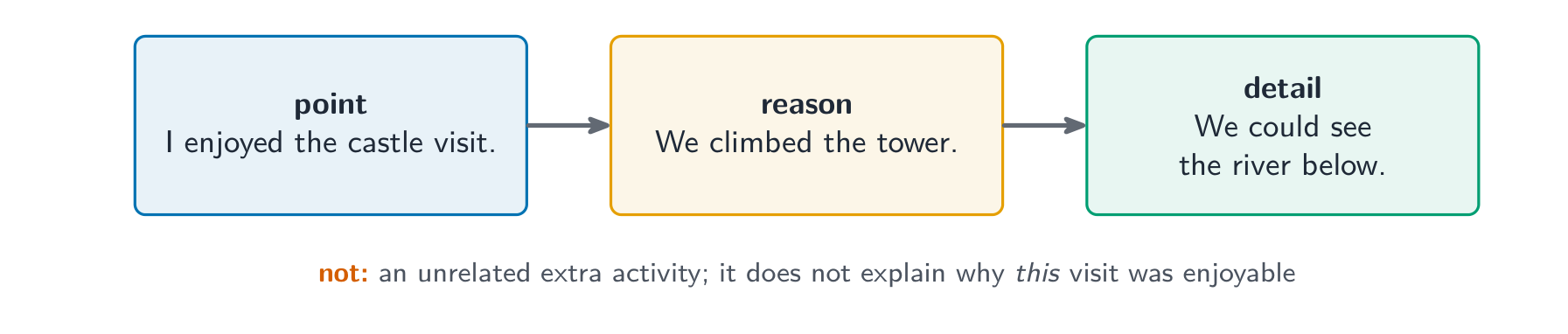
Which sentence shows rather than tells?
Difficulté 1/5 · 100 pièces + un petit bonus lors de la première réussite aujourd'hui
A detail gives a picture.
What can you add to develop a point?
Difficulté 2/5 · 140 pièces + un petit bonus lors de la première réussite aujourd'hui
Stay on the task.
Build a connected sentence
- Join the point and its development with because, so, when, which.
- "I felt nervous because I had never sung in front of 200 people before."
Which word best joins "I felt nervous" and "I had never sung in public"?
Difficulté 1/5 · 100 pièces + un petit bonus lors de la première réussite aujourd'hui
It gives the reason.
Worked example: developing three points
Task: Tell your friend about a school event: what it was, what you did, how you felt.
- What: "Last Friday our school held a charity fun run around the lake."
- What you did: "I ran five kilometres dressed as a banana, so everyone laughed when I passed!"
- Feeling: "I was exhausted at the end, but proud, because our class raised 3,000 yuan for the animal shelter."
How is "what you did" developed in the worked example?
Difficulté 1/5 · 100 pièces + un petit bonus lors de la première réussite aujourd'hui
Dressed as a banana, so everyone laughed.
Edit for the reader
- Read your email as your friend would. Is anything unclear? Is any point missing?
- Cut sentences that do not answer the task.
Do not just list facts. "We ran. It was fun. We raised money." covers the points but develops none. Add a detail or reason to each.
"We ran. It was fun. We raised money." develops each point well.
Difficulté 1/5 · 100 pièces + un petit bonus lors de la première réussite aujourd'hui
It lists facts without detail.
Number the task points, then develop each with a detail or reason. Join ideas with because, so, when, show rather than tell, and check every point is covered for your reader.
Write three developed sentences for: tell a friend about a new café — where it is, what you ate, and whether they should go.
Point, detail, link.