Opportunity cost
Introduit| English | Sens |
|---|---|
| opportunity cost/ɒpəˈtjuːnɪti kɒst/ | coût d'opportunité |
| next best alternative/nekst best ɔːlˈtɜːnətɪv/ | alternative suivante la plus avantageuse |
| consumers/kənˈsuːməz/ | consommateurs |
| producers/prəˈdjuːsəz/ | producteurs |
| trade-off/treɪd ɒf/ | compromis |
Every choice has a cost
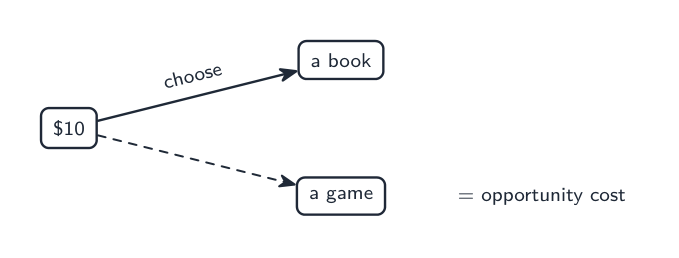
- Spend your savings on a holiday and you can't also spend it on a bike. Choosing one means giving up the other.
- That sacrifice — the opportunity cost 机会成本 — is one of the most important ideas in economics.
Opportunity cost is:
Difficulté 1/5 · 100 pièces + un petit bonus lors de la première réussite aujourd'hui
It is the single next-best alternative sacrificed.
Opportunity cost is the value of the ______ best alternative given up.
Difficulté 1/5 · 100 pièces + un petit bonus lors de la première réussite aujourd'hui
The single next-best alternative.
What opportunity cost is
- Opportunity cost = the next best alternative 次优选择 you give up when you make a choice.
- It applies to everyone: consumers 消费者, workers, producers 生产者 and governments.
Worked example. A government spends its budget on a new hospital instead of a new school. The opportunity cost is the school it gave up.
Opportunity cost on the frontier
Moving along the frontier, gaining more of one good always means giving up some of the other — that sacrifice is the opportunity cost.
A government builds a hospital instead of a school. The opportunity cost is:
Difficulté 1/5 · 100 pièces + un petit bonus lors de la première réussite aujourd'hui
The opportunity cost is the next best use of the budget — the school.
How opportunity cost shapes decisions
| Who: choice | Opportunity cost, and how it affects the decision |
|---|---|
| consumer: a new phone or a holiday | the holiday given up. A higher price for one makes the other look better |
| worker: university for 3 years or a job now | the wages given up for 3 years. If wages for school leavers rise, more people may choose to work |
| producer: a factory makes cars or trucks | the trucks it could have made. If trucks become more profitable, the firm may switch |
| government: hospitals or schools | the schools not built. Ministers compare which gives the bigger benefit |
Exam question. Explain the opportunity cost to a student of staying in full-time education for two more years. [4]
- Model answer: Opportunity cost is the next best alternative given up (1). If the student stays in education, the next best alternative is probably a full-time job (1). So the opportunity cost is the wages they could have earned for two years (1), and the work experience they would have gained. They may accept this cost because more qualifications can lead to higher wages later (1).
- Mark-scheme reasoning: define the term, name the specific alternative, and apply it to the student. "They lose money" without saying it is the wages from a job earns little.
Opportunity cost applies to consumers, producers and governments.
Difficulté 1/5 · 100 pièces + un petit bonus lors de la première réussite aujourd'hui
Anyone making a choice with scarce resources faces an opportunity cost.
Wages for school leavers rise sharply. How might this affect students deciding whether to stay in education?
Difficulté 1/5 · 100 pièces + un petit bonus lors de la première réussite aujourd'hui
The wages given up are the opportunity cost of staying in education. Higher wages make that cost bigger, so some students choose to work instead.
Why it matters
- Thinking in opportunity cost forces you to compare the real trade-off 取舍, not just the money price.
- Good decisions weigh what you gain against what you give up.
Opportunity cost is the single best alternative, not all of them. If you watch a film instead of studying, napping or going for a walk, the cost is only the one of those three you would most have chosen — not all three.
Opportunity cost is useful because it measures:
Difficulté 1/5 · 100 pièces + un petit bonus lors de la première réussite aujourd'hui
It compares what you gain with what you give up.
Worked example: a farmer's field
A farmer's field can grow 50 tonnes of wheat or 200 tonnes of potatoes in a year, but not both. Her third choice, renting the field out, would earn less than either crop. She plants potatoes. What is the opportunity cost?
- The next best alternative is the 50 tonnes of wheat she could have grown. The rent is not counted, because it was only her third choice.
- Per tonne: 200 tonnes of potatoes cost 50 tonnes of wheat, so each tonne of potatoes costs 50 ÷ 200 = 0.25 tonnes of wheat.
A factory can make 300 chairs or 100 tables in a week. It makes chairs. What is the opportunity cost of one chair, in tables?
Difficulté 2/5 · 140 pièces + un petit bonus lors de la première réussite aujourd'hui
300 chairs cost 100 tables, so one chair costs 100 ÷ 300 ≈ 0.33 tables.
Mia has one free evening. She would most like to go to a concert; her second choice is a shift paying 40 dollars; her third is a film. She goes to the concert. What is her opportunity cost?
Difficulté 1/5 · 100 pièces + un petit bonus lors de la première réussite aujourd'hui
Opportunity cost is only the next best alternative — the shift — not every option given up.
You've got it
- opportunity cost = the next best alternative given up
- it applies to consumers, workers, producers and governments, and changes in it can change their decisions
- it captures the real trade-off, not just the money price
Write from 6 classrooms given up
- A council builds a bridge instead of 6 classrooms.
- Name the opportunity cost.
A council spends its building budget on a bridge and gives up 6 classrooms. What is the opportunity cost?
The budget could have produced the classrooms instead.
What is the opportunity cost of the bridge?
Difficulté 1/5 · 100 pièces + un petit bonus lors de la première réussite aujourd'hui
The next best use of that budget was the 6 classrooms.