Production possibility curve diagrams
Introduit| English | Sens |
|---|---|
| production possibility curve/prəˈdʌkʃn ˌpɒsəˈbɪlɪti kɜːv/ | courbe des possibilités de production |
| trade-off/treɪd ɒf/ | compromis |
| efficient/ɪˈfɪʃənt/ | efficace |
| unemployed/ʌnemˈplɔɪd/ | chômeur |
| economic growth/ˌiːkəˈnɒmɪk ɡrəʊθ/ | croissance économique |
| technology/tekˈnɒlədʒi/ | technologie |
More guns or more butter?
- A country can use its resources to make weapons or consumer goods — but with limited resources, more of one means less of the other.
- The production possibility curve 生产可能性曲线 (PPC) draws this trade-off 取舍.
Reading the PPC
-
The PPC shows the maximum combinations of two goods an economy can make using all its resources fully.
-
Every point on the curve is efficient 有效率的: all resources are used. A point inside means some resources are unemployed; a point outside cannot be reached with current resources.
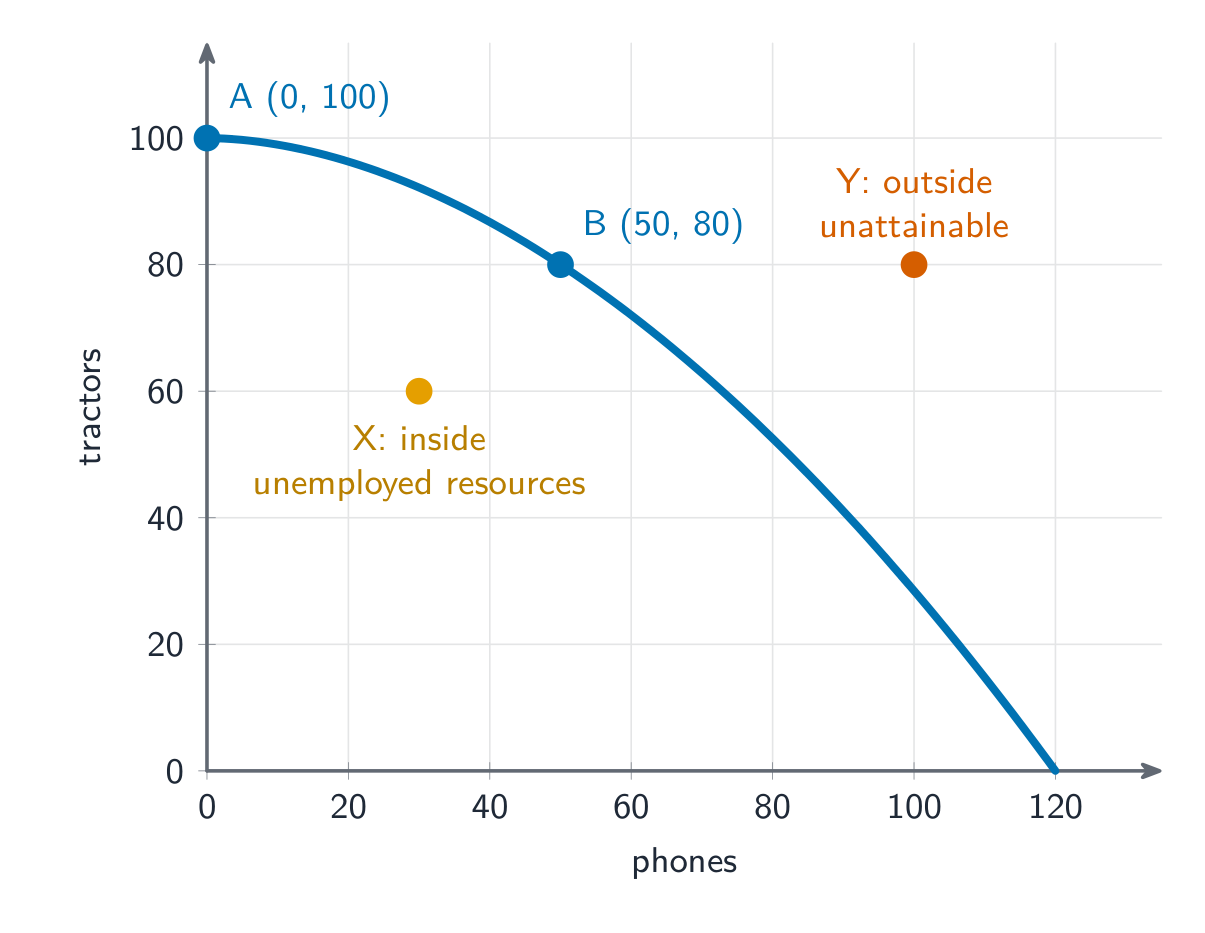
La courbe de possibilités de production
Frontier = maximum efficient combinations
The PPF is concave — a trade-off between two goods.
A point on the PPC represents an economy that is:
Difficulté 1/5 · 100 pièces + un petit bonus lors de la première réussite aujourd'hui
On the curve = full, efficient use; inside = waste; beyond = unattainable.
Opportunity cost on the curve
- Moving along the PPC to make more of one good means giving up some of the other — that's the opportunity cost.
- The PPC is usually bowed outwards: resources are not equally good at making both goods. The first workers moved from tractors to phones are those best suited to phones; later ones are worse at it, so each extra phone costs more tractors (increasing opportunity cost).
- A point inside the curve means resources are unemployed 闲置的 or wasted.
A point inside the PPC shows:
Difficulté 1/5 · 100 pièces + un petit bonus lors de la première réussite aujourd'hui
Inside the curve, resources are not fully used.
Moving along the PPC to produce more of one good has no opportunity cost.
Difficulté 1/5 · 100 pièces + un petit bonus lors de la première réussite aujourd'hui
False. On the PPC all resources are used, so producing more of one good means giving up some of the other: that is the opportunity cost.
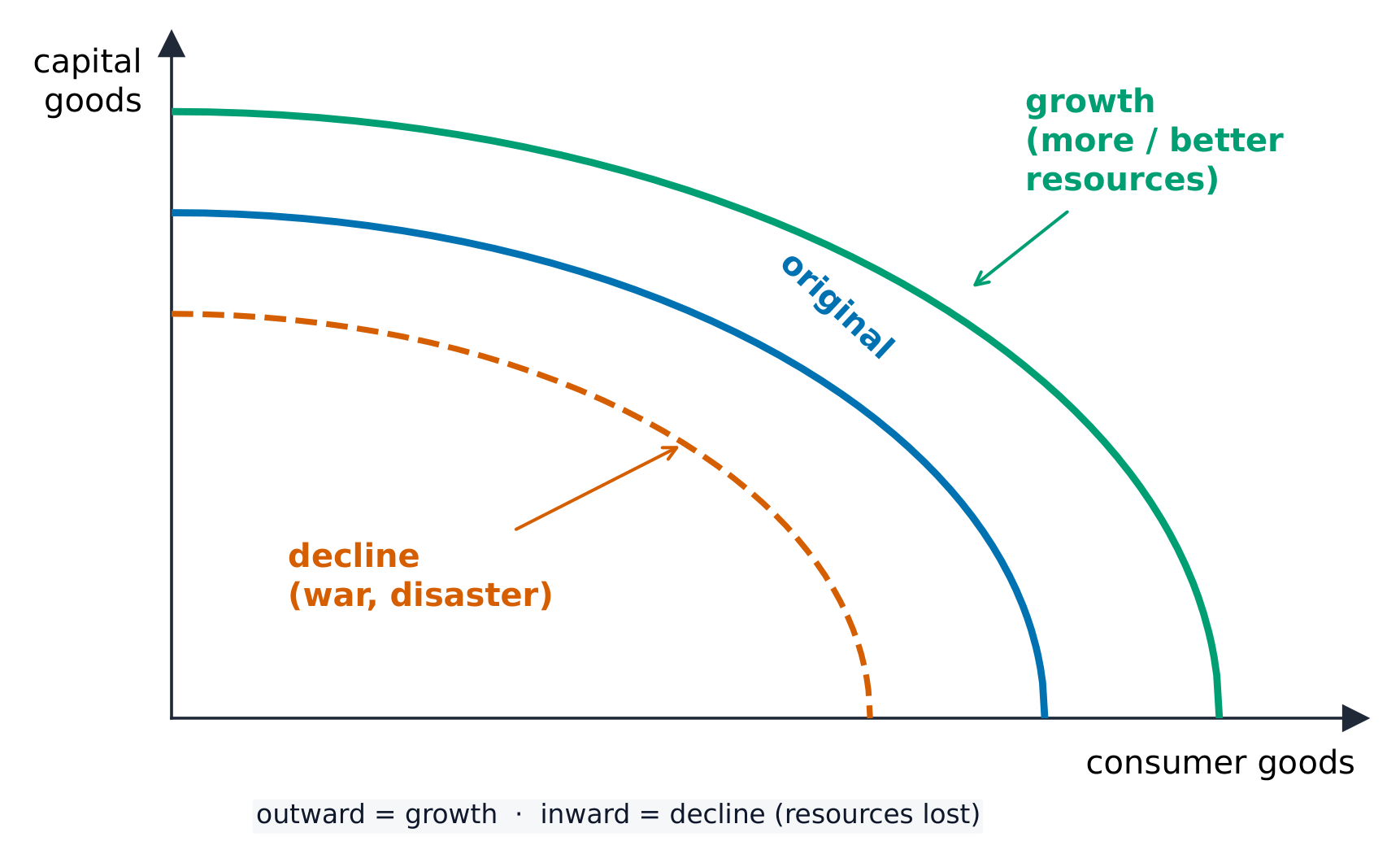
Shifts: economic growth 经济增长
| The whole PPC shifts outwards when… | The whole PPC shifts inwards when… |
|---|---|
| the quantity of resources rises: more workers (immigration, a larger population), more capital (investment), new land or raw materials | resources are lost: war, a natural disaster, many workers emigrating |
| the quality of resources rises: better education and training, new technology | resources run out or are damaged, such as exhausted mines or flooded farmland |
Exam question. Explain two causes of an outward shift in a country's PPC. [4]
- Model answer: First, investment in new machinery increases the quantity of capital (1), so the economy can produce more of both goods at full employment (1). Second, better education and training raise the quality of labour (1); more productive workers make more output from the same resources, so the maximum output rises (1).
- Mark-scheme reasoning: a cause alone earns one mark; the second mark is for explaining why maximum output rises. "Unemployed workers find jobs" is wrong here: that moves a point from inside the curve towards it and does not shift the curve.
Moving along ≠ shifting the curve. Changing the mix of goods is a move along the PPC; only more/better resources shift the whole curve outward.
Which shifts the whole PPC outward?
Difficulté 1/5 · 100 pièces + un petit bonus lors de la première réussite aujourd'hui
More/better resources or technology shift the curve out; changing the mix is a move along it.
Economic growth shifts the PPC ______.
Difficulté 1/5 · 100 pièces + un petit bonus lors de la première réussite aujourd'hui
More capacity moves the whole curve outward.
Unemployment falls as idle factories reopen. How is this shown on a PPC?
Difficulté 1/5 · 100 pièces + un petit bonus lors de la première réussite aujourd'hui
The resources already existed; they were just unused. Using them moves production towards the curve. Only more or better resources shift the curve.
Worked example: reading points on a PPC
Use the PPC in step 2. The country now makes 60 tractors and 30 phones (point X). Interpret this.
- Moving from (100 tractors, 0 phones) to (80, 50) gives up 20 tractors to gain 50 phones: the opportunity cost of 50 phones is 20 tractors.
- (60, 30) lies inside the curve: the country could make more of both, for example (80, 50), so some resources are unemployed. Better technology would shift the whole PPC outwards.
An economy moves along its PPC from 40 cars and 10 bikes to 30 cars and 35 bikes. How many cars are given up?
Difficulté 2/5 · 140 pièces + un petit bonus lors de la première réussite aujourd'hui
40 − 30 = 10 cars are given up for 25 more bikes.
A point outside the PPC can be reached today with the resources the economy has.
Difficulté 1/5 · 100 pièces + un petit bonus lors de la première réussite aujourd'hui
Points outside are unattainable until the economy grows.
You've got it
- the PPC shows max output combinations: on = efficient, inside = wasteful, beyond = unattainable
- moving along it has an opportunity cost
- the curve bows outwards because opportunity cost increases
- more or better resources shift the whole curve outward; lost resources shift it inward; using unemployed resources only moves a point towards the curve
Write from the data given
- An economy can move from 100 butter and 0 guns to 80 butter and 10 guns.
- Find the opportunity cost of one gun.
Moving from 100 butter and 0 guns to 80 butter and 10 guns, what is the opportunity cost of one gun, in butter?
20 divided by 10 is 2.
What is the opportunity cost of one gun?
Difficulté 1/5 · 100 pièces + un petit bonus lors de la première réussite aujourd'hui
20 butter divided by 10 guns is 2 butter per gun. Other options — 20 butter (the whole loss); 0 (because the economy can make both).