Diffusion
Introduit| English | Sens |
|---|---|
| diffusion/dɪˈfjuːʒn/ | diffusion |
| concentration/ˌkɒnsənˈtreɪʃn/ | concentration |
| relative molecular mass/ˈrelətɪv məˈlekjʊlə mæs/ | masse moléculaire relative |
Gases that race through a tube, 1830s
- In the early 1830s Thomas Graham, a chemist in Glasgow, measured how fast different gases escaped through small holes and plaster plugs. Light gases always moved faster: hydrogen escaped about four times as fast as oxygen. This is now called Graham's law.
- Gas and liquid particles spread by diffusion 扩散: the net movement from a region of higher concentration 浓度 to lower concentration, caused by random motion.
Graham found that lighter gases escape faster than heavier ones.
Difficulté 1/5 · 100 pièces + un petit bonus lors de la première réussite aujourd'hui
Hydrogen escaped about four times as fast as oxygen.
Random motion, net spreading
- Each particle moves randomly and collides with others. No particle "knows" where to go, but more particles leave a crowded region than enter it.
- Diffusion continues until the particles are evenly spread; then they still move, but there is no net change.
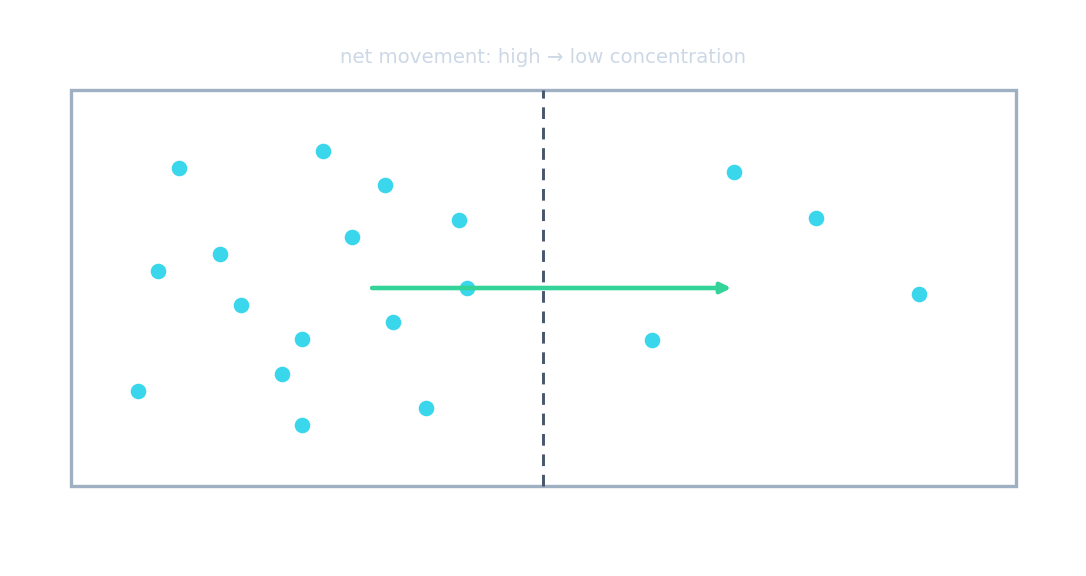
Watch particles diffuse
Set up a concentration difference and watch the particles spread out. Diffusion is the net movement of particles from where they are crowded to where they are not — driven by their own random motion, no stirring needed.
Diffusion
Release the cloud and the particles spread on their own from the crowded corner until they fill the box evenly — diffusion, sped up by heat.
Diffusion is the net movement of particles…
Difficulté 1/5 · 100 pièces + un petit bonus lors de la première réussite aujourd'hui
Caused by random motion.
Watching it happen
- A drop of potassium manganate(VII) in still water slowly turns all the water purple with no stirring. A smell spreads across a room in the same way.
- Diffusion is faster in gases than in liquids: gas particles are far apart and move faster. It does not happen in solids at room temperature in any noticeable way.
In which state is diffusion fastest?
Difficulté 1/5 · 100 pièces + un petit bonus lors de la première réussite aujourd'hui
Particles are far apart and fast.
Mass changes the rate
- At the same temperature, particles with a lower relative molecular mass 相对分子质量 move faster on average, so they diffuse faster.
- Higher temperature gives particles more kinetic energy, so diffusion speeds up.
Calculate the M_r of hydrogen chloride, HCl (A_r H = 1, Cl = 35.5).
Difficulté 2/5 · 140 pièces + un petit bonus lors de la première réussite aujourd'hui
1 + 35.5.
Raising the temperature makes diffusion slower.
Difficulté 1/5 · 100 pièces + un petit bonus lors de la première réussite aujourd'hui
Particles gain kinetic energy.
Worked example: the white ring in a tube
Cotton wool soaked in ammonia solution goes in one end of a long glass tube; cotton wool soaked in hydrochloric acid goes in the other. A white ring of ammonium chloride forms where the gases meet.
- Masses: NH₃, $M_r = 14 + 3(1) = 17$; HCl, $M_r = 1 + 35.5 = 36.5$.
- Prediction: NH₃ is lighter, so it diffuses faster and travels further.
- Result: the ring forms nearer the hydrochloric acid end.
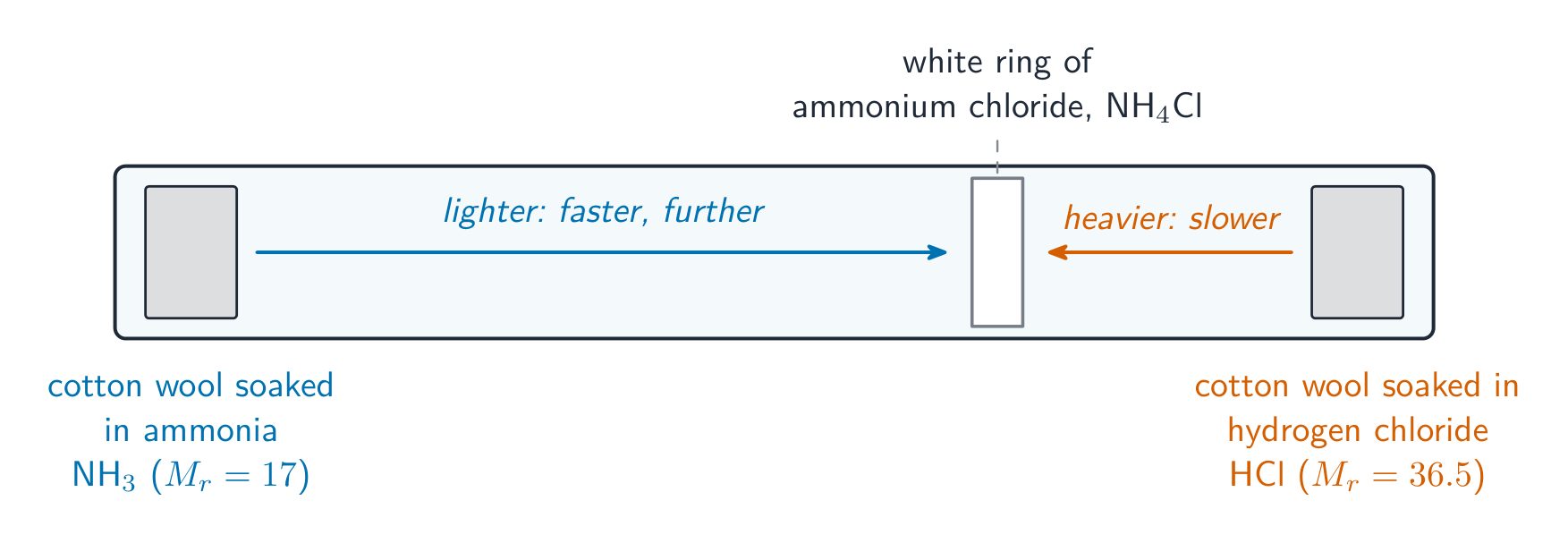
Where does the white ring form in the tube?
Difficulté 1/5 · 100 pièces + un petit bonus lors de la première réussite aujourd'hui
NH₃ (M_r 17) travels further.
Planning a fair comparison
- To compare two gases, keep the tube, temperature and starting amounts the same; measure the distance each gas travels before the ring forms.
- Seal the tube ends so the gases do not escape into the room.
Which should be kept the same to compare two gases fairly?
Difficulté 2/5 · 140 pièces + un petit bonus lors de la première réussite aujourd'hui
Only the gas should change.
Diffusion is not caused by particles "wanting" to spread out. It is the result of random motion: more particles move from where there are many to where there are few.
Diffusion is the net movement of particles from higher to lower concentration by random motion. It is faster in gases, at higher temperature, and for particles with lower $M_r$ — so NH₃ travels further than HCl.
Hydrogen bromide (HBr, M_r 81) is used instead of HCl with ammonia. Predict and explain where the ring forms compared with the HCl experiment.
Lower M_r, faster diffusion.