Accommodation, rods and cones
Introduit| English | Sens |
|---|---|
| accommodation/əˌkɒməˈdeɪʃn/ | l'accommodation |
| ciliary muscles/ˈsɪlɪəri ˈmʌslz/ | muscles ciliaires |
| rods/rɒdz/ | bâtonnets |
| cones/kəʊnz/ | cones |
Focusing near and far
- Your eye can switch focus from a distant hill to a book in your hands almost instantly.
- This focusing is accommodation 视觉调节, and seeing in colour and dim light depends on two cell types.
To focus on a NEAR object, the lens becomes:
Difficulté 1/5 · 100 pièces + un petit bonus lors de la première réussite aujourd'hui
A fatter lens bends light more for near objects.
The eye changing focus between near and far objects is called ______.
Difficulté 1/5 · 100 pièces + un petit bonus lors de la première réussite aujourd'hui
The lens changes shape to focus at different distances.
Accommodation
- The lens changes shape to focus on near or far objects.
- For near objects: the lens becomes fatter (more curved).
- For far objects: the lens becomes thinner (flatter).
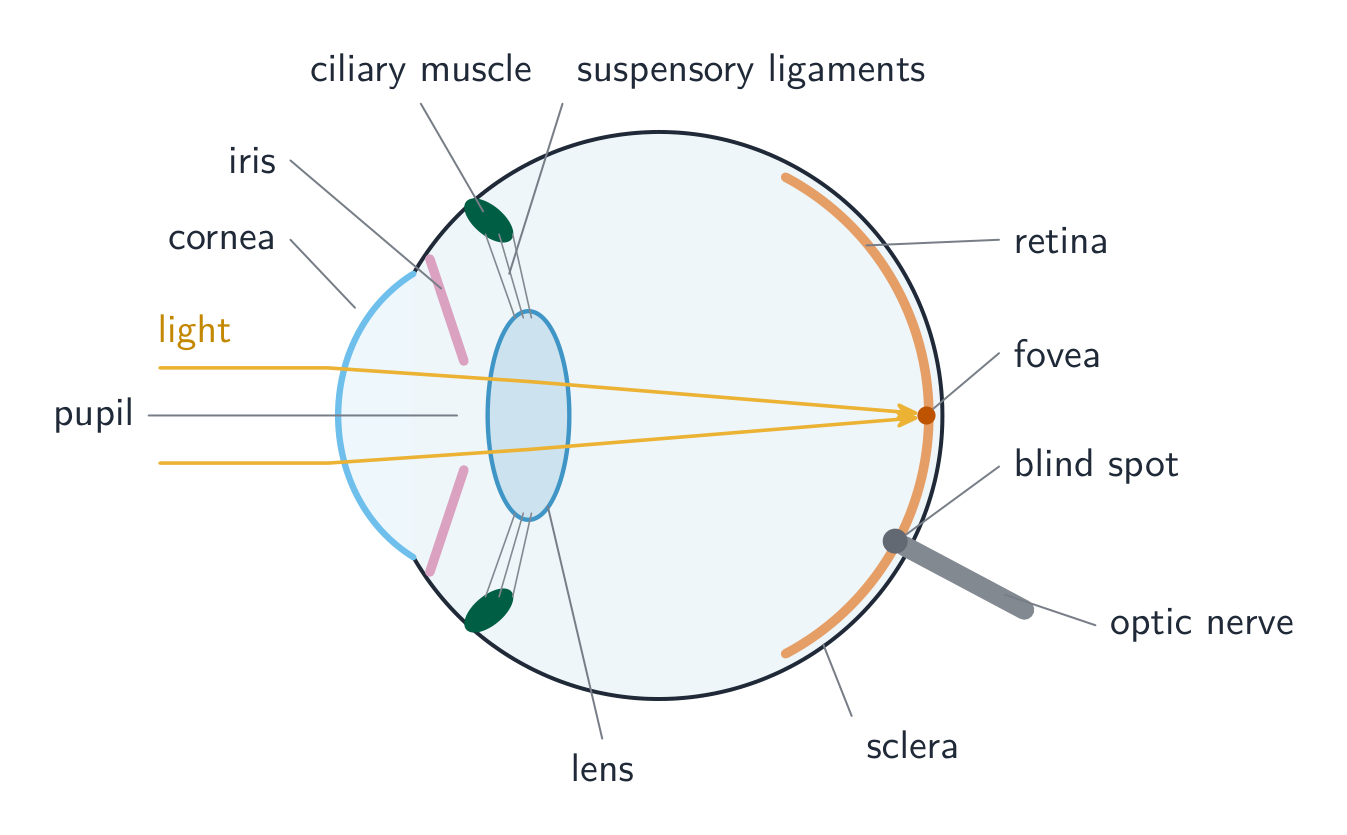
The eye focuses light onto the retina; the lens changes shape to focus on near or far objects
Accommodation — focusing the eye
The eye changes the shape of its lens to focus on near or far objects.
The lens shape is changed by the:
Difficulté 1/5 · 100 pièces + un petit bonus lors de la première réussite aujourd'hui
Ciliary muscles (and suspensory ligaments) change lens shape.
Controlled by the ciliary muscles 睫状肌
- The ciliary muscles and suspensory ligaments change the lens shape.
- Near object: ciliary muscles contract, lens fattens. Far object: they relax, lens flattens.
Rods are light-sensitive cells that:
Difficulté 1/5 · 100 pièces + un petit bonus lors de la première réussite aujourd'hui
Rods are sensitive in dim light; cones detect colour.
Rods detect colour and work best in bright light.
Difficulté 1/5 · 100 pièces + un petit bonus lors de la première réussite aujourd'hui
False. Cones detect colour and need bright light; rods work in dim light and see only in black and white.
Rods 视杆细胞 and cones 视锥细胞
- The retina has two light-sensitive cells: rods and cones.
- Rods: very sensitive, work in dim light, but give no colour. Cones: need bright light, detect colour.
In the dark you see in black and white. Only rods work in dim light, and they can't detect colour. That's why colours fade at night even though shapes are still visible.
Worked example: from the board to a book
A student looks up from reading a book to the board at the far side of the room. Describe how the eye changes its focus.
- For the distant board, light rays need little bending. The ciliary muscles relax, the suspensory ligaments become tight and pull the lens thin.
- Looking back at the near book, the rays need more bending: the ciliary muscles contract, the ligaments go slack, and the elastic lens becomes fat (more convex). This change is accommodation.
What shape is the lens when you focus on a phone held close to your face?
Difficulté 1/5 · 100 pièces + un petit bonus lors de la première réussite aujourd'hui
Near objects need more bending of light, so the lens is made fatter.
In dim light the pupil widens, letting more light reach the retina.
Difficulté 1/5 · 100 pièces + un petit bonus lors de la première réussite aujourd'hui
The radial muscles of the iris contract to widen the pupil in dim light.
You've got it
- accommodation: the lens fattens for near objects, flattens for far ones
- the ciliary muscles change the lens shape (contract = fatter lens)
- rods = dim light, no colour; cones = bright light, colour
Write from a near object
- A student looks up from a distant board to a book.
- The light in the room is very dim.
How does the lens change, and which cells still work in the dim light?
Accommodation changes lens shape with distance.
Which cells detect dim light but not colour?
Difficulté 1/5 · 100 pièces + un petit bonus lors de la première réussite aujourd'hui
Rods are the dim-light receptors.