Le cœur
Introduit| English | Sens |
|---|---|
| atria/ˈeɪtrɪə/ | oreillettes |
| ventricles/ˈventrɪklz/ | ventricules |
| deoxygenated/diːˈɒksɪdʒeneɪtɪd/ | désoxygéné |
| oxygenated/ˈɒksɪdʒeneɪtɪd/ | oxygéné |
| valves/vælvz/ | valves |
The pump that never rests
- Your heart beats about 100,000 times a day, pushing blood around your whole body.
- It is a muscular double pump with four chambers.
The upper chambers of the heart that receive blood are the:
Difficulté 1/5 · 100 pièces + un petit bonus lors de la première réussite aujourd'hui
Atria receive; ventricles pump.
The right side of the heart pumps blood to the:
Difficulté 1/5 · 100 pièces + un petit bonus lors de la première réussite aujourd'hui
Right side → lungs (deoxygenated blood); left side → body.
The lower chambers that pump blood out of the heart are the ______.
Difficulté 1/5 · 100 pièces + un petit bonus lors de la première réussite aujourd'hui
Ventricles pump; atria receive.
Four chambers
- Two upper atria 心房 receive blood; two lower ventricles 心室 pump it out.
- The right side handles deoxygenated 脱氧的 blood (to lungs); the left side handles oxygenated 含氧的 blood (to body).
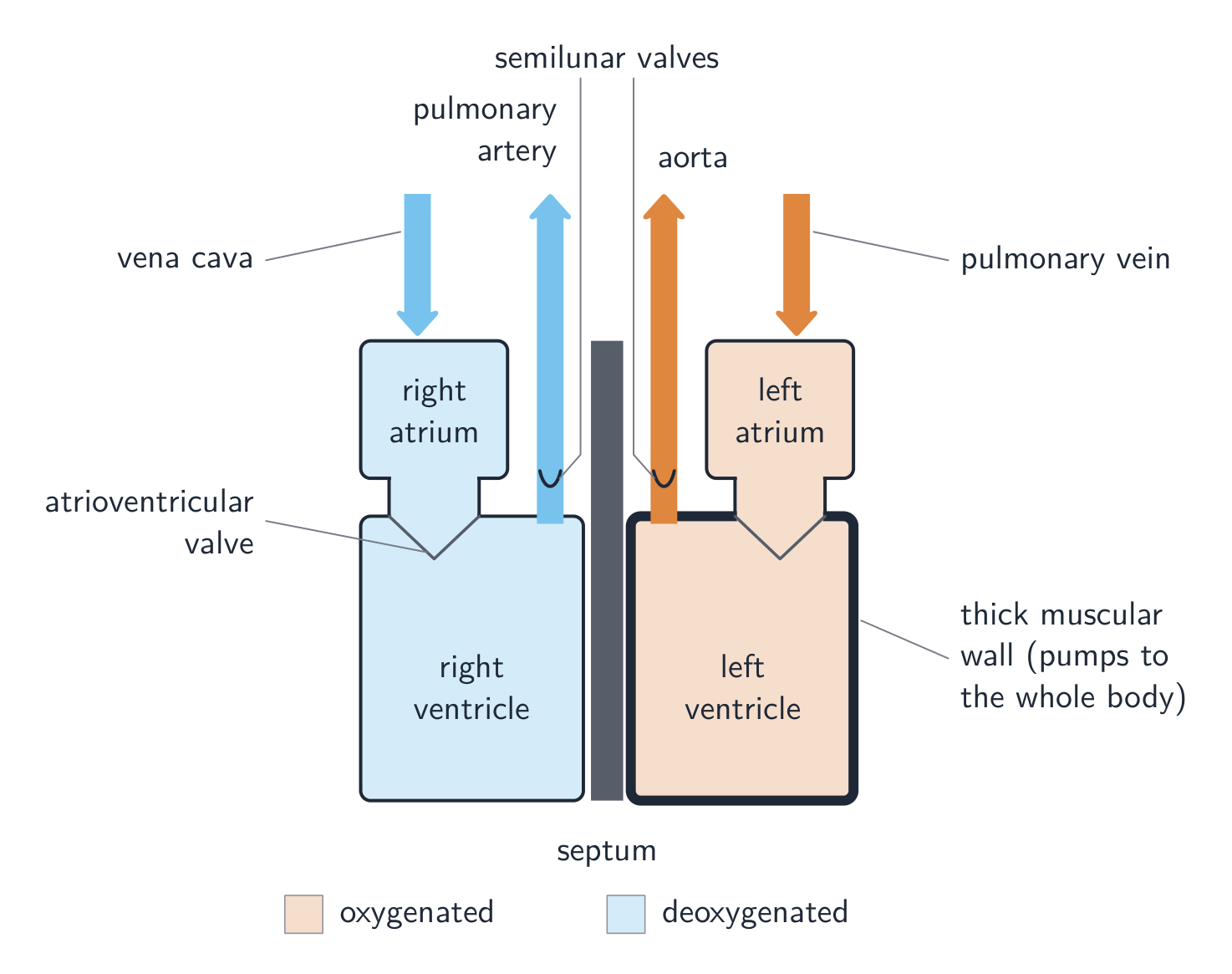
The heart has four chambers; the left ventricle wall is thickest because it pumps to the whole body
Blood flow through the heart
The four chambers and their valves keep blood moving one way — deoxygenated to the lungs, oxygenated to the body.
The valves of the heart:
Difficulté 1/5 · 100 pièces + un petit bonus lors de la première réussite aujourd'hui
Valves ensure one-way flow.
Valves 瓣膜 keep blood one-way
- Valves between the chambers and in the vessels stop blood flowing backwards.
- They make a "lub-dub" sound as they snap shut.
The heart (double circulation)
Follow the blood: blue comes back from the body, the right side pumps it to the lungs (it turns red), and the left side pumps it out to the body — a double circulation.
The right ventricle has a thicker muscular wall than the left.
Difficulté 1/5 · 100 pièces + un petit bonus lors de la première réussite aujourd'hui
False. The left ventricle has the thicker wall, because it pumps blood at high pressure around the whole body; the right only pumps to the lungs.
The left side works hardest
- The left ventricle has a thicker muscular wall than the right.
- It must push blood all the way around the body, at high pressure.
The left ventricle is thicker, not bigger in volume. Both ventricles pump the same volume, but the left has a much thicker muscle wall because it pumps blood to the whole body, not just the nearby lungs.
Worked example: pulse before and after exercise
A student counts 18 pulse beats in 15 seconds at rest, and 33 beats in 15 seconds just after a run. Find both heart rates and explain the change.
- Beats per minute = beats in 15 s × 4: at rest $18 \times 4 = 72$; after the run $33 \times 4 = 132$.
- Exercising muscles respire faster, so they need more oxygen and glucose and make more carbon dioxide. The heart beats faster (and breathing deepens) to deliver them and remove the waste; the rate falls back as the student recovers.
A pulse of 21 beats is counted in 15 seconds. What is the heart rate in beats per minute?
Difficulté 2/5 · 140 pièces + un petit bonus lors de la première réussite aujourd'hui
$21 \times 4 = 84$ beats per minute.
A fitter person's heart rate usually returns to its resting value more quickly after exercise.
Difficulté 1/5 · 100 pièces + un petit bonus lors de la première réussite aujourd'hui
A trained heart pumps more blood per beat, so it recovers sooner.
You've got it
- the heart has four chambers: two atria (receive) and two ventricles (pump)
- the right side serves the lungs; the left side serves the body
- valves prevent backflow; the left ventricle has the thickest wall
Write from the thicker ventricle
- One ventricle pumps blood to the lungs.
- The other pumps blood around the whole body.
Which ventricle has the thicker wall, and what do the valves do?
The longer route needs the stronger pump.
Which chamber has the thickest wall?
Difficulté 1/5 · 100 pièces + un petit bonus lors de la première réussite aujourd'hui
The left ventricle pumps to the whole body.