Translocation
Introduit| English | Sens |
|---|---|
| translocation/trænsləʊˈkeɪʃn/ | translocation : translocation |
| sources/ˈsɔːsɪz/ | sources : sources |
| sinks/sɪŋks/ | sinks : puits |
| tuber/ˈtjuːbə/ | tuber : tubercule |
Aphids as living syringes, 1953
- Aphids are tiny insects that push a needle-like mouthpart into a plant stem and feed on sugary sap. In 1953 the biologists J. S. Kennedy and T. E. Mittler let aphids feed, then cut off their bodies, leaving the mouthparts in the stem. Sap kept flowing out of the stub — pure phloem sap that could be collected and tested.
- The sap was rich in sucrose. Moving sucrose and amino acids through the phloem is translocation 转运.
What did the aphid mouthparts allow Kennedy and Mittler to collect?
Difficulté 1/5 · 100 pièces + un petit bonus lors de la première réussite aujourd'hui
It was rich in sucrose.
Sources and sinks
- Sources 源 release sugars into the phloem: leaves photosynthesising, or storage organs being used up in spring.
- Sinks 库 take sugars out of the phloem: growing shoots and roots, fruits, and storage organs filling up.
Translocation in the phloem
Phloem carries dissolved sugars from where they are made (the source) to where they are used or stored (the sink).
Match each part in summer to source or sink.
Difficulté 2/5 · 140 pièces + un petit bonus lors de la première réussite aujourd'hui
Release or use sugar.
Two directions
- Phloem carries sap both up and down the plant — from source to sink, wherever they are. Xylem carries water and minerals only upwards.
- Sucrose is transported because it is soluble but does not take part in reactions on the way.
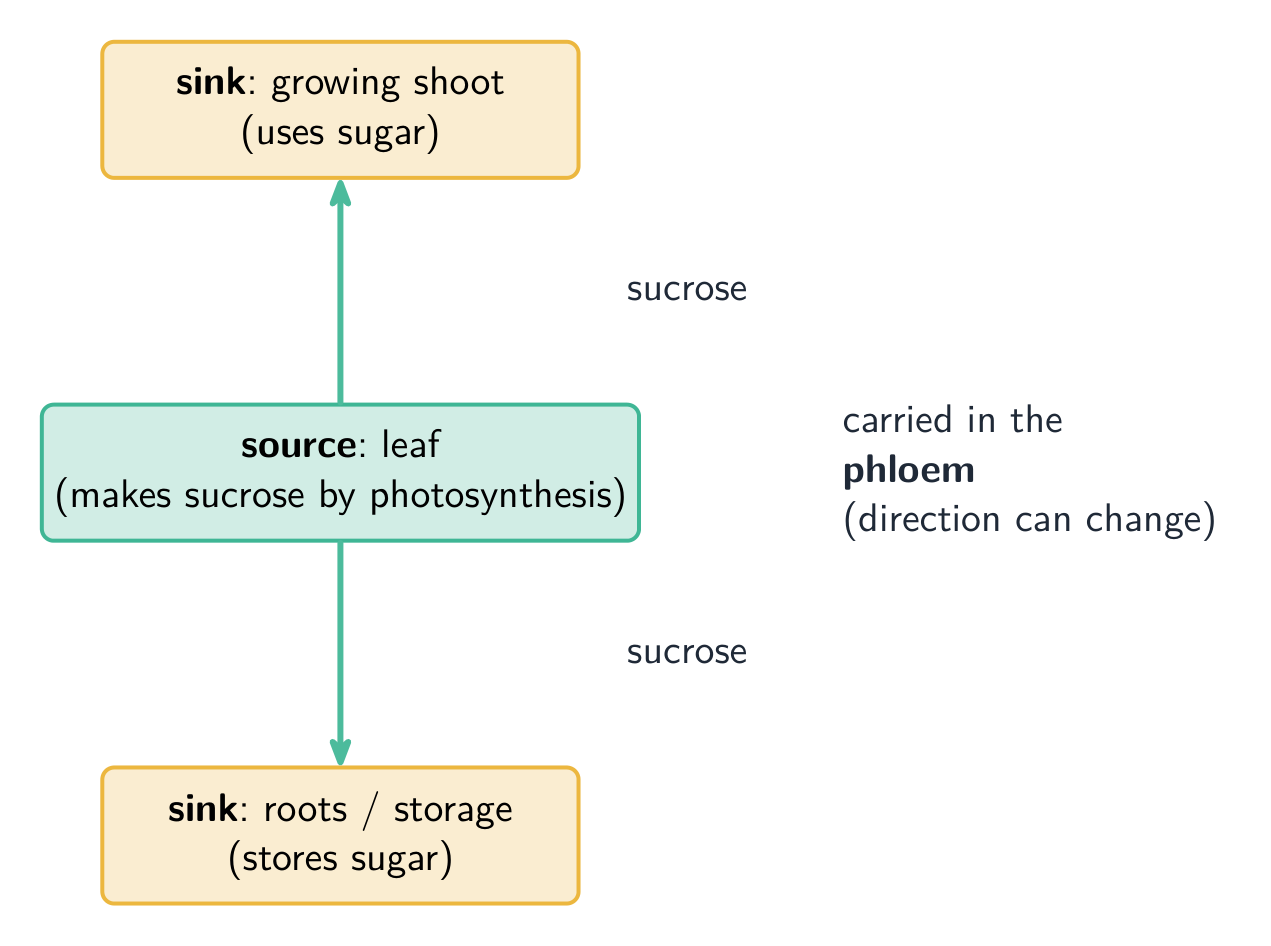
Phloem can carry sugars both up and down the plant.
Difficulté 1/5 · 100 pièces + un petit bonus lors de la première réussite aujourd'hui
From source to sink.
Which sugar is mainly transported in the phloem?
Difficulté 1/5 · 100 pièces + un petit bonus lors de la première réussite aujourd'hui
Soluble and unreactive on the way.
A source can become a sink
- A potato tuber 块茎 is a sink in summer, when leaves send sucrose down to be stored as starch.
- In spring, the tuber becomes a source: its starch is turned back into sugars and sent up to the new shoots, which have no leaves yet.
In spring, a potato tuber is a…
Difficulté 1/5 · 100 pièces + un petit bonus lors de la première réussite aujourd'hui
It sends sugars to new shoots.
Worked example: label sources and sinks
A tomato plant in summer has leaves, flowers, green fruits and roots.
- Source: the mature leaves, making sugars by photosynthesis.
- Sinks: the growing fruits (very strong sinks), the flowers, the roots and the growing tip.
- Direction: sugar moves up from leaves to the tip and fruits, and down to the roots — both directions at once.
Growing tomato fruits are strong sinks.
Difficulté 1/5 · 100 pièces + un petit bonus lors de la première réussite aujourd'hui
They take in much sugar.
Evidence from experiments
- Removing a ring of bark (which contains phloem) from a tree trunk makes the bark above the ring swell with trapped sugar, and the roots below eventually starve.
- Radioactive carbon given to a leaf as CO₂ appears later in the fruits and roots.
A ring of bark is removed from a tree. What happens above the ring?
Difficulté 1/5 · 100 pièces + un petit bonus lors de la première réussite aujourd'hui
Phloem is in the bark; xylem is deeper.
Phloem does not only carry sugar downwards. It carries it from source to sink, which can be up or down; xylem is the one-way upward tube.
Translocation moves sucrose and amino acids in the phloem from sources (leaves, storage organs in spring) to sinks (growing parts, fruits, storage organs filling). Phloem flows both ways; xylem only upwards.
Explain how one potato plant's tuber can be both a sink and a source in different seasons.
Seasons change roles.