Synthétisez les sources au lieu d'empiler des résumés
IntroduitThree summaries can still leave the reader asking “so what?”
- The materials team has notes on layout, preference and comprehension. Listing “Source P says… Source Q says… Source R says…” does not explain how the sources relate or what they contribute to the proposed sorting question.
- This original GAC033-aligned lesson teaches synthesis: connecting information around a question while preserving differences. The source cards below are invented classroom examples, not real research or citations. A real proposal needs verified sources from the search process in unit 5.3.
Que ajoute la synthèse au-delà d'une liste de résumés ?
Difficulté 1/5 · 100 pièces + un petit bonus lors de la première réussite aujourd'hui
La synthèse explique les relations et leurs implications tout en préservant les distinctions.
Compare question, method and outcome
- Read the three fictional cards as different pieces of evidence. P describes a task result; Q describes preference; R concerns a different kind of instruction. Do not combine every favourable statement as if all three measured the same outcome.
- Build a matrix with the source's question, participants, method, finding and limit. This makes a disagreement or mismatch visible before you write a paragraph. A missing method detail stays unknown, not filled with a convenient guess.
| Fictional card | Evidence described | Limit for our sorting proposal |
|---|---|---|
| P | 12 adults made fewer location-choice errors with separated labels in one task | Small adult sample and a different task |
| Q | 8 college volunteers preferred the more spacious of two designs | Preference, not accuracy |
| R | 32 students completed more steps correctly using shorter software instructions | Wording changed, not tray-label layout |
Quelle carte fictive mesure la préférence plutôt que la précision de la tâche ?
Difficulté 1/5 · 100 pièces + un petit bonus lors de la première réussite aujourd'hui
Q demande quels designs les volontaires ont préférés. Elle ne rapporte pas le tri correct.
Organise by a claim, not by an author list
- A possible theme is that presentation may influence how users respond, but different measures answer different questions. Put sources together where they speak to that theme, then explain the differences. Agreement about a broad idea does not prove agreement about a precise effect.
- Avoid “all sources prove spacing works.” P offers a task observation under limited conditions; Q supports a preference claim; R suggests attention to wording. The team should distinguish these contributions rather than upgrade them to one universal rule.
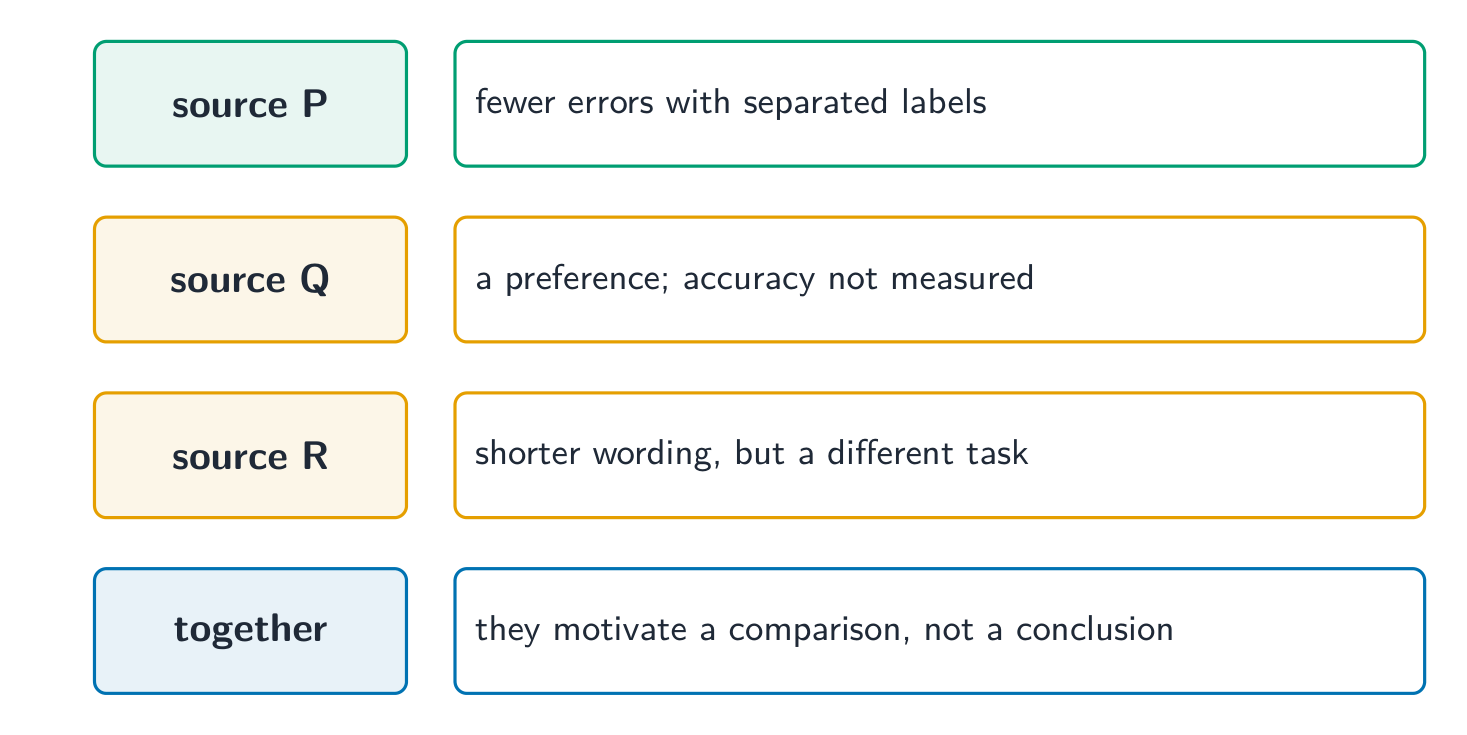
“The fictional cards suggest several ways instructions may be evaluated. P describes fewer choice errors with separated labels, whereas Q reports a preference without measuring accuracy. R concerns shorter wording in a different task. Together they motivate a careful comparison, but they do not establish that our layout B improves four-item sorting in this class.”
Quelles DEUX conclusions sont appropriément limitées ?
Difficulté 2/5 · 140 pièces + un petit bonus lors de la première réussite aujourd'hui
P et R ont des limites de tâche et d'échantillon explicites. Q ne mesure pas la précision, et la supériorité universelle n'est pas étayée.
Connect a justified gap to your question
- A research gap here is a question the reviewed evidence does not settle: how the two proposed layouts compare on this specific paper task. It is not a claim that no one anywhere has studied labels. Your search may be incomplete, and your project may be a local application of existing research.
- Explain why your next evidence would be useful and what it cannot add. The small class comparison could inform this design decision; it cannot establish a universal rule for all ages, settings and languages. A modest contribution can still be worthwhile.
Never use these invented cards as real references in an application, essay or research proposal. They model reasoning only. Replace them with sources you have read and can trace, and revise the argument to match those sources.
Un manque local signifie que l'équipe peut affirmer qu'aucun endroit au monde n'a étudié la mise en page des étiquettes.
Difficulté 1/5 · 100 pièces + un petit bonus lors de la première réussite aujourd'hui
Une question locale sans réponse n'est pas la preuve d'une absence mondiale de recherche. Les recherches ont des limites.
Preserve attribution and your own reasoning
- Keep source ideas attributed when you paraphrase. Changing a few words does not make another author's claim yours. Your contribution is the comparison, interpretation and connection to the project; make those moves visible in the paragraph.
- Check that the cited source supports the sentence beside it. Do not attach a source about preference to a claim about measured accuracy. Use a quotation only when its exact wording matters and keep the necessary location information in your notes.
Établissez l'ordre d'un processus d'écriture de synthèse.
Difficulté 3/5 · 200 pièces + un petit bonus lors de la première réussite aujourd'hui
L'argument découle de la comparaison ; il ne force pas des résultats sans rapport vers une conclusion préférée.
Revise a review around its purpose
- Write a 120-word synthesis of the three teaching cards, explicitly calling them fictional. Include one shared theme, one important difference, a limit and the reason for a local comparison. Then prepare a separate version using real verified sources for any actual proposal.
- Ask a partner to identify the sentence where you move from evidence to your own interpretation. If that move is unsupported, qualify it. A literature review should lead to the research question, not simply display the number of links collected.
Synthesis connects sources by a relevant question, keeps measures and limits distinct, attributes ideas and explains a justified next investigation.