Environment and Resources
Introduit| English | Sens |
|---|---|
| deforestation/diːˌfɒrɪˈsteɪʃn/ | déforestation |
| desertification/dɪˌzɜːtɪfɪˈkeɪʃn/ | désertification |
| Green Revolution/ɡriːn ˌrevəˈluːʃn/ | The twentieth-century expansion of crop yields through high-yielding varieties supported by irrigation, fertilisers, pest control and changed farming practices. |
| greenhouse gases/ˈɡriːnhaʊs ˈɡæsɪz/ | gaz à effet de serre |
| climate change/ˈklaɪmət tʃeɪndʒ/ | changement climatique |
A sea that disappeared, 1960–2007
- In 1960, the Aral Sea in Central Asia was the fourth-largest lake in the world, with a fishing industry of about 40 000 workers. Soviet planners then diverted the two rivers that fed it to irrigate cotton fields. By 2007, the sea had shrunk to about 10% of its size. Ships rusted on dry sand, and dust storms carried salt and chemicals into nearby towns.
- After 1900, rising population, industry and consumption put new pressure on the environment.
Why did the Aral Sea shrink?
Difficulté 1/5 · 100 pièces + un petit bonus lors de la première réussite aujourd'hui
Soviet irrigation planning.
Named environmental changes
- Deforestation 森林砍伐: forests were cleared for farms and timber, as in the Amazon.
- Desertification 荒漠化: dry land became desert, as in the Sahel of Africa, through overgrazing and drought.
Match each change to its example.
Difficulté 2/5 · 140 pièces + un petit bonus lors de la première réussite aujourd'hui
Named changes.
Fresh water: the sharpest case
- World fresh water use rose about six times during the 20th century.
- Rivers such as the Colorado and the Yellow River sometimes stopped reaching the sea.
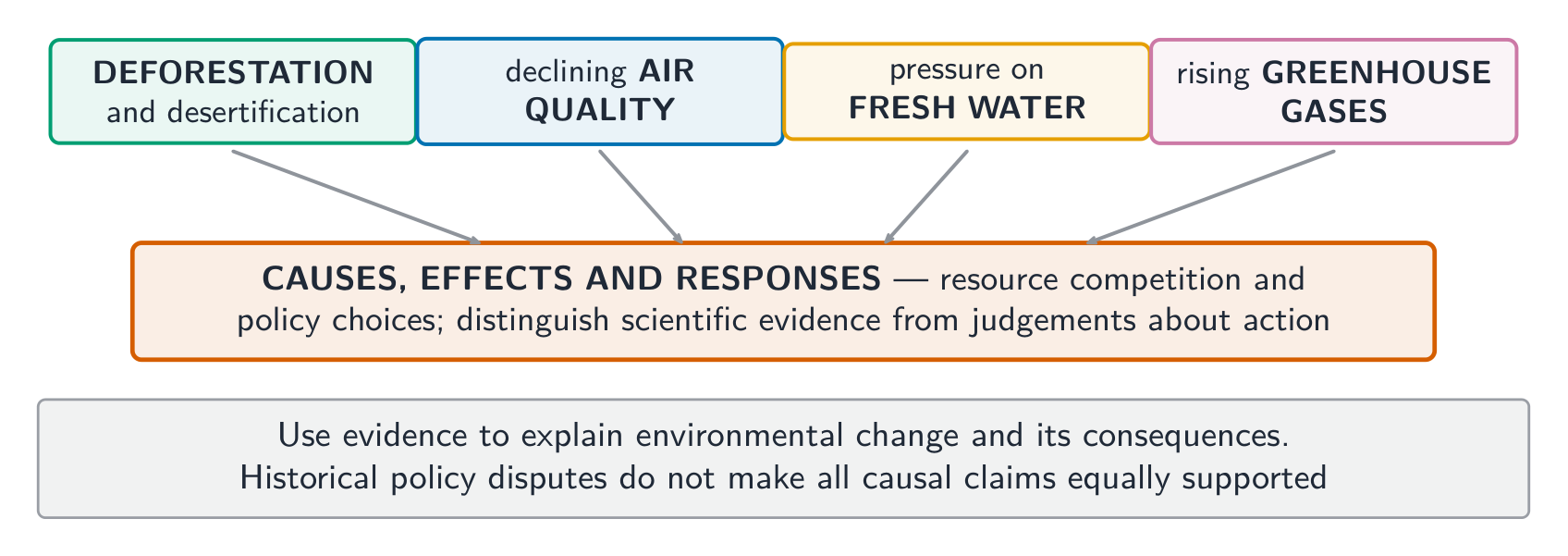
Cause, environmental change, or a further effect?
Sort each item in the CED's causal chain.
Worked example: population and food
- Known: world population was about 2.5 billion in 1950 and about 6 billion in 2000.
- Method: 6 ÷ 2.5 = 2.4.
- Cause: the Green Revolution 绿色革命 — new high-yield seeds, fertilisers and irrigation from the 1960s — fed 2.4 times as many people. But it used more water and chemicals, adding to pressure on rivers and soil.
World population rose from about 2.5 billion (1950) to about 6 billion (2000). How many times larger?
Difficulté 2/5 · 140 pièces + un petit bonus lors de la première réussite aujourd'hui
6 ÷ 2.5.
Greenhouse gases and debate
- Burning coal, oil and gas released greenhouse gases 温室气体 such as carbon dioxide; CO₂ in the air rose from about 315 parts per million in 1958 to over 410 by 2020.
- Scientists linked this to climate change 气候变化; states debated its causes and who should cut emissions, as at Kyoto (1997) and Paris (2015).
CO₂ rose from about 315 to about 410 parts per million. By how much?
Difficulté 2/5 · 140 pièces + un petit bonus lors de la première réussite aujourd'hui
410 − 315.
Competition over resources
- More use of water, oil and land increased competition between and within states.
- Disputes over shared rivers, such as the Nile, grew.
Match each to its role.
Difficulté 2/5 · 140 pièces + un petit bonus lors de la première réussite aujourd'hui
Cause, change, effect.
Environmental change was not only natural. The Aral Sea and rising CO₂ were caused by human decisions — irrigation plans and burning fossil fuels.
The shrinking of the Aral Sea was a natural process.
Difficulté 1/5 · 100 pièces + un petit bonus lors de la première réussite aujourd'hui
Human decisions caused it.
After 1900, population growth supported by the Green Revolution, industry and energy use caused deforestation, desertification, falling rivers and rising greenhouse gases. The Aral Sea shows how fast human decisions can destroy an environment, and climate change has become a global debate.
Explain the causes and effects of environmental change after 1900.
Causation.