Technology After 1900
Introduit| English | Sens |
|---|---|
| The Green Revolution/ðə ɡriːn ˌrevəˈluːʃn/ | Révolution verte |
Fifty-eight boxes leave Newark, April 1956
- On 26 April 1956, an old tanker called the Ideal-X left Newark, New Jersey, for Houston carrying 58 metal boxes — the first modern shipping containers. The trucking businessman Malcom McLean had realised that loading a whole box was far cheaper than loading goods piece by piece. Loading costs fell from about 5.86 dollars a ton to about 16 cents. Containers later carried most of the world's trade.
- After 1900, new technologies reduced distance, raised production and changed populations.
Loading costs fell from about 586 cents to about 16 cents a ton. By how many cents?
Difficulté 2/5 · 140 pièces + un petit bonus lors de la première réussite aujourd'hui
586 − 16.
Distance became a smaller problem
- Radio, television, air travel and later the internet and mobile phones connected people across the world.
- By 2020, over half of the world's people used the internet.
Energy raised production
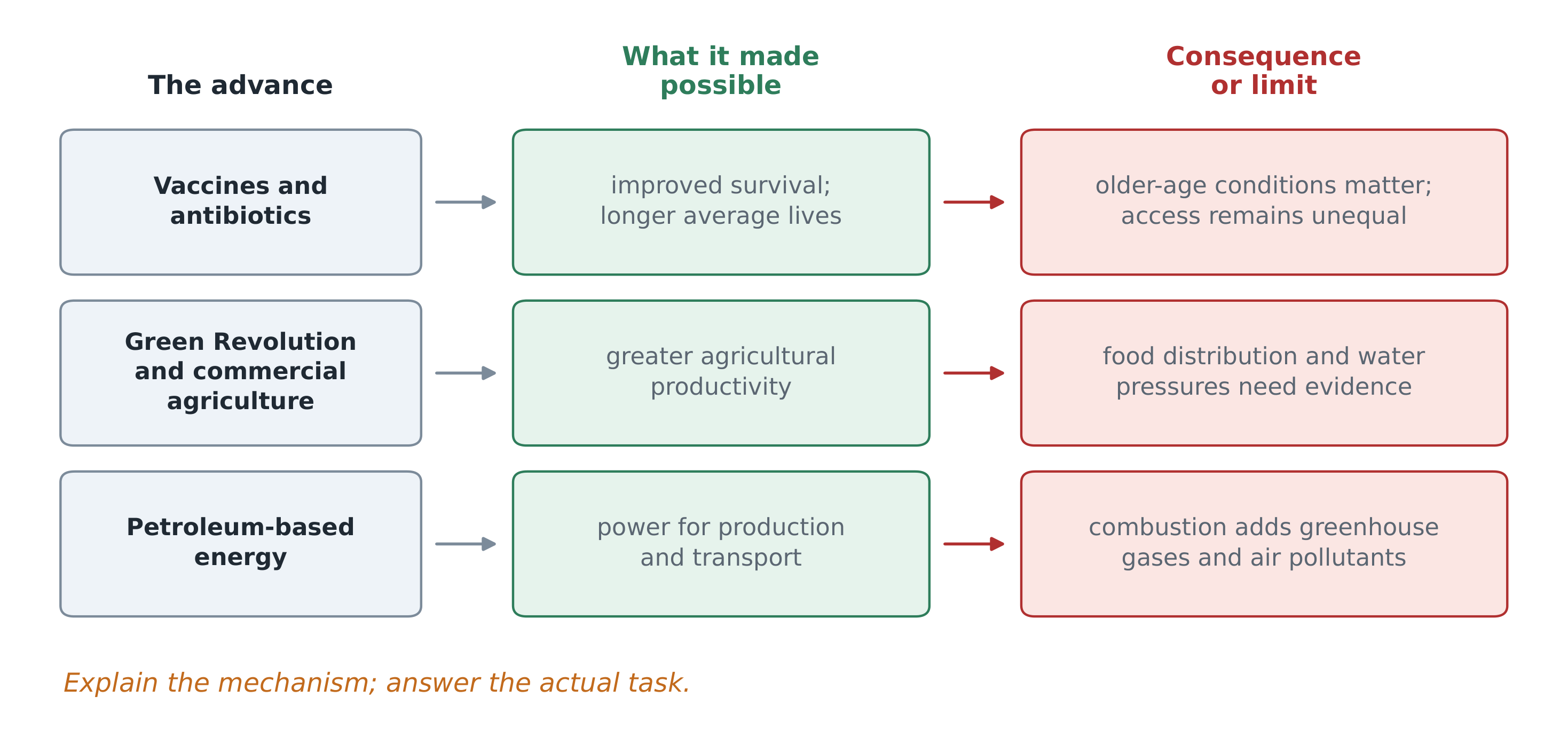
- Petroleum fuelled cars, planes and factories; nuclear power produced electricity from the 1950s.
- These made far more production possible — but also caused pollution and new risks.
Which effect does this technology have?
Sort each technology by the effect the CED names.
Match each technology to its effect.
Difficulté 2/5 · 140 pièces + un petit bonus lors de la première réussite aujourd'hui
Three effects.
Worked example: vaccines lengthened lives
- Advance: vaccines against polio (1955), measles (1963) and others, and antibiotics such as penicillin.
- Measure: worldwide, about 1 in 5 children died before age 5 in 1950; by 2020 it was about 1 in 26.
- Effect: longer lives and faster population growth — world population rose from about 2.5 billion in 1950 to about 7.8 billion in 2020.
How did child deaths before age 5 change from 1950 to 2020?
Difficulté 1/5 · 100 pièces + un petit bonus lors de la première réussite aujourd'hui
Vaccines and antibiotics.
World population rose from about 2.5 to about 7.8 billion. By how many billion?
Difficulté 2/5 · 140 pièces + un petit bonus lors de la première réussite aujourd'hui
7.8 − 2.5.
Food kept up with population
- The Green Revolution 绿色革命 — high-yield seeds, fertilisers and irrigation from the 1960s — greatly increased harvests in Mexico, India and elsewhere.
- India's wheat production roughly tripled between 1965 and 1990.
What did the Green Revolution use?
Difficulté 1/5 · 100 pièces + un petit bonus lors de la première réussite aujourd'hui
From the 1960s.
Changing population
- More effective birth control, such as the pill (1960), let families choose fewer children.
- Birth rates fell in many countries, especially as women's education rose.
New technology did not reach everyone equally. Many poor regions got vaccines, electricity and the internet much later than rich ones.
New technology reached everyone at the same time.
Difficulté 1/5 · 100 pièces + un petit bonus lors de la première réussite aujourd'hui
Poor regions got it later.
After 1900, containers, air travel and the internet shrank distance; oil and nuclear power raised production; the Green Revolution fed more people; and vaccines lengthened lives, while birth control let families choose to have fewer children.
Explain how technology changed populations after 1900.
Causation.