Governments and Economic Crisis
Introduit| English | Sens |
|---|---|
| Great Depression/ɡreɪt dɪˈpreʃn/ | Grande Dépression |
| Five Year Plans/faɪv jɪə plænz/ | plans quinquennaux |
"Fear itself", March 1933
- On 4 March 1933, Franklin Roosevelt became US president. About a quarter of American workers had no jobs, and thousands of banks had failed. "The only thing we have to fear is fear itself," he said. In his first hundred days, Congress passed 15 major laws to regulate banks, create jobs and support farmers. The Great Depression 大萧条 had pushed even a free-market democracy to act.
- In the 1930s, governments everywhere took a bigger role in the economy, but in very different ways.
How many major laws did Congress pass in Roosevelt's first hundred days?
Difficulté 2/5 · 140 pièces + un petit bonus lors de la première réussite aujourd'hui
The Hundred Days.
The state moves into the economy
- After the crash of 1929, world trade fell by about two thirds by 1934, and unemployment soared.
- Governments that had left the economy to markets now intervened.
By about how much did world trade fall from 1929 to 1934?
Difficulté 1/5 · 100 pièces + un petit bonus lors de la première réussite aujourd'hui
The crisis was global.
Three different answers
- Directing private owners: the US New Deal used public works, bank rules and Social Security, keeping private ownership.
- Fusing with organised groups: fascist Italy organised business and workers into state-controlled corporations; elsewhere, as in Mexico and Sweden, governments bargained with labour.
What is the state's relationship to producers here?
Sort each response by who decides.
Worked example: the Soviet Five Year Plans
- Method: from 1928, Stalin's Five Year Plans 五年计划 replaced private ownership with state planning; farms were forced into collectives.
- Result: steel output rose from about 4 million tonnes (1928) to about 18 million (1938) — 4.5 times as much.
- Cost: forced collectivisation caused a famine in 1932–33 that killed millions, especially in Ukraine and Kazakhstan.
Match each country to its response.
Difficulté 2/5 · 140 pièces + un petit bonus lors de la première réussite aujourd'hui
Three answers.
Soviet steel rose from about 4 to about 18 million tonnes. How many times as much?
Difficulté 2/5 · 140 pièces + un petit bonus lors de la première réussite aujourd'hui
18 ÷ 4.
Comparing the responses
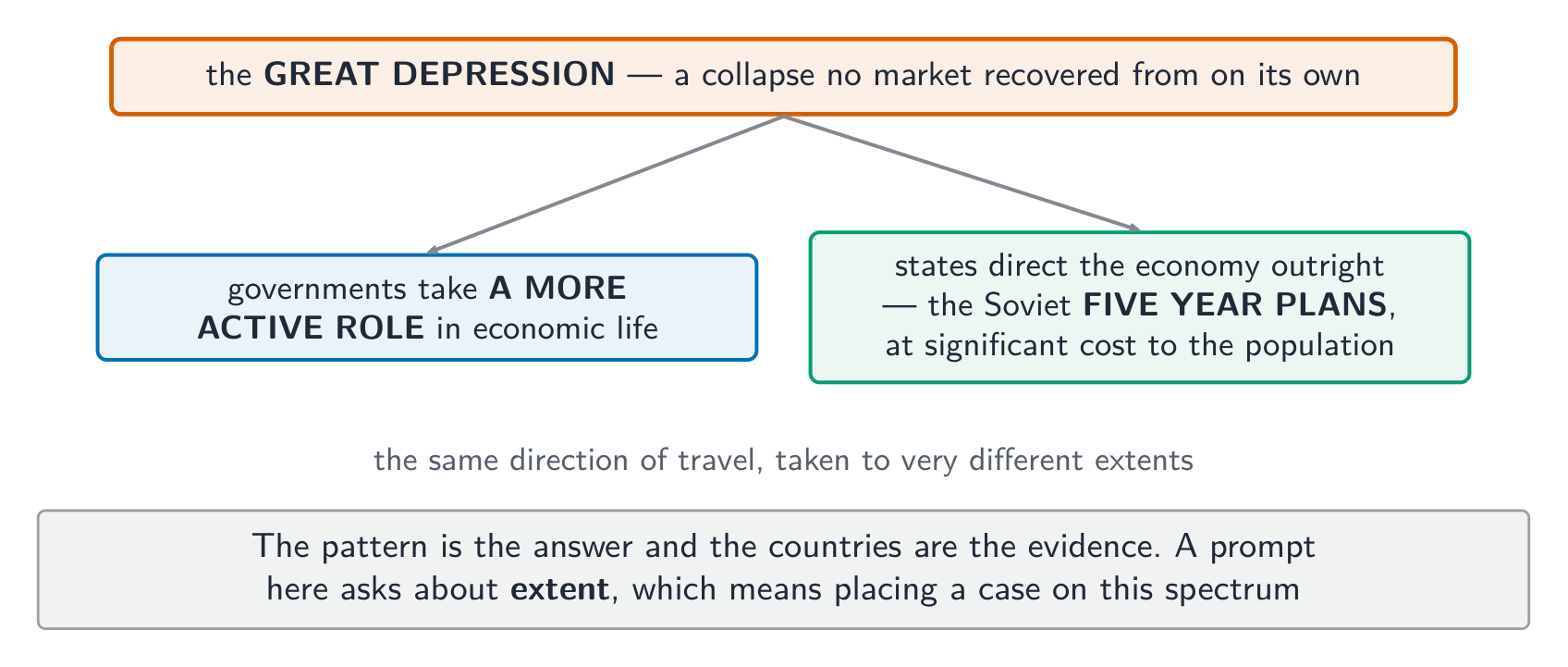
- All three increased state power over the economy.
- They differed in how much: the New Deal kept markets, fascism fused state and business, and the Soviet Union replaced markets entirely.
Beyond Europe and the US
- In Mexico, President Cárdenas took over foreign oil companies in 1938.
- In Japan, the military and big firms worked together to build industry for war.
Mexico took over foreign oil companies in 1938.
Difficulté 1/5 · 100 pièces + un petit bonus lors de la première réussite aujourd'hui
Under Cárdenas.
Worked exam skill: comparison SAQ and LEQ thesis
SAQ: (a) Identify ONE similarity in how two states responded to the Great Depression. (b) Explain ONE difference. (c) Explain ONE effect of a state's response.
(a) Both the United States and the Soviet Union increased the state's role in the economy in the 1930s: the New Deal created public-works jobs, and the Five Year Plans set production targets for industry.
(b) The New Deal kept private ownership and regulated it, for example through new bank rules, while the Soviet Union abolished private ownership and forced farmers into collectives.
(c) Soviet collectivisation disrupted farming so badly that a famine in 1932–33 killed millions, especially in Ukraine and Kazakhstan.
LEQ thesis: "Between 1929 and 1939, the United States, Italy and the Soviet Union all expanded state control of the economy in response to the Depression, but they differed sharply in how far they went: the New Deal regulated markets, fascist Italy fused business and labour under the state, and the Soviet Union replaced markets with central planning."
- Why it scores: each SAQ part answers only its own task with a specific example and date; the thesis makes a claim about similarity and difference and previews the line of reasoning (how far each state went).
Which is the strongest LEQ thesis for comparing responses to the Great Depression?
Difficulté 1/5 · 100 pièces + un petit bonus lors de la première réussite aujourd'hui
It makes a claim about both similarity and difference, with a line of reasoning. The others are vague, a fact, or an unsupported judgement.
The Soviet Union was not untouched by crisis. It escaped the Depression's unemployment, but its own policies caused a deadly famine.
The Soviet economy suffered no crisis in the 1930s.
Difficulté 1/5 · 100 pièces + un petit bonus lors de la première réussite aujourd'hui
Collectivisation caused famine.
The Great Depression pushed governments into the economy. The New Deal directed private owners, fascist Italy fused state and business, and Soviet Five Year Plans replaced private ownership — raising steel output 4.5 times at a terrible human cost.
SAQ practice. (a) Identify ONE way a government outside Europe and the US responded to the economic crisis of the 1930s. (b) Explain ONE reason for that response. (c) Explain ONE way it was similar to the New Deal.
One point per part; each needs specific evidence.