Borrowed Technology, New Oceans
Introduit| English | Sens |
|---|---|
| compass/ˈkʌmpəs/ | A tool with a magnetic needle that points north, first developed in China and used by sailors to find direction. |
| astronomical charts/əstrəˈnɒmɪkl tʃɑːts/ | Charts showing the positions of stars and planets, used by sailors to work out where they were. |
| lateen sail/ˈlætiːn seɪl/ | voile latine |
Around the Cape of Storms, 1488
- In early 1488, the Portuguese captain Bartolomeu Dias was blown south by a storm for 13 days. When he turned east, he found no land — he had passed the southern tip of Africa. On the way home he saw the cape, which King João II renamed the Cape of Good Hope, because it opened the way to India. Dias's two caravels carried a compass first developed in China and an astrolabe improved by Muslim scholars.
- From 1450, Europeans used technology borrowed from other peoples to cross the oceans.
Why was the cape renamed the Cape of Good Hope?
Difficulté 1/5 · 100 pièces + un petit bonus lors de la première réussite aujourd'hui
A route to India.
Dias was blown south for 13 days. About how many weeks? (one decimal place)
Difficulté 2/5 · 140 pièces + un petit bonus lors de la première réussite aujourd'hui
13 ÷ 7 ≈ 1.9.
Borrowed knowledge
- The compass 指南针 came from China; the astrolabe and astronomical charts 天文图 were developed by Greek and Islamic scholars.
- Europeans combined these older tools to sail far from land.
Match each tool to where it came from.
Difficulté 2/5 · 140 pièces + un petit bonus lors de la première réussite aujourd'hui
Borrowed technology.
Ships that made the difference
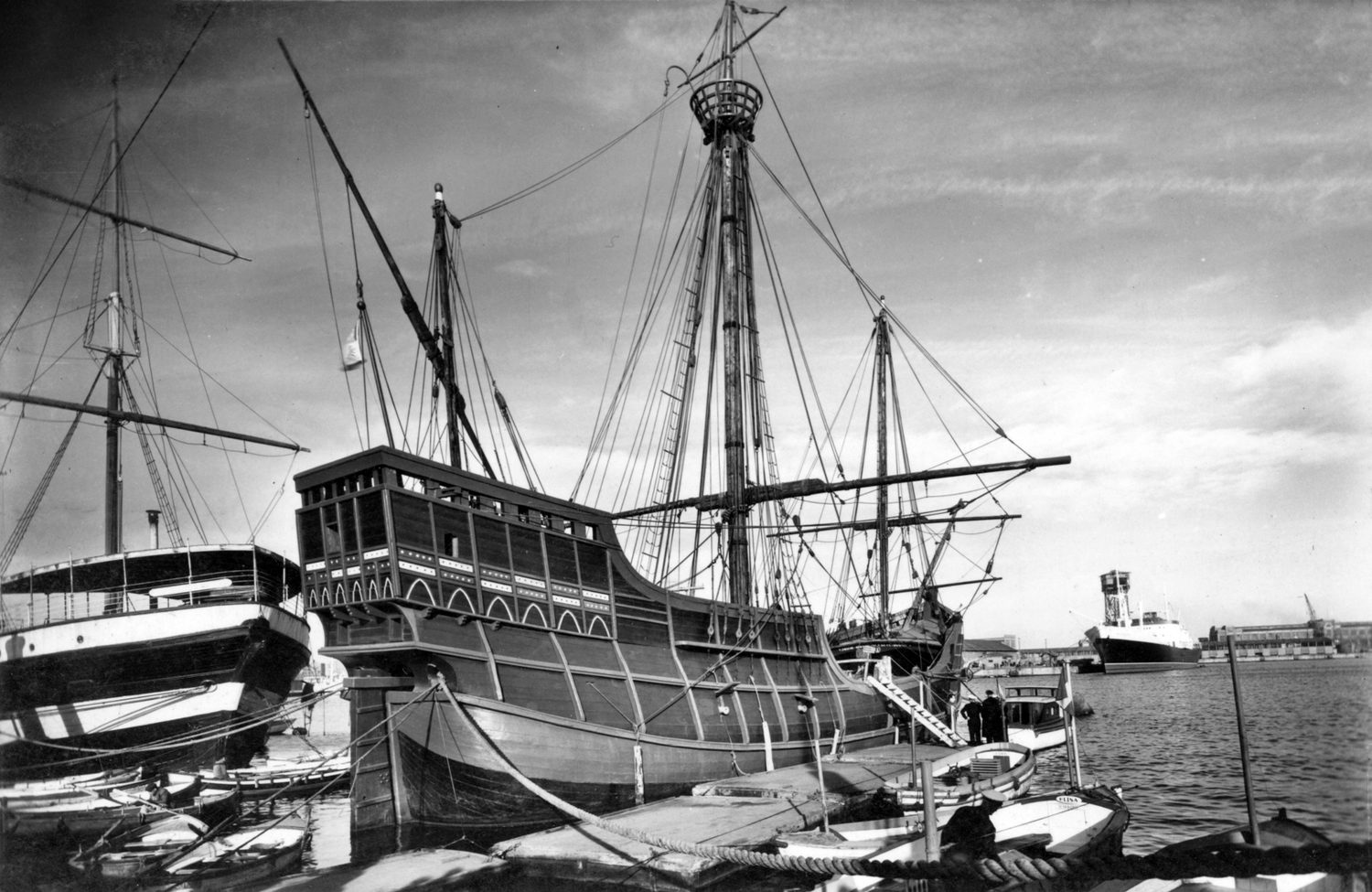
- The caravel was small, fast and able to sail close to the wind.
- Its lateen sail 三角帆, a triangular sail from the Indian Ocean and the Mediterranean, let it sail against the wind; the carrack and later the galleon carried larger cargoes.
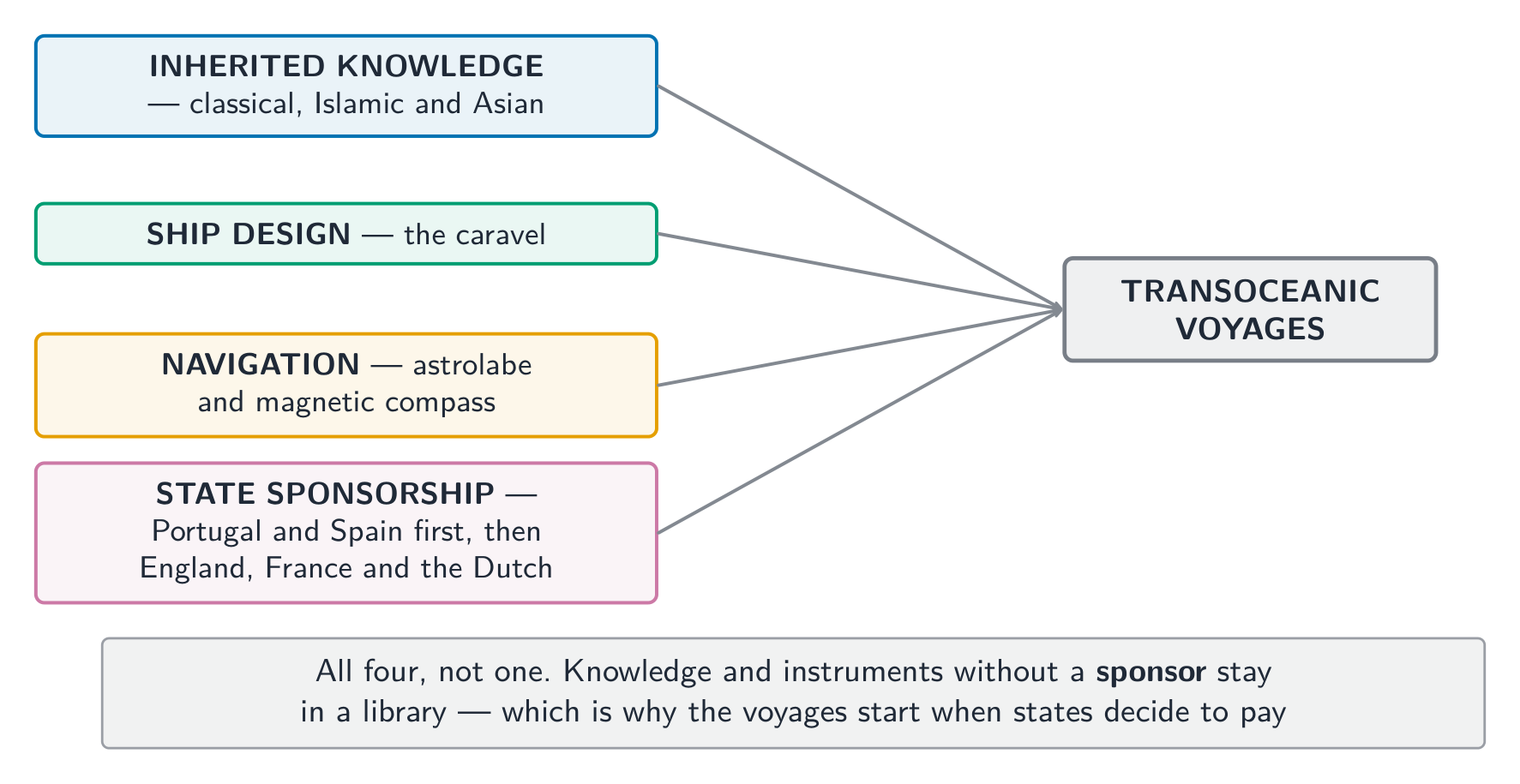
Collect the four conditions for a voyage
Knowledge, ship design, navigation and a sponsor — any three without the fourth produces no voyage.
What did the lateen sail allow?
Difficulté 1/5 · 100 pièces + un petit bonus lors de la première réussite aujourd'hui
A triangular sail.
Worked example: knowing the wind
- Problem: sailing straight south along Africa meant fighting headwinds.
- Solution: Portuguese sailors learned the volta do mar — sailing far west into the Atlantic to catch winds that carried them south and then east.
- Result: in 1497, da Gama's fleet sailed about three months out of sight of land — knowledge of winds was itself a technology.
What was the volta do mar?
Difficulté 1/5 · 100 pièces + un petit bonus lors de la première réussite aujourd'hui
Knowledge of winds.
Diffusion, not invention
- Most of these tools were not invented in Europe; they spread to it along trade routes.
- What was new was combining them with state funding.
Using this in an answer
- To explain the voyages, name the technology, where it came from and what problem it solved.
- Then link it to a sponsor who paid for the voyage.
Europe did not invent the tools of exploration. The compass, the astrolabe and the lateen sail came from China, the Islamic world and the Indian Ocean.
Europe invented the tools of exploration.
Difficulté 1/5 · 100 pièces + un petit bonus lors de la première réussite aujourd'hui
They spread from elsewhere.
From 1450, Europeans combined borrowed tools — the Chinese compass, the astrolabe, the lateen sail — with new ships like the caravel and knowledge of Atlantic winds. With state funding, these let Dias round Africa in 1488 and da Gama reach India.
Explain how technology made European oceanic voyages possible.
Causation.