Europe: Fragmented and Agricultural
Introduit| English | Sens |
|---|---|
| Magna Carta | The charter of 1215 in which King John of England agreed that the king must follow the law and could not take new taxes without the nobles' consent. |
| Decentralised/dɪˈsentrəlaɪzd/ | Décentralisé |
| feudalism/ˈfjuːdəlɪzəm/ | féodalité |
| manorial system/mæˈnɔːrɪəl ˈsɪstəm/ | The system in medieval Europe in which a lord's estate, worked by peasants and serfs, produced most of what its people needed. |
| serfdom/ˈsɜːfdəm/ | servage |
Barons force a king to agree, June 1215
- On 15 June 1215, at Runnymede near London, rebel barons forced King John of England to accept a charter later called Magna Carta 大宪章. It said the king could not take new taxes without the consent of his great nobles, and that no free man could be imprisoned "except by the lawful judgement of his peers". The barons held power because they had land and soldiers of their own.
- From 1200 to 1450, Europe was politically divided and agricultural, and land was the basis of power.
Why could the barons force King John to accept Magna Carta?
Difficulté 1/5 · 100 pièces + un petit bonus lors de la première réussite aujourd'hui
Land was power.
Three faiths in Europe
- Most of Europe was Roman Catholic; the east was Orthodox Christian; Muslims ruled much of Spain until 1492.
- Jewish communities lived across Europe, often facing persecution.
Politically fragmented
- Europe was divided into many kingdoms, principalities and city-states.
- Rule was decentralised 分权的: kings shared power with nobles, the Church and towns.
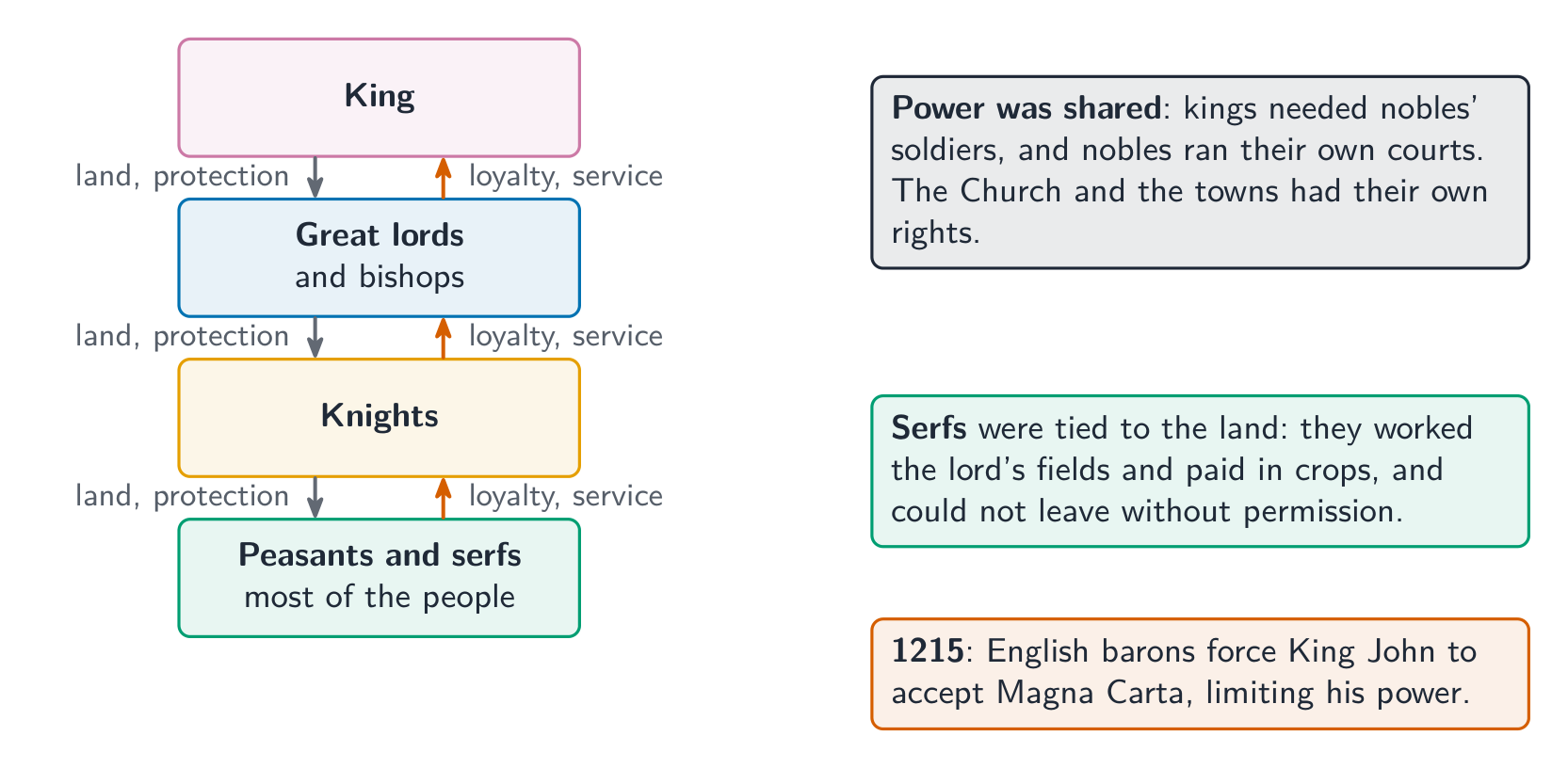
Centralised or decentralised — and on what basis?
Sort each feature by the system it belongs to.
Worked example: feudalism
- Exchange: under feudalism 封建制度, a king gave land to a lord (a vassal) in return for loyalty and soldiers.
- Consequence: the lord's soldiers were loyal to him, so a king could not easily remove him — as King John learned in 1215.
- Comparison: in Song China, officials were paid and could be moved to another province, so the centre was much stronger.
Match each to its category.
Difficulté 2/5 · 140 pièces + un petit bonus lors de la première réussite aujourd'hui
Centralised or decentralised.
In feudalism, what did a vassal give in return for land?
Difficulté 1/5 · 100 pièces + un petit bonus lors de la première réussite aujourd'hui
Land for loyalty.
An agricultural society
- Under the manorial system 庄园制度, a lord's estate (manor) produced most of what its people needed.
- Most peasants were bound by serfdom 农奴制: serfs could not leave the land and owed labour to the lord.
Serfs could leave the land whenever they wished.
Difficulté 1/5 · 100 pièces + un petit bonus lors de la première réussite aujourd'hui
They were bound to it.
Change after 1347
- The Black Death (1347–51) killed perhaps a third of Europe's people.
- With fewer workers, surviving peasants demanded higher wages and freedom, and serfdom declined in western Europe.
If Europe had about 75 million people and a third died in the Black Death, about how many million died?
Difficulté 2/5 · 140 pièces + un petit bonus lors de la première réussite aujourd'hui
75 ÷ 3.
"Fragmented" does not mean that Europe had no strong rulers. Some kings, like those of France and England, were powerful — but they had to share power with nobles and the Church.
Fragmented Europe had no powerful kings at all.
Difficulté 1/5 · 100 pièces + un petit bonus lors de la première réussite aujourd'hui
Kings shared power.
From 1200 to 1450, Europe was divided into many states. Feudalism gave land for loyalty, so lords with their own soldiers could limit kings, as at Runnymede in 1215. The manorial system and serfdom tied peasants to the land until the Black Death weakened them.
Compare how power was organised in Europe and Song China.
Comparison.