Ranking the Half-Century
Introduit| English | Sens |
|---|---|
| national identity/ˈnæʃənl aɪˈdentɪti/ | A shared sense of what it means to belong to the nation. |
Children who would not salute, 1943
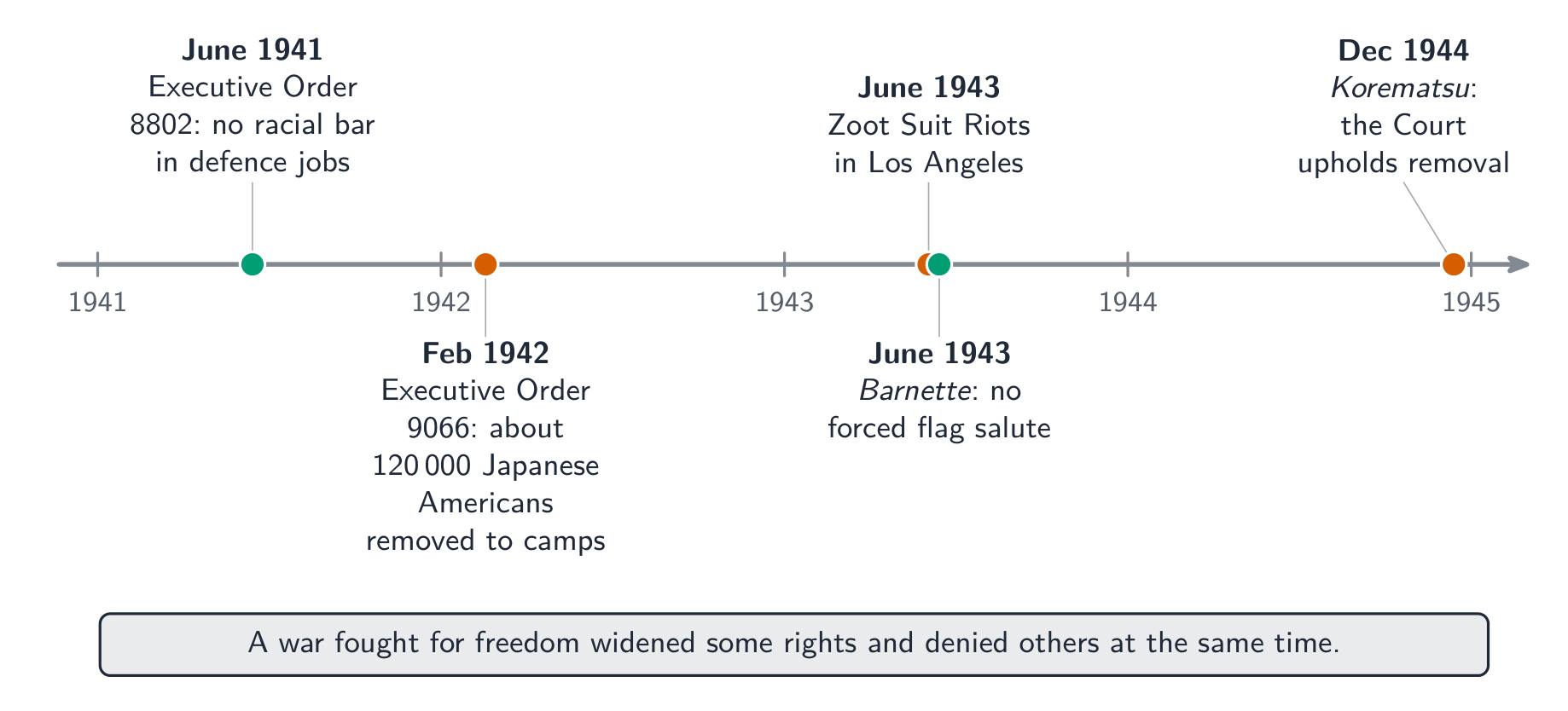
- On 14 June 1943 — Flag Day — the Supreme Court ruled in West Virginia v. Barnette that schools could not force children to salute the flag. The case was brought by Jehovah's Witness families whose children had been expelled for refusing. In the middle of a world war, Justice Robert Jackson wrote that no official could "prescribe what shall be orthodox in politics, nationalism, religion".
- Between 1890 and 1945, many events reshaped what it meant to be American. Historians compare them by stating a clear measure.
What did the Supreme Court rule in West Virginia v. Barnette?
Difficulté 1/5 · 100 pièces + un petit bonus lors de la première réussite aujourd'hui
14 June 1943.
The task: rank by a measure
- An essay may ask which development most changed American identity. You must choose, and explain your measure.
- Without a measure, a ranking is only an opinion.
Why must a ranking state a measure?
Difficulté 1/5 · 100 pièces + un petit bonus lors de la première réussite aujourd'hui
Rank by a stated measure.
Candidate events
- Immigration and the 1924 quotas; the First World War; the Great Migration of African Americans north; the 1920s mass culture; the Great Depression and New Deal; the Second World War.
- Each changed who counted as American, or how Americans saw their country.
Durability, reach, or identity?
Sort each event by the criterion it scores highest on.
Worked example: two usable measures
- Breadth: how many Americans did it affect? The Depression touched almost every family; about a quarter of workers lost their jobs.
- Duration: how long did the change last? The Second World War's effects — a global role, a new middle class, and the start of the civil rights movement — shaped the rest of the century.
- A judgement: by duration, the Second World War ranks highest; by breadth, the Depression may rank first.
Match each measure to its question.
Difficulté 2/5 · 140 pièces + un petit bonus lors de la première réussite aujourd'hui
Usable measures.
About what percentage of workers lost their jobs in the Depression?
Difficulté 2/5 · 140 pièces + un petit bonus lors de la première réussite aujourd'hui
Evidence of breadth.
Identity as the measure
- National identity 国家认同 includes who belongs and what values Americans share.
- The 1924 quotas narrowed who belonged; wartime service and the Barnette ruling widened ideas of freedom.
The 1924 quotas narrowed who was seen as belonging in America.
Difficulté 1/5 · 100 pièces + un petit bonus lors de la première réussite aujourd'hui
Identity narrowed.
Writing the comparison
- Name two events, state the measure, give evidence for each, and decide which mattered more by that measure.
- Acknowledge the strongest case for the other side.
A ranking without a stated measure is not an argument. Always say "by breadth" or "by duration" or "by effect on who belonged", then use evidence.
A ranking needs no stated measure.
Difficulté 1/5 · 100 pièces + un petit bonus lors de la première réussite aujourd'hui
It must state one.
To rank events from 1890 to 1945, state a measure — breadth, duration or effect on identity — and apply it with evidence. The Depression ranks high by breadth, the Second World War by duration, and events such as the 1924 quotas and the Barnette ruling show identity narrowing and widening.
Which development between 1890 and 1945 most changed American identity? State your measure.
Ranking.